Category: Nichibei Yakyu

  • Murder, Espionage, and Baseball: The 1934 All-American Tour of Japan

    Murder, Espionage, and Baseball: The 1934 All-American Tour of Japan

    by Robert K. Fitts

    Every Tuesday morning we will post an article from SABR’s award-winning books Nichibei Yakyu: Volumes I and II. Each will present a different chapter in the long history of US-Japan baseball relations. This week Rob Fitts writes about Babe Ruth and the ALL Americans’ 1934 visit to Japan.

    Katsusuke Nagasaki’s breath billowed as he loitered outside the Yomiuri newspaper’s Tokyo offices. The morning of February 22, 1935 was chilly. But that was good; nobody would look twice at his bulky overcoat. Matsutaro Shoriki, the owner of the Yomiuri Shimbun, was late. Nagasaki strolled up and down the block, trying to remain inconspicuous.

    Finally, at 8:40 A.M. a black sedan cruised down the street. Nagasaki halted in front of a bulletin board by the building’s entrance. He studied the announcements as a short, balding man with thick-framed glasses emerged from the car. As Shoriki began to climb the stairs into the building, Nagasaki strode forward, pulling a short samurai sword from beneath his coat. The blade flashed through the air, striking Shoriki’s head. The bloodied newspaper owner stumbled forward, as Nagasaki fled.

    Later that day, Nagasaki walked into a local police station and gave a detailed confession. The primary reason for the assassination attempt: Shoriki had defiled the memory of the Meiji Emperor by allowing Babe Ruth and his team of American all-stars to play in the stadium named in honor of the ruler.

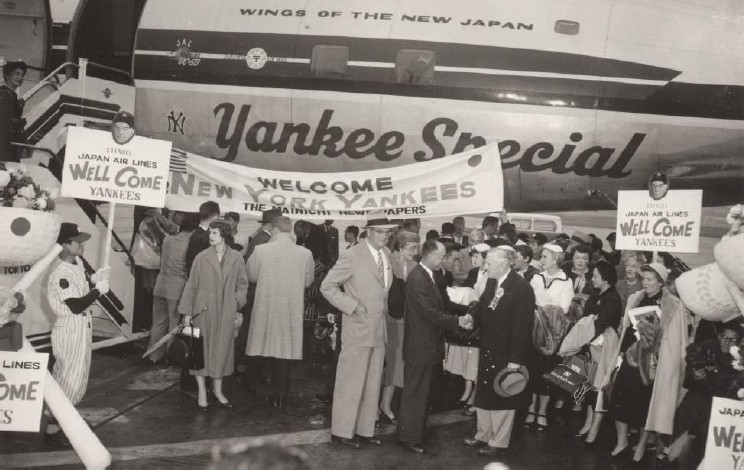
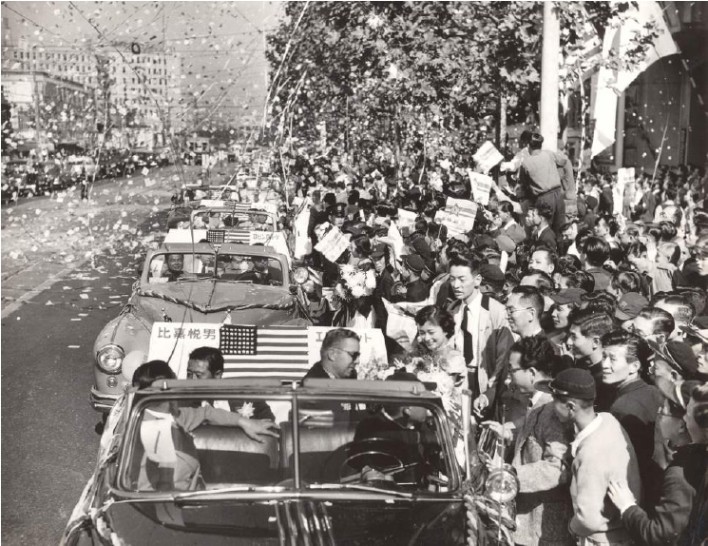
    Three months earlier, nearly a half-million Japanese had lined the streets of Tokyo to welcome the ballplayers to Japan. The players’ motorcade was led by Ruth in an open limousine. At 39, he had grown rotund, and just weeks before had agreed to part ways with the New York Yankees. But to the Japanese, he still represented the pinnacle of the baseball world. Sharing the car was his former teammate Lou Gehrig. The rest of the All-American baseball team, distributed three or four per car, followed: manager Connie Mack, Jimmie Foxx, Earl Averill, Charlie Gehringer, Lefty Gomez, Lefty O’Doul, and a gaggle of lesser-known stars.

    Only one player didn’t seem to belong—a journeyman catcher with a .238 career batting average named Moe Berg. Although he was not an All-Star caliber player, his off-the-field skills would explain his inclusion on the team. Berg was a Princeton University and Columbia Law School graduate who had already visited Japan in 1932. He was multilingual, causing a teammate to joke that Berg could speak a dozen languages but couldn’t hit in any of them. Berg would eventually become an operative for the Office of Strategic Services (OSS), the forerunner of the CIA, and many believe that the 1934 trip to Japan was his first mission as a spy.

    The pressing crowd reduced the broad streets to narrow paths just wide enough for the limousines to pass. Confetti and streamers fluttered down from multistoried office buildings, as thousands waved Japanese and American flags and cheered wildly. “Banzai! Banzai, Babe Ruth!” echoed through the neighborhood. Reveling in the attention, the Bambino plucked flags from the crowd and stood in the back of the car waving a Japanese flag in his left hand and an American in his right. Finally, the crowd couldn’t contain itself and rushed into the street to be closer to the Babe. Traffic stood still for hours as Ruth shook hands with the multitude.

    Ruth and his teammates stayed in Japan for a month, playing 18 games in 12 cities. But there was more at stake than sport: Japan and the United States were slipping toward war as the two nations vied for control over China and naval supremacy in the Pacific. Politically Japan was in turmoil. From the 1880s through 1920s, Japan had enjoyed a form of democracy. This period saw great strides in modernization, a flourishing of the arts, and close ties to the United States. Yet, as Japan’s power grew, so did its nationalism. A growing minority of Japanese citizens felt that the country should take its place among the world powers by expanding its military and colonizing its neighbors. Ultranationalist societies began assassinating liberal politicians and members of the free press. By the early 1930s, the civilian government could no longer control elements of the military. In 1931 nationalistic officers engineered the invasion of Manchuria and twice plotted to overthrow the government. War between the United States and Japan seemed inevitable.

    Politicians on both sides of the Pacific hoped that the goodwill generated by the tour and the two nations’ shared love of baseball could help heal their growing political differences. Many observers, therefore, considered the all-stars’ joyous reception significant. An article in the New York Times, for example, said, “The Babe’s big bulk today blotted out such unimportant things as international squabbles over oil and navies.” Connie Mack added that the tour was “one of the greatest peace measures in the history of nations.”

    Yet, not all Japanese wished the nations reunited. At the Imperial Japanese Army Academy, just two miles northwest of the parade, a group known as the Young Officers was planning a bloody coup d’etat, an upheaval that would jeopardize the tour’s success and put the players’ lives at risk. In another section of Tokyo, Nagasaki and his ultranationalist War Gods Society met at their dojo. Their actions would tarnish the tour with bloodshed.

    The 1934 tour began not as a diplomatic mission but as a publicity stunt to attract readers to the Yomiuri Shimbun. Matsutaro Shoriki had purchased the financially troubled newspaper in 1924 and quickly turned it into Tokyo’s third-largest daily by increasing its entertainment sections.

    In 1931 Shoriki decided to bolster sports coverage by sponsoring a team of American all-stars to play in Japan. The team, which included Lou Gehrig, Lefty Grove, and five other future Hall of Famers, won each of the 17 games against Japanese university and amateur teams, and the newspaper’s circulation soared. But Shoriki wasn’t satisfied. The major-league team had lacked the greatest drawing card in baseball—Babe Ruth.

    Shoriki immediately began organizing a second tour. Working closely with Sotaro Suzuki, a sportswriter who had lived in New York for nearly a decade, and National League batting champion Lefty O’Doul, Shoriki lined up the powerful 1934 squad. Most of the players’ wives accompanied their husbands on the trip, and the Ruths brought along their 18-year-old daughter, Julia. The tourists boarded the luxury liner Empress of Japan in Vancouver, British Columbia, on October 20 and, after a stop in Honolulu, arrived in Yokohama on November 2.

    Although American teachers had introduced baseball in 1872, Japan didn’t have a professional league. To challenge the Americans, Shoriki brought together Japan’s best amateur players to form the All-Nippon team. The team included 11 future members of the Japanese Baseball Hall of Fame and numerous colorful personalities.

    Two players, in particular, stood out. The first was hard to miss: 18-year-old Victor Starffin was the blondhaired, blue-eyed, 6-foot-3 son of a Russian military officer who had served Czar Nicholas II. During the Russian Revolution, the Starffins escaped by traveling in a freight train packed with typhoid patients, and later by hiding from the Red Army in a truck carrying corpses. After years on the run, the family settled in Japan. Young Victor fell in love with baseball and soon became a regional star. He hoped to play college ball, but in 1933 his father was convicted of killing a young Russian woman who worked in his teashop. The Yomiuri newspaper promised to use its influence to help Victor’s father if the young man would forsake college and play for the All-Nippon team.

    The All-Nippon squad also included a young American who hoped to become the first ethnic Japanese to make the major leagues. Jimmy Horio was born in Hawaii and left for California to follow his dreams at the age of 20. He played semipro for several years without breaking into Organized Baseball. Hearing that Shoriki was creating a team to challenge the visiting major leaguers, Horio traveled to Tokyo to try out. He hoped a stellar performance against the All-Americans would lead to a major-league contract. As a switch-hitter with power, Horio made the AllNippon team easily and hit cleanup, but would fail to impress the Americans.

    Over the next four weeks, the All-Americans and All-Nippon traveled together throughout Japan, visiting the northern island of Hokkaido; the industrial cities of Yokohama, Nagoya, and Osaka; the ancient capital of Kyoto; Kokura on the southern island of Kyushu; and, of course, Tokyo.

    Sotaro Suzuki, unidentified All-Nippon player, Lou Gehrig, Hisanori Karita, and Babe Ruth (Yoko Suzuki Collection)

    The tour began with two games at Tokyo’s Meiji Jingu Stadium. Prior to the games, fans camped out overnight to secure the best general-admission seats. They followed the Babe’s every move. A reporter stated, “The fans went crazy each time Ruth did anything—smiled, sneezed, or dropped a ball.” One old man brought a pair of high-powered binoculars, amusing himself and neighboring fans by focusing on the Bambino’s famous broad nose, making his nostrils fill the lens. Another fan, who worked in a textile factory designing kimono and undergarment patterns, had a novel plan. He would sit as close as possible to the field and study the Bambino’s face. He would memorize every feature, every wrinkle. Then he would return to the factory and create a pattern of the Babe’s face for a new line of Babe Ruth underwear. He was certain he would become rich.

    The Babe relished the attention and transformed into a comedian. During batting practice, he purposely missed some pitches—twisting himself around like a pretzel before falling over. Later, he began a game of shadow ball—hitting an imaginary grounder to Rabbit McNair at shortstop, who fielded it convincingly and started a double play, timed with perfect realism. The opening game itself was less interesting than Ruth’s antics. It pitted the All-Americans against the Tokyo Club, a team of recently graduated players from the Tokyo area, not the All-Nippon squad. It took just a few minutes for the fans, and players, to realize the difference in skill level between the two teams—the ball even sounded louder when coming off the American bats. The Americans seemed to score at will, pilling up 17 runs to Tokyo’s 1. To the crowd’s disappointment, none of the Americans hit a home run. Afterward, the Babe apologized for not going deep, telling reporters, “I was a little tired today, but tomorrow I will do my best to hit a home run.”

    The next day, November 4, the All-Americans played their first game against All-Nippon. It was the first time in history that true all-star teams representing the two countries clashed. Prior to the 1930s, visiting American professional teams were a mishmash of stars,journeymen, and minor-league players, and while the 1931 American club was a legitimate all-star team, it played only Japanese collegiate and company squads. The All-Nippon lineup featured six future Hall of Famers—Naotaka Makino, Hisanori Karita, Osamu Mihara, Minoru Yamashita, Jiro Kuji, and pitcher Masao Date. Although Date pitched “courageously,” and limited the All-Americans to five runs, the game’s outcome seemed inevitable. Jimmie Foxx, Lou Gehrig, and Earl Averill homered, with Averill going out twice. On the other side of the scorecard, American pitcher Joe Cascarella dominated the Japanese, giving up just three hits and walking only two.

    Next, the All-Americans traveled north. As they boarded a ferry to cross the straits to reach Hokkaido, officials handed each traveler a small map with three coastal areas circled in red. Large cursive writing proclaimed, “Photographing, sketching, surveying, recording, flying over the fortified zone, without the authorization of the commanding officer of this fortress are strictly prohibited by order.” The handout was not an empty threat. Japan was paranoid about espionage, and officials even inspected Ruth during the trip to make sure that he wasn’t taking photographs. But neither the proscription nor the officials stopped Moe Berg. Defying the warning, Berg whipped out his camera and filmed the area.

    The teams played two games in the northern provinces, enduring bone-chilling winds and frosted fields. Once again, the Americans won comfortably. On November 8 in Hakodate, the All-Americans took control of the game minutes after the first pitch as Averill hit a two-out, first-inning grand slam. Meanwhile, Lefty Gomez dazzled the fans and opponents with both his speed and control. Up 5-1, manager Ruth brought in third baseman Jimmie Foxx to close out the game. The burly third baseman preserved the victory by allowing just one run in the final three innings. The following day in Sendai, Ruth went deep twice and Gehrig, Foxx, and Bing Miller each hit one out in a 7-0 American victory.

    As the teams returned to Tokyo, two dozen army officers met at an isolated restaurant. Their purpose—to overthrow the Japanese government.

    The Great Depression had hit rural Japan particularly hard, leading to widespread starvation. At the same time, large trading companies, known as zaibatsu, flourished due to the unstable markets and rampant inflation. The conspirators, led by Captain Koji Muranaka, belonged to the loosely organized Young Officers movement. The Young Officers felt that Japan’s government had betrayed its citizens by putting the interests of big business before the welfare of the populace. The group advocated the violent overthrow of civilian rule, the declaration of martial law, and the Emperor taking direct control of the government. The divine Emperor, they believed, would end rural poverty by redistributing wealth and would lead Japan to world prominence by conquering Asia.

    On November 27 Japan’s parliament would meet in a special session. Once the politicians gathered, the Young Officers and their troops planned to attack the Diet Building, slaughter the civilian government, and seize power. Other sympathetic troops would battle loyalist regiments in the streets of Tokyo. No mention was made of Babe Ruth and the ballplayers, but as the Imperial Hotel faced the Emperor’s palace and was just a few blocks from the Diet Building, Muranaka’s plan put the Americans in the line of fire.

    Continue to read the full article on the SABR website

  • Herb Hunter’s Dream Tour: A Rabbit, Two Leftys, and an Iron Horse Visit a Dangerous Japan in 1931

    Herb Hunter’s Dream Tour: A Rabbit, Two Leftys, and an Iron Horse Visit a Dangerous Japan in 1931

    by Dennis Snelling

    Every Tuesday morning we will post an article from SABR’s award-winning books Nichibei Yakyu: Volumes I and II. Each will present a different chapter in the long history of US-Japan baseball relations. This week  Dennis Snelling tells us about the 1931 Major League tour of Japan.

    It was a tour initially framed by the dreams of retired fringe major-league outfielder Herb Hunter, the continuing quest of a Japanese newspaper publisher to bring Babe Ruth to Japan before he retired as a player, and the metastasizing of Japanese militarism.

    The tour ended with the best baseball team to visit Japan up to that time—including seven future Hall of Famers—winning all 17 games they played in the country, Japan’s political landscape in violent disarray, Babe Ruth still not having visited the country, and the beginning of the end of Herb Hunter’s global baseball aspirations.

    By 1931, Hunter was considered “Baseball’s Ambassador to Japan.” He had first crossed the Pacific Ocean 11 years earlier with a group of minor-league and marginal major-league players. During that trip, Hunter partnered with pitcher Charlie Robertson to earn money on the side, coaching the Waseda University baseball team.

    Hunter developed an affinity for the country— and the potential it offered him to make his mark on the baseball world—returning in 1921 to coach the baseball teams of both Waseda and Keio universities, wearing a chrysanthemum in his lapel each day. The San Francisco Chronicle reacted to this news by derisively challenging its readers to visualize the ex-San Francisco Seals outfielder coaching baseball to anyone, since Hunter’s reputation was that of the proverbial million-dollar athlete with a ten-cent head. He was physically gifted, but legendary for his onfield blunders.

    He once executed an outstanding running catch with the bases loaded and one out in the ninth, only to absent-mindedly exit for the clubhouse, oblivious to the fact that the ball was still in play. On another occasion, with two out and the bases loaded, he decided to showboat on an easy fly, making a one-handed swipe at the ball, which he dropped. Three runs scored.

    It was said that Hunter had once nearly spiked himself dodging a line drive. “He played that ball like a camel,” the account went. “He was not hurt but he had a narrow escape. A lot of runs scored while Herbie was untangling himself.”

    Even when Hunter’s efforts won a game, it sometimes resulted from a bonehead move. He stole home in a game against Portland on a 3-and-0 count and two runners on base. He was called safe, his run the eventual game-winner despite the fact that he never touched home plate, not to mention that during the play the shocked hitter had backed into the catcher, which should have been ruled interference. Al C. Joy of the hometown San Francisco Examiner wrote, “Just why he stole home at that particular moment nobody seems to know. And just why Umpire Casey did not call him out for several reasons nobody seems to know.”

    Despite his shortcomings, Hunter’s connections to Japanese universities enabled him to organize a troupe of major leaguers to Japan in 1922, and make several subsequent visits, including in 1928, when he enlisted Ty Cobb, Bob Shawkey, and Fred Hofmann. Hunter was now ready to bring another team of major-league all-stars to the Orient in 1931.

    But he was not to be wholly in charge of the effort. Commissioner Kenesaw Mountain Landis, mindful of the international implications of such an event, and noting Hunter’s checkered success with past ventures—especially when it came to handling money—permitted the tour to proceed only under the supervision of veteran sportswriter Fred Lieb.

    Hunter acquiesced—he had no choice—and once the tour was approved by major-league owners in mid-January, he prepared to finalize arrangements with Japan’s largest newspaper, Mainichi Shimbun.

    Catching wind of Hunter’s intentions, Matsutaro Shoriki, publisher of the rival Yomiuri Shimbun, intercepted him, ultimately persuading the American to award his newspaper exclusive sponsorship of the tour’s Tokyo segment. When Mainichi Shimbun backed out of sponsoring games in other parts of the country, Shoriki stepped in despite the added, and significant, financial burden, gambling that the event would put his publication on the map.

    Arrangements complete, Hunter returned to his home in Red Bank, New Jersey, where he managed a semipro team headquartered on his diamond, Hunter’s Field, while Fred Lieb pursued ballplayers for the trip.

    A 14-man roster was ultimately secured, including four 1931 World Series participants: A1 Simmons, Mickey Cochrane, Lefty Grove, and Frankie Frisch. To Shoriki’s disappointment there would be no Babe Ruth—who claimed barnstorming and movie commitments—but Ruth’s teammate and co-American League home run champion Lou Gehrig would be there. So would Willie Kamm, Rabbit Maranville, Muddy Ruel, George Kelly, Lefty O’Doul, Larry French, and Tom Oliver. Boston Braves pitcher Bruce Cunningham, a right-hander who had won only three of 15 decisions in 1931, and outfielder Ralph Shinners, who was just completing his career in the International League, rounded out the roster.

    Fred Lieb had thought the All-Stars unbeatable— although they did not start out that way.

    The team initially gathered in California in early October for a series of games in the Bay Area, and lost four of five against lineups composed almost entirely of Pacific Coast League players. The third game, against the San Francisco Seals, proved the most embarrassing. Lefty Grove, who arrived after the first two games along with the other World Series participants, took the mound and was battered for six runs in the first inning. The All-Stars began pointing fingers, with Grove loudly complaining about not having enough time to warm up. The left-hander settled down, shutting out San Francisco from the second inning through the fifth and striking out seven. But the All-Stars lost, 7-4, while collecting only four hits.

    Stateside exhibitions complete, the All-Stars boarded the luxury liner Tatsuta Maru for Japan; ship captain Shunji Ito, a talented golfer, accommodated the Americans by converting his deck-side course into a batting cage. On the way, there was a quick stop in Honolulu to play another tune-up game against locals.

    During the brief sojourn in Hawaii, the team slaughtered a group of local semipros, 10-0, before 12,000 fans—many of them arriving from other islands. The famously dour Grove displayed uncharacteristic enthusiasm afterward, declaring himself enamored with Hawaii and musing, “.. .wonder what my chances are of buying a small place here, I can use this old sunshine in January and February.”

    While the All-Stars cavorted in paradise, events in Asia were unfolding at a dramatic and dangerous pace. A month before the players’ departure for Japan, a renegade faction of the military, seeking war with China, destroyed a section of the South Manchuria Railway and blamed it on the Chinese. This contrivance provided the pretext for Japan to invade Manchuria; the Japanese government was caught off-guard by its own armed forces, but did nothing of consequence to curtail the action, and was widely condemned in the court of world opinion. As a result, the country the American ballplayers entered was far more dangerous and unstable than they appreciated.

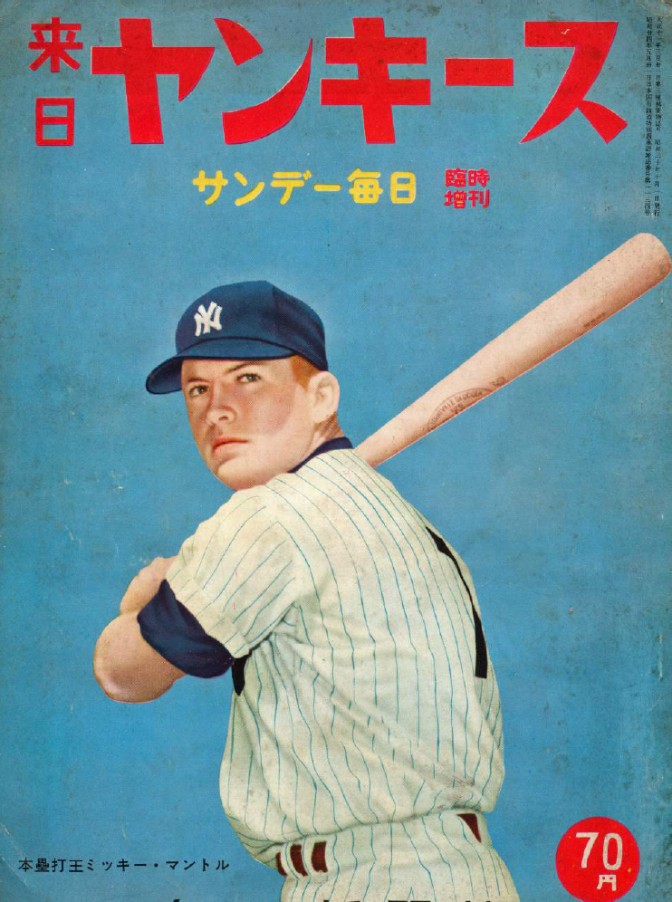
    1931 tour program featuring Lou Gehrig

    Thousands of enthusiastic Japanese baseball fans were on hand when the Tatsuta Maru docked following its two-week passage. After the mayors of Yokohama and Tokyo made brief presentations, the players boarded a special train bound for the capitol. There, the party was met by limousines waiting to convey them through the streets of downtown Tokyo.

    Fred Lieb described the journey “a continual ovation.” Special flags combining the emblems of the American and Japanese national banners were provided to those lining the route. Fans jammed the streets, pressing in on the motorcade as shouts of “banzai” and “welcome” rained down from office windows. Some of the more enthusiastic jumped onto limousine running boards to shake the hand of Rabbit Maranville or Lefty Grove—repeatedly shouting “Thirty-One!” at the latter in recognition of his total wins for Philadelphia that year.

    The Americans were flabbergasted. “I will remember this reception to my dying day,” remarked Lou Gehrig. “I do not know of anything in my entire career that has touched me as much as this welcome.” Frankie Frisch added, “It made me feel like a great military hero or a man who had flown across the Pacific.”

    Other than George Kelly, who had been a member of Hunter’s 1922 All-Stars, none of the players had previously visited Japan. The world was more compartmentalized than today, and the visitors were surprised and astonished by the modernity of Tokyo, on course to becoming one of the world’s major cities. At the same time, there were obvious differences in food, language, and customs—it was both fascinating and disorienting.

    Because Japan lacked professional baseball, the Americans would challenge college teams from the Tokyo Big Six University League—the highest level of baseball in the country—as well as all-star teams of alumni from those colleges and a few industry-sponsored squads.

    Despite massive unemployment in Japan due to the collapse of the silk industry, 65,000 attended the opening contest; the ceremonial first pitch was thrown by Japanese Education Minister Tanaka, decked out in formal dress, including a top hat. The starting pitcher for Rikkyo University, Takeshi Tsuji, pitched well, allowing only four hits and four runs, all unearned, in six innings. Three of the unearned runs were due to missed fly balls by the Japanese right fielder, who did not wear sunglasses—according to Fred Lieb, it was considered cowardly to use them.

    Al Simmons complimented Tsuji afterward for his deceptive sidearm delivery and impressive control, but the first game was an easy, 7-0, win for the All-Stars behind Bruce Cunningham, who allowed only two hits.

    The second game nearly resulted in a shocking Japanese victory. Masao Date, pitching for Waseda University, impressed Lieb, who afterward said that the Americans felt he would be a major league prospect if he were in the States. Date calmly escaped a first-inning bases-loaded jam by fooling Frankie Frisch on a full-count curveball, taken for strike three.

    The game was tied, 1-1, until the seventh, when Larry French surrendered a bases-loaded two-run double that gave Waseda a 3-1 lead. French, the possessor of an explosive temper, was removed from the game and furiously hurled his glove in disgust upon reaching the bench, cursing and screaming, “I’ve traveled nine thousand miles to be knocked out of the box by a bunch of Japanese college players!”

    Things did not get better. With only three pitchers along for the tour, others were utilized as emergency hurlers, including Lou Gehrig, who relieved French and allowed two more runs to score on a wild pitch and an out, stretching Waseda’s lead to four runs.

    Lieb, whom Landis had made responsible for the comportment of the players, watched in horror as French began hurling racial epithets from the bench. He attempted to shush the pitcher, pointing to Viscount Taketane Sohma, sitting at the end of the bench. Sohma, director of general offices at the Imperial Palace, had been educated in America and understood every word. To Lieb’s relief, he diplomatically chose not react to French’s tirade, which continued despite Lieb’s entreaties.

    The Americans ultimately stormed back to win, 8-5, saving French the embarrassment of losing, as Masao Date tired while Lefty Grove, who replaced Gehrig, struck out six straight batters on 19 pitches to end the game. Lieb later revealed that the All-Stars were arguing among themselves on the bench until Date walked the bases loaded and Lefty O’Doul promptly cleared them with a double to key a seven-run eighth inning.

    Continue to read the full article on the SABR website

  • Ty Cobb’s Last Hurrah: The 1928 Japan Tour

    Ty Cobb’s Last Hurrah: The 1928 Japan Tour

    by Tom Hawthorn

    Every Tuesday morning we will post an article from SABR’s award-winning books Nichibei Yakyu: Volumes I and II. Each will present a different chapter in the long history of US-Japan baseball relations. This week Tom Hawthorn tells us about Ty Cobb’s visit to Japan.

    On an off-day on the road in Cleveland, Tyrus Raymond Cobb, hailed for much of his career as the greatest player the game had ever known, announced his impending retirement. It was September 17, 1928. He had last been a starter in late July when he batted second for the Philadelphia Athletics before trotting out to right field. He went 2-for-5 that day with a single and a double, scoring what would be the winning run in a 5-1 game on a passed ball. Since then, he had been used sparingly as a pinch-hitter, going 1-for-9.

    The Georgia Peach was in his 24th season, a 41-year-old man who was now caught stealing more often than not. He appeared in only 95 games for Connie Mack’s team. While his .323 batting average was far from disgraceful, it was still his poorest performance in two decades.

    Many of his younger teammates spent the rare offday at the racetrack. Cobb invited reporters to gather in his room at the glamorous Hollenden Hotel, where he handed each of them a typewritten statement in which he announced his retirement even “while there still may remain some base hits in my bat.” The player spoke informally with the writers for hours, examining his career (he called Carl Weilman the toughest pitcher he faced) and expressing a desire to do nothing but enjoy his family’s company for a year. The only item on his agenda was some winter hunting near his home in Augusta, Georgia.

    “I am just baseball tired and want to quit,” Cobb said. “I will be leaving baseball with a lot of regrets and still with a light heart. It’s hard to pull away from a game to which one has given a quarter-century of his best manhood and which paved the road to lift me to a place of prominence and affluence.”

    He had been for a time the highest-paid player in the game, earning nearly a half-million dollars in salary over the seasons, while investments in a car company later absorbed by General Motors, as well as in Coca-Cola from his home state, ensured that he faced few future privations.

    The news of his pending retirement was greeted by newspapers as the passing of an era.

    “He is worth more than a million dollars,” noted the Morning Call of Allentown, Pennsylvania, “and is not worrying about his future or the price of pork chops.”The newspaper predicted that he might become a minority owner of a franchise in the high minors.

    Cobb recorded his 4,189th hit, a double, against the Washington Senators as a pinch-hitter on September 3. He played what would be his final game in the majors eight days later, popping out to Mark Koenig at shortstop to lead off the ninth in a 5-3 loss at Yankee Stadium. He would get his final two hits in an A’s uniform in Toronto in an exhibition game at Maple Leaf Stadium on September 14. Then it was on to Cleveland to sit on the bench.

    For a player reputed to be ill-tempered, he was wistful about spending time with his family.

    “Guess it’s time to get out of the game and play with my kids before they grow up and leave me,” he said in announcing his pending retirement. “And there’s that trip to Europe that I promised Mrs. Cobb this year.”

    His wife, Charlotte Marion Lombard, known as Charlie, did not get to see Europe in 1928. Three weeks after the hotel room session to announce his retirement, Cobb was traveling through Virginia on his way home to Georgia when he told friends of plans to play baseball overseas. In Japan.

    The news broke nationally on October 7 when the Associated Press carried on its wires a news item based on a Richmond Times-Dispatch story. The report said Cobb would spend seven weeks in Asia, accompanied by former pitcher Walter Johnson, the manager of the Newark Bears of the International League.

    Three days later, George A. Putnam, secretary-owner of the San Francisco Seals and a friend of Cobb’s, offered further details. The player was going to give lectures on the game. He was also going to suit up and play with university teams. The tour was sponsored by the Osaka newspaper Mainichi Shimbun and four universities—Waseda, Meiji, Osaka, and Keio, whose own baseball team had toured the United States for six weeks earlier in the year.

    The Pittsburgh Press had a scoop on the pending trip by several days. Sporting editor Ralph Davis, who was in New York to cover the first game of the World Series on October 4, slipped in a final paragraph at the end of his lengthy report on the Yankees’ 4-1 victory over the St. Louis Cardinals. He noted that Cobb had popped into the press box at Yankee Stadium and mentioned that he was off to Japan later in the month with two players on a tour organized by Herb Hunter.

    Hunter, whose own major-league career as a weak-hitting infielder-outfielder lasted 39 games with four different teams, first traveled to Japan with Doyle’s 1920 All-Americans and ended up coaching at several Japanese universities after the tour. In 1922, after what was his final season as a player, he led an all-star team of players, including Waite Hoyt, Herb Pennock, Casey Stengel, and George “High Pockets” Kelly, on a successful tour of Japan, Korea, China, the Philippines, and Hawaii. Hunter would go on to become a baseball ambassador, making at least 10 goodwill trips to Japan between 1920 and 1937.

    A month before Cobb made his announcement, Hunter got a cablegram from Japan inviting him to bring over another team of major leaguers. The assignment was going to be difficult, as active players were now banned from playing exhibition games after October 31. Hunter hoped whatever disappointment the hosts might feel would be assuaged by bringing the greatest all-around player the game had seen. According to Cobb biographer Charles C. Alexander, Hunter offered Cobb $15,000 for his services.

    Also joining the tour were Bob Shawkey, a savvy right-hander who had gone 195-150 over 15 seasons as a starter in the majors, mostly with the Yankees. When they released him after the 1927 season, Shawkey held team records for wins, shutouts, strikeouts, and innings pitched. He was a pitching coach and starter with the Montreal Royals in 1928, going 9-9.

    His catcher was former Yankees teammate Fred Hofmann, a 34-year-old journeyman who when once asked how he batted (right, left, or switch), responded, “Poor.” He was nicknamed “Bootnose” for an obvious facial feature. Hofmann hit .226 for the Boston Red Sox in 1928 in what proved to be his final major-league campaign, though he continued playing in the minors until age 43.

    Joining the three players was Ernest Cosmos “Ernie” Quigley, a stocky umpire bom in the Canadian province of New Brunswick. Quigley lettered at the University of Kansas as a football player and hurdler in track and field for the Jayhawks. A limited minor-league career gave way to coaching football and officiating in three sports. By the time he retired, he estimated he had worked 400 college football games, 1,400 college basketball games (as well as the 1936 US Olympic qualifying tournament), and more than 3,000 major-league games. He officiated three Rose Bowl games and six World Series, the most notable being the one remembered as the 1919 Black Sox series.

    Tagging along were Seals owner Putnam and travel agent Frank Ploof of Tacoma, Washington, described as a sponsor of the trip. The latter, who stood nearly 6-feet tall though weighing just 150 pounds, posed for a photograph in a baseball uniform with the three players.

    After traveling across the continent to Seattle, Cobb met with Japanese consul Suemasa Okamoto and his wife. He also led his tour mates, bolstered by local players, in defeating an amateur team from West Seattle by 12-5. Cobb went 4-for-6.

    The baseball tourists boarded the steamship SS President Jefferson of the American-Oriental Mail Line in Seattle on October 20, the ship departing at 11 A.M. Cobb was accompanied by his wife and three youngest children, Herschel, Beverly, and James. Quigley and Hunter were also joined by their families. Although some newspapers were still reporting that Johnson was on the tour, the old pitcher had backed out after signing days earlier to manage the Washington Senators.

    Continue to read the full article on the SABR website

  • Gentle Black Giants — Negro Leaguers in Japan: 1927 Philadelphia Royal Giants Tour

    Gentle Black Giants — Negro Leaguers in Japan: 1927 Philadelphia Royal Giants Tour

    by Bill Staples Jr.

    Every Tuesday morning we will post an article from SABR’s award-winning books Nichibei Yakyu: Volumes I and II. Each will present a different chapter in the long history of US-Japan baseball relations. This week  Bill Staples Jr discusses the Philadelphia Royal Giants 1927 visit to Japan.

    Kazuo Sayama, baseball historian, author, and member of the Japanese Baseball Hall of Fame (enshrined in 2021), states with great passion and conviction that had it not been for the tours of the Negro Leagues’ all-star Philadelphia Royal Giants in 1927 and the early 1930s, a professional baseball league in Japan would not have started when it did, in 1936.

    “There is no denying that the major leaguers’ visits were the far bigger incitement to the birth of our professional league. We yearned for better skill in the game,” said Sayama. “But if we had seen only the major leaguers, we might have been discouraged and disillusioned by our poor showing. What saved us was the tours of the Philadelphia Royal Giants, whose visits gave Japanese players confidence and hope.”

    Sayama first learned about the Royal Giants as a member of the Society for American Baseball Research in the early 1980s. Like the fictional Ray Kinsella, who heard voices telling him to build a baseball diamond in the middle of his cornfield, Sayama was a man possessed during much of the early part of that decade, researching and documenting the history of the Royal Giants.

    Also fueled by the desire to honor the Black US soldiers who coached him as a boy in Yokohama during the post-World War II occupation, Sayama hit the library stacks and microfiche in the archives and traveled the world interviewing anyone with a connection to the team.

    In doing so he discovered that the Negro Leaguers had visited Japan just as many times as the famous All-American major leaguers during the 1920s and 1930s (three times each), yet historians on both sides of the Pacific had all but forgotten the Philadelphia Royal Giants.

    “It is unfair that no words of gratitude have been spoken by the Japanese to this team,” lamented Sayama. He changed that by publishing his seminal work in Japan in 1985, Kuroki Yasashiki Jaiantsu, which details the events of their tours and the impact the team made while in Japan. Best of all, he captured firsthand accounts from many Japanese players who competed against the all-Black team, men who were so impressed and impacted by the touring players’ unique blend of baseball skill and human kindness that it inspired a term of endearment from Japanese players—with gratitude and fondness in their hearts, they referred to their guests as “Gentle Black Giants.”

    The Philadelphia Royal Giants were indeed the first all-Black team to play in Japan, but their games did not mark the first time for Black and Japanese baseball teams to compete head-to-head on a diamond. The history of games between ballplayers of Japanese ancestry and Black teams dates to at least May 19, 1908, when the Issei (first-generation Japanese in America) Mikado’s Japanese Base Ball Team from Denver played the Lexington (Missouri) Tigers. But earlier undocumented games probably took place. After that contest, and long before the Royal Giants set sail for Japan in 1927, dozens of such games occurred. Of those matchups, the following are noteworthy for their ties to the Royal Giants:

    • December 4, 1915, Honolulu—Chinese Travelers vs. 25th Infantry Wreckers. Outfielder Andy Yamashiro, the first Japanese American to sign a contract in Organized Baseball (in 1917), honed his skills competing in Hawaii as a member of the mixed-Asian Chinese Travelers (comprising Chinese, Japanese and Hawaiian players) against top-Black talent like Wilbur “Bullet” Rogan, Robert Fagen, Dobie Moore, and Oscar “Heavy” Johnson, all members of a military team known as the 25th Infantry Wreckers. Fagen and Rogan later barnstormed across the Pacific as members of the Royal Giants.Yamashiro managed the Hawaii Asahi ballclub that competed against the Royal Giants in 1927.
    • June 2, 1924, Washington, DC—Meiji University vs. Howard University. This game marked the first time a visiting team from Japan defeated an all-Black team. The Meiji roster included Saburo Yokoza- wa, a second baseman who in 1927 would compete against the Royal Giants in Japan as a member of the Daimai club.
    • September 6, 1925, Los Angeles—Fresno Athletic Club vs. L.A. White Sox. Over 3,000 fans packed into White Sox Park to witness Kenichi Zenimura’s Japanese nine defeat Lon Goodwin’s ballclub, 5-4. This encounter led to a rematch a year later, setting the wheels in motion for Goodwin to take his ballclub to Japan in 1927.

    Plans to take a Negro League team to Japan were proposed in the early 1920s but failed to materialize. On February 21, 1921, the Chicago Defenderwrote, “A syndicate of Japanese here representing authorities at Waseda, Tokio [sic], Yokohama and Kobe Universities in Japan, announced last week that they are eager to take an all-star baseball team made up of members of the Race to their fatherland next fall for a series of games. A large sum of money has been deposited in a local bank to defray all expenses, which guarantees the proposition is in good faith.”

    The goals of the planned 1921 tour were ambitious. “The spokesman further stated that … the main idea is to put baseball on a firm foundation, and to have the interest manifested in the pastime [in Japan] as in this country [United States].” The stars never aligned for that Negro Leagues all-star tour of Japan to occur. That would take another five years.

    As a follow-up to their thriller in 1925, Lon Goodwin and Zenimura scheduled a rematch for the L.A. White Sox and the Fresno Athletic Club (FAC), a doubleheader in Fresno over the Fourth of July weekend, 1926. Zenimura’s team, bolstered by a few non-Japanese players, called themselves the Fresno All-Stars. They defeated the L.A. White Sox in both games, 9-4 and 4-3.

    Off the field, it was customary for Zeni to invite visiting teams to social outings the night before a game. Thus, the Fourth of July weekend created the opportunity for Zenimura and Goodwin to discuss the possibility of parallel tours of Japan in the future.

    Born in Hiroshima, Japan, Zenimura had visited his motherland as a baseball ambassador a few times prior to 1926. In 1921-22 he traveled to Hiroshima, where he coached baseball at Koryo High School. In 1924 he returned with his FAC, completing a successful 46-day tour of Japan, playing 28 games and finishing with a 21-7 record.

    By the summer of 1926, Zeni already had plans in place for another tour of Japan for the following spring. He had learned valuable lessons during the first tour and shared them with the Fresno press. “In Japan it doesn’t pay to win a game [by] a far margin. If we do then there won’t be any crowd coming to the next game … One day we played against the pro team of Osaka which is known as Diamonds and in our first game we defeated them by a score of 11-2. In this game quite a many fans [sic] came to see the outcome but on the following day with the same teams there was hardly any people in the stand[s]. For this reason, it is hard for the visiting team to play a game in Japan.”

    Months later, Goodwin received a chance to put Zenimura’s advice into practice. On December 21, approximately five months after the series in Fresno, the Nippu Jiji reported that Goodwin’s L.A. White Sox—not the Philadelphia Royal Giants—had received an invitation to tour Japan from officials in Fukuoka City, one of the locations where the FAC competed during the 1924 tour.

    To help plan his team’s tour, Goodwin turned to Joji “George” Irie, a Japanese native who was known in Los Angeles’s Little Tokyo area as an active sports and entertainment manager. The Japanese Who’s Who in California described Irie as a man “with an impressive mien and stature of such dignity,” adding that professionally he was “agile and enthusiastic, quick to weigh the interests, and daring enough to take any means to achieve his ends; his inscrutable ability defies imagination for his swiftness and vehemence.”

    Bom in 1885 in the Yamaguchi Prefecture of Japan, Irie arrived in the United States at age 20 and went east to study law at the University of Pennsylvania. He returned to California in the early 1920s and worked as a translator in sectors that served the legal needs of the Japanese immigrant community. He eventually caught the attention of Yoshiaki Yasuda, president of the Japan-US Film Exchange Company, who hired him to be the organization’s secretary. In that role, he helped Yasuda oversee the world of entertainment in LA’s Little Tokyo, including sumo, kembu (Japanese sword-fight theater), baseball, and gambling. In 1935, several years after Irie’s involvement in the Royal Giants ended, Yasuda was assassinated by the yakuza (Japanese mob). According to Professor Kyoko Yoshida, this murder, coupled with the photos of the Royal Giants posing with sumo and other figures of Japan’s underworld, suggest that Irie’s work might have placed himself, Goodwin, and the Royal Giants, in close proximity to the Japanese mob during the 1927 tour.

    Before the team departed for Japan, Irie sent officials there an advance roster of the players slated to join the tour. The names reflected on the list included all of the members of the Philadelphia Royal Giants entry in the 1926-1927 California Winter League: O’Neal Pullen, C; Frank Duncan, 1B-C; Newt Allen, 2B; Newt Joseph, 3B; Willie Wells, SS; James Raleigh “Biz” Mackey, SS, P, C; Carroll “Dink” Mothell, Utility; Norman “Turkey” Steames, OF; Herbert “Rap” Dixon, OF; Crush Holloway, OF; Andy Cooper, P; Bill Foster, P; George Harney, P; Wilbur “Bullet Joe” Rogan, P-OF.

    Of those 14 players, Goodwin could persuade only five to take him up on his offer to tour Japan—Pullen, Duncan, Mackey, Dixon, and Cooper. Goodwin had fallen out of favor with organized Negro Leagues baseball in the East, and delivered a parting shot when the team sailed off for Japan. “The National Negro and the Eastern Leagues are cutting salaries to a place where a ballplayer is not fairly paid for services rendered,” Goodwin told the press.

    To fill out the roster, Goodwin recruited players from his semipro team, the L.A. White Sox. Thus, when the ship pulled away from Los Angeles on March 9, 1927, the revamped Philadelphia Royal Giants roster comprised O’Neal Pullen, C; Frank Duncan, 1B-C; Robert Fagen, 2B; Jesse Walker, 3B; James Raleigh “Biz” Mackey, SS, P, C; John Riddle, 3B-SS; Julius “Junior” Green, OF; Herbert “Rap” Dixon, OF; Joe Cade, OF; Andy Cooper, P; Ajay Johnson, P; Eugene Tucker, P; Alexander “Slowtime” Evans, P; Lonnie Goodwin, manager; and George Irie, promoter/ interpreter.

    As a result of the roster change, the team chemistry changed too. For the five members of the Philadelphia Royal Giants of the California Winter League, baseball was their full-time profession. For the others, it was a passion and an extracurricular activity outside of their day jobs. For example, Ajay Johnson was a police officer who would later become one of the first Black lieutenants in LAPD history. John Riddle attended the University of Southern California, where he also played football and earned a degree in architecture. Joe Cade was a US Navy Veteran and firefighter, who became a favorite in Hawaii to fans with military ties. The captain of the team was Mackey, whose ability to play multiple positions combined with his laid-back demeanor and patience in teaching others made him the perfect fit as a team leader on a goodwill tour.

    After a rocky 5,497-mile, 20-day journey crossing the Pacific Ocean, the Royal Giants arrived in Yokohama on March 29. The team spent two days working out their sea legs and preparing to do battle against the best college, amateur, and industrial leagues teams Japan had to offer. Their first game, against the Mita Club, was scheduled for April l.

    Coverage by Yakyukai (Baseball World) magazine revealed that the Japanese media misunderstood the ethnicity of their dark-skinned guests. “The ‚ÄòPhiladelphia Royal Giants’ sounds like a magnificent name. This team of American Indians became very famous. …”

    Setting aside the mix-up on players’ racial backgrounds, Yakyukai detailed the events of the first game: “The stadium was jam-packed because people had heard that the black players had the reputation of being a powerful team. While the Mita Club were practicing on the field, the Royal Giants entered with big smiles and were welcomed by loud applause from the crowd. They wore off-white jerseys just like the Sundai uniform. The Royal Giants started to entertain the fans. They began light warm-ups and batting practice. They hit very well for sure. All their hits looked like line drives. They were well-built and physically much stronger than Mita’s batters. During fielding practice, the shortstop, Mackey, showed off his strong arm. The speed of the ball was like a bullet. The first baseman (Duncan) also performed well with his slick glove work. Both Mackey and the first baseman shined among the infielders. However, some flaws in their fielding skills were noticeable. If the Japanese team were to stand a chance, they needed to take advantage of the Giants’ weak points. … There were two umpires, Ikeda and Oki. The game started with the Mita going to bat first. The pitchers were Takeo Nagai and Cooper.”

    Continue to read the full article on the SABR website

  • Rethinking the Philadelphia Bobbies 1925 Tour in Japan: ‘Embarrassment to the Nation’ or ‘Great Success’?

    Rethinking the Philadelphia Bobbies 1925 Tour in Japan: ‘Embarrassment to the Nation’ or ‘Great Success’?

    by Kat Williams

    Every Tuesday morning we will post an article from SABR’s award-winning books Nichibei Yakyu: Volumes I and II. Each will present a different chapter in the long history of US-Japan baseball relations. This week  Kat Williams discusses the Philadelphia Bobbies 1925 doomed visit to Japan.

    “Crack! The ball hits the bat. Smack! That ball hits Edith Houghton’s waiting glove at short who quickly throws to first to get the batter and all in a twinkling of an eye. These women play the game in a manner that would no doubt delight the heart of many a manager who ever saw them play.”

    Leona Kearns of the 1925 Philadelphia Bobbies in Japan. (Library of Congress, Prints & Photographs Division, LC-DIG-ggbain-38869)

    Writing about a baseball game between the Passaic Girls and the Lansdale Chryslermen, this unnamed reporter was shocked to see women play baseball with talent and dedication. “It was surprising to watch the brand of ball that these girls can play,” he continued. “They take their baseball in a serious way and all the jeering of the “wise guys’ who stand on the sidelines and do the looking on cannot daunt them.” Even the crowd’s “jeers soon turn to cheers when they see the girls in real action.” The reporter’s shock at the women’s quality of play was not a new phenomenon. Rather, it echoed hundreds of other local news reports about female baseball players written in sports pages during the early 1920s. Why so shocked? Did they not read each other’s work?

    Perhaps it was a lack of public interest in women’s baseball that kept reporters from recognizing a growing trend? But that wasn’t the case. Even reports of large crowds and fervent fans did not stick in the minds of sports reporters. Approximately 1,500 fans showed up to the Lansdale, Pennsylvania, game, roughly 20 percent of the town’s population. Meanwhile, in Maple Shade, New Jersey, the largest crowd of the season came to watch the “famous invading lassies,” the Philadelphia Bobbies, play the local baseball club. In that game, shortstop Edith Houghton had five hits, including two doubles and a home run. By this time, the late 1920s, Houghton had been widely written about. She was a standout on the Philadelphia Bobbies team that toured Japan in 1925 and was so well-known that fans in small towns clamored to see her play. There was public interest. Still, in story after story, sports reporters seemed shocked to see women playing baseball at a high level.

    Were they skeptical of other reporters’ assessment of good baseball? Some of the language was kind of over the top. In a Philadelphia Inquirer article, “The Quaker City Maids of the Diamond,” Gordon Mackey hailed the play of Edith Houghton and Edith Ruth. “Both members liked to play baseball and they COULD play the game—make no mistake on that score.” In a baseball barnstorming tour their play was legendary but, “like Alexanders in skirts or Hannibals in bloomers, they longed for other worlds to conquer after they had cleaned up most of the alleged sterner sex in duels of the diamond in 1925.” Houghton “could play shortstop in a way that would make Joe Boley toss his glove in the air and yell, “bravo,’” and Ruth was “the holder of the initial sack and how she can go after those quick throws and hug that base is nobody’s business.” Team play was also lauded with the same exaggerated language. “What an infield. They work with the rhythm and snappiness that is characteristic of any big-league team.” That over-the-top language—Hannibals in Bloomers and shouts of bravo!—made the players appear aberrant. There is almost a freakshow quality to the enthusiastic description.

    Reporters’ continued surprise at women’s good play was most certainly related to the more common descriptions of women’s baseball which emphasized the players’ femininity.” For decades reporters introduced female players as “neat,” “attractive in their uniforms,” and as “spectacles.” They simply skipped over a discussion of their play and instead focused on their appearance, their “dainty hands,” and how it must have been hard for them to hold the glove. They marveled at their “feminine strength” and how hard it must have been to play against “professional strength.” They were used to writing about women who were, in their eyes, not very talented and unwilling to get dirty or to take the game seriously. A report about the Hollywood Bloomer girl team began, “A bevy of beauties from Hollywood, California took time out from powdering their noses and gave a picked team of the Coca Cola Greys the battle of their lives. … The ladies put up a good game but couldn’t stand up under the strain.” Even when their play was good and the individual talent exceptional, reporters were still likely to describe games as “an unusual tussle,” played by nine “fair maidens.” Most women had been described in these terms for decades. Just because they donned a baseball uniform did not mean that would change.

    To reporters and to many men who played, managed, or promoted baseball, there was a set of expectations, standards for play, and a distinct language used to discuss the game and its male players. There were no such expectations or standards for women. As a result, women’s play was judged against that of men, making it difficult for them to be seen as talented players. So they were not. Because it was unfathomable to even think of women in actual baseball terms—a slugger, a hurler, or aggressive on the basepaths—a whole other language emerged to describe women’s baseball. Reporters sprinkled some baseball terms in among talk of their physical appearance—”The longlegged beauty on the third base bag sure can play the hot corner.” And because women were used to being described this way they did not resist. They just kept playing.

    Women’s insistence on playing and the dilemma of reporters tasked with reporting on their games ultimately combined to establish a separate set of standards and expectations for female baseball players. And over time, two separate baseball spheres, one for men and one for women. From our twenty-first-century perspective, we could claim that these gender-specific standards worked against women who sought legitimacy as baseball players. It could be argued that creating separate baseball spheres took agency or control away from women. Nothing could be further from the truth.

    Existing in separate spheres was not new to women. They lived, worked, and studied under a different set of standards than men. So it was likely no surprise to them that the same would happen within the game of baseball. As they had always done, though, women never stopped pushing against the boundaries forced upon them. They learned the game, played it, and from within their baseball sphere, they defined for themselves what baseball meant. They set their own standards and, most significantly, they defined baseball success in their own terms. As it was for men, winning games, playing well, and making money were all part of women’s definition of success, but that was only the beginning. Baseball was an opportunity, a new experience, and a location where women could excel in an endeavor previously off-limits to them. Playing the game provided women with a chance to see the country and ultimately the world. It allowed them to make their own money and to realize a sense of independence. To many players, success was found in the opportunities baseball afforded them and not only in the box score.

    There are many examples to illustrate the ways in which women embraced their separate baseball sphere and used it to their benefit, but none is more engaging than the story of the Philadelphia Bobbies and their 1925 barnstorming tour of Japan. The Bobbies’ tour provides an opportunity to show how women not only embraced their separate baseball sphere but used it to challenge traditional definitions of baseball success and to define for themselves how and where they fit into the narrative of baseball. The tour shows how one set of baseball standards were used to plan, guide, and then judge the tour, and how another set, the ones defined and accepted by the women themselves, provide a completely different interpretation. One side saw the tour as an unmitigated disaster, while the other saw it as a great success.

    Continue to read the full article on the SABR website

  • San Jose Asahi’s 1925 Tour of Japan and Korea

    San Jose Asahi’s 1925 Tour of Japan and Korea

    by Ralph Pearce

    Every Tuesday morning we will post an article from SABR’s award-winning books Nichibei Yakyu: Volumes I and II. Each will present a different chapter in the long history of US-Japan baseball relations. This week  Ralph Pearce discusses the Japanese American San Jose Asahi’s 1925 tour of Japan and Korea.

    The San Jose Asahi Baseball Club was one of a number of Japanese teams to organize in Northern California between 1903 and 1915. Other cities to organize early teams included San Francisco, Oakland, Alameda, and Florin. The name Asahi means Morning Sun in Japanese and was a popular team name. San Jose’s first Asahi team was made up of Issei (first-generation immigrants) players and lasted only a few years. In 1918 one of the former Issei players encouraged a young Nisei (second-generation) fellow, Jiggs Yamada, to reconstitute the team with Nisei players. Jiggs, a catcher, enlisted the assistance of 15-year-old pitcher Russell Hinaga, and the two soon put a team together.

    Unlike the Issei players, these young Nisei players were bom in the United States and had attended English-language schools with a largely Caucasian enrollment. Because of this, both a generational and cultural gap existed between the Issei and Nisei. Through the shared love of baseball, Nisei teams like the San Jose Asahi helped bridge this divide. In the early 1920s, a sympathetic newspaper columnist in San Jose, Jack Graham, encouraged the Asahi to extend that bridge by participating in games outside the Japanese leagues. This participation drew the larger San Jose community to the Asahi Diamond in Japantown, and there Caucasians began to mingle with Japanese Americans, helping to establish familiarity and friendship.

    Another bridge in the making was the growing baseball friendship between the United States and Japan. Japan’s enthusiasm for the game had been spreading since its introduction in the 1870s. The tradition of international baseball exchanges began with Waseda University’s 1905 tour of the American West Coast and continues to this day. This friendship through the two nations’ shared love of baseball helped foster cultural appreciation and understanding.

    San Jose’s opportunity to visit Japan came in 1925 at the invitation of Meiji University, whose baseball club had toured the United States the year before. The timing couldn’t have been better for the Asahi; several of the players—Jiggs Yamada, Morio “Duke” Sera, Fred Koba, and Earl Tanbara—were anticipating retirement from the team. It was agreed that they would stay with the Asahi until their return from Japan.

    It is believed that Meiji University provided some funds for tour expenses, though much of the burden was on the team and its Issei supporters. The first obstacle was the cost of transporting 17 passengers to and from Japan. Jiggs Yamada explained how this was accomplished:

    Well first, we had to get some way to go to Japan. A boat was the only thing we could get. We happened to have a boy, Earl Tanbara. … Tanbara’s folks, mother and father, worked for the Dollar Steamship Company family in Piedmont. So when he graduated high school, we had his father talk to Mr. Dollar and ask him if he could do us a favor. He said, “Sure, as soon as Earl [goes] to Cal [Berkeley] and graduated, he’s got to work for me at the steamship company.” They were going to open up an agent in India. So he said, “Sure, if he promises to do that, I can have him going on our boat to Japan.” .. .So that’s how we got to go to Japan on a boat. People figured it was funny how we got to go to Japan . because at that time the steamship boat was expensive.

    A few days before departure, Asahi supporter Seijiro Horio gave $800 to Nobukichi Ishikawa, the team’s treasurer. This appears to have been the primary funding source for the team’s trip.

    Jack Graham publicized the coming tour to Japan in a number of articles. On March 18, 1925, the day before the team departed, he wrote: “There will be a big delegation of fans in attendance and a bumper crowd of Japanese fans will be on hand to see their favorite sons in their final game in this city. The Asahi team will sail on Saturday for Japan, where they will play a series of games in the flowery kingdom. On their return, they will stop in the Hawaiian Islands, where they will play seven or more games. It will be the latter part of June before they return. The Asahi team has made many friends in this city by their gentlemanly manner in playing the national game, and whenever they stage a game here there is always sure to be a big turn-out.”

    The next day, Graham ran a column praising the Asahi and encouraging local pride in the team as representatives of San Jose. A large photograph of the team ran at the top of the sports section, remarkable in that images of local teams rarely appeared in either American or Japanese American papers at the time. The caption read in part: “The Japanese Asahi baseball team will leave San Jose on the first leg of its joumey to the land of cherry blossoms this morning, when it takes the train to San Francisco where it will stay until Saturday, when it will embark on the President Cleveland for Japan.”

    The team members making the trip to Japan were pitchers Jimmy Araki and Russell Hinaga; catchers Ed Higashi and Jiggs Yamada; first baseman Harry Hashimoto; second baseman Tom Sakamoto; third baseman Morio “Duke” Sera; shortstop Fred Koba; third baseman-outfielder Sai “Cy” Towata; outfielders Frank Takeshita, Frank Ito, and Earl Tanbara; and utility players Jitney Nishida and Jimmie Yoshida. While the team was in Japan, the strong Asahi “B” team continued to play in San Jose against teams of its caliber. Asahi Diamond was also made available for use by other local teams and management of the diamond was temporarily turned over to locals Happy Luke Williams and Chet Maher.

    The Asahi, along with the trip’s manager, Kichitaro Okagaki, and its treasurer, Nobukichi Ishikawa, left San Francisco on March 21, 1925, and a little over two weeks later they arrived in Japan, giving them about a week to recover before their first game. When the team arrived in Japan, Earl Tanbara purchased two Mizuno baseball scorebooks. Earl kept meticulous track of each game, including dates, locations, and the names of all the players.

    The Asahi played their first game on Thursday, April 9, against their hosts Meiji University. They lost 8-2 with Araki going the distance on the Meiji grounds. The Asahi played their second game on Saturday, April 11, against Waseda University. They were playing better now, though they lost in a 12-9 slugfest. Russ Hinaga and Jimmy Araki shared the pitching chores, Frank Ito got a double, Harry Hashimoto had a triple, and Cy Towata and Earl Tanbara hit home runs. Each side recorded only one error.

    The Asahi played their third game two days later with a rematch against their hosts, Meiji University. Jimmy Araki again pitched the entire game with Ed Higashi doing the catching. Araki was knocked around for a 9-4 loss, despite a batch of errors by Meiji. Next up—the very next day—was Keio University, another tough team. If the Asahi were ready for a win, it would have to wait for another day. Araki and Hinaga pitched the team to a 20-4 shellacking, the Asahi racking up seven errors along the way.

    Two days later, on April 16, the Asahi faced Tokyo Imperial University. Once again Araki and Hinaga teamed up. The team was sharper that day, making only one error. Harry Hashimoto hit two doubles, chalking up a run. That was the Asahi’s only run, though, to six for Tokyo and their fifth loss in five games. The Asahi played for the love of the game, but they were serious competitors and this situation was not acceptable. Jiggs Yamada explained the problem and the remedy:

    We didn’t play so good because our legs were shaking and all that and the ball was different. It was a regular size American ball, but the cowhide, it slips. The pitcher couldn’t play, pitch curves or anything and the players themselves couldn’t throw the bases, so we couldn’t play good. So finally we told the manager [Okagaki] of our team “Get us some American balls.” So they sent us a one dozen box of American balls, then we started to play different. Then we started to play our regular play.

    Teammate Duke Sera confirmed the situation, saying that after leaving Tokyo, the manager saw to it that future Japanese teams could use their own baseballs when they were in the field, and that the Asahi players would use American balls when they were in the field.

    On April 18, the Asahi played yet another strong university nine. This time it was against Hosei. Jimmy Araki took to the mound for the Asahi and despite several errors, the team finally got its first win. The Asahi won 7-4 and scored all their runs in the first three innings, thanks in part to a home run by Araki himself. The team followed up a week later with a 25-5 victory over Sendai, with Hinaga pitching and Araki sharing left field with Tanbara. The Asahi suffered another loss on May 1, against Takarazuka before beginning a 13-game winning streak.

    The Asahi had played their first six games in Tokyo against strong university teams before venturing north to Sendai. From Sendai, they headed south about 500 miles to Osaka. They played three games in the Osaka area and one game in nearby Kyoto. In the game against Kyoto Imperial University, Tom Sakamoto hit a dramatic “Sayonara Home Run” or walk-off home run in the 10th inning to win 3-2.

    From Osaka, the team headed south to Hiroshima for two games. As they traveled the country by train, they continued to accumulate wins and, more importantly, became acquainted with the land of their parents.

    One of the players, Duke Sera, had been bom in Hawaii, and then raised by his uncle in Hiroshima. His uncle had sent him to Stanford University to complete his education. When the team visited Hiroshima, Duke’s uncle held a reception for the team. According to Yamada, when the uncle met Duke and the team he quipped, “What the hell are you doing with this bunch here? You’re supposed to be studying!”

    After the final game in Hiroshima on May 12, the Asahi traveled 400 miles back to Tokyo. It was the team’s original intention to return to the United States sometime in June. Whatever plans they may have had, however, were altered upon their return to Tokyo (except for Duke Sera, who had to return to his studies at Stanford). Jiggs shared the change of plans:

    Continue to read the full article on the SABR website

  • Kenichi Zenimura, ‘The Father of Japanese American Baseball,’ and the 1924, 1927, and 1937 Goodwill Tours

    Kenichi Zenimura, ‘The Father of Japanese American Baseball,’ and the 1924, 1927, and 1937 Goodwill Tours

    by Bill Staples, Jr.

    Every Tuesday morning we will post an article from SABR’s award-winning books Nichibei Yakyu: Volumes I and II. Each will present a different chapter in the long history of US-Japan baseball relations. This week Bill Staples, Jr. tell us about one of the most important Japanese American baseball players–Kenichi Zenimura and three of the tours he organized.

    Few baseball fans know the story of early twentieth-century Nikkei (Japanese American) baseball. Despite this lack of awareness, the Nikkei impact is still visible in today’s game. It’s subtle, though, visible only to the well-informed. The legacy is not a retired uniform number displayed inside a major-league ballpark, but the names on the back of the uniforms. In 2022 those names are Akiyama, Darvish, Kikuchi, Maeda, Ohtani, Sawamura, and Suzuki—and in 2025, it will almost certainly include Ichiro on a plaque in the National Baseball Hall of Fame.

    The national pastime has unofficially become the international pastime, and this is the enduring legacy of Nikkei baseball and the work of pioneers like Kenichi Zenimura (1900-1968).

    During the years 1923 to 1930, no major-league team barnstormed in Japan. The highest-caliber competition from the United States during this time came in the form of Nikkei and Negro League teams like Zenimura’s Fresno Athletic Club (FAC) and the Philadelphia Royal Giants. During this major-league void, Nikkei and Negro Leaguers helped elevate the level of play in Japan and set the stage for the 1931 and 1934 tour of stars like Lou Gehrig and Babe Ruth, and the start of the professional Japanese Baseball League in 1936.

    In 1962 Zenimura was crowned the “Dean of Nisei Baseball” by veteran Fresno Bee sports reporter Tom Meehan. Shortly after Zeni’s death in 1968, the same sentiment was echoed by Bee reporter Ed Orman. Approximately 25 years later, baseball historian Kerry Yo Nakagawa refined that tribute for a new audience, calling Zenimura “The Father of Japanese American Baseball.” Nakagawa and others believe that Zeni deserves this title for his unparalleled career and collective impact as a player, manager, and global ambassador.

    PREWAR GOODWILL AMBASSADOR

    Between 1905 and 1940, roughly one out of four (26.5 percent) tours across the Pacific featured a Nikkei team visiting Japan. When examining the tours between 1923 and 1940, Zenimura’s impressive impact becomes apparent. Of the 53 tours during this period, Zenimura was involved, to some degree, with 17 (32 percent) of those efforts. When he himself was not traveling, Zeni supported or influenced 14 different tours by other Nikkei teams, visiting Japanese ballclubs, Negro League teams, and major-league all-stars.

    The following is an in-depth look at Zenimura’s three major tours—1924, 1927, and 1937—in which he participated directly, allowing him to shine in his homeland of Japan.

    Kenichi Zenimura (right) with his cousin Tasumi Zenimura (left) in 1928. 

    THE 1924 TOUR

    The seeds for Zenimura’s 1924 tour were planted on Independence Day in 1923 when the Fresno Athletic Club battled the Seattle Asahi for the National Nikkei Baseball Championship. The Asahi had earned the respect of the baseball world by winning the majority of their games during tours to Japan between 1915 and 1923. In a best-of-three series, the FAC defeated the Asahi to become the undisputed Nikkei baseball champions. With the victory, Fresno also won the right to tour Japan the following year.

    In preparation for the tour, the FAC scheduled games against high-caliber competition, including the Pacific Coast League Salt Lake City Bees, who conducted spring training in Fresno. In a three-game series, the FAC surprised the Bees with a 6-4 victory in game one, marking the first time a Nikkei team defeated a PCL ballclub. The series also marked the presence of Frank “Lefty” O’Doul. Newly signed from San Francisco, O’Doul did not compete in the loss, but his powerful bat helped the Bees take games 2 and 3.

    More important than O’Doul’s on-field performance was the historical significance of his involvement. The gregarious southpaw would later be enshrined in the Japanese Baseball Hall of Fame for his life’s work as a celebrated ambassador of US-Japan baseball relations. Most likely, this 1924 encounter marks O’Doul’s first interaction with ballplayers of Japanese ancestry.

    On September 2, 1924, the FAC boarded the SS President Pierce for Japan.Six weeks later they stepped inside Koshien Stadium to play their first opponent, Daimai. The FAC recorded a shutout 5-0 victory behind the arm of Kenso “The Boy Wonder” Nushida. Fresno pitchers did not allow a run until their third game, on October 14, a 4-3 loss in a rematch with Daimai.

    During their 46-day stay in Japan (October 11 to November 26), the Fresno team traveled approximately 1,300 miles (about 2,100 kilometers), covering nine cities—starting in Osaka, with stops in smaller locales between Hiroshima, Tokyo, and Yokohama. They played 27 games, finishing with a 20-7 record and an overall .741 winning percentage.

    After watching the Fresno captain compete on the field, a reporter with the Japan Times wrote, “Zenimura is one of the smartest and most colorful players the writer had ever seen. He was the terror of the diamond, a man who played every position in baseball. He was tricky, shrewd and positive poison to every opponent.”

    In Tokyo, Zeni penned his thoughts on the Japan tour experience in a letter to the Fresno Morning Republican, which was published on December 5. It read:

    Tokyo, Japan
    November 16, 1924

    Mr. T.P. Spink
    Sports Editor,
    The Republican.

    Dear Sir: –

    The Fresno team is doing a [sic] good work in Japan and so far our record stands 18 victories and 5 lost. In today’s game we played against Keio and defeated them by the score of 8-to-4. We gave the last four runs in the last of the ninth after two men gone.

    In Japan it doesn’t pay to win a game in a far margin. If we do then there won’t be any crowd coming to the next game, saying that we are too strong for this Japan team and so on. We had many examples in Osaka.

    Beat Diamonds

    One day we played against the pro team of Osaka which is known as Diamonds and in our first game we defeated them by a score of ll-2. In this game quite a many fans [sic] came to see the outcome but on the following day with the same teams there was hardly any people in the stand[s]. For this reason, it is hard for the visiting team to play a game in Japan.

    Another thing disadvantaging us is the way these Tokyo umpires calls [sic] on decisions against us. … I can’t figure the way these umpires make a bad decision when ever the play is close. We had enough of the raw decisions in Tokyo, but what can we do in Japan!!!

    Meet Champions

    Tomorrow we are playing against Waseda, the intercollegiate champions of Japan. We hope to beat them badly and by the time this letter reaches you, you will be able to get the result.

    On the way to the States I am figuring of stopping over to Honolulu and spend my Christmas and New Year’s there. About five of the players are going to do the same and eleven of the remaining players will be in Fresno by 13th of December 1924.

    As soon as the team reaches to Fresno we would like to play a three game series with the Fresno Tigers.

    Yours truly,

    K. ZENIMURA
    (Captain).

    The Waseda contest mentioned in the letter resulted in a 3-2 loss for Fresno. FAC lost the game, but won the respect of the opposing manager, Chujun Tobita. He praised the visiting team’s baseball skills, saying they were “amazing” in their demonstration of technique and power.

    Continue to read the full article on the SABR website

  • The Diamond Stage: Herb Hunter’s 1922 Tour of Japan

    The Diamond Stage: Herb Hunter’s 1922 Tour of Japan

    by Adam Berenbak

    Every Tuesday morning we will post an article from SABR’s award-winning books Nichibei Yakyu: Volumes I and II. Each will present a different chapter in the long history of US-Japan baseball relations. This week Adam Berenbak tells us about the 1922 MLB tour led by Herb Hunter.

    THE PLOT

    The Polo Grounds. New York’s National League champs were on the verge of beating the mighty Yankees for the second year in a row. The 1922 World Series was once again a series in one park, as each game for the past two years had found a home at Coogan’s Bluff. As the triumph neared, Herbert Hunter, a former Giant attending the game, received a cablegram inviting him and the stars of the Series on a tour of Japan. Eager to capitalize on this moment, he recruited several Yanks and Giants, including the dashing George Kelly, to make the trip across the Pacific. Little did they know that they had just been swept up in an international plot to corrupt baseball, a plot not too distant from the Black Sox conspiracy that had nearly ruined faith in the great game.

    Luckily for the history of the sport, this was not the truth of the 1922 tour of Japan, nor a plot in any sense other than fictional. The United Pictures Company had assembled a team of actors, both American and Japanese, as well as a loose script about an international conspiracy plot, to travel with the group of major-league all-stars, assembled by Hunter, during their trip overseas.Known officially as the All-American Baseball Team but often called the Herb Hunter All-Stars, they sailed across the Pacific after the 1922 season to face college and club teams that represented the height of Japanese talent. In addition to the professional actors, the American and Japanese ballplayers portrayed themselves in the film, participating in the unique experience of acting on two stages at once—in front of the crowds that gathered in Japanese ballparks as well as future crowds in theaters. It might be said that somewhere between fact and fiction lies the truth, and while the tour did not produce the kind of melodrama filmgoers would be eager to view, the games generated their own drama and myths, straddling that line between fact and fiction in the legacy of international baseball.

    VANCOUVER

    The Canadian Pacific Railway train number 1 arrived in British Columbia on October 17, 1922, carrying with it the team of major leaguers set to sail for Japan and begin a tour of baseball diplomacy. On the 19th the Vancouver weather held and the touring pros, led by Herb Hunter, opened their trip with a 16-1 walloping of Ernie Paepke’s local squad, providing a thrill to a crowd that had little access to major-league ball as well as a proper warm-up prior to the long boat ride to Japan. During the game, George Kelly, Irish Meusel, Joe Bush, and Fred Hofmann all saw playing time. Because all four had participated in the recent World Series, this technically broke the rules against Series stars barnstorming together. However, due to the pickup nature of the game, neither the press nor the players, and especially not the fans, seemed to care. The team boarded the Empress of Canada for Honolulu immediately after the game.

    Once aboard and on their way, the team received a telegram from Judge Kenesaw Mountain Landis, hired as commissioner two years prior to clean up the game wrecked by what has become known as the Black Sox Scandal. Reports had reached Landis that the barnstorming rules he guarded with such ferocity had been broken. Just the year before, he had chastised, suspended, and fined Babe Ruth for similar barnstorming infractions. He was furious, especially after only reluctantly giving Hunter permission for the tour. The tourists communicated with home via Bob Brown, sponsor of the Vancouver game, to whom they messaged a wireless reply to Judge Landis’s barnstorming complaint. Brown in turn sent an explanation over the wire assuring Landis that there was no intentional rule-breaking and that the entire experience fostered nothing but goodwill and economic possibilities in the Northwest. What went unmentioned in the press was that the game was not on the printed schedule, and it was probably the unscheduled barnstorming that added to Landis’s ire. Landis made no reply but was reported sleepless over the incident. His objections to barnstorming, along with his reported racial prejudice, combined with the events of the 1922 tour to shape the relationship between US and Japanese baseball for the next decade.

    Tour organizer Herbert Harrison Hunter had been a professional ballplayer since 1914, and signed with John McGraw’s Giants in 1915. Though he had been touted as a sure-bet prospect, Hunter was never able to fulfill those promises in New York or anywhere else in the big leagues. He had first made his way to Japan as part of the 1920 Gene Doyle tour that featured primarily Pacific Coast League players. An eccentric among eccentrics, and more of an entertainer on baseball’s stage, Hunter was always a dandy (to McGraw’s consternation and confusion), and enjoyed sticking out, wearing “a fresh chrysanthemum every day” and touring the nightlife of Tokyo as a celebrity. During the 1920 tour, Hunter began coaching the Waseda University nine. He seemed to enjoy the way the students looked up to him; he treated them to elaborate dinners and allowed them to worship him.

    Herb Hunter

    He found work back in the States in 1921, playing the majority of the year in the South Atlantic League before an end-of-season call-up to the St. Louis Cardinals. In the fall Branch Rickey released him in support of his endeavors in Japan. Though Hunter, bom in Boston on Christmas Day 1895, had played in only 39 games over four seasons with the Giants, Red Sox, Cardinals, and Cubs, his major-league experience, however brief, was highly valued in Japan. In the winter of 1921 and into early 1922, Hunter returned to Japan to coach both Waseda and Keio Universities and developed a friendship with the “father of Japanese baseball,” Isoo Abe.

    With Abe’s help, a sponsorship by Mariya Sporting Goods, and the backing of the Mainichi Shimbun newspaper company, Hunter sought to arrange for a group of major leaguers, including Babe Ruth, to tour Japan after the end of the 1922 season.

    Having witnessed the unrealized potential of the 1920 Doyle tour, as well as the value in the promise of Ruth, he knew the revenue was there. And it wouldn’t hurt to align himself with Ruth, the most popular player in the world, to achieve his financial and celebrity ambitions. After spending the whole winter in Japan, he sailed back in February of 1922 with a mission to build a roster, armed with a guarantee of $50,000, though it would be only to cover expenses. Hunter envisioned this as the first of what would be annual tours, with him at the center, his mission to promote himself as much as to establish regular international competition with a real “world series.”

    Although Hunter had also worked with Keio as well as other teams that would eventually form the Big Six University system, it was his relationship with the Waseda team that played the biggest role in getting the first real major-league tour of Japan under way. Waseda was eager to become the dominant team in Japan as well as the foremost ambassador of the Japanese game. Between the beginning of 1920 and the All-Stars’ visit in the fall of 1922, the team had faced US competition seven times on both sides of the Pacific. Instrumental in their drive were Abe, who had founded the Waseda team and had led the first-ever transcontinental tour when his team traveled the US West Coast in 1905, and Chujun Tobita, a man on a mission. Tobita had played with the Waseda nine back in 1910 when the University of Chicago had beaten them soundly, and the loss inspired the second baseman. Now the manager of Waseda, he drove the team with his famous “death training,” developed to hone the skills and spirit of the young players. Success, in part, meant beating Chicago, and “[i]f the players do not try so hard as to vomit blood in practice, then they cannot hope to win games.”

    With Waseda’s support, the backing of the Mainichi Shimbun, a tentative agreement from both American League President Ban Johnson and Landis that goodwill tours would benefit the game (as long as its participants conducted themselves as diplomats and nobody got injured), and even the support of President Warren Harding, who noted the tour’s “real diplomatic value,” Hunter assembled an all-star squad for the 1922 tour.

    But first a roster would need to be constructed. Rogers Hornsby, Harry Heilmann, and Frank Frisch topped Hunter’s list, but all of his backers in Japan were especially pining for home-run hitters Babe Ruth and George “High Pockets” Kelly. Near the height of his fame, Ruth was a draw everywhere he went, and Japanese fans reportedly clamored for a chance to see him in person—something that didn’t happen for another 12 years. Ruth proved to be unattainable, and most of the others declined for various reasons—even an invitation to Art Nehf that was initially accepted fell through when John McGraw requested that he stay stateside.

    In the end, Hunter secured the 1921 National League home run king George Kelly and put together a team featuring members of the 1922 World Series competitors. Included with Kelly were fellow Giants Casey Stengel and Irish Meusel, along with Waite Hoyt, Fred Hofmann, and Joe Bush from the Yankees. Also on the team were future Hall of Famer Herb Pennock, Amos Strunk, Brooklyn outfielder Bert Griffith, Luke Sewell, Riggs Stevenson, and Bibb Falk. Rounding out the group was John “Doc” Lavan, Hunter’s ex-teammate on the Cardinals. The agreement with Landis included a clause that the players would receive no 1923 contract until they reported to spring training in good health after returning from the tour. New York Sun sportswriter Frank O’Neill joined as an organizer as well as reporter, along with George Moriarty, who was along as much to be the eyes and ears of Landis as umpire. It may have been Moriarty who had reported the barnstorming infraction, but nonetheless his role seemed to be keeping an eye on the proclivities of some of those players prone to take a drink outside the confines of Prohibition. Some of the organizers’ and players’ wives accompanied the team, a request made in light of the 1920 tour’s unruly behavior.

    After arriving in Yokohama on the last day of October, the Americans checked into the Tokyo Imperial Hotel. The hotel was one of the few structures to survive the great earthquake that struck Japan in September of the following year. That disaster, known as the Great Kanto Earthquake, devastated Tokyo and led to fires and tsunamis that killed more than 100,000 people.

    Japan’s fortunes had fluctuated since the end of the Meiji period, a decade prior to Hunter’s tour. The silk market, and the stock market along with it, had crashed in 1920, and the country’s place on the world stage was precarious. Tension between the United States and Japan was high as arguments were about to begin in front of the US Supreme Court regarding barring immigrants of Asian descent from becoming naturalized American citizens.28 The importance of the diplomatic aspect of baseball tours grew as these tensions grew, and the 1922 tour proved how successful the tours could be. This diplomatic endeavor was showcased on the baseball diamond at the Shibaura Grounds in Tokyo’s Minato ward.

    Continue to read the full article on the SABR website

  • 1921 Vancouver Asahi’s Tour to Japan

    1921 Vancouver Asahi’s Tour to Japan

    by Satoshi Matsumiya and Yobun Shima

    Every Tuesday morning we will post an article from SABR’s award-winning books Nichibei Yakyu: Volumes I and II. Each will present a different chapter in the long history of US-Japan baseball relations. This week Satoshi Matsumiya and Yobun Shima focus on the 1921 tour of Japan by the Vancouver Asahi.

    The Vancouver Asahi team was formed in 1914 with players who were mostly graduates of the Vancouver Japanese Community National School. Ihachi Miyasaki (a.k.a. Matsujiro Miyasaki), who ran a transportation business, became the manager of the team, which was organized through the Shiga Prefecture network and Matsumiya stores’ connections. The team played and practiced in vacant lots near the school and at Powell Grounds.

    In 1918, the Asahi was reorganized under the leadership of president Sotojiro Matsumiya by recruiting top players from nearby Japanese Canadian teams (such as the Yamato, Mikado, and Victoria Nippon) to form a stronger team now named the Asahi Baseball Club. In July 1918 they formed the Vancouver International League with Caucasian teams and started to play league games. That year, the Asahi finished second in the International League but lost the playoffs. The following year, they won the International League with an overwhelming record of 11 wins and 1 loss. Although the Asahi featured a full lineup of Japanese players against White teams who were bigger and more powerful, they showed that teamwork and smart game play could win the league championship. Japanese Canadian baseball fans were excited by the victory and gathered at the Powell Street Grounds to share their hopes for an Asahi tour to Japan. But team members said, “No, it’s too early for that. We will have to polish our team’s skills before demonstrating them to the Japanese people in our ancestral country.”

    In 1920 the presidency of the Asahi team changed to Henry Masataro Nomura, who decided to rename the team the Asahi Athletic Club, withdraw from the International League, and join the higher-ranked Vancouver City League to improve Asahi’s performance. Nomura had relocated in 1917 from St. Louis to Vancouver, where he started practicing dentistry on the second floor of Royal Bank. He was a passionate advocate of a theory for healthy baseball and sports but some of the players did not agree with him and they sometimes rebelled.

    Asahi finished third in the City League in the 1920 season with a record of 10 wins and 14 losses. At the end of the season, there was a resurgence of talk about a tour to Japan. Some Japanese Canadians enthusiastically proposed that the team should demonstrate their baseball ability in their ancestral country to help raise the spirits of the team’s players. It was around this time that Yuji Uchiyama, one of the Asahi players, had returned to Vancouver after accompanying the Seattle Mikado team on their Japan tour. Uchiyama told the Asahi players about the current baseball situation in Japan. The Japanese Canadian Nisei (second-generation) players, who hoped of visiting their motherland, listened to him with shining eyes, and the team’s expectations for a tour to Japan rose at once. Nomura, as the leader of the team, showed great interest in the idea of a Japan tour and told many people about the plan to help gain support. Nevertheless, six players (Barry Kiyoshi Kasahara, Harry Miyasaki, Junji George Ito, Bull Oda, Tom Nichi Matoba and Sotaro Matsumiya) decided to withdraw from the Asahi team to form a new baseball club named the Vancouver Asahi Baseball Team (also known as the Tigers). The two groups were not in agreement over whether to go on the Japan tour. It was also rumored that they were divided over Nomura’s management policy.

    Nomura’s Asahi Athletic Club rejoined the City League while the new Vancouver Asahi Baseball Team (the Tigers) joined the Terminal League, which had been previously known as the International League. Therefore, the two Asahi teams played in separate leagues. At the end of the 1921 season, the Asahi Athletic Club decided to follow Nomura’s plan and go on a tour to Japan.

    On August 24, the day of the departure for Japan, a send-off party for the team was held at the Yang Ming Lou restaurant. Tour leader Nomura said, “We have been negotiating with Makoto [Shin] Hashido of the Japan Athletic Association for a long time. And they decided to invite us to Japan officially, so here we are today. The games will be played mainly against the Japanese university teams. And we will also visit Hokkaido plus Kansai to foster friendship between Japan and Canada.”

    The touring party consisted of 19 members: 12 Japanese players, four Caucasian players, and three leaders. These were Henry Masataro Nomura and his wife, Lovenda; scorer Yosomatsu (Nishizaki) Horii; umpire Dr. Fletcher; pitchers Mickey Kitagawa (captain), Tokikazu Tanaka, and Tat Larson; catchers Yo Horii, and Jack Wyard; first baseman Happy Yoshioka; second basemen Joe Nimi and Yuji Uchiyama (manager); third baseman Ernie Paepke (coach); shortstop George Iga; left fielders Joe Brown and Tamotsu Miyata; center fielder Eddie Kitagawa; right fielder Ted Furumoto; and substitute Takashi Kikukawa. The four Caucasian players were added to the Japan tour team for promotional reasons and to reinforce the squad.

    The players’ spirits were high because the Japan trip was not only a tour of their ancestral country but was also a mission to promote friendship between Canada and Japan and to introduce British Columbian industry. The players received new uniforms, enjoyed the send-off party, and each expressed his determination to do his best. At 11:30 P.M., about 200 Japanese Canadians and Caucasians gathered at the pier to see the team off. The players lined up on the deck of the Kashima Maru with bouquets of flowers in their hands, donated by volunteers, and shouted “Banzai! Banzai!” The ship sailed off with a whoosh that pierced the air. A series of reports about the tour were to be written by manager Yuji Uchiyama and sent to the Tairiku Nippo (Continental Daily Newspaper) in Vancouver under the title “The Baseball Tour.”

    The trip to Japan took two weeks. Also traveling on the Kashima Maru was the University of Washington baseball team, which was also touring Japan. In all, 10 teams from North America and Hawaii toured Japan that year: the University of California, Washington University, the Hawaiian Nippon, the Hawaiian Hilo, the Hawaii All-Stars, the Canadian Stars, the Suquamish Indians, the Sherman Indians, the Seattle Asahi, and the Vancouver Asahi. All of them were hoping to play with Japanese university teams. This phenomenon showed how popular Japanese baseball had become and how active baseball exchanges between Japan and the United States were.

    As the voyage progressed, the Asahis played catch, ran, and played pepper on the deck during the day to prevent their bodies from getting too slow. Sometimes, their precious baseballs flew overboard into the sea. In the evening they met to discuss strategy and learn the signs. There were some players, however, who could not get up from their beds owing to seasickness.

    On September 9 in the evening, after the long voyage, the Kashima Maru at last dropped anchor at Yokohama Port.

    Continue to read the full article on the SABR website

  • The 1921 Native American Tours of Japan

    The 1921 Native American Tours of Japan

    by Yoichi Nagata, Mark Brunke and Rob Fitts

    Every Tuesday morning we will post an article from SABR’s award-winning books Nichibei Yakyu: Volumes I and II. Each will present a different chapter in the long history of US-Japan baseball relations. Today Yoichi Nagata, Mark Brunke and Rob Fitts focus on the two Native American baseball tours of Japan which both took place in 1921. This article was selected as a winner of the 2023 McFarland-SABR Baseball Research Award.

    In the late nineteenth century as the American frontier closed, the myth of the Wild West began. Buffalo Bill’s Wild West show, dime novels, and, later, Western movies created a fictitious past dominated by stereotypes of cowboys, gunslingers, and Indians. In most of these genres, Native Americans were depicted as exotic, almost non-human, wild and cruel savages. This stereotype proliferated throughout the United States, Europe, and even Japan. Nonetheless, Wild West entertainment became popular throughout the United States and Europe. In 1921 two baseball promoters tried separately to capitalize on this international fad by bringing Native American baseball teams to Japan. But neither tour turned out as planned.

    The genesis for these tours took place on the Nebraska plains in 1895 when Guy Wilder Green, a law student at the University of Nebraska and player-manager of the Stromsburg town baseball club, organized a game against the Genoa Indian Industrial School. To his surprise, “Even in Nebraska, where an Indian is not at all a novelty … when the Indians came to Stromsburg, business houses were closed and men, women and children turned out en masse. … I reasoned that if an Indian base ball team was a good drawing card in Nebraska, it ought to do wonders further east if properly managed.” After graduating from law school in 1897, Green created the All-Nebraska Indian Base Ball Team (soon shortened to the Nebraska Indians) which became one of the nation’s most popular barnstorming baseball clubs. From 1897 to 1906 the Nebraska Indians played 1,637 games in 17 states and Canada.

    In 1906 much of the United States was enthralled by all things Japanese. Japan had just emerged as the improbable victor in the Russo-Japanese War, and the Waseda University baseball club had recently toured the West Coast. Green decided to capitalize on the fad by creating an all-Japanese baseball club to barnstorm across the Midwest. It became the first Japanese professional team on either side of the Pacific, as pro ball would not come to Japan until 1921.

    1906 Advertising Card, Ken Kitsuse Collection, National Baseball Hall of Fame

    Although Green would advertise that he had “scour[ed] the [Japanese] empire for the best men obtainable,” he did nothing of the sort. In early 1906 Green instructed Dan Tobey, the Caucasian captain of the Nebraska Indians, to form a team from Japanese immigrants living in California. Led by player-manager Tobey, Green’s Japanese Base Ball Team embarked on a 25-week tour that covered over 2,500 miles through nine Midwestern states as they played about 170 games against town teams and independent clubs. Despite success on the diamond, Green disbanded the club at the end of the season. Two members of the squad, Tozan Masuko and Atsuyoshi “Harry” Saisho, went on to organize their own Japanese barnstorming teams and eventually the Native American tours of Japan.

    TOZAN MASUKO AND THE 1921 SUQUAMSSH TOUR

    Born in 1881 in the village of Niida in Fukushima Prefecture, Tozan Masuko spent most of his childhood in Tokyo, where he became enamored with the newspaper industry.To further his education, he came to the United States on his own at the age of 14 in 1896. He attended an American high school, where he fell in love with baseball. After graduation, he became a reporter for Shin Sekai in San Francisco before moving to Los Angeles to work for the Rafu Shimpo in 1904. There, he joined the newspaper’s baseball team and accompanied Guy Green’s Japanese Base Ball team during its 1906 barnstorming tour, occasionally filling in as a utility player or umpire.

    Tozan Masuko, promoter of the 1921 Suquamish tour 

    In 1907 the Rafu Shimpo transferred Masuko to Denver, where he decided to create his own professional Japanese barnstorming team. The Mikado’s Japanese Base Ball Team played 22 games in the summer of 1908 in Colorado, Kansas, and Missouri before rain cut its season short. The following year, he teamed with Harry Saisho to organize another barnstorming team called the Japanese Base Ball Association, which planned to tour the Midwest. That tour also failed after just a few games. During both tours, Masuko tried to promote the teams with exaggerations and outright lies, claiming his squads of local immigrants were “composed of the best nine players from the Japanese Empire … picked from the colleges of Japan … straight from the Orient.” Tozan remained in Denver as editor of the Denver Shimpo for nine more years before moving to Salt Lake City to become editor of the Utah Nippo in 1917. By 1920, however, Masuko had moved to Yokohama, Japan. Drawing on his past experience promoting the Mikado’s and JBBA baseball teams, Tozan decided to become a sports promoter. The endeavor did not go well: A tendency to exaggerate and a lack of scruples got in the way.

    Masuko began his new career by bringing Ad Santel and Henry Weber to Japan to “test the relative merits of American wrestling with Japanese jujitsu.” Santel, who is still considered one of the greatest “catch wrestlers” of all time, was the reigning world light-heavyweight champion. Since 1914 he had been wrestling Japan’s top judo champions—often defeating them easily. As a result, he was well-known in Japan. Weber, a 6-foot, 200-pound blond who “looked like a Greek god,” was not Santel’s equal on the mat but was nonetheless a renowned wrestler and Santel’s manager.

    A large crowd met Santel and Weber on the pier as they arrived in Yokohama on February 26, 1921. Beneath banners bearing the wrestlers’ names in both English and Japanese, kimono-clad girls presented the visitors with wreaths of flowers and bouquets as the crowd cheered “Banzai!” Tozan accompanied the wrestlers to Tokyo, where they would spend the next week preparing for a match against Japan’s experts from the Kodokan Judo Institute—the school created by the sport’s founder, Jigoro Kano.

    Although Masuko had arranged for a prominent judo expert to provide opponents for Santel and Weber, he had never contacted the Kodokan itself. Members of the school were outraged when they heard of Masuko’s plans. Kodokan representatives decreed that any student who took part in the match would be expelled, as “the spirit of Bushido prevents … taking part in any professional show of judo.”

    Despite the edict, several judo experts accepted the challenge and wrestled Santel and Weber on March 5 and 6 at Yasukuni Shrine. Sellout crowds of 6,000 to 8,000 attended each day, bringing in an estimated 24,000 yen. After the matches, the wrestlers asked for their 35 percent cut of the gate receipts plus reimbursement for their travel expenses. Masuko, however, claimed that the matches had produced a profit of only 196 yen and promised to pay when cash became available. They next went to Nagoya, where Tozan had arranged two more matches. Despite strong attendance, the wrestlers still did not receive their money. A few days later in Osaka, Santel and Weber refused to enter the ring unless they were paid upfront. Masuko coughed up 300 yen and the matches took place. Noting the large crowds, the wrestlers demanded 1,000 yen prior to the third match. After much wrangling, they eventually accepted a check from a local promoter.

    The next morning, when Santel presented the check at the bank, he was told that the promoter had no account, making the check worthless. Returning to the Osaka promoter’s office, Santel learned that Masuko and the local promoter “had drawn on the money due to them until there was nothing left.” The American wrestlers searched in vain for Tozan, who had left Osaka and gone into hiding.

    A sympathetic judo expert stepped forward and arranged bouts to raise enough money for Santel and Weber to return to the United States. As he left, Santel told reporters, “Our stay in Japan has been very pleasant in some ways, and we will not carry away the impression that everyone here is bad. … There are swindlers everywhere and we just happen to become connected with two in Japan.” Santel and Weber declined to bring charges against Masuko as legal fees and further time in Japan would have been prohibitively expensive.

    A few months later, Tozan once again brought athletes to Japan. This time he returned to the sport he loved and planned to bring the first Native American baseball club to Japan. On July 2, 1921, he arrived in Seattle on board the Fushimi Mara. By the first week of August, Masuko was making arrangements for a team of Suquamish Indians, a group of Native Americans from the western shores of Puget Sound, who had been playing baseball since the late nineteenth century, to accompany him back to Japan. How Masuko learned of the Suquamish team is unknown, but the Bremerton Searchlight reported, “In their efforts to secure an all-Indian ball team for the trip, the promoters have tried out practically every Indian ball team on the coast and the fact that the Suquamish team was finally chosen is a considerable boost for the local players.”

    Masuko, who said he was a representative of the Sennichitochi Real Estate and Building Corporation of Osaka, claimed the Suquamish were being invited by Meiji University.

    Howard Myrick, who ran the Seattle branch of the A.G. Spalding & Brothers sporting-goods company, was responsible for assembling the squad but the exact relationship between Masuko and Spalding is unknown. The Suquamish players believed their contracts were with Spalding, but, to their chagrin, that would not be the case.

    On the morning of August 6, 1921, at 10 A.M., Masuko and the Suquamish ballclub boarded the Alabama Mara at Pier 6 in Seattle and sailed for Yokohama. The squad was an amalgamation of teenage outfielders, semipro veterans, and a legendary pitcher who was called “the Chief Bender of the Northwest.” He threw a fastball, a curve, and a signature pitch called the “clam ball” that would rise as it approached the hitter.Accompanying the Suquamish was a semipro team from Ballard, Washington, that had been renamed the Canadian Stars for the Japanese visit.The teams planned to stay in Japan for about two months.

    Cover page of a history of the tour produced by the Suquamish tribe

    The Canadian Stars and the Suquamish teams were familiar with each other. They met two weeks earlier on July 24, with the Canadian Stars, at that time called the Ballard Merchants, winning, 11-3. The game was started by the main pitchers for both teams. The purveyor of the “clam ball,” 31-year-old Louie George, started for Suquamish, and a future major-league pitcher, 24-year-old Rube Walberg, in a breakout semipro season that would catapult him into professional baseball, started for Ballard. The Suquamish had Arthur Sackman pitching relief and Lawrence Webster was at catcher. The game was previewed in the Seattle Daily Times on July 22, giving us an idea of the perception of the Suquamish style of play: “The Ballard Merchants are going to Suquamish, looking for an easy game, but you never can tell about Indian ball players, as they do not do what is expected of them. In some cases, they break up all kinds of defensive plays by hitting pitch-outs for home runs and making their opponents very uncomfortable.” The Suquamish team was referred to in the same newspaper as being “made up of the best Indian ball players in the Northwest.”

    The regular Suquamish team that competed in Seattle area semipro games formed the core of the team that traveled to Japan. Many of their regular players, however, could not travel for two months because of work and stayed home. Enough players stayed behind that the Suquamish had a separate team that continued playing to the end of the semipro season in October.

    Seven players on the touring team were members of the Suquamish Tribe: Lawrence “Web” Webster, 22 years old, catcher and outfielder; Charles Thompson, 28, third base and shortstop; Harold “Monte” Belmont, 18, outfield; Roy Loughrey, 20, outfield; Woody Loughrey, 17, outfield; Richard Temple, 18, center field and utility; and Arthur Sackman, 17, outfield and pitcher. The five younger players had experience playing baseball at Indian boarding schools.

    Needing to supplement the core of the Suquamish club, the team brought along Louie George and four nonnative players—known as “boomers.” The 31-year-old George was a member of the Port Gamble S’Klallam Tribe and, according to the Seattle Daily Times, “is the star of the team. This pitcher is a veteran of many tight pitching duels with Seattle hurlers, having played with Indian teams for years. He also is a heavy slugger and a good outfielder.” Having lost the end of his thumb in a motorcycle accident, George threw an unusual pitch he called a “clam ball.” His nephew Ted George remembered, “It was a pitch that rolled off a shortened thumb at a unique angle … rising as it approached the batter. … It befuddled hitters … and when mixed with a blazing fastball and killer curve became stuff of legend.”

    The nonnative “boomers” were 31-year-old Lee “Bill” Rose, first base, catcher, and utility, who became the team’s captain; 27-year-old Roy “Cannon Ball” Woolsey, pitcher, outfield, and coach; 27-year-old James C. Smith, second base; and 23-year-old John Lukanovic, outfield, first base, and pitcher. All four were longtime Northwest Coast semipro players.

    Woody Loughrey recalled that during the 16-day trip to Japan, the squad “worked out on the ship, out on the open deck. See it got pretty rough all right” and on “the better days, why, we worked out up there playing catch and running up and down the deck.” Lawrence Webster added, “[T]hat continued rise and fall of those boats itself was awful monotonous, so we started playing catch on the boat. And we started out with about three dozen baseballs so we could keep our arms in shape. By the time we got over there, we had two, just two, not two dozen. That’s all we had [the rest went overboard]. So we hung on to those two and we got over, and we got some new ones that was made over in that country. And there was quite a bit of difference in the baseball. While the size was practically the same, theirs was dead, you’d hit it and it wouldn’t go very far.”

    The two clubs arrived in Yokohama on the steamer Alabama at noon on August 22,1921. The Suquamish immediately went to their inn to change into uniforms and then to the Yokohama Park Grounds to practice. “A big gathering of Japanese fans” waited at the park “to give the invading teams an enthusiastic welcome … and to watch their every movement with bat and glove.” The clubs were expected to stay in Japan for two months, playing collegiate teams in Tokyo and touring the country.

    Promoter Tozan Masuko bragged to reporters that he had a big tour planned and that his powerful Native American squad would battle against the top Japanese teams. “The tour would start in Tokyo against Meiji University, and then the Indians will play Waseda, Keio, Hosei and Rikkyo Universities, Mita and Tomon Clubs and others. After the Tokyo series, they will go to the Tohoku region with Meiji University, playing in Fukushima, Morioka, Hokkaido, Niigata, and Nagaoka before heading to Kansai for games against Daimai and Star Clubs and other teams. Though depending on circumstances, they are eager to barnstorm even in Shikoku, Kyushu, Manchuria and Korea.”

    But none of this was true. Meiji University had neither committed to sponsor the tour nor travel with the visitors to Tohoku. In fact, Masuko had not arranged any games and would put together the schedule on the fly.

    Continue to read the full article on the SABR website

  • All-Stars, Amateurs and Acrimony: Gene Doyle’s 1920 Tour of Japan

    All-Stars, Amateurs and Acrimony: Gene Doyle’s 1920 Tour of Japan

    by John Harney

    Every Tuesday morning we will post an article from SABR’s award-winning books Nichibei Yakyu: Volumes I and II. Each will present a different chapter in the long history of US-Japan baseball relations. Today John Harney focuses on the 1920 major league tour of Japan..

    It began with big dreams and ended in chaos and farce. The 1920 tour was a lot of things all at once: a high profile, all-star tour that served as a diplomatic mission to engender positive relationships between two rising global powers, the United States and the Empire of Japan; a largely successful business enterprise planned and carried out by experienced entrepreneurs; and a debacle that saw a baseball tour with high hopes collapse in acrimony and accusations of skullduggery. Certainly, it was not boring.

    The first mentions of the tour in the American press started to show up in the late spring and early summer of 1920. California-based sports promoter Gene Doyle was promising big things. Specifically, Doyle sought to take an all-star team to Japan to play in exhibition games against local teams. Boasting the cream of the American professional ranks, the tour would feature teams representing each of the major leagues. Doyle had successfully persuaded Buck Weaver, star third baseman of an impressive Chicago White Sox team that had rather surprisingly lost to the Cincinnati Reds in the World Series the season before, to lead the group to Japan.

    It was not solely an American enterprise. Doyle was in partnership with two Japanese businessmen, Yumindo Kushibiki and Tommy Tominaga. Kushibiki was by this time a well-known figure in the United States, known as the “Japanese Exhibition King” for his work in introducing the American public to Japanese cultural artifacts at the Columbian Exposition at Chicago in 1893 and, closer in proximity to the 1920 tour, the Panama-Pacific International Exposition of 1915 in San Francisco. Tominaga was more of an obscure figure, an “Americanized Japanese” who had attended high school in Los Angeles but graduated from Waseda University, a bright star in both Japan’s academic and baseball worlds. In truth, he was a fairly minor player who succeeded in establishing himself as a go-between for Kushibiki and Doyle, but his involvement helped give credence to the feasibility of a tour to Japan and lent the endeavor an air of cultural exchange as an act of American generosity.

    The advantages of the tour seemed clear enough, at least to Doyle, who utilized a network of contacts in the California press to hype up interest. The visit of John McGraw and Charles Comiskey’s World Tour to Japan in 1913 gave sufficient precedent, and Doyle and his fellow organizers sang all the right notes. This tour would deepen friendship between the two countries, and also allow the Americans to assist their fellow baseball people in Japan to kick-start professional baseball in that country. The commercial advantages also appeared to be evident and the American papers, long since used to the reality of barnstorming and offseason financial opportunities for baseball players, naturally went along in those assumptions.

    From the start, then, Doyle’s tour—and in the months to come and in the years since it would come to be associated primarily with its central organizer and promoter more than any of the players—was a hybrid of naked commercial interest and a somewhat ambivalent commitment to deepening cultural ties across the Pacific and facilitating a natural leadership position for the United States in the growth of the game across the world. Doyle had big plans; but it wasn’t to be.

    For one thing, Weaver did not join them. Embroiled in the growing Black Sox scandal of the fall of 1920, he dropped out of the tour. He had been the big draw, the biggest name attached to the tour on the day of its announcement. Doyle had intended for Weaver to serve as captain of the AL team and de facto head of the playing squad as a whole. Initially, this had seemingly been successful: By July, Doyle was able to claim that Weaver had helped in signing a host of major leaguers, including St. Louis Browns first baseman George Sisler, Detroit Tigers catcher Eddie Ainsmith, and Weaver’s White Sox teammate Happy Felsch. Tominaga and others talked a big game indeed, happily comparing the coming tour to the around-the-world Giants-White Sox Tour of 1913. It was not to be. Ainsmith, however, stuck with Doyle, and along with Sam Bohne, a Seattle Indian about to begin a career with the Cincinnati Reds in 1921, formed the core leadership of the team. The other big names evaporated.

    The rest of the purportedly all-star group was made up of players from the Pacific Coast League, many of whom had a veneer of legitimacy by having had a cup of coffee in the majors. Outfielder Herbert Harrison Hunter had played a handful of games over the years with the New York Giants, the Chicago Cubs, and most recently the Boston Red Sox. Jack Sheehan had appeared briefly for the Brooklyn Robins. One player, catcher Everett Gomes, was so unknown, even to the press on the West Coast, that in reports on the tour they would refer to him simply as “Catcher Gomes.” Still Doyle persevered. Early plans of a tour around California were scrapped, and they moved to head directly to East Asia with a brief stopover in Honolulu.

    The Hawaiian reception to the tour was enthusiastic. The local lodge of Elks served as hosts and sponsors of the team, and, expecting a dawn arrival, planned to treat the visitors to a sightseeing trip by automobile around Honolulu, followed by a formal lunch and a game later in the afternoon. The Hawaiian hosts got their game—Ainsmith led the AL team to victory over the NL players—but in the end the tourists stopped by the islands for only a few hours. The players returned to the S.S. Korea shortly after and were soon on their way. Doyle was on a high. “So far the trip has been a success,” he wrote to the Los Angeles Express’s Harry Grayson, painting a pretty picture. The players were all in good spirits: Ainsmith was living up to his role of tour captain well, “[f]ull of pepper and keeps the [players] hustling.” Bohne was growing a mustache, and another PCL veteran, Portland Beaver Sammy Ross, was doing a bang-up job running the Filipino band on the entertainment committee. Doyle wanted to be very clear: All was well. So united were the boys, in fact, that to a man they were livid with Minneapolis Millers infielder Carl Sawyer, the latest player to drop out. “[W]hat the gang thinks of him isn’t fit for print,” Doyle told Grayson.

    This merry band arrived in Japan ready for anything and everything. The Japanese baseball world gave it to them. The visit, coming in late November and December in the offseason between fall and spring collegiate seasons, was primed for the attention of an enthusiastic and knowledgeable baseball-loving public. Baseball in Japan by 1920 was continuing to grow, with increasingly sophisticated youth and collegiate baseball infrastructures but a still-nascent professional scene. Excitement for the visit of the Americans was high. The Osaka Mainichi Shimbun reported on the anticipated arrival of the team on November 22, scheduled at 3:30 P.M. on the S.S. Korea. The article showcased large photographic inserts featuring a number of the players, including the aforementioned Carl Sawyer. News of Sawyer’s “treachery” had not yet reached the Japanese editors. The Americans themselves were ready for Japan, the paper said that they had been “swinging bats and leaping about the deck” of the ship in anticipation of landfall near Tokyo.

    The opening game in Japan, a competition between teams representing the AL and the NL to fit the tour’s billing as an all-star tour from the major leagues, took place on November 25. The occasion had actually been delayed two days by rain, despite Doyle and Kushibiki’s original intention for the players to get to work almost as soon as they made landing in Japan, perhaps taking to the field on the day of arrival. Nevertheless, the opening exhibition was a success. The NL came out 2-1 winners, but Ainsmith was heralded as the big star, blasting the only home run of the game.

    The Americans played their first game against Japanese collegiate opposition the next day. Waseda University was home to arguably the most prestigious baseball program in Japan. Waseda had played the first intercollegiate varsity baseball game in the country, a 1903 contest vs. Keio University. By 1920, Waseda was one of six major college teams. In 1924, these teams would formally come together to compete annually in the “Big Six League”; but already the universities played each other in a de facto annual championship with fall and spring seasons. The All-American team faced four collegiate teams in total: Waseda, Keio, Meiji University, and Hosei University. This represented the top tier of Japanese baseball talent, the best-drilled, and—despite their youth—the most competitively seasoned.

    Continue to read the full article on the SABR website

  • Returning Home: The 1914 Seattle Nippon and Asahi Japanese American Tours

    Returning Home: The 1914 Seattle Nippon and Asahi Japanese American Tours

    by Robert Fitts

    Every Tuesday morning we will post an article from SABR’s award-winning books Nichibei Yakyu: Volumes I and II. Each will present a different chapter in the long history of US-Japan baseball relations. In this article Robert Fitts discusses the first Japanese American teams to visit Japan.

    INTRODUCTION

    Between 1890 and 1910, over 100,000 Japanese immigrated to the West Coast of the United States. Many settled in the urban centers of San Francisco, Los Angeles, and Seattle. Within a few years, each of these immigrant communities had thriving baseball clubs. The first known Japanese American team was the Fuji Athletic Club, founded in San Francisco around 1903. A second Bay Area team, the Kanagawa Doshi Club, was created the following year. That same year, newsmen at the Rafu Shimpo organized Los Angeles’s first Issei (Japanese immigrant) team. Other clubs followed in the wake of Waseda University’s 1905 baseball tour of the West Coast. Many players learned the game while still in Japan at their high schools or colleges. Others picked up the sport in the United States. The first Japanese professional club was created the following year by Guy Green of Lincoln, Nebraska. His Green’s Japanese Base Ball Team, consisting of Japanese immigrants from Los Angeles, barnstormed throughout the Midwest in the spring and summer of 1906.

    Seattle’s first Japanese American club, called the Nippon, was also organized in 1906. Shigeru Ozawa, one of the founding players, recalled that the team was not very good at first and was able to play only the second-tier White amateur nines. By 1907 the team had a large local following. In its first appearance in the city’s mainstream newspapers, the Seattle Star noted that “before one of the largest crowds seen at Woodlands park the D.S. Johnstons defeated the Nippons, the fast local Jap team, by a score of 11 to 5.” In May 1908, before a game against the crew of the USS Milwaukee,the Seattle Daily Times reported that the Nippon “have picked up the fine points of the great national game rapidly from playing the amateur teams around here every Sunday.”

    Two months later, the Daily Times featured the team when it took on the all-female Merry Widows. Mistakenly referring to the Nippons as “the only Japanese baseball club in America,” the newspaper reported, “when these sons of Nippon went up against the daughters of Columbia, viz., the Merry Widow Baseball Club, it is a safe assumption that the game played at Athletic Park yesterday afternoon was the most unique affair in the annals of the national game.” Over a thousand fans, including many Japanese, watched the Nippons win, 14-8.

    Soon after the game with the Merry Widows, second baseman Tokichi “Frank” Fukuda and several other players left the Nippon and created a team called the Mikado. The Mikado soon rivaled the Nippons as the city’s top Japanese team, with the Seattle Star calling them “one of the fastest amateur teams in the city.” In both 1910 and 1911, the Mikado topped the Nippon and Tacoma’s Columbians to win the Northwest Coast’s Nippon Baseball Championship.

    As Fukuda’s love for baseball grew, he realized the game’s importance for Seattle’s Japanese. The games brought the immigrants together physically and provided a shared interest to help strengthen community ties. It also acted as a bridge between the city’s Japanese and non-Japanese population, showing a common bond that he hoped would undermine the anti-Japanese bigotry in the city.

    In 1909 Fukuda created a youth baseball team called the Cherry—the West Coast’s first Nisei (Japanese born outside of Japan) squad. Under Fukuda’s guidance, the club was more than just a baseball team. Katsuji Nakamura, one of the early members, explained in 1918, “The purpose of this club was to contact American people and understand each other through various activities. We think it is indispensable for us. Because there are still a lot of Japanese people who cannot understand English in spite of the fact that they live in an English-speaking country. That often causes various troubles between Japanese and Americans because of simple misunderstandings. To solve that issue, it has become necessary that we, American-born Japanese who were educated in English, have to lead Japanese people in the right direction in the future. We have been working the last ten years, according to this doctrine.”

    As the boys matured, the team became stronger on the diamond and in 1912 the top players joined with Fukuda and his Mikado teammates Katsuji Nakamura, Shuji “John” Ikeda, and Yoshiaki Marumo to form a new team known as the Asahi. Like the Cherry, the Asahi was also a social club designed to create the future leaders of Seattle’s Japanese community, and forge ties with non-Japanese through various activities, including baseball. Once again the new club soon rivaled the Nippon as Seattle’s top Japanese American team.

    THE NIPPON TOUR

    During the winter of 1913-14, Mitomi “Frank” Miyasaka, the captain of the Nippon, announced that he was going to take his team to Japan, thereby becoming the first Japanese American ballclub to tour their homeland. To build the best possible squad, Miyasaka recruited some of the West Coast’s top Issei players. From San Francisco, he recruited second baseman Masashi “Taki” Takimoto. From Los Angeles, Miyasaka brought over 30-year-old Kiichi “Onitei” Suzuki. Suzuki had played for Waseda University’s reserve team before immigrating to California in 1906. A year later, he joined Los Angeles’s Japanese American team, the Nanka. He also founded the Hollywood Sakura in 1908. In 1911 Suzuki joined the professional Japanese Base Ball Association and spent the season barnstorming across the Midwest. Miyasaka’s big coup, however, was Suzuki’s barnstorming teammate Ken Kitsuse. Recognized as the best Issei ballplayer on the West Coast, in 1906 Kitsuse had played shortstop for Guy Green’s Japanese Base Ball Team, the first professional Japanese club on either side of the Pacific. He was the star of the Nanka before playing shortstop for the Japanese Base Ball Association barnstorming team in 1911. Throughout his career, Kitsuse drew accolades for his slick fielding, blinding speed, and heady play.

    To train the Nippons in the finer points of the game, Miyasaka hired 38-year-old George Engel (a.k.a. Engle) as a manager-coach. Although Engel had never made the majors, he had spent 14 seasons in the minor leagues, mostly in the Western and Northwest Leagues, as a pitcher and utility player. Miyasaka also created a challenging schedule to ready his team for the tour. They began their season with games against the area’s two professional teams from the Northwest League. On Sunday, March 22, they lost, 5-1, to the Tacoma Tigers, led by player-manager and future Hall of Famer Joe “Iron Man” McGinnity. The following Sunday the Seattle Giants, which boasted seven past or future major leaguers on the roster, beat them 5-1. Despite the one-sided loss, the Seattle Daily Times noted, “the Nippons … walked off Dugdale Field yesterday afternoon feeling well satisfied with themselves for they had tackled a professional team and had made a run.”

    In April 1914, Keio University returned for its second tour of North America. After dropping two games in Vancouver, British Columbia and a third to the University of Washington, Keio met the Nippons on April 9 at Dugdale Park in what the Seattle Daily Times called “the world’s series for the baseball championship of Japan.” On the mound for Keio was the great Kazuma Sugase, the half-German “Christy Mathewson of Japan,” who had starred during the school’s 1911 tour. The team also included future Japanese Hall of Famers Daisuke Miyake, who would manage the All-Nippon team against Babe Ruth’s All-Americans in 1934, and Hisashi Koshimoto, a Hawaiian-born Nisei who would later manage Keio.

    Nippons manager George Engel was in a quandary. His usual ace Sadaye Takano was not available and as Keio would host his team during its coming tour of Japan, he needed the Nippons to prove they could challenge the top Japanese college squad. Engel reached out to William “Chief’ Cadreau, a Native American who had pitched for Spokane and Vancouver in the Northwestern League, one game for the 1910 Chicago White Sox, and would later pitch a season for the African American Chicago Union Giants. Pretending that he was a Japanese named Kato, Cadreau started the game. According to the Seattle Star, “Engel was very careful to let the Keio boys know that Kato, his pitcher, was deaf and dumb. But later in the game Kato became enthused, as ball players will, and the jig was up when he began to root in good English.” Nonetheless, Cadreau handled Keio relatively easily, striking out 13 en route to a 6-3 victory.

    Throughout the spring and summer, the Nippons continued to face the area’s top teams, including the African American Keystone Giants, to prepare for the trip to Japan. Yet in their minds, the most important matchup was the three-game series against the Asahi for the Japanese championship. The Nippons took the first game, 4-2, on July 12 at Dugdale Park but there is no evidence that they finished the series. Not to be outdone by their rivals, the Asahi also announced that they would tour Japan later that year. Sponsored by the Nichi-nichi and Mainichi newspapers, the Asahi would begin their trip about a month after the Nippons left for Japan.

    The Nippon left Seattle aboard the Shidzuoka Maru on August 25. Their departure went unreported by the city’s newspapers as international news took precedence. Germany had invaded Belgium on August 4, opening the Western Front theater of World War I. Throughout the month, Belgian, French, and British troops battled the advancing Germans. Just days before the ballclub left for Japan, the armies clashed at Charleroi, Mons, and Namur with tens of thousands of casualties. On August 23, Japan declared war on Germany and two days later declared war on Austria.

    After two weeks at sea, the Nippon arrived at Yokohama on September 10. The squad contained 11 players: George Engel, Frank Miyasaka, Yukichi Annoki, Kyuye Kamijyo, Masataro Kimura, Ken Kitsuse, Mitsugi Koyama, Yohizo Shimada, Kiichi Suzuki, Sadaye Takano, and Masashi Takimoto. Accompanying the ballplayers was the team’s cheering group, consisting of 21 members and led by Yasukazu Kato. The group planned to attend the games to cheer on the Nippon and spend the rest of their time sightseeing.

    As the Shidzuoka Maru docked, a group of reporters, Ryozo Hiranuma of Keio University, Tajima of Meiji University, and a few university players came on board to welcome the visiting team. The group then took a train to Shinbashi Station in Tokyo, where they were met by the Keio University ballplayers at 2:33 P.M. The Nippon checked in at the Kasuga Ryokan in Kayabacho while the large cheering group, which needed two inns to accommodate them, settled down at the Taisei-ya and Sanuki-ya.

    Only two hours later, the Nippon arrived at Hibiya Park for practice. Not surprisingly, after the voyage they were not in top form. The Tokyo Asahi noted, “Even though the Seattle team is composed of Japanese, their ball-handling skills are as good as American players, and … their agile movements are very encouraging. … They hit the ball with a very free form, but yesterday, they did not place their hits very accurately, most likely due to fatigue. … The Seattle team did not have a full-fledged defensive practice with each player in position, so we did not know how skilled they were in defensive coordination, but we heard that the individual skills of each player were as good as those of Waseda and Keio. In short, the Seattle team has beaten Keio University before, so even though they are Japanese, they should not be underestimated. On top of that, they have good pitching, so games against Waseda University and Keio University are expected to arouse more than a few people’s interest, just like the games against foreign teams in the past.”

    The Nippon would stay in Japan for almost four months, but the baseball tour itself consisted of just eight games—all played during September against Waseda and Keio Universities. The players spent the rest of the time traveling through their homeland and visiting family and friends.

    Continue to read the full article on the SABR website