

The Hall of Fame candidate’s season in Taiwan resolved a national crisis, more or less
by Jerry Chen
2013 was a big year in baseball. It was the year the third iteration of the World Baseball Classic was held. It was the year the Houston Astros moved to the American League. It was also the year Manny Ramírez played half a season in Taiwan … and saved Taiwanese baseball.
This year is Manny Ramírez’s 10th and final year on the Baseball Hall of Fame ballot. The general consensus is that he will not get enough votes to be inducted, even if he gets a final-year sympathy bump. He has the numbers to back up his legacy, and even though his performance-enhancing drug (PED) controversy will likely prevent him from getting enough votes, this is a story of how he (basically) saved Taiwanese baseball.
Manny’s Hall of Fame case
Manny’s career statistics are simply impressive. A few highlights from the Hall of Fame ballot: 12-time All-Star (1995, 1998-2008) and nine-time Silver Slugger Award winner (1995, 1999-2006) as outfielder… Won World Series MVP with Red Sox in 2004…Member of Red Sox’s 2004 and 2007 World Series Championship teams.
According to Baseball Reference, from 1996 to 2006, Manny never produced wins above replacement (WAR) below 4.0 in any given season, and he contributed 7.3 WAR in 1999.1 He was an excellent slugger, leading the AL in slugging percentage and OPS in 1999, 2000, and 2004. He slashed .312/.411/.585 over his entire MLB career.
Alas, Manny Ramírez failed two PED tests and was suspended twice, in 2009 and 2011. He retired from MLB the second time and never quite made it back even as he tried. If not for his PED-related suspensions, Ramírez would have undoubtedly been inducted into the Hall of Fame already. His statistics are unquestionably solid, and even his critics would agree he was one of the best right-handed hitters of all time. Former teammate and slugger David Ortiz was inducted in his first year of eligibility, and Manny put up significantly better numbers over his career.
But, if not for the way his MLB career ended, he may not have gone to Taiwan and rejuvenated its national sport.
Dark ages and a national crisis
Taiwanese professional baseball experienced the second of its dark ages in the late-2000s,2 with four game-fixing scandals occurring within five years. The 2009 scandal involved many star Brother Elephants and Sinon Bulls players and dealt a major blow to an already embattled league. That year, the government convened a national affairs conference3 and set up a task force with the goal of reviving the national sport. Nevertheless, attendance was down almost 30% from its 2009 levels for each of the next three years and was poised to trend further downward.
Out of this chaos and decline came a much needed restructuring: Sinon Corporation sold the Bulls to Kaohsiung-based conglomerate E-United Group, who renamed the team EDA Rhinos.4 The team under new ownership immediately pursued new initiatives, one of which was: acquiring Manny Ramírez.
After retiring from MLB in 2011, Ramírez filed to be reinstated and ultimately served a negotiated-down 50-game suspension in the Oakland Athletics system. Once released by the A’s, he expressed interest in playing in Taiwan. The Rhinos were determined to make a deal happen and publicly confirmed their intention to sign him in February 2013. They reached an agreement with Ramírez in March and successfully acquired the most decorated foreign player in Taiwanese history.
On March 11, 2013, Manny arrived in Taiwan. His first words upon arrival? “I love Kaohsiung.”
Manny mania
Kaohsiung loved Manny back. His arrival was met with extreme excitement. It was unprecedented for someone with all of his credentials aforementioned to join the Taiwanese league. And he delivered not just star power, but also dominance in the batter’s box. On April 4, Manny hit his first home run in Taiwan and then went on to hit seven more in the next three months. He slashed .352/.422/.555 with 21 extra base hits and 43 RBI in the 49 games that he played in Taiwan.
Like a whirlwind, Manny’s visit was fast, impressive, and very short-lived. By the end of June, when he announced he would opt out of his contract, he was leading the league in batting average, home runs, and RBI. He already led the Rhinos to their first half-season title in the team’s inaugural year.
By some estimates, Manny’s first week in Taiwan drove NT$13.7 million, or nearly half a million US dollars, in ticket and advance sales alone. In 2013, the league drew 1,459,072 total attendees, a 150% increase from the year prior and the largest audience in a decade.
Where are they now?
EDA Rhinos: The EDA Rhinos struggled without Manny in the second-half, placing last in that half, but they still secured a berth to the Taiwan Series given their first-half title and second place overall record. They lost the 2013 Taiwan Series to the Uni-President Lions. After four seasons and a championship in 2016, E-United Group sold the team to Fubon Financial for NT$300 million (toughly $10 million). As the Fubon Guardians, the team has struggled perennially and seen frequent manager turnover.
Manny Ramírez: After leaving Taiwan, Manny spent a few years in the Texas Rangers and Chicago Cubs systems before signing with a Japanese independent league team and the Sydney Blue Sox of the Australian Baseball League. His seasons were cut short or canceled altogether due to COVID-19 and ongoing medical issues. He has been on the Hall of Fame ballot since 2017, reaching 34.3% of the vote last year.
As for Taiwanese baseball? It got a much needed boost from Manny mania.5 Although it would not reach the same 1.5 million audience size achieved in 2013 until almost a decade later, the consistent 1.3-1.4 million annual attendance prior to the global pandemic stabilized the fanbase. In 2020, amidst the pandemic, Manny expressed interest in returning to Taiwan, at age 47. The CPBL did not need Manny’s star power to generate interest this time, and it became the first league in the world to return to action while the rest of the world suspended play.
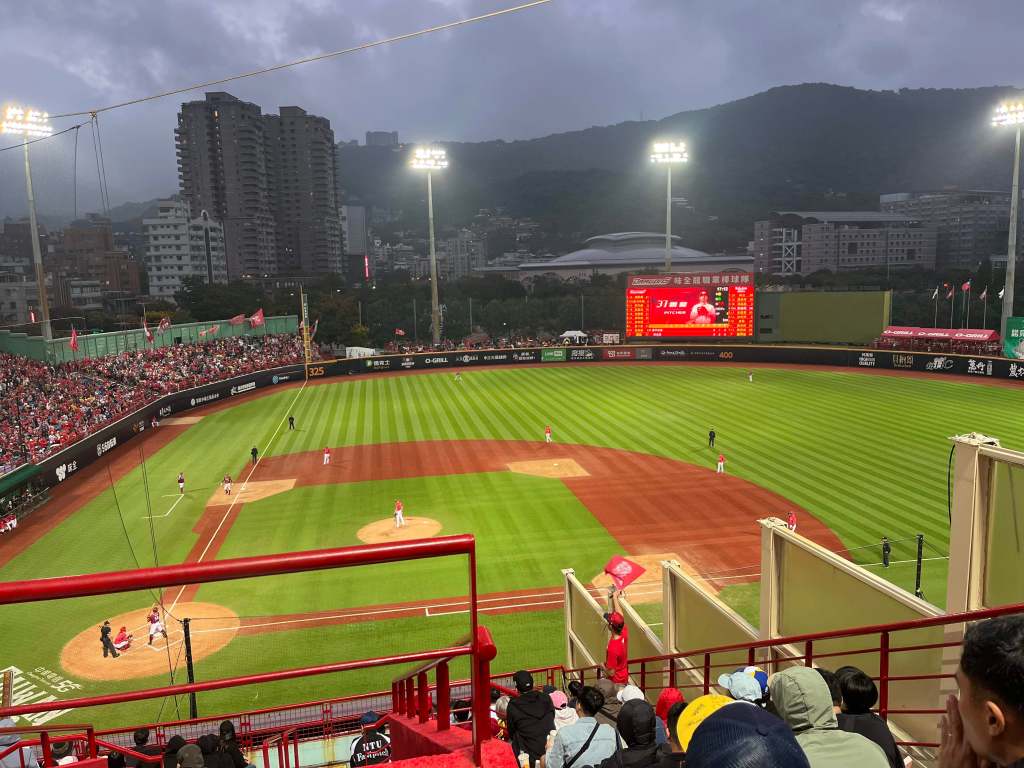
The league eventually added two expansion teams, the Wei Chuan Dragons in 2021 and the TSG Hawks in 2024. Attendance has reached all-time highs every year since 2023. Even though it has been over 12 years since Manny Ramírez played half a season for the EDA Rhinos, Taiwanese baseball will always have him to thank for reviving the sport all those years ago.
And, for that, perhaps Manny deserves an honorable mention at Cooperstown.
Covering the bases
Taiwan Cooperative Bank defeated Taichung and won its seventh Popcorn League title. The Rakuten Monkeys have offered slugger Li Lin an eight-year NT$180 million ($5.7 million) contract extension. Athletics left-hander Wei-En Lin got a MLB Pipelineas a member of one of 2025’s most improved farm systems. The SoftBank Hawks announced they were supportive of new signee Jo-Hsi Hsu playing in the World Baseball Classic.
1 Per FanGraphs’ calculations, he produced 4.0+ WAR from 1996 to 2003, with 7.5 in 1999.
2 The first dark ages were in the late 1990s, when the country experienced its first game-fixing scandals involving the “Black Eagles” and a developing league schism.
3 In Taiwan, a national affairs conference is a meeting of public officials, academics, subject matter experts, and/or private sector advisors; it is typically called in the event of political or economic crisis, akin to emergency advisory meetings or summits in the U.S.
4 The team was named after E-United Group’s hospitality and entertainment arm, E-DA World.
5 Team Taiwan’s participation in the 2013 World Baseball Classic, where it placed eighth in the world, also contributed to general interest and investment in the game that year. Veteran pitcher Chien-Ming Wang, whose early seasons with the New York Yankees electrified the country just a few years earlier, pitched for his national team for the first time since 2004.
You can follow Jerry’s blog on Taiwanese baseball at:


 SABR Asian Baseball Research Committee Blog