
by Yusuke Suzumura
Every Tuesday morning we will post an article from SABR’s award-winning books Nichibei Yakyu: Volumes I and II. Each will present a different chapter in the long history of US-Japan baseball relations. Here Yusuke Suzumura discusses Stanford University’s 1913 tour of Japan.
The Stanford University Baseball Team is closely connected to the development of baseball in Japan. This stems from 1904-05, when Waseda University was planning an expedition to the United States and negotiated with different universities there, and Stanford University was the first to respond. One of the reasons Stanford accepted Waseda’s request was that Zentaro Morikubo was a student at Stanford and facilitated negotiations between the two universities. Zentaro was the son of Sakuzo Morikubo, a member of the House of Representatives in Japan’s Imperial Diet; Zentaro later became a member of the Japan Amateur Athletic Association and was appointed a member of the Japan Baseball Umpires’ Association (an organization founded in 1916 with the intent of spearheading the establishment of baseball rules in Japan). As such, Zentaro Morikubo was a prominent figure in the baseball world at the time.
The Waseda team traveled to the United States in 1905, played against the Stanford Cardinals twice, and lost both games. They lost because the Waseda team’s play did not extend much beyond the rudimentary stages of throwing and hitting the ball, whereas the Stanford team approached the sport in an organized and systematic manner.
On March 31,1913, Keio University announced an invitation to the Stanford University baseball team to visit Japan later that spring. At the time, St. Mary’s College and Santa Clara University were the two best college baseball teams on the West Coast, and Stanford was second to these universities, alongside the University of California and the University of Washington. Stanford had won games against all of these universities before they visited Japan, and therefore Keio was “expected to probably lose.”
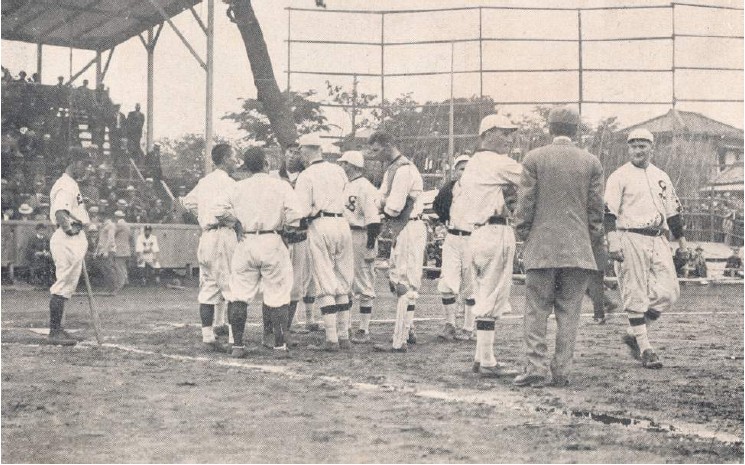
An 11-man contingent boarded the passenger ship Nippon Maru and departed San Francisco on May 10, 1913. Graduate student R.W. Wilcox was the manager. The players were Ray Maple, pitcher; Al Gragg, pitcher; Leslie Dent, catcher; Tom Workman, first base; Louis Cass, second base; Pete McCloskey, third base; Zeb Terry, shortstop; Arthur Halm, left field; Walter Argabrite, center field; and Heinie Beeger, right field.
The trip was scheduled for 10 weeks, longer than any previous trip by a Stanford team. They planned to play at least 12 games, starting with Keio in Japan, with a two-week visit to Hawaii on the way home. Keio provided 7,000 yen ($3,500) to cover the trip expenses. In 1913, 7,000 yen was equivalent to approximately 28 million yen (approximately $240,000) in 2022. In addition, the Stanford baseball team raised $200 from a match against the Santa Cruz Colored Giants; the university donated $250; and the Quadrangle Club donated $50, making for a total of $500. With the funds provided from the Japanese side and the donations from Stanford, the large amount of money they were able to raise suggests high expectations for the trip in both countries.
The Stanford group arrived at Yokohama around 8 A.M. on May 27. The Japan Times reported, “Immediately after the health inspection, the six-foot huskies were swarmed by a gang of newspaper reporters, and the Keio ball players and students who went out in a launch to meet them. ‘Banzai’ and college cheers were exchanged on the deck.” The team held a press conference at the request of the Japanese press, in which they described how they spent their time training during the 17-day voyage on the Nippon Maru. “Thankfully, the seas were calm, so we were able to practice every day. We still ended up dropping 15 of the four-dozen balls into the sea. However, perhaps because of the daily practice, everyone gained weight, with some of us gaining as much as 12 kg [about 26 pounds].”
Obviously, the team had indulged in a comfortable lifestyle during the voyage. However, when the Stanford players arrived at Yokohama, despite their massive weight gain, their physiques drew little attention from the Japanese, who remarked only that their physiques were “imposing.”
By way of example, the Yomiuri Shimbun favorably introduced the players in the following terms: “They are all elegant young gentlemen, dressed in winter suits and caps. Their physiques seem particularly imposing when one looks at the All-Philippines Baseball Team. Based on this alone, they would seem to have the power to overwhelm the Japanese baseball world.”
The All-Philippines Baseball Team had come to Japan on May 10, and had planned to stay until June 1 and play a total of 10 games with Waseda, Keio, Meiji University, and Yokohama Commercial School. Some of the games were canceled due to rain, and the Philippines team ended up playing eight games, of which it won only one, against Waseda, losing the other seven.
The All-Philippines Baseball Team was said to have “selected the very best of Philippine baseball,” with a total of 16 members, of which 13 were players, and one was a substitute. The players were generally of medium build and height, and while three had excellent physiques, another three were of smaller stature. While the results of the games are not necessarily always decided on the basis of physique, when one considers that the Philippines team had won only one out of the eight games, it is perhaps unsurprising that people thought that physique played a part in the team’s poor performance. The comment that “[t]heir physiques seem particularly imposing when one looks at the All-Philippines Baseball Team” can be taken not only as a comparison of the physiques of the All-Philippines players and the Stanford University players but also as an indication that there were high expectations for the latter based on the superiority of their physiques.
It should be noted that an article in the Tokyo Asahi Shimbun reported that “the players bore no signs of fatigue and were very comfortable during their 17-day voyage, with each gaining about 750 g [about 1.5 pounds].” Compared with the Yomiuri Shimbun article, none of the players seems to have gained a large amount of weight. While it is difficult to judge which description is accurate, we can nevertheless deduce that the players did indeed gain weight during the voyage.
The Stanford team was evaluated favorably by the Japanese during their time in Japan, as illustrated by the Tokyo Asahi Shimbun: “They are all the very best of young gentlemen morally influenced by Dr. Jordan, who resembled a messenger of the god of peace, and they seem to be very pleasant and friendly upon first meeting in the American style.”
“Dr. Jordan” was David Starr Jordan, who became the first president of Stanford University in 1891 and also became the first chancellor of the university in June 1913. Jordan visited Japan frequently from 1900 to investigate his academic specialty of ichthyology, the study of fish. Moreover, Jordan was a researcher, university administrator, anti-imperialist, and antiwar activist. Rather than his role as an ichthyologist and educator, the assessment of Jordan in Japan related to his opposition to the anti-Japanese-immigration movement in the United States, which was the most significant concern between the two countries at the time; he was on the side of the Japanese, arguing that “no parliament should pass the Japanese Exclusion Act.” In addition, he was described as “a great player for peace” who “loved peace and was convinced that peace was a global truth.”
Thus, the baseball players were depicted as gentlemen inspired by Jordan precisely because they were at Stanford University. In addition, the more distinctive players in the group were thus described:
Pigeon-toed and with a liking for beans, Cass is the odd man out in the group—so pigeon-toed in fact that his fellows tease him every which way. He made everyone laugh by saying that he was going to advertise himself in the papers as a pigeon-toed rickshaw man when he arrived in Tokyo. Argabrite’s family runs a bean shop, and he also has a great liking for beans, hence the nickname “Bean.” Workman is extremely timid and never left his lifeboat during the voyage.
While matters such as physique and family business have nothing to do with baseball itself, these topics were a good source of information to better know the players. The fact that such articles seeking to convey the personalities of the players were published, even if they were primarily intended to amuse the readers and satisfy their curiosity, demonstrates that people had a high level of interest in the Stanford University baseball team.
Having thus attracted people’s attention, how did the Stanford players adjust once they were in Japan? They started practicing at 1 P.M. on May 28 at Keio University’s Tsunamachi Grounds, with the practice lasting for 1 hour and 30 minutes. Second baseman Cass hit a succession of home runs to left field and left fielder Halm hit “a fire-breathing home run like a powerful cannon” with a long shot to right field. In defensive practice, the players threw the ball with machine-like accuracy, catching even difficult throws. Although they had not yet shown their full potential, the Stanford players were praised as “the epitome of the American national sport.”
The players’ track records were good as well, and as a team they were the strongest since the Stanford University baseball team was founded. They were said to be among the best teams on the West Coast, having won four times and lost once against Santa Clara University, which had previously defeated the Waseda University baseball club, 10-2. The cleanup hitter was Louis Cass, and the ace pitcher was Ray Maple, a side- arm thrower. Maple, first baseman Tom Workman, and shortstop Zeb Terry had such a high level of skill that they had been invited to join professional clubs. Maple turned down an offer to join the Philadelphia Athletics, Walkman received an offer from the Boston Red Sox, and Terry was invited to join the Portland Beavers of the Pacific Coast League and later had a seven-year major league career.
Given this context, it was thought that Keio, Meiji, and the Tomon Club, which consisted of graduates of the Waseda University baseball club, would not be able to compete with the Stanford team. In fact, the Stanford team did not perform as well as its track record would have suggested.
Continue to read the full article on the SABR website
 SABR Asian Baseball Research Committee Blog