
by Henry Tran
Every Monday morning we will post an article from SABR’s award-winning books Nichibei Yakyu: Volumes I and II. Each will present a different chapter in the long history of US-Japan baseball relations. This week HENRY TRAN focus on the Mets 1974 trip to Japan.
For certain kids growing up in Tokyo in the 1970s, three of the most popular sports to watch on television were baseball, pro wrestling, and roller derby. For Hanshin fans, there was not much to cheer during the 1974 season, except for Koichi Tabuchi, the best offensive catcher in the league at that time, the Japanese equivalent of Johnny Bench. Some of the favorite wrestling moments were seeing Tiger Jeet Singh and Antonio Inoki going at each other or the Destroyer teaming with Giant Baba to face off against Fritz von Erich or Abdullah the Butcher. Then there was the Thursday night Roller Derby of the Tokyo Bombers against the New York Bombers or the LA T-Birds. Baseball, however, always took priority over the others. The one annoying thing was that the baseball TV broadcasts began at from 7 P.M., and at 9 P.M., whether the game was in the middle of excitement or a blowout, suddenly a woman’s voice offered this message: “Kono ban gumi wa goran no su pon sa no tei kyo de okuri shimasu” (“This program is brought to you by the following sponsors”) and the broadcast was over. That was when anyone wanting to know how the game ended had to listen to it on the radio.
The summer of 1974 had a treat for baseball fans: a US collegiate team visiting Japan for a series. Managed by the legendary Rod Dedeaux, the team was loaded with hitters. One of the highlights of the series was the game played at Meiji Jingu Stadium when pitcher Takashi Yamaguchi from Kansai University struck out 13 American batters in a 6-3 victory for Japan. Then an exciting Central League race between the Yomiuri Giants and the Chunichi Dragons made it a busy baseball summer. And Japanese fans were buzzing all summer long in anticipation of a visit by the New York Mets in November.
Hank Aaron ended the 1973 season with 713 career home runs, and second-year skipper Yogi Berra engineered the New York Mets to the NL pennant. Across the Pacific Ocean, Japan’s most popular team, the Giants, captured their 15th Japan Series, winning in five games over the Nankai Hawks. The baseball landscape in 1974 was heading into an exciting era. The Mets were invited to Japan for a goodwill tour at the conclusion of the season. With Aaron breaking Babe Ruth’s home-run record on April 8, 1974, Japan invited him over for a home-run contest with Sadaharu Oh. November could not come soon enough for Japanese fans. Despite the Mets’ disappointing season in 1974, which ended with a 71-91 record and a fifth-place finish in the National League East Division, Japanese fans were eager to see Berra, the Yankees’ former star catcher, and his All-Star pitcher, Tom Seaver.
On October 24 the Mets delegation arrived at Haneda International Airport in a chartered DC-8. As expected, the delegation was welcomed by hundreds of media members and fans. A lot of the fans remembered that Berra had come to Japan almost two decades earlier, in 1955, as a member of the Yankees. They were looking forward to seeing the Mets play 18 games in 12 cities. For different reasons, nine Mets players decided not to make the trip including Jerry Grote, Cleon Jones, George Stone, and Tug McGraw. Berra brought up Roy Staiger and Ike Hampton from Triple-A Tidewater. (Hampton later played a season for the Kintetsu Buffaloes.) The Mets also included on their roster Joe Torre, whom they had just acquired from St. Louis in exchange for Ray Sadecki and Tom Moore.
During the tour the Mets faced the Yomiuri Giants 10 times; the other eight games were split between an All-Japan team and squads of the Giants and another Nippon Professional Baseball Organization team.
Game 1: Mets vs. Giants
Korakuen Stadium, home of the Yomiuri Giants for almost 30 years, was located next to Korakuen Amusement Park. With a capacity of 50,000, it was the second largest ballpark in the JPL behind Koshien, home of the rival Hanshin Tigers, which could hold 60,0000. In a race decided by percentage points a few weeks before, the Giants lost the Central League pennant to the Dragons by a record of 71-50-9 (.5867) to 70-49-11 (.5882) – the closest winning margin ever. The postseason was an emotional time for Yomiuri, because the country’s favorite player, Shigeo “Mr. Giant” Nagashima, retired.
On October 26, a capacity crowd filled the stadium to see the 1973 Cy Young Award winner, Tom Seaver, on the mound. Seaver pitched three innings, giving up three runs. The Mets jumped to a quick 3-0 lead off starter Mitsuhiro Sekimoto (10-5, 2.28 ERA during the season). With New York leading, 7-6, going into the bottom of the eighth inning, Oh parked a grand slam off reliever Jerry Cram and the Giants won, 10-7. John Milner, Wayne Garrett, and Dave Schneck all hit homers for the Mets. The Giants’ offense was impressive, recording 16 hits.
Game 2: Mets vs. Giants
A crowd of 40,000 showed up for a Monday afternoon game at Korakuen. Jon Matlack was on the hill against Kazumi Takahashi. Matlack pitched four solid innings and the Mets led 4-2 on Don Hahn’s home run in the top of the fifth. However, as in Game 1, the Mets were not able to hang on to a lead, when reliever Jack Aker walked six runners to allow the Giants to tie the game in the bottom of the ninth. Shigeru Kobayashi and Osamu Shimano kept the Mets scoreless in the last five innings. Neither team scored in the 10th and the game was called a 4-4-tie. This was done mainly so the teams could catch a flight to Sapporo for Game 3 the next day. Mets manager Berra noticed that the Japanese style of play was more aggressive since his first visit in the 1950s. “They’ve improved a lot, they’re more aggressive now, they go for the hit-and-run play, and they bunt more,” he commented.
Game 3: Mets vs. Giants
After an opening loss and a tie, the Mets were looking for a win in Sapporo. The teams arrived at Maruyama Stadium on October 29, a ballpark built in 1934 that seated 25,000. Occasionally the Giants and other teams played regular-season games at Maruyama. Jerry Koosman got the start. Before the game, Tom Seaver gathered seven Yomiuri pitchers in center field and gave advice about his four pitches and mechanics. New York Times writer Joseph Durso wrote: “They stood in a quiet semicircle on the center field grass in Maruyama Stadium beneath majestic mountains colored in the yellow and red of autumn. Expensive chalet homes snuggled into the slopes leading to the ski jump built for the 1972 Winter Olympics. In parkas and coats, the early arrivals began to crowd the gentle hill beyond the outfield fence at the foot of the mountain, spreading blankets on the cold ground to watch for the next four hours while the Giants and New York Mets brought their traveling goodwill tour north. Wood-burning heaters warmed the players in the dugouts and Sapporo beer warmed the customers who had paid $10 for box seats.”
The Giants got to Koosman early, scoring two runs in the bottom of the second inning, but the Mets responded with two in the top of the third off starter Mitsuhiro Sekimoto. The Mets took the lead, 4-2, on a two-run single by Felix Millan in the fourth before Yomiuri recaptured the lead with three in the bottom of the fifth. The Mets got a run off reliever Takaaki Taniyama to tie the game at 5-5 in the sixth, but in the bottom of that inning, the Giants went ahead on a home run by Kazumasa Kono off reliever Bob Miller to win the game, 6-5. For the third straight game, the Mets did not hold on to their lead.
Game 4: Mets vs. Giants
After the game the teams flew to Sendai, the capital city of Miyagi prefecture. As in Sapporo, there were no professional baseball teams in Sendai. The multipurpose Miyagi Athletic Stadium opened in 1952 with a capacity of 30,000: a mere 7,000 seats but standing room for 23,000. Tom Seaver faced off against Nobuhiro Tamai, pitched six innings and drove in a run in the top of the fifth. Ed Kranepool homered off Shigeru Kobayashi to tie the game at 2-2 in the top of the seventh, but reliever Hank Webb gave up the winning run in the bottom of the inning, making the final score 3-2. Yoshimasa Takahashi came in to save the game for the Giants in the top of the ninth. The Mets were winless in four tries.
Game 5: Mets vs. Giants
The Mets arrived in Fukushima prefecture after a 90-minute ride on a bullet train. Kaiseizan Stadium had just opened in 1974 and was owned by Koriyama City. On this October 31 afternoon, with the temperature in the 40s, 18,000 fans flooded into the park to see Bob Apodaca start against Tadao Yokoyama. After seven innings, the Mets had a familiar 2-0 lead, with runs in the second inning on a fielder’s choice and an unearned run in the sixth. Once again the Mets were not able to hold on to their lead, as the Giants scored three runs in the bottom of the eighth inning, two of them on a double by Toshimitsu Suetsugu to put them in the lead, 3-2. The Mets came back in the top of the ninth with a solo home run by John Milner, his second in the series, and the two teams settled for another 3-3 tie. After five games against the Giants, the Mets were still winless.
Game 6: Mets vs. All-Japan
The Mets were back to the familiar territory of Tokyo and Korakuen. A two-game series with the All-Stars was set for the weekend, in conjunction with Culture Day and the home-run contest between Hammerin’ Hank and Oh.
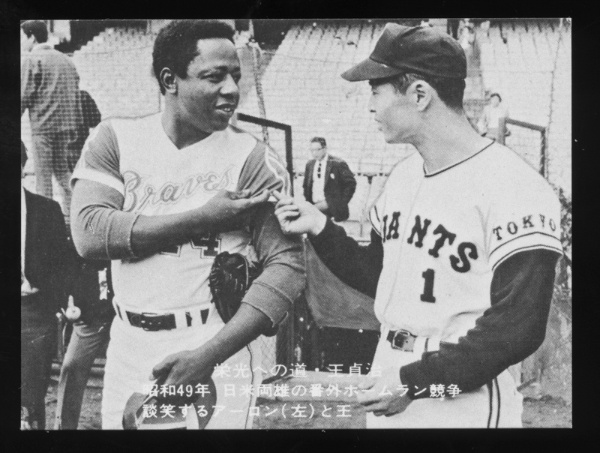
Aaron arrived at Haneda Airport on November 1 after a 17-hour flight from Atlanta and was thrust into a press conference at the Hotel Okura in Minato-ku with his rival, Japanese home-run king Oh. Aaron had completed the 1974 season with 733 home runs and Oh had 634. The two home-run heavyweights would take several rounds of swings to see who would wear the crown. Aaron had not swung at a ball since Atlanta’s last game of the season, against Cincinnati on October 2. In that game, he parked a homer off the Reds’ reliever Rawly Eastwick in the seventh inning, his 20th of the season.
Aaron and Oh were at the park taking batting practice at 10:30 A.M. The Mets and the All-Japan team were also there to prepare for their game after the home-run contest. Joe Pignatano, a coach for the Mets and a former catcher for the Dodgers, pitched to Aaron while batting practice pitcher Kuniyasu Mine threw to Oh. The 40-year-old Aaron was supposedly the underdog to the 34-year-old Oh, who had the home crowd of 50,000 behind him and was hitting against his familiar batting-practice pitcher.
Aaron suggested the rules for the contest: Each batter would swing at 20 balls and whoever put the most into the stands would win. Aaron was being paid $50,000 and Oh $20,000. Oh won the coin toss and elected to go first. There were four rounds of five pitches in each. In the first round, Oh put three balls (measuring 330 feet, 396 feet, and 412 feet) into the right-field stands. Aaron followed with 396-foot and 380-foot homers. After one round, Oh led 3-2. In the second round, Oh put three more into the stands, one of them almost 400 feet. Aaron put four over the wall to tie the score at 6-6 after two rounds. In the third round Oh managed only one rocket, and Aaron hit three to take the lead, 9-7. In the final round, Oh put two over, including a 400-footer, to tie it at 9-9. Aaron parked a 429-foot blast with his third swing to win the contest, 10 homers to 9.
After the two kings met in person, Aaron expressed his humble feeling about the contest: “Oh is only 34, he has a chance to hit over 800. Winning today’s contest proves nothing. If there is any meaning, it is that we made the fans happy.” The fans were happy indeed: they were treated to a one-time event.
The game followed the contest and the Mets were still looking for their first win. Southpaw Jon Matlack was assigned to go against the best hitters of NPB. Yakult Swallows’ ace pitcher Hiromu Matsuoka, who was 17-15 with a 2.80 ERA during the season, started for the All-Japan team. Matlack pitched beautifully, giving up just two hits in eight innings, while Matsuoka struggled with the Mets hitters, surrendering six runs in 2⅔ innings. The Mets’ Joe Torre, Ron Hodges, and Ted Martinez homered in an 8-0 victory over the All-Stars. The All-Stars included future Hall of Famers Isao Harimoto, Tsutomu Wakamatsu, Yutaka Fukumoto, Koichi Tabuchi, Oh, and Nagashima, but the Japanese media speculated that the All-Stars were not as good as the Giants, who had won their ninth straight championship in 1973.
Game 7: Mets vs. All-Japan
The next day, November 3, the Mets and the All-Stars squared off again with Jerry Koosman on the mound against Keishi Asano, who went 12-15 with a 2.49 ERA during the season with the Yakult Swallows. The Mets trailed 2-1 going into the top of the ninth, but Felix Millan and Ed Kranepool homered to put New York ahead 4-2 (the eventual the final score) and give Harry Parker the win. The Mets’ pitching had held the best of NPB to two runs in 18 innings. Berra summarized in his own way: “It took us a week to catch up – the pitchers, at least. Hitters can usually hit – Aaron showed that Saturday in his home‐run contest against Oh. But pitchers can go stale, the way ours did.”
Game 8: Mets vs. Giants
The Mets were playing their fourth straight game at Korakuen with another sellout crowd of 50,000 and looked for their first win against the Giants behind Tom Seaver. Yomiuri, wanting to continue its unbeaten streak, put Tsuneo Horiuchi on the mound. Seaver doubled in two runs to put the Mets up 3-1 in the top of the second but in the bottom of the inning, Shigeru Takada hit a three-run homer to put the Giants back on top, 4-3. John Milner hit a tying home run in the third; it would be the Mets’ last run of the game. Kazumasa Kono hit a solo homer in the bottom of the third to regain the lead and Oh added a solo homer in the sixth to make it a 6-4 game. Yomiuri then scored three runs on five hits, a walk, and two errors in the seventh and another in the eighth to win 10-4. In all, the Giants pounded out 17 hits, including three home runs.
That evening, the Mets and Giants attended a reception at the US Embassy. Hank Aaron was also in attendance and the players from both teams exchanged game feedback as Shigeo Nagashima’s wife, Akiko, translated. Akiko had gone to Kokomo High School in Indiana and the College of St. Teresa in Winona, Minnesota.
Read the rest of the article on SABR.org
 SABR Asian Baseball Research Committee Blog