
by Robert K. Fitts
Every Tuesday morning we will post an article from SABR’s award-winning books Nichibei Yakyu: Volumes I and II. Each will present a different chapter in the long history of US-Japan baseball relations. This week Rob Fitts writes about Babe Ruth and the ALL Americans’ 1934 visit to Japan.
Katsusuke Nagasaki’s breath billowed as he loitered outside the Yomiuri newspaper’s Tokyo offices. The morning of February 22, 1935 was chilly. But that was good; nobody would look twice at his bulky overcoat. Matsutaro Shoriki, the owner of the Yomiuri Shimbun, was late. Nagasaki strolled up and down the block, trying to remain inconspicuous.
Finally, at 8:40 A.M. a black sedan cruised down the street. Nagasaki halted in front of a bulletin board by the building’s entrance. He studied the announcements as a short, balding man with thick-framed glasses emerged from the car. As Shoriki began to climb the stairs into the building, Nagasaki strode forward, pulling a short samurai sword from beneath his coat. The blade flashed through the air, striking Shoriki’s head. The bloodied newspaper owner stumbled forward, as Nagasaki fled.
Later that day, Nagasaki walked into a local police station and gave a detailed confession. The primary reason for the assassination attempt: Shoriki had defiled the memory of the Meiji Emperor by allowing Babe Ruth and his team of American all-stars to play in the stadium named in honor of the ruler.
Three months earlier, nearly a half-million Japanese had lined the streets of Tokyo to welcome the ballplayers to Japan. The players’ motorcade was led by Ruth in an open limousine. At 39, he had grown rotund, and just weeks before had agreed to part ways with the New York Yankees. But to the Japanese, he still represented the pinnacle of the baseball world. Sharing the car was his former teammate Lou Gehrig. The rest of the All-American baseball team, distributed three or four per car, followed: manager Connie Mack, Jimmie Foxx, Earl Averill, Charlie Gehringer, Lefty Gomez, Lefty O’Doul, and a gaggle of lesser-known stars.
Only one player didn’t seem to belong—a journeyman catcher with a .238 career batting average named Moe Berg. Although he was not an All-Star caliber player, his off-the-field skills would explain his inclusion on the team. Berg was a Princeton University and Columbia Law School graduate who had already visited Japan in 1932. He was multilingual, causing a teammate to joke that Berg could speak a dozen languages but couldn’t hit in any of them. Berg would eventually become an operative for the Office of Strategic Services (OSS), the forerunner of the CIA, and many believe that the 1934 trip to Japan was his first mission as a spy.
The pressing crowd reduced the broad streets to narrow paths just wide enough for the limousines to pass. Confetti and streamers fluttered down from multistoried office buildings, as thousands waved Japanese and American flags and cheered wildly. “Banzai! Banzai, Babe Ruth!” echoed through the neighborhood. Reveling in the attention, the Bambino plucked flags from the crowd and stood in the back of the car waving a Japanese flag in his left hand and an American in his right. Finally, the crowd couldn’t contain itself and rushed into the street to be closer to the Babe. Traffic stood still for hours as Ruth shook hands with the multitude.
Ruth and his teammates stayed in Japan for a month, playing 18 games in 12 cities. But there was more at stake than sport: Japan and the United States were slipping toward war as the two nations vied for control over China and naval supremacy in the Pacific. Politically Japan was in turmoil. From the 1880s through 1920s, Japan had enjoyed a form of democracy. This period saw great strides in modernization, a flourishing of the arts, and close ties to the United States. Yet, as Japan’s power grew, so did its nationalism. A growing minority of Japanese citizens felt that the country should take its place among the world powers by expanding its military and colonizing its neighbors. Ultranationalist societies began assassinating liberal politicians and members of the free press. By the early 1930s, the civilian government could no longer control elements of the military. In 1931 nationalistic officers engineered the invasion of Manchuria and twice plotted to overthrow the government. War between the United States and Japan seemed inevitable.
Politicians on both sides of the Pacific hoped that the goodwill generated by the tour and the two nations’ shared love of baseball could help heal their growing political differences. Many observers, therefore, considered the all-stars’ joyous reception significant. An article in the New York Times, for example, said, “The Babe’s big bulk today blotted out such unimportant things as international squabbles over oil and navies.” Connie Mack added that the tour was “one of the greatest peace measures in the history of nations.”
Yet, not all Japanese wished the nations reunited. At the Imperial Japanese Army Academy, just two miles northwest of the parade, a group known as the Young Officers was planning a bloody coup d’etat, an upheaval that would jeopardize the tour’s success and put the players’ lives at risk. In another section of Tokyo, Nagasaki and his ultranationalist War Gods Society met at their dojo. Their actions would tarnish the tour with bloodshed.
The 1934 tour began not as a diplomatic mission but as a publicity stunt to attract readers to the Yomiuri Shimbun. Matsutaro Shoriki had purchased the financially troubled newspaper in 1924 and quickly turned it into Tokyo’s third-largest daily by increasing its entertainment sections.
In 1931 Shoriki decided to bolster sports coverage by sponsoring a team of American all-stars to play in Japan. The team, which included Lou Gehrig, Lefty Grove, and five other future Hall of Famers, won each of the 17 games against Japanese university and amateur teams, and the newspaper’s circulation soared. But Shoriki wasn’t satisfied. The major-league team had lacked the greatest drawing card in baseball—Babe Ruth.
Shoriki immediately began organizing a second tour. Working closely with Sotaro Suzuki, a sportswriter who had lived in New York for nearly a decade, and National League batting champion Lefty O’Doul, Shoriki lined up the powerful 1934 squad. Most of the players’ wives accompanied their husbands on the trip, and the Ruths brought along their 18-year-old daughter, Julia. The tourists boarded the luxury liner Empress of Japan in Vancouver, British Columbia, on October 20 and, after a stop in Honolulu, arrived in Yokohama on November 2.
Although American teachers had introduced baseball in 1872, Japan didn’t have a professional league. To challenge the Americans, Shoriki brought together Japan’s best amateur players to form the All-Nippon team. The team included 11 future members of the Japanese Baseball Hall of Fame and numerous colorful personalities.
Two players, in particular, stood out. The first was hard to miss: 18-year-old Victor Starffin was the blondhaired, blue-eyed, 6-foot-3 son of a Russian military officer who had served Czar Nicholas II. During the Russian Revolution, the Starffins escaped by traveling in a freight train packed with typhoid patients, and later by hiding from the Red Army in a truck carrying corpses. After years on the run, the family settled in Japan. Young Victor fell in love with baseball and soon became a regional star. He hoped to play college ball, but in 1933 his father was convicted of killing a young Russian woman who worked in his teashop. The Yomiuri newspaper promised to use its influence to help Victor’s father if the young man would forsake college and play for the All-Nippon team.
The All-Nippon squad also included a young American who hoped to become the first ethnic Japanese to make the major leagues. Jimmy Horio was born in Hawaii and left for California to follow his dreams at the age of 20. He played semipro for several years without breaking into Organized Baseball. Hearing that Shoriki was creating a team to challenge the visiting major leaguers, Horio traveled to Tokyo to try out. He hoped a stellar performance against the All-Americans would lead to a major-league contract. As a switch-hitter with power, Horio made the AllNippon team easily and hit cleanup, but would fail to impress the Americans.
Over the next four weeks, the All-Americans and All-Nippon traveled together throughout Japan, visiting the northern island of Hokkaido; the industrial cities of Yokohama, Nagoya, and Osaka; the ancient capital of Kyoto; Kokura on the southern island of Kyushu; and, of course, Tokyo.
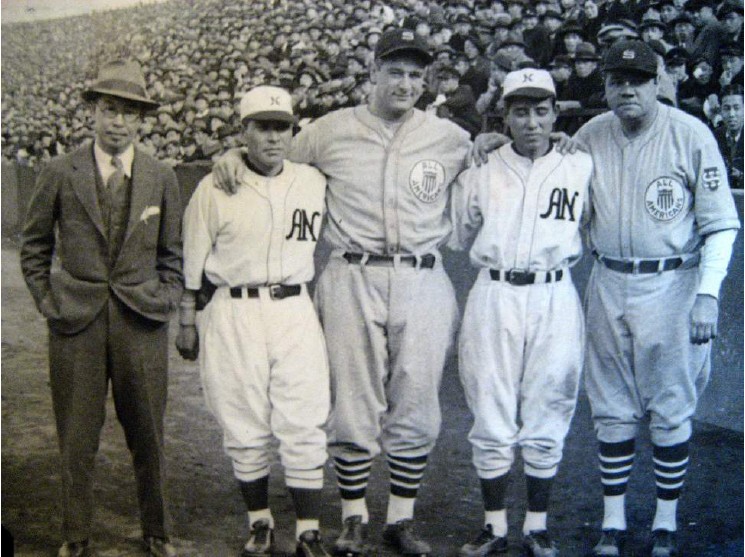
The tour began with two games at Tokyo’s Meiji Jingu Stadium. Prior to the games, fans camped out overnight to secure the best general-admission seats. They followed the Babe’s every move. A reporter stated, “The fans went crazy each time Ruth did anything—smiled, sneezed, or dropped a ball.” One old man brought a pair of high-powered binoculars, amusing himself and neighboring fans by focusing on the Bambino’s famous broad nose, making his nostrils fill the lens. Another fan, who worked in a textile factory designing kimono and undergarment patterns, had a novel plan. He would sit as close as possible to the field and study the Bambino’s face. He would memorize every feature, every wrinkle. Then he would return to the factory and create a pattern of the Babe’s face for a new line of Babe Ruth underwear. He was certain he would become rich.
The Babe relished the attention and transformed into a comedian. During batting practice, he purposely missed some pitches—twisting himself around like a pretzel before falling over. Later, he began a game of shadow ball—hitting an imaginary grounder to Rabbit McNair at shortstop, who fielded it convincingly and started a double play, timed with perfect realism. The opening game itself was less interesting than Ruth’s antics. It pitted the All-Americans against the Tokyo Club, a team of recently graduated players from the Tokyo area, not the All-Nippon squad. It took just a few minutes for the fans, and players, to realize the difference in skill level between the two teams—the ball even sounded louder when coming off the American bats. The Americans seemed to score at will, pilling up 17 runs to Tokyo’s 1. To the crowd’s disappointment, none of the Americans hit a home run. Afterward, the Babe apologized for not going deep, telling reporters, “I was a little tired today, but tomorrow I will do my best to hit a home run.”
The next day, November 4, the All-Americans played their first game against All-Nippon. It was the first time in history that true all-star teams representing the two countries clashed. Prior to the 1930s, visiting American professional teams were a mishmash of stars,journeymen, and minor-league players, and while the 1931 American club was a legitimate all-star team, it played only Japanese collegiate and company squads. The All-Nippon lineup featured six future Hall of Famers—Naotaka Makino, Hisanori Karita, Osamu Mihara, Minoru Yamashita, Jiro Kuji, and pitcher Masao Date. Although Date pitched “courageously,” and limited the All-Americans to five runs, the game’s outcome seemed inevitable. Jimmie Foxx, Lou Gehrig, and Earl Averill homered, with Averill going out twice. On the other side of the scorecard, American pitcher Joe Cascarella dominated the Japanese, giving up just three hits and walking only two.
Next, the All-Americans traveled north. As they boarded a ferry to cross the straits to reach Hokkaido, officials handed each traveler a small map with three coastal areas circled in red. Large cursive writing proclaimed, “Photographing, sketching, surveying, recording, flying over the fortified zone, without the authorization of the commanding officer of this fortress are strictly prohibited by order.” The handout was not an empty threat. Japan was paranoid about espionage, and officials even inspected Ruth during the trip to make sure that he wasn’t taking photographs. But neither the proscription nor the officials stopped Moe Berg. Defying the warning, Berg whipped out his camera and filmed the area.
The teams played two games in the northern provinces, enduring bone-chilling winds and frosted fields. Once again, the Americans won comfortably. On November 8 in Hakodate, the All-Americans took control of the game minutes after the first pitch as Averill hit a two-out, first-inning grand slam. Meanwhile, Lefty Gomez dazzled the fans and opponents with both his speed and control. Up 5-1, manager Ruth brought in third baseman Jimmie Foxx to close out the game. The burly third baseman preserved the victory by allowing just one run in the final three innings. The following day in Sendai, Ruth went deep twice and Gehrig, Foxx, and Bing Miller each hit one out in a 7-0 American victory.
As the teams returned to Tokyo, two dozen army officers met at an isolated restaurant. Their purpose—to overthrow the Japanese government.
The Great Depression had hit rural Japan particularly hard, leading to widespread starvation. At the same time, large trading companies, known as zaibatsu, flourished due to the unstable markets and rampant inflation. The conspirators, led by Captain Koji Muranaka, belonged to the loosely organized Young Officers movement. The Young Officers felt that Japan’s government had betrayed its citizens by putting the interests of big business before the welfare of the populace. The group advocated the violent overthrow of civilian rule, the declaration of martial law, and the Emperor taking direct control of the government. The divine Emperor, they believed, would end rural poverty by redistributing wealth and would lead Japan to world prominence by conquering Asia.
On November 27 Japan’s parliament would meet in a special session. Once the politicians gathered, the Young Officers and their troops planned to attack the Diet Building, slaughter the civilian government, and seize power. Other sympathetic troops would battle loyalist regiments in the streets of Tokyo. No mention was made of Babe Ruth and the ballplayers, but as the Imperial Hotel faced the Emperor’s palace and was just a few blocks from the Diet Building, Muranaka’s plan put the Americans in the line of fire.
Continue to read the full article on the SABR website
 SABR Asian Baseball Research Committee Blog