

Dongdaemun Baseball Stadium and Suengui Baseball Stadium
by Jeonghyun Won
Korea’s First Baseball Stadium: Dongdaemun Baseball Stadium
The history of baseball is not complete if we only look at the records of players and teams. The stadiums where the games are played are just as integral to baseball’s story. In the United States, the birthplace of baseball, the first baseball field is believed to have been Elysian Fields in Hoboken, New Jersey, built in the early-to-mid 1800s. Although it no longer exists, records say that the first official baseball game took place there on June 19, 1846. Korea’s first baseball stadium also, unfortunately, no longer exists. Where one now finds Dongdaemun Design Plaza (DDP), one of Seoul’s most famous tourist attractions, once stood Dongdaemun Stadium, the birthplace of Korean baseball. The history of Dongdaemun Stadium parallels Korea’s own painful modern history. In 1925, during the Japanese colonial era, the Japanese government constructed Gyeongseong Stadium as part of its policy to indoctrinate and control the Korean population. This was the beginning of Dongdaemun Stadium. After Korea’s liberation, the stadium was renamed Seoul Stadium.
At that time, Seoul Stadium was the mecca of Korean sports and the beating heart of the nation. The stadium hosted the most popular sporting events in Korea, including high school baseball tournaments and international competitions like the Asian Baseball Championship. It was here that Choi Dong-won, one of the greatest pitchers in Korean baseball history, recorded an astonishing 17 consecutive hitless innings. The legendary rivalry between Kim Geon-woo and Park No-jun, one of the defining rivalries of the early professional baseball era, also began here. The very first game in the history of the Korea Baseball Organization (KBO) (MBC Blue Dragons vs. Samsung Lions, 1982) was held at Seoul Stadium, and in 1985 the OB Bears (now the Doosan Bears), the first KBO champions, used the stadium as their home ground for an entire season.
But Seoul Stadium could not escape the flow of time. In preparation for the 1986 Asian Games and the 1988 Seoul Olympics, the government built the new Seoul Sports Complex in Jamsil. Seoul Stadium lost its position as the center of Korean sports, was renamed Dongdaemun Stadium, and entered a period of gradual decline.

High school baseball games continued to be held there, but the stadium was overshadowed by the popularity of professional baseball. To make matters worse, the decades-old facilities were increasingly shunned by players and spectators alike. In the mid-2000s, one baseball insider remarked, “The artificial turf is practically like concrete—if you make a mistake, you could get seriously injured. The dugouts are so cramped that players have to stand throughout the entire game. The bathrooms and other facilities are terrible, making things just as uncomfortable for fans[ZP1] [c2] .”[i]After years of debate, Dongdaemun Stadium finally closed its doors on November 13, 2007, following the Seoul High School Baseball Fall Championship final between Baemyung High School and Chungam High School.
The Heart of Incheon Baseball: Suengui Baseball Stadium
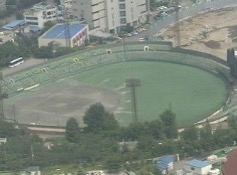
If one only thinks about today’s professional baseball scene, the cities that come to mind are Seoul, Gwangju, or Busan. But Incheon also has every right to call itself a “baseball city.” Records show that as early as 1897, students of the Incheon English Night School played one of Korea’s first baseball games there. Incheon Commercial & Industrial High School (now Incheon High School) even represented Korea several times at Koshien, Japan’s most prestigious high school baseball tournament, during the Japanese colonial period.
Suengui Baseball Stadium was the site of countless memories for Incheon’s baseball-loving citizens. Built about ten years after Dongdaemun Stadium, Suengui opened its gates in 1934. During the heyday of high school baseball, Incheon High School and Incheon Dongsan High School were among the most dominant teams in the country, and Suengui Stadium was packed to capacity almost every day. Even after the start of professional baseball, fans continued to flock to the stadium. The Sammi Superstars (one of the KBO’s inaugural teams), and later the Cheongbo Pintos and the Taepyeongyang Dolphins, all used Suengui as their home stadium. However, the professional teams’ results paled in comparison to those of the legendary local high school teams. In the 20 seasons of professional baseball played at Suengui, the postseason was hosted there only four times.
The gap between the fans’ overflowing passion and their teams’ underwhelming performance sometimes led to a rowdy, almost “hooligan-like” fan culture. While baseball fandom throughout Korea could be unruly in the early professional years, Incheon fans were considered especially intense, earning the nickname “Dowon Warriors” (Dowon Stadium was another common name for Suengui Stadium due to its proximity to Dowon Station). During Sammi’s infamous 18-game losing streak, fans once blocked the players’ bus and even demanded hearings with the team’s manager. But this passion also helped advance Korea’s fan culture. In the 1980s, before organized cheering squads existed, Suengui had an unofficial cheer captain, Mr. Kim Young-sik, who would rally the fans, lead applause, and chant the players’ names, setting the foundation for the lively cheering culture that KBO fans know today.
Suengui Stadium later served as the home of the Hyundai Unicorns and SK Wyverns, but in 2001 it relinquished its “home of pro baseball” status to Munhak Baseball Stadium. Eventually, the site was redeveloped for a soccer-specific stadium and residential apartments, and Suengui passed into history.
“As Long as We Remember, It Never Truly Disappears”
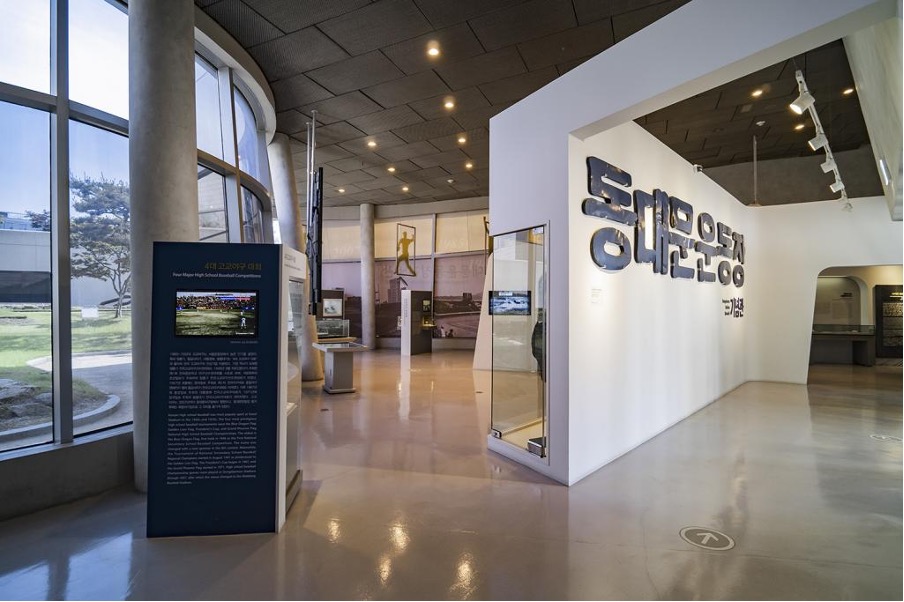
Today, if you visit Euljiro 7-ga in Seoul or Dowon-dong in Incheon, you won’t find a baseball stadium. But the spirit of the ballparks can still be felt. Inside Dongdaemun Design Plaza, the Dongdaemun Stadium Memorial Hall preserves the history of the stadium and displays equipment used there. At Incheon’s Dowon Station underpass, an exhibition called the “Incheon Sports Timeline” briefly recounts the history of Suengui Stadium. Through these spaces, one hopes that American baseball fans, and fans everywhere, can gain a deeper appreciation for Korean baseball and enjoy it even more.
[i] “Dongdaemun Design Plaza (DDP) – Past and Present, and the Stories Buried Beneath It,” Redian (Seoul, Korea), September 6, 2019, (https://www.redian.org/news/articleView.html?idxno=136378 (last accessed September 23, 2025).
 SABR Asian Baseball Research Committee Blog