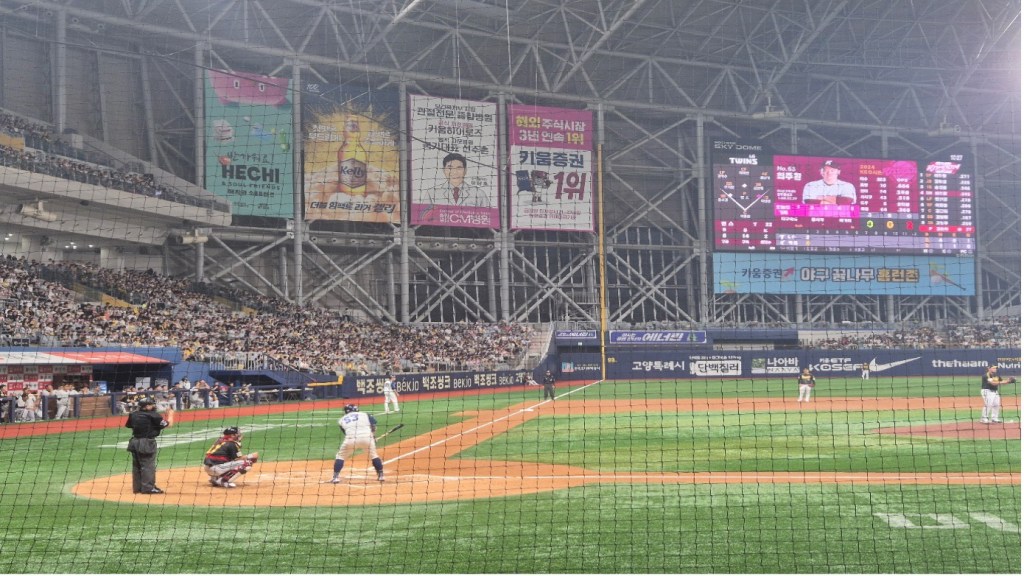
Professional sports in Korea began in earnest in the 1980s. At the time, Korea had industrialized, and the economy was more stable than before, but the country was still under military rule. Before the voices for democracy and press freedom grew stronger, President Chun Doo-hwan’s government fostered the sports industry to divert public dissatisfaction (along with films and the sex industry, this was called the “3S Policy”).
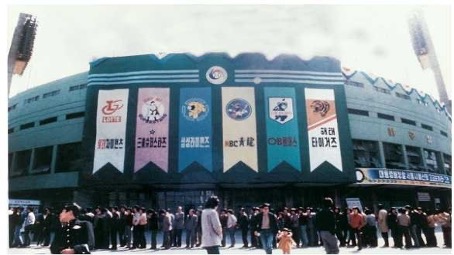
The government encouraged major corporations, which played a large role in the Korean economy, to establish professional baseball teams. Responding to this, corporations formed teams. On December 11, 1981, the Korea Baseball Organization (KBO) was founded. Soon after, in March 1982, the Korean Professional Baseball League (KBO League) opened. From then on, Korea’s international baseball exchange began to center around the KBO League.
Sammi Superstars – based in Incheon/Gyeonggi-do/Gangwon-do/5 provinces of North Korea
Lotte Giants – based in Busan/Gyeongsangnam-do
Samsung Lions – based in Daegu/Gyeongsangbuk-do
Haitai Tigers (now KIA Tigers) – based in Gwangju/Jeolla
OB Bears (now Doosan Bears) – based in Daejeon/Chungcheong
In 1985, the OB Bears relocated to Seoul, and Binggrae Eagles (now Hanwha Eagles) filled the gap. In 1990, the Ssangbangwool Raiders (disbanded in 1999) joined, starting the true 8-team structure of the 1990s. However, during the 1997 financial crisis, ownership changes and team dissolutions created a turbulent history. Despite this, baseball’s popularity grew, leading to the creation of more teams. The current 10-team system was completed in 2015 with the founding of the Suwon-based kt wiz.
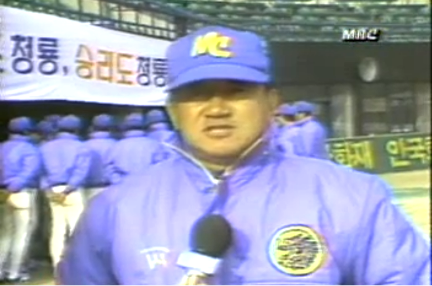
From its start in 1982 until the mid-1990s, the KBO League consisted only of Korean players. International exchange was minimal, and overseas Koreans or Koreans with Japanese pro experience filled the role of “foreign players.” Notable examples include pitcher Myeong-bu Jang (Japanese name: Hiroaki Fukushi) and player-manager In-chun Baek of MBC Blue Dragons.
At that time, the gap between Korean and Japanese baseball was far greater than today. In-chun Baek’s record of a .412 batting average in 1982 (still the KBO’s only .400 hitter) and Myeong-bu Jang’s 30-win season in 1983 both reflected that disparity.
In 1998, Korea finally introduced its foreign player system, about 15 years after the league’s founding. Since then, players from Japan, the United States, Mexico, the Dominican Republic, Venezuela, Puerto Rico, and Curaçao, among others, have joined. With superior physical ability, they brought powerful batting and dominant pitching.Korean players, competing with them, raised their skills to international levels. This led to global success: silver medals in the 2006 and 2009 World Baseball Classic, and a gold medal at the 2008 Beijing Olympics, proving Korea’s competitiveness in world baseball.
From the mid-1990s, more Korean student athletes also challenged foreign leagues. Some skipped the KBO and went directly abroad after graduation. In 1994, Chan Ho Park became the first to enter Major League Baseball. After him came pitchers Jin-ho Cho, Byung-hyun Kim, Jae-weong Seo, hitters Hee-seop Choi, Shin-soo Choo, Ji-man Choi, and others.
Meanwhile, many KBO players at that time went to Japan first instead of the U.S. Legends such as pitcher Dong-yeol Sun, shortstop Jong-beom Lee, pitcher Sang-hoon Lee, pitcher Dae-sung Koo, and slugger Seung-yeop Lee all advanced to Japanese baseball.
Direct movement of Korean pros to the U.S. began in the 2000s. Players like Hyun-jin Ryu, Jung-ho Kang, Byung-ho Park, Ha-seong Kim, and Jung Hoo Lee used the posting system to reach MLB. Student athletes also continue to pursue MLB directly after high school, examples include Hyun-il Choi, Jun-seok Shim, Ji-hwan Bae, Hyeong-chan Eom, and Won-bin Cho.
Recently, a unique trend has emerged: foreign players who played in the KBO return to MLB, a phenomenon called “reverse export” in Korea. Merrill Kelly, now a pitcher for the Texas Rangers, is a prime example. Others such as Chris Flexen, Erick Fedde, and Mike Tauchman also polished their skills in Korea before resuming MLB careers.
In the past, the KBO was just an option for players who failed to adjust in MLB. Now, it is positioned as a springboard for returning to MLB. Seeing these “reverse export” successes, many foreign players knock on the KBO’s door before directly attempting MLB.
Thus, the KBO has become not only a field of opportunity for Korean players but also for foreign players. Through this cross-border exchange, the league has become a stage where new baseball stories continue to unfold.
Every Tuesday morning we will post an article from SABR’s award-winning books Nichibei Yakyu: Volumes I and II. Each will present a different chapter in the long history of US-Japan baseball relations. This week Bill Staples, Jr. tell us about one of the most important Japanese American baseball players–Kenichi Zenimura and three of the tours he organized.
Few baseball fans know the story of early twentieth-century Nikkei (Japanese American) baseball. Despite this lack of awareness, the Nikkei impact is still visible in today’s game. It’s subtle, though, visible only to the well-informed. The legacy is not a retired uniform number displayed inside a major-league ballpark, but the names on the back of the uniforms. In 2022 those names are Akiyama, Darvish, Kikuchi, Maeda, Ohtani, Sawamura, and Suzuki—and in 2025, it will almost certainly include Ichiro on a plaque in the National Baseball Hall of Fame.
The national pastime has unofficially become the international pastime, and this is the enduring legacy of Nikkei baseball and the work of pioneers like Kenichi Zenimura (1900-1968).
During the years 1923 to 1930, no major-league team barnstormed in Japan. The highest-caliber competition from the United States during this time came in the form of Nikkei and Negro League teams like Zenimura’s Fresno Athletic Club (FAC) and the Philadelphia Royal Giants. During this major-league void, Nikkei and Negro Leaguers helped elevate the level of play in Japan and set the stage for the 1931 and 1934 tour of stars like Lou Gehrig and Babe Ruth, and the start of the professional Japanese Baseball League in 1936.
In 1962 Zenimura was crowned the “Dean of Nisei Baseball” by veteran Fresno Bee sports reporter Tom Meehan. Shortly after Zeni’s death in 1968, the same sentiment was echoed by Bee reporter Ed Orman. Approximately 25 years later, baseball historian Kerry Yo Nakagawa refined that tribute for a new audience, calling Zenimura “The Father of Japanese American Baseball.” Nakagawa and others believe that Zeni deserves this title for his unparalleled career and collective impact as a player, manager, and global ambassador.
PREWAR GOODWILL AMBASSADOR
Between 1905 and 1940, roughly one out of four (26.5 percent) tours across the Pacific featured a Nikkei team visiting Japan. When examining the tours between 1923 and 1940, Zenimura’s impressive impact becomes apparent. Of the 53 tours during this period, Zenimura was involved, to some degree, with 17 (32 percent) of those efforts. When he himself was not traveling, Zeni supported or influenced 14 different tours by other Nikkei teams, visiting Japanese ballclubs, Negro League teams, and major-league all-stars.
The following is an in-depth look at Zenimura’s three major tours—1924, 1927, and 1937—in which he participated directly, allowing him to shine in his homeland of Japan.
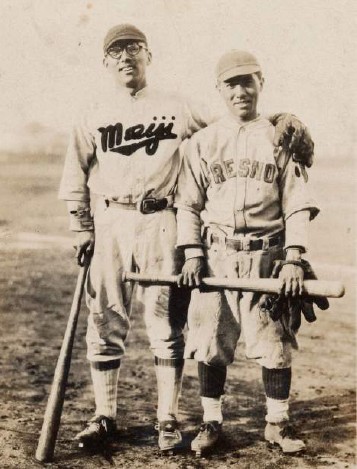
Kenichi Zenimura (right) with his cousin Tasumi Zenimura (left) in 1928.
THE 1924 TOUR
The seeds for Zenimura’s 1924 tour were planted on Independence Day in 1923 when the Fresno Athletic Club battled the Seattle Asahi for the National Nikkei Baseball Championship. The Asahi had earned the respect of the baseball world by winning the majority of their games during tours to Japan between 1915 and 1923. In a best-of-three series, the FAC defeated the Asahi to become the undisputed Nikkei baseball champions. With the victory, Fresno also won the right to tour Japan the following year.
In preparation for the tour, the FAC scheduled games against high-caliber competition, including the Pacific Coast League Salt Lake City Bees, who conducted spring training in Fresno. In a three-game series, the FAC surprised the Bees with a 6-4 victory in game one, marking the first time a Nikkei team defeated a PCL ballclub. The series also marked the presence of Frank “Lefty” O’Doul. Newly signed from San Francisco, O’Doul did not compete in the loss, but his powerful bat helped the Bees take games 2 and 3.
More important than O’Doul’s on-field performance was the historical significance of his involvement. The gregarious southpaw would later be enshrined in the Japanese Baseball Hall of Fame for his life’s work as a celebrated ambassador of US-Japan baseball relations. Most likely, this 1924 encounter marks O’Doul’s first interaction with ballplayers of Japanese ancestry.
On September 2, 1924, the FAC boarded the SS President Pierce for Japan.Six weeks later they stepped inside Koshien Stadium to play their first opponent, Daimai. The FAC recorded a shutout 5-0 victory behind the arm of Kenso “The Boy Wonder” Nushida. Fresno pitchers did not allow a run until their third game, on October 14, a 4-3 loss in a rematch with Daimai.
During their 46-day stay in Japan (October 11 to November 26), the Fresno team traveled approximately 1,300 miles (about 2,100 kilometers), covering nine cities—starting in Osaka, with stops in smaller locales between Hiroshima, Tokyo, and Yokohama. They played 27 games, finishing with a 20-7 record and an overall .741 winning percentage.
After watching the Fresno captain compete on the field, a reporter with the Japan Times wrote, “Zenimura is one of the smartest and most colorful players the writer had ever seen. He was the terror of the diamond, a man who played every position in baseball. He was tricky, shrewd and positive poison to every opponent.”
In Tokyo, Zeni penned his thoughts on the Japan tour experience in a letter to the Fresno Morning Republican, which was published on December 5. It read:
Tokyo, Japan November 16, 1924
Mr. T.P. Spink Sports Editor, The Republican.
Dear Sir: –
The Fresno team is doing a [sic] good work in Japan and so far our record stands 18 victories and 5 lost. In today’s game we played against Keio and defeated them by the score of 8-to-4. We gave the last four runs in the last of the ninth after two men gone.
In Japan it doesn’t pay to win a game in a far margin. If we do then there won’t be any crowd coming to the next game, saying that we are too strong for this Japan team and so on. We had many examples in Osaka.
Beat Diamonds
One day we played against the pro team of Osaka which is known as Diamonds and in our first game we defeated them by a score of ll-2. In this game quite a many fans [sic] came to see the outcome but on the following day with the same teams there was hardly any people in the stand[s]. For this reason, it is hard for the visiting team to play a game in Japan.
Another thing disadvantaging us is the way these Tokyo umpires calls [sic] on decisions against us. … I can’t figure the way these umpires make a bad decision when ever the play is close. We had enough of the raw decisions in Tokyo, but what can we do in Japan!!!
Meet Champions
Tomorrow we are playing against Waseda, the intercollegiate champions of Japan. We hope to beat them badly and by the time this letter reaches you, you will be able to get the result.
On the way to the States I am figuring of stopping over to Honolulu and spend my Christmas and New Year’s there. About five of the players are going to do the same and eleven of the remaining players will be in Fresno by 13th of December 1924.
As soon as the team reaches to Fresno we would like to play a three game series with the Fresno Tigers.
Yours truly,
K. ZENIMURA (Captain).
The Waseda contest mentioned in the letter resulted in a 3-2 loss for Fresno. FAC lost the game, but won the respect of the opposing manager, Chujun Tobita. He praised the visiting team’s baseball skills, saying they were “amazing” in their demonstration of technique and power.
Continue to read the full article on the SABR website
The Clyde Sukeforth Chapter (ME/NH) in conjunction with the Gardner-Waterman Chapter (VT) offers a special presentation with SABR Member Rob Fitts in a Zoom Meeting on Wednesday, November 5, 2025 at 7 PM Eastern, 4 PM Pacific. All baseball fans are welcome!
Fitts will talk about his new book and provide an introduction to Japanese baseball.
In the Japanese Ballpark: Behind the Scenes of Nippon Professional Baseball
This book takes you deep inside the heart of Japan’s national pastime—far beyond the box scores and highlight reels. To discover what truly sets Japanese baseball apart, author Robert Fitts went straight to the source: the players, managers, umpires, team owners, mascots, beer girls, and lifelong fans who live and breathe the sport. Through their personal stories and behind-the-scenes insights, you’ll get an insider’s look at how the game works, and what makes Japanese baseball unique—and so much fun. Get a front-row seat to the traditions, strategies, and spirit that define baseball in Japan. From the passion of the fans to the precision of the game, every page offers eye-opening stories and insights you won’t find anywhere else. Whether you’re a die-hard fan or just discovering the magic of the Japanese game, In the Japanese Ballpark can help you fully experience every pitch, hit, and cheer.
Robert Fitts has published eleven books and numerous articles on the history of baseball in Japan and Japanese baseball cards. He received his Ph.D. in historical archaeology from Brown University and ran excavations in New York City before turning to baseball history. He is the founder and chair of the Society of American Baseball Research’s Asian Baseball Committee and recently received the society’s Chadwick Award for lifetime contributions to baseball history. He currently is a curatorial consultant for the Yakyu-Baseball exhibit at the National Baseball Hall of Fame in Cooperstown.
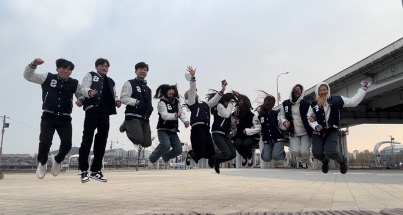
It’s been over 40 years since professional baseball took root in Korea. It’s now gone beyond being just a sport and has deeply permeated Korean daily life and culture. Traces of baseball can be found not only in the cheers and songs at the stadium but also in everyday scenes outside the ballpark. One such example is the sight of students on university campuses wearing matching jackets as a group. This jacket, called the “gwajam,” actually originated from the “baseball jacket,” and today it has become the uniform of youth. More than just a fashion item, this jacket has found its place in Korean society. But how did it get there?
A Tradition Born with the Harvard Baseball Team
The roots of the baseball jacket trace back to 19th-century American college baseball traditions. At the time, Harvard’s baseball team awarded its starting players sweaters embroidered with the school’s initials. These were known as letterman sweaters. They weren’t just for warmth, they were symbols of honor, proof of one’s baseball skill and achievement.
Over time, the tradition evolved into a more practical jacket: wool for the body, providing warmth, and leather for the sleeves, offering durability against friction and wind. This combination was perfect for athletes braving cold weather on the field. At the same time, the two-tone design of wool and leather created a bold look that expressed school colors and identity. With its blend of function and symbolism, the “varsity jacket” became an iconic symbol of American college sports.
Early Harvard baseball team in the 19th century
The Birth of the “Baseball Jacket” in Korea
This jacket entered Korea in the 1980s, coinciding with the launch of professional baseball. The two-tone design of wool body and leather sleeves resembled the thick warm-up jackets worn by players in the dugouts. In fact, players from the MBC Blue Dragons, one of the founding teams, were often seen wearing such jackets with their blue uniforms. This became a familiar sight to fans.
When combined with the popular image from American dramas and movies, “baseball teams wear varsity jackets,” Koreans naturally began calling this unfamiliar jacket yagujamba (baseball jacket). Unlike its difficult English name, the simple and catchy Korean nickname stuck instantly with the public.
By the late 1990s, university sports teams and clubs began adopting baseball jackets as group uniforms. It’s said that Seoul National University’s rugby team was the first to make them, which is often cited as the origin of the Korean-style gwajam (short for “gwahak jamba,” or “department jacket”).The trend soon spread to academic departments, and the naming system took hold: school/department name on the front, and name/student ID/graduation year on the back. So widespread was the practice that almost every Korean university student came to own at least one. More than showing belonging, gwajam became a symbol of youth itself, carrying memories of that time.
Over time, the gwajam branched out into more variations beyond the original baseball jacket: long padded coats for winter, hoodies for mobility, and custom jackets for individuality. Though the forms changed, the core remained the same: wearing the same jacket together to affirm belonging and share memories. Just as baseball teams express identity through uniforms, the gwajam became another kind of uniform showcasing the collective bonds of students.
Another Legacy Left by Baseball
In the U.S., the varsity jacket symbolized the achievements of outstanding athletes. In Korea, however, the gwajam was reborn as an expression of group solidarity. Though its direct link to baseball seems small, the survival of the name “baseball jacket” owes much to the cultural symbolism of professional baseball in Korea.
Baseball did not end at the stadium. Its name carried over into campus life, becoming part of the landscape of youth. Years later, when one pulls out a gwajam from the closet and wears it again, the cheers, laughter, and time spent with friends come rushing back.The name borrowed from baseball isn’t just a label, it’s proof that Korean baseball culture has deeply embedded itself beyond the game, into everyday life and memories of youth. That’s why even today, the baseball jacket remains the uniform of youth, a testament to the enduring power of baseball culture.
In the spring of 1942, 15-year-old Momo Nagano needed a way to fill her time.
She was imprisoned at the Manzanar Relocation Center along with approximately 10,000 other people of Japanese ancestry. When she’d arrived with her mother and two brothers, she’d been horrified.
The detention facility was located in the middle of the desert, about 225 miles northeast of Los Angeles. As I describe in my book “When Can We Go Back to America? Voices of Japanese American Incarceration during World War II,” barbed wire surrounded the perimeter and armed soldiers peered down from guard towers. The toilets and showers lacked partitions, and Nagano was forced to stand in long lines for hours in mess halls that served canned food. Her bed was a metal cot. She was directed to stuff straw into a bag for a makeshift mattress. She didn’t know whether she and her family would ever be able to return to their Los Angeles home.
One day, the teenager decided to pick up a glove and play softball. Her son, Dan Kwong, told me in an interview that Nagano ended up playing catcher for The Gremlins, one of the camp’s many women’s softball teams.
“In one game, a batter connected with the ball and then threw the bat, clocking my mom in the nose, breaking it,” he said. “But despite her injury, she still enjoyed playing, even though she didn’t think her team was very good.”
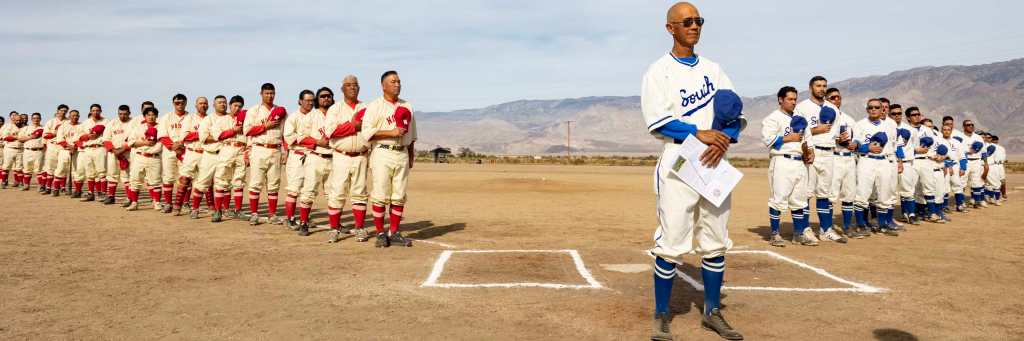
Eighty years later, the descendants of prisoners – such as Nagano’s son, Kwong – are playing baseball again in Manzanar. Thanks to an effort spearheaded by Kwong, a baseball field on the site has been restored as a way to both celebrate the resiliency of so many prisoners and memorialize this dark period in U.S. history.
Every Tuesday morning we will post an article from SABR’s award-winning books Nichibei Yakyu: Volumes I and II. Each will present a different chapter in the long history of US-Japan baseball relations. Today John Harney focuses on the 1920 major league tour of Japan..
It began with big dreams and ended in chaos and farce. The 1920 tour was a lot of things all at once: a high profile, all-star tour that served as a diplomatic mission to engender positive relationships between two rising global powers, the United States and the Empire of Japan; a largely successful business enterprise planned and carried out by experienced entrepreneurs; and a debacle that saw a baseball tour with high hopes collapse in acrimony and accusations of skullduggery. Certainly, it was not boring.
The first mentions of the tour in the American press started to show up in the late spring and early summer of 1920. California-based sports promoter Gene Doyle was promising big things. Specifically, Doyle sought to take an all-star team to Japan to play in exhibition games against local teams. Boasting the cream of the American professional ranks, the tour would feature teams representing each of the major leagues. Doyle had successfully persuaded Buck Weaver, star third baseman of an impressive Chicago White Sox team that had rather surprisingly lost to the Cincinnati Reds in the World Series the season before, to lead the group to Japan.
It was not solely an American enterprise. Doyle was in partnership with two Japanese businessmen, Yumindo Kushibiki and Tommy Tominaga. Kushibiki was by this time a well-known figure in the United States, known as the “Japanese Exhibition King” for his work in introducing the American public to Japanese cultural artifacts at the Columbian Exposition at Chicago in 1893 and, closer in proximity to the 1920 tour, the Panama-Pacific International Exposition of 1915 in San Francisco. Tominaga was more of an obscure figure, an “Americanized Japanese” who had attended high school in Los Angeles but graduated from Waseda University, a bright star in both Japan’s academic and baseball worlds. In truth, he was a fairly minor player who succeeded in establishing himself as a go-between for Kushibiki and Doyle, but his involvement helped give credence to the feasibility of a tour to Japan and lent the endeavor an air of cultural exchange as an act of American generosity.
The advantages of the tour seemed clear enough, at least to Doyle, who utilized a network of contacts in the California press to hype up interest. The visit of John McGraw and Charles Comiskey’s World Tour to Japan in 1913 gave sufficient precedent, and Doyle and his fellow organizers sang all the right notes. This tour would deepen friendship between the two countries, and also allow the Americans to assist their fellow baseball people in Japan to kick-start professional baseball in that country. The commercial advantages also appeared to be evident and the American papers, long since used to the reality of barnstorming and offseason financial opportunities for baseball players, naturally went along in those assumptions.
From the start, then, Doyle’s tour—and in the months to come and in the years since it would come to be associated primarily with its central organizer and promoter more than any of the players—was a hybrid of naked commercial interest and a somewhat ambivalent commitment to deepening cultural ties across the Pacific and facilitating a natural leadership position for the United States in the growth of the game across the world. Doyle had big plans; but it wasn’t to be.
For one thing, Weaver did not join them. Embroiled in the growing Black Sox scandal of the fall of 1920, he dropped out of the tour. He had been the big draw, the biggest name attached to the tour on the day of its announcement. Doyle had intended for Weaver to serve as captain of the AL team and de facto head of the playing squad as a whole. Initially, this had seemingly been successful: By July, Doyle was able to claim that Weaver had helped in signing a host of major leaguers, including St. Louis Browns first baseman George Sisler, Detroit Tigers catcher Eddie Ainsmith, and Weaver’s White Sox teammate Happy Felsch. Tominaga and others talked a big game indeed, happily comparing the coming tour to the around-the-world Giants-White Sox Tour of 1913. It was not to be. Ainsmith, however, stuck with Doyle, and along with Sam Bohne, a Seattle Indian about to begin a career with the Cincinnati Reds in 1921, formed the core leadership of the team. The other big names evaporated.
The rest of the purportedly all-star group was made up of players from the Pacific Coast League, many of whom had a veneer of legitimacy by having had a cup of coffee in the majors. Outfielder Herbert Harrison Hunter had played a handful of games over the years with the New York Giants, the Chicago Cubs, and most recently the Boston Red Sox. Jack Sheehan had appeared briefly for the Brooklyn Robins. One player, catcher Everett Gomes, was so unknown, even to the press on the West Coast, that in reports on the tour they would refer to him simply as “Catcher Gomes.” Still Doyle persevered. Early plans of a tour around California were scrapped, and they moved to head directly to East Asia with a brief stopover in Honolulu.
The Hawaiian reception to the tour was enthusiastic. The local lodge of Elks served as hosts and sponsors of the team, and, expecting a dawn arrival, planned to treat the visitors to a sightseeing trip by automobile around Honolulu, followed by a formal lunch and a game later in the afternoon. The Hawaiian hosts got their game—Ainsmith led the AL team to victory over the NL players—but in the end the tourists stopped by the islands for only a few hours. The players returned to the S.S. Korea shortly after and were soon on their way. Doyle was on a high. “So far the trip has been a success,” he wrote to the Los Angeles Express’s Harry Grayson, painting a pretty picture. The players were all in good spirits: Ainsmith was living up to his role of tour captain well, “[f]ull of pepper and keeps the [players] hustling.” Bohne was growing a mustache, and another PCL veteran, Portland Beaver Sammy Ross, was doing a bang-up job running the Filipino band on the entertainment committee. Doyle wanted to be very clear: All was well. So united were the boys, in fact, that to a man they were livid with Minneapolis Millers infielder Carl Sawyer, the latest player to drop out. “[W]hat the gang thinks of him isn’t fit for print,” Doyle told Grayson.
This merry band arrived in Japan ready for anything and everything. The Japanese baseball world gave it to them. The visit, coming in late November and December in the offseason between fall and spring collegiate seasons, was primed for the attention of an enthusiastic and knowledgeable baseball-loving public. Baseball in Japan by 1920 was continuing to grow, with increasingly sophisticated youth and collegiate baseball infrastructures but a still-nascent professional scene. Excitement for the visit of the Americans was high. The Osaka Mainichi Shimbun reported on the anticipated arrival of the team on November 22, scheduled at 3:30 P.M. on the S.S. Korea. The article showcased large photographic inserts featuring a number of the players, including the aforementioned Carl Sawyer. News of Sawyer’s “treachery” had not yet reached the Japanese editors. The Americans themselves were ready for Japan, the paper said that they had been “swinging bats and leaping about the deck” of the ship in anticipation of landfall near Tokyo.
The opening game in Japan, a competition between teams representing the AL and the NL to fit the tour’s billing as an all-star tour from the major leagues, took place on November 25. The occasion had actually been delayed two days by rain, despite Doyle and Kushibiki’s original intention for the players to get to work almost as soon as they made landing in Japan, perhaps taking to the field on the day of arrival. Nevertheless, the opening exhibition was a success. The NL came out 2-1 winners, but Ainsmith was heralded as the big star, blasting the only home run of the game.
The Americans played their first game against Japanese collegiate opposition the next day. Waseda University was home to arguably the most prestigious baseball program in Japan. Waseda had played the first intercollegiate varsity baseball game in the country, a 1903 contest vs. Keio University. By 1920, Waseda was one of six major college teams. In 1924, these teams would formally come together to compete annually in the “Big Six League”; but already the universities played each other in a de facto annual championship with fall and spring seasons. The All-American team faced four collegiate teams in total: Waseda, Keio, Meiji University, and Hosei University. This represented the top tier of Japanese baseball talent, the best-drilled, and—despite their youth—the most competitively seasoned.
Continue to read the full article on the SABR website
Every Tuesday morning we will post an article from SABR’s award-winning books Nichibei Yakyu: Volumes I and II. Each will present a different chapter in the long history of US-Japan baseball relations. In this article Robert Fitts discusses the first Japanese American teams to visit Japan.
INTRODUCTION
Between 1890 and 1910, over 100,000 Japanese immigrated to the West Coast of the United States. Many settled in the urban centers of San Francisco, Los Angeles, and Seattle. Within a few years, each of these immigrant communities had thriving baseball clubs. The first known Japanese American team was the Fuji Athletic Club, founded in San Francisco around 1903. A second Bay Area team, the Kanagawa Doshi Club, was created the following year. That same year, newsmen at the Rafu Shimpo organized Los Angeles’s first Issei (Japanese immigrant) team. Other clubs followed in the wake of Waseda University’s 1905 baseball tour of the West Coast. Many players learned the game while still in Japan at their high schools or colleges. Others picked up the sport in the United States. The first Japanese professional club was created the following year by Guy Green of Lincoln, Nebraska. His Green’s Japanese Base Ball Team, consisting of Japanese immigrants from Los Angeles, barnstormed throughout the Midwest in the spring and summer of 1906.
Seattle’s first Japanese American club, called the Nippon, was also organized in 1906. Shigeru Ozawa, one of the founding players, recalled that the team was not very good at first and was able to play only the second-tier White amateur nines. By 1907 the team had a large local following. In its first appearance in the city’s mainstream newspapers, the Seattle Star noted that “before one of the largest crowds seen at Woodlands park the D.S. Johnstons defeated the Nippons, the fast local Jap team, by a score of 11 to 5.” In May 1908, before a game against the crew of the USS Milwaukee,the Seattle Daily Times reported that the Nippon “have picked up the fine points of the great national game rapidly from playing the amateur teams around here every Sunday.”
Two months later, the Daily Times featured the team when it took on the all-female Merry Widows. Mistakenly referring to the Nippons as “the only Japanese baseball club in America,” the newspaper reported, “when these sons of Nippon went up against the daughters of Columbia, viz., the Merry Widow Baseball Club, it is a safe assumption that the game played at Athletic Park yesterday afternoon was the most unique affair in the annals of the national game.” Over a thousand fans, including many Japanese, watched the Nippons win, 14-8.
Soon after the game with the Merry Widows, second baseman Tokichi “Frank” Fukuda and several other players left the Nippon and created a team called the Mikado. The Mikado soon rivaled the Nippons as the city’s top Japanese team, with the Seattle Star calling them “one of the fastest amateur teams in the city.” In both 1910 and 1911, the Mikado topped the Nippon and Tacoma’s Columbians to win the Northwest Coast’s Nippon Baseball Championship.
As Fukuda’s love for baseball grew, he realized the game’s importance for Seattle’s Japanese. The games brought the immigrants together physically and provided a shared interest to help strengthen community ties. It also acted as a bridge between the city’s Japanese and non-Japanese population, showing a common bond that he hoped would undermine the anti-Japanese bigotry in the city.
In 1909 Fukuda created a youth baseball team called the Cherry—the West Coast’s first Nisei (Japanese born outside of Japan) squad. Under Fukuda’s guidance, the club was more than just a baseball team. Katsuji Nakamura, one of the early members, explained in 1918, “The purpose of this club was to contact American people and understand each other through various activities. We think it is indispensable for us. Because there are still a lot of Japanese people who cannot understand English in spite of the fact that they live in an English-speaking country. That often causes various troubles between Japanese and Americans because of simple misunderstandings. To solve that issue, it has become necessary that we, American-born Japanese who were educated in English, have to lead Japanese people in the right direction in the future. We have been working the last ten years, according to this doctrine.”
As the boys matured, the team became stronger on the diamond and in 1912 the top players joined with Fukuda and his Mikado teammates Katsuji Nakamura, Shuji “John” Ikeda, and Yoshiaki Marumo to form a new team known as the Asahi. Like the Cherry, the Asahi was also a social club designed to create the future leaders of Seattle’s Japanese community, and forge ties with non-Japanese through various activities, including baseball. Once again the new club soon rivaled the Nippon as Seattle’s top Japanese American team.
THE NIPPON TOUR
During the winter of 1913-14, Mitomi “Frank” Miyasaka, the captain of the Nippon, announced that he was going to take his team to Japan, thereby becoming the first Japanese American ballclub to tour their homeland. To build the best possible squad, Miyasaka recruited some of the West Coast’s top Issei players. From San Francisco, he recruited second baseman Masashi “Taki” Takimoto. From Los Angeles, Miyasaka brought over 30-year-old Kiichi “Onitei” Suzuki. Suzuki had played for Waseda University’s reserve team before immigrating to California in 1906. A year later, he joined Los Angeles’s Japanese American team, the Nanka. He also founded the Hollywood Sakura in 1908. In 1911 Suzuki joined the professional Japanese Base Ball Association and spent the season barnstorming across the Midwest. Miyasaka’s big coup, however, was Suzuki’s barnstorming teammate Ken Kitsuse. Recognized as the best Issei ballplayer on the West Coast, in 1906 Kitsuse had played shortstop for Guy Green’s Japanese Base Ball Team, the first professional Japanese club on either side of the Pacific. He was the star of the Nanka before playing shortstop for the Japanese Base Ball Association barnstorming team in 1911. Throughout his career, Kitsuse drew accolades for his slick fielding, blinding speed, and heady play.
To train the Nippons in the finer points of the game, Miyasaka hired 38-year-old George Engel (a.k.a. Engle) as a manager-coach. Although Engel had never made the majors, he had spent 14 seasons in the minor leagues, mostly in the Western and Northwest Leagues, as a pitcher and utility player. Miyasaka also created a challenging schedule to ready his team for the tour. They began their season with games against the area’s two professional teams from the Northwest League. On Sunday, March 22, they lost, 5-1, to the Tacoma Tigers, led by player-manager and future Hall of Famer Joe “Iron Man” McGinnity. The following Sunday the Seattle Giants, which boasted seven past or future major leaguers on the roster, beat them 5-1. Despite the one-sided loss, the Seattle Daily Times noted, “the Nippons … walked off Dugdale Field yesterday afternoon feeling well satisfied with themselves for they had tackled a professional team and had made a run.”
In April 1914, Keio University returned for its second tour of North America. After dropping two games in Vancouver, British Columbia and a third to the University of Washington, Keio met the Nippons on April 9 at Dugdale Park in what the Seattle Daily Times called “the world’s series for the baseball championship of Japan.” On the mound for Keio was the great Kazuma Sugase, the half-German “Christy Mathewson of Japan,” who had starred during the school’s 1911 tour. The team also included future Japanese Hall of Famers Daisuke Miyake, who would manage the All-Nippon team against Babe Ruth’s All-Americans in 1934, and Hisashi Koshimoto, a Hawaiian-born Nisei who would later manage Keio.
Nippons manager George Engel was in a quandary. His usual ace Sadaye Takano was not available and as Keio would host his team during its coming tour of Japan, he needed the Nippons to prove they could challenge the top Japanese college squad. Engel reached out to William “Chief’ Cadreau, a Native American who had pitched for Spokane and Vancouver in the Northwestern League, one game for the 1910 Chicago White Sox, and would later pitch a season for the African American Chicago Union Giants. Pretending that he was a Japanese named Kato, Cadreau started the game. According to the Seattle Star, “Engel was very careful to let the Keio boys know that Kato, his pitcher, was deaf and dumb. But later in the game Kato became enthused, as ball players will, and the jig was up when he began to root in good English.” Nonetheless, Cadreau handled Keio relatively easily, striking out 13 en route to a 6-3 victory.
Throughout the spring and summer, the Nippons continued to face the area’s top teams, including the African American Keystone Giants, to prepare for the trip to Japan. Yet in their minds, the most important matchup was the three-game series against the Asahi for the Japanese championship. The Nippons took the first game, 4-2, on July 12 at Dugdale Park but there is no evidence that they finished the series. Not to be outdone by their rivals, the Asahi also announced that they would tour Japan later that year. Sponsored by the Nichi-nichi and Mainichi newspapers, the Asahi would begin their trip about a month after the Nippons left for Japan.
The Nippon left Seattle aboard the Shidzuoka Maru on August 25. Their departure went unreported by the city’s newspapers as international news took precedence. Germany had invaded Belgium on August 4, opening the Western Front theater of World War I. Throughout the month, Belgian, French, and British troops battled the advancing Germans. Just days before the ballclub left for Japan, the armies clashed at Charleroi, Mons, and Namur with tens of thousands of casualties. On August 23, Japan declared war on Germany and two days later declared war on Austria.
After two weeks at sea, the Nippon arrived at Yokohama on September 10. The squad contained 11 players: George Engel, Frank Miyasaka, Yukichi Annoki, Kyuye Kamijyo, Masataro Kimura, Ken Kitsuse, Mitsugi Koyama, Yohizo Shimada, Kiichi Suzuki, Sadaye Takano, and Masashi Takimoto. Accompanying the ballplayers was the team’s cheering group, consisting of 21 members and led by Yasukazu Kato. The group planned to attend the games to cheer on the Nippon and spend the rest of their time sightseeing.
As the Shidzuoka Maru docked, a group of reporters, Ryozo Hiranuma of Keio University, Tajima of Meiji University, and a few university players came on board to welcome the visiting team. The group then took a train to Shinbashi Station in Tokyo, where they were met by the Keio University ballplayers at 2:33 P.M. The Nippon checked in at the Kasuga Ryokan in Kayabacho while the large cheering group, which needed two inns to accommodate them, settled down at the Taisei-ya and Sanuki-ya.
Only two hours later, the Nippon arrived at Hibiya Park for practice. Not surprisingly, after the voyage they were not in top form. The Tokyo Asahi noted, “Even though the Seattle team is composed of Japanese, their ball-handling skills are as good as American players, and … their agile movements are very encouraging. … They hit the ball with a very free form, but yesterday, they did not place their hits very accurately, most likely due to fatigue. … The Seattle team did not have a full-fledged defensive practice with each player in position, so we did not know how skilled they were in defensive coordination, but we heard that the individual skills of each player were as good as those of Waseda and Keio. In short, the Seattle team has beaten Keio University before, so even though they are Japanese, they should not be underestimated. On top of that, they have good pitching, so games against Waseda University and Keio University are expected to arouse more than a few people’s interest, just like the games against foreign teams in the past.”
The Nippon would stay in Japan for almost four months, but the baseball tour itself consisted of just eight games—all played during September against Waseda and Keio Universities. The players spent the rest of the time traveling through their homeland and visiting family and friends.
Continue to read the full article on the SABR website
Every Tuesday morning we will post an article from SABR’s award-winning books Nichibei Yakyu: Volumes I and II. Each will present a different chapter in the long history of US-Japan baseball relations. Here Yusuke Suzumura discusses Stanford University’s 1913 tour of Japan.
The Stanford University Baseball Team is closely connected to the development of baseball in Japan. This stems from 1904-05, when Waseda University was planning an expedition to the United States and negotiated with different universities there, and Stanford University was the first to respond. One of the reasons Stanford accepted Waseda’s request was that Zentaro Morikubo was a student at Stanford and facilitated negotiations between the two universities. Zentaro was the son of Sakuzo Morikubo, a member of the House of Representatives in Japan’s Imperial Diet; Zentaro later became a member of the Japan Amateur Athletic Association and was appointed a member of the Japan Baseball Umpires’ Association (an organization founded in 1916 with the intent of spearheading the establishment of baseball rules in Japan). As such, Zentaro Morikubo was a prominent figure in the baseball world at the time.
The Waseda team traveled to the United States in 1905, played against the Stanford Cardinals twice, and lost both games. They lost because the Waseda team’s play did not extend much beyond the rudimentary stages of throwing and hitting the ball, whereas the Stanford team approached the sport in an organized and systematic manner.
On March 31,1913, Keio University announced an invitation to the Stanford University baseball team to visit Japan later that spring. At the time, St. Mary’s College and Santa Clara University were the two best college baseball teams on the West Coast, and Stanford was second to these universities, alongside the University of California and the University of Washington. Stanford had won games against all of these universities before they visited Japan, and therefore Keio was “expected to probably lose.”
An 11-man contingent boarded the passenger ship Nippon Maru and departed San Francisco on May 10, 1913. Graduate student R.W. Wilcox was the manager. The players were Ray Maple, pitcher; Al Gragg, pitcher; Leslie Dent, catcher; Tom Workman, first base; Louis Cass, second base; Pete McCloskey, third base; Zeb Terry, shortstop; Arthur Halm, left field; Walter Argabrite, center field; and Heinie Beeger, right field.
The trip was scheduled for 10 weeks, longer than any previous trip by a Stanford team. They planned to play at least 12 games, starting with Keio in Japan, with a two-week visit to Hawaii on the way home. Keio provided 7,000 yen ($3,500) to cover the trip expenses. In 1913, 7,000 yen was equivalent to approximately 28 million yen (approximately $240,000) in 2022. In addition, the Stanford baseball team raised $200 from a match against the Santa Cruz Colored Giants; the university donated $250; and the Quadrangle Club donated $50, making for a total of $500. With the funds provided from the Japanese side and the donations from Stanford, the large amount of money they were able to raise suggests high expectations for the trip in both countries.
The Stanford group arrived at Yokohama around 8 A.M. on May 27. The Japan Times reported, “Immediately after the health inspection, the six-foot huskies were swarmed by a gang of newspaper reporters, and the Keio ball players and students who went out in a launch to meet them. ‘Banzai’ and college cheers were exchanged on the deck.” The team held a press conference at the request of the Japanese press, in which they described how they spent their time training during the 17-day voyage on the Nippon Maru. “Thankfully, the seas were calm, so we were able to practice every day. We still ended up dropping 15 of the four-dozen balls into the sea. However, perhaps because of the daily practice, everyone gained weight, with some of us gaining as much as 12 kg [about 26 pounds].”
Obviously, the team had indulged in a comfortable lifestyle during the voyage. However, when the Stanford players arrived at Yokohama, despite their massive weight gain, their physiques drew little attention from the Japanese, who remarked only that their physiques were “imposing.”
By way of example, the Yomiuri Shimbun favorably introduced the players in the following terms: “They are all elegant young gentlemen, dressed in winter suits and caps. Their physiques seem particularly imposing when one looks at the All-Philippines Baseball Team. Based on this alone, they would seem to have the power to overwhelm the Japanese baseball world.”
The All-Philippines Baseball Team had come to Japan on May 10, and had planned to stay until June 1 and play a total of 10 games with Waseda, Keio, Meiji University, and Yokohama Commercial School. Some of the games were canceled due to rain, and the Philippines team ended up playing eight games, of which it won only one, against Waseda, losing the other seven.
The All-Philippines Baseball Team was said to have “selected the very best of Philippine baseball,” with a total of 16 members, of which 13 were players, and one was a substitute. The players were generally of medium build and height, and while three had excellent physiques, another three were of smaller stature. While the results of the games are not necessarily always decided on the basis of physique, when one considers that the Philippines team had won only one out of the eight games, it is perhaps unsurprising that people thought that physique played a part in the team’s poor performance. The comment that “[t]heir physiques seem particularly imposing when one looks at the All-Philippines Baseball Team” can be taken not only as a comparison of the physiques of the All-Philippines players and the Stanford University players but also as an indication that there were high expectations for the latter based on the superiority of their physiques.
It should be noted that an article in the Tokyo Asahi Shimbun reported that “the players bore no signs of fatigue and were very comfortable during their 17-day voyage, with each gaining about 750 g [about 1.5 pounds].” Compared with the Yomiuri Shimbun article, none of the players seems to have gained a large amount of weight. While it is difficult to judge which description is accurate, we can nevertheless deduce that the players did indeed gain weight during the voyage.
The Stanford team was evaluated favorably by the Japanese during their time in Japan, as illustrated by the Tokyo Asahi Shimbun: “They are all the very best of young gentlemen morally influenced by Dr. Jordan, who resembled a messenger of the god of peace, and they seem to be very pleasant and friendly upon first meeting in the American style.”
“Dr. Jordan” was David Starr Jordan, who became the first president of Stanford University in 1891 and also became the first chancellor of the university in June 1913. Jordan visited Japan frequently from 1900 to investigate his academic specialty of ichthyology, the study of fish. Moreover, Jordan was a researcher, university administrator, anti-imperialist, and antiwar activist. Rather than his role as an ichthyologist and educator, the assessment of Jordan in Japan related to his opposition to the anti-Japanese-immigration movement in the United States, which was the most significant concern between the two countries at the time; he was on the side of the Japanese, arguing that “no parliament should pass the Japanese Exclusion Act.” In addition, he was described as “a great player for peace” who “loved peace and was convinced that peace was a global truth.”
Thus, the baseball players were depicted as gentlemen inspired by Jordan precisely because they were at Stanford University. In addition, the more distinctive players in the group were thus described:
Pigeon-toed and with a liking for beans, Cass is the odd man out in the group—so pigeon-toed in fact that his fellows tease him every which way. He made everyone laugh by saying that he was going to advertise himself in the papers as a pigeon-toed rickshaw man when he arrived in Tokyo. Argabrite’s family runs a bean shop, and he also has a great liking for beans, hence the nickname “Bean.” Workman is extremely timid and never left his lifeboat during the voyage.
While matters such as physique and family business have nothing to do with baseball itself, these topics were a good source of information to better know the players. The fact that such articles seeking to convey the personalities of the players were published, even if they were primarily intended to amuse the readers and satisfy their curiosity, demonstrates that people had a high level of interest in the Stanford University baseball team.
Having thus attracted people’s attention, how did the Stanford players adjust once they were in Japan? They started practicing at 1 P.M. on May 28 at Keio University’s Tsunamachi Grounds, with the practice lasting for 1 hour and 30 minutes. Second baseman Cass hit a succession of home runs to left field and left fielder Halm hit “a fire-breathing home run like a powerful cannon” with a long shot to right field. In defensive practice, the players threw the ball with machine-like accuracy, catching even difficult throws. Although they had not yet shown their full potential, the Stanford players were praised as “the epitome of the American national sport.”
The players’ track records were good as well, and as a team they were the strongest since the Stanford University baseball team was founded. They were said to be among the best teams on the West Coast, having won four times and lost once against Santa Clara University, which had previously defeated the Waseda University baseball club, 10-2. The cleanup hitter was Louis Cass, and the ace pitcher was Ray Maple, a side- arm thrower. Maple, first baseman Tom Workman, and shortstop Zeb Terry had such a high level of skill that they had been invited to join professional clubs. Maple turned down an offer to join the Philadelphia Athletics, Walkman received an offer from the Boston Red Sox, and Terry was invited to join the Portland Beavers of the Pacific Coast League and later had a seven-year major league career.
Given this context, it was thought that Keio, Meiji, and the Tomon Club, which consisted of graduates of the Waseda University baseball club, would not be able to compete with the Stanford team. In fact, the Stanford team did not perform as well as its track record would have suggested.
Continue to read the full article on the SABR website
Every Tuesday morning we will post an article from SABR’s award-winning books Nichibei Yakyu: Volumes I and II. Each will present a different chapter in the long history of US-Japan baseball relations. Today Joe Niese focuses on the Wisconsin Badger’s 1909 tour of Japan.
In 1905, President Theodore Roosevelt sent his eldest daughter, Alice, and Secretary of War William Howard Taft on a tour of the Far East, making stops in China, Japan, Korea, and the Philippines. The trip was part of Roosevelt’s plan to act as mediator in the Russo- Japanese War, in the process solidifying the United States’ place in the hierarchy of trading in the Orient. While the visit was successful on both accounts, by the end of the decade the relationship between Japan and the United States was growing contentious over actions being taken in South Manchuria (China). In essence, the United States was on the brink of being blocked out of Oriental trading by Japan’s South Manchurian train line. Taft, who became president in 1909, saw an opportunity to work toward an agreement of some kind, where both countries could continue to utilize the area. Hoping that a resolution could be made, Taft saw a prospect for bonding in one of the two nations’ few common grounds—the baseball diamond. The University of Wisconsin-Madison had a series of games planned for the fall in Japan, and Taft wanted to capitalize on the game’s international appeal.
Baseball was one of the University of Wisconsin’s first athletic teams. The first recorded game was played on April 30,1870, when the university’s team, the Mendotas, thumped the Capital City Club, 53-18. In 1877 a baseball association was formed. By the first decade of the 1900s, the school’s baseball program had become a victim of the game’s nationwide success. Seemingly every club and fraternity on campus was fielding a team. In January 1909, when financial constraints arose, university officials proposed that the intercollegiate team be dropped in favor of skating and intramural baseball. Ultimately, the plan never came to fruition, but the baseball team, under coach Tom Barry, did little to prove its worth, ending with a 4-8 record and a fifth-place finish in the Big Ten Conference.
During the tepid 1909 season, Genkwan Shibata, a native of Toyama, Japan, and an honor student in the university’s commerce program, had been negotiating a series of games between the school team and ballclubs in Japan. “Shibby” worked with Professor Masao Matsuoka of Tokyo’s Keio University (a 1907 alumnus of Wisconsin) to bring the plan to fruition. Just before commencement, it was announced that the university would send a baseball team to Japan in the fall for a series of games. To offset some of the cost, Keio helped sponsor the trip, guaranteeing up to $4,000 toward Wisconsin’s finances. This was the second time in as many years that an American university had traveled to Japan to play an exhibition series. The previous fall, Waseda University sponsored a trip for the University of Washington.
Due to Barry’s commitments as the head football coach, a replacement baseball coach was sought out. The university didn’t have to look far, turning to part-time political science faculty member Charles McCarthy. The timing couldn’t have been any better for McCarthy, who had recently suffered a self-described “nervous breakdown.” A renaissance man, he had been steeped in work for the past decade. After obtaining his doctorate in American history from Wisconsin-Madison in 1901, McCarthy helped set up the Wisconsin Legislative Library. His knowledge of economics made him a frequent sounding board for President Roosevelt. He remained at the university as a part-time political science lecturer and assistant football coach. He was also heavily involved in the state’s progressive movement and the political movement’s quintessential work, the “Wisconsin Idea.”
As much as McCarthy was involved in politics, he was an athlete at heart. Despite his slight frame, McCarthy had been an All-American fullback and standout punter at Brown University. While attending law school at the University of Georgia, he took over the football coaching duties from Glenn Scobey “Pop” Warner. He coached for two years (1897-98), leading the team to a 6-3 record. When he came to Wisconsin as a doctoral student, he immediately immersed himself in the athletic program, focusing on football. In the years leading up to the trip to Japan (1907-09), he “played an extremely important part in the athletic situation” at the university.
In addition to McCarthy acting as coach and university representative, Shibata was named business manager and interpreter. Ned Jones was the press correspondent. Everyone on the Badgers’ 13-man roster was a Wisconsinite: catchers Elmer Barlow and Arthur Kleinpell; pitchers Douglas Knight and Charles Nash; first baseman Mike Timbers; second basemen John Messmer and Kenneth Fellows; third baseman Arthur Pergande; shortstops J. Allen Simpson and Oswald Lupinski; and outfielders David Flanagan, Harlan Rogers, and R. Waldo Mucklestone.
The Badgers didn’t have any future major leaguers, but they were a talented group. Knight pitched for former big leaguer Emerson “Pink” Hawley’s Oshkosh Indians of the Wisconsin-Illinois League while waiting for the trip. Barlow and Messmer attracted interest from professional ball teams. Messmer, the team’s best all-around athlete, was the university’s first nine-letter winner, collecting three each in football, baseball, and track. He also captained the swim team, dabbled in water polo, and was a “prime candidate for the crew team,” perhaps the school’s most popular and competitive athletic team. Rogers was a three-sport star (football, basketball, and baseball).
In July, University president Charles R. Van Hise received a letter from President Taft, an ardent baseball fan, for McCarthy to pass along to Thomas J. O’Brien, the ambassador to Japan. It read:
My dear Ambassador: I am advised that the faculty of the University of Wisconsin has accepted the invitation of the Keio University of Japan to play a series of ten games of baseball with the Japanese university in the month of September.
I am glad such a trip is to be undertaken, as it can not but be of advantage to the universities in the encouragement of manly sports and athletics, and will lead to a better understanding between the universities of the two countries.
I shall greatly appreciate any courtesies of consideration within your power which you may be able to extend to the team while in Japan which may add to the usefulness and pleasure of their visit there.
Continue to read the full article on the SABR website
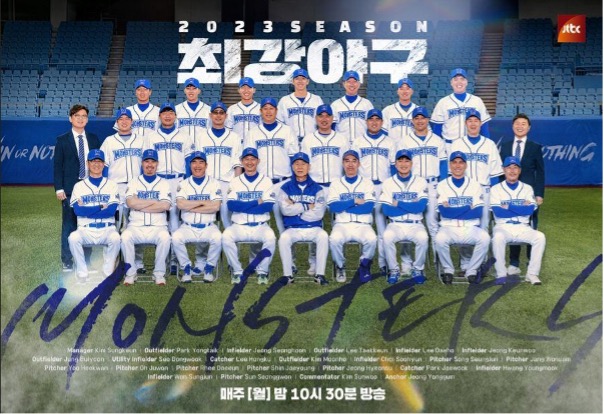
The KBO League has ten professional teams, but every fan recognizes an unofficial 11th team: the Strongest Monsters (now the Blazing Fighters). The Monsters first appeared on JTBC’s variety show Strongest Baseball (known to Americans as A Clean Sweep, and currently airing on Netflix). The premise was simple: retired players who had once excelled in the KBO form a team and compete against high school, university, and minor league teams. If they fail to maintain a winning percentage above .700 for the season, the program ends. The logline was straightforward, but the results were surprising.
Strongest Baseball Shakes Up the Game in Korea
TV shows where retired players form a team and play baseball have existed before, with Back to the Ground on MBN as a prime example. But those programs stopped at simply evoking nostalgia for legendary players. Strongest Baseball went a step further, setting a .700 winning-percentage target and giving viewers a clear reason to cheer for the team as if it were a real professional club.
Strongest Monsters Team Roster, 2023 Season
Strongest Baseball rewrote the playbook for Korean baseball entertainment. On game days, Jamsil Baseball Stadium – the largest in Korea, with over 20,000 seats – was sold out. Like a pro team, the Monsters had their own fight songs and sold jerseys.
Above all, the true value of Strongest Baseball lies in how it sparked the popularity of the KBO League. By adopting a variety show format that anyone could enjoy without pressure, it allowed viewers to naturally learn the rules of baseball. As a result, it broke down one of professional baseball’s biggest entry barriers: its complicated rules. The Strongest Monsters also faced high school teams, introducing promising young players to the audience. Fans who had supported these prospects continued to follow them into the KBO once they were drafted. From 2022 to 2024, the years during which Strongest Baseball aired, KBO League’s annual attendance rose from 6.07 million to 8.10 million to 10.88 million. In boosting the league’s popularity, Strongest Baseball clearly served as a catalyst.
The future seemed bright, but that expectation fell apart. The Strongest Monsters roster now plays under the name Blazing Fighters, and the show’s title has changed from Strongest Baseball to Blazing Baseball. Meanwhile, the show Strongest Baseball remains, with a new roster preparing for broadcast. So, what happened in between?
The Conflict Between JTBC and Studio C1
The split into two programs began with a dispute between the broadcaster and the production company. The original Strongest Baseball was produced by Studio C1 and aired by JTBC. Each season began with open tryouts, and season four was no exception – until February 2025, just weeks before tryouts, when JTBC abruptly announced their cancellation.
Studio C1 quickly countered, stating that tryouts would proceed as planned. Indeed, they did, but the incident brought the JTBC–C1 conflict into the open. The next flashpoint was production costs: JTBC accused C1 of overbilling and withholding financial records and announced it would replace the production company.
C1 fired back, claiming JTBC had withheld live game revenue for two years without disclosing the amounts. They also declared they would continue producing the program independently. The dispute escalated into lawsuits, which are still ongoing.
From Strongest Monsters to Blazing Fighters
Fans’ attention shifted to the players – whichever side retained the Monsters’ core identity would inherit its fanbase. The winner was C1. Except for Sim Soo-chang and Oh Ju-won, the entire roster sided with C1. With the players’ backing, CEO Jang Si-won quickly began production on a new show, rebranding Strongest Baseball as Blazing Baseball and renaming the team Blazing Fighters.
Blazing Fighters on the field
Challenges persisted after the Fighters’ debut. When C1 uploaded Blazing Baseball episodes to YouTube, JTBC filed complaints, leading to repeated takedowns. The turning point came from business deals: despite legal risks, the Fighters signed a home stadium contract with the city of Daejeon, secured a uniform deal with Wilson, and sold patch ads to sponsors including Kakao Pay Securities.
C1’s biggest win was landing a live broadcast contract with SBS Plus, a major terrestrial channel. Now, for the first time, a baseball variety show streamed games like a professional team. To top it off, C1 launched its own platform, where fans could watch Blazing Baseball without fear of takedowns. While it has generated less buzz than seasons 1-3 (because those streamed on Netflix), Blazing Baseball still sells out Gocheok Sky Dome tickets in just five minutes.
The Trials of Strongest Baseball
Meanwhile, Strongest Baseball has faced headwinds before even airing. Only two players from the original Monsters stayed with the JTBC version. JTBC quickly filled the roster with other retired players, but a bigger issue arose when hiring a new manager.In late June, JTBC announced Lee Jong-beom, a coach for kt wiz, as the new Strongest Baseball manager – right in the middle of the KBO season. With kt in a tight pennant race, the loss of a coach angered the team’s fans, who directed their frustration at both Lee and JTBC. Lee explained that he accepted the job because he believed “reviving Strongest Baseball will greatly advance Korean baseball,” but public opinion remained cold. Already criticized by the original fanbase, the show now lost neutral viewers as well.
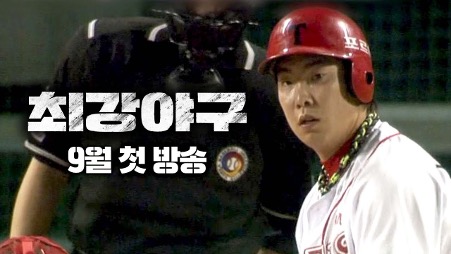
Thumbnail of the teaser for Strongest Baseball
Strongest Baseball is slated to premiere in September, but its teaser videos are filled with more comments supporting Blazing Baseball and criticizing JTBC.
So now the question is, will Blazing Baseball keep its old fanbase and remain on top? Or will Strongest Baseball use JTBC’s corporate power to turn the tide? Whether JTBC or C1 ultimately prevails, one fact remains: this is a turning point in Korean baseball entertainment as well as the growing popularity of the game in Korea.
How this saga ends could have a massive impact on whether Korean baseball continues its shocking rise and the way it will be seen on the international stage for years to come.
The first Japanese professional baseball game took place not in Tokyo, not in Osaka, or even in Japan, but in a tiny town in Northeastern Kansas.
In 1906 much of United States was enthralled by Japan and all things Japanese. Japan had just emerged as the improbable victor in the Russo-Japanese War and the year before the Waseda University baseball club had toured the West Coast. Guy W. Green, the owner of the Nebraska Indians Baseball Club, decided to capitalize on the fad by creating an all-Japanese baseball team to barnstorm across the Midwest. It would be the first Japanese professional team on either side of the Pacific.
Guy W. Green (center) with his Nebraska Indians Base Ball team ca. 1905
The early twentieth century was the heyday of barnstorming baseball. Independent teams crisscrossed the country playing in one-horse towns and large cities. There were all female teams, squads of only fat men, clubs of men sporting beards, and teams consisting of “exotic” ethnicities. These independent squads were often called “semi-professional” to differentiate them from teams in Organized Baseball (clubs formally associated with Major League Baseball), but they were professional enterprises. The teams signed players to contracts, paid salaries during the season, provided transportation and housing on the road, charged admission to games, and were intent on turning a profit.
Although Green would claim that he had “scour[ed] the [Japanese] empire for the best players obtainable,” he did nothing of the sort. In early 1906 Green instructed Dan Tobey, captain of the Nebraska Indians, to form a team from Japanese immigrants living in California. Players congregated our March 15 in Havelock, Nebraska for two weeks of practice. It soon became evident that not all of his recruits were strong enough to play on a professional independent squad, so Green and Tobey decided to bolster his roster with Native Americans —hoping that most spectators would not be able to tell the difference.
The starting lineup featured five Japanese: Toyo Fujita, a writer for the Rafu Shimpo newspaper, at first base; Tetsusaburo Uyeda from Yamaguchi Prefecture at second; 21-year-old Ken Kitsuse from Kagoshima at short; and 21-year-old Umekichi “Kitty” Kawashima from Kanagawa and a man identified only as Naito in the outfield. Manager Dan Tobey and Nebraska Indian veteran Sandy Kissell shared the pitching duties and played outfield on their off days. Seguin, another member of the Nebraska Indians, was the catcher. Roy Dean Whitcomb, an 18-year-old Caucasian from Lincoln, usually played third base under the name Noisy, while a man known only as Doctor filled in as necessary.
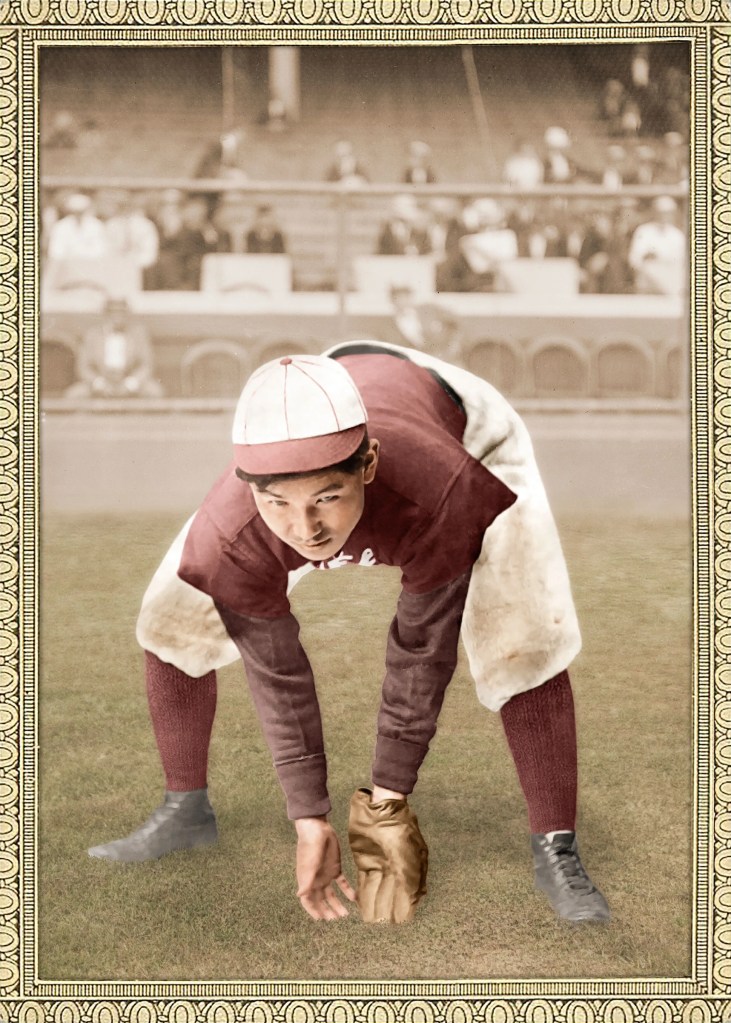
1906 Advertising Card, Ken Kitsuse Collection, National Baseball Hall of Fame
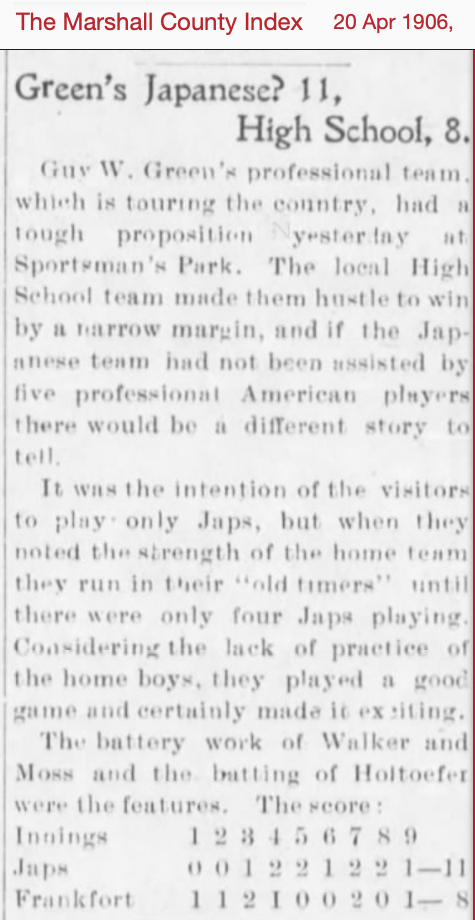
On evening of April 13, Green’s Japanese Base Ball Team left Havelock and headed south to begin a twenty-five-week tour that would cover over twenty-five hundred miles through Nebraska, Kansas, Oklahoma, Texas, Arkansas, Indiana, Illinois, Iowa, and Missouri. Their first stop was Frankfort, a small town of about 1,400 people in northeastern Kansas, where they would play the town’s high school squad.
Frankfort, Kansas circa 1906
Prior to the game, Guy Green sent out promotional material and flooded local newspapers with advertising and press releases. At the time, there were so few Japanese living in the Midwest that many rural farmers had never seen a Japanese person. So, Green’s advertisements emphasized the players’ foreignness and the uniqueness of the team. A typical announcement read, “Green’s [team] are the most novel baseball organization the world has ever known. Every player is a genuine Japanese. Not one of them can speak a word of English. They do all their coaching in Japanese and is certainly the most Japanesy Japanese you have ever listened to.”
Playing on the public’s fascination with the Russo-Japanese War, Green also concocted fictional backgrounds for his players. An April 13, 1906 article in the Frankfort Review noted, “One of the most interesting members of Green’s Japanese baseball team is Kitsuse, who left school in Japan to serve during the last great war with Japan. He was wounded in the left leg at Mukden so severely that he was compelled to go home and even yet he limps slightly. He is one of the best me on the team, however, and always a great favorite with the crowds.” Kitsuse, however, immigrated to California on June 8, 1903, almost two years before the 1905 Battle of Mukden.
1906 Advertising Card, Ken Kitsuse Collection, National Baseball Hall of Fame
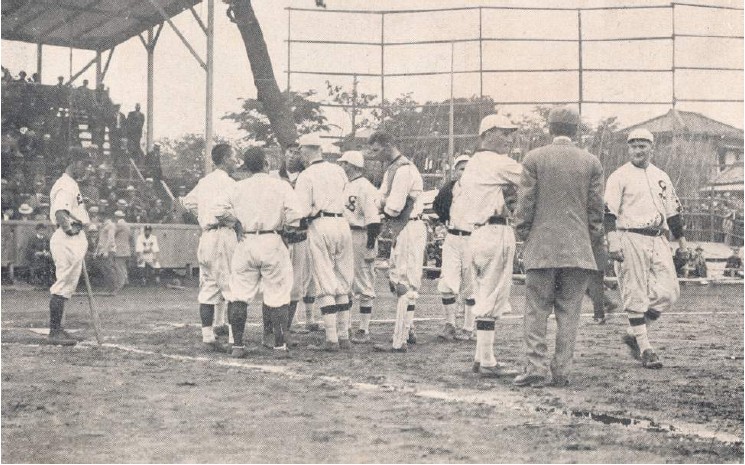
On Sunday, April 15 the two teams met on a leveled field just outside of town. There were no grandstands or bleachers—spectators sat and stood on a raised berm that surrounded the diamond. The high schoolers took the field in brand-new red and grey uniforms that had just arrived a couple of days before. The Japanese squad wore white pants reaching just below the knees, wide leather belts, maroon stockings, maroon undershirts, and a winged-collared maroon jersey with “Greens Japs” stitched in white block letters across the chest. The caps were white with maroon bills.
As the high school contained just 41 students, the match should have been an easy victory for Green’s independent team. Perhaps seeing the game as an opportunity to allow his weaker players to gain experience, Tobey started a mostly Japanese lineup. But Tobey had underestimated the skinny, 15-year-old redhead on the mound. The teenage ace, Fairfield “Jack” Walker would go on to pitch for the University of Kansas in 1911-12 and professionally in the Class D Nebraska State League and the Eastern Kansas League. Although a quiet kid, the Horton Headlight noted “when playing Walker wears a perpetual grin that makes a lot of batters mad because they think he is laughing at them.”
Besides Walker, the school’s lineup consisted of George Moss behind the plate; a boy identified only as Russell at first; Harold Haskins at second; Willis Cook at third; Leo Holthoefer at short; and Robert Barrett, John McNamara and Walker (unknown first name) in the outfield.
The schoolboys jumped out to an early 4-1 lead after three innings, forcing Tobey to bring in what the Marshall County Index called “five professional American players.” The visitors battled back, scoring in every inning after the second, to eventually win 11-8. The Frankfort Review reported, “A large number of people witnessed the game and they prounce [sic] it one of the best games ever played here.”
The near loss to schoolboys confirmed Tobey’s view that many of his Japanese players were not talented enough for an independent team. Green’s Japanese squad would stay on the road until October 10, playing about 170 games and winning 122 of the 142 games for which results are known, but there is no record of the team using an all Japanese starting lineup again.
Despite the lengthy tour and the uniqueness of the club, The Sporting News, as well as big market newspapers in New York, Washington and Los Angles, did not cover or even mention Green’s Japanese team. As a result, the first professional Japanese players had little impact on the national or international baseball scene and were soon forgotten. But the tour marked the true beginnings of Japanese-American baseball. After the season, the players headed back to the West Coast to form independent Japanese ball clubs. The Mikado’s Japanese Base Ball Team of Denver would barnstorm in Colorado and Kansas in 1908, while the Nanka of Los Angeles would play at the amateur level before changing its name to the Japanese Base Ball Association and becoming an independent barnstorming team in 1911. These teams’ success helped spawn numerous Nikkei clubs as baseball became an integral part of the Japanese-American community and culture.
1908 Denver Mikado’s Japanese Base Ball Team
You can read more about the Guy Green’s Japanese Base Ball Team and the early pioneers of Japanese American baseball in my new book Issei baseball: The First Japanese American Ballplayers (University of Nebraska Press, 2020).
I would like to thank Alice Jones of the Frankfort City Library and Dwight “Skip” McMillen for their invaluable help searching the archives in Frankfort, Kansas.
Identified Frankfort Players
Frank Robert Barrett (born April 16, 1888 Frankfort KS – died December 28, 1968 Los Angeles)
James Willis Cook (born April 30, 1887 Frankfort KS – died December 13, 1960 San Anselmo, CA
Harold Haskins (born ca. 1892- 12/6/1918, died in the 1918 influenza epidemic)
Leo Holthoefer (born January 1, 1886 Atchinson, KS – died December 12, 1927 Denver, CO)
John McNamara (born 1890, Nebraska)
George Edward Moss (born October 6, 1887 Frankfort KS – died June 13, 1961 Frankfort KS)
Fairfield “Jack” Walker (born February 20, 1891 Frankfort KS – died 1951, Wichita, KS)













 SABR Asian Baseball Research Committee Blog