Tag: Carter Cromwell

  • The 1979 Major League All-Star Series in Japan

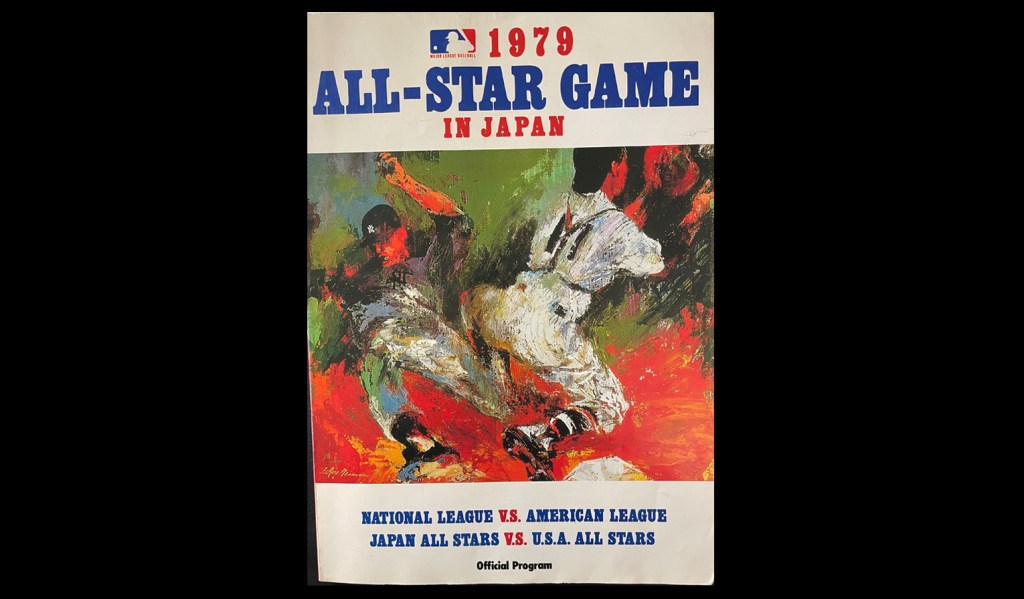
    The 1979 Major League All-Star Series in Japan

    by Carter Cromwell

    Every Monday morning we will post an article from SABR’s award-winning books Nichibei Yakyu: Volumes I and II. Each will present a different chapter in the long history of US-Japan baseball relations. This week Carter Cromwell tells us about the 1979 MLB All-Stars visit to Japan.

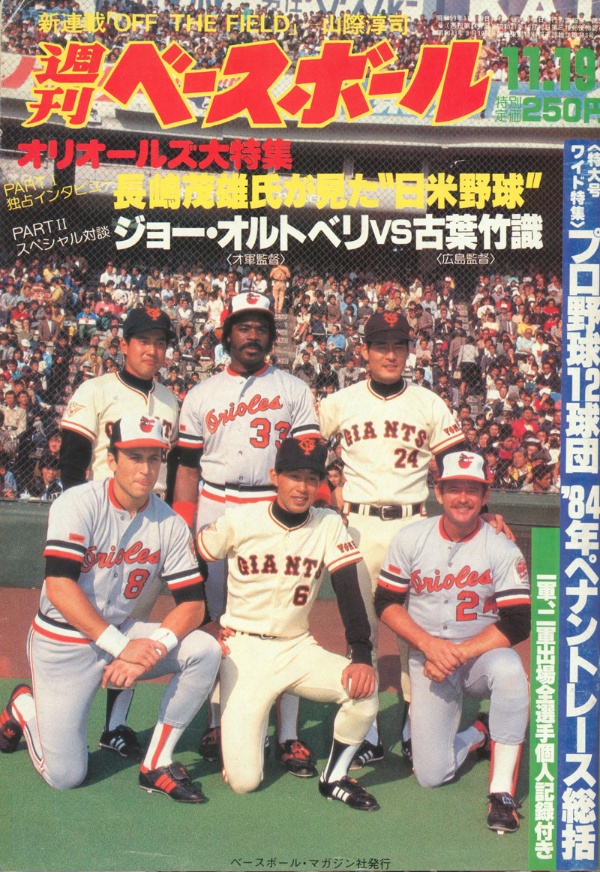
    When a group of major-league baseball all-stars traveled to Japan in November 1979 for a series of games, it represented a shift, of sorts. Since the end of World War II, most baseball tours of Japan had been by single teams. A US all-star team had not played in Japan since the Eddie Lopat All-Stars made the trek after the 1953 season.

    The 1979 tour was dreamed up by Philadelphia Phillies Vice President Bill Giles and Cappy Harada, who was born in Santa Maria, California, to Japanese parents and at the time was director of the international division of the Major League Baseball Promotion Corporation. This was the first time the United States had sent complete American League and National League all-star teams to Japan for a series.

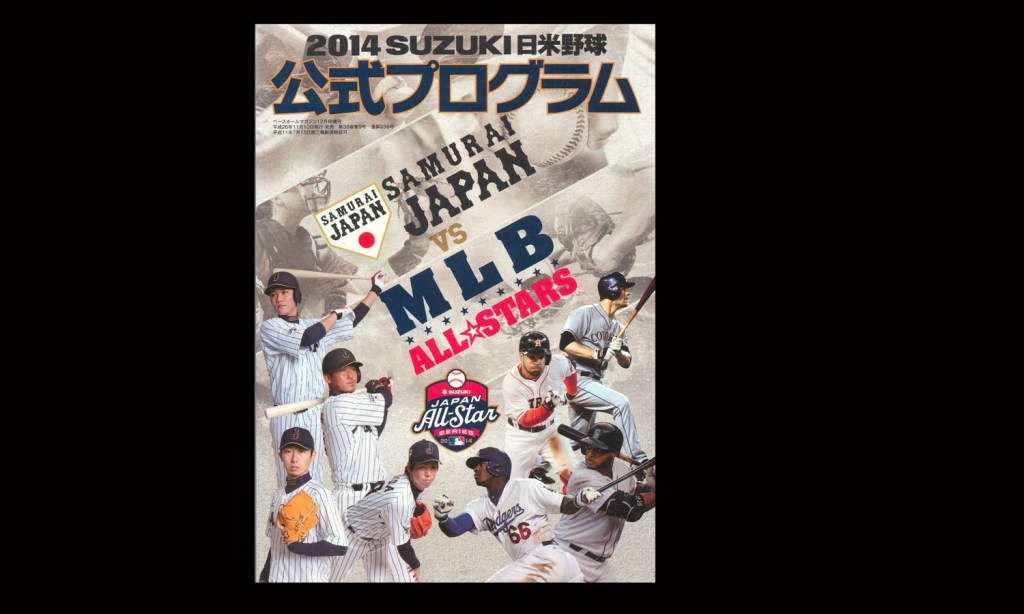
    The American squad was divided evenly among American Leaguers and National Leaguers and was managed by the Orioles’ Earl Weaver and the Dodgers’ Tom Lasorda respectively. The schedule ran from November 7 to November 20, with the US teams playing seven games against each other and a combined US club playing twice against a team of Japanese players.

    In the years since, the Japanese have consistently demonstrated their baseball prowess in various international competitions. But though it had made strides, the game in Japan in 1979 was still not the equal of the game in the United States, so the Japanese were eager to see the Americans play. Virtually every ticket for every game was sold in advance, with the most expensive costing $22,or about $89.79 in 2022 dollars.

    Of course, the Japanese weren’t unfamiliar with US players, since they could watch videotaped highlights of US games on television on Sundays, and newspapers and magazines in the country reported on the major leagues. An Associated Press story noted, “[Pete] Rose is at least as familiar a name in Japan as Jimmy Carter. The escapades of Reggie Jackson and the salary hassles of [Dave] Parker are followed with keen interest. Ever since American teachers introduced the game to Japan in the 1870s, the Japanese have looked upon America as baseball’s holy land – at the same time aspiring to build their own version to match it.”

    So actually seeing the Americans play in person was an exciting proposition.

    Though some like Jim Rice, George Brett, and Jack Clark had to pull out of the tour beforehand for various reasons, the US roster was loaded. It included eventual Hall of Famers Rod Carew, Lou Brock, Ozzie Smith, Ted Simmons, Paul Molitor, and Phil Niekro. The California Angels’ Don Baylor was coming off the best season of his career, in which he had hit 36 home runs, driven in 139 runs, and was voted the American League’s Most Valuable Player. Others might be classified in the so-called Hall of the Very, Very Good – players like Parker, Cecil Cooper, Lance Parrish, Larry Bowa, Bill Madlock, Jim Sundberg, Dennis Martinez, Tug McGraw, and Ken Singleton. Singleton, in fact, finished second to Baylor in the MVP voting that year after hitting 35 home runs, driving in 111 runs, and posting a .938 OPS. There was also Rose, who would be in the Hall if not for his gambling issues.

    “[Rose] is my favorite American player,” said Japanese Hall of Famer Sadaharu Oh, who holds the world career home-run record (868). “He never misses a game.”

    Nonetheless, a spokesman for the Japanese baseball commissioner’s office said the Japan team will be “playing to win.” And there was no doubt that it was a strong club. Compiled by a vote of sportswriters, it included eight players who would eventually gain induction into the Japanese Baseball Hall of Fame – first baseman Oh, plus outfielders Yutaka Fukumoto, Koji Yamamoto, and Tsutomu Wakamatsu, and pitchers Choji Murata, Keishi Suzuki, Hisashi Yamada, and Manabu Kitabeppu.

    Oh, of course, was the biggest name. He had even received a National Hero Award from the Japanese government after exceeding Hank Aaron’s career record of 755 home runs. Sometimes referred to as the Bamboo Bambino by the Japanese news media, he had a slash line of .301/.446/.634 over 22 seasons with the Yomiuri Giants. He drove in 2,170 runs in his career, even though the Nippon Professional Baseball season was 22 to 32 games shorter than that of the American majors.

    “I really like to watch Oh swing,” Rose said. “He picks up his front leg but doesn’t go forward until he’s ready to commit himself. He keeps his hands and his weight back until he’s ready to swing.”

    In 1979, at the age of 39, Oh had just completed his next-to-last season and had hit 33 home runs while batting .285, driving in 81 runs, and posting a .980 OPS. To many, that would have been very good, especially at that age, but Oh found it unacceptable. “I had a very disappointing year,” he said. “I hurt my side and missed several weeks. I had 33 home runs … but drove in only 81 runs. Five years ago, I had ‘only’ 33 home runs but drove in 118. And besides, the [Yomiuri] Giants finished 10½ games out this year. Very sad.”

    Other Japanese players were nearly as transcendent as Oh, though not well known to most Americans. An 11-time all-star, Tsutomu Wakamatsu posted a .319/.375/.481 career slash line, won two batting titles, and as of 2023 still held the second-highest career batting average in Nippon Professional Baseball history for players with 4,000 or more at-bats. He was the Central League Most Valuable Player and MVP of the Japan Series in 1978. In 1979 he batted .306 with an .871 OPS. Koji Yamamoto was a 13-time all-star for the Hiroshima Carp, a 10-time winner of the Diamond Glove Award, and seven consecutive seasons the leader in assists among outfielders. At the time of the 1979 series, he was coming off a .293 season with a 1.002 OPS.

    Yutaka Fukumoto played 20 seasons with the Hankyu Braves, a predecessor of today’s Orix Buffaloes, and posted a .291 batting average and .819 OPS, along with an otherworldly total of 1,065 stolen bases.

    American Leon Lee, who played 10 seasons in Japan, observed that Fukumoto “was a great base runner, too, adding, “I remember many times he would lead off a game by getting on base, stealing second, getting sacrificed to third, and scoring on a sacrifice fly.”

    On the pitching side, Choji Murata won 215 games over 23 seasons, 22 of them with the Lotte Orions. He was a three-time Pacific League ERA champion and threw five one-hitters. He had finished the 1979 season with 17 victories, a 2.96 earned-run average, and a 1.09 WHIP.

    Leon Lee’s brother Leron, who played in Japan for 11 seasons, remembered, “Choji Murata was … fabulous. He was the best pitcher I’ve seen except for Bob Gibson. In 1979, he pitched against the American All-Stars, and Ted Simmons … told me that Choji Murata was the best pitcher he ever faced in his life, bar none. That’s how good Murata was. He could throw 90 to 96 miles an hour consistently, had a great forkball, and he had this really funky windup with a high kick. I saw him throw an inside pitch that hit the bat below the label, broke it in half, and the ball had so much power that it went through the bat, hit the batter on his back leg, and rolled out into fair territory along with the head of the bat. Everybody in the stadium stopped for two or three seconds and looked. It was unbelievable for a ball to go through a bat and still have enough momentum to hit the batter in the leg and roll forward.”

    Though 1979 was a down year for Keishi Suzuki (10-8, 4.41 ERA), he spent 20 years with the Kintetsu Buffaloes and won 317 games with a 3.11 ERA and low 1.12 WHIP. He had eight 20-victory seasons and led the Pacific League in strikeouts eight times. Leron Lee learned about Suzuki very early on, the night before his first game in Japan, in fact. The team had a meeting to go over the opponents, and a scout went on and on about how good Suzuki was.

    “I said to [teammate] Jim Lefebvre that if this guy pitches like the scout says, we’re not going to get any hits tomorrow,” Lee said. “And, sure enough, Suzuki pitched a one-hitter! That guy was the best left-handed pitcher I ever faced. I faced Steve Carlton and several pretty good pitchers in the big leagues, but this guy was unbelievable. He was an absolutely fabulous pitcher who could have pitched in the major leagues very easily.”

    An interesting aside is that when he was the Kintetsu manager, Suzuki’s disputes with pitcher Hideo Nomo indirectly played a role in Nomo’s eventual signing with the Los Angeles Dodgers in 1995.

    In 19 seasons with Hiroshima, Manabu Kitabeppu was 213-141 and ranks 17th all-time in pitching victories in NPB. He was an all-star seven times. In 1986 he won the ERA title, took the MVP and Gold Glove awards and was named to the “Best Nine,” which includes the best player at each position in both the Central and Pacific Leagues, as determined by a pool of journalists. During the 1979 season, just his fourth in the NPB, he had won 17 games and allowed an average of just 1.6 walks per nine innings.

    Hisashi Yamada, Japan’s greatest submarine pitcher, was 284-166 in 20 seasons with the Hankyu Braves. His lifetime ERA was 3.18 and his WHIP a low 1.13. In the mid-1970s Yamada was the most dominant pitcher in Japanese baseball, winning three consecutive Pacific League MVP Awards (1976-1978). He was named to five Best Nine teams and 13 all-star squads, and won five Gold Glove Awards. In 1979 he had finished with a 21-5 record and a 2.73 ERA. Leon Lee said Yamada was the “toughest pitcher I ever faced in my 17-year professional career. He had great control and was never afraid to pitch inside. The biggest thing was that he completely controlled the tempo of the game and never gave the hitters time to get comfortable at the plate.” Leron Lee named players like Oh, Yamada, Murata, Suzuki, Yamamoto, and the Hanshin Tigers’ Masayuki Kakefu (also on the 1979 Japan All-Stars) among several he said could have been major leaguers.

    The schedule began on November 7 with the American League battling the National League at Yokohoma Stadium. The teams played each other again on November 8 (Kusanagi Stadium in Shizuoka), November 11 (Korakuen Stadium in Tokyo), November 12 (Seibu Stadium in Tokorozawa), November 13 (Nagoya Stadium), November 17 (Seibu Stadium in Tokorozawa), and November 18 (Yokohama Stadium).

    The NL stars won the first game 11-2 behind a 16-hit attack. The Chicago Cubs’ Dave Kingman hit a two-run homer, and Niekro picked up the win. In Game 2 the Nationals rallied from a 4-1 deficit to tie the game 5-5 on an eighth-inning sacrifice fly by Kingman. The contest was called after 10 innings because of a time limit in Japanese games.

    Game 3 went to the American League, 6-3, and the AL followed that with a 6-5 victory in Game 4 before 21,000 fans at Seibu Stadium, as Kansas City’s Willie Wilson singled home the winning run in the bottom of the ninth inning. The National League had scored three runs in the first inning and another in the second to lead 4-0 before the AL rallied.

    After that, though, the NL had its way, winning the last three games of the series by scores of 12-9 (after trailing by 7-0), 3-2, and 7-1 in the finale on a two-hitter by Niekro.

    For the Japanese fans, though, the most anticipated games of the series were the two between the United States and Japan. A wire-service story just prior the tour noted that the US players would be “scrutinized, idolized and analyzed for what makes their game different from the Japanese national pastime of ‘besuboru.’” And there were differences. The Japanese relied more on small ball and fundamentals, and they utilized off-speed pitches more often. The Americans, on the other hand, focused more on the big inning, especially with a manager like Weaver. In addition, both the baseball itself and the ballparks in Japan were slightly smaller.

    The first game took place November 14 before 31,000 fans in Nishinomiya, a city between Kobe and Osaka. Yamamoto, of the 1979 Japan Series champion Hiroshima Carp, hit a solo home run off US starter Niekro in the bottom of the second inning to give Japan a 1-0 lead. The Americans scored twice off Yamada in the top of the third inning, but the Japanese answered quickly with three runs in the bottom of the third to take a 4-2 lead.

    The US team came back with a run in the fourth when Cooper tripled and scored on a sacrifice fly by Madlock, and the Americans got a two-run home run by Simmons off Suzuki in the sixth to lead 5-4. Bowa then hit a solo homer off Japan’s Shigeru Kobayashi in the seventh, and that proved to be the difference as Japan got an RBI single from Kakefu of the Hanshin Tigers in the bottom of the inning to account for the final 6-5 score.

    Knuckleballer Niekro pitched three innings and allowed four hits, two walks, and two earned runs before being relieved by Oakland’s Rick Langford. Nonetheless, he baffled Oh, whom he struck out twice, once with the bases loaded and no one out. Oh said, “It felt like the ball was swaying left and right. I wasn’t able to hit it at all. It was a mysterious ball.” For the Japan side, Murata held the major leaguers hitless in the eighth and ninth innings, primarily with his forkball.

    After the game, US manager Weaver said, “It was a close game. I was worried and felt relieved that we won. There was little difference today with the pitchers of either team. [The Japanese] certainly could play major league baseball.” That, of course, was 16 years before Nomo proved the point by signing with the Dodgers and earning All-Star and Rookie-of-the-Year honors in his first season.

    Yukio Nishimoto, who had managed the Kintetsu Buffaloes to the 1979 Pacific League title and was leading the Japan All-Stars, said, “The Americans are speedier than the Japanese. … I’m afraid the difference is decidedly in their favor. We’d be lucky to win two games out of 10.”

    They got one six days later.

    A crowd of 42,000 at Tokyo’s Korakuen Stadium watched the Americans score single runs in the third inning (a home run by Parrish off the left-field foul pole against Japan starter Naoki Takahashi) and in the seventh (a sacrifice fly by the California Angels’ Carney Lansford) to lead 2-0. Six US pitchers held the Japanese scoreless until the bottom of the eighth inning, when Kinji Shimatani of the Hankyu Braves electrified the fans by ripping a 2-and-0 pitch from Cleveland’s Sid Monge for a three-run homer to give the Japanese a 3-2 lead. And that was enough, as Kitabeppu pitched the eighth inning and Tatsuo Komatsu of the Chunichi Dragons the ninth to get the save.

    Since the US and Japanese teams played just two games against each other, the final statistics do not represent a large sample size. For the Americans, Cecil Cooper was 2-for-3 in the one game he played, and Ted Simmons was 2-for-7 in two games with a home run and two RBIs. They were the only Americans to get more than one hit in the two games, as the team batted a minuscule .172. The US pitchers posted a 3.18 earned-run average over 17 innings and held the Japan stars to a .210 batting average.

    Virtually all the Japanese position players participated in both games, with Yasunori Oshima (Chunichi) batting .500 (1-for-2), Kakefu and Fukumoto each .429, and Hideji Kato (Hankyu) .333. On the pitching side, Murata did not allow a run in four innings while striking out five batters. Takahashi gave up just one run in four innings, while Yamada allowed two runs in three innings of work. The Japan ERA in the two games was 3.50.

    Overall, the tour was considered a success, though there was some complaining by players about the travel. One day, for example, eight buses and trains were necessary to get the group from a hotel in Tokyo to a ballpark and then to Nagoya.

    There was also some controversy when first Carew and then Rose went home early and Kingman had to be talked out of going home the same day Carew left. Japan’s Kyodo News Service quoted Rose as saying he had suffered a leg injury while going after a pop fly “and it’s been getting worse.” Rose had also arrived in Japan ahead of the others and had announced beforehand that he would not be staying until the end.

    As for Carew, American League spokesman Bob Fishel said he had injured a tendon in his right heel before the trip. Carew, however, said that the injury was just part of the reason for his leaving after playing in two games. He also felt league officials had not come through on prior commitments for endorsement and appearance income. He said he had been hesitant to make the trip but did so because of promises that he could make $40,000 to $50,000 in endorsements and appearances, in addition to the base pay of $11,000 to players on the winning team and $8,500 to those on the losing club.

    “Now I can’t help but feel that we were told these things simply so that we would say ‘yes’ to making the trip,” Carew said. “I definitely doubt that I’d ever make another. I had wanted to stay home, but they made it sound as if it was something I couldn’t pass up.”

    The Pittsburgh Pirates’ Bill Madlock said, “We’d been led to believe there would be ways to pick up extra money for endorsements. It just didn’t happen.” Cecil Cooper added, “I really was disappointed. I thought we would be involved in a lot more endorsements and things like that. Only a few players got them. I don’t think I would come back.”

    The expectation of ancillary income was due in part because Rose had been to Japan the previous year with the Cincinnati Reds and had been in demand for endorsements, television appearances, and autograph sessions. Joe Reichler, who at the time helped run the Major League Baseball Promotion Corporation, was quoted as saying, “I think a lot of the players saw how well [Rose] did and figured the same thing would happen to them. [But] there really were no firm commitments along these lines.”

    Milwaukee Brewers pitcher Lary Sorensen felt that that it was “not a big issue teamwide. Maybe it was for a few of the main guys. But I was young and just happy to be there.” And Singleton said in a 2021 conversation that “it didn’t matter to me one way or the other. Some guys may have been concerned about it, and it would have been OK if it had happened to me, but it was no big deal that it didn’t.”

    In the past there had been incidents of Americans going to Japan and behaving in a rude, arrogant, boorish manner. This time, they were generally considered to be well-behaved, though interpreter Toyo Kunimitsu sometimes saw them differently, as described in Robert Whiting’s seminal book about Japanese baseball, You Gotta Have Wa.

    The [US] All-Stars were rather tacky and rude,” said Kunimitsu, who worked as translator for foreign players with the Yakult Swallows and, later, the Chunichi Dragons. “Once we were on a long bus ride [and] John Candelaria, the pitcher for the [Pittsburgh] Pirates, had been drinking a lot of beer and had to urinate. So he urinated into a bucket and threw it out the window. I was shocked. The driver was really angry. He wanted me to throw Candelaria off the bus, but finally agreed to let him stay when Candelaria said he would stop drinking beer. I saw a lot of bad examples of spoiled Americans on that tour.”

    Nonetheless, the Americans took the games seriously, and many had positive memories.

    Parker had not wanted to come on the tour because of a bad knee, but he finally agreed and played in most of the games, even playing some in center field and sliding on his bad knee. The New York Yankees’ Bobby Murcer was said to have been upset that he did not get more playing time. Kingman, usually not accommodating to the media, stood on the sidelines after the first US-Japan game and answered question after question from reporters through an interpreter. Simmons could have returned home after the last AL-NL contest, but he volunteered to stay for the second game against Japan and played the entire game.

    “To me, this was the trip of a lifetime,” Simmons said. “I really have no complaints. I enjoyed it, and so did my wife. Japan is a country I [had] always wanted to visit, and to be able to do it this way is terrific.”

    Singleton said, “It was a great trip. We were treated well and enjoyed it tremendously.” Pitcher Rick Langford of Oakland said, “It’s an honor and a pleasure to be here [in Japan].” And Sorensen and Angels pitcher Mark Clear, both newlyweds, considered the trip to be their honeymoons.

    “I was just 23, had never been to Japan and had just gotten married, so I thought ‘Wow, what a great opportunity to travel and see some of the world,’” Sorensen said. “They treated us with great respect, and the games were great because the fans were so enthusiastic. It was like going to a football game in the U.S.

    “The whole trip was an autograph session,” he added with a laugh. “Whenever we’d go out, people would point at us and then ask for autographs. For the majority of us, it was a fabulous tour, and we thoroughly enjoyed it. It was a lot of fun.”

    Sorensen remembered a couple of amusing occurrences, one on the team plane. The Pirates had recently upset Weaver’s Baltimore Orioles to win the 1979 Word Series and, in the process, had adopted the Sister Sledge hit song “We Are Family” as their unofficial anthem. During a flight, Sorensen noticed Candelaria, Parker, and Madlock sneaking toward the front of the plane where Weaver was sitting.

    “They had a big boom box and blasted out ‘We Are Family,’” Sorensen said. “It didn’t bother Earl, but we all thought it was funny.”

    Sorensen recalled another time when a Japanese TV reporter was in the US dugout and providing live commentary during a game. As he was wont to do, Weaver got into a profanity-laced argument with a couple of the American umpires, and the reporter translated what was being said for his Japanese audience. However, when Weaver said something like “You’re a bleeping, bleep, bleep,” the reporter was stumped for a translation and simply repeated Weaver’s exact words over the air.

    Lou Brock, who had retired after the just-completed 1979 season, was honored after the final game for his fine career, and Lasorda gave big thanks to the Japanese, in particular chief sponsor Junichi Wada. “It was a great gift Mr. Wada gave the Japanese people,” Lasorda said. After the final game, both teams paraded around the perimeter of the stadium, and the fans came as close as possible to the field to give them a standing ovation.

    “Overall, it was a good experience,” Larry Bowa said. “There were problems with travel, and we all got tired. Going to Japan, however, was quite an experience.”

    Had the Japanese game made up some ground in its quest of equaling or surpassing the Americans? Weaver said after the first game that Japanese baseball had made tremendous improvement since his previous visit in 1971. All the players, he added, looked like potential home-run sluggers.

    Sorensen felt somewhat differently, though he could see that there was quality in the Japanese roster.

    At the time, I think the Japanese game was at the Triple-A level. The biggest thing was the size difference; we had size and skill sets that, at the time, were noticeably different. They didn’t have any (Shohei) Ohtanis then, although that’s changed over time. But there’s no question that they had some really good players, were fundamentally sound, and were very well prepared. They took the game very seriously, probably more so than we did, and they were more aggressive with small ball than we were. Skillwise, they had some infielders that could probably have been major leaguers. And while most of their pitchers didn’t throw hard, they were tough because they could throw a bunch of different pitches with different deliveries and from several arm angles.

    Singleton said he “wasn’t too impressed with the Japanese pitchers then, though they did a good job of mixing their offerings and using off-speed pitches.” He commented, “I was more impressed with them when I went back to Japan with the Orioles after the 1984 season. Since then, of course, they’ve had quite a few pitchers come over to the major leagues and do well. The two games were really competitive, though. We were more about power – the Japanese players would watch us in batting practice and were impressed. On the other hand, the Japanese played small ball really well.”

    As the Japan Times noted, “the gap that existed between American and Japanese baseball has been narrowed by the two U.S.-Japanese games.”

    Read the full version of this article on the SABR website
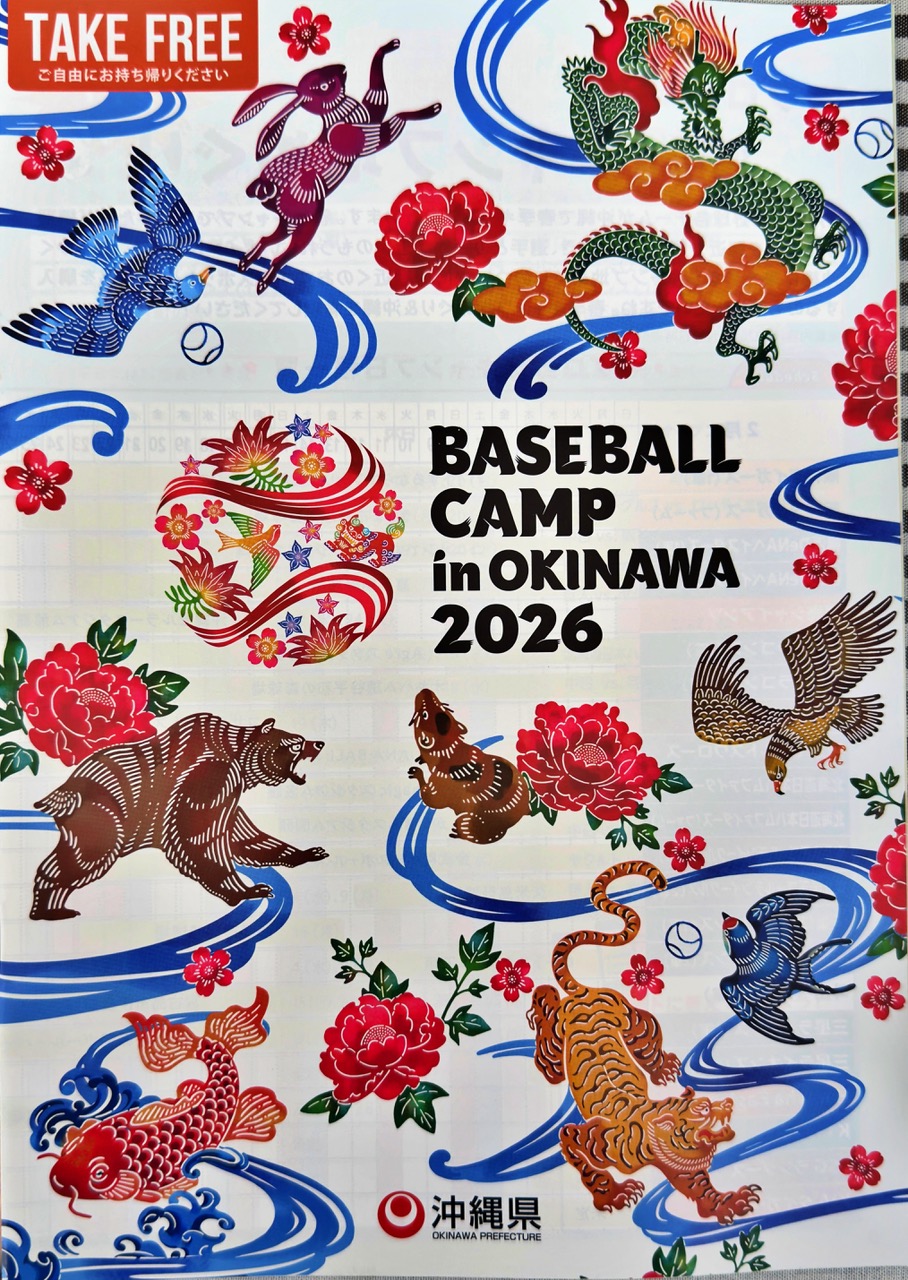
  • SPRING TRAINING ON OKINAWA

    SPRING TRAINING ON OKINAWA

    By Carter Cromwell

    The outlook – mostly sunny.  The temperatures – around 20 C (70 F).  Wind – gentle breezes for the most part.  Shirt-sleeve weather.  Perfect for having a snack, enjoying a favorite beverage, and casually observing a spring-training baseball game.

    In Okinawa.

    Not in Florida, nor Arizona. Not Major League Baseball, but Nippon Professional Baseball (NPB) – the wellspring of talent for Samurai Japan, winner of three World Baseball Classic titles and the favorite of many to win the 2026 tournament currently under way.

    Nine of the 12 NPB teams trained this February in the more or less tropical environs of Okinawa – the Yomiuri Giants, Hanshin Tigers, Rakuten Golden Eagles, Chiba Lotte Marines, Chunichi Dragons, Hiroshima Carp, Yokohama DeNA BayStars, Nippon-Ham Fighters, and Tokyo Yakult Swallows.  Absent are the SoftBank Hawks, Seibu Lions, and Orix Buffaloes, who train in Miyazaki.

    In addition, the Korean Baseball Organization’s (KBO) Kia Tigers and Samsung Lions and the farm club of the KBO’s Doosan Bears trained here this year, along with the Korean team in the World Baseball Classic.

    The NPB teams had workouts and games on Okinawa from February 1 until late in the month, after which they moved to the mainland for preseason games that continue until March 20.  The regular season begins March 27.

    Traveling to the other side of the world to see spring training might seem as a stretch to many fans, but the experience can be worth it.  The days are often pleasant in mid-to-late February.  Though bounded by the East China Sea and the Philippine Sea, at this time of year Okinawa lacks the heat and humidity of Florida and the dryness of Arizona.  The experience in Okinawa is more relaxed and less commercialized than MLB spring training.  There, fans won’t pay regular-season prices for tickets to exhibition games. Put another way, they won’t pay big league prices to (often) see minor league players.

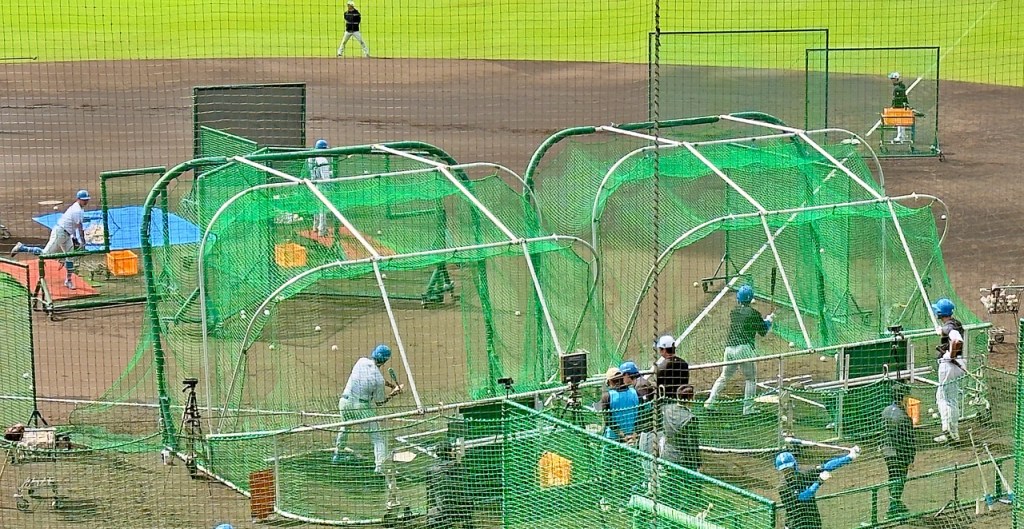
    The double batting cage setup at the Fighters’ camp (photo by Carter Cromwell)

    Also, the spring training map in Okinawa is pretty compact, making it easier for fans to see multiple teams. The farthest distance between any two sites is 47 miles (76 km), which makes it very similar to the Cactus League in Arizona where the 10 spring training ballparks are all in the Phoenix area and the greatest distance between any two is also 47 miles.[i] Florida’s Grapefruit League is much more spread out, with many of the stadiums more than 100 miles apart and the longest distance between any of the two is 217 miles (350 km).[ii]

    Some observations from a week-long sojourn in Okinawa last month:

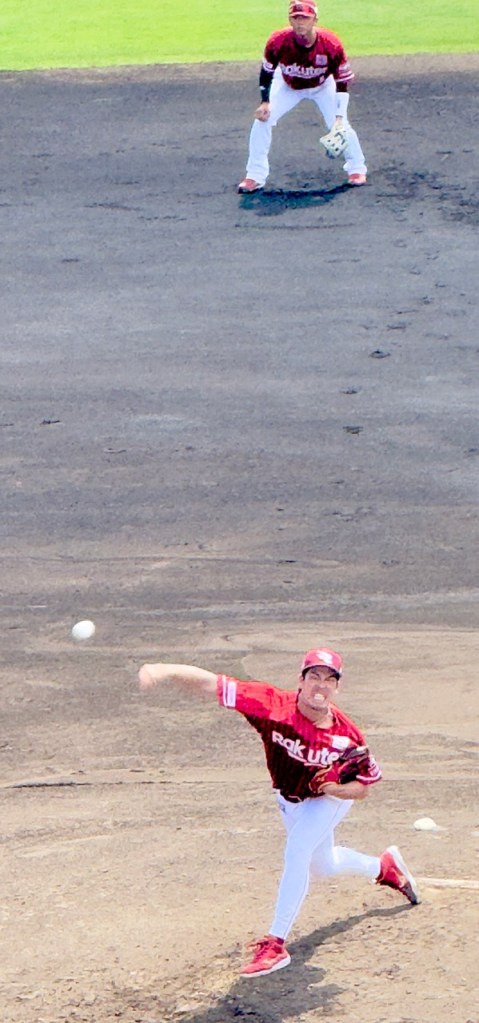
    • It was interesting to see pitchers Kenta Maeda and Shintaro Fujinami – who established themselves in NPB before playing in the United States – trying to revive their careers. The two started for Rakuten and Yokohama, respectively, at Ginowan Municipal Stadium, the spring home of the BayStars.  

    Maeda had 10-season stint in MLB but had a rough time during his two seasons with Detroit. The Tigers released him early in the 2025 season, and he then spent time in both the Chicago Cubs and New York Yankees organizations.  

    Fujinami was with the Athletics and Baltimore in 2023, in the New York Mets minor league system in 2024, and began last season in Seattle’s organization before being released and signing with the BayStars, for whom he was 1-0 with a 4.09 ERA in six appearances. At all his stops, he displayed a triple-digit fastball combined with difficulty throwing strikes.

    Kenta Maeda pitching for Rakuten against Yokohama (photo by Carter Cromwell)

    Maeda pitched two innings against Yokohama, retiring the first four batters he faced before running into trouble in the second inning. With one out, he gave up a four-pitch walk, a flare single, and two RBI singles. Fujinami went three innings, allowing a run on three hits and – surprisingly – no bases on balls.

    • Hanshin Stadium, regular-season home of the Tigers, is the only NPB facility with an all-dirt infield, but all the spring training ballparks feature these. It means the grounds crew must rake around the bases and the mound after the third, fifth, and seventh innings, and they water down the entire infield after the fifth inning. At MLB ballparks, smoothing of the infield usually happens just once during a regulation-length game, and there is no need to water down the dirt areas during a game.
    • Despite these being merely exhibitions, the teams’ cheering sections were at each game, with noisemakers and cheers for each batter just like in regular-season contests.
    • The largest of the spring training facilities is Okinawa Cellular Stadium, which hosts the Yomiuri Giants.  It has 15,000 fixed seats in addition to – it is said – room for another 15,000 either standing or sitting on the grassy area beyond the outfield.  The official attendance for a game there against the Swallows was 7,400.
    • During the Giants – Swallows contest, a foul ball hit a nearby seat and bounced off a young boy’s face. Interestingly, the alert mom made sure to grab the ball before attending to her son, who, fortunately, did not need medical attention.
    • It’s always interesting to see import players here. Bobby Dalbec, once a top prospect for the Boston Red Sox and now 30, is in his first year with the Giants.  He singled in his only at-bat against the Swallows.  Another MLB alum – Trey Cabbage (Angels, Astros, Pirates) – is in his second season with Yomiuri.  He was 1-2 in the game.
    • A contest between the Marines and Dragons included ex-MLB players such as Miguel Sano (Twins, Angels), Gregory Polanco (Pirates), Jason Vosler (SF Giants, Reds, Mariners), Orlando Calixte (Royals, SF Giants), and Andre Jackson (Pirates, Dodgers). Polanco also spent three years with the Yomiuri Giants, and Jackson two seasons with the BayStars. In this particular game, Sano hit a long home run to right-center field in his first at-bat.  
    • Luke Voit, who played for five MLB teams over seven seasons, is back with Rakuten after a successful half-season in 2025 in which he hit .300 with 13 home runs in 67 games. He’s the team’s primary first baseman and sometimes designated hitter.
    • Each NPB team is allowed to have as many as four import players on the active roster at any one time.
    • A number of key players were not in Okinawa, instead playing for Samurai Japan as it ramped up for the WBC that began in early March: pitchers Hiromi Ito (Fighters), Taisei Ota (Giants), Yumeto Kanemaru (Dragons), Atsuki Taneichi (Marines), Hiroto Takahashi (Dragons), Shoma Fujihira (Golden Eagles), and Koki Kitayama (Fighters); catchers Seishiro (Sakamoto (Tigers) and Yuhei Nakamura (Swallows); infielders Shugo Maki (BayStars), Kaito Kozono (Carp), and Teruaki Sato (Tigers); and outfielder Shota Morishita (Tigers).  
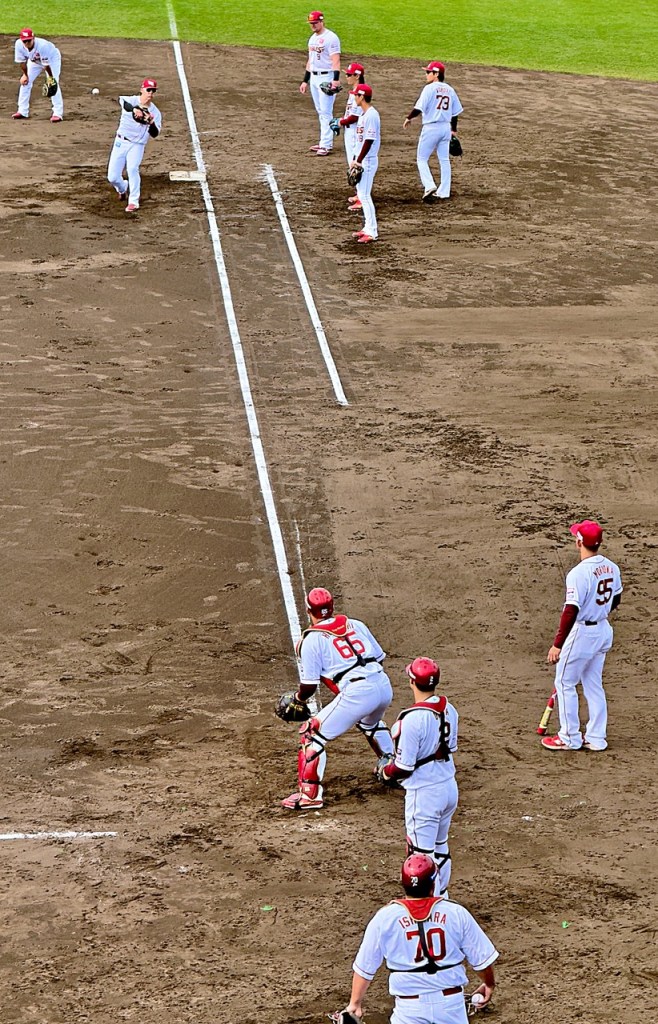
    • Teams in the U.S. nowadays rarely take infield before a game, but it remains a staple of all the Japanese teams. It’s just one indication of their focus on fundamentals, and it’s entertaining to see them go through it so crisply.  Infield ends with a foul popup to the catcher, and the fans always cheer when he catches it.
    Rakuten Golden Eagles infield drills (photo by Carter Cromwell)
    • As mentioned earlier, there is not as much commercialization of spring training here, but one can still find the usual caps, jerseys, and other paraphernalia for sale.  Most of the food is outside the stadiums under tents or in food trucks, rather than inside.  You’ll find corn dogs, but also yakisoba, takoyaki (octopus balls), bento boxes, curry rice, yakitori (grilled chicken skewers), and long potatoes. Other options include gyukatsu (fried beef cutlet) rice bowls, edamame, ramen, and more.  
    • In the Marines – Dragons game, the Marines pitcher struck the leadoff hitter in the head with his first pitch in the bottom of the first inning and was immediately ejected.  An NPB rule calls for an ejection whenever a batter is hit in the head with a pitch, regardless of whether it was intentional.
    • One will see quite a few players with three-digit numbers on the backs of their uniforms.  Those designate players on the farm teams.
    • During workouts, one can observe players practicing tagging up on fly balls.  Hitters also practice fouling balls off, a skill that helps them stay alive on two-strike counts.  These are “small” things that can make a difference between success and failure. 
    • The teams also utilize two cages side by side during batting practice.  Hitters in one work on pulling the ball, while the batters in the other practice going to the opposite field.
    • Outfielder/designated hitter Franmil Reyes, who appeared for four MLB teams, has hit 57 home runs the last two seasons for Nippon-Ham. The Fighters’ spring training home is in Nago and right next to the ocean. During one batting practice session, Reyes launched seven home runs into the water – a different take on the “splash hit” made famous at San Francisco’s Oracle Park. 
    • Teams often will work out in the mornings and then have intra-squad games in the afternoons.  It’s surprising to see how many fans come to see what might seem like mundane workouts.  At the Fighters’ camp, large crowds stood by the fence just to watch pitchers go through fielding practice.  
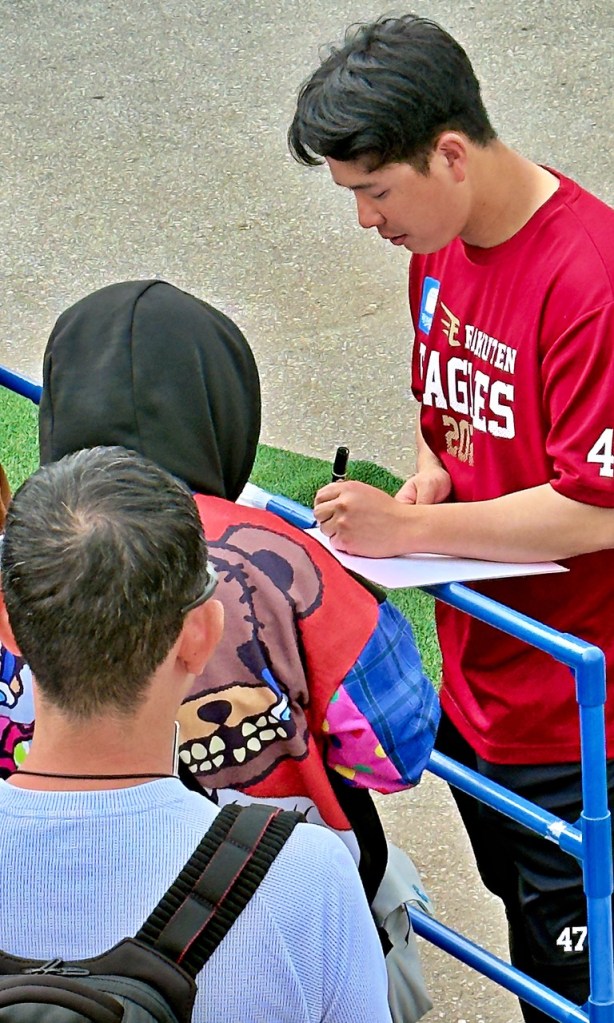
    • When workouts are over, fans hoping for autographs will rush to line up at gates they know players will be exiting through.  Many of the players comply.
    Rakuten pitcher Masaru Fujii signing autographs (photo by Carter Cromwell)

    Away from the ballparks, there are other attractions that are worth one’s time.  Okinawa has more history than many realize.  Often, Westerners think of Okinawa only in terms of World War II or the many current U.S. military installations there, if they think about it at all.  

    Okinawa was officially annexed by Japan in 1879 when the Meiji government forcibly abolished the Ryukyu Kingdom, deposed the king, and established Okinawa Prefecture. This finalized years of increasing control by the Satsuma Domain, which had controlled the region as a vassal state since 1609. 

    Consider the following:

    • Churaumi Aquarium – one of the top tourist attractions in Okinawa, featuring whale sharks and one of the largest aquarium tanks in the world
    • Shurijo Castle – completed in the 15th century, it was the royal residence for the king and his family, and it also functioned as the government house of what was the Kingdom of Ryukyu prior to Japan’s takeover.
    • Okinawa World, a theme park featuring a massive natural cave, a craft village and snake museum
    • Okinawa Prefectural Peace Memorial Museum & Cornerstone of the Peace, established in 1975 next to the spot where the World War II Battle of Okinawa ended
    • Kokusai St. & Makishi Market
    • Tsushima-maru Memorial Museum – Dedicated to a Japanese passenger/cargo ship that was sunk by the submarine USS Bowfin during World War II, while carrying approximately 1,800 passengers, including many schoolchildren
    • Surfing is a year-round activity on Okinawa, but it’s recommended only for intermediate to advanced surfers because of shallow, sharp coral reef breaks. Newbies who often fall from their boards will get their feet cut by the coral.

    [i] https://www.springtrainingconnection.com/distances.html

    [ii] https://www.springtrainingconnection.com/distances.html

  • DEVELOPMENT OF BASEBALL IN SAUDI ARABIA

    DEVELOPMENT OF BASEBALL IN SAUDI ARABIA

    by Carter Cromwell

    Probably few are aware of it, but baseball has a history in Saudi Arabia. Until recently, though, it was like an old, rarely perused book that had long gathered dust in the attic. 

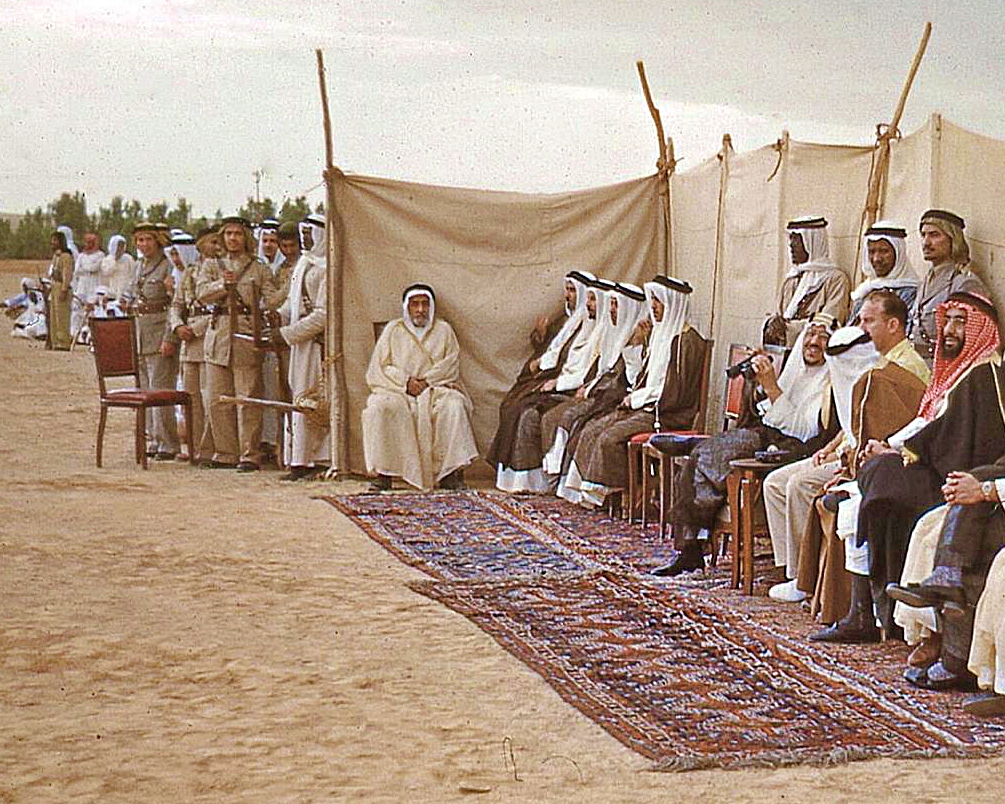
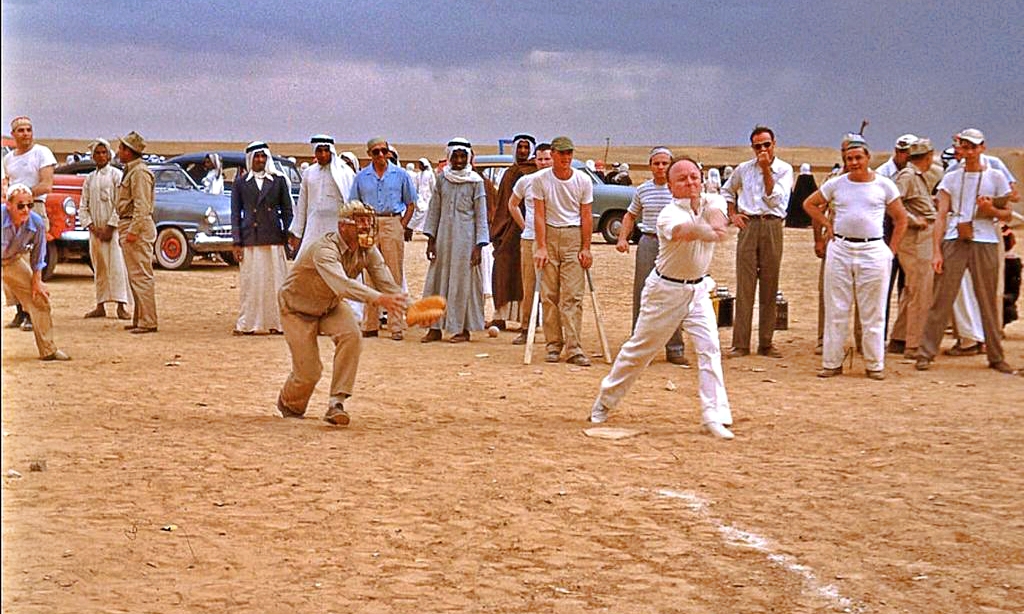
    Not many know that Americans brought baseball to Saudi Arabia in the early 1930s when companies began searching there for oil, which was finally discovered in 1938. Then-king Saud even attended a game in 1954. Children of expat employees of the Arabian American Oil Company (Aramco) played baseball in Dhahran, whose team advanced to the Little League World Series 23 times before interest slackened for a number of years. 

    But now there is an effort to update the story for a larger audience. Much is yet to be written, but people from the governmental level on down are working to change the narrative. 

    In part, this reflects the pivot toward sports that some Middle East countries have made in recent years, the Saudi-sponsored LIV Golf Tour and Qatar’s hosting of the 2022 World Cup football (soccer) tournament being two examples. It also fits with Saudi Vision 2030, the goal of which is to increase diversification in the country economically, socially, and culturally. 

    The Saudi Baseball and Softball Federation (SBSF) was established in late 2019. Baseball United, the Dubai-based professional league that played its initial regular season late last year, is working with the federation to develop the sport, and the Dhahran Youth Baseball Association (DYBA) is rebuilding a program that had gone into decline.

    It is unquestionably a long-term project, but it’s happening.

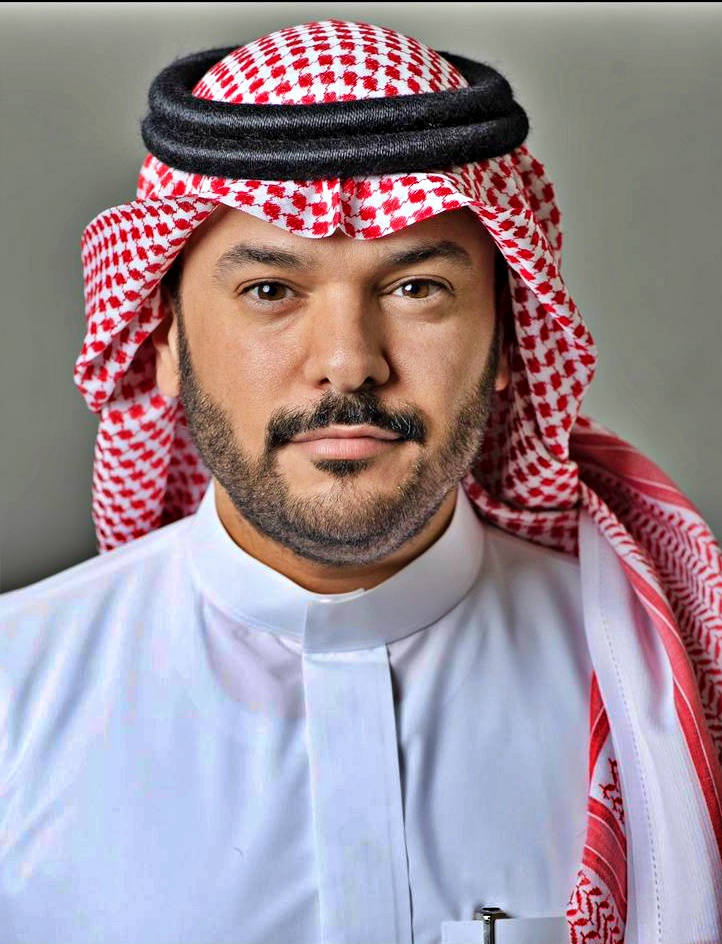
    Nayef Bin-Humaid is president of the Saudi Baseball and Softball Federation. He lived for 10 years in the United States, mostly near Washington, D.C. His interest in baseball began when he would go with friends to games of MLB’s Washington Nationals. After returning to his home country, he eventually landed in a government job with a project for Vision 2030.

    “I was approached in December 2019 by the Saudi Olympic Committee, which was interested in establishing a governmental body supporting baseball,” Bin-Humaid said. “That would feed into one of the pillars of Vision 2030 in terms of expanding sports activities in the country and, more importantly, expand the game for Saudis.”

    Nayef bin-Humaid
    “Photo courtesy of Nayef bin-Humaid”

    Bin-Humaid was elected president of the federation and got to work immediately, only to be delayed by the Covid-19 pandemic.

    “We started in January 2020, and our first order of business was to find out who was playing the game in Saudi, who wants to play, and what could we do to expand the game within the country,” he said. “We started by going into American and Japanese communities, as well as others that we thought might include people who were interested in baseball. Though baseball is not that popular here, we were surprised to find that there were Saudis who loved the game, wanted to participate, and follow MLB teams closely.”

    Covid-19 soon hit and put a lot of efforts on hold, but the working group was still able to develop a plan and the necessary steps. It connected the Saudi federation with the Asian Baseball Federation and the World Baseball Softball Confederation, while also obtaining seed funding from the Saudi Ministry of Sport. 

    “That enabled us to hire some employees, kick-start a marketing campaign, and get a few other things in motion,” Bin-Humaid said. 

    Jean-Michel Mayeur came on as technical director of the Saudi federation in 2024. The native of France has a long background as a player and coach, directing a baseball academy in Montpellier for nearly 20 years. 

    “I’m excited because I understand the potential here, but it’s going to take a while to develop,” he said. “It’s a big challenge. The main focus now is grassroots development.”

    Bin-Humaid echoed that, saying, “We’re definitely working to develop at the grassroots levels. We’re very lucky to have someone like Jean-Michel who loves the game, is great with kids, and has run an academy. He took on the challenge of coming to a foreign country with the game in its very early stages and help put together a development plan that we can take to schools.”

    The efforts currently focus on a number of areas, including:

    • Working with schools to get baseball instruction into physical education curricula so that more Saudis will be exposed to the game
    • A partnership with the Yokohama DeNA BayStars of Japan’s top professional league to bring some young Saudi players to clinics there
    • Integrating Baseball5 programs into school curricula as a pathway to baseball
    • Establishment of Saudi national teams in baseball, softball, and Baseball5
    • Staging tournaments
    • Working to develop leagues, so players can get consistent competition

    “We’re working hard to get baseball into schools,” Mayeur said. “Getting people interested early on is key. First, we need to teach physical education teachers how to teach baseball. The goal is to have classes during the school days and then after-school activities involving baseball. Baseball5 should help people get interested, too, since you don’t need a ton of equipment or have to train pitchers.”

    Joan Bonhaure, Karim Mejri, and Jean-Michael Mayeur

    Mayeur also noted the need to establish academies; train coaches, players, scorekeepers, and umpires; organize tryouts and tournaments; build more fields that meet regulation standards; establish leagues; and … well, a lot of stuff.

    “The list is long,” Mayeur acknowledged, “but we’ve made progress. We’ve established national teams in baseball, softball, and Baseball5, and having the partnership with the BayStars is really nice. We have four Saudi kids, ages 13-16, there to get instruction and observe the pro team’s practices. We hope to send more in the future, and also have some Saudi teams go there to compete against high school players.”

    Owen Reid of Reid Baseball is an independent consultant who conducts clinics in various countries, many of which – such as Tunisia, Bangladesh, Thailand, Malaysia, Indonesia, and Kyrgyzstan – are not on the baseball map. He started holding clinics in Saudi Arabia in 2016 and made more than 30 visits before moving there with his family early in 2025.

    “I’ve seen the game shift from being a novelty to an option, and now it’s more and more becoming an opportunity for families and Saudi kids eager to challenge themselves with something new,” Reid said. “It’s still true that most of the players I work with are expats, but I’ve seen encouraging growth in the number of Saudi ballplayers. And what excites me most is retention.  Once they try it, they often stay with it. Curiosity is turning into commitment.”

    Bin-Humaid said, “We have around 1,000 registered players in the country now. We focus on kids who are interested and show potential. We monitor them and work to keep them in the game, even when they go abroad to university and play. We’ve taken some to camps in places like eastern Europe, France, and the Dominican Republic, in addition to Japan. We hope to carry the torch for advancement of the game in western Asia.”

    He added that there are now baseball coaches in about a dozen high-level private schools, since physical education classes in public schools mostly focus on football (soccer). 

    For his part, Reid has increasingly worked with coaches, as well as players, and said, “By equipping coaches in Saudi Arabia with the tools, language, and standards to create positive baseball environments, we multiply the impact. The more educated and empowered coaches are, the more impact they can have on the next generation of people and ballplayers.”

    Under the terms of its partnership with the Saudi federation, announced in March 2024, Baseball United has the right to establish franchises in Riyadh, Jeddah, and Dammam. Baseball United will help promote the game across the region, develop local talent in Saudi Arabia, and design training programs and curricula for players, coaches, and umpires at both the amateur and professional levels. The league will also look to host future tournaments and league games in Saudi Arabia.

    Kash Shaikh, who will leave his role as chairman and CEO of Baseball United effective March 1, has led the organization since its inception four years ago.  He has a personal connection that helps drive his interest in bringing baseball to the region – he lived in Dhahran for three years while his parents worked in the oil industry, and he played Little League baseball there.

    “For the longer term, we have a 15-year partnership to bring baseball to Saudi. This is the most under-developed region as far as baseball goes, so we’re doing as much as possible to help the sport grow. We’re helping with the Saudi national team program – we put a team on the field last fall for the Baseball United Arab Classic. We’re also helping from a resource and financial standpoint, as well as bringing expertise to the training and curriculum programs.”

    Bin-Humaid added, “Baseball United has made a significant commitment to developing the game here. They sponsored one of our tournaments, which involved people from various embassies in Riyadh, and they also committed to sending expert coaches and trainers when we need them.”

    Mayeur also sees Baseball United’s participation as a positive: “The partnership is huge. We need to make baseball fashionable for the kids. Once they get teams in Saudi, it will give people a reason to come watch. We need that kind of thing to push development.”

    Bin-Humaid also noted the importance of the long-standing baseball community in Dhahran. 

    “Luckily, we connected with the baseball community in eastern Saudi – the Aramco people in Dhahran,” he said. “The coaches, parents, and kids there are very much into it.”

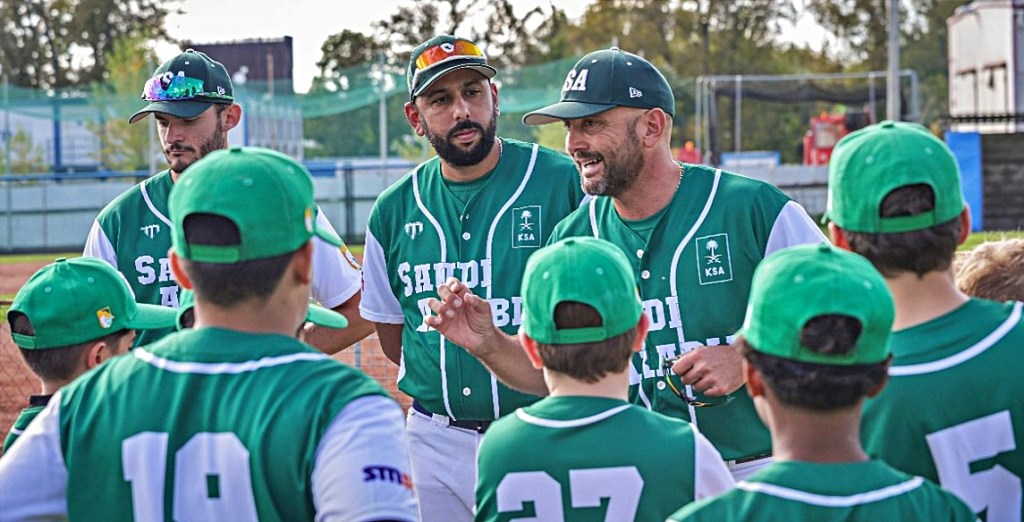
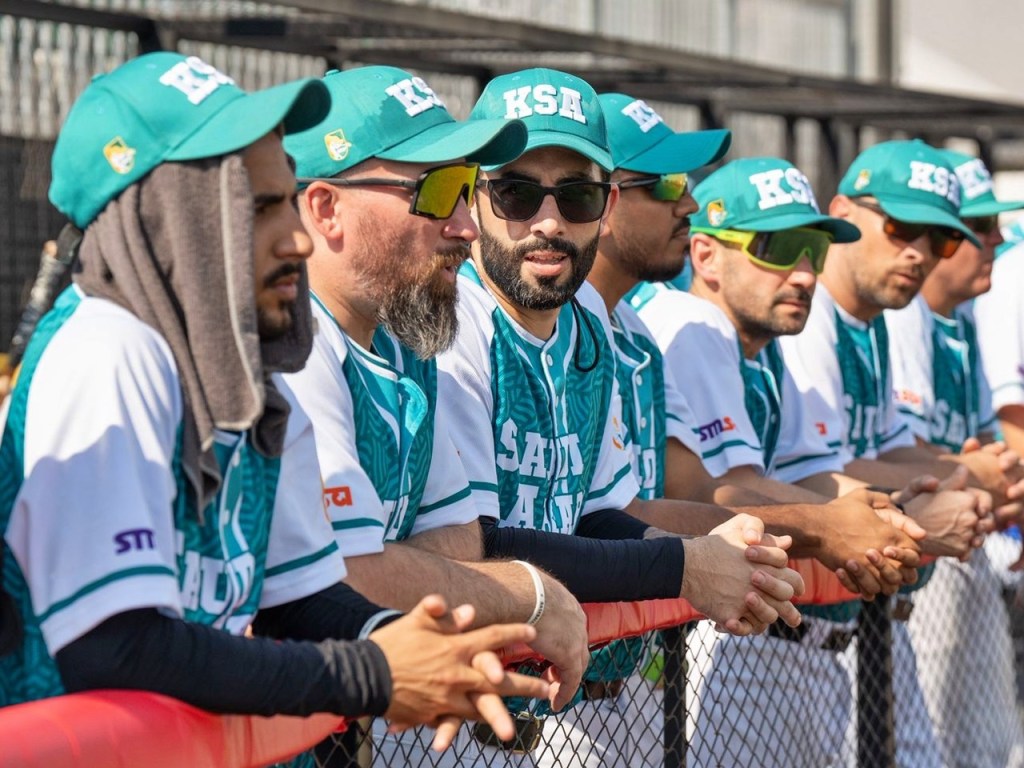
    Erich Sutterlin (third from left) and teammates from the Saudi Arabia national team. Photo courtesy of Erich Sutterlin

    Erich Sutterlin, president of the Dhahran Youth Baseball Association (DYBA) and a school teacher in the Aramco community, added, “The federation identified us as an entry point for finding baseball talent in the Kingdom. Several of our players participate in international tournaments under the auspices of the federation and the Saudi Committee. We’re separate from an organizational standpoint, but our players benefit from being involved with their teams.

    “The relationship with the SBSF has led to some interesting developments such as a Baseball5 club at our school, which has helped introduce the game to players from countries that don’t have strong baseball backgrounds,” Sutterlin continued. “And the SBSF has visited schools and encouraged the Saudi players in our leagues to invite their friends so they can learn about baseball.” 

    Getting more Saudis playing the game is a major part of the federation’s mission, of course, and there has been some progress in Dhahran. Sutterlin said that a 12-U team played in a tournament in the Czech Republic in September 2025, finishing second out of 12 teams, and a 15-U team comprised of expats and Saudis competed in a tournament in Italy in November. He noted, however, that “the expat and Saudi kids here don’t go to school together, so it’s more of a challenge to get the Saudis to play. The ones that do participate are often children of ‘mixed’ parentage.”

    Still, there is progress. As Reid remarked, “I see Saudi families returning season to season and ballplayers coming back to the field each time I return to Dhahran.”

    Glenn Makechnie, Sutterlin’s predecessor as head of the DYBA and a geologist with Aramco, said that there are Saudis playing in every age group, and also on the travel teams. “They’re still in the minority, but we’re inclusive of kids at all skill levels, not just the more interested ones. Recently, one team had 11 different nationalities among the 13 players.  And while the number of Saudi participants is low, some of our best players are Saudis.  There are some on our 12-U and 15-U travel teams who are performing very well. 

    “We also collaborate with the Little League in Qatar, which is very active and hosts regional tournaments. Two American high schools there have programs, as well.”

    This comes after baseball interest in the Aramco community trended downward for more than a decade. After the long period of success from 1983-2011, the Dhahran Little League team was shifted to the Asia-Pacific region, which was more competitive. That, combined with a shrinking expat population at Aramco that reduced the pool of potential players and baseball-savvy parents, resulted in less success and dwindling interest in attending the Little League tournament. 

    After the 2017 season, when the program struggled to get nine players to fill out an all-star team, the DYBA’s board of directors let the association’s Little League charter expire. Overall participation fell off, and the Covid-19 pandemic exacerbated the decline.  The program was completely shut down from the spring of 2020 until the fall of 2021.

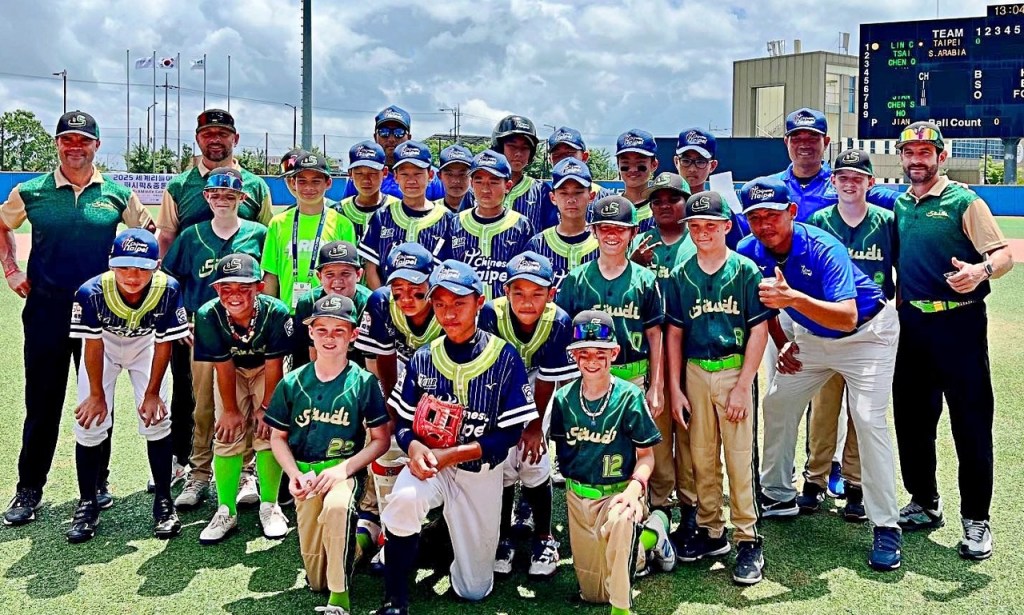
    The DYBA Little League just after playing Chinese Taipei in the 2025 Asia-Pacific & Middle East Tournament in South Korea.  Photo courtesy of Erich Sutterlin

    “When we tried to reboot after Covid, we could barely field two teams for a 12-U kid-pitch division,” Makechnie said. “It’s taken a monumental effort from all involved to grow the league back to where it is today. We’ve had great support from parents internally and from external resources such as the SBSF and Reid Baseball.”

    Makechnie said there are parallel programs within the Aramco community – youth baseball supported by Aramco and a chartered Little League initiative that “intertwines with the youth baseball program.” There are approximately 260 young people playing on the various teams, including T-ball, and there are 20-25 girls playing softball, with some of the latter also involved with baseball. In addition, there is a new senior league that utilizes pitching machines, rather than live pitchers. “There aren’t enough older people who can pitch,” he said wryly.

    “We’ve really had to re-think our goals and organizational structure to create meaningful baseball experiences for all our membership,” Makechnie continued. “Even though the North American expat population is decreasing, overall baseball participation is about the same. That’s good in a way, but it also means we have fewer baseball-savvy people helping, so we’ve had to get creative. We’re probably the most unique baseball organization in the world.”

    Now, interest is expanding again, although it hasn’t reached the levels of two or three decades ago. Saudi Arabia returned to international Little League action at the 2025 Asia-Pacific & Middle East Tournament in South Korea, though it failed to advance from pool play. 

    Reid has partnered with the DYBA since 2016, putting on multiple clinics each year, and he worked with this year’s Little League team.

    As for the future, there is a need to continue building more fields, as well as establish leagues. There are perhaps 15 fields in the country now, including several at the Aramco facilities in Dhahran. About half are private, and not all meet regulation standards.

    For the sport to grow and evolve, Reid sees the need for greater access within communities – i.e., more leagues at multiple levels – continued development of coaches, additional facilities that are multi-use and adapted to the hot climate, a clear league structure that provides pathways to greater competitive levels, and role models and greater visibility for the game.

    “The foundation is there, and baseball here continues to build momentum,” Reid said. 

    Bin-Humaid said, “We’re committed to keep pushing forward. We will participate in the Asian Games in Qatar in 2030, and we’ll be the host nation of the Asian Games in 2034. By then, we want to have a team that not only participates but competes.”

    Mayeur added, “We just need time and exposure. If we can show baseball to kids, we can get them interested. We just have to keep going, and things will happen.”

  • A New League called Baseball United Begins Play in Dubai

    A New League called Baseball United Begins Play in Dubai

    By Carter Cromwell

    DUBAI, United Arab Emirates – Birthed just three and a half years ago, Baseball United took a major step toward adulthood this November.

    Formed to bring professional baseball to a region with little exposure to the game, Dubai-based Baseball United had staged a two-game showcase in November 2023 involving several former Major League Baseball (MLB) standouts; then the Arab Classic a year later that matched the national teams of nine countries; and an exhibition series in February 2025 between two of its teams. 

    But when Karan Patel of the Mumbai Cobras threw a fastball to Pavin Parks of the Karachi Monarchs at 8:21pm on November 14, it marked a significant milestone. It was the first pitch of the first game of the first regular season of the first professional baseball league representing the Middle East and South Asia. And it took place in the first and only pro baseball facility in the region – Baseball United Ballpark

    Parks, by the way, hit that first pitch over the left field fence for a home run, and he hit another in the ninth inning as part of a five-run rally that lifted Karachi to a 6-4 victory. 

    “We’ve visualized this for three years, and – as I stand before you now – it looks even better than in my dreams,” Baseball United co-founder and CEO Kash Shaikh told the crowd of approximately 3,000 prior to the opening game. 

    Former major-leaguer Mariano Duncan, who manages the Mumbai team and has been with the league from early on, said, “We’ve finally brought a baseball season to Dubai. There’s a lot more work to do, but I’m happy we’ve been able to take this big step.”

    The November 14 contest began a one-month season in which each of the four teams will play nine games, followed by a best-of-three series for the championship. All the clubs – the Arabia Wolves and Mid East Falcons, along with the Cobras and Monarchs – play at Baseball United Ballpark with games broadcast in several countries and streamed live on YouTube.

    The league is attempting the yeoman’s task of germinating the game in what might seem like infertile soil – creating something from scratch, as Shaikh has said. To do this, Baseball United has worked to develop the fan experience – something always important but especially so in this case since the game is unknown to a large portion of the potential fan base.

    “It’s a long process to really grow the fan base,” Shaikh said. “We’re taking the game where most people don’t know it. This is the most under-developed region as far as baseball goes, so this is going to take some time. We have to do is make sure people enjoy the overall experience.”

    John Miedrich, a co-owner and executive vice president of operations, concurred: “We’re talking about teaching the game, of course, but it’s just as important to teach the fan experience. Baseball is so new to the region that most people don’t have an understanding of the game, but if they have a good overall experience when they attend, there’s a chance they’ll come back.”

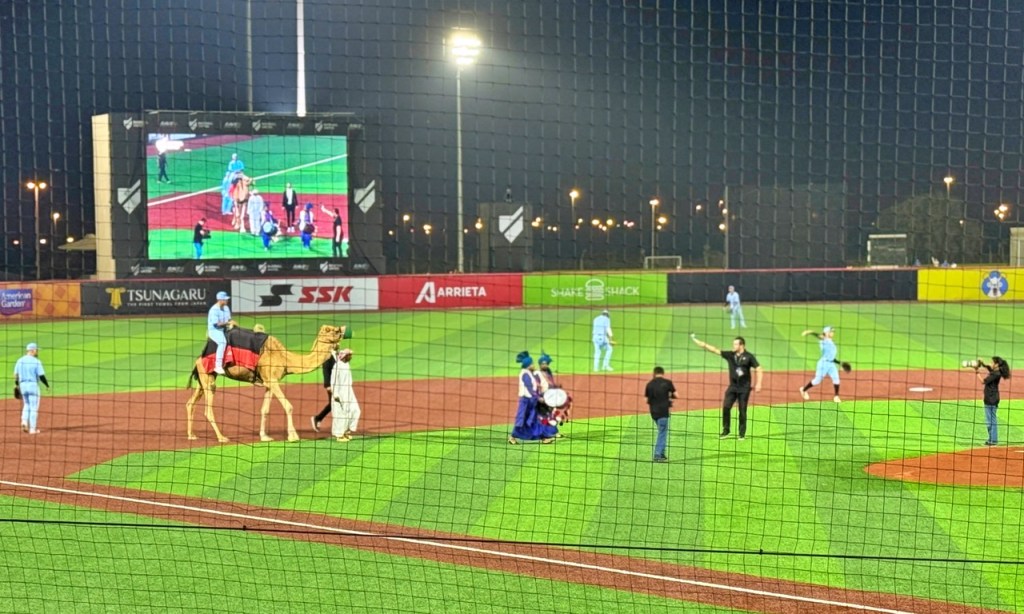
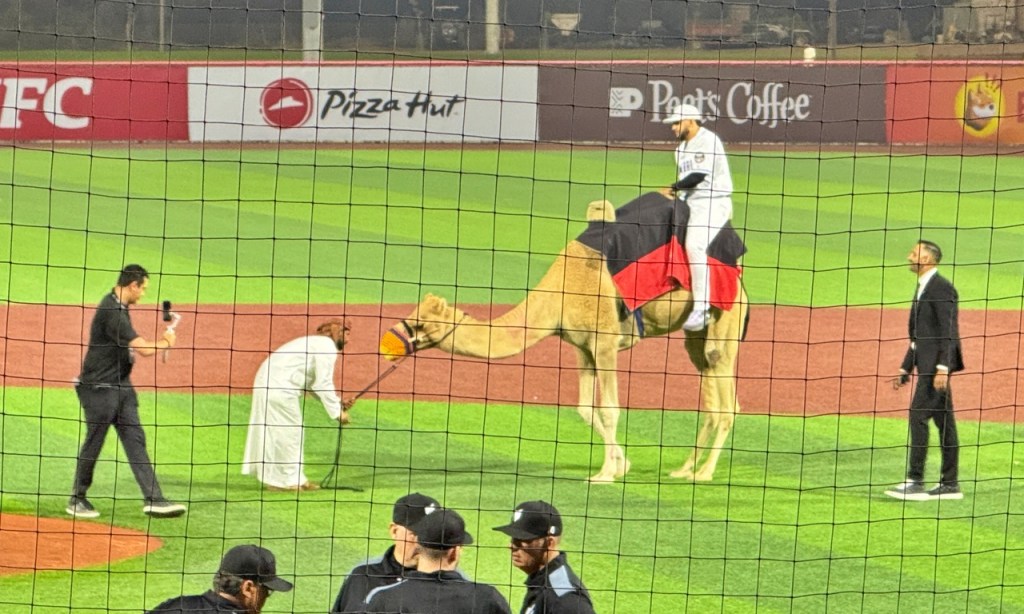
    Similar to games in Japan and Korea, the games feature cheering sections on each side with people waving towels, as well as bands in the left field and right field stands. There is music throughout, a dance team that sometimes performs between innings, kids racing mascots around the bases between innings once per game, and a youngster enthusiastically announcing “Play Ball” to the crowd. And perhaps the most unique innovation is having each starting pitcher enter the game from the bullpen while riding a camel.

    The league also features some new rules:

    • If a game is tied after nine innings, a home-run derby, or swing-off, will decide the winner. Each team’s nominated player gets 10 swings to hit as many home runs as possible. If the hitters tie, a sudden-death swing-off occurs. 
    • Each team has a designated runner it can use once per inning, without the man he replaces being removed from the game.
    • As many as three times in a game, the team at bat can declare a “Money Ball”. A  bright yellow ball replaces the regular white one, and if the player at bat hits a home run, it doubles the number of runs scored. If the batter is walked or hit by a pitch, the Money Ball rolls over to the next batter.
    • “Fireball” – If the team in the field calls a fireball and the current batter strikes out, the inning is over, regardless of how many outs there were at the time. Each team is allowed three fireballs per game. 

    “We started the fireball this year because people said we had rules to help the teams at bat but nothing to help the pitchers,” Shaikh said. “Some people like the rules, and others don’t, but we think this makes us stand out a little more.”

    Antonio Barranca, an American and catcher for the Arabia Wolves who played two years in the Atlanta Braves organization, said, “It’s kind of crazy – but fun – to see some things like the new rules and pitchers riding on camels. It makes the league a little different and helps them get their brand out.”

    At a media event the day before the opener, Shaikh pointed out left and right fields to the media members and had to make it clear that the second baseman doesn’t actually position himself on the base. He also explained the “charge” fanfare and the seventh-inning stretch during which fans sing “Take Me Out to the Ball Game”. Then he invited them to play a game of catch with the likes of co-owner and former major league catcher Robinson Chirinos and others. 

    Likewise, the television commentators sometimes explained situations likely not understood by those new to the game. For example: why there is no need to tag a runner on a force play. 

    The population of Dubai is approximately 90 percent expatriate, and more than a few residents come from baseball-playing countries such as the U.S., Canada, Japan, Korea, Taiwan, and others. Baseball also has some similarities to cricket, which has a large, rabid following in countries like India and Pakistan. 

    “To spread the word, we’ve been talking a lot with people from the various embassies, the Philippine softball family; the cricket people from Australia, New Zealand, India, and Pakistan; and others,” Miedrich said. 

    The league has, in part, constructed the team rosters with an eye toward attracting fans of different nationalities. A check of the rosters, shows that, while many of the players are American, there are players born in 23 other countries – from Europe, North America, South America, Central America, the Caribbean, South Asia, and East Asia.

    Seven players have MLB experience, the most prominent being outfielder Alejandro de Aza of the Mid East Falcons. More than 20 players have been in the minor league organizations of MLB teams; more than 40 have played in independent leagues; and at least seven have played in European leagues. 

    Shaikh pointed out that “Mumbai has two players from the Philippines [shortstop Lord De Vera and outfielder Ian Mercado], as well as six from India. Karachi has four Pakistanis – look out for Musharraf Khan, a 6-7 pitcher – and there are 14 Japanese players on the Mid East Falcons.” 

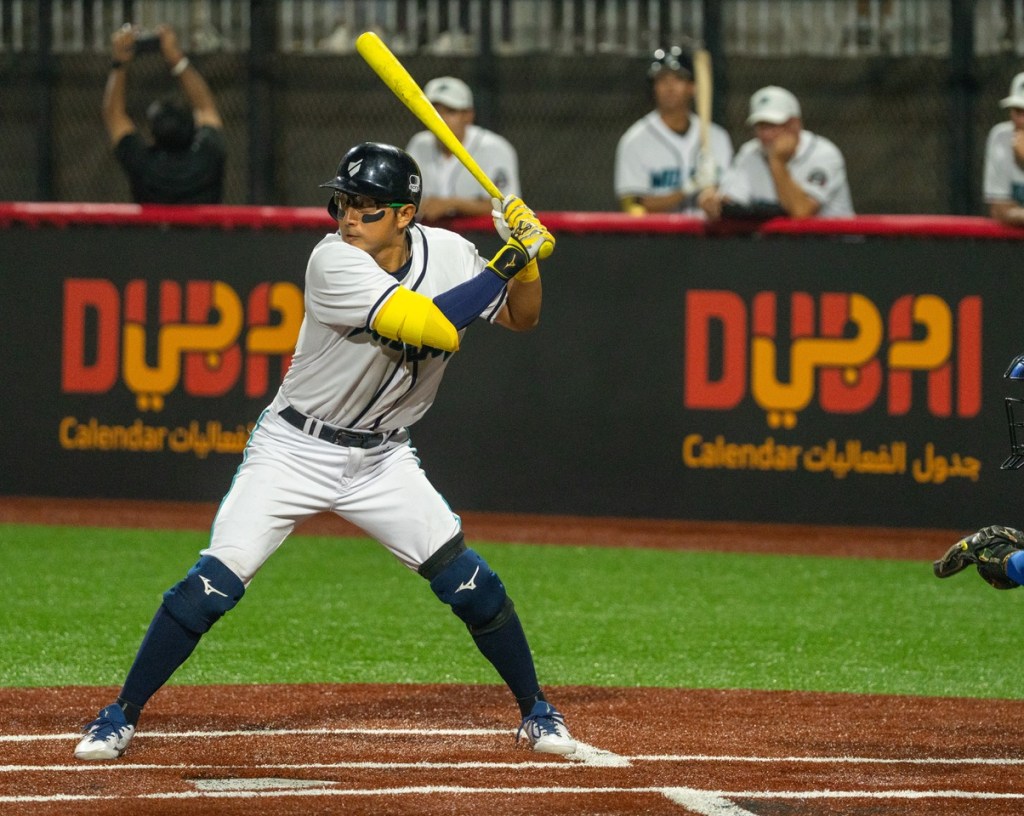
    The Japanese contingent includes former Nippon Professional Baseball (NPB) stars Munenori KawasakiHiroyuki Nakajima, and Shuhei Fukuda; others with NPB experience; and Manato Tanai, an 18-year-old shortstop who was the fifth pick in the 2024 NPB draft and is considered one of the Yokohama DeNA BayStars’ better prospects. Kawasaki is 44 years old, Nakajima 43, and Fukuda 36. Kawasaki spent five seasons in MLB with Seattle, Toronto, and the Chicago Cubs.

    Hiroyuki Nakajima

    “The Falcons are quickly becoming a fan favorite in Japan,” Shaikh said on a recent game broadcast,[i]“with 60 percent of the roster composed of Japanese. It’s a great mix of veterans and young prospects.” 

    Three other Japanese – outfielder Yo Kanahara and pitchers Yudai Mizushina and Shotaro Nakata – earned their spots by winning a reality show competition produced by Japan’s Tokyo Broadcast System (TBS) network, which also broadcasts the games.

    “The show started with 300 players, and just the three were chosen,” according to Chiharu Yamamura, Baseball United’s senior director of Japan Operations. “I worked with TBS on the series, and they want to do it again next year – maybe even export the show format to other countries.”

    Several of the Japanese played leading roles in Mid East’s first game November 19. Kazuki Yabuta and Shotaro Kasaharacombined with Mizushina and former major leaguer Severino Gonzalez to pitch the league’s first no-hitter in a 2-0 victoryover Karachi. Kawasaki had two hits, including a double that led to the Falcons’ first run, and Kanahara scored both runs as the designated runner. 

    Through December 2, Kawasaki and Nakajima were each averaging .353 and Fukuda .188. Tanai showed off a good arm, but had just two hits in his first 15 at bats before going 3-3 with two walks against Mumbai on December 2. Yabuta had an 0.63 earned-run mark  after 14 1/3 innings along with 23 strikeouts and four walks, and Kasahara had pitched 2 2/3 scoreless innings. Haru Yoshioka, a 19-year-old BayStars prospect, had a 2.45 ERA through 3 2/3 innings, and Shuto Sakurai, who has pitched in NPB for both Yokohama and Rakuten, was 1-0 and had struck out nine batters in six innings. 

    “Kawasaki has been incredible – such an ambassador for the game,” Shaikh said. “He’s 44 now but still in great shape, and I see him at the cricket fields [next to the ballpark] teaching the young kids.”

    Munenori Kawasaki

    Mid East manager Dennis Cook, a former MLB pitcher who also runs the Polish national team with Arabia manager John McLaren, said Kawasaki “is a little long in the tooth, but he can still play. He, Nakajima, and Fukuda are fundamentally sound, won’t strike out a lot, and will put the ball in play.” 

    Baseball United is betting that a long-term, grass-roots approach will eventually bear fruit, but getting to this point has been no easy task.

    “This whole project was exciting because it was an empty canvas here, but it was daunting because it was an empty desert,” Shaikh said. “I had an idea of [the size of the task] beforehand but didn’t know the level it would take in training and so forth. And I didn’t realize how much government relations there was to do – with the federations, tourism councils, and government officials. That’s been a crazy part of the journey. 

    “I knew it would be the hardest thing I’ve ever done, but it’s been even harder.”

    Duncan, the Mumbai manager, said he’s been associated with Baseball United since the early days and that he got Hall-of-Famer Barry Larkin involved. As a co-founder, Larkin is senior vice president and leads player development strategies and initiatives. 

    “I was asked to help find investors, and Barry was the first person I thought about,” Duncan said. “Knowing that he’d been involved internationally as coach of the Brazil WBC (World Baseball Classic) team, I thought he’d be the perfect guy.”

    For his part, Larkin said he had been to India a number of years ago as part of a government program during the George W. Bush and Barack Obama administrations. 

    “I worked a lot of baseball tryouts, camps, and clinics in New Delhi,” Larkin said. “I didn’t see many baseball-specific skills there, but I noticed that there was a lot of athleticism. I said to myself that if I ever got a chance to come back to this region and do something, I’d do it.”

    Larkin said he went to Shaikh, whom he had known from some previous promotional projects, and Dubai was eventually chosen as a base of operations “because it’s more centrally located.”

    More investors joined over time. Shaikh, Larkin and fellow Hall-of-Famers Mariano Rivera and Adrian Beltre are co-founders and sit on the board of directors along with Chirinos. The former players listed as co-owners also include Albert PujolsElvis AndrusFelix HernandezNick Swisher, Ryan HowardBartolo ColonHanley RamirezMatt BarnesShane VictorinoLuis SeverinoJair JurrjensAndrelton SimmonsDidi GregoriusStarling MarteRonald Acuna Jr., and Robinson Cano.

    As for progress, Shaikh points to accomplishments such as the events held in 2023, 2024, and early 2025; partnering with media outlets such as TBS in Japan, PTV, the national broadcaster in Pakistan, and Zee Entertainment Enterprises in India, both of which will broadcast all this season’s games live; signing up sponsors, including some from the U.S. and Japan; and getting the ballpark built.

    The league said that three million viewers watched the international broadcast of the February 2025 series between the Wolves and Falcons and that 17 linear and digital broadcast partners carried the games, with viewership in more than 100 countries. 

    Appearing on the broadcast of a recent game, Shaikh said that the broadcasts of the opening game attracted approximately seven million viewers. “That’s an MLB All-Star Game-level [of viewership],” he said, “and it’s going to continue adding up.”

    Another data point is views of the games streamed over YouTube. The 11 games through December 2 attracted approximately 163,000 views, with per-game views ranging from a low of 7,200 to a high of 24,000.

    The ballpark is a story in itself. The original plan had been to play on a modified cricket pitch, but scheduling became an issue, as other events sometimes had priority and bumped baseball to other dates. 

    “We were the red-headed stepchild,” Shaikh said wryly. “We realized that we couldn’t have a season without having our own stadium.”

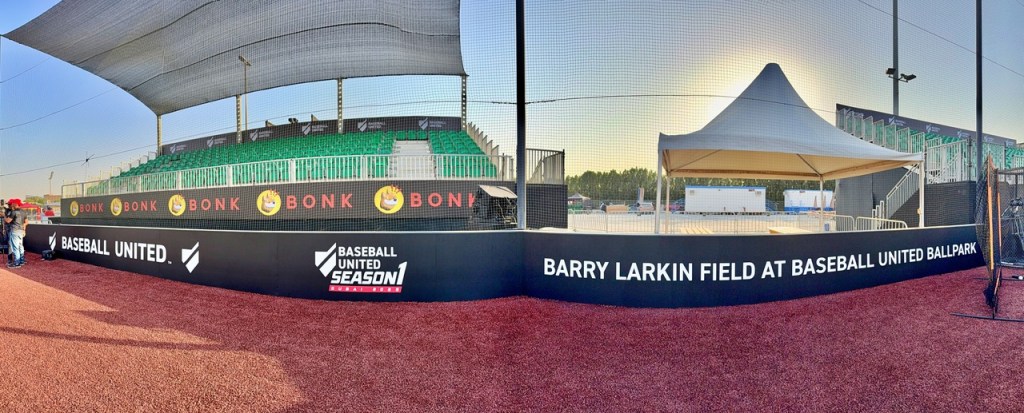
    So he and his team built Baseball United Ballpark next to a soccer/rugby stadium and a cricket ground – in just 38 days.

    “A year ago, this was all dust and dirt,” Shaikh said proudly with a sweep of his arm. “Now, it’s our Field of Dreams here in the desert.”

    Its dimensions are identical to those of Yankee Stadium, and it has top-quality lighting with seating for approximately 3,000 fans. If it becomes necessary, the current stands can be expanded higher, and there is room down the lines to add more sections. The stands, as well as the food and drink setups, can be stored when not in use.

    Except for the mound, the field is covered with artificial turf, the same as used by the NPB’s Yokohama DeNA BayStars. Carlos Mirabal, Baseball United’s director of baseball operations, did much of the work on this, leveraging contacts he made in Japan during the six seasons he pitched for NPB’s Nippon-Ham Fighters.

    “We have to wash the turf to keep the dust off, but we’ll use a lot less water than if we had natural grass,” Mirabal explained. “The area around the mound is a combination of mud from Pakistan and the U.S. Most of it is Pakistan mud, but the area around the rubber and where the pitchers land is American mud because it’s softer.”

    Karim Ayubi, an outfielder and Curacao native who has played in the Boston Red Sox organization since 2021, said, “This is a very impressive setup. It surprised me. The turf is good because it’s soft enough and doesn’t get as hot during the days as some turfs do.”

    So, going forward . . . 

    “We want to make sure everyone gets playing time and experiences this journey,” former major league shortstop Jay Bell, who manages the Karachi team, said. “Ultimately, we’re here to represent baseball and help it expand – that’s more important than anything.”

    Larkin said, “We want to be a very competitive league; that’s the main thing. Regardless of whether the level of play is rookie league, Class A, AA or whatever. We want our players to get exposure and have chances to play at higher levels. Like the two kids from the Philippines. There is no pro ball there, so maybe playing here will give them a shot somewhere else. Or [Pavin] Parks – maybe he turns out to be a Kyle Schwarber type of guy.”

    Jacob Teter, an outfielder/first baseman formerly in the Baltimore Orioles and Houston Astros organizations, looked at this as being an opportunity, as well. “It’s really great to see them bring baseball to a place that doesn’t have it and give guys like me a chance to play and show what we can do. I’ve never been to this part of the world, but I get to come here and play baseball. That’s pretty cool.”

    Lou Helmig, a first baseman/outfielder and German national who spent time in the Philadelphia Phillies system and last year was in the U.S. independent leagues, said, “I love this. It’s a new opportunity to make things happen.”

    As for next season, Shaikh said “the plan is to have two additional teams and for each team to play 15 games. If we can get another venue, we might lengthen the season to two or two-and-a-half months. The dream scenario is to play during most of the November – February time frame and in multiple locations, but there is a lot to figure out with logistics and politics.”

    In March 2024, Baseball United announced a partnership with the Saudi Baseball and Softball Federation that gives the league an unlimited term to host games and tournaments in Saudi Arabia and includes rights to new Baseball United franchises that will represent Riyadh, Jeddah, and Dammam. But there is much to work out before that happens. 

    “A limiting factor there is getting partners to help build ballparks,” Shaikh said. “The Saudi sports scene is experiencing massive transformation now in a lot of areas – the 2034 World Cup will be there – and pretty much all the venues are under construction or on lockdown, so we’ve been slower about moving into Saudi.”

    For the moment, the primary goal is to put the existing operations on solid footing.

    “We’ve come further in three years than anyone expected,” Shaikh said. “The challenge now is to build momentum over the course of this season. Our goal is sustainability, and these next two years are really important.”

    NOTES: Miedrich said Baseball United has development programs in India and Pakistan and that the one in Pakistan is near the city of Peshawar, in territory heavily influenced by the Pakistani Taliban. Taliban members sometimes watch baseball training sessions while carrying weapons and wearing bandoliers. Because of tribal custom, the players must wear long pants during workouts, regardless of the temperature . . . With the ballpark’s field almost entirely covered with artificial turf, there is no dirt around the bases or in the batters’ boxes. It was amusing to see hitters automatically start to smooth out the dirt as they approached the plate – only to realize that there was none . . . A dance team performed between innings. While these are almost always comprised entirely of women, there were two men on this eight-person team, and a number of fans remarked on it . . . Of the four umpires, two were from the Czech Republic (Zdenek Zidek and Frantisek Pribyl) and two from Mexico (Jair Fernandez and Humberto Saiz). Zidek has experience umpiring in the U.S. affiliated minor leagues . . . There is no place at the ballpark to store a regular (metal) batting cage – colloquially called a “turtle” – so Baseball United uses an inflatable one. 

    END TEXT

    Unless otherwise noted:

    • All quotes from Kash Shaikh are from a Zoom interview that took place September 9, 2025, and from in-person interviews September 14-16, 2025.
    • All quotes from Barry Larkin, John Miedrich, Mariano Duncan, Jay Bell, Dennis Cook, Chiharu Yanamura, Lou Helmig, and Karim Ayubi are from in-person interviews September 14-16, 2025.
    • Quotes from Antonio Barranca are from a telephone interview September 15, 2025.
    • Quotes from Jacob Teter are from a telephone interview September 16, 2025.

    In addition, the author consulted baseballreference.com and baseballunited.com.


    [i] Go to the top of the eighth inning – starting 2:35 into the broadcast: https://www.youtube.com/watch?v=_QAPf9g7Z-E&t=9747s.