
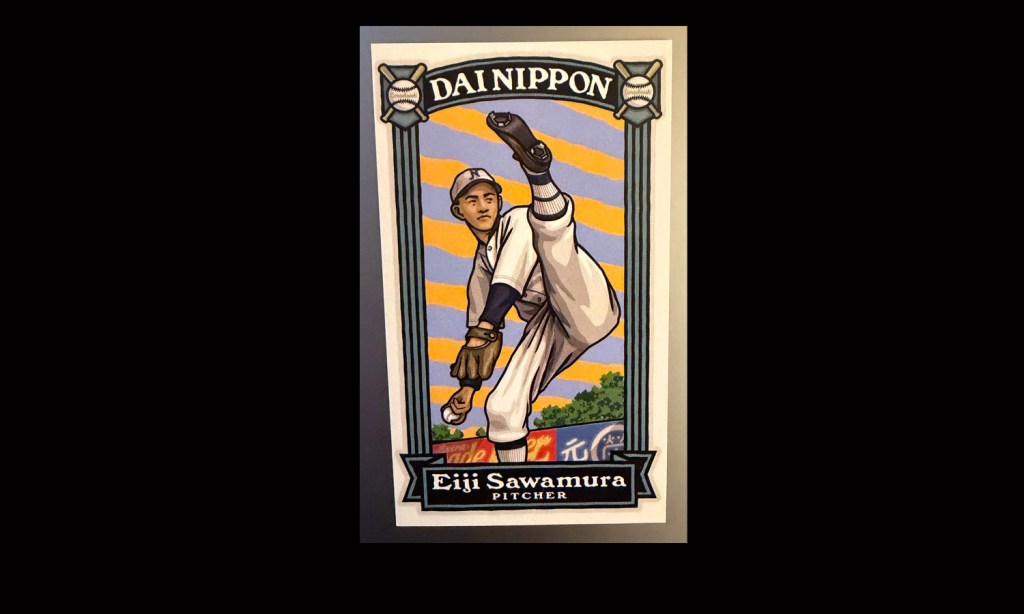
Japan’s Number One
by Gary Cieradkowski
Before dawn on December 2nd, 1944, the USS Sea Devil, a U.S. Navy Balao-class submarine, quietly stalked a Japanese convoy near Kyushu, the southern-most part of the Japanese islands. Radar showed at least 11 escorted targets, and the Sea Devil surfaced in the pre-dawn darkness to track the convoy by sight.
A sudden wave nearly swamped the surfaced sub — a sailor was washed off the bridge and onto the deck below, and water poured into the open hatch, flooding the crew’s mess, radio room, and both of its dual engine rooms. Fortunately, the damage was repairable, and in one of the engine rooms, Motor Machinist Mate 3rd Class Ray Ebbets worked hard alongside the rest of the black gang to get their station back online.
To those of the crew who were baseball fans, the Motor Machinist Mate’s last name must have rung a bell, for Ray Ebbets’ grandfather was Charlie Ebbets, the owner of the Brooklyn Dodgers and the man for whom Ebbets Field was named.
But all that didn’t matter at that moment. The Sea Devil was on a trajectory to intercept a Japanese convoy, and as the rest of the crew hastened to repair their stations, the men in the extreme fore and aft of the sub armed and loaded their torpedo tubes. The captain of the USS Sea Devil, Commander Ralph Styles, ordered the watch below decks, the hatches shut, and all preparations to submerge. Lingering just below the surface, the skipper watched the convoy through the periscope, maneuvering his sub closer and closer to the convoy, trying to gain the best angle of attack.
Satisfied with his position, Captain Styles launched four torpedoes at a freighter and, after missing, quickly ordered two more fired at another one. This time, the torpedoes hit, and within minutes, the freighter began slipping beneath the sea. Captain Styles swung his vulnerable sub out of the path of a destroyer escort and fired four more torpedoes at a troop ship. The Sea Devil was now almost directly in the path of the convoy.
The skipper sounded the dive alarm, and the sub headed for the safety of the deep sea. On the way down, everyone on board, from Captain Styles to Motor Machinist Mate Ebbets, could hear the massive explosion as the Sea Devil’s torpedoes ripped into the hull of the troop ship and ignited the stores of ammunition carried in her second hold. Although they couldn’t see it, the Hawaii Maru disintegrated in the massive explosion, killing every last man aboard her.
Among the 1,843 soldiers of the Japanese 23rd Division who perished that morning on the Hawaii Maru was Lieutenant Eiji Sawamura. Besides being recently promoted from the ranks before shipping out on what was supposed to be his third combat deployment, Eiji Sawamura also happened to be Japan’s greatest baseball pitcher and its first sports superstar. To Ray Ebbets and even the most dedicated baseball fans amongst the crew of the Sea Devil, the name Sawamura probably wouldn’t have rung a bell. But, if you added that he was the Japanese schoolboy who struck out Babe Ruth, Jimmie Foxx, Lou Gehrig, and Charlie Gehringer, you then might have gotten more than a few to exclaim: “Oh yeah!”
JUST OVER 10 YEARS earlier, in what must have seemed like another world, Eiji Sawamura was a 17-year-old high school student with a blazing fastball and tantalizing curve who was hand-picked to represent his country against an American all-star team led by Babe Ruth.
Born in Mie Prefecture on February 1, 1917, Eiji Sawamura was raised to be a ballplayer. His father Kenji had played years earlier when the game was first introduced to the island by American schoolteachers and visiting sailors, and he passed his love of the game down to his firstborn son. After years of practice with his father, Sawamura developed sharp control, lightning speed (for his age), and a baffling curve.
Sawamura became his elementary school’s baseball team’s starting pitcher in the 4th grade. The following year, he pitched the school to victory in the Mie Prefecture tournament. In the national tournament, Sawamura’s team was defeated in the third round, but his fifteen strikeouts per game average raised eyebrows.
In 1933, Sawamura entered Kyoto Commercial High School. Because the school had only just started a baseball program, none of its players could match Sawamura’s experience and skill. When Sawamura single-handedly pitched the school into the quarterfinals of the national tournament, Kyoto Commercial became known as a “one-man team.”
In the 1934 spring season, Kyoto Commercial was eliminated in the second round of the national tournament but advanced to the quarterfinals in the summer tournament. In one round, Sawamura struck out 23 of the 27 batters he faced. His fastball was so overpowering that one team prepared to face him by having their pitcher throw batting practice one meter closer to the plate to replicate Sawamura’s velocity. He would strike out 97 batters over 48 innings before Kyoto Commercial was eliminated in the quarterfinals.
In a regular-season game that fall, Sawamura made headlines when he whiffed 36 in a 16-inning game. By now, Eiji Sawamura was by far the best high school pitcher on the island. All of Japan’s “Big 6” universities were vying with one another to recruit Sawamura after graduation. Unfortunately, according to the article “Strikes, Sacrifice, and Glory: The Life of Eiji Sawamura” by James Hoadley, “Sawamura left Kyoto Commercial after a disciplinary incident involving a teammate, which prevented him from further participating in student baseball.”
FOR A WHILE, it looked like Eiji Sawamura’s baseball career was stopped just as it was starting. At the time, there wasn’t a professional baseball league in Japan, and college competition was the highest level a ballplayer could aspire to. If Sawamura wanted to continue playing baseball, it would be strictly on a recreational level.
However, Matsutaro Shoriki, president of the Yomiuri Shimbun, Japan’s leading newspaper, was setting a plan in motion to create his country’s first professional baseball league. The first step was to generate nationwide interest in the game. To accomplish this, Shoriki arranged for Philadelphia Athletics owner and manager Connie Mack to bring a Major League all-star team headed by Babe Ruth to tour the island. The tour would take place in the fall and winter, following the end of the 1934 major league season. And since this would be the most high-profile assembly of American ballplayers ever to tour the island, Shoriki needed a Japanese team that could challenge the professionals and whip up interest and pride in his fellow countrymen.
When American teams had toured Japan in the past, their competition was usually college and recreational clubs. For this grand tour, Shoriki aimed to assemble an all-island all-star team, “Dai Nippon” (All-Japan), comprising the best ballplayers in the country. If the tour was a success, as he believed it would be, this all-star team would then form the nucleus of Japan’s first professional league.
After his impressive performance in the high school championships, Eiji Sawamura was a shoo-in for Shoriki’s team that would challenge the Americans. Tadao Ichioka, the head of the Yomiuri Shimbun’ssports department, traveled to Kyoto to recruit the young pitcher. According to baseball historian Robert Fitts, the newspaper offered to pay him 120 yen ($36) per month, a nice sum in Japan at the time. Sawamura’s father Kenji encouraged his son to accept the offer.
After mulling it over, and, according to a 2021 Yomiuri Shimbun article, Matsutaro Shoriki promising him he would “take care of him for life,” Sawamura decided it was a gamble he was willing to take. If Shoriki’s league was a success, he could potentially make a good enough living to send his younger siblings to college. Of course, there was also the honor of representing his country against the world’s best ballplayers and seeing how he would personally perform when pitted against them.
DAI NIPPON would be the best aggregation of native baseball talent ever assembled in the country. Besides 17-year-old Eiji Sawamura, the roster was carefully curated from current and former collegiate stars, including Jiro Kuji, Naotaka Makino, Osamu Mihara, Shigeru Mizuhara, and Minoru Yamashita, all of whom would become future members of the Japan Baseball Hall of Fame. Also recruited to Dai Nippon was another teenage high school pitcher, Russian emigre Victor Starffin.
The tour unfolded as expected; the Americans beat Dai Nippon in seven straight contests. In his first two appearances against the Americans, Sawamura was hit hard. It wasn’t something to be ashamed of; the Americans won every game by a large margin, outscoring Dai Nippon 77 to 13 runs. No Japanese pitcher had been able to handle the seasoned professionals. It was his third try in which Eiji Sawamura made history and became an instant legend.
The November 20, 1934 game took place at Kusanagi Stadium in Shizuoka, a city about 80 miles south of Yokohama at the foot of Mt. Fuji. With the midday sun at his back, the 17-year-old took the mound before 30,000 fans and proceeded to put the Americans down without giving up a hit.
In the bottom of the fourth inning, Sawamura faced lead-off batter Eric McNair, shortstop of the Athletics, who hit a harmless pop fly for the first out. Future Hall of Famer and 6-time all-star Charlie Gehringer was up next. One of the toughest men in the majors to strike out, Sawamura did just that, with a bit of help from the glaring sun behind him. Next, the great Babe Ruth took his place at the plate. Although the big man was at the end of his storied career, he could still pound the ball. The local teams he faced on the tour presented no real obstacle to him, and he hit one home run after another, captivating the appreciative Japanese fans.
Although he hadn’t performed all that well against the Americans, Sawamura had fanned the Bambino 10 days earlier and went into his windup knowing that the Babe was indeed fallible. Two fastballs and one curve later, he struck the big fella out again to end the inning.
In the bottom of the fifth, Sawamura took the mound to face Lou Gehrig. With his big leg kick, sizzling fastball, and that midday sun, Gehrig went down swinging. The Japanese crowd, who had routinely rooted for the American stars thus far, now began to sense that something magical was happening. Ever since the turn of the century, American teams had come to Japan and thoroughly defeated the local competition. In most games, it wasn’t even a close contest, but here and now, a home-grown ballplayer was striking out the greatest baseball players in the world.
The giant Philadelphia Athletics first baseman Jimmie Foxx was up next. His muscular physique had intimidated even the best pitchers in the American League, but here in far-off Japan, an unknown 17-year-old high school kid struck out the 9-time all-star. That Earl Averill broke the strikeout streak by getting thrown out on a grounder didn’t matter, nor did it that the Americans would win the game 1-0 on a Lou Gehrig home run — Eiji Sawamura was an instant national hero.
After the game, Connie Mack reportedly offered to take the pitcher back to America with him. “If you train him thoroughly on a farm team for three years at the age of 18” Mack said, “he would surely be useful in the major leagues.” Sawamura declined; he didn’t know English and didn’t want to leave Japan. American newspapers picked up the story, and while many baseball fans might not have known the kid’s name, they sure knew the story of the Japanese schoolboy who struck out Ruth, Gehrig, Gehringer, and Foxx.
By the time the tour left Japan, Sawamura had struck out every big leaguer on the team except Bing Miller at least once. The American all-stars spoke highly of the young pitcher, telling reporters that with a few more years of seasoning, he could make the major leagues.
MEANWHILE, Matsutaro Shoriki and Tadao Ichioka retained most of the specially assembled team to form the nucleus of the Dai Nippon Tokyo Yakyu Club (Great Japan Tokyo Baseball Club). The plan was to send the team on an exhibition tour of North America the following spring with the goal of improving their baseball skills by playing against professional players.
“Schoolboy Sawamura” was already known to American sports fans due to his strikeout performance against Ruth and company and would be the key to the success of the tour.
However, the teenage pitcher remained on the fence. He had planned on attending Keio University and pitching for the school’s formidable baseball team. Foregoing college and joining the new professional league would be a considerable risk. However, Sawamura’s father, Kenji, encouraged his son to accept the opportunity. Besides the honor of being among the first members of Japan’s first professional baseball league, the money would be a big help to his family.
The team, mercifully renamed the “Tokyo Giants,” played from Canada to Mexico and as far east as Cincinnati. Along with fellow pitcher Victor Starffin, Eiji Sawamura was the toast of the American media. Sawamura had mediocre success pitching against minor league Pacific Coast League teams but did exceptionally well against mid-level semi-pro competition. His fastball was estimated to be in the low 90s, and observers judged his curve to be of major league quality.
While in Milwaukee, a man approached Eiji Sawamura before a game. Thrusting a piece of paper at him, the young pitcher, who didn’t speak or read English, thought he was signing yet another autograph for a grateful fan. It was only after that same man confronted the Tokyo Giants’ manager to inquire when Sawamura would report to the Pittsburgh Pirates, that it finally became clear that the “fan” was actually a major league scout! According to the Giants’ business manager, Sotaro Suzuki, it took a small payoff to convince the scout to tear up the contract.
It was fortunate that the contract was voided, because by the time the tour ended, Sawamura had come to dislike North America. According to newspaper accounts, the pitcher couldn’t adjust to the lack of rice at mealtime and blamed it for what he perceived to be his poor performance on the tour. He didn’t like the arrogance of North American women, and the Western culture differed too much from what he was used to back in Japan. Although it may have been tempting to join a professional American baseball team, Eiji Sawamura was destined to return to Japan and become a founding member of that country’s first professional baseball league.
FROM THE START of its first season in 1936, Eiji Sawamura was the undisputed star. Tokyo Giants’ teammate Victor Starffin was Sawamura’s equal in talent, but he was a foreigner of Russian parentage. Sawamura was pure Japanese, and the fans loved and regarded him almost as a God. But despite the level of talent on the Tokyo Giants, the team performed poorly in the first half of the season, winning only two of their seven games. Despite Sawamura’s ERA of 2.18, the lack of his teammates’ effort led to his disappointing one-win and one-loss record.
The young pitcher must have been having second thoughts about ditching a college education for this new league. Sawamura loathed his teammates for not taking the game seriously, laughing off losses and partying late into the night. Before the second half of the 1936 season, the Tokyo Giants initiated a rigorous training program to whip the team into shape. At first, the dejected pitcher watched the workouts with disinterest. However, inspired by rookie Katsumi Shiraishi’s tireless work ethic and iron discipline rekindled Sawamura’s enthusiasm. The training paid off, and the Giants began playing like real professionals.
The highlight of the season came when Eiji Sawamura pitched the first no-hitter in Japanese professional baseball. The Friday, September 25 game at Koshien Stadium against the Osaka Tigers was immortalized not just for Sawamura’s pitching, but also for the extraordinary odds he overcame to accomplish it.
By the sixth inning, it became clear that Sawamura was on his way to a possible no-hitter. Giants catcher, Takeshi Nakayama, was told by some of the Tigers players that a no-hitter would be embarrassing to their team. Understanding the weight embarrassment carried in Japanese culture, Nakayama began signaling to the Osaka batters which pitch was coming. This was a dangerous strategy as the Giants had scored only a single run thus far, and a couple of well-placed hits could not only cost Sawamura a no-hitter but also the game. However, even with Nakayama giving away the pitches, the Tigers could not overcome Sawamura’s complete dominance that day. The 19-year-old continued to mow down the Tigers and won the game, 1-0.
The Tokyo Giants finished in second place behind the Osaka Tigers. Eiji Sawamura was the league’s best pitcher with a 13-2 record and 1.04 ERA. In the three-game championship series against Osaka, Sawamura won two games to give the Tokyo Giants their first title.
Eiji Sawamura was even better in the first half of the 1937 season. On May 1, he no-hit the Osaka Tigers a second time and then set a record for the new league with five consecutive wins. All spring, Tokyo and Osaka were locked in an exciting pennant race. Going into the final two games of the season, Osaka was up by a game and a half in the standings. Despite suffering from an eye injury, Sawamura took the mound and beat the Tigers in the first game, then came back the following day to beat them again, clinching the pennant for the Giants.
His 24 wins, 0.81 ERA and 196 strikeouts earned him the first pitcher’s Triple Crown in Japanese history and he received the very first Most Valuable Player Award.
Sawamura won another nine games in the Fall season, bringing his 1937 record to 33-10 with a 1.38 ERA. His complete dominance over the competition can be seen in his ten shutouts and 325 strikeouts.
AT THE HEIGHT of his fame, Eiji Sawamura was asked to represent his country once again, this time in the Japanese Imperial Army. At his induction physical, the pitcher was singled out as the ultimate specimen of Japanese manhood. The press that eagerly covered his induction quoted army officers crediting baseball and sports in general as the ideal way for the country’s youth to prepare for battle. Sawamura trained as an infantryman and, in April 1938, was sent off to war.
Japan had been skirmishing with China off and on since 1931, and beginning in 1937, had been waging full-on war, trying to conquer the entire country.
As he battled across China with the 33rd Infantry Regiment, the Japanese newspapers following the ballplayer wrote fanciful stories of how his great pitching arm was now put to use lobbing grenades so accurately that he saved his comrades time and again from certain death. Sawamura was shot in his left arm in the fall of 1938, but recovered quickly and rejoined his unit in the field.
When out of the front lines, he gave morale-boosting exhibitions, throwing the heavy hand grenades in distance competitions for the benefit of grateful troops and newsreel cameras. The Japanese press ate it up, and baseball fans back home devoured news of their great hero.
HAVING COMPLETED his military service, the pitcher returned to the Giants in 1940. Now 24 years old, Sawamura had contracted malaria in China and suffered from insomnia. The two years of fighting and hand grenade exhibitions had done severe damage to his arm. His control was still as sharp as it ever was, but the famed fastball was left somewhere back in China. Now, he had to rely on outsmarting the opposition with his brains instead of speed.
Though he tossed his third no-hitter that season, Sawamura wasn’t the pitcher he had once been. His record of seven wins and one loss appear impressive on the surface, but the Japanese Professional Baseball League was a shadow of its former self, with many of its better players serving in the military. Even with the lesser-quality opposition, he slipped to a 9-5 record the following season.
Victor Starffin replaced him as the Giants’ number one starter, something the competitive Sawamura bitterly resented. “I’m not going to lose to him yet,” Sawamura told his teammate Shigeru Mizuhara, “I’ll throw a faster ball than him.”
Eiji Sawamura’s effectiveness might have slipped, but he was still the idol of baseball fans nationwide, and his mere presence on the mound pulled in the crowds. He married his long-time sweetheart, Sakai Yuko, in May 1941, and not long after, he was recalled to active duty.
WHEN THE JAPANESE ARMY invaded the Philippines in December 1941, Eiji Sawamura was with them. Where he once challenged the Americans on the baseball field, he now fought them on the field of battle. Brought up in the way of the modern warrior where surrender is not an option, Sawamura could not hide his disdain for the Americans when they put down their rifles and surrendered.
Because of his great fame, Eiji Sawamura became a valuable propaganda tool. Newspapers one again carried stories about how his legendary accuracy in throwing hand grenades was put to use saving himself and his comrades from certain doom at the hands of the Americans. When interviewed by visiting newspaper correspondents, Sawamura repeated false rumors of American atrocities against Japanese civilians that enraged the people back home. Most importantly, Eiji Sawamura’s example of sacrifice and duty inspired many who aspired to emulate their hero.
SAWAMURA WAS DISCHARGED in the spring of 1943, and he rejoined the Tokyo Giants once again. In 1940, he was able to rely on his famed control to stay competitive when his speed left him, but a year in the Philippine jungles robbed him of even that last remaining talent. Sawamura was forced to alter his delivery from an overhand to a sidearm motion.
Working through shoulder pain and debilitating bouts of malaria, Sawamura was only able to appear in eleven innings over four games for the Giants. He was 0-3, giving up 17 runs on 17 hits, walking 12, and striking out just 2 batters. Unable to contribute as a pitcher, Sawamura took on the role of mentor to the younger players and assistant to rookie manager Haruyasu Nakajima.
When Eiji Sawamura had not received a contract for the 1944 season, he visited the offices of the Tokyo Giants in person. A team official bluntly notified him that he had been fired. Undaunted, the pitcher considered offers from several other teams, but the owner of the Giants, Sotaro Suzuki, convinced him to retire. He reasoned that it would be useless to try to cling to past glory, as it would do nothing except cheapen his memory. He was a hero to millions of his countrymen, and as such, he should go out with grace and honor. Eiji Sawamura reluctantly agreed.
Sawamura took a job as a clerk in a defense plant. With only a high school education, he was not qualified for high-paying jobs and struggled to pay bills. He had a hard time adjusting to life outside of the spotlight and resented having to live under his in-laws’ roof. He stubbornly insisted to his wife that there was still a place for him with the Giants.
The world did get a little brighter when he and Sakai Yuko welcomed a daughter. Sawamura gradually came to peace with being fired from the Giants and bore no grudge towards the management. He told his family he was looking forward to this new era of his life.
BUT THEN, with the Japanese Navy all but destroyed and the Imperial Army being wiped out island by island, Sawamura found himself recalled into the service a third time. Sawamura’s father, Kenji, believed it was he who was responsible for his son repeatedly being sent off to war. If only he had encouraged his son to pursue college instead of a professional baseball career, his higher education would have spared him from being sent to the front.
Eiji Sawamura and his unit shipped out for the Philippines on November 27th. Gone were the cheering fans that saw him off at the dock the two previous times he left for the war. Only his father watched as the ship steamed out of Yokohama harbor and disappeared over the horizon.
Five days later, the ship would cross paths with the USS Sea Devil, and Lieutenant Eiji Sawamura would be among the 1,843 soldiers of the Japanese 23rd Division who perished that morning.
AFTER THE WAR, baseball played a crucial role in restoring normalcy and pride to a devastated Japan. Eiji Sawamura, in part due to the timely retirement that preserved his legacy, was held up as Japan’s greatest ballplayer. His death in the war also helped promote an anti-militarist feeling amongst the Japanese people.
In 1947, the Japanese magazine Nekkyu established the Eiji Sawamura Award, given annually to the best pitcher in the Nippon Professional Baseball League. That same year, the Tokyo Giants retired the number 14 he wore during his tenure with the team. And when the Japanese Baseball Hall of Fame was founded in 1959, Eiji Sawamura was among the first nine inductees. To this day, Eiji Sawamura remains a legend, often referred to simply as “Japan’s Number One.”
Visit Gary Cieradkowski’s website to read more fascinating baseball stories, purchase his books and award-winning baseball cards, including one of Eiji Sawamura.
 SABR Asian Baseball Research Committee Blog