
by Chris Hicks
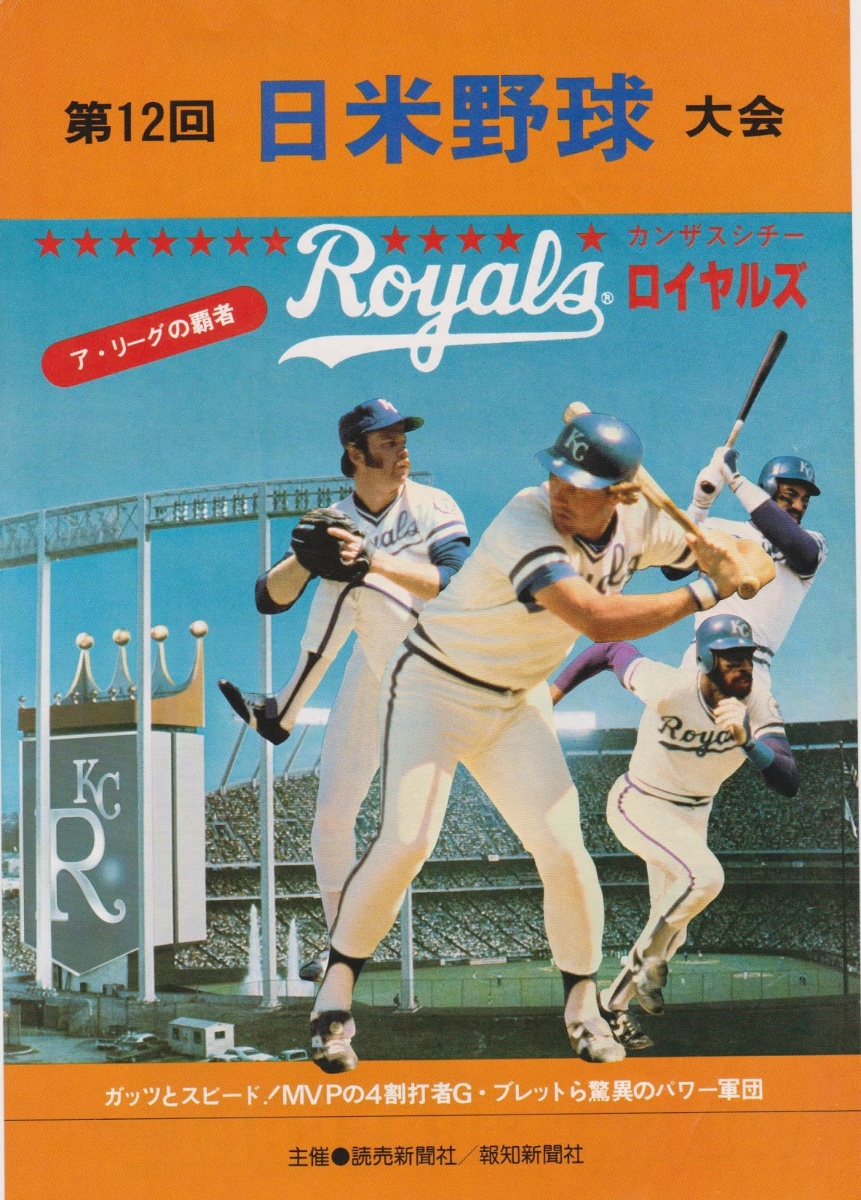
Every Monday morning we will post an article from SABR’s award-winning books Nichibei Yakyu: Volumes I and II. Each will present a different chapter in the long history of US-Japan baseball relations. This week Chris Hicks tells us about the 1981 Kansas City Royals visit to Japan.
For decades it had been the hope of Matsutaro Shoriki, the owner of the Yomiuri Shimbun Group, a conglomerate that produces the Yomiuri Shimbunnewspaper and owns the Yomiuri Giants baseball team, that there would one day be a “true world series” played between the champions of the World Series and the Japan Series. After Matsutaro’s death in 1969, his son Toru continued the dream. The concept gained traction in 1971 when Commissioner Bowie Kuhn accompanied the Baltimore Orioles on their Japanese tour. When he returned to the States, Kuhn announced that he and the baseball commissioner of Japan, Nobumoto Ohama, had agreed to a “‘joint feasibility study’ of an international World Series.” Although no agreement emerged from the study, Shoriki continued to invite championship-caliber major-league teams to face off against the Japanese champion. Arrangements for the postseason tours, however, had to begin before the start of each season so Shoriki needed to guess which club would win the World Series. In 1974 he invited the New York Mets, a season after they had won the National League pennant, and in 1978 the Cincinnati Reds, but neither came to Japan as the reigning World Series champion.
Early in 1981, Shoriki invited the Kansas City Royals, the defending American League champions, gambling on their continued success. Should the Royals win the 1981 World Series and the Yomiuri Giants win the Japan Series, then the eight scheduled games between the teams would fulfill the dream of a “true world series.” The Royals’ full schedule in Japan consisted of 17 games played in 14 cities between October 28 and November 24,1981.
But the 1981 season was filled with frustration for the Royals. The team struggled in the first half of the season with a 20-30 record before the players union went on strike on June 12. The strike ended 50 days later. As the players returned to the field for the All-Star Game in Cleveland on August 9, the owners hammered out the logistics of the interrupted season. The division leaders when the strike began would face the division winners (based on records after the strike) of the post-strike season in the playoffs.
Not long after the season resumed, the Royals fired manager Jim Frey and replaced him with Dick Howser. The team went on to win 30 of its last 53 games and finish at the top of the AL West Division in the season’s second half. The season’s arbitrary break into unequal halves shut some teams with overall winning records out of the playoffs. In the AL West, the Royals, with an overall 50-53 season record, went to the postseason while the Texas Rangers (57-48) and Chicago White Sox (54-52) stayed home. Royals third baseman George Brett, commenting on the Royals’ inclusion in the playoffs, said, “We don’t belong. We know it.” Oakland swept the Royals to advance to the second round of the playoffs.
Looking for a better 1982 season, Howser used the games in Japan to test staff changes and prepare his team. Immediately after the season, the Royals had hired Cloyd Boyer as the pitching coach and Joe Nossek as the third-base coach so that these integral members of the coaching staff could use the trip to get to know the team’s players. Coach Jim Schaffer and minor-league instructor Gary Blaylock also accompanied the team.
The Royals took nearly all of their regular players to Japan, including stars Brett, Frank White, Willie Wilson, Dennis Leonard, and Dan Quisenberry. The only regular not making the trip was center fielder Amos Otis, who had just signed a new two-year contract and declined to go, stating that his priority was healing a leg injury and preparing for the 1982 season. Howser brought along a handful of young players who spent most of the 1981 season with Triple-A Omaha. The tour offered an ideal opportunity to evaluate Onix Concepcion, Tim Ireland, Pat Sheridan, Daryl Motley, and Atlee Hammaker.
For Hammaker, the Japan tour was not just about baseball. In 1954, after serving in the Korean War, his father, Col. Charles A. Hammaker, was stationed in Kyoto, where he met his future wife, Saeko. As a child, Atlee lived in Japan for a year with his grandparents, an aunt, and his mother while his father served in the Vietnam War. Hammaker’s grandmother was at the airport to greet her grandson and the rest of the Royals team when they arrived on October 28.
The team spent two days resting and practicing before beginning the 17-game series on Saturday, October 31. The first two games were against the Central League champion Yomiuri Giants in what the organizers had hoped would be the opening games of the unofficial international world series.
A crowd of 32,000 came to Korakuen Stadium in Tokyo to watch Jim Wright face Giants ace Suguru Egawa, who captured the 1981 Central League MVP honors with a 20-6 record and a 2.28 ERA. Despite giving up two hits in the first inning and six hits overall, Egawa pitched well, blanking the Royals though four innings. “[He] had good control today,” said Wilson. “He can make it in the majors.” By the fifth inning, however, Wilson noticed something. “He was running the same pattern on me, fastball, curveball, fastball, curveball. … [H]e threw the fastball, so I waited for the curve.” Wilson guessed right and sent the next pitch into the right-field stands to give the Royals a 2-0 lead. The Royals added another run in the seventh when Wilson singled to score Clint Hurdle. Meanwhile, Wright held the Giants to three hits before Hammaker entered the game in relief in the fifth inning. With his Japanese relatives in the stands watching, Hammaker pitched three one-hit, shutout innings to earn the 3-0 victory before Quisenberry closed out the game. Howser praised his pitchers’ performances: “Our pitchers were too good for the Giants.”
In the third inning Hal McRae collided with Giants second baseman Kazunori “Toshio” Shinozuka while breaking up a double play, injuring his calf. McRae was removed from the field on a stretcher and taken to the hospital. He missed the next four games and was not at full strength when he returned.
The second game between the Royals and Giants at Korakuen was an extra-inning nailbiter. The Royals scored in the fourth inning as Frank White doubled off Giants starter Takashi Nishimoto and later scored on a balk. The Giants came back with a vengeance in the bottom of the inning when Yasutomo Suzuki hit a two-run double and Takashi Yoshida hit a pitch from Rich Gale over the outfield wall to score three more runs, making it a 5-1 ballgame. The Royals responded with two in the fifth on a two-run home run by Onix Concepcion but missed an opportunity for a third run when Frank White was unable to knock in Willie Wilson, who tripled with two outs. Home runs by George Brett in the sixth and Jamie Quirk in the seventh tied the game, 5-5. The Giants had opportunities in the sixth and eighth innings but failed to score. Yomiuri reliever Mitsuo Sumi struck out seven Royals in a row in the eighth and ninth and the beginning of the 10th before Concepcion doubled, stole third, and scored on a single by Wilson. Renie Martin held the Giants scoreless in the bottom of the 10th for the thrilling 6-5 victory.
The Royals enjoyed the Japanese fans and their cheering sections with their rhythmic chants accompanied by horns, drums, and whistles. Quisenberry and Martin made up songs to the beat. “We kinda hot dog for them during batting practice and make them laugh,” said Quisenberry. They’re so much nicer than American fans. No fights in the stands, always polite, quick to laugh.”
The third game of the series had the Royals taking on a new opponent, the Japanese All-Stars, at Korakuen Stadium on Tuesday, November 3. Six future members of the Japanese baseball Hall of Fame appeared in the game: Yutaka Fukumoto, Tatsunori Hara, Choji Murata, Hiromitsu Ochiai, Tsutomu Wakamatsu, and Koji Yamamoto. The scoring got underway in the first on a two-run homer by Willie Aikens. But in the bottom of the first, Tomohisa Shoji began with a double off Larry Gura. Gura then walked Hiromichi Ishige and threw a wild pitch, allowing the runners to move up a base. Yamamoto singled Shoji home and Ochiai singled to score Ishige. Hara followed with a three-run inside-the-park home run to give the All-Stars a 5-2 lead. Shoji added another run with a solo homer in the second. Neither team scored again until the top of the seventh inning, when Brett hit a solo home run off reliever Tatsuo Komtasu. In the bottom of the inning, Ishige put the final nail in the Royals’ coffin with a solo homer of his own, handing the Royals their first defeat of the series. Japanese Crown Prince Akihito and Princess Michiko witnessed the 7-3 victory.
The Royals saw new surroundings but a familiar opponent when they played in Sendai’s Miyagi Baseball Stadium against the Yomiuri Giants on November 5. Yomiuri began with a run in the first inning as Yasuyuki Nakai doubled off Atlee Hammaker and came home on Kazunori Shinozuka’s single. The Giants scored three more in the third. Starting pitcher Shoji Sadaoka singled, Tadashi Matsumoto tripled, and Nakai hit another double before scoring on a fly out by Shinozuka. Yomiuri struck for three more runs off relief pitcher Jim Wright in the seventh inning to make the final score 7-0. Sadaoka gave up just one hit in six innings and reliever Hisao Niura pitched three innings of two-hit shutout ball to draw the series even at two wins and two losses. Yomiuri manager Motoshi Fujita noted, “Sadaoka succeeded in keeping the balls low and his balls were quite well controlled today.”
In the fifth game the Royals played southwest of Tokyo at Yokohama Stadium against a combined team of Taiyo Whales and Yomiuri Giants. The Royals had no trouble getting runners on base but struggled to get them across home plate in a 9-1 drubbing. In a sloppy first inning, the Japanese scored three runs on two walks, two errors by Brett, a sacrifice fly and a passed ball. The Royals pushed a run across in the second inning on Pat Sheridan’s sacrifice fly with the bases loaded but the Japanese added runs in the third and sixth innings to lead 5-1 before Tomio Tashiro sealed the game with a three-run homer in the seventh. The Giants-Whales added a final run in the eighth. The Royals offense left 13 runners on base. Howser noted, “Our boys are hitting well … but the ground is slippery resulting in many errors. We will try to win three straight games from Sunday.” While their husbands were playing, the wives did a little sightseeing. They visited Fuji-Hakone-Izu National Park and the Great Buddha, a 37-foot bronze statue dating from the thirteenth century, in Kamakura.
The series returned to Korakuen Stadium as the Royals took on the Giants in the sixth game on Sunday, November 8. Kansas City jumped out to an early lead as Brett hit a solo home run (his third of the series) in the first off Yomiuri starter Hajime Kato, but the lead was fleeting as starter Dennis Leonard gave up a grand slam to Kenji Awaguchi in the third inning. Willie Aikens and Yasutomo Suzuki also hit solo home runs as Yomiuri won, 6-2. The loss was the Royals’ fourth straight and the visitors had a dismal 2-4 record.
In Game 7 on Tuesday, November 10, at Seibu Stadium, a combined Yomiuri Giants-Seibu Lions team looked to hand the Royals their fifth straight loss. George Brett started things off with a two-run home run in the first inning off starter Masayuki Matsunuma. But the lead was lost in the second inning when the Japanese scored four against starter Paul Splittorff, highlighted by a two-run double by Hiromichi Ishige and a solo home run by Tatsunori Hara. Brett struck back with a solo homer in the third to narrow the score to 4-3. The Japanese however, solidified their lead in the next inning as Ishige doubled in two runs after a successful double steal by Yoshiie Tachibana and Takanori Okamura. Hara knocked in the final run in the fifth inning on a sacrifice fly to hand the Royals a 7-3 loss. With the loss, the Royals had dropped five straight, setting the record for the most consecutive losses by a major-league team in a postseason tour of Japan. After the game, Howser said he “regretted” being the first American pro manager to lose five straight in Japan. He noted that his pitching staff “was in poor condition” and that except for Brett the Royals “couldn’t buy a hit.”
The Giants and Royals left the Tokyo area the next day. The fans at Kusanagi Ballpark in Shizuoka were treated to a pitchers’ duel between the Royals’ Mike Jones and the Giants’ Hisao Niura in the eighth game. Over the first five innings, Jones blanked the Giants on one hit and Niura nearly matched him with two hits surrendered. Kazuaki Fujishiro replaced Niura in the top of the sixth and gave up a leadoff double to U.L. Washington. Washington moved to third on a fly out and scored on John Wathan’s single. Relievers Renie Martin and Dan Quisenberry locked down the game with four innings of one-hit shutout ball as the Royals won, 1-0. “I’m relieved,” said Howser after the win. “Our pitching has shaped up and [I] think we could play better in the remaining games.”
The next day, November 12, the teams traveled west to Nagoya, where Kansas City played a combined Yomiuri and Chunichi Dragons team in the ninth game of the series. Brett continued hitting the ball well, belting a solo homer off starter Tatsuo Komatsu in the first inning. From there on, however, the only scoring came from the Japanese squad. Royals starter Larry Gura struggled, giving up a two-run homer to Yasunori Oshima and two solo home runs to Masaru Uno. After the 5-1 loss, Howser noted, “A homer by George Brett isn’t enough to win a ballgame.”
Games 10 through 12 occurred in the area around Kyoto and Osaka. The schedule also allowed time for the Royals to do some sightseeing. The group shot the rapids on the Hozu River in traditional flat-bottomed boats steered with oars and powered by the current and bamboo poles. They also went to Nijo Castle in Kyoto, a home of the Shogun from the early 1600s, that was later named a UNESCO World Heritage Site. The touring party not only enjoyed the cultural sites but also shopping and eating. “The Royals are eating plenty of things they can’t spell and … some things they’d rather not have identified,” wrote Mike McKenzie of the Kansas City Star. “We’re eating like kings,” said Quisenberry. “Some guys are gaining weight. Not getting like Sumo wrestlers, but gaining.” During his brief time in Japan, Quisenberry became a Sumo fan. “They’re better than our pro wrestling. They psych each other out, and they’re for real. I can’t understand anything they’re saying, but it’s fun to watch.”
On Saturday, November 14, the Royals played a Yomiuri and Hankyu Braves combined team at Nishinomiya Stadium. The teams stayed locked in a pitching duel with the score tied 1-1 until the eighth inning. Royals starter Dennis Leonard surrendered just the one run and three hits in seven innings, while the Japanese used four pitchers to hold the Royals. In the top of the eighth, designated hitter Hal McRae clocked a two-run homer off reliever Tomoyuki Sekiguchi to take the lead. In the bottom half of the inning, Quisenberry relieved Leonard and gave up a two-run home run to Kenji Awaguchi that tied the game at 3-3. The game remained scoreless through the 10th inning and then was declared a tie.
With the 3-6-1 record, the Japanese media claimed the Royals were either not taking the tour seriously or were just not that good. After the 10 games, the Japanese had outhit them .238 (78-for-328) to .217 (74-for-341) and outscored them 49 to 23. Fans complained that they paid $22 to $25 a ticket to see “a feeble American team.”
“We are trying,” said Dennis Leonard. “They are just embarrassing us. We’ve been outhit, outpitched, outplayed. I think when we came over here, we thought it was going to be a cakewalk. Instead, we’re struggling.” George Brett said, “Nobody likes to lose. We’re professionals. We go out and try to win every game. We just can’t seem to get the big hit when we need it.”
“The team is mad,” said Quisenberry. “It’s depressing. A lot of guys 5-feet-6 and 150 pounds are hitting home runs against us. Their pitchers are throwing straight fastballs, letter high, and we’re popping up and striking out. The game is over, and we’re beaten 7-1, and we can’t figure out why or how. … Players come back to the bench after striking out or giving up a key hit, and they’re mad at the world. Not quite like the regular season, but almost. We don’t like to get embarrassed.”
Howser and some players blamed the losses on the lengthy layoff between the end of the Royals’ season and the start of the games in Japan, noting that the Japanese had ended their playoffs only days before the start of the tour. “Not working out before we came hurt us more than I thought it would,” noted McRae. “Personally, I’m not in good shape,” Leonard admitted. “In previous years, we probably could have overcome [the layoff],” said Frank White. “But the Japanese players have improved, especially their pitching.” Quisenberry agreed: “About 50 percent of the pitchers I’ve seen could play in the major leagues. They are much more surehanded than we are in the field. … Their hitters are very disciplined, hardly ever striking out with their short, compact swings.”
Read the full version of this article on the SABR website
 SABR Asian Baseball Research Committee Blog