
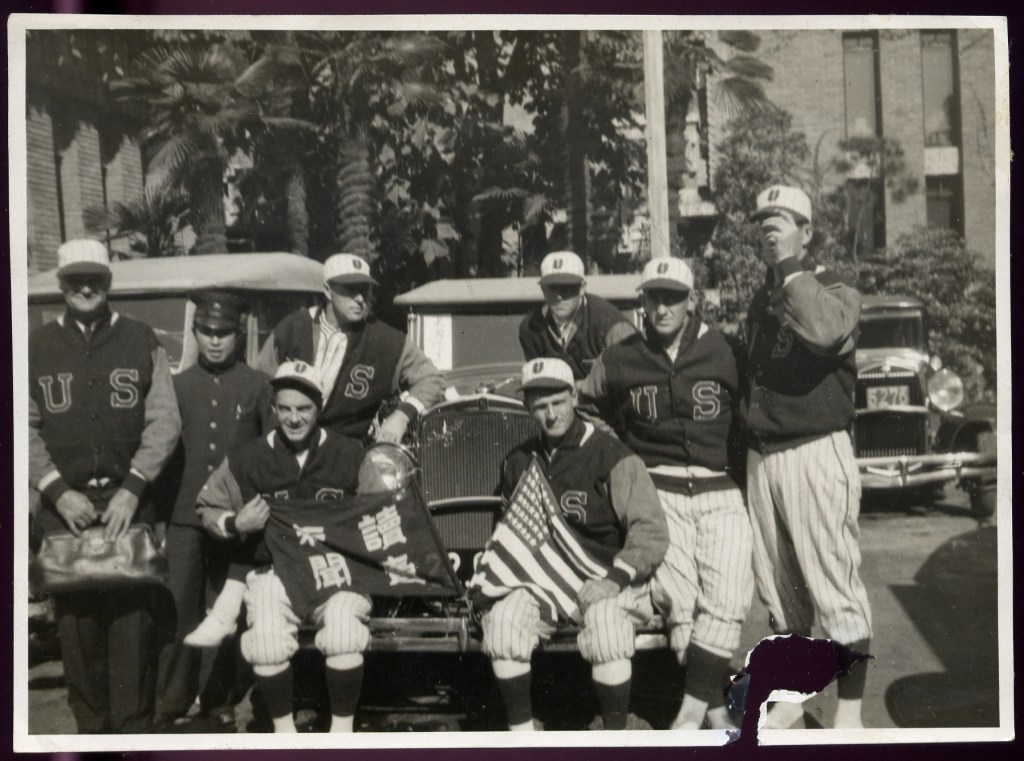
by Dennis Snelling
Every Tuesday morning we will post an article from SABR’s award-winning books Nichibei Yakyu: Volumes I and II. Each will present a different chapter in the long history of US-Japan baseball relations. This week Dennis Snelling tells us about the 1931 Major League tour of Japan.
It was a tour initially framed by the dreams of retired fringe major-league outfielder Herb Hunter, the continuing quest of a Japanese newspaper publisher to bring Babe Ruth to Japan before he retired as a player, and the metastasizing of Japanese militarism.
The tour ended with the best baseball team to visit Japan up to that time—including seven future Hall of Famers—winning all 17 games they played in the country, Japan’s political landscape in violent disarray, Babe Ruth still not having visited the country, and the beginning of the end of Herb Hunter’s global baseball aspirations.
By 1931, Hunter was considered “Baseball’s Ambassador to Japan.” He had first crossed the Pacific Ocean 11 years earlier with a group of minor-league and marginal major-league players. During that trip, Hunter partnered with pitcher Charlie Robertson to earn money on the side, coaching the Waseda University baseball team.
Hunter developed an affinity for the country— and the potential it offered him to make his mark on the baseball world—returning in 1921 to coach the baseball teams of both Waseda and Keio universities, wearing a chrysanthemum in his lapel each day. The San Francisco Chronicle reacted to this news by derisively challenging its readers to visualize the ex-San Francisco Seals outfielder coaching baseball to anyone, since Hunter’s reputation was that of the proverbial million-dollar athlete with a ten-cent head. He was physically gifted, but legendary for his onfield blunders.
He once executed an outstanding running catch with the bases loaded and one out in the ninth, only to absent-mindedly exit for the clubhouse, oblivious to the fact that the ball was still in play. On another occasion, with two out and the bases loaded, he decided to showboat on an easy fly, making a one-handed swipe at the ball, which he dropped. Three runs scored.
It was said that Hunter had once nearly spiked himself dodging a line drive. “He played that ball like a camel,” the account went. “He was not hurt but he had a narrow escape. A lot of runs scored while Herbie was untangling himself.”
Even when Hunter’s efforts won a game, it sometimes resulted from a bonehead move. He stole home in a game against Portland on a 3-and-0 count and two runners on base. He was called safe, his run the eventual game-winner despite the fact that he never touched home plate, not to mention that during the play the shocked hitter had backed into the catcher, which should have been ruled interference. Al C. Joy of the hometown San Francisco Examiner wrote, “Just why he stole home at that particular moment nobody seems to know. And just why Umpire Casey did not call him out for several reasons nobody seems to know.”
Despite his shortcomings, Hunter’s connections to Japanese universities enabled him to organize a troupe of major leaguers to Japan in 1922, and make several subsequent visits, including in 1928, when he enlisted Ty Cobb, Bob Shawkey, and Fred Hofmann. Hunter was now ready to bring another team of major-league all-stars to the Orient in 1931.
But he was not to be wholly in charge of the effort. Commissioner Kenesaw Mountain Landis, mindful of the international implications of such an event, and noting Hunter’s checkered success with past ventures—especially when it came to handling money—permitted the tour to proceed only under the supervision of veteran sportswriter Fred Lieb.
Hunter acquiesced—he had no choice—and once the tour was approved by major-league owners in mid-January, he prepared to finalize arrangements with Japan’s largest newspaper, Mainichi Shimbun.
Catching wind of Hunter’s intentions, Matsutaro Shoriki, publisher of the rival Yomiuri Shimbun, intercepted him, ultimately persuading the American to award his newspaper exclusive sponsorship of the tour’s Tokyo segment. When Mainichi Shimbun backed out of sponsoring games in other parts of the country, Shoriki stepped in despite the added, and significant, financial burden, gambling that the event would put his publication on the map.
Arrangements complete, Hunter returned to his home in Red Bank, New Jersey, where he managed a semipro team headquartered on his diamond, Hunter’s Field, while Fred Lieb pursued ballplayers for the trip.
A 14-man roster was ultimately secured, including four 1931 World Series participants: A1 Simmons, Mickey Cochrane, Lefty Grove, and Frankie Frisch. To Shoriki’s disappointment there would be no Babe Ruth—who claimed barnstorming and movie commitments—but Ruth’s teammate and co-American League home run champion Lou Gehrig would be there. So would Willie Kamm, Rabbit Maranville, Muddy Ruel, George Kelly, Lefty O’Doul, Larry French, and Tom Oliver. Boston Braves pitcher Bruce Cunningham, a right-hander who had won only three of 15 decisions in 1931, and outfielder Ralph Shinners, who was just completing his career in the International League, rounded out the roster.
Fred Lieb had thought the All-Stars unbeatable— although they did not start out that way.
The team initially gathered in California in early October for a series of games in the Bay Area, and lost four of five against lineups composed almost entirely of Pacific Coast League players. The third game, against the San Francisco Seals, proved the most embarrassing. Lefty Grove, who arrived after the first two games along with the other World Series participants, took the mound and was battered for six runs in the first inning. The All-Stars began pointing fingers, with Grove loudly complaining about not having enough time to warm up. The left-hander settled down, shutting out San Francisco from the second inning through the fifth and striking out seven. But the All-Stars lost, 7-4, while collecting only four hits.
Stateside exhibitions complete, the All-Stars boarded the luxury liner Tatsuta Maru for Japan; ship captain Shunji Ito, a talented golfer, accommodated the Americans by converting his deck-side course into a batting cage. On the way, there was a quick stop in Honolulu to play another tune-up game against locals.
During the brief sojourn in Hawaii, the team slaughtered a group of local semipros, 10-0, before 12,000 fans—many of them arriving from other islands. The famously dour Grove displayed uncharacteristic enthusiasm afterward, declaring himself enamored with Hawaii and musing, “.. .wonder what my chances are of buying a small place here, I can use this old sunshine in January and February.”
While the All-Stars cavorted in paradise, events in Asia were unfolding at a dramatic and dangerous pace. A month before the players’ departure for Japan, a renegade faction of the military, seeking war with China, destroyed a section of the South Manchuria Railway and blamed it on the Chinese. This contrivance provided the pretext for Japan to invade Manchuria; the Japanese government was caught off-guard by its own armed forces, but did nothing of consequence to curtail the action, and was widely condemned in the court of world opinion. As a result, the country the American ballplayers entered was far more dangerous and unstable than they appreciated.

Thousands of enthusiastic Japanese baseball fans were on hand when the Tatsuta Maru docked following its two-week passage. After the mayors of Yokohama and Tokyo made brief presentations, the players boarded a special train bound for the capitol. There, the party was met by limousines waiting to convey them through the streets of downtown Tokyo.
Fred Lieb described the journey “a continual ovation.” Special flags combining the emblems of the American and Japanese national banners were provided to those lining the route. Fans jammed the streets, pressing in on the motorcade as shouts of “banzai” and “welcome” rained down from office windows. Some of the more enthusiastic jumped onto limousine running boards to shake the hand of Rabbit Maranville or Lefty Grove—repeatedly shouting “Thirty-One!” at the latter in recognition of his total wins for Philadelphia that year.
The Americans were flabbergasted. “I will remember this reception to my dying day,” remarked Lou Gehrig. “I do not know of anything in my entire career that has touched me as much as this welcome.” Frankie Frisch added, “It made me feel like a great military hero or a man who had flown across the Pacific.”
Other than George Kelly, who had been a member of Hunter’s 1922 All-Stars, none of the players had previously visited Japan. The world was more compartmentalized than today, and the visitors were surprised and astonished by the modernity of Tokyo, on course to becoming one of the world’s major cities. At the same time, there were obvious differences in food, language, and customs—it was both fascinating and disorienting.
Because Japan lacked professional baseball, the Americans would challenge college teams from the Tokyo Big Six University League—the highest level of baseball in the country—as well as all-star teams of alumni from those colleges and a few industry-sponsored squads.
Despite massive unemployment in Japan due to the collapse of the silk industry, 65,000 attended the opening contest; the ceremonial first pitch was thrown by Japanese Education Minister Tanaka, decked out in formal dress, including a top hat. The starting pitcher for Rikkyo University, Takeshi Tsuji, pitched well, allowing only four hits and four runs, all unearned, in six innings. Three of the unearned runs were due to missed fly balls by the Japanese right fielder, who did not wear sunglasses—according to Fred Lieb, it was considered cowardly to use them.
Al Simmons complimented Tsuji afterward for his deceptive sidearm delivery and impressive control, but the first game was an easy, 7-0, win for the All-Stars behind Bruce Cunningham, who allowed only two hits.
The second game nearly resulted in a shocking Japanese victory. Masao Date, pitching for Waseda University, impressed Lieb, who afterward said that the Americans felt he would be a major league prospect if he were in the States. Date calmly escaped a first-inning bases-loaded jam by fooling Frankie Frisch on a full-count curveball, taken for strike three.
The game was tied, 1-1, until the seventh, when Larry French surrendered a bases-loaded two-run double that gave Waseda a 3-1 lead. French, the possessor of an explosive temper, was removed from the game and furiously hurled his glove in disgust upon reaching the bench, cursing and screaming, “I’ve traveled nine thousand miles to be knocked out of the box by a bunch of Japanese college players!”
Things did not get better. With only three pitchers along for the tour, others were utilized as emergency hurlers, including Lou Gehrig, who relieved French and allowed two more runs to score on a wild pitch and an out, stretching Waseda’s lead to four runs.
Lieb, whom Landis had made responsible for the comportment of the players, watched in horror as French began hurling racial epithets from the bench. He attempted to shush the pitcher, pointing to Viscount Taketane Sohma, sitting at the end of the bench. Sohma, director of general offices at the Imperial Palace, had been educated in America and understood every word. To Lieb’s relief, he diplomatically chose not react to French’s tirade, which continued despite Lieb’s entreaties.
The Americans ultimately stormed back to win, 8-5, saving French the embarrassment of losing, as Masao Date tired while Lefty Grove, who replaced Gehrig, struck out six straight batters on 19 pitches to end the game. Lieb later revealed that the All-Stars were arguing among themselves on the bench until Date walked the bases loaded and Lefty O’Doul promptly cleared them with a double to key a seven-run eighth inning.
Continue to read the full article on the SABR website


 SABR Asian Baseball Research Committee Blog