Tag: issei-baseball

  • Returning Home: The 1914 Seattle Nippon and Asahi Japanese American Tours

    Returning Home: The 1914 Seattle Nippon and Asahi Japanese American Tours

    by Robert Fitts

    Every Tuesday morning we will post an article from SABR’s award-winning books Nichibei Yakyu: Volumes I and II. Each will present a different chapter in the long history of US-Japan baseball relations. In this article Robert Fitts discusses the first Japanese American teams to visit Japan.

    INTRODUCTION

    Between 1890 and 1910, over 100,000 Japanese immigrated to the West Coast of the United States. Many settled in the urban centers of San Francisco, Los Angeles, and Seattle. Within a few years, each of these immigrant communities had thriving baseball clubs. The first known Japanese American team was the Fuji Athletic Club, founded in San Francisco around 1903. A second Bay Area team, the Kanagawa Doshi Club, was created the following year. That same year, newsmen at the Rafu Shimpo organized Los Angeles’s first Issei (Japanese immigrant) team. Other clubs followed in the wake of Waseda University’s 1905 baseball tour of the West Coast. Many players learned the game while still in Japan at their high schools or colleges. Others picked up the sport in the United States. The first Japanese professional club was created the following year by Guy Green of Lincoln, Nebraska. His Green’s Japanese Base Ball Team, consisting of Japanese immigrants from Los Angeles, barnstormed throughout the Midwest in the spring and summer of 1906.

    Seattle’s first Japanese American club, called the Nippon, was also organized in 1906. Shigeru Ozawa, one of the founding players, recalled that the team was not very good at first and was able to play only the second-tier White amateur nines. By 1907 the team had a large local following. In its first appearance in the city’s mainstream newspapers, the Seattle Star noted that “before one of the largest crowds seen at Woodlands park the D.S. Johnstons defeated the Nippons, the fast local Jap team, by a score of 11 to 5.” In May 1908, before a game against the crew of the USS Milwaukee,the Seattle Daily Times reported that the Nippon “have picked up the fine points of the great national game rapidly from playing the amateur teams around here every Sunday.”

    Two months later, the Daily Times featured the team when it took on the all-female Merry Widows. Mistakenly referring to the Nippons as “the only Japanese baseball club in America,” the newspaper reported, “when these sons of Nippon went up against the daughters of Columbia, viz., the Merry Widow Baseball Club, it is a safe assumption that the game played at Athletic Park yesterday afternoon was the most unique affair in the annals of the national game.” Over a thousand fans, including many Japanese, watched the Nippons win, 14-8.

    Soon after the game with the Merry Widows, second baseman Tokichi “Frank” Fukuda and several other players left the Nippon and created a team called the Mikado. The Mikado soon rivaled the Nippons as the city’s top Japanese team, with the Seattle Star calling them “one of the fastest amateur teams in the city.” In both 1910 and 1911, the Mikado topped the Nippon and Tacoma’s Columbians to win the Northwest Coast’s Nippon Baseball Championship.

    As Fukuda’s love for baseball grew, he realized the game’s importance for Seattle’s Japanese. The games brought the immigrants together physically and provided a shared interest to help strengthen community ties. It also acted as a bridge between the city’s Japanese and non-Japanese population, showing a common bond that he hoped would undermine the anti-Japanese bigotry in the city.

    In 1909 Fukuda created a youth baseball team called the Cherry—the West Coast’s first Nisei (Japanese born outside of Japan) squad. Under Fukuda’s guidance, the club was more than just a baseball team. Katsuji Nakamura, one of the early members, explained in 1918, “The purpose of this club was to contact American people and understand each other through various activities. We think it is indispensable for us. Because there are still a lot of Japanese people who cannot understand English in spite of the fact that they live in an English-speaking country. That often causes various troubles between Japanese and Americans because of simple misunderstandings. To solve that issue, it has become necessary that we, American-born Japanese who were educated in English, have to lead Japanese people in the right direction in the future. We have been working the last ten years, according to this doctrine.”

    As the boys matured, the team became stronger on the diamond and in 1912 the top players joined with Fukuda and his Mikado teammates Katsuji Nakamura, Shuji “John” Ikeda, and Yoshiaki Marumo to form a new team known as the Asahi. Like the Cherry, the Asahi was also a social club designed to create the future leaders of Seattle’s Japanese community, and forge ties with non-Japanese through various activities, including baseball. Once again the new club soon rivaled the Nippon as Seattle’s top Japanese American team.

    THE NIPPON TOUR

    During the winter of 1913-14, Mitomi “Frank” Miyasaka, the captain of the Nippon, announced that he was going to take his team to Japan, thereby becoming the first Japanese American ballclub to tour their homeland. To build the best possible squad, Miyasaka recruited some of the West Coast’s top Issei players. From San Francisco, he recruited second baseman Masashi “Taki” Takimoto. From Los Angeles, Miyasaka brought over 30-year-old Kiichi “Onitei” Suzuki. Suzuki had played for Waseda University’s reserve team before immigrating to California in 1906. A year later, he joined Los Angeles’s Japanese American team, the Nanka. He also founded the Hollywood Sakura in 1908. In 1911 Suzuki joined the professional Japanese Base Ball Association and spent the season barnstorming across the Midwest. Miyasaka’s big coup, however, was Suzuki’s barnstorming teammate Ken Kitsuse. Recognized as the best Issei ballplayer on the West Coast, in 1906 Kitsuse had played shortstop for Guy Green’s Japanese Base Ball Team, the first professional Japanese club on either side of the Pacific. He was the star of the Nanka before playing shortstop for the Japanese Base Ball Association barnstorming team in 1911. Throughout his career, Kitsuse drew accolades for his slick fielding, blinding speed, and heady play.

    To train the Nippons in the finer points of the game, Miyasaka hired 38-year-old George Engel (a.k.a. Engle) as a manager-coach. Although Engel had never made the majors, he had spent 14 seasons in the minor leagues, mostly in the Western and Northwest Leagues, as a pitcher and utility player. Miyasaka also created a challenging schedule to ready his team for the tour. They began their season with games against the area’s two professional teams from the Northwest League. On Sunday, March 22, they lost, 5-1, to the Tacoma Tigers, led by player-manager and future Hall of Famer Joe “Iron Man” McGinnity. The following Sunday the Seattle Giants, which boasted seven past or future major leaguers on the roster, beat them 5-1. Despite the one-sided loss, the Seattle Daily Times noted, “the Nippons … walked off Dugdale Field yesterday afternoon feeling well satisfied with themselves for they had tackled a professional team and had made a run.”

    In April 1914, Keio University returned for its second tour of North America. After dropping two games in Vancouver, British Columbia and a third to the University of Washington, Keio met the Nippons on April 9 at Dugdale Park in what the Seattle Daily Times called “the world’s series for the baseball championship of Japan.” On the mound for Keio was the great Kazuma Sugase, the half-German “Christy Mathewson of Japan,” who had starred during the school’s 1911 tour. The team also included future Japanese Hall of Famers Daisuke Miyake, who would manage the All-Nippon team against Babe Ruth’s All-Americans in 1934, and Hisashi Koshimoto, a Hawaiian-born Nisei who would later manage Keio.

    Nippons manager George Engel was in a quandary. His usual ace Sadaye Takano was not available and as Keio would host his team during its coming tour of Japan, he needed the Nippons to prove they could challenge the top Japanese college squad. Engel reached out to William “Chief’ Cadreau, a Native American who had pitched for Spokane and Vancouver in the Northwestern League, one game for the 1910 Chicago White Sox, and would later pitch a season for the African American Chicago Union Giants. Pretending that he was a Japanese named Kato, Cadreau started the game. According to the Seattle Star, “Engel was very careful to let the Keio boys know that Kato, his pitcher, was deaf and dumb. But later in the game Kato became enthused, as ball players will, and the jig was up when he began to root in good English.” Nonetheless, Cadreau handled Keio relatively easily, striking out 13 en route to a 6-3 victory.

    Throughout the spring and summer, the Nippons continued to face the area’s top teams, including the African American Keystone Giants, to prepare for the trip to Japan. Yet in their minds, the most important matchup was the three-game series against the Asahi for the Japanese championship. The Nippons took the first game, 4-2, on July 12 at Dugdale Park but there is no evidence that they finished the series. Not to be outdone by their rivals, the Asahi also announced that they would tour Japan later that year. Sponsored by the Nichi-nichi and Mainichi newspapers, the Asahi would begin their trip about a month after the Nippons left for Japan.

    The Nippon left Seattle aboard the Shidzuoka Maru on August 25. Their departure went unreported by the city’s newspapers as international news took precedence. Germany had invaded Belgium on August 4, opening the Western Front theater of World War I. Throughout the month, Belgian, French, and British troops battled the advancing Germans. Just days before the ballclub left for Japan, the armies clashed at Charleroi, Mons, and Namur with tens of thousands of casualties. On August 23, Japan declared war on Germany and two days later declared war on Austria.

    After two weeks at sea, the Nippon arrived at Yokohama on September 10. The squad contained 11 players: George Engel, Frank Miyasaka, Yukichi Annoki, Kyuye Kamijyo, Masataro Kimura, Ken Kitsuse, Mitsugi Koyama, Yohizo Shimada, Kiichi Suzuki, Sadaye Takano, and Masashi Takimoto. Accompanying the ballplayers was the team’s cheering group, consisting of 21 members and led by Yasukazu Kato. The group planned to attend the games to cheer on the Nippon and spend the rest of their time sightseeing.

    As the Shidzuoka Maru docked, a group of reporters, Ryozo Hiranuma of Keio University, Tajima of Meiji University, and a few university players came on board to welcome the visiting team. The group then took a train to Shinbashi Station in Tokyo, where they were met by the Keio University ballplayers at 2:33 P.M. The Nippon checked in at the Kasuga Ryokan in Kayabacho while the large cheering group, which needed two inns to accommodate them, settled down at the Taisei-ya and Sanuki-ya.

    Only two hours later, the Nippon arrived at Hibiya Park for practice. Not surprisingly, after the voyage they were not in top form. The Tokyo Asahi noted, “Even though the Seattle team is composed of Japanese, their ball-handling skills are as good as American players, and … their agile movements are very encouraging. … They hit the ball with a very free form, but yesterday, they did not place their hits very accurately, most likely due to fatigue. … The Seattle team did not have a full-fledged defensive practice with each player in position, so we did not know how skilled they were in defensive coordination, but we heard that the individual skills of each player were as good as those of Waseda and Keio. In short, the Seattle team has beaten Keio University before, so even though they are Japanese, they should not be underestimated. On top of that, they have good pitching, so games against Waseda University and Keio University are expected to arouse more than a few people’s interest, just like the games against foreign teams in the past.”

    The Nippon would stay in Japan for almost four months, but the baseball tour itself consisted of just eight games—all played during September against Waseda and Keio Universities. The players spent the rest of the time traveling through their homeland and visiting family and friends.

    Continue to read the full article on the SABR website

  • Solving the Mystery of Togo Hamamoto

    Solving the Mystery of Togo Hamamoto

    by Rob Fitts

    Originally published on RobFitts.com February 15, 2021

    The history of early Japanese American baseball is still being discovered. There is so much we do not know. Mainstream, English-language newspapers rarely covered Japanese American daily life or sport. When these newspapers did mention Japanese immigrant baseball, the articles were often garbled—full of misspellings, factual errors, and sometimes overt bigotry. On top of this, early twentieth century sportswriters enjoyed telling an entertaining story more than report fact. Piecing together history from these articles is challenging as most of the reports cannot be taken at face value but instead need to be confirmed by independent sources. As an example, let’s examine the story of Togo Hamamoto.

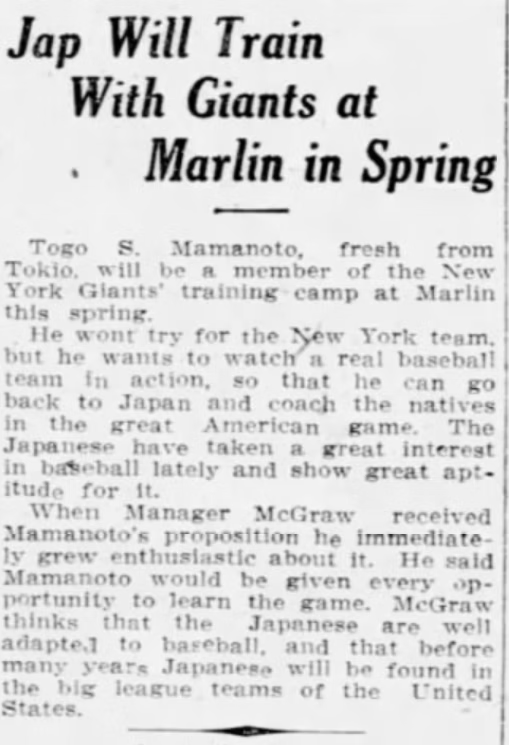
    In mid-January 1911, an intriguing article ran on the sports pages across the United States. On January 17th, New York Giants manager John McGraw announced that Togo S. Hamamoto of Tokyo would be joining the team at Marlin Springs, Texas, to observe American “scientific baseball.”

    A press release noted that Hamamoto, “who has the backing of a number of influential citizens of Tokyo, . . . will devote his time to mastering the game.”[1] “His backers plan to add professional baseball in their own country.”[2] “McGraw plans to do all in his power to spread the gospel of the game in foreign lands,” the release continued. He “is prophesying that some day [sic] a real world’s championship will be played with the United States and Japan as rivals.”[3] Newspapers across the country, from large-market dailies to bi-weekly rags in rural villages, reprinted the announcement.

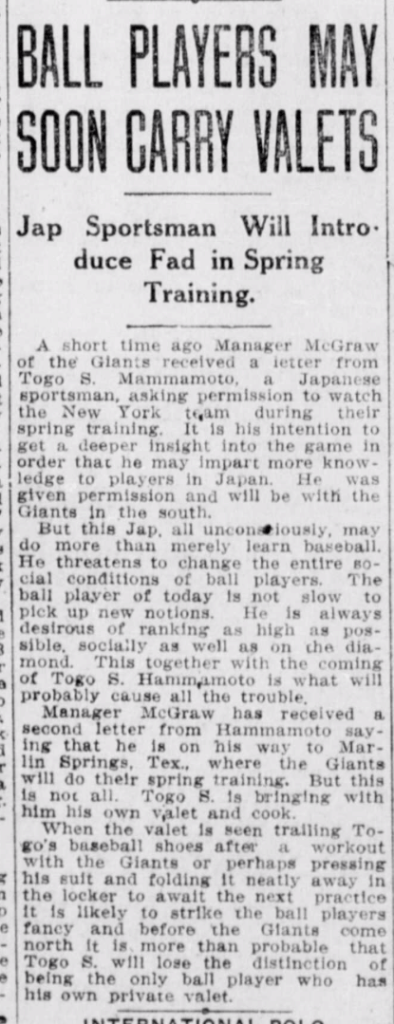
    About a month later, Hamamoto was in the news again. This time, reporters had transformed him from an observer into a player receiving a tryout. “Togo is a star player among the Japs, and will work out daily,” reported the Chronicle-Telegram of Elyria, Ohio. “He may play on the second team.”[4] But of more interest to the writers were reports of Hamamoto bringing his valet and personal cook to training camp.

    He “may do more than merely learn baseball. He threatens to change the entire social conditions of ball players,” joked an anonymous writer. “When the valet is seen trailing Togo’s baseball shoes after a workout with the Giants or perhaps pressing his suit and folding it neatly away in the locker to await the next practice, it is likely to strike the ball players’ fancy and before the Giants come north it is more than probable that Togo S. will lose the distinction of being the only ball player who has his own private valet.”[5] Another writer worried, “McGraw fears a valet oiling Togo’s shoes and fanning him between innings, may cause the Giants to insurge [sic] and ask for the same treatment.”[6]

    On March 9, the sports editor of the New York Times asked, “Where is Togo Hamamoto, the Japanese athlete, who was going to train with the New York Giants at Marlin Springs? Togo burned up the cables getting permission from Manager McGraw to get inside information on training a baseball team, and McGraw gave him permission to join the camp. But he hasn’t appeared, and nothing has been heard from him.”[7] The Giants began practicing in Marlin’s Emerson Park on February 20 and stayed until March, practicing in Emerson Park. Reports from the Giants’ spring training camp fail to mention Hamamoto and newspaper articles do not provide a reason for his absence.

    When I wrote the first draft of Issei Baseball in 2018, I wondered if the story was a hoax dreamed up by a bored sportswriter yearning for the start of the baseball season. My searches of immigration records found no man named Hamamoto arriving from Japan in 1911, plus his name does not appear in Japanese baseball histories. On top of that, his name is suspiciously similar to Irving Wallace’s fictional character Togo Hashimura, the Japanese “school boy” whose book of fictitious letters describing life in America had become a best seller in 1909. I concluded that the articles written about Hamamoto attending spring training were a hoax written for amusement.

    That changed in early 2019 when I received a copy of Tetsusaburo “Tom” Uyeda’s previously classified FBI file. Uyeda, who had played on Guy Green’s 1906 Japanese Base Ball Team and the 1908 Denver Mikado’s Japanese Base Ball Team, was unjustly convicted in 1942 by the U.S. Alien Enemy Hearing Board as a Japanese spy. During his appeal, Uyeda explained; “In the Spring of 1912, I received a letter from one Mr. Hamamoto who asked me to come over to St. Louis, Missouri, to assist in organizing a baseball team.”[8]

    Refocusing my research on St. Louis, I found a Togo S. Hamamoto listed in the city directory as valet working for Hugh Kochler, a wealthy brewer. Born Shizunobu Hamamoto in Nagasaki on December 25, 1884, he arrived in Seattle on the SS Shimano Maru on April 22, 1903. He made his way to St. Louis in 1906 and began working as a valet while reporting on Major League baseball for the Nagasaki-based newspaperSasebo. He attended four or five games per week and became friendly with a number of the players, including Cristy Mathewson, Lou Gehrig, and Babe Ruth [9].

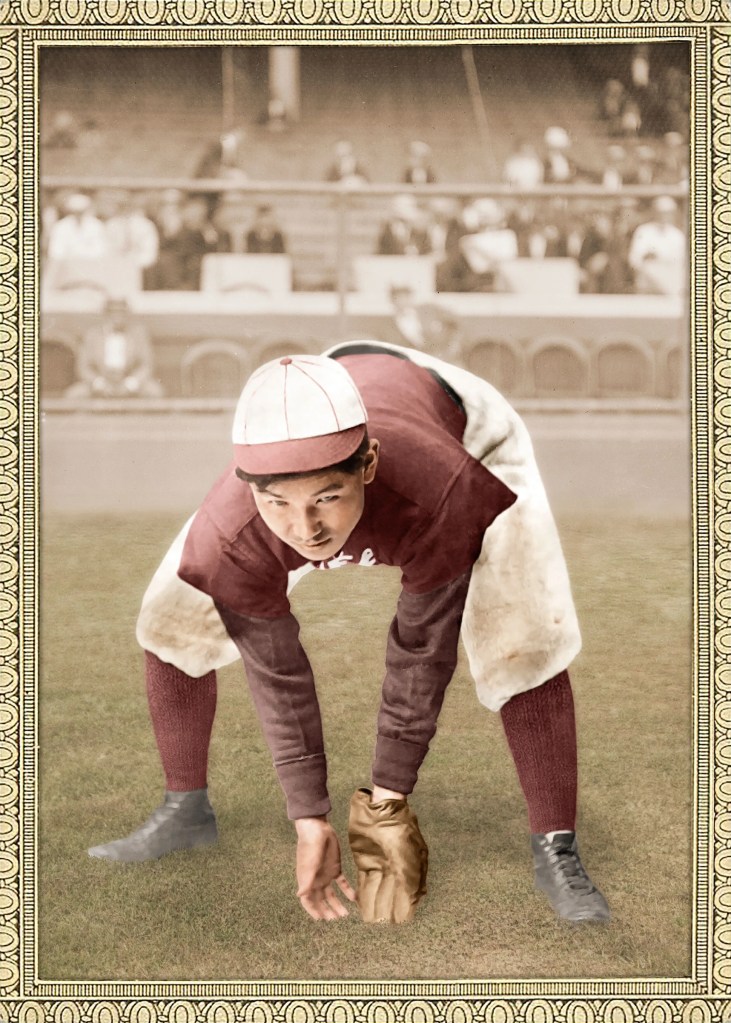
    But did Hamamoto attend the Giants’ spring training in 1911? There was no evidence that he had until June 2020 when Robert Klevens, owner of Prestige Collectibles and an authority of Japanese baseball memorabilia, found this postcard.

    The picture shows Hamamoto wearing a Giants uniform made between 1909 and 1910 (the team used a different logo on their sleeve in 1908 and switched to pinstripes in 1911). The solid stocking pattern was used by the Giants only in 1909, but we do not know if the Giants issued these to Hamamoto or if he wore his own stockings. 

    (Illustration from Baseball Uniforms of the 20th Century by Marc Okkonen

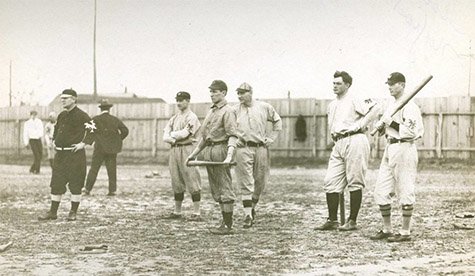
    As new uniforms were expensive and teams did not have large budgets, it was common for players to practice in uniforms from previous seasons. This picture from spring training in 1912, for example, shows Giants players in various uniform styles.

    I have not been able to locate enough pictures of Emerson Park to confirm if the photograph of Hamamoto was taken there, but the wooden fence in the photograph is similar to the fence surround the ballpark. Efforts to identify the Mr. S noted on the back has been fruitless.

    So even though the postcard does not prove that Hamamoto attended the Giants spring training in 1911, it is likely that the newspaper stories were partly accurate and that he eventually arrived. Hamamoto’s time with the Giants, however, did not lead to a professional baseball league in Japan. Unsuccessful attempts to create a pro circuit did not begin until 1920s and it was not until the creation of Japanese Baseball League in 1936 that Japan would have a stable professional league.

    Hamamoto would eventually turn his back on baseball. A few years later, he was in the stands watching his home-town Browns battle Walter Johnson and the Washington Senators when a St. Louis batter popped out in a key situation. “Some of the people behind me, and one of them was a lady, used such language—oh, it was so bad that I decided baseball did not always contain the three cardinal principals which I think a sport should have—Dignity, Honesty, and Humor. Since then I have not gone to ball games.”[10]

    Around 1916, while still working as a valet for Kochler, Hamamoto took up golf. He played at every opportunity and soon mastered the sport. In 1929, he won St. Louis’s Forrest Park Golf Club’s championship and went on to play in several national amateur championships. Upon his father’s death in 1933, he returned to Nagasaki to inherit the estate. At the end of World War II, he became an interpreter for the police in Haiki, Japan.[11] The year of his death is unknown.


    [1]
    Salt Lake Telegram, January 17, 1911, 7.

    [2] Akron Beacon Journal, January 18, 1911, 8.

    [3]Salt Lake Telegram, January 17, 1911, 7.

    [4]Chronicle-Telegram, February 23, 1911, 3.

    [5]Winnipeg Tribune, February 24, 1911, 7.

    [6]Elyria Chronicle-Telegram, February 23, 1911, 3.

    [7]New York Times, March 9, 1911, 12.

    [8] Tetsusaburo Uyeda to Edward J. Ennis, January 3, 1944. World War II Alien Enemy Detention and Internment Case Files, Tetsusaburo “Thomas” Uyeda, Case 146-13-2-42-36.

    [9]St. Louis Post-Dispatch, August 1, 1929, 19.

    [10]St. Louis Post-Dispatch, August 1, 1929, 19.

    [11]St. Louis Star and Times, December 4, 1945, 22.

  • The First Japanese Professional Game Took Place in …. Kansas?

    The First Japanese Professional Game Took Place in …. Kansas?

    by Rob Fitts

    The first Japanese professional baseball game took place not in Tokyo, not in Osaka, or even in Japan, but in a tiny town in Northeastern Kansas.

    In 1906 much of United States was enthralled by Japan and all things Japanese. Japan had just emerged as the improbable victor in the Russo-Japanese War and the year before the Waseda University baseball club had toured the West Coast. Guy W. Green, the owner of the Nebraska Indians Baseball Club, decided to capitalize on the fad by creating an all-Japanese baseball team to barnstorm across the Midwest. It would be the first Japanese professional team on either side of the Pacific.

    Guy W. Green (center) with his Nebraska Indians Base Ball team ca. 1905

    The early twentieth century was the heyday of barnstorming baseball. Independent teams crisscrossed the country playing in one-horse towns and large cities. There were all female teams, squads of only fat men, clubs of men sporting beards, and teams consisting of “exotic” ethnicities. These independent squads were often called “semi-professional” to differentiate them from teams in Organized Baseball (clubs formally associated with Major League Baseball), but they were professional enterprises. The teams signed players to contracts, paid salaries during the season, provided transportation and housing on the road, charged admission to games, and were intent on turning a profit.

    Although Green would claim that he had “scour[ed] the [Japanese] empire for the best players obtainable,” he did nothing of the sort. In early 1906 Green instructed Dan Tobey, captain of the Nebraska Indians, to form a team from Japanese immigrants living in California. Players congregated our March 15 in Havelock, Nebraska for two weeks of practice. It soon became evident that not all of his recruits were strong enough to play on a professional independent squad, so Green and Tobey decided to bolster his roster with Native Americans —hoping that most spectators would not be able to tell the difference.

    The starting lineup featured five Japanese: Toyo Fujita, a writer for the Rafu Shimpo newspaper, at first base; Tetsusaburo Uyeda from Yamaguchi Prefecture at second; 21-year-old Ken Kitsuse from Kagoshima at short; and 21-year-old Umekichi “Kitty” Kawashima from Kanagawa and a man identified only as Naito in the outfield. Manager Dan Tobey and Nebraska Indian veteran Sandy Kissell shared the pitching duties and played outfield on their off days. Seguin, another member of the Nebraska Indians, was the catcher. Roy Dean Whitcomb, an 18-year-old Caucasian from Lincoln, usually played third base under the name Noisy, while a man known only as Doctor filled in as necessary.

    1906 Advertising Card,
    Ken Kitsuse Collection, National Baseball Hall of Fame

    On evening of April 13, Green’s Japanese Base Ball Team left Havelock and headed south to begin a twenty-five-week tour that would cover over twenty-five hundred miles through Nebraska, Kansas, Oklahoma, Texas, Arkansas, Indiana, Illinois, Iowa, and Missouri. Their first stop was Frankfort, a small town of about 1,400 people in northeastern Kansas, where they would play the town’s high school squad.

    Frankfort, Kansas circa 1906

    Prior to the game, Guy Green sent out promotional material and flooded local newspapers with advertising and press releases. At the time, there were so few Japanese living in the Midwest that many rural farmers had never seen a Japanese person. So, Green’s advertisements emphasized the players’ foreignness and the uniqueness of the team. A typical announcement read, “Green’s [team] are the most novel baseball organization the world has ever known. Every player is a genuine Japanese. Not one of them can speak a word of English. They do all their coaching in Japanese and is certainly the most Japanesy Japanese you have ever listened to.”

    Playing on the public’s fascination with the Russo-Japanese War, Green also concocted fictional backgrounds for his players. An April 13, 1906 article in the Frankfort Review noted, “One of the most interesting members of Green’s Japanese baseball team is Kitsuse, who left school in Japan to serve during the last great war with Japan. He was wounded in the left leg at Mukden so severely that he was compelled to go home and even yet he limps slightly. He is one of the best me on the team, however, and always a great favorite with the crowds.” Kitsuse, however, immigrated to California on June 8, 1903, almost two years before the 1905 Battle of Mukden.

    1906 Advertising Card, Ken Kitsuse Collection, National Baseball Hall of Fame

    On Sunday, April 15 the two teams met on a leveled field just outside of town. There were no grandstands or bleachers—spectators sat and stood on a raised berm that surrounded the diamond. The high schoolers took the field in brand-new red and grey uniforms that had just arrived a couple of days before. The Japanese squad wore white pants reaching just below the knees, wide leather belts, maroon stockings, maroon undershirts, and a winged-collared maroon jersey with “Greens Japs” stitched in white block letters across the chest. The caps were white with maroon bills.

    As the high school contained just 41 students, the match should have been an easy victory for Green’s independent team. Perhaps seeing the game as an opportunity to allow his weaker players to gain experience, Tobey started a mostly Japanese lineup. But Tobey had underestimated the skinny, 15-year-old redhead on the mound. The teenage ace, Fairfield “Jack” Walker would go on to pitch for the University of Kansas in 1911-12 and professionally in the Class D Nebraska State League and the Eastern Kansas League. Although a quiet kid, the Horton Headlight noted “when playing Walker wears a perpetual grin that makes a lot of batters mad because they think he is laughing at them.”

    Besides Walker, the school’s lineup consisted of George Moss behind the plate; a boy identified only as Russell at first; Harold Haskins at second; Willis Cook at third; Leo Holthoefer at short; and Robert Barrett, John McNamara and Walker (unknown first name) in the outfield.

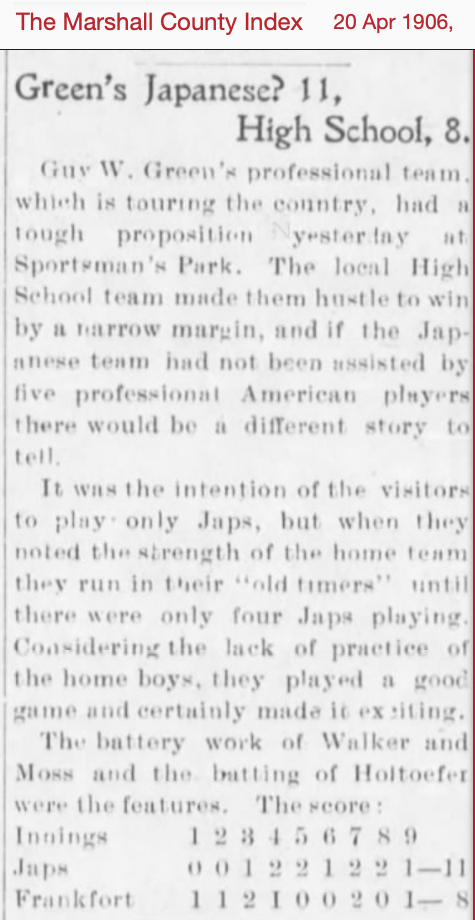
    The schoolboys jumped out to an early 4-1 lead after three innings, forcing Tobey to bring in what the Marshall County Index called “five professional American players.” The visitors battled back, scoring in every inning after the second, to eventually win 11-8. The Frankfort Review reported, “A large number of people witnessed the game and they prounce [sic] it one of the best games ever played here.”

    The near loss to schoolboys confirmed Tobey’s view that many of his Japanese players were not talented enough for an independent team. Green’s Japanese squad would stay on the road until October 10, playing about 170 games and winning 122 of the 142 games for which results are known, but there is no record of the team using an all Japanese starting lineup again.

    Despite the lengthy tour and the uniqueness of the club, The Sporting News, as well as big market newspapers in New York, Washington and Los Angles, did not cover or even mention Green’s Japanese team. As a result, the first professional Japanese players had little impact on the national or international baseball scene and were soon forgotten. But the tour marked the true beginnings of Japanese-American baseball. After the season, the players headed back to the West Coast to form independent Japanese ball clubs. The Mikado’s Japanese Base Ball Team of Denver would barnstorm in Colorado and Kansas in 1908, while the Nanka of Los Angeles would play at the amateur level before changing its name to the Japanese Base Ball Association and becoming an independent barnstorming team in 1911. These teams’ success helped spawn numerous Nikkei clubs as baseball became an integral part of the Japanese-American community and culture.

    1908 Denver Mikado’s Japanese Base Ball Team

    You can read more about the Guy Green’s Japanese Base Ball Team and the early pioneers of Japanese American baseball in my new book Issei baseball: The First Japanese American Ballplayers (University of Nebraska Press, 2020).

    I would like to thank Alice Jones of the Frankfort City Library and Dwight “Skip” McMillen for their invaluable help searching the archives in Frankfort, Kansas.

    Identified Frankfort Players

    Frank Robert Barrett (born April 16, 1888 Frankfort KS – died December 28, 1968 Los Angeles)

    James Willis Cook (born April 30, 1887 Frankfort KS – died December 13, 1960 San Anselmo, CA

    Harold Haskins (born ca. 1892- 12/6/1918, died in the 1918 influenza epidemic)

    Leo Holthoefer (born January 1, 1886 Atchinson, KS – died December 12, 1927 Denver, CO)

    John McNamara (born 1890, Nebraska)

    George Edward Moss (born October 6, 1887 Frankfort KS – died June 13, 1961 Frankfort KS)

    Fairfield “Jack” Walker (born February 20, 1891 Frankfort KS – died 1951, Wichita, KS)