

by Bill Staples, Jr.
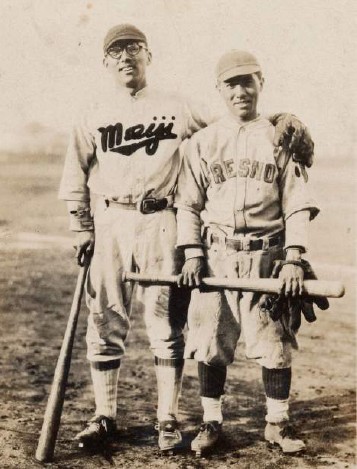
Every Tuesday morning we will post an article from SABR’s award-winning books Nichibei Yakyu: Volumes I and II. Each will present a different chapter in the long history of US-Japan baseball relations. This week Bill Staples, Jr. tell us about one of the most important Japanese American baseball players–Kenichi Zenimura and three of the tours he organized.
Few baseball fans know the story of early twentieth-century Nikkei (Japanese American) baseball. Despite this lack of awareness, the Nikkei impact is still visible in today’s game. It’s subtle, though, visible only to the well-informed. The legacy is not a retired uniform number displayed inside a major-league ballpark, but the names on the back of the uniforms. In 2022 those names are Akiyama, Darvish, Kikuchi, Maeda, Ohtani, Sawamura, and Suzuki—and in 2025, it will almost certainly include Ichiro on a plaque in the National Baseball Hall of Fame.
The national pastime has unofficially become the international pastime, and this is the enduring legacy of Nikkei baseball and the work of pioneers like Kenichi Zenimura (1900-1968).
During the years 1923 to 1930, no major-league team barnstormed in Japan. The highest-caliber competition from the United States during this time came in the form of Nikkei and Negro League teams like Zenimura’s Fresno Athletic Club (FAC) and the Philadelphia Royal Giants. During this major-league void, Nikkei and Negro Leaguers helped elevate the level of play in Japan and set the stage for the 1931 and 1934 tour of stars like Lou Gehrig and Babe Ruth, and the start of the professional Japanese Baseball League in 1936.
In 1962 Zenimura was crowned the “Dean of Nisei Baseball” by veteran Fresno Bee sports reporter Tom Meehan. Shortly after Zeni’s death in 1968, the same sentiment was echoed by Bee reporter Ed Orman. Approximately 25 years later, baseball historian Kerry Yo Nakagawa refined that tribute for a new audience, calling Zenimura “The Father of Japanese American Baseball.” Nakagawa and others believe that Zeni deserves this title for his unparalleled career and collective impact as a player, manager, and global ambassador.
PREWAR GOODWILL AMBASSADOR
Between 1905 and 1940, roughly one out of four (26.5 percent) tours across the Pacific featured a Nikkei team visiting Japan. When examining the tours between 1923 and 1940, Zenimura’s impressive impact becomes apparent. Of the 53 tours during this period, Zenimura was involved, to some degree, with 17 (32 percent) of those efforts. When he himself was not traveling, Zeni supported or influenced 14 different tours by other Nikkei teams, visiting Japanese ballclubs, Negro League teams, and major-league all-stars.
The following is an in-depth look at Zenimura’s three major tours—1924, 1927, and 1937—in which he participated directly, allowing him to shine in his homeland of Japan.
THE 1924 TOUR
The seeds for Zenimura’s 1924 tour were planted on Independence Day in 1923 when the Fresno Athletic Club battled the Seattle Asahi for the National Nikkei Baseball Championship. The Asahi had earned the respect of the baseball world by winning the majority of their games during tours to Japan between 1915 and 1923. In a best-of-three series, the FAC defeated the Asahi to become the undisputed Nikkei baseball champions. With the victory, Fresno also won the right to tour Japan the following year.
In preparation for the tour, the FAC scheduled games against high-caliber competition, including the Pacific Coast League Salt Lake City Bees, who conducted spring training in Fresno. In a three-game series, the FAC surprised the Bees with a 6-4 victory in game one, marking the first time a Nikkei team defeated a PCL ballclub. The series also marked the presence of Frank “Lefty” O’Doul. Newly signed from San Francisco, O’Doul did not compete in the loss, but his powerful bat helped the Bees take games 2 and 3.
More important than O’Doul’s on-field performance was the historical significance of his involvement. The gregarious southpaw would later be enshrined in the Japanese Baseball Hall of Fame for his life’s work as a celebrated ambassador of US-Japan baseball relations. Most likely, this 1924 encounter marks O’Doul’s first interaction with ballplayers of Japanese ancestry.
On September 2, 1924, the FAC boarded the SS President Pierce for Japan.Six weeks later they stepped inside Koshien Stadium to play their first opponent, Daimai. The FAC recorded a shutout 5-0 victory behind the arm of Kenso “The Boy Wonder” Nushida. Fresno pitchers did not allow a run until their third game, on October 14, a 4-3 loss in a rematch with Daimai.
During their 46-day stay in Japan (October 11 to November 26), the Fresno team traveled approximately 1,300 miles (about 2,100 kilometers), covering nine cities—starting in Osaka, with stops in smaller locales between Hiroshima, Tokyo, and Yokohama. They played 27 games, finishing with a 20-7 record and an overall .741 winning percentage.
After watching the Fresno captain compete on the field, a reporter with the Japan Times wrote, “Zenimura is one of the smartest and most colorful players the writer had ever seen. He was the terror of the diamond, a man who played every position in baseball. He was tricky, shrewd and positive poison to every opponent.”
In Tokyo, Zeni penned his thoughts on the Japan tour experience in a letter to the Fresno Morning Republican, which was published on December 5. It read:
Tokyo, Japan
November 16, 1924
Mr. T.P. Spink
Sports Editor,
The Republican.
Dear Sir: –
The Fresno team is doing a [sic] good work in Japan and so far our record stands 18 victories and 5 lost. In today’s game we played against Keio and defeated them by the score of 8-to-4. We gave the last four runs in the last of the ninth after two men gone.
In Japan it doesn’t pay to win a game in a far margin. If we do then there won’t be any crowd coming to the next game, saying that we are too strong for this Japan team and so on. We had many examples in Osaka.
Beat Diamonds
One day we played against the pro team of Osaka which is known as Diamonds and in our first game we defeated them by a score of ll-2. In this game quite a many fans [sic] came to see the outcome but on the following day with the same teams there was hardly any people in the stand[s]. For this reason, it is hard for the visiting team to play a game in Japan.
Another thing disadvantaging us is the way these Tokyo umpires calls [sic] on decisions against us. … I can’t figure the way these umpires make a bad decision when ever the play is close. We had enough of the raw decisions in Tokyo, but what can we do in Japan!!!
Meet Champions
Tomorrow we are playing against Waseda, the intercollegiate champions of Japan. We hope to beat them badly and by the time this letter reaches you, you will be able to get the result.
On the way to the States I am figuring of stopping over to Honolulu and spend my Christmas and New Year’s there. About five of the players are going to do the same and eleven of the remaining players will be in Fresno by 13th of December 1924.
As soon as the team reaches to Fresno we would like to play a three game series with the Fresno Tigers.
Yours truly,
K. ZENIMURA
(Captain).
The Waseda contest mentioned in the letter resulted in a 3-2 loss for Fresno. FAC lost the game, but won the respect of the opposing manager, Chujun Tobita. He praised the visiting team’s baseball skills, saying they were “amazing” in their demonstration of technique and power.
Continue to read the full article on the SABR website
 SABR Asian Baseball Research Committee Blog