
by Kat Williams
Every Tuesday morning we will post an article from SABR’s award-winning books Nichibei Yakyu: Volumes I and II. Each will present a different chapter in the long history of US-Japan baseball relations. This week Kat Williams discusses the Philadelphia Bobbies 1925 doomed visit to Japan.
“Crack! The ball hits the bat. Smack! That ball hits Edith Houghton’s waiting glove at short who quickly throws to first to get the batter and all in a twinkling of an eye. These women play the game in a manner that would no doubt delight the heart of many a manager who ever saw them play.”
Writing about a baseball game between the Passaic Girls and the Lansdale Chryslermen, this unnamed reporter was shocked to see women play baseball with talent and dedication. “It was surprising to watch the brand of ball that these girls can play,” he continued. “They take their baseball in a serious way and all the jeering of the “wise guys’ who stand on the sidelines and do the looking on cannot daunt them.” Even the crowd’s “jeers soon turn to cheers when they see the girls in real action.” The reporter’s shock at the women’s quality of play was not a new phenomenon. Rather, it echoed hundreds of other local news reports about female baseball players written in sports pages during the early 1920s. Why so shocked? Did they not read each other’s work?
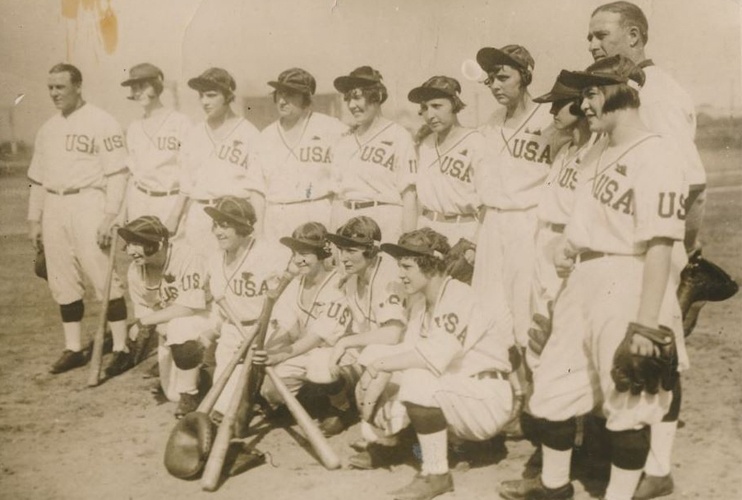
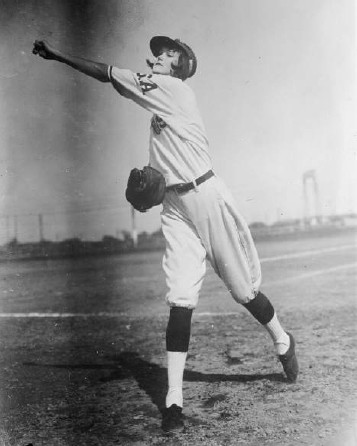
Perhaps it was a lack of public interest in women’s baseball that kept reporters from recognizing a growing trend? But that wasn’t the case. Even reports of large crowds and fervent fans did not stick in the minds of sports reporters. Approximately 1,500 fans showed up to the Lansdale, Pennsylvania, game, roughly 20 percent of the town’s population. Meanwhile, in Maple Shade, New Jersey, the largest crowd of the season came to watch the “famous invading lassies,” the Philadelphia Bobbies, play the local baseball club. In that game, shortstop Edith Houghton had five hits, including two doubles and a home run. By this time, the late 1920s, Houghton had been widely written about. She was a standout on the Philadelphia Bobbies team that toured Japan in 1925 and was so well-known that fans in small towns clamored to see her play. There was public interest. Still, in story after story, sports reporters seemed shocked to see women playing baseball at a high level.
Were they skeptical of other reporters’ assessment of good baseball? Some of the language was kind of over the top. In a Philadelphia Inquirer article, “The Quaker City Maids of the Diamond,” Gordon Mackey hailed the play of Edith Houghton and Edith Ruth. “Both members liked to play baseball and they COULD play the game—make no mistake on that score.” In a baseball barnstorming tour their play was legendary but, “like Alexanders in skirts or Hannibals in bloomers, they longed for other worlds to conquer after they had cleaned up most of the alleged sterner sex in duels of the diamond in 1925.” Houghton “could play shortstop in a way that would make Joe Boley toss his glove in the air and yell, “bravo,’” and Ruth was “the holder of the initial sack and how she can go after those quick throws and hug that base is nobody’s business.” Team play was also lauded with the same exaggerated language. “What an infield. They work with the rhythm and snappiness that is characteristic of any big-league team.” That over-the-top language—Hannibals in Bloomers and shouts of bravo!—made the players appear aberrant. There is almost a freakshow quality to the enthusiastic description.
Reporters’ continued surprise at women’s good play was most certainly related to the more common descriptions of women’s baseball which emphasized the players’ femininity.” For decades reporters introduced female players as “neat,” “attractive in their uniforms,” and as “spectacles.” They simply skipped over a discussion of their play and instead focused on their appearance, their “dainty hands,” and how it must have been hard for them to hold the glove. They marveled at their “feminine strength” and how hard it must have been to play against “professional strength.” They were used to writing about women who were, in their eyes, not very talented and unwilling to get dirty or to take the game seriously. A report about the Hollywood Bloomer girl team began, “A bevy of beauties from Hollywood, California took time out from powdering their noses and gave a picked team of the Coca Cola Greys the battle of their lives. … The ladies put up a good game but couldn’t stand up under the strain.” Even when their play was good and the individual talent exceptional, reporters were still likely to describe games as “an unusual tussle,” played by nine “fair maidens.” Most women had been described in these terms for decades. Just because they donned a baseball uniform did not mean that would change.
To reporters and to many men who played, managed, or promoted baseball, there was a set of expectations, standards for play, and a distinct language used to discuss the game and its male players. There were no such expectations or standards for women. As a result, women’s play was judged against that of men, making it difficult for them to be seen as talented players. So they were not. Because it was unfathomable to even think of women in actual baseball terms—a slugger, a hurler, or aggressive on the basepaths—a whole other language emerged to describe women’s baseball. Reporters sprinkled some baseball terms in among talk of their physical appearance—”The longlegged beauty on the third base bag sure can play the hot corner.” And because women were used to being described this way they did not resist. They just kept playing.
Women’s insistence on playing and the dilemma of reporters tasked with reporting on their games ultimately combined to establish a separate set of standards and expectations for female baseball players. And over time, two separate baseball spheres, one for men and one for women. From our twenty-first-century perspective, we could claim that these gender-specific standards worked against women who sought legitimacy as baseball players. It could be argued that creating separate baseball spheres took agency or control away from women. Nothing could be further from the truth.
Existing in separate spheres was not new to women. They lived, worked, and studied under a different set of standards than men. So it was likely no surprise to them that the same would happen within the game of baseball. As they had always done, though, women never stopped pushing against the boundaries forced upon them. They learned the game, played it, and from within their baseball sphere, they defined for themselves what baseball meant. They set their own standards and, most significantly, they defined baseball success in their own terms. As it was for men, winning games, playing well, and making money were all part of women’s definition of success, but that was only the beginning. Baseball was an opportunity, a new experience, and a location where women could excel in an endeavor previously off-limits to them. Playing the game provided women with a chance to see the country and ultimately the world. It allowed them to make their own money and to realize a sense of independence. To many players, success was found in the opportunities baseball afforded them and not only in the box score.
There are many examples to illustrate the ways in which women embraced their separate baseball sphere and used it to their benefit, but none is more engaging than the story of the Philadelphia Bobbies and their 1925 barnstorming tour of Japan. The Bobbies’ tour provides an opportunity to show how women not only embraced their separate baseball sphere but used it to challenge traditional definitions of baseball success and to define for themselves how and where they fit into the narrative of baseball. The tour shows how one set of baseball standards were used to plan, guide, and then judge the tour, and how another set, the ones defined and accepted by the women themselves, provide a completely different interpretation. One side saw the tour as an unmitigated disaster, while the other saw it as a great success.
Continue to read the full article on the SABR website
 SABR Asian Baseball Research Committee Blog