

by Bill Staples Jr.
Every Tuesday morning we will post an article from SABR’s award-winning books Nichibei Yakyu: Volumes I and II. Each will present a different chapter in the long history of US-Japan baseball relations. This week Bill Staples Jr discusses the Philadelphia Royal Giants 1927 visit to Japan.
Kazuo Sayama, baseball historian, author, and member of the Japanese Baseball Hall of Fame (enshrined in 2021), states with great passion and conviction that had it not been for the tours of the Negro Leagues’ all-star Philadelphia Royal Giants in 1927 and the early 1930s, a professional baseball league in Japan would not have started when it did, in 1936.
“There is no denying that the major leaguers’ visits were the far bigger incitement to the birth of our professional league. We yearned for better skill in the game,” said Sayama. “But if we had seen only the major leaguers, we might have been discouraged and disillusioned by our poor showing. What saved us was the tours of the Philadelphia Royal Giants, whose visits gave Japanese players confidence and hope.”
Sayama first learned about the Royal Giants as a member of the Society for American Baseball Research in the early 1980s. Like the fictional Ray Kinsella, who heard voices telling him to build a baseball diamond in the middle of his cornfield, Sayama was a man possessed during much of the early part of that decade, researching and documenting the history of the Royal Giants.
Also fueled by the desire to honor the Black US soldiers who coached him as a boy in Yokohama during the post-World War II occupation, Sayama hit the library stacks and microfiche in the archives and traveled the world interviewing anyone with a connection to the team.
In doing so he discovered that the Negro Leaguers had visited Japan just as many times as the famous All-American major leaguers during the 1920s and 1930s (three times each), yet historians on both sides of the Pacific had all but forgotten the Philadelphia Royal Giants.
“It is unfair that no words of gratitude have been spoken by the Japanese to this team,” lamented Sayama. He changed that by publishing his seminal work in Japan in 1985, Kuroki Yasashiki Jaiantsu, which details the events of their tours and the impact the team made while in Japan. Best of all, he captured firsthand accounts from many Japanese players who competed against the all-Black team, men who were so impressed and impacted by the touring players’ unique blend of baseball skill and human kindness that it inspired a term of endearment from Japanese players—with gratitude and fondness in their hearts, they referred to their guests as “Gentle Black Giants.”
The Philadelphia Royal Giants were indeed the first all-Black team to play in Japan, but their games did not mark the first time for Black and Japanese baseball teams to compete head-to-head on a diamond. The history of games between ballplayers of Japanese ancestry and Black teams dates to at least May 19, 1908, when the Issei (first-generation Japanese in America) Mikado’s Japanese Base Ball Team from Denver played the Lexington (Missouri) Tigers. But earlier undocumented games probably took place. After that contest, and long before the Royal Giants set sail for Japan in 1927, dozens of such games occurred. Of those matchups, the following are noteworthy for their ties to the Royal Giants:
- December 4, 1915, Honolulu—Chinese Travelers vs. 25th Infantry Wreckers. Outfielder Andy Yamashiro, the first Japanese American to sign a contract in Organized Baseball (in 1917), honed his skills competing in Hawaii as a member of the mixed-Asian Chinese Travelers (comprising Chinese, Japanese and Hawaiian players) against top-Black talent like Wilbur “Bullet” Rogan, Robert Fagen, Dobie Moore, and Oscar “Heavy” Johnson, all members of a military team known as the 25th Infantry Wreckers. Fagen and Rogan later barnstormed across the Pacific as members of the Royal Giants.Yamashiro managed the Hawaii Asahi ballclub that competed against the Royal Giants in 1927.
- June 2, 1924, Washington, DC—Meiji University vs. Howard University. This game marked the first time a visiting team from Japan defeated an all-Black team. The Meiji roster included Saburo Yokoza- wa, a second baseman who in 1927 would compete against the Royal Giants in Japan as a member of the Daimai club.
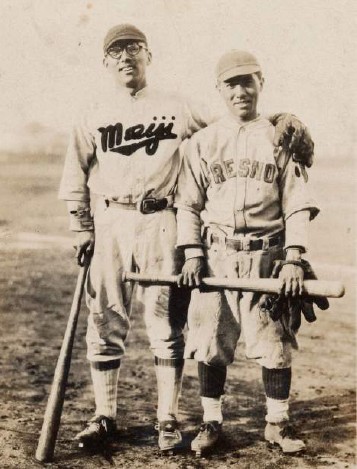
- September 6, 1925, Los Angeles—Fresno Athletic Club vs. L.A. White Sox. Over 3,000 fans packed into White Sox Park to witness Kenichi Zenimura’s Japanese nine defeat Lon Goodwin’s ballclub, 5-4. This encounter led to a rematch a year later, setting the wheels in motion for Goodwin to take his ballclub to Japan in 1927.
Plans to take a Negro League team to Japan were proposed in the early 1920s but failed to materialize. On February 21, 1921, the Chicago Defenderwrote, “A syndicate of Japanese here representing authorities at Waseda, Tokio [sic], Yokohama and Kobe Universities in Japan, announced last week that they are eager to take an all-star baseball team made up of members of the Race to their fatherland next fall for a series of games. A large sum of money has been deposited in a local bank to defray all expenses, which guarantees the proposition is in good faith.”
The goals of the planned 1921 tour were ambitious. “The spokesman further stated that … the main idea is to put baseball on a firm foundation, and to have the interest manifested in the pastime [in Japan] as in this country [United States].” The stars never aligned for that Negro Leagues all-star tour of Japan to occur. That would take another five years.
As a follow-up to their thriller in 1925, Lon Goodwin and Zenimura scheduled a rematch for the L.A. White Sox and the Fresno Athletic Club (FAC), a doubleheader in Fresno over the Fourth of July weekend, 1926. Zenimura’s team, bolstered by a few non-Japanese players, called themselves the Fresno All-Stars. They defeated the L.A. White Sox in both games, 9-4 and 4-3.
Off the field, it was customary for Zeni to invite visiting teams to social outings the night before a game. Thus, the Fourth of July weekend created the opportunity for Zenimura and Goodwin to discuss the possibility of parallel tours of Japan in the future.
Born in Hiroshima, Japan, Zenimura had visited his motherland as a baseball ambassador a few times prior to 1926. In 1921-22 he traveled to Hiroshima, where he coached baseball at Koryo High School. In 1924 he returned with his FAC, completing a successful 46-day tour of Japan, playing 28 games and finishing with a 21-7 record.
By the summer of 1926, Zeni already had plans in place for another tour of Japan for the following spring. He had learned valuable lessons during the first tour and shared them with the Fresno press. “In Japan it doesn’t pay to win a game [by] a far margin. If we do then there won’t be any crowd coming to the next game … One day we played against the pro team of Osaka which is known as Diamonds and in our first game we defeated them by a score of 11-2. In this game quite a many fans [sic] came to see the outcome but on the following day with the same teams there was hardly any people in the stand[s]. For this reason, it is hard for the visiting team to play a game in Japan.”
Months later, Goodwin received a chance to put Zenimura’s advice into practice. On December 21, approximately five months after the series in Fresno, the Nippu Jiji reported that Goodwin’s L.A. White Sox—not the Philadelphia Royal Giants—had received an invitation to tour Japan from officials in Fukuoka City, one of the locations where the FAC competed during the 1924 tour.
To help plan his team’s tour, Goodwin turned to Joji “George” Irie, a Japanese native who was known in Los Angeles’s Little Tokyo area as an active sports and entertainment manager. The Japanese Who’s Who in California described Irie as a man “with an impressive mien and stature of such dignity,” adding that professionally he was “agile and enthusiastic, quick to weigh the interests, and daring enough to take any means to achieve his ends; his inscrutable ability defies imagination for his swiftness and vehemence.”
Bom in 1885 in the Yamaguchi Prefecture of Japan, Irie arrived in the United States at age 20 and went east to study law at the University of Pennsylvania. He returned to California in the early 1920s and worked as a translator in sectors that served the legal needs of the Japanese immigrant community. He eventually caught the attention of Yoshiaki Yasuda, president of the Japan-US Film Exchange Company, who hired him to be the organization’s secretary. In that role, he helped Yasuda oversee the world of entertainment in LA’s Little Tokyo, including sumo, kembu (Japanese sword-fight theater), baseball, and gambling. In 1935, several years after Irie’s involvement in the Royal Giants ended, Yasuda was assassinated by the yakuza (Japanese mob). According to Professor Kyoko Yoshida, this murder, coupled with the photos of the Royal Giants posing with sumo and other figures of Japan’s underworld, suggest that Irie’s work might have placed himself, Goodwin, and the Royal Giants, in close proximity to the Japanese mob during the 1927 tour.
Before the team departed for Japan, Irie sent officials there an advance roster of the players slated to join the tour. The names reflected on the list included all of the members of the Philadelphia Royal Giants entry in the 1926-1927 California Winter League: O’Neal Pullen, C; Frank Duncan, 1B-C; Newt Allen, 2B; Newt Joseph, 3B; Willie Wells, SS; James Raleigh “Biz” Mackey, SS, P, C; Carroll “Dink” Mothell, Utility; Norman “Turkey” Steames, OF; Herbert “Rap” Dixon, OF; Crush Holloway, OF; Andy Cooper, P; Bill Foster, P; George Harney, P; Wilbur “Bullet Joe” Rogan, P-OF.
Of those 14 players, Goodwin could persuade only five to take him up on his offer to tour Japan—Pullen, Duncan, Mackey, Dixon, and Cooper. Goodwin had fallen out of favor with organized Negro Leagues baseball in the East, and delivered a parting shot when the team sailed off for Japan. “The National Negro and the Eastern Leagues are cutting salaries to a place where a ballplayer is not fairly paid for services rendered,” Goodwin told the press.
To fill out the roster, Goodwin recruited players from his semipro team, the L.A. White Sox. Thus, when the ship pulled away from Los Angeles on March 9, 1927, the revamped Philadelphia Royal Giants roster comprised O’Neal Pullen, C; Frank Duncan, 1B-C; Robert Fagen, 2B; Jesse Walker, 3B; James Raleigh “Biz” Mackey, SS, P, C; John Riddle, 3B-SS; Julius “Junior” Green, OF; Herbert “Rap” Dixon, OF; Joe Cade, OF; Andy Cooper, P; Ajay Johnson, P; Eugene Tucker, P; Alexander “Slowtime” Evans, P; Lonnie Goodwin, manager; and George Irie, promoter/ interpreter.
As a result of the roster change, the team chemistry changed too. For the five members of the Philadelphia Royal Giants of the California Winter League, baseball was their full-time profession. For the others, it was a passion and an extracurricular activity outside of their day jobs. For example, Ajay Johnson was a police officer who would later become one of the first Black lieutenants in LAPD history. John Riddle attended the University of Southern California, where he also played football and earned a degree in architecture. Joe Cade was a US Navy Veteran and firefighter, who became a favorite in Hawaii to fans with military ties. The captain of the team was Mackey, whose ability to play multiple positions combined with his laid-back demeanor and patience in teaching others made him the perfect fit as a team leader on a goodwill tour.
After a rocky 5,497-mile, 20-day journey crossing the Pacific Ocean, the Royal Giants arrived in Yokohama on March 29. The team spent two days working out their sea legs and preparing to do battle against the best college, amateur, and industrial leagues teams Japan had to offer. Their first game, against the Mita Club, was scheduled for April l.
Coverage by Yakyukai (Baseball World) magazine revealed that the Japanese media misunderstood the ethnicity of their dark-skinned guests. “The ‚ÄòPhiladelphia Royal Giants’ sounds like a magnificent name. This team of American Indians became very famous. …”
Setting aside the mix-up on players’ racial backgrounds, Yakyukai detailed the events of the first game: “The stadium was jam-packed because people had heard that the black players had the reputation of being a powerful team. While the Mita Club were practicing on the field, the Royal Giants entered with big smiles and were welcomed by loud applause from the crowd. They wore off-white jerseys just like the Sundai uniform. The Royal Giants started to entertain the fans. They began light warm-ups and batting practice. They hit very well for sure. All their hits looked like line drives. They were well-built and physically much stronger than Mita’s batters. During fielding practice, the shortstop, Mackey, showed off his strong arm. The speed of the ball was like a bullet. The first baseman (Duncan) also performed well with his slick glove work. Both Mackey and the first baseman shined among the infielders. However, some flaws in their fielding skills were noticeable. If the Japanese team were to stand a chance, they needed to take advantage of the Giants’ weak points. … There were two umpires, Ikeda and Oki. The game started with the Mita going to bat first. The pitchers were Takeo Nagai and Cooper.”
Continue to read the full article on the SABR website

 SABR Asian Baseball Research Committee Blog