Tag: Los Angeles Dodgers

  • Tommy Lasorda: Baseball’s Global Ambassador and the Los Angeles Dodgers’ 1993 Friendship Tour of Japan

    Tommy Lasorda: Baseball’s Global Ambassador and the Los Angeles Dodgers’ 1993 Friendship Tour of Japan

    by Mark Langill

    Every Monday morning we will post an article from SABR’s award-winning books Nichibei Yakyu: Volumes I and II. Each will present a different chapter in the long history of US-Japan baseball relations. This week Mark Langill highlights the Dodgers 1993 trip to Japan .

    What felt like a nostalgia trip unexpectedly served as a dress rehearsal for the next frontier of professional baseball when the 1993 Los Angeles Dodgers staged a modest five-game “Friendship Series” in Taiwan and Japan.

    Nobody could’ve predicted a “Tornado” on the horizon, one of the nicknames bestowed upon Kintetsu Buffaloes pitcher Hideo Nomo, who in 1993 was a four-time All-Star and former Pacific League MVP. His contract issues with Kintetsu led to his retirement from Japanese baseball after the 1994 season, an exit strategy discovered by agent Don Nomura when analyzing the sport’s seemingly ironclad working agreements covering the United States and Japan. Nomo became only the second player from a Japanese professional league – and the first in 30 years – to play in the majors during his National League Rookie of the Year campaign with the Dodgers in 1995.

    “There was no business reason for the 1993 Japan trip, other than growing baseball at the international level,” said Fred Claire, a 30-year Dodger executive who was the team’s general manager from 1987 to 1998. “[Brooklyn Dodgers team President] Walter O’Malley’s global vision of the game was continued by his son, Peter. But when you go back in time, the thought of a player from Japan playing in the majors seemed like an impossible reach. There were no major-league teams scouting in Japan. There was no reason to use those scouting resources because there were players from Latin America, Mexico, and other parts of the world.”

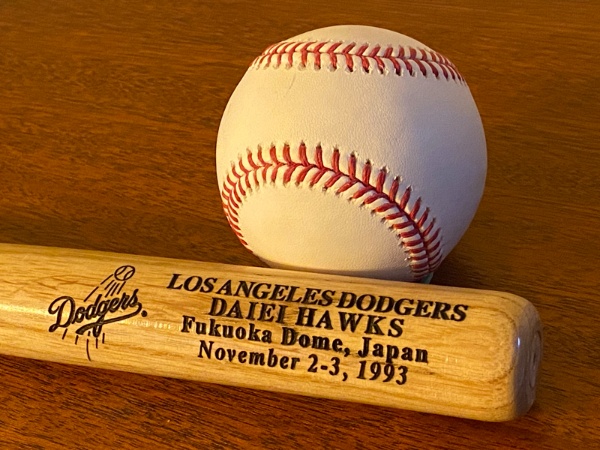
    Manager Tommy Lasorda’s Dodgers became the first major-league team to play in Taiwan, posting a 1-2 record in Taipei against all-stars from the Chinese Professional League. Los Angeles then traveled to Fukuoka, Japan, for a pair of games against a combination of the Fukuoka Daiei Hawks of the Pacific League and the Yomiuri Giants of the Central League.

    Nomo wasn’t part of the exhibition at the newly opened Fukuoka Dome in 1993. Claire didn’t stick around for the Japan portion of the trip, flying from Taiwan to Los Angeles and continuing to Naples, Florida, for a meeting of major-league general managers.

    Instead of a stealth scouting mission, the 1993 trip represented another chance for Peter O’Malley to promote international baseball. He was 18 years old in 1956 when the Brooklyn Dodgers spent nearly five weeks in Japan after the World Series. His roommate was broadcaster Vin Scully, who reported on the 19-game exhibition for Sport magazine.

    During their ownership of the franchise between 1950 and 1998, the O’Malley family used Dodgertown, the spring-training facility in Vero Beach, Florida, along with Dodger Stadium in Los Angeles after its 1962 opening, to host international events.

    After selling the Dodgers to Fox Group in 1998, O’Malley kept his ties to the Vero Beach area, at one point operating a lease at “Historic Dodgertown” in a partnership with his sister Terry Seidler, Nomo, and former Dodgers pitcher Chan Ho Park, who in 1994 became the first player from Korea to appear in the majors. The Vero Beach complex was taken over by Major League Baseball in 2019 and renamed after Dodgers Hall of Famer Jackie Robinson.

    The O’Malleys and Lasorda were also close to Rod Dedeaux, the University of Southern California baseball coach who won 11 NCAA titles during his 45-year tenure. Dedeaux played two games at shortstop for the 1935 Dodgers and was a longtime champion of international baseball. He coached Team USA in a baseball exhibition during the 1964 Olympics in Tokyo and in the 1984 Olympics baseball tournament at Dodger Stadium. (Japan defeated Team USA in the Gold Medal game.)

    In a 1991 interview with the Mainichi Daily News, Peter O’Malley outlined his hopes for a true global baseball series. Dodger Stadium played host to the 1991 International Baseball Association World All-Star Game with top amateur players representing 28 countries.

    I’m an advocate of such competition. And I think my colleagues in the majors are quickly becoming receptive to such an idea, too. I don’t think major-league baseball feels threatened at all. On the contrary, I get the feeling baseball’s leaders think the timing is just about right. Logistics – travel, etc. – are no longer a problem. Baseball is extremely popular and profitable outside the U.S. in many countries like Japan and Korea. The competitiveness is there. I think they feel now’s the time to capitalize on it and move on it.

    It will be the best two teams going at it in a seven-game World Series. Say, the Los Angeles Dodgers and the Chunichi Dragons. But the international playoff would involve more than just the U.S. and Japan. After all, there are some strong Latin American leagues and the Korean pro league is coming on fast. It’s only been in existence for 10 years and look at how many competitive players there are. And pro ball is catching on in Taiwan. Plus, who knows where else the sport might also grow rapidly. The possibilities are endless and exciting.

    As publicity director of the Dodgers in the early 1970s, Claire accompanied Dodgers Alan Foster and Von Joshua along with a dozen other major-league players on a trip to Japan sponsored by the Nichiren-Shoshu Buddhist sect. As vice president of marketing in 1980, Claire, along with O’Malley, traveled to Japan to negotiate with Mitsubishi officials as the Dodgers became the first team with a color video scoreboard, debuting “Diamond Vision” at the 1980 All-Star Game.

    Lasorda, who died in 2021 at 93, spent 71 years in the Dodgers organization. The former left-handed pitcher, bumped from Brooklyn’s 1955 roster to make room for rookie Sandy Koufax, first arrived in Japan in the spring of 1965 for a series of clinics with fellow scout Kenny Myers. Lasorda had also worked with members of the Tokyo Giants during the first of their five trips to Vero Beach between 1961 and 1980.

    Lasorda’s 1965 arrival at the airport in Tokyo was fitting for a man still a decade away from international celebrity. Nobody met Lasorda and Myers at the airport because the baseball officials had the wrong date. The scouts went to the Hilton Hotel and rested after their nine-hour flight.

    During their three-week trip, Lasorda and Myers toured various landmarks and baseball facilities, including the Imperial Palace and the Olympic Village. Working with the Yomiuri Giants prior to their spring training, Lasorda gave tips to the pitchers. Myers, who converted Los Angeles prep track star Willie Davis into a left-handed-hitting center fielder, worked with Yomiuri hitters.

    In his diary, Lasorda made notes on everything from his dinner reviews – “the most tender steak I ever ate” – to the training methods and facilities of his Japanese hosts. The lineup for manager Tetsuhara Kawakami’s 1965 Giants included outfielder Sadaharu Oh, third baseman Shigeo Nagashima, and lefty pitcher Masaichi Kaneda. All four Giants later had their uniforms retired, the same honor eventually bestowed to Lasorda by the Dodgers.

    Our second day of training was just about the same as our last. The Japanese coaches believe in a lot of calisthenics and they spent about 2 hrs. a day on it. We work out from 11 a.m. to 3 p.m. with no breaks in between. We had a meeting of the manager and the coaches. They asked our opinion of the day’s work and we gave it to them – they must concentrate more on the fundamentals. These people are anxious to learn – they want to surpass the Americans in baseball.

    The pitchers here in Japan have no idea how to throw a curveball and no conception of throwing a changeup. I will have to concentrate on these two factors very much. The stars of the team, Nagashima, 3B, ‘O’, 1B and Kaneda, P – are really nice guys and they have accepted us. I have pitchers hollering around camp and Mgr. said he never heard so much life.

    Spring training in 1965 became significant for both Lasorda and US-Japan baseball relations. Because the major leagues were implementing an amateur draft in June, Lasorda as a scout could no longer use his charm and negotiation tactics to sign top prospects, as he did the previous summer with Los Angeles prep star outfielder Willie Crawford. Lasorda drove Crawford to his high-school prom and delivered a stirring eulogy at the funeral of Crawford’s grandfather, a man whom Lasorda had never met.

    At the time of the Lasorda-Myers trip, the status of Japanese pitcher Masanori Murakami remained in limbo after the San Francisco Giants had promoted the lefty from Class A Fresno in September 1964. The Nankai Hawks had sent the 20-year-old Murakami to the United States for minor-league experience in the summer, but his success at Fresno led the Giants to promote him to the majors. San Francisco wanted to keep Murakami, who signed a major-league contract, and the Hawks demanded the return of their prospect. A compromise was finally reached: Murakami would spend one more season in San Francisco and return to Japan in 1966.

    After Lasorda’s 1965 Japan trip, which concluded with side trips to Bangkok, New Delhi, Iran, and Tel Aviv, it was back to Dodger Stadium for his next assignment. Scouting director Al Campanis decided Lasorda should become a minor-league manager. His first team produced a 33-33 record at Pocatello, Idaho, of the rookie-level Pioneer League. Lasorda worked his way up the ladder in the Dodger farm system and eventually replaced Walter Alston as Dodgers manager in September 1976.

    Life in Southern California would never be the same as Lasorda hugged his players – a stark contrast to Alston’s “Quiet Man” persona – and claimed to “bleed Dodger blue.” Frank Sinatra sang the National Anthem for Lasorda’s first Opening Day in 1977. With a big lead in September, Lasorda sent comedian Don Rickles – wearing a Dodgers uniform and number 40 – to the mound to visit with a suddenly confused reliever, Elias Sosa.

    After becoming the first National League skipper to win pennants in his first two years since Gabby Street of the 1930-31 Cardinals, Lasorda was invited to manage a team of National League all-stars against a team of American League stars on a postseason trip to Japan in 1979. In true Lasorda fashion, he motivated his team by privately telling each individual that the Most Valuable Player of the series was going to receive a new automobile. When Cincinnati’s George Foster won MVP honors, he received a bouquet of flowers and a shoulder shrug from his manager. “That’s what I heard,” Lasorda claimed with a straight face.

    Lasorda, though, was disappointed with American League manager Earl Weaver of the Baltimore Orioles. During a controversial play, Weaver argued with umpires and used language the otherwise feisty Lasorda didn’t think appropriate in a goodwill exhibition setting.

    The 1993 trip to Japan was extra-special because Dodgers All-Star catcher Mike Piazza happened to be Lasorda’s godson; his father, Vince Piazza, was a longtime friend from Tommy’s hometown of Norristown, Pennsylvania. A 62nd-round draft choice in 1988, Piazza rewrote the Los Angeles rookie record book in 1993 with 35 home runs, 112 RBIs, and a .318 batting average.

    Piazza played a key role in returning the Dodgers to a respectable 81-81 record in 1993 after a 99-loss disaster in 1992 in which the team finished in last place for the first time since 1905. The Dodgers enjoyed knocking the 103-win San Francisco Giants out of the pre-wild-card format postseason with a 12-1 victory on the final day of the regular season as Piazza clubbed two home runs.

    Piazza and former World Series pitching star Orel Hershiser were the Dodgers marquee names on the tour. Two other rookies became future stars – pitcher Pedro Martinez, traded by the Dodgers to Montreal weeks after the Japan tour, and Yomiuri Giants outfielder Hideki Matsui.

    In addition to baseball, the Dodgers took a tour of Dazaifu, an ancient Japanese regional center, and the Dazaifu Tenmangu Shrine. Lasorda and several Dodger players visited a children’s hospital and passed out Dodger souvenirs and commemorative pins.

    Lasorda provided the photo-op of the tour during batting practice on November 2 by throwing his arms around American sumo star Chad Rowan, who wrestled in Japan under the name Akebono Taro. Earlier in 1993, the 360-pound Rowan made history by becoming the first non-Japanese wrestler to reach Yokozuna status, the highest rank in sumo. Rowan, in town for a wrestling tournament, threw out the ceremonial first pitch.

    “The Fukuoka Dome was out of this world,” said first baseman Eric Karros, the 1992 NL Rookie of the Year. “We took a tour before the first game and saw the large training facility and practice areas. There were large mirrors where the Fukuoka players practiced their swings.

    The Dodgers wore a small black patch with “IKE” in white letters on their uniforms in memory of Akihiro “Ike” Ikuhara, the longtime assistant to Peter O’Malley, who died in October 1992.

    Ikuhara joined the Dodgers organization in the spring of 1965 after asking Japanese sportswriter Sotaro Suzuki for an introduction to O’Malley in order to study American baseball. He joined the Dodgers’ Spokane team in the Triple-A Pacific Coast League, where O’Malley was general manager. Ikuhara moved to the Dodgers in 1967. He supervised visits to the United States by the Yomiuri Giants in 1967, 1971, 1975, and 1981, along with the visits of the Samsung Lions of South Korea in 1985 and the Chunichi Dragons of Nagoya, Japan, in 1988. Ikuhara teamed with Nagashima in broadcasting the World Series back to Japan from 1981 to 1986. He was named to the Japan Baseball Hall of Fame in 2002.

    In the series opener, the Dodgers staked Hershiser to a 3-0 lead in the first inning against pitcher Kenichi Wakatabe of the Hawks. Brett Butler reached first on an error. Jose Offerman and Piazza hit consecutive RBI doubles and Tim Wallach drove home Piazza. The Japanese scored twice in the sixth on three hits, including a double over the head of Darryl Strawberry in right field. Chihiro Hamana’s RBI single in the seventh tied the game.

    In the bottom of the 11th inning, number-9 hitter Hiroshi Yugamidani greeted reliever Jim Gott with a line drive to center. Butler tried a shoestring catch, but the ball went past him. A relay throw from shortstop Offerman to backup catcher Jerry Brooks made the play at home plate close, but Yugamidani was ruled safe and gave Japan a 4-3 victory. Yugamidani batted .203 with one home run during the regular season.

    Although many Dodgers thought the runner was out at home, Lasorda didn’t protest the call. In the clubhouse, Hershiser took the umpire’s decision in stride because it was an exhibition. Someone asked Lasorda what would have happened if that call was made during a regular-season game. He simply smiled.

    In the second game, on November 3, Dodgers pitching yearned for the airport shuttle while struggling in a 16-1 loss. Were it a spring-training game, the umpires might have offered the teams an early exit. Instead, the capacity crowd of 42,000 watched the combined Fukuoka-Yomiuri squad score nine runs in the fifth inning on four hits and five walks. Overall, the Dodgers pitchers allowed 15 walks and three wild pitches. A leadoff double in the fifth inning by Chihiro Hamana off starter Ramon Martinez triggered the landslide. Relievers Felix Rodriguez and Jonathan Hurst followed Martinez to the mound as five of the fifth-inning walks were with the bases loaded. The Japanese added five runs in the eighth off reliever Jim Gott.

    Hurst, who pitched for the Dodgers’ Triple-A Albuquerque affiliate in 1993 after being claimed on waivers from the Montreal Expos, had been a late addition to the Asia tour roster for bullpen insurance. With veteran Dodgers pitchers Kevin Gross, Tom Candiotti, and Todd Worrell not making the trip, the Dodgers also brought along Rodriguez, who in 1993 converted from catcher to pitcher at Class-A affiliate Vero Beach.

    The Dodgers left Asia with a dismal 1-4 record. “I’m disappointed. I’d be lying if I said anything else,” said Lasorda. “When you go a month and then you just throw batting practice, [and] you don’t play in game situations, then it makes a difference.” But “We made these people happy anyway. We made the folks in Taiwan happy and we made the people of Japan happy.” “It’s all in fun anyway,” added Darryl Strawberry.

    Lasorda remained the Dodgers manager until the summer of 1996, when a mild heart attack in June led to his retirement. His last full season in the Los Angeles dugout coincided with Nomo’s 1995 arrival – via a minor-league contract because a strike by the Players Association had led to the cancellation of the 1994 World Series and had frozen 40-man rosters during the winter. Nomo attended spring training with Dodgers minor leaguers and was promoted after the strike ended.

    Lasorda’s trademark as a manager was providing postgame food in his office, a way to keep communication lines open with his players. Lasorda, who often served Japanese cuisine in Nomo’s honor, recalled his 1965 Japan trip in which Kaneda cooked a four-course dinner for a visiting Dodgers scout.

    “Just when baseball had its problems, here comes this young man from Japan with a unique delivery and great ability,” Lasorda said in 1995 as Nomo started the All-Star Game in Texas. “All of a sudden, he’s got the world chasing him and wanting to see him pitch.” Among those watching was Murakami, who became a baseball commentator for NHK after an 18-year pitching career in Japan. Murakami worked many of Nomo’s games at Dodger Stadium and on the road.

    Lasorda was elected to the National Baseball Hall of Fame in 1997. He came out of retirement at age 72 to coach Team USA in the 2000 Olympics in Sydney, Australia. With O’Malley and Dedeaux in attendance, Lasorda’s team – a collection of minor-league players and veteran major-league catcher Pat Borders – stunned Cuba, 4-0, in the Gold Medal game.

    In 2006 Commissioner Bud Selig named Lasorda baseball’s official ambassador for the inaugural World Baseball Classic and did so again in 2009 when the Classic was played at Dodger Stadium. In 2008 Lasorda was honored with the Order of the Rising Sun, Gold Rays with Rosette, by the Emperor of Japan for his contributions to Japanese baseball. He made countless trips to Japan, serving as a key liaison between the Dodgers and the Orix Buffaloes in their “friendship” agreement.

    “It’s amazing to watch Tommy Lasorda go through an airport in Japan,” said Acey Kohrogi, the Dodgers’ director of Asian operations from 1995 to 2013. “Everyone else gets their identification and passport ready to go through security. Tommy just keeps on walking, smiling and waving.”

    Overall, Lasorda visited 28 countries in his lifetime, including Colombia, Denmark, Monaco, Norway, Bermuda, Egypt, Iraq, Turkey, and Afghanistan. He continued to travel during the next two decades, attending his final game at the 2020 World Series in Arlington, Texas, when Los Angeles defeated Tampa Bay at Globe Life Field, a neutral site necessitated by the COVID-19 pandemic.

    “I don’t know if there was a better ambassador to the game than Tommy,” Fred Claire said. “Not because he was a Dodger, but because who he was. The primary reason was his absolute love of the game. It didn’t matter what country Tommy was in. In his own way, Tommy spoke every language. Obviously, he was always good with Spanish. But Tommy had that way of breaking through all barriers to teach, to promote, and talk about the game.”
  • 1966: The Dodgers Return to Japan

    1966: The Dodgers Return to Japan

    by Andy McCue

    Every Monday morning we will post an article from SABR’s award-winning books Nichibei Yakyu: Volumes I and II. Each will present a different chapter in the long history of US-Japan baseball relations. This week Andy McCue focuses on the 1966 Los Angeles Dodgers tour of Japan.

    By 1966, the bloom was coming off the chrysanthemum of Japan tours by major-league teams. Rebuilding US-Japan relations was less worrisome as the Japanese economy surged and Tokyo proved a stout ally for American fears about Russian and Chinese policies in Asia. Concerns about whether the tour would make money thrust themselves into the picture. The strain of major-league pennant races made more players reluctant to travel, and the lure of “exotic” Japan had dimmed.

    The changes showed up between the lines for the first time as an American team barely outlasted its Japanese rivals. Still, the 1966 tour provided the venue to regularize the official relationship between American and Japanese professional baseball.

    It had been a decade since the last Dodgers’ tour of Japan. That had been a Brooklyn Dodgers team that had just dropped a seven-game World Series to the New York Yankees after defeating them the previous year. This time it was a Los Angeles Dodgers team, which had just been swept in the World Series by the Baltimore Orioles a year after winning it all. The hoped-for match between the American and Japanese champions, a consistent hope of the Tokyo promoters, was thwarted yet again.

    The tour followed in the wake of a contentious battle between the San Francisco Giants and the Japanese Pacific League’s Nankai Hawks over pitcher Masanori Murakami. Murakami, whom Nankai lent to the Giants for American-style training, proved such a sensation that the Giants called him up late in the 1964 season. He pitched so well that they refused to return him to Nankai and kept him for the 1965 season. The Japanese team thought the two clubs had a gentleman’s agreement, the Giants thought they had a binding contract for Murakami’s services. After much negotiation and bitterness, he had returned to Nankai for 1966

    The bad feelings over Murakami hovered in June 1965 as the Yomiuri Shimbun withdrew its offer to sponsor a tour that fall by the Pittsburgh Pirates. For the Japanese newspaper, sponsoring a tour was a commercial venture and “[t]he Pirates are unknown in Japan and we did not want to risk going into the red,” said Kanzo Hashimoto, head of the company’s promotions department.

    Commissioner Ford Frick was holding to the contract he had worked out with the Japanese in 1955. Under that agreement, a major-league team could visit every two years, with the selection alternating between the National and American Leagues. The Pirates had been the first team to volunteer for the 1965 trip, Frick said, so they were chosen. The last team to visit Japan had been the Detroit Tigers in 1962, and the 1964 trip had been postponed because Tokyo was hosting the summer Olympics that year.

    Yomiuri, which also owned the Yomiuri Giants, Japanese professional baseball’s dominant team, turned to the Dodgers. Walter O’Malley had been steadily building a relationship with Japanese professional baseball in the years since his team’s 1956 visit. Japanese players and coaches had been hosted at spring training in Vero Beach as well as in Los Angeles. Dodger instructors, including Al Campanis and Tommy Lasorda, had made spring-training visits to conduct clinics in Japan. The newspaper executives knew the Dodgers would be a strong draw.

    Frick was annoyed at Yomiuri’s end run to the Dodgers and The Sporting News editorialized that it would not work. But by the spring of 1966, O’Malley and Toru Shoriki, president of the Yomiuri Group and its Giants, were negotiating terms for the trip. In a little over a month, the formal invitation was announced. A few weeks later, baseball owners approved the tour, rubber-stamping Yomiuri’s end run. Both the Dodgers and Shoriki’s Giants had been champions in 1965, and the matchup offered promising opportunities for promotion and to see how much Japanese professional baseball was progressing.

    Clouds appeared on the tour’s horizon even before the formal invitation. Dodgers shortstop Maury Wills, the prime offensive engine of a team that did not score well, was planning a career as an entertainer when his baseball career ended. The 33-year-old had permission to arrive a week late at 1965 spring training while he toured Japan playing his banjo and singing. But, general manager Buzzie Bavasi claimed he had revoked that permission during salary negotiations. Hard things were said on both sides before an agreement was reached for a $35,000 raise to $80,000 for 1966.

    Wills’s negotiations were overshadowed that spring by the revolutionary holdout of Dodgers aces Sandy Koufax and Don Drysdale. Drysdale’s appreciation of his value had been sparked by an offer from Japan of a $500,000 multiyear pact in late 1965. Frick threatened both Drysdale and the Japanese for a move he said would break Drysdale’s contract and jeopardize both the pitcher’s future and Japanese baseball’s relationship with the major leagues. The offer’s detail and whether it was real were never revealed as Drysdale chose to try to increase his salary and stay in the United States.

    In two innovations anathema to baseball owners, and especially Walter O’Malley, Drysdale and Koufax held out together and hired an agent. They asked for three years, with $200,000 annually for Koufax and $150,000 for Drysdale. Drysdale had earned a reported $75,000 in 1965, with Koufax slightly less. At first, Bavasi and O’Malley scoffed. But the hurlers hired an entertainment industry agent and began to work on deals for their own Japan tour and for movie studio and television contracts. The first movie opportunity fizzled, but Drysdale and Koufax ultimately appeared as actors. The leverage had its effect. Eventually, Koufax signed for $125,000 and Drysdale for $110,000.

    But the ripples went further. New Major League Baseball Players Association Executive Director Marvin Miller watched the holdout closely and pointed to the inequities of the process and the value of agents as he educated the board of the Players Association to the problems and the opportunities of negotiations. Within the Dodger organization, it gave Koufax and Drysdale much more freedom from management dictates. They would use that power to decline to accompany the team to Japan that fall.

    As the season progressed, there were increasing signs that other Dodgers were not enamored of the trip. The 1966 season was a grueling pennant race. The 1965 World Series winners led the league for only one day before gaining first place permanently on September 11. Their lead was never bigger than 3½ games. The season came to a close in a rain-splattered East Coast trip that included multiple doubleheaders. The Pittsburgh Pirates were not out of it until they lost the second game of a twin bill on October 1. The San Francisco Giants were eliminated only when Koufax won the second game of the Dodgers’ doubleheader in Philadelphia on October 2, the last day of the season. “Thank God it’s over,” said Koufax, echoing the sentiments of his teammates.

    The team’s exhaustion was clearly exhibited in the four-game World Series sweep at the hands of the Baltimore Orioles. The Dodgers’ offense managed only four runs in the four games.

    All this played into existing disenchantment with the Japan trip. As early as June, Phil Collier of the San Diego Union was reporting that Koufax, Drysdale, catcher John Roseboro, and outfielder Ron Fairly, the team’s player representative, were balking. “All we know is what we’ve read in the newspaper. The club hasn’t told us a thing,” Fairly told Collier. O’Malley had done all the negotiations with Shoriki without consulting the players. By August, Maury Wills’s name was added to the reluctants’ list.

    The front office brought pressure and most players fell into line. Ron Fairly said it was made clear to him that he would have to go. Wills tried to beg off with a sore knee. He’d twisted it beating out a bunt in July but had played on what was feared to be torn cartilage for the rest of the season. On the day he twisted his knee, he had 30 stolen bases. He would steal only eight the remainder of the season and had to be hypnotized to be willing to endure the pain from the knee and the raw patches on his legs from sliding. He too was told he had to go, but was promised he would play minimal amounts. Wes Parker told Walter O’Malley he had been to Japan before and wasn’t interested in seeing it again. Besides, he was sore and tired after the season. Parker was allowed to join Koufax and Drysdale with the stay-at-homes. Don Sutton, who had arm trouble surface in September, was held back on medical advice.

    The pitching situation was a severe blow as the Dodgers left California. Koufax, Drysdale, Claude Osteen, and Sutton had started 154 of the team’s 162 games. Only Osteen was on the trip, and manager Walter Alston suggested he was tired as well.Pitching had carried them to the pennant, giving up three runs a game, more than a run lower than the league average. Meanwhile, the offense was scoring 3.7 runs a game, third worst in the league. The Dodgers would face Japanese teams with the same anemic offense but a heavy sprinkling of arms from the bullpen and their minor-league system.

    The players who did go each received $3,000 and the equivalent of another $750 in yen from Yomiuri. The players talked of buying cameras and other electronics.

    The team left on the trip under a cloud of skepticism in the wake of the World Series. Typical was the Los Angeles Times’s Frank Finch’s story previewing the trip: “Having endeared themselves forevermore in the hearts of Marylanders with their peaceful visit to Baltimore last weekend, the Dodgers depart today for a goodwill tour of Japan.” Snide references to the World Series would populate headlines and stories throughout the trip.

    The team stopped in Honolulu for two exhibition games against teams of local major and minor leaguers with Bo Belinsky and Don Larsen brought in to provide the pitching. The Dodgers won both handily.

    While with the Dodger party in Honolulu, Commissioner William Eckert discussed a deal with his Japanese counterpart, Toshiyoshi Miyazawa, to cover future trips to Japan and, he hoped, avoid the disagreements that had clouded the Pirates’ proposed visit and the Dodgers’ eventual trip. They tentatively agreed that no team could visit Japan more than once in a six-year period and “no two teams from the same league can visit Japan more than two years in succession.”

    In Japan, expectations were high. “United States-Japan Battle of Champions” headlined the Yomiuri newspaper amid talk of a “real World Series.” The American military’s Far East Network announced it would broadcast most of the games. The 80-person Dodger delegation arrived in Tokyo on October 20 to the expected lavish greeting and a full slate of social events as well as ballgames. O’Malley blamed Koufax’s absence on a sore arm and said Drysdale had to attend to “business interests.” Asked by reporters if he foresaw a Japan-US International Series, O’Malley said, “I don’t see how you can prevent it. Japanese baseball is progressing admirably and the ballplayers are skillful. The public will demand it.” And, asked if the Dodgers would make a special effort to beat the Japanese champion Yomiuri Giants, O’Malley said, “definitely so.” Added Alston, “We’re on a four-game losing streak and want to win here.”

    The next day, Eckert presented Shoriki with a bronze plaque bearing an engraved message and signature from President Lyndon Johnson. After handing the message to Shoriki, Eckert also presented him with a World Series championship ring. It was the first World Series ring ever presented to a person not connected with a team participating in a World Series. “I myself and other Japanese concerned would like to further continue to promote Japan-U.S. friendly ties and contribution to peace, through baseball,” Shoriki said. The Dodgers worked out at Tokyo’s Korakuen Stadium in anticipation of the next day’s opener.

    Game 1: October 22, Tokyo

    The Dodgers started the tour with a bang, 21 hits including six homers in a 16-5 drubbing of the Yomiuri Giants. Willie Davis and Jim Lefebvre hit two homers apiece while Tommy Hutton and Osteen each hit one before 40,000 people at Korakuen. Yomiuri provided a 7,000 yen ($19.44 in those days) reward for each home run. The game story noted that the 21 hits were four more than the Dodgers had managed in the entire World Series. Outfielders Toshimitsu Suetsugu and Akira Kunimatsu each had two hits to lead the Giants. The Giants had wrapped up a Japan Series championship over the Nankai Hawks on Wednesday October 19, while the Dodgers had not played a serious game since October 9.

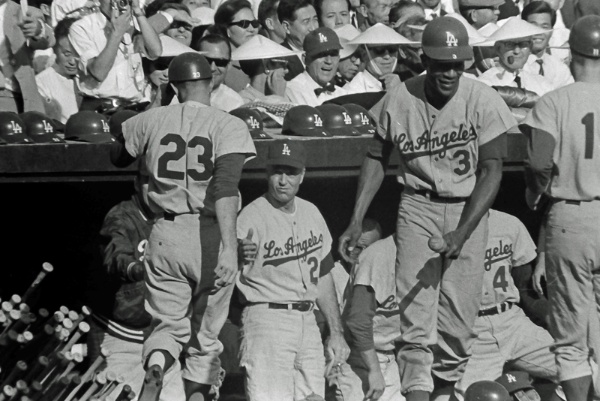
    Claude Osteen, Walt Alston and Willie Davis during the 1966 tour of Japan (Robert Fitts Collection)

    Game 2: October 23, Tokyo

    The Giants evened up the series as left-hander Akio Masuda shut out the visitors, 5-0, allowing just three singles. Another crowd of 40,000 saw Suetsugu provide the key hit with a triple. “We were just no good today,” said Alston. “The boys just couldn’t touch the Japanese southpaw. He had a sneaky fastball plus a good assortment of other pitches.”

    The defeat echoed loudly in the United States the following Saturday (October 29). ABC had sent Red Barber to Tokyo for its weekly Wide World of Sports. The segment reported on the Dodgers’ tour and focused on Masuda’s gem. He “made the Dodgers look like sleepwalkers, groping blindly and mechanically on the road to nowhere,” wrote Arthur Daley in the New York Times.

    Game 3: October 25, Sapporo

    The Dodgers returned to the victory column with a 3-1 win over the Giants at Maruyama Stadium in Japan’s northernmost major city. Despite a steady rain, a crowd of 30,000 watched left-hander Kazumi Takahashi, who was chosen to start because of his similarity to Masuda, give up run-scoring hits to Maury Wills, Lou Johnson, and Willie Davis. Davis’s RBI was aided by Sadaharu Oh’s error. Katsutoyo Yoshida drove in the Giants’ run. In an incident that would echo for several years, Wills sprained his injured knee rounding third base when a rain-soaked patch of grass gave way. He was immediately replaced by pinch-runner Tommy Dean.

    Game 4: October 26, Sendai

    The Giants evened up the series yet again, mowing down the Dodgers 13-6 at Miyagi Stadium before 32,000 fans. The 13 runs set a record for the most tallies by a Japanese team against an American professional club. Jim Barbieri gave the Dodgers an optimistic start with a leadoff home run, but Yukinobu Kuroe matched him in the bottom of the first. The Dodgers’ second featured four runs on a parade of singles, but it was the bottom of the second that proved decisive. The Giants pounded Osteen and young Joe Moeller for six runs on five hits and two walks with two outs. Dodger minor leaguer Leon Everitt gave up another four runs in the seventh inning.

    October 27 was a travel day and the Dodgers stopped in Tokyo on their way to Osaka. While there, Wills asked Walter O’Malley’s permission to return to the United States for medical treatment on his knee. O’Malley, already missing Koufax and Drysdale, refused. Wills said he had been promised he would only have to play a couple of innings a game but had played almost full games early in the series. He decided he needed to go and jumped on a flight to the United States.

    O’Malley was incensed. “As the captain of the team, a higher degree of devotion to duty was expected of Maury,” the owner said. Then, adding a subtle threat about Wills’s post-playing future, O’Malley added: “I thought this particular boy showed evidence of having executive ability, and so did others.” The Wills story would come to dominate US coverage of the trip.

    Game 5: October 28, Osaka

    After a travel day, the Dodgers faced off with a team of players chosen from the Giants and the Nankai Hawks, champions of Japan’s Pacific League. (The Giants were champions of the rival Central League.) Alan Foster, who had spent the 1966 season with the Dodgers’ Albuquerque farm club, shut out the Japanese team 5-0 in front of 19,000 fans at Osaka Stadium. Utility infielder John Kennedy contributed two home runs. (He had hit three during the regular season.) The game featured the Dodgers’ first meeting with Murakami in Japan. In his two years in the National League, Murakami had pitched 13 innings against the Dodgers, giving up only one earned run. For Nankai in 1966, Murakami had gone 6-4 with a 3.08 ERA. That day in Osaka, he gave up three runs in 1⅔ innings, including one of Kennedy’s blasts and another by Barbieri.

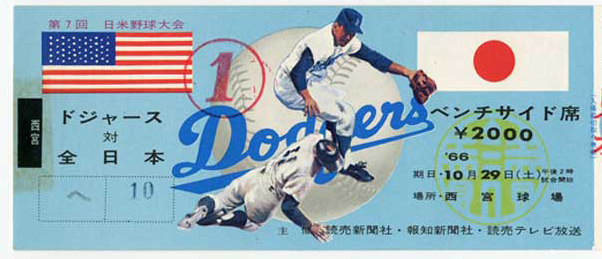
    Game 6: October 29, Nishinomiya

    The Dodgers’ bats livened up in a second game against an all-star squad, winning 7-1 in this Osaka suburb. Jim Brewer, Bob Miller, and Phil Regan stifled the Japanese team, while Lou Johnson and Tommy Davis contributed their first home runs of the tour. The crowd of 30,000 at Nishinomiya Stadium saw the Dodgers frustrate the All-Stars by turning four double plays.

    Game 7: October 30, Osaka

    The Dodgers got a measure of revenge against Masuda, their nemesis in the second game, as Dick Stuart and Nate Oliver reached him for home runs to key a five-run ninth inning and a 9-7 Dodgers victory at historic Koshien Stadium, home to Japan’s annual high-school tournament. Murakami started the game and pitched 3⅓ shutout innings, but the bullpen could not hold the lead. The All-Stars had taken the lead by beating up on Joe Moeller and Ron Perranoski for four runs in the seventh inning. Phil Regan and Nick Willhite restored order and shut out the Japanese team for the rest of the day. John Kennedy also homered for the Dodgers, while Teruyuki Takakura of the Nishitetsu Lions hit one for the All-Stars before 43,000 people.

    Game 8: November 1, Toyama

    The Giants rejoined the campaign in this seaside resort city and the Dodgers prevailed with a 5-2 victory. The score was tied 2-2 in the top of the eighth inning. Akio Masuda was brought in yet again, but pinch-hitter Dick Stuart drove in a run and Al Ferrara singled to drive in two more. Phil Regan shut down the Giants in the eighth and ninth for the win at Toyama Stadium before 23,000 fans.

    November 2 was a travel day and the Wills story was thickening. In Tokyo, an “embarrassed” O’Malley said he would be meeting Japanese Prime Minister Eisaku Sato on Friday and “try to explain and apologize for Wills.” O’Malley sought to frame it as a larger issue: “The United States is more or less involved in this loss of face caused by Wills’ defection.” O’Malley felt his long commitment to developing baseball as an international sport and building close ties with Japanese baseball was being undermined by Wills. The US government had not officially sponsored the trip but President Lyndon Johnson had sent a message of encouragement to the team.

    Wills, meanwhile, was proving elusive. He had gotten off his US-bound flight at a refueling stop in Honolulu. The Dodgers’ team physician, Dr. Robert Kerlan, said he had not heard from Wills. The shortstop/musician was soon spotted playing his banjo with Don Ho at Duke’s, a Honolulu night club, and at other spots around the city.

    In Japan, four groups of Dodgers visited four US military hospitals in the Tokyo area. The cultural and social obligations of the tour demanded time nearly every day with receptions, cocktail parties, golf outings, visits to tourist sites, and other diversions taking up the Dodgers’ between-games time. It was not a restful vacation.

    Game 9: November 3, Tokyo

    It was a Dodger homer barrage in an 8-5 victory over the Japan All-Stars as a crowd of 39,000 celebrated the Culture Day holiday at Korakuen Stadium. Ron Fairly hit bases-empty and three-run homers while Jeff Torborg and Jim Lefebvre slugged two-run shots. It would prove the high point of the trip, with the Americans now 7-2.

    Game 10: November 5, Tokyo

    After a day to reflect, the Japan All-Stars regrouped for an 8-2 win before 34,000 at Korakuen Stadium. Shinichi Eto of the Chunichi Dragons started the parade with a two-run homer in the first. The Giants’ Sadaharu Oh, who had led the Central League with 48 homers, contributed two more round-trippers. Jim Lefebvre’s bases-empty homer was the only protest by the Dodgers. “Too much Eto and too much Oh,” said Alston. “The barnstorming major leaguers never looked more listless,” wrote Pacific Stars and Stripes sports editor Lee Kavetski.

    Game 11: November 6, Tokyo

    The next day the Dodgers played at Korakuen Stadium before 34,000 people including Emperor Hirohito and Empress Nagako. The team was not up to royal scrutiny, losing 11-3 to the Japan All-Stars. Alan Foster’s first pitch was deposited in the left-field stands by the Giants’ Shigeo Nagashima. Yukinobu Kuroe of the Giants and pitcher Tetsuya Yoneda of the Hankyu Braves also homered. Ron Fairly and John Roseboro homered for the Dodgers. After the game, the Dodgers emerged from their dugout to tip their caps and wave to the royal couple, who had never seen a visiting American team before and had not been to a Japanese professional league game since 1959.

    Eckert and O’Malley made their visit to Prime Minister Sato. During a five-minute meeting at Sato’s official residence, the Americans presented a baseball with O’Malley’s signature and a pass good for all major-league games for the 1967 season. They also presented O’Malley’s apologies for Wills’s absence.

    “The Dodgers may have drawn blanks elsewhere, but they are diplomatic successes in Japan,” reported the Los Angeles Times’s Frank Finch. “No matter where they go, to a shrine, a restaurant or a ball park, they are besieged by the friendly grins of red-hot baseball fans. The official badge issued by Walter O’Malley to the touring troupe is like an open sesame. People who can’t read English instantly recognize the familiar ‘Dodgers’ name in its script form. ‘Doh-jars,’ with the accent on the second syllable, is one of the most popular words in Tokyo, Sapporo, Osaka, Sendai, Nagoya and other cities where the team has appeared.”

    Wills was still in Honolulu, although Bavasi, who was also in Hawaii on a cruise, said he thought the shortstop was in California. Wills was reported at a Democratic fundraiser starring Sammy Davis Jr. but brushed aside any questions about the situation. Kerlan said he still had not heard from Wills. Bavasi said there would be no discipline until all the facts were known. He said a post-World Series examination had found there was no need for an operation, but that if something had happened subsequently, Wills should be seeing Kerlan. “If he’s off playing the banjo somewhere, he must think the banjo is more important than baseball,” Bavasi said.

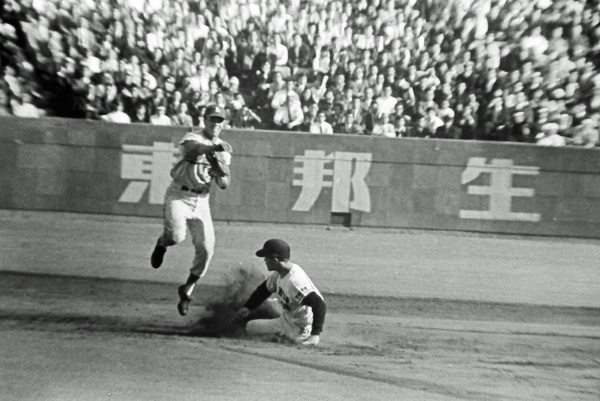
    Maury Wills attempts to turn a double play against the Yomiuri Giants (Robert Fitts Collection)

    Game 12: November 8, Okayama

    The combined Yomiuri-Nankai team returned as the Dodgers’ opponents and fell 10-2. Ron Fairly and Nate Oliver hit home runs, but the Dodgers’ biggest contributor was John Roseboro with a double, two singles, and four RBIs. The 20,000 fans in Okayama Stadium saw the Dodgers score six runs, including Oliver’s home run, in the ninth inning to blow the contest open.

    Game 13: November 9, Hiroshima

    The Japanese opposition was now a team combining the Giants and members of the hometown Hiroshima Carp. The teams played to a 10-inning 10-10 tie before 18,000 at Hiroshima Municipal Stadium. Earlier in the day, a 25-person Dodger delegation had placed a wreath on the site of the atomic bomb’s impact. The game was called because of the need to meet the travel schedule. The Dodgers built an early lead, 10-4 after seven innings, but the home team rallied with six runs in the eighth and ninth innings off Claude Osteen, Phil Regan, and Ron Perranoski. “Something is wrong with Osteen,” said Alston. “He just can’t seem to hit his stride on this tour. With 10 runs, we shouldn’t have had any trouble.” Dick Stuart, with two, John Kennedy, and Jim Lefebvre hit home runs to build the Dodgers’ early lead.

    Game 14: November 11, Kumamoto

    The series moved to the island of Kyushu, the Dodgers’ first move off the main island of Honshu. The opponent at Fujisaki Stadium was a team combined from the Giants and the Nishitetsu Lions, based in the nearby city of Fukuoka. Alan Foster and Ron Perranoski held down the locals while Jim Lefebvre produced two run-scoring doubles to propel the offense. Foster limited the Japanese to one hit until he tired in the eighth inning. With the 6-3 win, the Dodgers’ record stood at 9-4-1. They would not win another game.

    Game 15: November 12, Fukuoka

    The teams moved to Fukuoka’s Heiwadai Ball Park and the Japanese shut down the Dodgers, 4-0. Joe Moeller gave up all the runs in the first four innings. It was the National League champions’ fifth loss of the tour, the most by any visiting American professional club.

    Game 16: November 14, Kokura

    Moving to the northern tip of Kyushu, the Dodgers dropped a 3-1 game to the Yomiuri Giants, moving their record to 9-6-1. Eighteen-year-old Tsuneo Horiuchi of the Giants held the Dodgers to six hits before 20,000 at Kokura Stadium. In the third inning, Dodgers starter Nick Willhite walked two batters before Sadaharu Oh came to the plate. Oh blasted one over the fence, but then was called out for passing the runner who had started at first base, limiting the benefit to two runs. The Giants’ final run scored three innings later when Akira Kunimatsu doubled in Oh. The defeat left the Dodgers’ record against the Giants at 3-3.

    Game 17: November 15, Nagoya

    Now facing a combined team from the Giants and the Chunichi Dragons, the Dodgers dropped their third in a row before 28,000 at Chunichi Stadium. Home runs by Sadaharu Oh and Toshimitsu Suetsugu powered the Japanese team. The Dodgers’ third loss in a row marked the first time an American team had suffered such a streak.

    Also that day, the Japanese government awarded O’Malley its highest honor for a non-Japanese – the Order of the Sacred Treasure, Gold Rays with Neck Ribbon, recognizing his efforts to foster Japan-United States friendship through professional baseball.

    The Dodger wives felt rewarded as well. The spouses of Tommy Dean, Bob Miller, Ron Perranoski, John Roseboro, Dick Stuart, and Jeff Torborg had made the trip and seen the sights and the cultural performances. And done some shopping. “I must have visited and bought out every department store in Japan,” said Sue Ellen Perranoski. “I bought a pearl ring, Christmas cards, kimonos, toys and a truckload of other things.”

    Game 18: November 16, Shizuoka

    The tour, the worst by an American club in the history of the exchange, wound up with a 7-3 loss to the Yomiuri Giants, a game mercifully ended after seven innings because of darkness at Kusanagi Ball Park. It was the Dodgers’ eighth loss (9-8-1 overall) and their fourth straight defeat. Both were records for futility by an American team. For those viewing the tour as an international World Series, it meant the Giants had prevailed 4-3. The Giants jumped on Joe Moeller for four runs in the first inning and never looked back. The 21,000 in attendance saw Sadaharu Oh hit a grand slam, which would have been his third game in a row with a homer (and sixth for the series) except for his baserunning blunder in the 16th game. Al Ferrara homered in the Dodgers’ three-run sixth. Akio Masuda started and closed out his work with 3⅔ shutout innings.

    The post-mortems started immediately. Giants manager Tetsuharu Kawakami said the series clearly showed that the gap between Japanese and American professional baseball had narrowed.

    Comparing the 1966 tour to the one a decade earlier, he said, “We have learned a lot since then. Our baseball is at least 50 percent improved. Our bunting is better, the base runners are smarter now, and we play more inside baseball like the Americans.” Others were not so encouraged. Tokumi Matsumoto, a columnist for the Mainichi Daily News, quoted a fellow Japanese baseball writer: “It is obviously dangerous for the Japanese to believe the 9 win-8 loss-1 tie result indicates the Japanese pro ball standard is almost equal with that of the major leagues.”

    Dodgers manager Walter Alston said he was sorry over his team’s performance and offered specific praise for Oh, Masuda, and Horiuchi. He said he felt Japanese hitters, especially for power, had improved more than their pitchers since the Dodgers’ 1956 trip. Both managers noted that the absence of Koufax and Drysdale had had a big impact on the tour.

    After a day of relaxation and shopping on the 19th, the Dodgers’ charter plane left for Los Angeles on the 20th.

    For the Dodgers, the consequences were coming. Some came directly from the tour. Others had been pending over the season.

    The Dodgers party was still in Tokyo when the biggest blow fell. On November 18, Sandy Koufax announced that he was retiring. He knew he could keep competing and winning, but he also knew he risked permanent damage from an excruciatingly painful elbow that required extensive treatment before and after each start. O’Malley, still in Tokyo, wished him well.

    As baseball’s Winter Meeting started on November 28, Bavasi started other planned changes. Former batting champion Tommy Davis, who had been on the trip, was traded to the New York Mets for the second baseman the Dodgers thought they needed – Ron Hunt. Three days later, the inevitable consequence of the Japan trip fell into place. Wills was traded to the Pittsburgh Pirates for Bob Bailey and Gene Michael. Wills eventually had left Hawaii and visited Kerlan in Los Angeles. Kerlan said the knee was no worse than it had been at the end of the season. He prescribed extended rest, which had been the basis of Wills’s request to miss the Japan trip. Bavasi said this was the only time Walter O’Malley had forced his hand on a baseball decision. Wills, evidently forgiven, returned to the Dodgers in 1969.

    The remake of the Dodgers’ roster would not work well. The team fell into the second division for two years and wouldn’t win another pennant for eight years, or another World Series until 1981.

    Walter, and later Peter, O’Malley worked hard to improve and deepen relations with Japanese baseball. Yomiuri sent the Giants (and 21 Japanese reporters) to Vero Beach for joint spring training with the Dodgers in 1967. The Giants, or individual players, returned many times in the future and other Japanese professional and college teams would come for spring training. The Dodgers did not return to Japan until 1993, but these decades-long contacts were instrumental in the Dodgers’ ability to sign Hideo Nomo when he became the first major Japanese star to join an American major-league team in 1995.

    The agreement between the two commissioners had sparked Japanese dreams that they were evolving toward parity with the US major leagues. The relationships the O’Malleys and the Dodgers forged with Japanese baseball were instrumental in giving them the opportunity to sign Nomo, and effectively confirm Japanese baseball as a second-tier operation as its major stars could dream of better salaries and the satisfaction of competing successfully at the highest levels of professional baseball.

    ANDY McCUE, a former Board President of SABR, won the Seymour Medal for Mover and Shaker: Walter O’Malley, the Dodgers, and Baseball’s Westward Expansion. He is also the author of Baseball by the Books: A History and Complete Bibliography of Baseball Fiction and Stumbling Around the Bases: The American League’s Mismanagement in the Expansion Eras (University of Nebraska Press, 2022). He holds a master’s degree in Chinese history.

    Continue to read the full article on the SABR website