
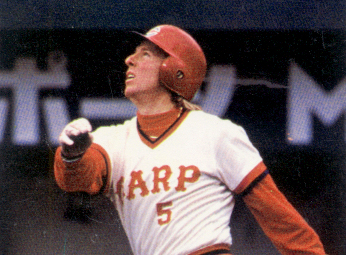
Don Newcombe and I were the only two people who pitched in the big leagues and were position players in Japan. Newcombe pitched with the Dodgers and played first base in Japan. I pitched for the Padres for just for a little while, and then I played outfield in Japan. That’s what I’m the proudest of, that I could do a little bit of everything.
All through high school and during two years in college, I pitched and played right field. Right field was my favorite position. Roberto Clemente was my idol, so I had to be a right fielder. I was signed as an outfielder by the Padres in 1973. My first year in A ball, I hit .355, won the batting championship. I went to AA the next year, but I broke my hand. I went back to AA in the next year and my manager was Pat Corrales. He was a Fresno boy too. I used to throw batting practice to the whole team because I could always throw strikes and then somebody would throw to me. So, in AA that year, I was hitting the worst I had ever hit my life. I was hovering around .270, and Pat said, “You know what, Mike? I may just bring you in from right field and let you pitch a little bit.”
The first game he brought me in we were playing the Giants and Jack Clark was on that team. I struck out Clark three times that night and I threw 8 1/3 shutout innings. So, Corrales said, “Hey, I’m going to let you DH, but I’m going to bring you in and let you pitch a little bit more.” To make a long story short, he brought me in the last month and a half of the season. I ended up at 5-0, three saves and a 2.10 ERA in AA. Then [the next year], I went to spring training, and I threw really well, and I made a big club as a pitcher. To be truthful, I wasn’t prepared to be in the big leagues as a pitcher because my best position was outfield, or probably utility because I could play a little bit of everything.
After I got sent down [in 1976] from the big leagues, I threw back-to-back shutouts in Hawaii. Then they moved me to long relief and a little bit of closing, and they would DH me. Back then it was really tough to be a DH when we had position players sitting on the bench and I’m coming into pitch but also DHing. Those were fun times, but they were tough times too. For some of the position players it was difficult because I played two or three years in a row with them, and they were not getting a chance to play [because I’m playing both ways].
As a two-way player, you’re always ready. Because I would usually be DHing, I’d be in the back taking swings [for most of the game]. I’d get ready mentally there. And then as far as pitching, the manager would usually let me know, “Hey, if we tie up the game or we get within a run, I may bring you in.” So, I always kind of knew where I was. I’d often get four or five at bats a night and then maybe pitch in the 7th, 8th or 9th inning. So, you get a routine down and it didn’t bother me because I was the type of pitcher who could throw seven, eight, or nine warm-up pitches and I was ready to go.
I even got to catch a few games. If I could have done it all over again from day one, I would have learned to hit left-handed and I would have been a catcher because I think that’s the best the road to the big leagues. You can be a good hitter, like Mike Piazza, or you can be a good defensive player. But if we look over the years, there’s not a lot of people who did both really well. I started toying with it by catching in the bullpen. Then finally they let me catch few games. As a catcher, you are involved in every play. That’s what I enjoyed. If I could do it all over again, I’d learn to hit left-handed and be a catcher, even though right field is my favorite position.
The Hawaii team I played on when we won the PCL championship in 1976 had Bobby Valentine in first base, Adrian Garrett, Billy Alman at short, Dave Roberts catching, Rod Gaspar at center, and Gene Richard in left. So, we had a great, great team. It got Roy Hartsfield a job with the Toronto Blue Jays the next year as a manager.
After the 1979 season, I was pretty much decided that my baseball career was over. Over the years, I got to know Fibber Hirayama. He was a Fresno boy, and he had played for the Carp. Fibber left me a message that said, “Hey, Mike, can you give me a call?” I thought he maybe wanted me to throw batting practice to somebody. But he said, “How would you like to go to Japan?” And my first question was, “Am I going to pitch or am I going to hit?” He said, “They want you as a hitter.”
So, I did some homework. The Carp had won the Japan Series the year before and I was replacing Adrian Garratt. I had played with Adrian on that AAA team in Hawaii. He was a great guy. He hit 40 home runs [in 1978], but according to the Japanese, he couldn’t play defense. But they won the Japan Series! So, when I had the opportunity, I was ecstatic. I was thinking, “Why are they wanting Mike Dupree to come to Japan, instead of Adrian Garrett who had 40 home runs and was just a really a good guy.” But I was so pleased because all I ever wanted to do from a little kid up was to play baseball. My short career in the big leagues was great, but Japan eventually ended up being the highest and the best part of my career because of the team I played on. So, I thanked Mr. Hirayama every time I saw him. I would say, “Sir, I’m so thankful that you had enough trust in me to send me to Japan.”
I had never seen a Japanese player or a game, so I knew very little about Japanese baseball other than they were in phenomenal shape. Also that they overtrained a little bit more than they should have and that their pitchers threw a little bit more than they should have. I knew that I had to be in the best shape of my life before I went to Japan. And I was. But once I got there, it didn’t take me long to realize that they were considerably better than what was portrayed to me. That was no triple-A team.
For spring training, I flew over about three weeks before my wife because she was giving birth to our daughter. We didn’t train in Hiroshima; we went to a small village, and it was beyond cold. I remember hitting for five minutes on a left-handed pitcher, then five minutes on a right-handed pitcher, and the games were so cold. It took me [just] one game to realize that these people were over the top into baseball. I mean, baseball was just everything. I knew baseball was big, but I [was still surprised] how hard we trained and how much we trained, how much we hit, and how much we threw and ran. It was good to have Jim Lyttle there. He had already been there three seasons. Jimmy was really great. We instantly got along really well and I’m very thankful that he was there. I was 28 years old and wasn’t quite as calm I am now. [I was] a young and cocky kid. Jimmy would just say, “Hey, we’re going to do it so just calm down. We’re going to run so just adapt.” Finally, I started adapting. Jimmy was good for me.
Jimmy was well respected by the team, really well respected. He was a practical joker, and he was kind of notorious for hiding gloves. He was also really big on hot foots. The guys who weren’t playing sat in the first two rows of the dugout and clapped and yelled in unison. So Jimmy would get behind somebody in the front row and light him on fire! The guys would scream and our manager, Takeshi Koba, who always stood at the corner of the dugout, very upright, would look over, but say nothing.
One of the first things I found out, and I found out the hard way, was the aggressiveness was stronger in the States, at least in 1980, by far. Early in the season, maybe a month into it, I was on second base, and there was a base hit to left field. I went through third, and the catcher was like four feet in front of home plate. I had nowhere to go. I couldn’t slide because I’d come up short [of the plate], so I dropped my shoulder, and I knocked him over. You wouldn’t believe it, both benches emptied. It was just craziness. I wasn’t looking to knock the catcher over, but I had no other alternative.
You also didn’t take the second baseman out when you slid into second base. In the States,
guys like Lee May and some of those old big guys couldn’t wait to send a shortstop or second baseman into the outfield. “Oh no, Dupree-san. You don’t slide in the second base. It hurts,” I was told. We played a lot more physical in the States. Also, nobody ever tried to pick anybody off, but every time somebody would get on, the pitcher would stop and lob it over to first base.
In my first game, I’m going along and I’m 0 for 3. I’m having a great first game! I’m really showing off. I’m making him forget Adrian Garrett (laughs). In the top of the ninth, we were tied and they had their speediest runner on second base. They got a base hit to me in left field, and I came up throwing. I threw a strike to home, and he was out. Well, guess who led off the bottom of the ninth inning? I had been watching the pitcher the inning before, and he started off every time with an outside fastball. First pitch, I hit it out, over the right center field wall. So, I was called the sayonara kid for most of the year. That was a thrill. I was just trying to get on base, but as soon as I hit it, I thought, “This has got a chance!” I was on the magazine covers, so that was a nice way [to start in Japan], even though I was only one for four.
I got to my locker the next day, and there was this little envelope with nothing but yen. I went over to Jimmy, and he said, “Get used to it.” That opening game made me an awful lot of money. Even if I went 0-3, but I made a good play during the game, there was always a little something. When I say a little something, the equivalent two, three, four, five hundred dollars. But the opening game, I was blown away by what was in my locker the next day because I wasn’t prepared for it. You don’t see that in the States!
Another thing that surprised me was that some of the managers would get very, very vocal with the umpires. Now Earl Weaver and Lou Panella used to argue and get kicked out, but some of the Japanese just took it to the nth degree. If it was a star being called out on strikes, they were right up there [in the umpire’s face]. Sadaharu Oh had a [tiny] strike zone, like about six-by-six inches (laughs). I’d see some of those pitches that Oh-san would take, and I’d think, “Oh my God!” I always used to have fun with Jimmy, about our strike zone [foreigners had notoriously large strike zones]. Jimmy used to tell me, when you get two strikes, get as close to the plate and swing. Luckily, I was a first ball or second ball hitter. I wanted to hit. I didn’t see a lot of interaction between managers. Every now and then in the States, you’ll see one of our managers yell over to the other dugout, and Panella would go after the opposing managers. Japanese managers were a little calmer to each other, but they certainly got into it with umpires.
Now, the new stadium in Hiroshima I hear is fantastic, but the old one was fun and quaint. When I got to Hiroshima, the first thing I saw when I ran out on the field was the all-dirt infield. It was first time I played on an all-dirt infield. I remember telling Jimmy, “As much as I heard it rains over here, there’s going to be little lakes out here all the time.” I thought the outfield was really good. But I was blown away at the dirt.
Now if it was raining, we didn’t play. I think in 1980 we had 28 rain outs, and it was only a 130-game schedule. The season in Japan is longer than it is in the big leagues because you play every game, so you have to go back and play the rain outs. In Japan, you played in little towns, five or six games a year. They tried to play as soon as it quit raining, because the town only had one game a year. It was raining hard before one of these games, and I told Jimmy, “We’re getting the night off.” He said, “Don’t worry, it’s going to quit raining.” They landed two helicopters opposite each other on the field [to dry the diamond with their propellers]. We end up playing an hour later. They just got it ready.
When I played in 1980, a lot of my friends said Japanese stadiums were like AAA ballparks because they’re smaller and they’re shorter. Well, you know, I played in the Tokyo Stadium back in the day and center field was 405 or 410 and some of the lines are 315 or 330. [Since then], I think the Japanese players have gotten stronger. They’ve certainly gotten better, but the Carp team that I played with in 1980 was the best team that I ever played on. That team would have had three stars in the big leagues.
We played a 130-game schedule, and we ended up winning our division by 6 1/2 games. I think what made the team so good was the chemistry on the field. If you play enough games, there’s going to be friction. But they just got along well, I never saw any friction. [It helped that] we got out of the gate quickly and the pecking order [on a Japanese team] was big back then. The chemistry was built by the organization, but they just got along well. You know, I never had one Japanese player yell at me or say something underneath his breath or anything. Never.
I really didn’t see the Japanese players off the field, just during the games and before games. Did you know that they eat a meal right before every game? That was amazing to me. We would eat hot noodles and rice and chicken. So, I didn’t have a lot of involvement with them outside of the ballpark, but in the ballpark, I was treated great. Plus, we had an interpreter everywhere that we went. Wally Yamane was our interpreter. We were always hoping he was saying what we were saying, and not saying, “Oh Dupree-san said, ‘He is going to hit thirty home runs and drive 100 RBI.’” The players, as a whole, were really good to me.
I can just see our manager Koba standing very upright with his hat on looking down at us. Koba-san treated me nice. He usually went through my interpreter Wally, and I was never called into his office. So, he was great. He just let me and Jimmy play. He played a little bit un-Japanese baseball. We only had only one guy, our shortstop, who had good speed and might steal. But our pitching was good, and we had great hitters. So, the three-run home run, the two-run home run were really important for us. Koba-san wanted to play for longer innings as opposed to just one or two runs, so he didn’t run himself out [of innings] and he didn’t bunt a lot. [This strategy] was dictated by having some really good talent. We had guys like Koji Yamamoto (we only played 130 games and he hit 44 homers!), Sachio Kinugasa, our first baseman Jitsuo Mizutani, who had great power and won a batting championship, and Jimmy, who had a great year. We had guys who could hit the ball out, so Koba played more for the big inning as opposed to just giving an out away. We also had the best defensive outfield in Japan. Jimmy was great in right field. Koji was really conservative, but he was a good outfielder. And then I loved to come up throwing in left field, so we had by far the best defensive outfield in Japan. I mean hands down.
Koji Yamamoto was about 5’ 10”, 165 lbs. and he hit the ball so hard and so far. Now his strike zone wasn’t like me and Jimmy’s, but it wasn’t [as small as] Oh-san’s either. He hit the ball so hard consistently. He was the best Japanese player that I played with, by far. He was very, very quiet, but on a flyball into the gap that I would dive for and my hat went flying off, he’d be the first one to hand it to me; the first one to give me a little bit of a high five. He was as humble as a superstar possibly could be.
Sachi Kinugasa was nothing but first class to me first, first class. For a guy 5’ 9” and 170 lbs., he could hit the ball a mile. He wasn’t the hitter Koji was then. But if I remember right that year, he hit 31 home runs and played great defense. It was close in the dugout, who had more respect Koji or Kinugasa. Sachi understood English, and he was just one of my favorites; him and Enatsu were probably my two favorite individual players.
Me and Enatsu had a little bit of a bond. I liked him. When I played with him, he was at the tail end of his career, but he could have pitched in the States because he pitched like American power pitchers pitch. And he was fun to play with. His locker was real close to mine and he would come in, look over at me and just give me a little wink and kind of shake his head. He was another one I love playing with, but he was more at the end of his career where Koji was right in the prime. Kinugasa was a little bit at the end of his career, but that was the best team ever played on.
At that time, stealing signs was really common in Japan. It was notorious in Hiroshima. We had a guy out in center field who had binoculars behind one-way glass so nobody could see. Koba-san would relay. “Dupre-san!” might mean curveball, or off-speed, or shuto. If they didn’t say anything, it might be a fastball. They were right on, probably 90%. When you’re right on 90%, whoa, you can be a little bit better hitter. People steal signs in America, like the Astros did, but as a whole, when guys are throwing 95 to 100 mph, even if you know what’s coming, it’s still awful hard to hit it.
In the Japan Series, we lost the first two games at home. We were so dominant at home, and I was thinking, “Oh my gosh!” Then we went on the road, and Jimmy got hot. We won the next two, lost one, so we were down 3-2. We came back to Hiroshima and won the last two games. Jimmy Lyttle was the MVP. I remember that I didn’t have a great series. I got two hits the final game and I made a nice diving catch in left field. That last game was back and forth. They got the lead and then in the sixth inning we took the lead, and we brought Enatsu in for the last three innings, and he won it for us. After the game, we marched around the field. The owner was first in the parade, naturally. Koba-san was second, then his main two coaches, then the other coaches, and then the players with the gaijin somewhere towards the back. We walked around the stadium three or four times, and it was just for the fans to appreciate and applaud and say thank you.
I would have liked to have gone back another year, but I think that they wanted the Adrian Garrett type. I mean, when you win the World Series, you don’t usually break up the nucleus. I wasn’t Koji or Jim Lyttle or Kinugasa, but I brought something else to the game every night and I’d run through the wall to catch the ball for you. I tried to do everything. I did the little things, so I was disappointed I wasn’t able to go back the next year. That’s probably the biggest disappointment I take away from Japan, but that’s small compared to all the things that I came away with. I just absolutely loved everything about it.
I have such fond memories of Japan. Those were good times. I don’t know if you remember Rick Dempsey. During a rain out, he [stuffed something under his jersey to make] a big stomach and went to home plate, took a big fake swing, and ran around the bases. When he got halfway around third, he slid home on the tarp. So, they had just shown the clip on Japanese TV when we had a rain delay, and the players came up and said Dupree-san? They knew I would do it. They weren’t going to do it. We were on the road and they said, “Dupree-san, do running home run.” I said, I would do it [for a price] and I named a ridiculous number of yen. And they said, Okay!” So, I got a bat and went to home plate with a helmet like I was batting. The first pitch I took, and I yelled at an imaginary umpire. “It was too high, too high!” I did this about two times, and then I swung, and ran all the way around [the bases]. I hit third base and then about a quarter down I literally slid on the tarp all the way home. The guys in the dugout were just going crazy. It was in the magazines. I don’t know if the guys had more respect for me after doing something goofy and being part of them. And you ready for this? The next day in the locker was cash in a little envelope. I wasn’t really expecting that. The sad part was that we ended up playing that night. And it was cold! I couldn’t get that jersey off fast enough afterwards. That was probably the goofiest thing that I did.
You go to the game in America, and you enjoy it. When you see the grass and the field for the first time, you’re excited by the beauty of the ballpark. But in Japan, it’s a happening. I mean, the drums, the banners, the cheering. I have two huge banners. Because of the way I played, I had a nickname of Hustle Boy. So I have a banner that’s probably 10 by 6 feet with my face with really blonde hair and “Hustle Boy” all over it. I also have another banner that they gave me when I left. The fans waved them in the outfield right behind me, and Jimmy had his in right field. Unless you’re there [you can’t really understand]. You can tell people what it’s all about, but it’s just nine innings of cheering. They just enjoy it and it’s their lives. It was just constant yelling and screaming. It was such a happening. It was unbelievable.
I have not been back to Japan since 1980, but we’re going with my daughter and son-in-law and grandkids this August [2025]. We’re really looking forward to going back to Hiroshima. I can’t wait for my grandkids, and even my daughter and son-in-law, to be there firsthand. I can tell people about it, but once you experience it, it’s amazing.
You know that they’re big on signatures. Guys would knock on the hotel door but have nothing to sign. So, they would want me to sign my name with a magic marker on their suits. I would say, “No, no.” You know, I didn’t speak Japanese very good. But they would say, “Please Dupree-san.” So, I did that a half a dozen times and then a young lady came to the door, and opened up her blouse. I was praying there were no cameras down the hallway. So, I signed it real quick, said thank you and closed the door. They’re so big on autographs and stuff like that because baseball’s the only true team sport. We can’t relate to that. The average person only has baseball. Golf is so expensive you can’t afford to play. I signed a lot of 8 by 10 cards [shikishi], I can tell you that! I was very thankful to be in Japan so I signed for everyone I could. A few times a year, I still get mail from Japan and when I do, it’s usually a baseball to sign or a very elaborate letter, because baseball is so popular over there.
Oh-san retired in 1980; that’s the year I played. So, my favorite memento is a big, beautiful color picture of me and Oh shaking hands. I had the most respect [for him]. When people say he wouldn’t hit all those home runs over here. No, he wouldn’t. But he was a great, great hitter and he would have hit many over here. He was a great hitter and just as good a person.
I told you earlier, all I ever wanted to do was play baseball. I made it to the Big Leagues. Was I a star? No, not at all. Japan made all the years of playing baseball worth it because with only two Americans per team, I played every game but two. I got hit with a pitch and I was supposed to be out for two weeks. I actually missed only one game. I came back two days later. I had a lot of fulfillment in winning the World Series of Japan. And it was the best team I ever played on, so I only have good memories from Japan, good memories.
Read more Carp Tales at https://www.robfitts.com/blog

