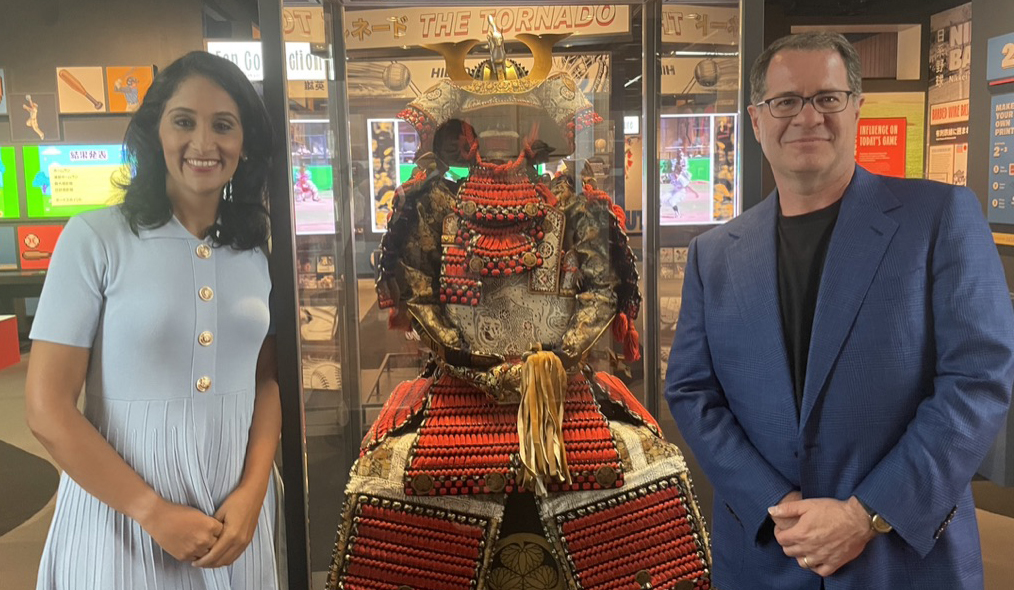
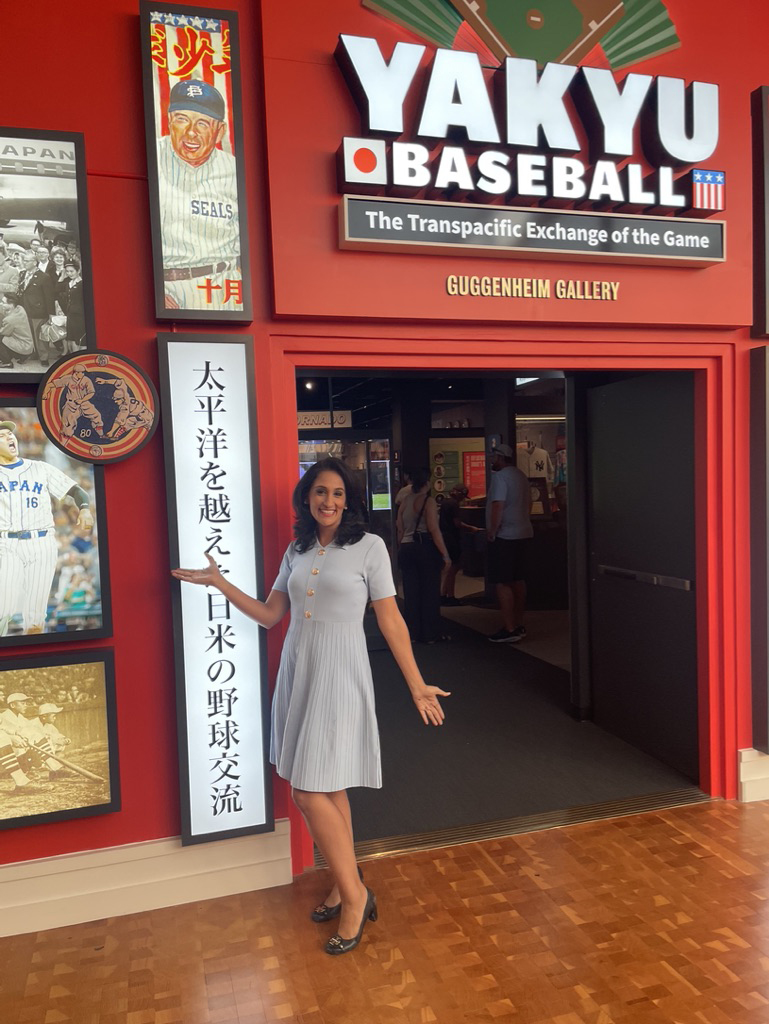
NHK World-Japan’s Deeper Look host Del Irani visited the Yakyu-Baseball exhibit at the National Baseball Hall of Fame and Museum in Cooperstown to examine the history of Japan- U.S. relations through baseball.
In this two-part series, Irani interviews SABR’s Asian Research Committee Chair Robert Fitts about the the long history of Japan-U.S. baseball interaction, baseball diplomacy, and the cultural importance of Japanese playing in Major League Baseball.
Every Tuesday morning we will post an article from SABR’s award-winning books Nichibei Yakyu: Volumes I and II. Each will present a different chapter in the long history of US-Japan baseball relations. In this article Robert Fitts describes the first professional baseball tour of Japan.
The “King of Baseball” was on the prowl for a new opportunity. Mike Fisher, known by everybody as Mique, was a bom promoter and bom self-promoter. He was a risk taker, tackling daunting projects with enthusiasm and usually succeeding. He was the quintessential late-nineteenth-century American man; through hard work and gumption this son of a poor Jewish immigrant transformed himself into a West Coast baseball magnate.
Bom in New York City in 1862, Fisher grew up in San Francisco. Renowned for his speed, he played baseball in the California League during the 1880s before an industrial accident in March 1889 damaged his left hand and sidelined his career. Fisher soon became a policeman in Sacramento, rising to the rank of detective. During his time away from the game, he put on weight and by 1903 was a repeat champion in the fat men’s races held at local fairs.
In February 1902, a new opportunity presented itself when the California League offered Fisher the Sacramento franchise. Fisher pounced on it. In December 1902, the league transformed into the Pacific Coast League, but within a year Fisher relocated his franchise to Tacoma, Washington. Hampered by poor attendance, despite winning the 1904 championship, Fisher sold his share in the team but stayed on as manager as the franchise moved to Fresno in 1906. But his stay in Fresno was short as he left the team after the 1906 season. Without a franchise, Fisher turned to promoting and, in the fall of 1907, took a squad of PCL all-stars to Hawaii.
“So pleased is Mike Fisher with the reception that his team has met with here,” reported the Hawaiian Gazette, “that he is already planning for more worlds to conquer. He is now laying his lines for a trip to be made … next year, which will extend farther yet from home. … The plan, as outlined by Fisher, will include a start from San Francisco, with a team composed exclusively of players from the National and American leagues,” and a stop in Hawaii before continuing on to Japan, China, and the Philippines. It was the first time an American professional squad headed to the Far East.
By early December 1907, Fisher had teamed up with Honolulu athlete and sports promoter Jesse Woods to organize the trip. Woods sent a flurry of letters to Asian clubs to gauge their interest. In February, John Sebree, the president of the Manila Baseball League, responded “that Manila would meet any reasonable expense in order to see some good fast baseball by professional players.” In early March, Woods received a letter from the Keio University Baseball Club stating that they would help arrange games in Japan for the American team. The Hawaiian Gazette noted, “This was good news for Woods, who has been in doubt as how such a trip would be received by the Japanese. There has been so much war talk that Woods was afraid that Japanese might refuse to play baseball with us.” A letter in early April from T. Matsumura, the captain of the Yokohama Commercial School team, confirmed the enthusiasm for the tour in Japan: “When you visit our country, you would certainly receive a most hearty welcome from our baseball circles.” Isoo Abe, the manager of the Waseda University team, added, “We are preparing to give you a grand ovation. We are going to make you feel at home, and we will strive to make your visit to Japan to be one that will linger long in your memories.”
In late June, Woods sailed for Asia to finalize the details for the tour. The touring team was now known as the Reach All-Americans. With the name change, it is likely that the A.J. Reach Company sponsored the team but despite extensive research, the nature of the sponsorship is unknown. Woods’s reports from the Far East were encouraging. “I have all the arrangements made. Forfeit money is up everywhere, and everything is on paper. The team will take in Japanese and Chinese ports and Manila.”
While Woods was working out the itinerary, Fisher built his roster. As usual, he thought big. It would be “a galaxy of the best players in the country.” He began by engaging Jiggs Donahue, the Chicago White Sox’ slick-fielding first baseman, to manage and help recruit the team. “I do not know why Mike Fisher came to me to ask me to get up the team, for I did not know him,” Donahue told a reporter. “I will willingly undertake the work, however, for I believe it will prove to be a grand trip and a success.” Donahue quickly recruited fellow Chicagoans Frank Chance, Orval Overall, and Ed Walsh and began working on the leagues’ two biggest stars, Honus Wagner and Napoleon Lajoie. “Both Wagner and Lajoie are said to be enthusiastic over the plan,” reported the Inter Ocean of Chicago, “but cannot decide whether or not they will be able to arrange their affairs in such a way as to make the trip, which will last two or three months.” By June, Fisher had added New York Highlanders star Hal Chase, Chicago’s Doc White, and Bill Bums of the Senators. Although Wagner and Lajoie declined the invitation, Fisher’s team received a boost on August 23 when Ty Cobb announced that he would join the tour. The recently married star planned to take his bride on the trip as a honeymoon.
Continue to read the full article on the SABR website
In 2022 Japanese baseball celebrated its official 150th birthday. Most officials and historians date the introduction of baseball to Japan to 1872 when American teacher Horace Wilson taught the game to his Japanese students. Recent research, however, has shown that the crew of the U.S.S. Colorado played against American residents of Yokohama in October 1871, and perhaps against Japanese residents of Osaka in January 1871[1] Now, a newspaper article shows that baseball was played as early as July 1869 in Kobe.
A few years ago, historian Aaron M. Cohen began sending me clippings about Japanese baseball from his files. Among the clippings was an article written by Harold S. Williams in 1976 discussing the origins of Japanese baseball. Williams was an Australian who lived in Kobe, Japan, from 1917 to his death in 1987, except for the war years. Williams wrote extensively about the early history of Kobe and Japanese culture.
In his article, “Shades of the Past: The Introduction of Baseball into Japan,” Williams argued “the names of those who actually first introduced the game into Japan is something which never will be known. Furthermore nobody knows, nobody can ever know, exactly where or precisely when the first game was played. Certainly it would have been a very modest and informal affair”[2] A sentence in the article caught my attention. He wrote: “in Kobe, on 4th August, 1869, about eighteen months after the port was opened, The Hiogo News reported: …one evening last week we saw as many as 7 or 8 men playing cricket and a still larger number playing baseball.”
Intrigued, I shared this with my colleague from Kawasaki, Japan, Yoichi Nagata. Yoichi went to the National Diet Library in Tokyo to track down the original source. The text of the article, appearing on page 434, is as follows.
“The exuberant spirit of youthful Kobe has been disporting itself for some days past a little out of the beaten track. This is a fact that, in spite of all kinds of adverse circumstances, the enthusiasm of a few cricketers has burst through the bonds that hitherto bound it, and bat, ball and stumps have been paraded through our streets. …The practice ground—no, it would not be right to call it by that name—the ball–splitting ground, or the ground upon which play has been carried on, has been the N.E. corner of the “sand patch” of a year ago—now well overgrown with weeds, grass, etc., etc. The best of this has been selected, the grass has been cut, and it makes a fair ground for practice. If anyone is skeptical on this point, he should join in an evening’s play, but novices should be fairly warned of the surrounding dangers, or the drains and stakes may cause a nasty tumble. The stakes are the corner posts of the different unsold lots, and those who have run against them say they are pretty firmly driven in. These are minor disadvantages, and the cricketeers say that a man never runs against them twice,—memory acts as a kindly warning, and one proof of their stability has hitherto been found quite sufficient.Truly, the “sand patch” has been used for purposes never dreamed of, and that it was apparently least fitted for. Two successful Race Meetings have been held on this non-elastic turf, and one evening last week we saw as many as 7 or 8 men playing cricket, and a still larger party playing baseball.We are pleased to hear it is the intention of the cricketeers to form a club, and wish them every success. Although there is sufficient talent here to form a good club, we fear the obstacles in the way of success are greater than are anticipated, unless the promoters are fortunate enough to secure a plot of ground at a very small expense, such, for instance, as an unused portion of a Race Course (should a Race Course be made here.) To buy or rent a piece of ground will entirely will be entirely beyond the means of such a club as can be formed here. A large piece of ground is required—say from 3,500 to 4,000 tsubos, and this at the lowest Japanese rental will amount to a very considerable figure yearly, to say nothing of the cost of preparing and keeping it in repair. The most feasible plan we have heard proposed is that permission should be obtained to use a certain portion of the N.E. corner of the Concession, level it, and cover it with mould, turf, &c. This scheme has few objections. The cost will be trifling, and in a few months, a decent practice grounds can be made. As the land is not likely to be required for some time, we think the Native Authorities would have very little objection to it being used for the purpose. We are aware the ground would be anything but perfect, and far from what a fine player would desire… .”
In March 2025 Yoichi and I returned to the Diet Library to search the Hiogo News for more early references to baseball. Unfortunately, we came up empty.
The “sand patch” mentioned in the Hiogo News article was not a particular location within Kobe but rather was a nickname for the entire area allocated for the foreign settlement. With a few exceptions, Japan was closed to foreigners from the beginning of the seventeenth century until American Admiral Matthew Perry entered Tokyo Bay with his Black Ships in 1853 and demanded access to the country for trade. The subsequent 1854 Convention of Kanagawa and 1858 Treaty of Amity and Commerce opened seven ports for trade and allowed for a foreign settlement, or Concession, at each port.
The Kobe Concession was opened on January 1, 1868. The land set aside for the foreign settlement was a barren sandy plain with poor drainage. Soon dubbed the “Sand Patch,” it became a swamp with knee deep quicksand during the rainy season and a dusty wasteland during the dry season. Early settlers began reclaiming the land and constructing trading houses and homes. By mid 1868, the area had been surveyed and laid out with staked plots ready for sale. Within the first year, the settlement’s small population (it contained about 200 Westerners in 1871) established two newspapers, social clubs, and on March 1, 1869, a horse racing club.
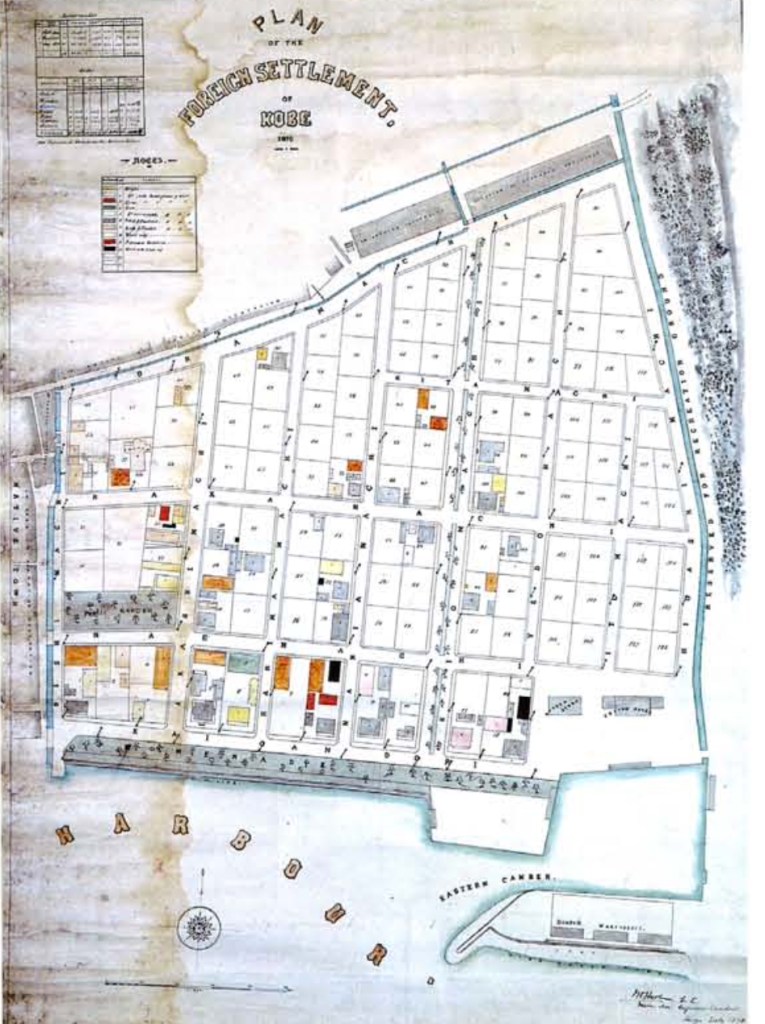
1868 map of Kobe showing the foreign concession on the right
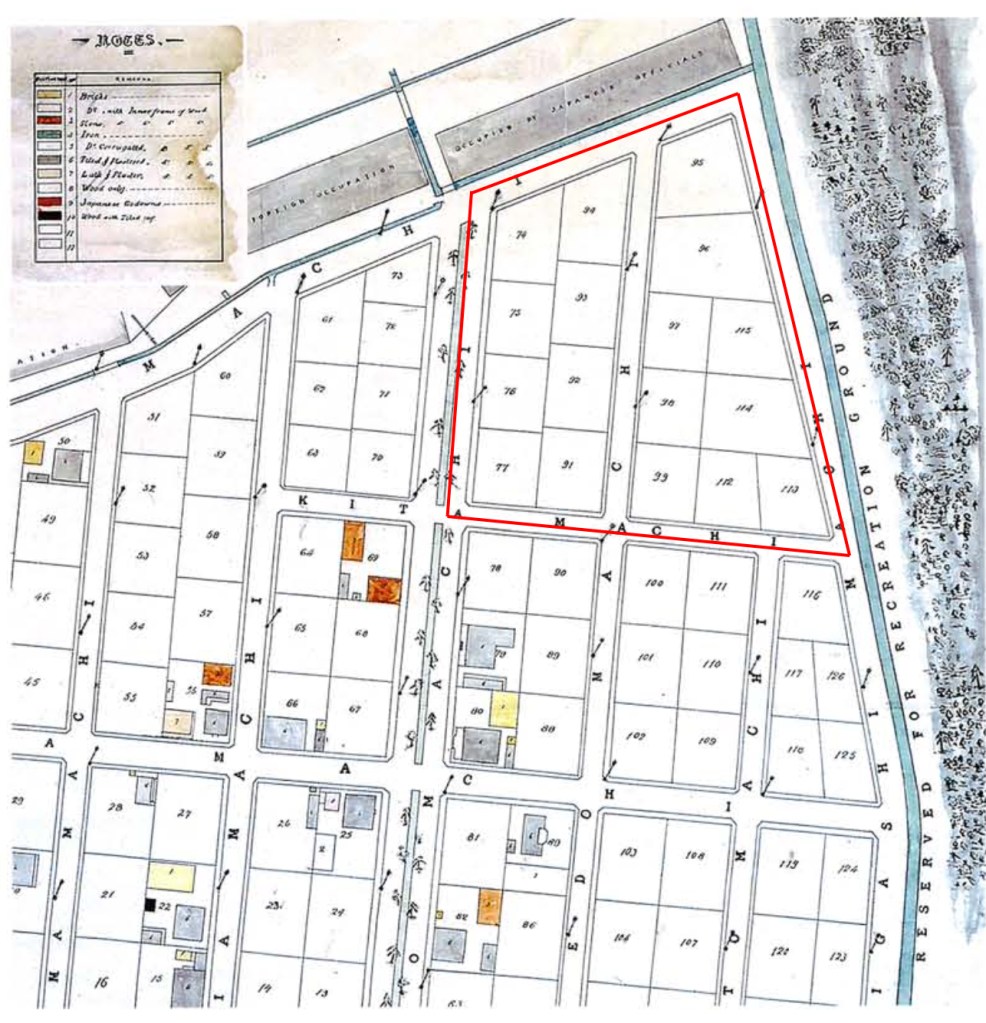
An 1870 plan of the Kobe Concession shows the location of the staked plots for sale and the approximate location of the ground used for cricket and baseball in July 1869. As the article clearly states that the ground was in the northeast corner of the concession and contained stakes marking the unsold lots, we can place the area just to the west of modern Kobe City Hall between Kyomachisuji Street on the west, Hanadokeisen Street on the north, Higashimachi-Suji Street on the east, and Kitamachi Street on the south.
1870 Plan of Kobe’s Foreign Settlement Detail of the 1870 plan showing location of ball groundsLocation of ball grounds on modern map
Sadly, Williams is correct that we may never know the identities of these early ballplayers. A complete list of early Kobe settlers that includes nationalities does not seem to exist. Therefore, we cannot identify the American residences who may have played in this July 1869 game.
In September 1870 the foreign residents of Kobe established the Kobe Regatta & Athletic Club and in 1872 reached an agreement with the Japanese authorities to create a recreation ground on the land just east of the concession where future cricket and baseball games were held.
With the digitization of newspapers and other sources from Meiji Japan, I expect that future researchers will find more evidence of early baseball in Japan. But Williams is probably correct that we will never know the exact date and location of first baseball game in Japan.
[1] Nobby Ito’s research on the 1871 game in Osaka is summarized in Michael Clair’s August 17, 2024, article on MLB.com “Search for Japan’s baseball origins unearths new possibility.”
[2] Williams’s article was originally published in the 1976 Journal of the American Chamber of Commerce in Japan and was republished in Culture, Power & Politics in Treaty Port Japan, 1854-1899: Key Papers, Press and Contemporary Writings, edited by J.E. Hoare (Amsterdam University Press, 2028).
Originally published on RobFitts.com February 15, 2021
The history of early Japanese American baseball is still being discovered. There is so much we do not know. Mainstream, English-language newspapers rarely covered Japanese American daily life or sport. When these newspapers did mention Japanese immigrant baseball, the articles were often garbled—full of misspellings, factual errors, and sometimes overt bigotry. On top of this, early twentieth century sportswriters enjoyed telling an entertaining story more than report fact. Piecing together history from these articles is challenging as most of the reports cannot be taken at face value but instead need to be confirmed by independent sources. As an example, let’s examine the story of Togo Hamamoto.
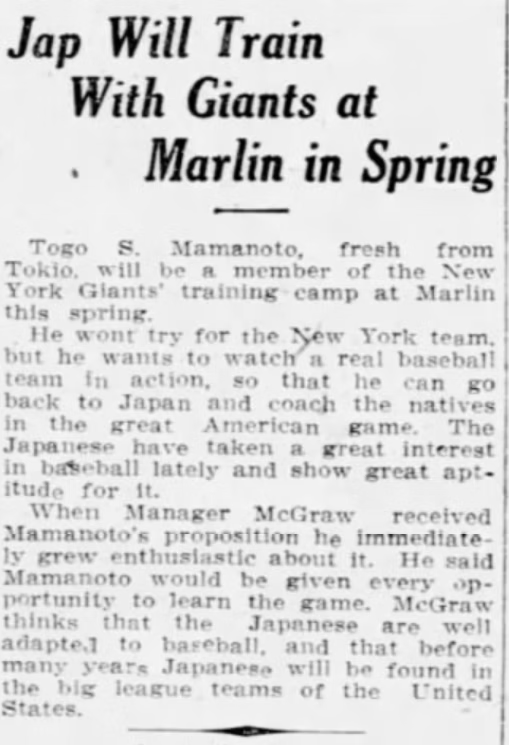
In mid-January 1911, an intriguing article ran on the sports pages across the United States. On January 17th, New York Giants manager John McGraw announced that Togo S. Hamamoto of Tokyo would be joining the team at Marlin Springs, Texas, to observe American “scientific baseball.”
A press release noted that Hamamoto, “who has the backing of a number of influential citizens of Tokyo, . . . will devote his time to mastering the game.”[1] “His backers plan to add professional baseball in their own country.”[2] “McGraw plans to do all in his power to spread the gospel of the game in foreign lands,” the release continued. He “is prophesying that some day [sic] a real world’s championship will be played with the United States and Japan as rivals.”[3] Newspapers across the country, from large-market dailies to bi-weekly rags in rural villages, reprinted the announcement.
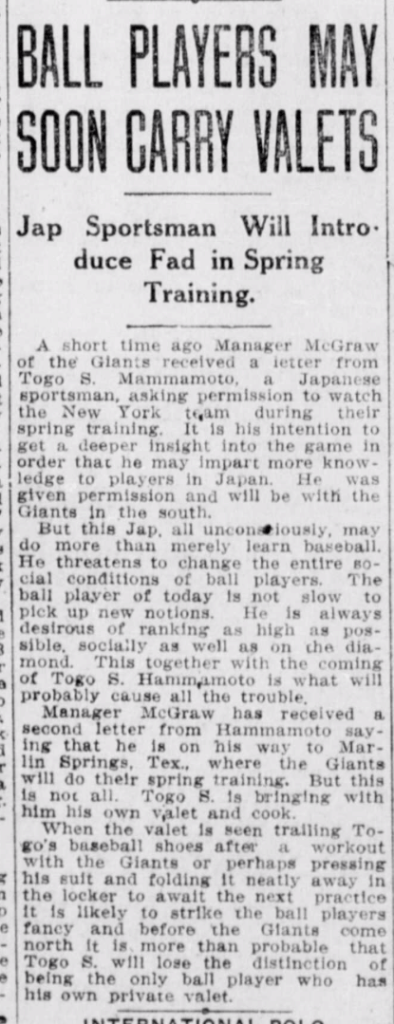
About a month later, Hamamoto was in the news again. This time, reporters had transformed him from an observer into a player receiving a tryout. “Togo is a star player among the Japs, and will work out daily,” reported the Chronicle-Telegram of Elyria, Ohio. “He may play on the second team.”[4] But of more interest to the writers were reports of Hamamoto bringing his valet and personal cook to training camp.
He “may do more than merely learn baseball. He threatens to change the entire social conditions of ball players,” joked an anonymous writer. “When the valet is seen trailing Togo’s baseball shoes after a workout with the Giants or perhaps pressing his suit and folding it neatly away in the locker to await the next practice, it is likely to strike the ball players’ fancy and before the Giants come north it is more than probable that Togo S. will lose the distinction of being the only ball player who has his own private valet.”[5] Another writer worried, “McGraw fears a valet oiling Togo’s shoes and fanning him between innings, may cause the Giants to insurge [sic] and ask for the same treatment.”[6]
On March 9, the sports editor of the New York Times asked, “Where is Togo Hamamoto, the Japanese athlete, who was going to train with the New York Giants at Marlin Springs? Togo burned up the cables getting permission from Manager McGraw to get inside information on training a baseball team, and McGraw gave him permission to join the camp. But he hasn’t appeared, and nothing has been heard from him.”[7] The Giants began practicing in Marlin’s Emerson Park on February 20 and stayed until March, practicing in Emerson Park. Reports from the Giants’ spring training camp fail to mention Hamamoto and newspaper articles do not provide a reason for his absence.
When I wrote the first draft of Issei Baseball in 2018, I wondered if the story was a hoax dreamed up by a bored sportswriter yearning for the start of the baseball season. My searches of immigration records found no man named Hamamoto arriving from Japan in 1911, plus his name does not appear in Japanese baseball histories. On top of that, his name is suspiciously similar to Irving Wallace’s fictional character Togo Hashimura, the Japanese “school boy” whose book of fictitious letters describing life in America had become a best seller in 1909. I concluded that the articles written about Hamamoto attending spring training were a hoax written for amusement.
That changed in early 2019 when I received a copy of Tetsusaburo “Tom” Uyeda’s previously classified FBI file. Uyeda, who had played on Guy Green’s 1906 Japanese Base Ball Team and the 1908 Denver Mikado’s Japanese Base Ball Team, was unjustly convicted in 1942 by the U.S. Alien Enemy Hearing Board as a Japanese spy. During his appeal, Uyeda explained; “In the Spring of 1912, I received a letter from one Mr. Hamamoto who asked me to come over to St. Louis, Missouri, to assist in organizing a baseball team.”[8]
Refocusing my research on St. Louis, I found a Togo S. Hamamoto listed in the city directory as valet working for Hugh Kochler, a wealthy brewer. Born Shizunobu Hamamoto in Nagasaki on December 25, 1884, he arrived in Seattle on the SS Shimano Maru on April 22, 1903. He made his way to St. Louis in 1906 and began working as a valet while reporting on Major League baseball for the Nagasaki-based newspaperSasebo. He attended four or five games per week and became friendly with a number of the players, including Cristy Mathewson, Lou Gehrig, and Babe Ruth [9].
But did Hamamoto attend the Giants’ spring training in 1911? There was no evidence that he had until June 2020 when Robert Klevens, owner of Prestige Collectibles and an authority of Japanese baseball memorabilia, found this postcard.
The picture shows Hamamoto wearing a Giants uniform made between 1909 and 1910 (the team used a different logo on their sleeve in 1908 and switched to pinstripes in 1911). The solid stocking pattern was used by the Giants only in 1909, but we do not know if the Giants issued these to Hamamoto or if he wore his own stockings.
(Illustration from Baseball Uniforms of the 20th Century by Marc Okkonen
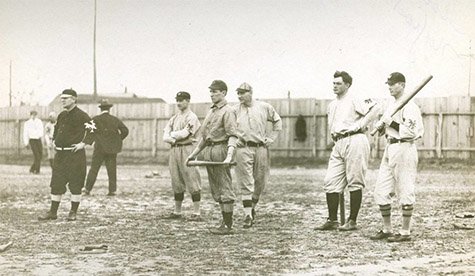
As new uniforms were expensive and teams did not have large budgets, it was common for players to practice in uniforms from previous seasons. This picture from spring training in 1912, for example, shows Giants players in various uniform styles.
I have not been able to locate enough pictures of Emerson Park to confirm if the photograph of Hamamoto was taken there, but the wooden fence in the photograph is similar to the fence surround the ballpark. Efforts to identify the Mr. S noted on the back has been fruitless.
So even though the postcard does not prove that Hamamoto attended the Giants spring training in 1911, it is likely that the newspaper stories were partly accurate and that he eventually arrived. Hamamoto’s time with the Giants, however, did not lead to a professional baseball league in Japan. Unsuccessful attempts to create a pro circuit did not begin until 1920s and it was not until the creation of Japanese Baseball League in 1936 that Japan would have a stable professional league.
Hamamoto would eventually turn his back on baseball. A few years later, he was in the stands watching his home-town Browns battle Walter Johnson and the Washington Senators when a St. Louis batter popped out in a key situation. “Some of the people behind me, and one of them was a lady, used such language—oh, it was so bad that I decided baseball did not always contain the three cardinal principals which I think a sport should have—Dignity, Honesty, and Humor. Since then I have not gone to ball games.”[10]
Around 1916, while still working as a valet for Kochler, Hamamoto took up golf. He played at every opportunity and soon mastered the sport. In 1929, he won St. Louis’s Forrest Park Golf Club’s championship and went on to play in several national amateur championships. Upon his father’s death in 1933, he returned to Nagasaki to inherit the estate. At the end of World War II, he became an interpreter for the police in Haiki, Japan.[11] The year of his death is unknown.
[8] Tetsusaburo Uyeda to Edward J. Ennis, January 3, 1944. World War II Alien Enemy Detention and Internment Case Files, Tetsusaburo “Thomas” Uyeda, Case 146-13-2-42-36.
In October 2003, I had the pleasure of interviewing former Carp manager Takeshi Koba before an oldtimers’ game at Tokyo Dome. Koba played for the Carp from 1958 to 1969 but is more famous for managing Hiroshima during their famous Akaheru (Red Helmet) era. From 1975 to 1985 Koba led the Carp to ten winning seasons and three Japan Series championships. He was elected to the Japan hall of fame in 1999.
How does one become a manger in Japanese baseball? You ask the owner. There are many younger managers nowadays who have no coaching experience and of course no managing experience and yet they are able to become managers. I think that it’s different from the system in the United States. In Japan if you play and you become famous then you can become a manager.
In my first year as a manager, I was able to win the league championship. But you never know how many years you can actually be a manager. If you don’t get results, the fans aren’t happy, and the team nudges you to quit. So, what do you do? You have to play ball, you have to make sure that people who come to watch enjoy themselves, and also you have to win. So, you have to make sure that the players get together as one and work towards winning. My job as the manager was to make sure that the team was together on that. And when you eventually get fired, my goal was to not have regrets.
When you take over a team and you have no good pitchers and the defense is bad and you really have to start from scratch then it takes quite a long time to build a winning team, but usually there are only certain sections or certain players who need improvement. It was my job as a manager to reach out to those players and together with the coaches to nurture them in certain directions or in certain ways. Every year I would have to figure out who those players were and pick them out. There are only nine positions in baseball and not including the pitcher, eight positions. I always said that I wanted six or seven position players to be there until the end of the game.
When I became the manager, we had on our team Koji Yamamoto and Sachio Kinugasa. These were special players. They were recognized by all of the other ballplayers as stars, and they were why we were able to win the 1975 championship. They became role models for the younger players throughout the year. All I needed to say to the young players was, “If you want to catch up to Yamamoto and Kinugasa, if you want to exceed these two, you have to practice harder.” That’s all that was required.
I was also really very lucky with my two foreign players. Gail Hopkins and Richie Scheinblum could hit and play defense. They were all-round players. I could count on them from the beginning of the game to the end of the game. So, it made managing very easy. When U.S. players come to Japan, there are coming here after really working very hard in the American Minor and Major Leagues. As a manager I asked Jim Lefebvre to scout some players for us. I asked him for players who could adjust to the style here in Japan. Lefebvre said that it really depended on the wife. If the wife can be interested in coming to Japan, if the wife agrees and enjoys the experience then that’s very important. So, I asked for such players.
When I was a manager, I think that I did everything I wanted to do and I put my whole self into it. I gave it my best. There are many people who say that I am a Dr. Jekyll and Mr. Hyde—that I have a dual personality because outside of the field I’m very quiet and I don’t say much and don’t complain but once I’m on the field my eyes change, and I become very severe. There are some players who say that I hit them! I never hit anybody, but I put my all into it, and I made sure that the players understood that I’m putting my all into it because that’s an important part of creating a winning team.
I always told my players from the very beginning of the season that if they had complaints or there was something about the team or the way I was managing that they didn’t like that they could talk to me at any time. And if I could, I would solve that problem to the best of my abilities. Throughout the season, I thought if I could do that it would be best. I didn’t want to be at the end of the season with a player not doing his best and not performing well for the team. I wanted to avoid that kind of situation as it made everyone dissatisfied.
As a manager, I talked with my coaches, I talked with my staff, and I told them throughout the year that I was confident that I would do my best for the team but if during practice you find something that we need to do more or if another team was doing something that was better then tell me about it. I was proud of what I was doing but I might not have been doing it the best way so if there was something else that’s better, I wanted them to tell me about it. One thing that I think I succeeded in doing well was to create good switch hitters. For example, there were pitchers who the scouts brought to the team but we decided that they weren’t very good as pitchers so we decided to use them as outfielders. If they had the necessary legs and powerful bodies, I would tell them, “Why don’t you work hard and try to become a switch hitter?” Many of my athletes succeed in becoming very good switch hitters. With a group of good switch hitters we were able to create a good team. I think that is why we were able to compete for the league championship for many years.
When I was playing with a company team, one day I had injured my right finger and I came to the field in street clothes, carrying my right arm, obviously in pain. My manger was very angry with me. He said, “Go back in and put your uniform on!” After I put my uniform on again, he told me to stand in the batter’s box and he threw balls right at me. I was scared so I put my bat in front of me with my left hand because my right was injured. Somehow the ball was hitting the bat that I held with my left hand and my manger yelled, “See you can do it! If you work for one week, you can develop your left arm so you can hit with your left arm.” As you can see, my body is not very big. He said, “If you take time off, your body is going to be less developed so you can’t take any time off. You have to always be in there and keep playing.” That was an important lesson.
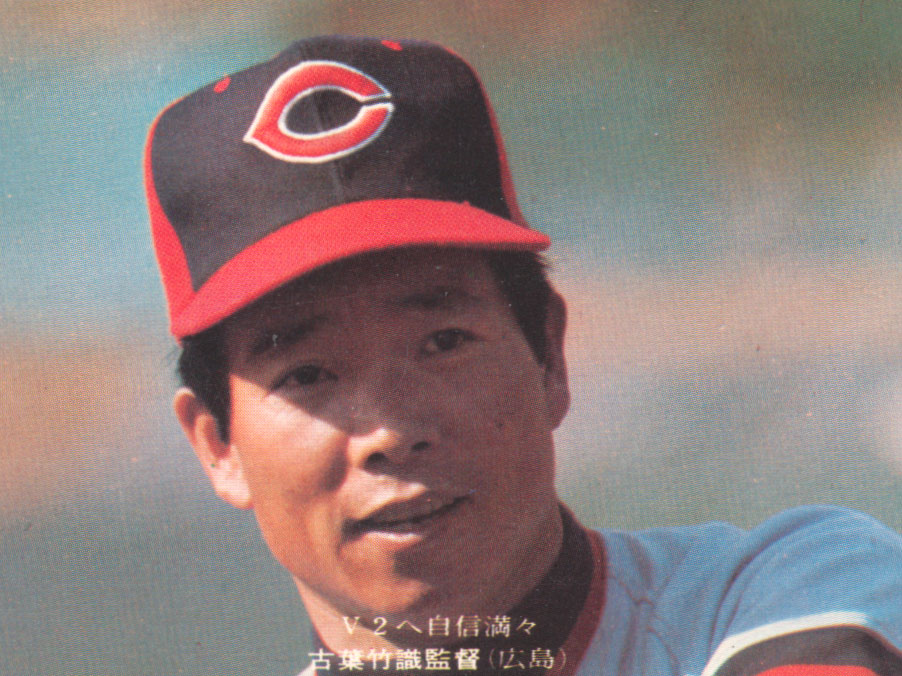
1975-76 Calbee Baseball Card of Takeshi Koba
[Editor’s note: In 1963, Koba’s sixth year of professional ball, Koba was in contention for the Central League batting title when he was hit in the face with a pitch and hospitalized.]
The injury definitely influence how I played afterwards, maybe it was just a matter of several millimeters but I was no longer able to hit the ball on the meat of the bat so my contact became weaker and therefore I didn’t have as many hits. My average went from .339 to .219 the next year. So, I asked myself how else can I contribute to the game? And I thought, I can use my legs. So, I started stealing bases and I led the league in stolen bases the following year. That’s what I told my athletes, “Ask yourself, how you can contribute to the game.”
When I was a manager, I always went to see the instructional league in Florida and we sent our young players there to participate. After the regular season here, I would go over and watch these young American players train and they would be working very hard. Most of them were from A or AA and were hoping to make it up to the AAA or Major League level. I took my young players with me because I wanted them to see what kind of severe reality, what kinds of conditions, the U.S. Minor Leaguers were playing in. U.S. players were given only $12 or $13 per day to participate in this. And if they didn’t perform well, they were put back down into the lower-level teams. I wanted the Carp players to understand this. I think that because the Carp players were actually able to see it for themselves, they were stimulated to improve more.
I was the manager of both Hiroshima and Yokohama. I was the manager of Hiroshima for eleven years. Managers of the other teams would say, “Hey, why are you practicing so hard?” Even when we were on the road before away games, I would always make sure that there were opportunities to practice just as hard. I think that the major difference between American and Japanese baseball, is that in America there is a Rookie League, A, AA, AAA, a whole system where the athletes who come up from the bottom can improve and move up to the next level. But in Japan, there is only the major club and the farm team. So, there are always about ten people, or more, in the farm who don’t quite have the bodies yet, don’t have the techniques yet to play in the major league. If you are always playing in the games you can gain the experience you need but if you aren’t in the games, you have to practice that much harder so that when it’s your turn to play in the games you can play well. If you don’t practice very hard, you can not surpass the other players and get into the major league. The other teams said, “Oh you practice so hard, you must always be tired.” But the tradition of hard practices still continues on the Hiroshima team today. I think because we had such hard practices the younger athletes grew and developed and matured.








 SABR Asian Baseball Research Committee Blog