April 15, 2026, marks the 120th anniversary of the first professional game in Japanese baseball history. Thirty years before the formation of a professional league in Japan, Guy W. Green, the owner of the Nebraska Indians Baseball Team, gathered a dozen immigrants from Japan to form an all-Japanese baseball squad to barnstorm across the Midwest of the United States. Like Green’s Nebraska Indians players, the Japanese players signed contracts and were paid to play, making them the first known professional Japanese team on either side of the Pacific. Guy Green’s Japanese Base Ball Team played their first game on April 15, 1906, in Frankfort, a small town in Northeastern Kansas. In 2020, I published an article on this game, but after five years of further research it is time to update the story. The following article is the first in a series focusing on these Issei baseball pioneers. It includes sections from my previous article with updates and changes when necessary.
The early twentieth century was the heyday of barnstorming baseball. Independent teams crisscrossed the country playing in one-horse towns and large cities. There were all female teams, squads of only fat men, clubs of men sporting beards, and teams consisting of “exotic” ethnicities. These independent squads were often called “semi-professional” to differentiate them from teams in Organized Baseball (clubs formally associated with Major League Baseball), but they were professional enterprises. The teams signed players to contracts, paid salaries during the season, provided transportation and housing on the road, charged admission to games, and were intent on turning a profit.
In 1906 much of United States was enthralled by Japan and all things Japanese. Japan had just emerged as the improbable victor in the Russo-Japanese War and the year before the Waseda University baseball club had toured the West Coast. Guy W. Green decided to capitalize on the fad by creating an all-Japanese baseball team to barnstorm across the Midwest.
Although Green would claim that he had “scour[ed] the [Japanese] empire for the best players obtainable,” he did nothing of the sort. In early 1906 Green instructed Dan Tobey, captain of the Nebraska Indians, to form a team from Japanese immigrants living in California. Players congregated on March 15 in Havelock, Nebraska to practice.
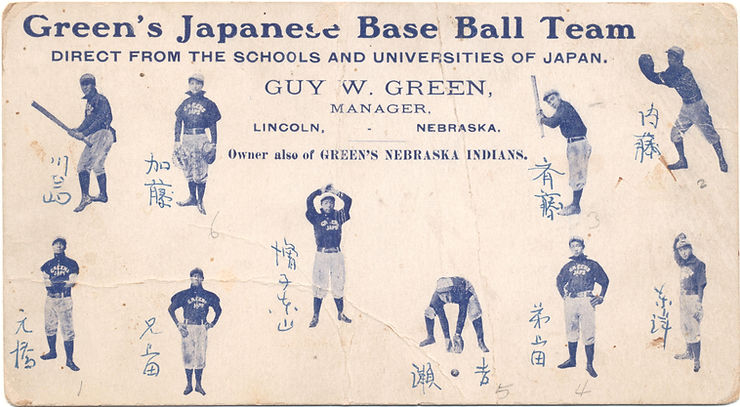
1906 Advertising Card, Ken Kitsuse Collection, National Baseball Hall of Fame
The team contained some extraordinary men. At first base was Ichiro Fujisaku, who played under the name Toyo Fujita. Fujisaku would become a movie star, appearing in about a dozen Hollywood and Japanese films. Playing second base was Tetsusuburo Uyeda, the third son of a Japan Diet member. During World War II, Uyeda would be jailed as a spy but afterwards his daughter would marry an heir to the Anheisier-Busch fortune. The shortstop was Ken Kitsuse, considered to be the best Issei player of the time. His father was also a member of the Japan Diet. The outfield consisted of Junjiro Uyeda, Tetsusuburo’s brother; Umekichi “Kitty” Kawashima; and Koji Naito, a graduate of Keio University. Acting as an umpire when needed was Tozan Masko, who would become a journalist, sports promoter, and eventually a swindler.
As some of the Issei players lacked the skills to play on a professional independent squad, Green and Tobey decided to bolster his roster with Native Americans —hoping that most spectators would not be able to tell the difference. Manager Dan Tobey, who would eventually be inducted into the Boxing Hall of Fame as an announcer, and Nebraska Indian veteran Sandy Kissell shared the pitching duties and played outfield on their off days. Seguin, another member of the Nebraska Indians, was the catcher, while Roy Dean Whitcomb, an 18-year-old Caucasian from Lincoln, usually played third base under the name Noisy. A man known only as Doctor filled in as necessary.
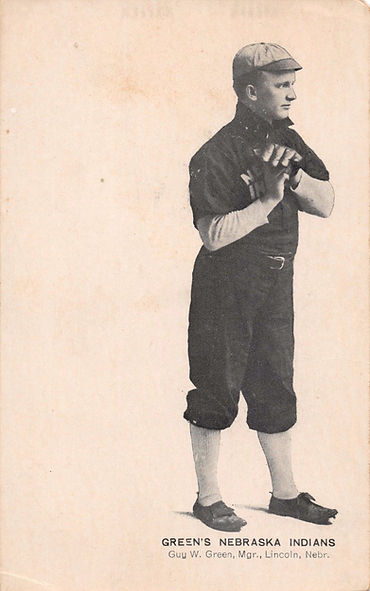
Manger and pitcher Dan Tobey
During the lunch break on the second or third day of practice, Tobey handed out the club rules. With Masuko interpreting, he laid out the fines for undesirable behavior: $2 for being late for a game; $2 for lazy playing; $3 for refusing to follow the manager’s orders; $3 for refusing to travel to the ballpark with the team; $3 for gambling; and $5 for drinking alcohol. He then produced a stack of contracts for the players to sign. “Of course, we happily signed immediately,” one player remembered. “We had been worried that Mr. Green might not be satisfied with our techniques and would send us home, so we were so happy to be offered contracts that we didn’t even think about reading it.”
After practicing for about a month in Lincoln, Nebraska, on April 13 Guy Green’s Japanese Base Ball Team headed south to begin a twenty-five-week tour that would cover over twenty-five hundred miles through Nebraska, Kansas, Oklahoma, Texas, Arkansas, Indiana, Illinois, Iowa, and Missouri. Their first stop was Frankfort, a small town of about 1,400 people in northeastern Kansas, where they would play the town’s high school squad.
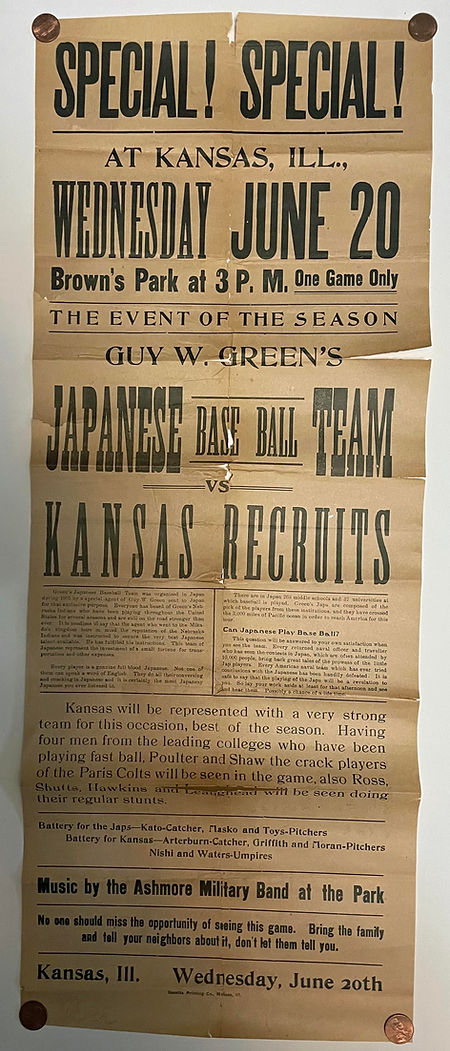
Prior to the game, Guy Green sent out promotional material and flooded local newspapers with advertising and press releases. At the time, there were so few Japanese living in the Midwest that many rural farmers had never seen a Japanese person. So, Green’s advertisements emphasized the players’ foreignness and the uniqueness of the team. A typical announcement read, “Green’s [team] are the most novel baseball organization the world has ever known. Every player is a genuine Japanese. Not one of them can speak a word of English. They do all their coaching in Japanese and is certainly the most Japanesy Japanese you have ever listened to.”
An advertising poster for Guy Green’s Japanese Team
Playing on the public’s fascination with the Russo-Japanese War, Green also concocted fictional backgrounds for his players. An April 13, 1906, article in the Frankfort Review noted, “One of the most interesting members of Green’s Japanese baseball team is Kitsuse, who left school in Japan to serve during the last great war with Japan. He was wounded in the left leg at Mukden so severely that he was compelled to go home and even yet he limps slightly. He is one of the best me on the team, however, and always a great favorite with the crowds.” Kitsuse, however, immigrated to California on June 8, 1903, almost two years before the 1905 Battle of Mukden.
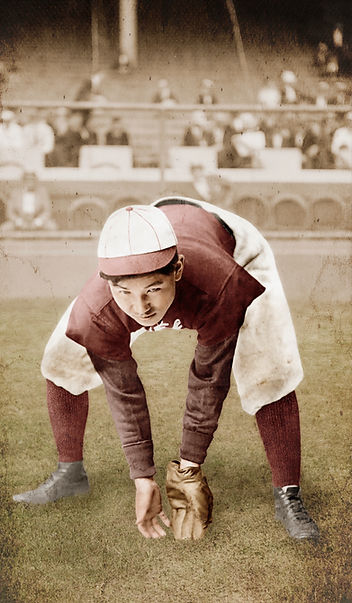
Shortstop Ken Kitsuse
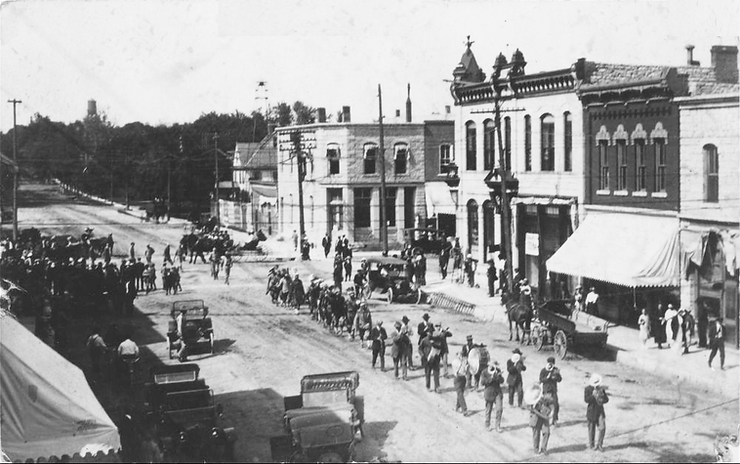
On Sunday, April 15, Frankfort welcomed the visiting team in style with a parade to Sportsman’s Park led by a thirty-piece cornet band. According to the Nebraska State Journal, “both teams, together with city officials, were in the procession.” The exact location of the ballpark is currently unknown, but evidence suggests that it was on the western edge of town.
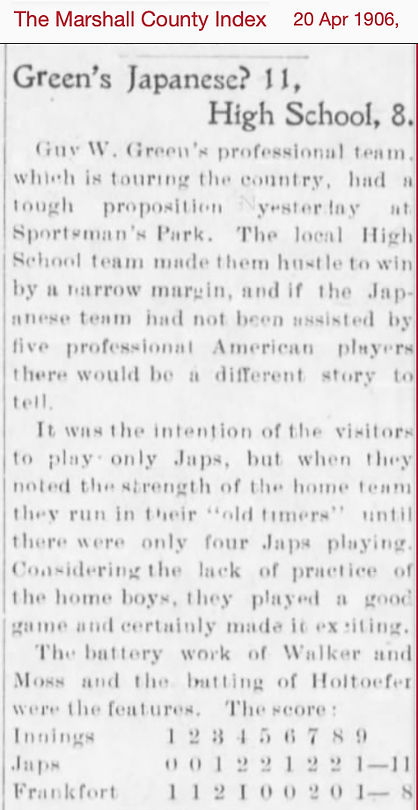
The high schoolers took the field in brand-new grey uniforms which just arrived a couple of days before. They had F.H.S. stitched across their jerseys in red and wore red caps and stockings. The Marshall County Indexnoted that “the boys look very striking in their new toggery.” The Japanese squad wore white pants reaching just below the knees, wide leather belts, maroon stockings, maroon undershirts, and a winged-collared maroon jersey with “Greens Japs” stitched in white block letters across the chest. The caps were white with maroon bills.
A parade in Frankfort, Kansas circa 1906
As the high school contained just 41 students, the match should have been an easy victory for Green’s professional team, so Tobey started a mostly Japanese lineup. But Tobey had underestimated the skinny, 15-year-old redhead on the mound. The teenage ace, Fairfield “Jack” Walker would go on to pitch for the University of Kansas in 1911-12 and professionally in the Class D Nebraska State League and the Eastern Kansas League. Although a quiet kid, the Horton Headlight noted “when playing Walker wears a perpetual grin that makes a lot of batters mad because they think he is laughing at them.”
No box score for the game survives, just a notation of the pitchers and catchers, but based on the lineups used by the high school just two days earlier and in the following weeks, we can infer that pitcher Fairfield Walker was backed up by George Moss behind the plate; a boy identified only as Russell at first; Harold Haskins at second; Willis Cook at third; Leo Holthoefer at short; and Robert Barrett, John McNamara and Walker (unknown first name but perhaps Isaac B.) in the outfield.
The schoolboys jumped out to an early 4-1 lead after three innings, forcing Tobey to bring in what the Marshall County Index called “five professional American players.” The visitors battled back, scoring in every inning after the second, to eventually win 11-8. The Frankfort Review reported, “A large number of people witnessed the game, and they pronounced it one of the best games ever played here.”
Nonetheless, the game irked some local residents. Later that week, the Frankfort Review reported, “The protest against the Sunday ball playing, made by the ministers of this city last Saturday, met with approval of nearly everybody. There is no denying the fact that Sunday ball playing in a town the size of Frankfort is not good for the morals of the town. In a large city ball playing is alright, in fact beneficial for it amuses a class of people who would probably spend their time at worse places, and the noise does not disturb anyone. The usual small town game is annoying to many people. However, last Sunday’s game at Sportsman’s Park was not noisy. Our people are interested in baseball, and always patronized the games well but we know they would prefer to have the games played on other than Sundays.”
After the Sunday game, the next day Green’s team traveled 14 miles to the west to play the Blue Rapids town team at Riverside Park, which still exists. The report on the 7-6 Japanese victory in the Blue Rapid Times provides insights on the barnstorming team’s economics. “The business houses pretty generally closed up or dismissed their clerks and there was a fine turnout. There were 356 paid admissions and the school children who were admitted free swelled the attendance to close to 500. The receipts were $85.30, of which the home team got one-fourth.”
Green’s Japanese squad would stay on the road until October 10, playing about 170 games against small town teams and a few semi-pro squads throughout the Midwest. They won 122 of the 142 games for which results are known.
Despite the lengthy tour and the uniqueness of the club, The Sporting News, as well as big market newspapers in New York, Washington and Los Angeles, did not cover or even mention Green’s Japanese team. As a result, the first professional Japanese players had little impact on the national or international baseball scene and were soon forgotten. But the tour marked the true beginnings of Japanese American baseball. After the season, the players headed back to the West Coast to form amateur Japanese ball clubs. These teams’ success helped spawn numerous Nikkei clubs as baseball became an integral part of the Japanese American community and culture.
You can read more about the Guy Green’s Japanese Base Ball Team and the early pioneers of Japanese American baseball in my book Issei baseball: The First Japanese American Ballplayers (University of Nebraska Press, 2020).
Fitts devoted chapters about his interview subjects from every aspect of Japanese baseball under the sun. Twenty-six of them, including a player, umpire, manager, fan, cheerleader, beer girl, data analyst, general manager, assistant general manager, commissioner, agent and team owner.
In fact, chapters regarding two managers, both with Dodgers connections, are included in the work: Trey Hillman, who was Don Mattingly’s bench coach from 2011 to 2013, and Bobby Valentine, a Dodgers minor and major leaguer from1968 through 1972, when he was included in a blockbuster trade which also sent Billy Grabarkewitz, Frank Robinson, Bill Singer and Mike Strahler to Anaheim for Andy Messersmith and Ken McMullen.
Chapter 26: Bobby Valentine, Manager
Former Major League player Bobby Valentine managed the Texas Rangers, New York Mets, and Boston Red Sox as well as the Chiba Lotte Marines in 1995 and 2005–2009. He led the Marines to the championship in 2005.
I went to Japan for the first time in the early 1980s. I was invited by Mizuno Sporting Goods because at that time I was thought to be the first player to use a Mizuno glove in the Major Leagues. In 1978 Mizuno’s master glove maker, Nobuyoshi Tsubota, came to spring training in Florida and set up a little workshop in a Winnebago he parked on the street right outside the players’ parking lot. I was riding by on my bike, and I stopped in, and Tsubota-san made me a glove. I used it from that day on. Later that season, I was going to be in the starting lineup for some reason and the game was going to be on national television. Joe Torre was our manager, and his brother Frank was the vice president of Rawlings. The game was on a Saturday, and Frank came to the stadium on Friday night. When I arrived on Saturday morning to get ready for the game, the Mizuno label was ripped off my glove! But I used it, and it was the first time a Mizuno glove was used in the Majors— or so I thought. Later, we found out that Lou Gehrig had his glove stolen during the 1934 tour, and Mizuno made him a replacement that he used when he returned to the States.
Then in 1986 I went over as a coach on the postseason All- Star tour. My first impression was that the players looked better than I thought they would. Then in 1989 I went over as part of the Japan- U.S. baseball summit that Tatsuro Hirooka put together. I got to meet a lot of the baseball hierarchy, including Shigeo Nagashima, Katsuya Nomura, and Hirooka-san. Once again, I was impressed, especially by a young player named Hiromitsu Ochiai. So, by the time I got there in 1995 to manage the Chiba Lotte Marines, I already had a good impression of Japanese baseball. Then in that first year, I got to work with Hirooka-san. I was amazed at his knowledge and his understanding of the game. He was as spectacular a baseball man as I had ever been around. And I had been around a lot of the older baseball guys in America. I had played baseball and been a young coach on the same staff as Frank Howard and George Bamberger, and I was really close to Tommy Lasorda and Al Campanis and then later Bobby Bragan.
In the early 1990s most Americans’ understanding of Japanese baseball was totally misconceived. It was based on Tom Selleck and Mr. Baseball— almost totally based on that and the stories that guys told from their experiences. Most of the guys were bad storytellers, and most of them had an ugly American’s perspective. I think that some of the guys who could have told the story properly were never asked, or it never got into the mainstream media, which was presenting a very opinionated and uneducated view of Japanese baseball, in my opinion.
There was a lot of resistance to acknowledging the baseball culture of Japan. There was still prejudice, probably hangover effects from the war. I knew some Americans who had actually experienced World War II and had a preconceived prejudice of the Japanese being the enemy. It wasn’t acceptable by my standards, but I thought it to be natural. They were very comfortable having a predetermined opinion of what the culture was and what the baseball culture was in Japan. When I went over with the Major League All-Star team in 1986, to a man they played and respected the Japanese players. They said, “Hey man, that pitcher is pretty good. Hey, this guy can hit. Hey, they’re throwing from the outfield just like we are.” There was a reckoning from those who were seeing without blinders on.
When I got there in ’95, Japanese baseball culture had an inferiority complex. Nearly everyone believed that it was a lesser league, a lesser brand of baseball. A lot of that was based on a size and speed comparison. There wasn’t that really fast guy, and there wasn’t that really big guy who was born from Japanese parents. So, there was that physical inferiority, but there was also just the idea of watching a championship game from the United States on TV and having it called the World Championship and then watching your championship on TV and having it called the Japan Championship that lends itself to an inherent inferiority situation.
The same year that I first managed the Marines, Hideo Nomo came over to the States. I always thought of that as an exchange, basically the first player coming over here and the first manager going over there. We did a crossover. What I was expecting when I got to Japan was an enthusiastic fandom for Nomo, a superhero trying to do something that no one had ever done before. But instead, he was treated like an outsider, and the fans and the baseball community, mainly the older baseball community, were pulling against him at the beginning and saying he would fail. I remember having conversations with Hirooka-san and others, and they thought he was going to fall on his face, and they weren’t really rooting for him, which I found really amazing. Or maybe, in their hearts they were pulling for him, but they were embarrassed to come out and say it in case he failed. So, I’m not sure what the true mentality of the baseball hierarchy in Japan was at the beginning of Nomomania. I know what I heard, and I know what they said, but it’s such a different culture that sometimes you have to get an interpreter to understand what’s really meant.
After managing in Japan, I had an even greater appreciation of the Japanese game. I always thought it was real baseball, and then I got to experience it and I was like, “Holy cow!” When I brought the Marines to Arizona to practice in the spring of 1995, I had Nolan Ryan and Tom House come out to watch Hideki Irabu throw. He wasn’t like Nomo with the whirlwind windup and the split finger that confused everyone. He was actually someone who stood out there and had a fastball better than everyone else. And he was from Japan!
When I was the Mets manager in 1997, I went to Shigeo Nagashima’s spring camp, which started two weeks before we did, and I asked him if he could give me a pitcher who was not going to make the Yomiuri Giants ichi-gun (main team) so that I could take him to spring training and have him pitch for the Mets. He was like, “Why would you want to do that?” And I said because I want to show the Japanese community, as well as the U.S. community, that a guy who can’t pitch for your team can pitch for mine. So, I brought over Takashi Kashiwada, and he actually pitched for the Mets and did a decent job.
Measuring change is one of the hardest things in the world to do. You look back twenty years, and you realize that things have really changed, right? When I came back to manage the Marines in the mid-2000s, it seemed that the decade between my two stints was like the 1975 to 1985 decade in the States when times were changing. There had been a kind of cultural swing. I think that Nomo going to the States allowed a freedom of spirit to be attached to baseball in Japan.
In 1995 I misunderstood why I was there. I thought I was there to teach the Japanese how to play the game, because that’s what I was told when I was being interviewed for the job. They said that Hirooka knew how to play the game, but the Japanese players really didn’t. As it turned out, they knew how to play the game. They just needed someone to let them know that they knew how to play the game. Ten years later when I went back, that was my mission, not teaching them how to play the game, but letting them understand that they knew it well enough to compete at any level. But by that time, Ichiro was doing his thing, and Matsui was on the Yankees, and that inferiority complex that I thought they had was no longer there.
There have been several noticeable changes since 1995, both on and off the field. One of the most challenging times of my life was getting the Japanese hierarchy to understand one thing that I thought they needed to change. They thought that a hitter should always swing down on the ball and hit ground balls because they weren’t big enough and strong enough to hit home runs. I argued, “How could you say that when the guy who hit more home runs than anybody on earth was a Japanese and my size?” You don’t have to be a big guy to hit it over the fence. What you need is a good swing.
But even Sadaharu Oh thought you should swing down at the ball. In 1995 I had weekly debates with Hirooka-san, who was on the same team with Oh and saw how Oh developed the swing that made him hit more home runs than anybody else who ever lived. And it was a downswing. So one time, after showing me videos in slow motion and stop action, Hirooka-san brought in a wonderfully fine-tuned samurai sword and a bundle of sticks bounded by a rope. In one of the great training exercises that Oh did with the sword, they hang this bundle of sticks, and you swing the sword, and if you swing properly, at the right angle with the right velocity, you go through that bundle as though it was a piece of paper. And if you don’t, then the sword ricochets back and it might hit you in the forehead and cut your head open! They had me try it. And they were right. If you went in at the right angle, and it was a bit of a downswing with the sword, it would go through. It went through on my first attempt. Then they had me swing up at it, and it bounced off, and the ricochet almost stabbed me in my backside!
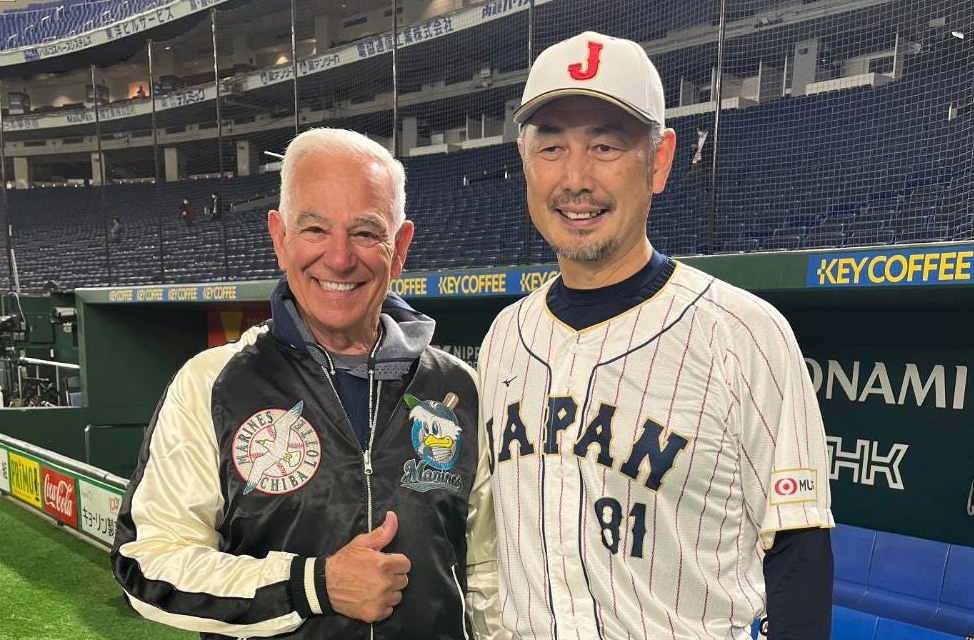
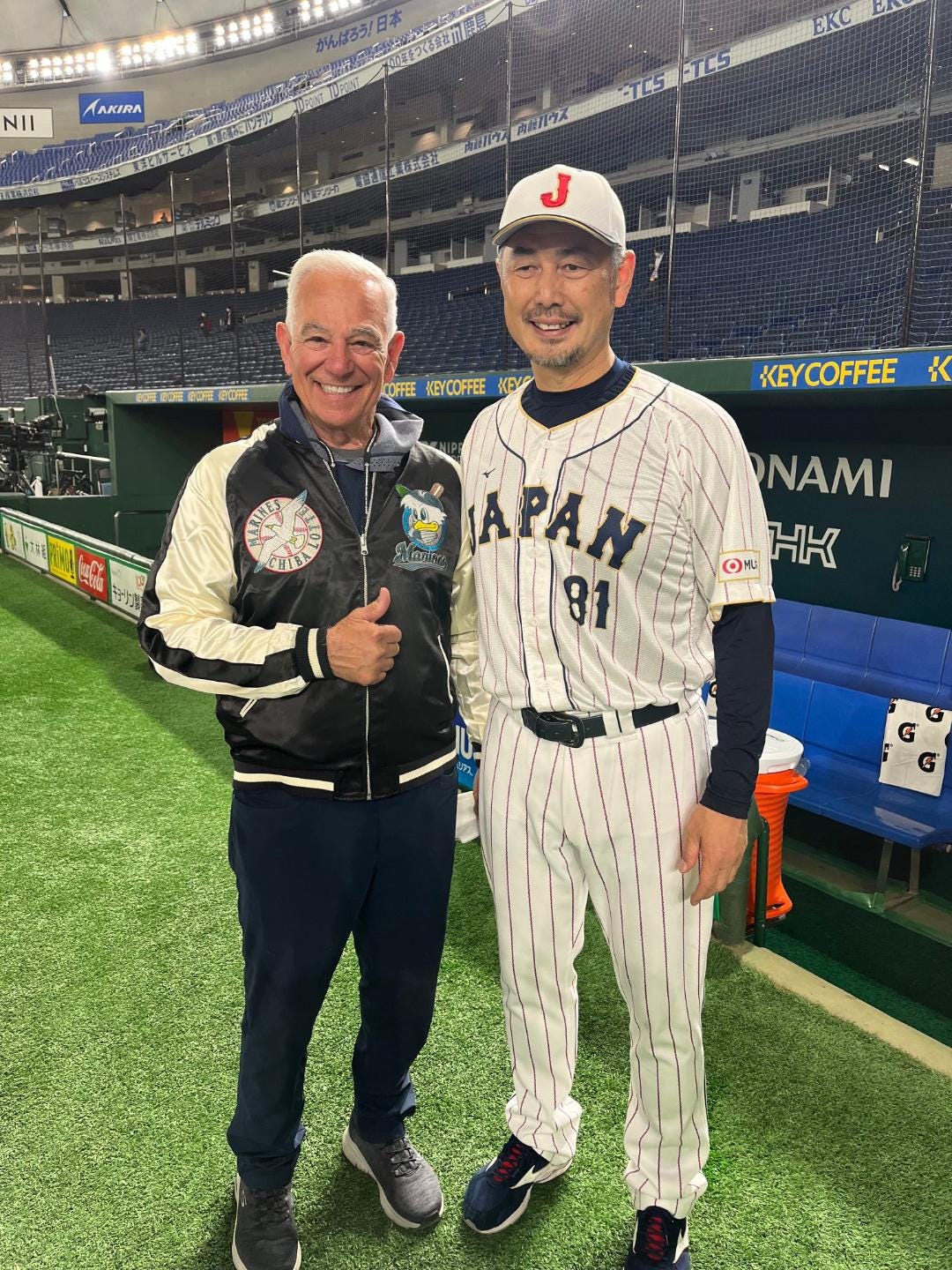
Bobby Valentine with former MLB pitcher Masato Yoshii. Courtesy of Jim Allen.
That was all cool, but then I needed another two months to explain to Hirooka how a sword has no weight at the end of it, and a bat has a weight at the end of it. These interpretive conversations were multiple and always the same. I said the same thing, and he would always agree that he understood what I was saying, but that he didn’t agree with what I was saying. Then finally at the end of the year, and it was one of the most satisfying moments, he said to me, “I understand what you’re saying, and I understand that you are right, but I just don’t want the players to know that.” There was so much time and effort invested into this philosophy of hitting in Japan that they didn’t want to reverse it, so they just let it be. Luckily, some of the players kind of got the message. Today, many of the hitters in Japan, and in Korea for that matter, definitely have an upswing.
The other major change is on the field. The Japanese now have incorporated the backhand as a standard way of fielding. In 1995 there was a rite of passage for those who entered the professional ranks of baseball in Japan. You had to field one thousand ground balls at one time without leaving the field, and while fielding them if you went to your right, you had to go so hard that you got in front of the ball. That was the way you fielded. When you went to your right, you always got in front of the ball, so the ball hit you in the chest if it didn’t go into the glove. But from about 1995, some of the infielders started to incorporate the backhand, and that made a big difference in their range factor and in their ability to throw the ball across the diamond more efficiently.
Those are the two technical things that changed from the first time I got there. The hitting one is rather large and the fielding one is a little more subtle. By incorporating those two changes, the players now look very similar to the professional players in the States.
Another thing that’s changed— Japanese baseball now leans toward recovery, not only toward effort. The idea that doing more, and more was better, has changed just a little. When I got to Japan in 1995, to miss a minute of practice while your teammates were practicing, even if you had to go to the bathroom, would be frowned upon. Everyone played all the time, and there was no pitch limit. I instituted a 15 pitch-per- inning goal and a 135-per- game maximum. You would have thought that I was asking families to give away their first-born child! Suggesting that a pitcher should have a limitation on his pitches per inning and per game was unheard of in Japan.
While I was managing there, Masahiro Tanaka pitched twelve innings in the 2006 Koshien final that ended in a tie and then came back the next day and pitched seven innings. I mean, are you kidding me? It was some of the greatest stuff I’ve ever seen in my life. It was a badge of honor to leave it all out on the field. The idea that you had to come back and do it again the next day wasn’t necessarily part of the equation.
A crazy example of this happened in my first year. After a game we lost, I got showered and dressed and then came out, and Hirooka, the general manager, was standing behind the batting cage, and my third baseman was taking batting practice. It’s about 11:30 at night. Sweat is pouring off of his chin, and he had just played nine innings. And the pitcher is throwing curveballs. I watched for a while because I figured, well, he needed practice hitting curveballs. And I watched for a little longer. I guess he needed a little more practice hitting curveballs. Then, I went over to Hirooka-san and asked, “So how long is he going to be hitting here tonight?”
And he said, “Until he can hit the curveball.”
Of course! I thought. There was no consideration that the next day was a day game, and it was going to be 93 degrees, and this guy had to go home, come back, and then play nine more innings.
That has changed. The players are not wearing themselves down as much, and that’s why I think the athletes now are bigger and stronger. They have time to recover and build rather than just breaking their bodies down through constant work.
I have to touch on this. Somewhere it should be said, or maybe it shouldn’t be said, but it took Japan about twenty years to discourage players from smoking cigarettes. In traditional Japanese baseball culture, that was what you were supposed to do. If you looked at the back of a magazine, all the stars in the ads were smoking. And if they were smoking, you had to smoke. When I first got there in 1995, right behind the dugout there was something like a table with a grid on the top where you put your cigarette out and then just dropped it into this long ashtray. The guys would come in from the field and line up like it was buffet line, eight or nine of them smoking cigarettes. It was crazy! But that has changed as well.
You know that doing the same thing over and over again and expecting different results is insanity, but businesswise the Japanese teams had a way of doing the same thing over and over again and being very satisfied with the same result. So, when I came back in 2005, I was hired to do more than the managing. I was also there to help them transition into more of a Major League–type business, to help them run the club as a standalone business instead of an advertising vehicle for the international company that lends its name to the team.
Akio Shigemitsu, who ran the club, was the son of the owner of Lotte, and he was only part Japanese, so he was seen as an outsider. I think that’s what gave him the idea to give Hirooka-san the go ahead to find a foreign manager. Shigemitsu-san wasn’t getting the weekly memo from Watanabe-san (the president of the Yomiuri Giants) that everything in Japanese baseball is great and don’t try to change a thing until I call and give you the go-ahead. He didn’t totally follow the marching orders. All of the interaction we ever had was at these very formal geisha dinners: private room, sitting on the floor, geisha gals pouring your sake, talking about the weather and all the other really important things that we could definitely agree on to make sure there wasn’t going to be any confrontation at this social event. But we would also talk about doing things a little differently to make the Marines a better team and business.
When Shigemitsu-san gave me the go-ahead to talk with people about marketing, it was marketing the mascot and the team brand. It was never marketing the players. Japanese baseball, just like Japanese culture, in my opinion, is such a closed culture. They treated baseball as an entertainment vehicle that was closed to the public. There was an idea that players should not interact with the fans. It was as if it would lower your image if you didn’t keep a barrier between the players and those who paid to see them play. I think what they wanted was the secretive, aloof, no-contact kind of superstar, the Joe DiMaggio type. But, marketing the player and promoting the player and letting the fans have contact with the player have changed for the better over the years. It’s now part of the business side that they’re trying to sell, not only the brand but also the talent.
Between-inning entertainment has also become part of the business. The teams always had the mascots, but now there are mascots, cheerleaders, plus other events between innings to entertain fans. Japanese teams have become more cognizant that they need the fans to have the game. At one time, the fans needed the game, so they provided the game. The mentality changed a little so that now the game needs the fans. I think they’re getting it now. It’s a different ownership situation.
But it was tough to change the marketing. Marketing is one of those weird concepts in Japan. People are supposed to want to buy your product, right? Having to persuade consumers is a newer concept, and baseball is one of the older and more conservative businesses there. For example, I almost needed an act of Congress to allow kids to come on the field after Sunday games and run around the bases.
I’m concerned that NPH will become like the Negro Leagues. I tried to tell players that the good players should stay there and that the medium players should go to the States and make more money. But don’t take the stars away from their teams because that’s what MLB did to the Negro Leagues. The Negro Leagues were great leagues for their fans. The last Negro World Series was in 1949, two years after Jackie Robinson came to the Dodgers. That’s a whole story for another day, right? But that’s always my fear, that MLB is going to do that to another great league.
I think a lot has been taken away from NPB because the players want to go where the grass is greener. They need to plant a few new lawns, and the beginning is to get new venues. You can then charge more money for suites and generate revenue from within the business itself rather than from the parent company. Then that money can be reinvested in R&D (research and development) and the minor leagues and in major league salaries and talent.
It looks like NPB is actually moving to do it with the Hokkaido new dome and the plans to renovate Jingu and make that into a spectacular downtown venue. The Giants are going to be forced to do something. Chiba, I hear, is going to spend over a billion dollars to build a new stadium along with Lotte and ZoZo in partnership.
One solution for NPB would be to increase their minor league system and their R&D. The problem with their system has been that they have eighty players in each organization. Thirty of them are basically on the ichi-gun (top team), and fifty of them are in the single ni-gun (minor league) team. The ni-gun manager has to keep sharp the guys who might come up to the big leagues as temporary replacements. Since there’s only one team, there is no room to develop young players. Sometimes, players are in the minor leagues for years without playing in a game. But they go to practice every day, five and six hours a day of practice. That’s the mentality: keep practicing, and you’ll get better. Well, I kept trying to tell them that they need to play to get better. It’s a game of playing, not just a game of hitting and throwing. Three of the organizations now have more than one minor league team, so that’s a start.
NPB also has to improve their feeder system. When you have four thousand high schools and eighty colleges playing baseball and then you draft only seventy or eighty kids a year, that is not forward thinking. They’ve got to spend more on developing players because there are a lot of players who fall through the cracks. Japanese kids develop physically later, and basically when they’re seventeen, they’re being judged whether or not they’re going to be a professional player. The feeder system has changed a little bit. It used to be Koshien to contract. Star in high school Koshien, and you get a contract. You’re one of the eighty players selected by a team. But now, teams are giving more opportunities for college and even industrial and independent league players to play professionally.
Still, Japan needs to embrace the independent leagues. We have Minor League teams in the States that allow fans who aren’t close to a Major League franchise to go out and watch a professional baseball game. In Japan, there are independent league teams in all these little country towns. As in America, these should be seen as the place to go in the community. One could go to a baseball game with your kid and enjoy it and then go home without worrying about catching the last train out of Tokyo to get home. But the independent leagues haven’t built up a strong fan base. I was trying to expand the independent leagues when I was there because a stronger independent league system would produce more players for NPB. In 2006 when I was managing the Marines, I scouted independent teams, and I took a kid named Katsuya Kakunaka from an independent team in the draft. After I left, he wound up leading the league in hitting in 2012.
So anyway, that’s what I think NPB needs to do. They need to improve their facilities, create more minor league teams and more independent teams, and then they need to get together on what they’re doing. I think what they need to do eventually is change the baseball hierarchy.
And I think that’s already starting to change. And I think they should at least explore the possibility of having a division of Major League Baseball in Asia— not where teams are traveling back and forth between Asia and the United States, but where the winner of an Asian division enters the playoffs for a true world championship. Now, of course, that would change the model in Japan, and I don’t know that change is what they would really like to do. But I think that if baseball wants to expand and continue to grow worldwide, it would be better to merge and grow rather than just have MLB handpick talent and eliminate the competition.
Of course, we have the WBC. But it interrupts the season. I don’t think that you’re ever going to get the best brand of baseball being played before the season. If it’s a true all-star situation, then I think it should be played midseason with everyone taking a break. Or it should be an Olympic sport played during the Winter Olympics. I always thought that would be the sensible thing to do, play the tournament in a dome during the Winter Olympics because it’s the off-season.
But you know, after winning the first one, and winning it often, I feel that Japan should get a bigger cut of the pie. I thought that they should have negotiated that from day one, but they didn’t. I felt and feel that it could be a big boost economically for the players. Also with the WBC, people will continue to say, “Oh, yeah, Japan only won because they take it more seriously. Japan only won because they practiced more before it started.” Well, if they’re going to practice more and use better players and be better prepared, which makes it a better event, then they should be rewarded economically for that.
My advice to American fans seeing their first Japanese game? Well, they should understand that the food is going to be better than they’ve ever had at a baseball park, so order properly: that the kegs are on legs and you’re going to get a very cold and foam-filled glass of beer that you absolutely have to have, and that you should pay attention to the game just like everyone else around you, because they won’t miss a pitch or an inning regardless of the score or who’s at the plate. The Japanese give the game that respect when they’re in the stands. There’s a better understanding of the game from the fans. It’s not necessarily vocalized or transmitted through action. If someone thinks something is good here in the States, they stand up in front of the person behind them and start yelling and waving their hands, regardless of whether the guy behind them can see. It’s a little different in Japan. But if you turn to the seventy-year- old woman to your left and ask what the count is, she’ll probably know. That should be appreciated.
The Japanese players will look and act in a very similar way, and they do that out of respect for the game. They feel that there’s a certain way to dress, a certain way to act when they’re on the field, a certain way to swing and miss in a very dramatic fashion. There are little moments of drama in a Japanese game that are kind of unique, but you have to know what you’re looking at to actually see them. There’s a little bit of Kabuki theater when they have a collision or get hit by a pitch or swing violently and miss or dive for a ball. Also, the idea of the count going full is respected a little more in Japan, that the battle has taken place and now it comes to this crescendo and the outcome will be on the next pitch. That’s Japanese baseball in its truest, purest form. The game is built around those moments. That’s why they love it.
The Clyde Sukeforth Chapter (ME/NH) in conjunction with the Gardner-Waterman Chapter (VT) offers a special presentation with SABR Member Rob Fitts in a Zoom Meeting on Wednesday, November 5, 2025 at 7 PM Eastern, 4 PM Pacific. All baseball fans are welcome!
Fitts will talk about his new book and provide an introduction to Japanese baseball.
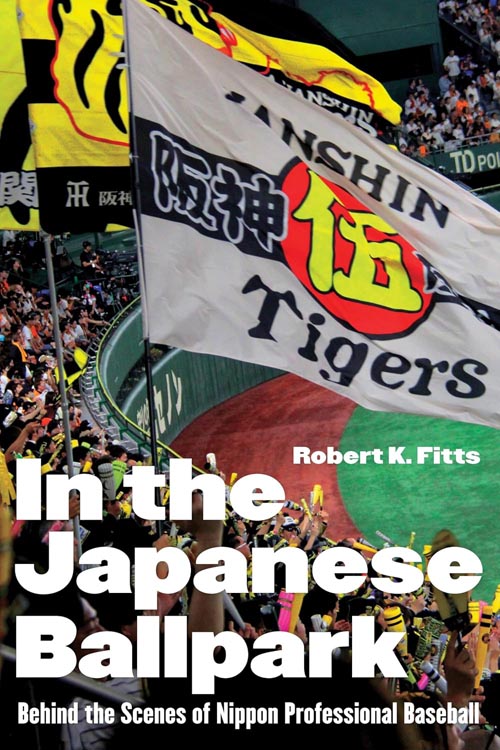
In the Japanese Ballpark: Behind the Scenes of Nippon Professional Baseball
This book takes you deep inside the heart of Japan’s national pastime—far beyond the box scores and highlight reels. To discover what truly sets Japanese baseball apart, author Robert Fitts went straight to the source: the players, managers, umpires, team owners, mascots, beer girls, and lifelong fans who live and breathe the sport. Through their personal stories and behind-the-scenes insights, you’ll get an insider’s look at how the game works, and what makes Japanese baseball unique—and so much fun. Get a front-row seat to the traditions, strategies, and spirit that define baseball in Japan. From the passion of the fans to the precision of the game, every page offers eye-opening stories and insights you won’t find anywhere else. Whether you’re a die-hard fan or just discovering the magic of the Japanese game, In the Japanese Ballpark can help you fully experience every pitch, hit, and cheer.
Robert Fitts has published eleven books and numerous articles on the history of baseball in Japan and Japanese baseball cards. He received his Ph.D. in historical archaeology from Brown University and ran excavations in New York City before turning to baseball history. He is the founder and chair of the Society of American Baseball Research’s Asian Baseball Committee and recently received the society’s Chadwick Award for lifetime contributions to baseball history. He currently is a curatorial consultant for the Yakyu-Baseball exhibit at the National Baseball Hall of Fame in Cooperstown.




 SABR Asian Baseball Research Committee Blog