by Roberta J. Newman
Every Monday morning we will post an article from SABR’s award-winning books Nichibei Yakyu: Volumes I and II. Each will present a different chapter in the long history of US-Japan baseball relations. This week Roberta Newman focuses on the 2002 MLB-Japan All-Star series.
The glossy, color print advertisement for the 2002 All-Star Japan Series features an exterior shot of a terminal at Tokyo Narita airport. But instead of planes pulling up to the gates, giant baseball bats of various makes and models encircle the building, as if preparing to disgorge passengers. Below the image the ad copy reads “Zenbei Rainichi” (All-Americans Arrive in Japan) and below that in a smaller font, “Nichibei Yakyu 2002” (Japan America Baseball 2002). Next to small type across the bottom, headshots of six players, from both Major League Baseball (MLB) and Nippon Professional Baseball (NPB) including Ichiro Suzuki, Barry Bonds, and Hideki Matsui are arrayed in a row. The winner of a major global advertising award in 2003, this clever print ad, designed to be placed in glossy magazines and other color publications, is clearly aimed at a large, knowledgeable consumer base. Produced by BBDO Japan, it is a quality advertisement that suggests quality entertainment.
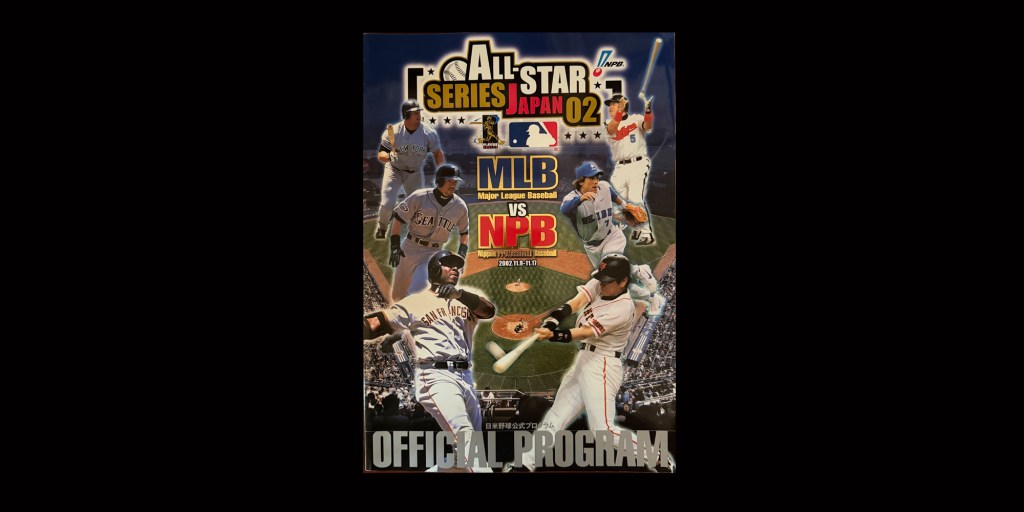
The event, the 2002 MLB-NPB All-Star Series, was a seven-game series, played over nine days, from November 9 to 17. In addition, the MLB team played a warm-up game against the Japanese champion Yomiuri Giants. It was the eighth Nichibei All-Star Series, held in even-numbered years between 1986 and 2006, with the exception of 1994, the strike year. The MLB All-Star team was led by manager Art Howe, who had just signed a four-year, $9.4 million contract to manage the New York Mets. Accompanying Howe were headline stars Barry Bonds, Ichiro Suzuki, Bernie Williams, Roberto Alomar, and Jason Giambi. Every game was broadcast live on Nippon TV (NTV), and the Japanese press corps was large, as it usually is for events featuring national baseball heroes.
Interest in the best players from each league competing against one another appeared to be high. Just ahead of both the 2002 and 2003 seasons, Sony issued a SquareSoft-designed Playstation2 game entitled Nichibei Pro Yakyu: Final League (Japanese-America Pro Baseball), pitting player-created teams from Japan and the United States against each other. Potential virtual rosters would no doubt have resembled the lineups competing in the actual series. On the publishing end, the book Nichibei Puroyakyu Chinbamen Meijajji (literally Excellent and Absurd Judges for Rare Settings in Japan and US Professional Baseball), written by the Pacific League record-keeper and statistics columnist for Shukan Baseball, Isao Chiba, provided Japanese fans of the international matchup the opportunity to test their trivia skills.
Coverage of the all-star series by the English-language press was sparse and limited in scope. Even the generally enthusiastic Japan Times, Japan’s foremost English-language newspaper, devoted fewer column inches than might be expected to the series. There were occasional game accounts, but not for every contest. Moreover, the paper offered only line scores, as opposed to complete box scores. What coverage there was in the English-language press, both North American and Japanese, coalesced around a central theme, the fate of Yomiuri Giants’ slugging super-star Hideki Matsui. With Matsui poised to sign with a major-league team – speculation correctly centered on the New York Yankees – the game coverage took a backseat to Matsui-mania.
The coming All-Star Series also caused media to ponder the fate of Japanese professional baseball, given the impending departure of one of its biggest stars. An article on the front page of the November 5 English-language edition of the Mainichi Shimbun asked, “Is Japanese Baseball a Farm System for the Bigs?” It is a rhetorical question, answered with, “[T]he loss of [Hideki Matsui] to MLB means that a further hollowing out of Japanese professional baseball is probably inevitable.” He wrote, “To hear some people talk, the future of Nippon Pro Baseball as we know it, is on the line. When Matsui follows Ichiro and Kazuhiro Sasaki to the Show, they say, it will signal that the NPB has become nothing more than a launching pad to the big leagues.”
Perhaps expectedly, members of the American press approached this question from the opposite perspective. Anthony McCarron, the Yankees beat writer for the New York Daily News, opined, “Matsui, an icon akin to Michael Jordan in Japan,” joining an MLB team would be “something Japanese fans are eager to see.” Of the frontrunners for Matsui’s services, McCarron wrote, the Yankees “have done extensive ground work in Japan recently, including establishing a working agreement with the (Yomiuri) Giants and sending stars Bernie Williams and Jason Giambi to play in Japan with a group of major-league all-stars.” Clearly, McCarron was less concerned about the “hollowing out” process than the Japanese journalists. The point, however, was the same. Japanese baseball was becoming a feeder for the majors. In this light, the all-star series served two purposes; it provided a showcase for Japanese players contemplating a move to US baseball, and it created an opportunity for interested major-league teams to send emissaries to help convince Japanese targets that their particular teams were right for them.
Perhaps no one was clearer about the role of the 2002 All-Star Series as a Matsui-centric undertaking than Filip Bondy of the Daily News. He wrote, “The eight-game, four-city baseball series beginning on Saturday between Major League and Japan League stars has become as much a shopping trip as a competition. Every American team, including the Mets, wants to wheel a cart through these East Asian aisles. Howe, as manager of the Major League stars, has a perfect view of the merchandise.” Although referring to Matsui and his NPB teammates as “merchandise” is less-than journalistic in tone – something that was characteristic of Bondy’s writing in general – his point was well-taken. From either a Japanese or American perspective, the 2002 international celebration of baseball had certainly taken on an acquisitional tone, and Matsui was the prize quarry.
While Matsui-mania may have been the order of the day, a few English-language newspapers previewed the series and the participating players with enthusiasm. The Nanaimo (British Columbia) Daily News listed the entire MLB roster, but featured players who were either Canadian nationals or played for Canadian teams. The paper foregrounded Eric Hinske of the Toronto Blue Jays in its coverage and noted that he would be joined by Montreal native Eric Gagne and Montreal Expos pitchers Bartolo Colon and Tomo Ohka, a Japanese native, alongside the likes of Bonds.
In the same vein, the South Florida Sun Sentinel of Fort Lauderdale focused its attention on the two Florida Marlins joining the tour. Profiling Derrek Lee, the Sun Sentinel underscored his family’s history with professional Japanese baseball. His uncle, Leron Lee, played for a decade with the Lotte Orions. His father, Leon Lee, was also an Orion, and later a Yokohama Taiyo Whale and a Yakult Swallow. In 2003 Leon Lee would make history. After joining the Orix Blue Wave as hitting coach, he replaced Hiromichi Ishige as manager early in the season, becoming the first African American to manage in Japanese professional baseball. Given his family’s history, Derrek Lee made an ideal subject for a pre-tour preview. Discussing Japanese baseball, Lee noted, “They treat you so well over there. They don’t have basketball and football, so baseball is their sport. If you do well, they’ll treat you good. [Leon] was pretty big over there and the fans loved him. Some guys have a tough time making the adjustment, because if you don’t do well, it can be tough.” Lee added, “It’s not as different as you would think. It’s pretty Westernized. A lot of people over there, especially now, speak English. It’s not all just raw fish and kimonos.”
The Japan Times’ sole Matsui-free preview centered on David Eckstein of the World Series champion Anaheim Angels. The article, headlined “Lil’ Angel Packs a Big League Punch,” by staff writer Rob Smaal, presented Eckstein’s small stature as evidence that similar-sized Japanese players could, in fact, succeed in the majors. Eckstein, himself, mentioned Ichiro as proof-positive. The article concluded with a discussion of the Angel’s taste in food. Smaal wrote, “While Eckstein holds Japanese ballplayers in high regard, he’s not quite as fond of some of the local cuisine. ‘I’m not a Sushi man,’ Eckstein says. ‘In fact, I don’t eat fish at all. But I do love beef, so I’ve been told that I’ve got to try some of that Kobe beef, maybe tonight.’” The same Japan Times issue also included a photograph of Barry Bonds and Yomiuri Giants owner Tsuneo Watanabe dressed in traditional happi coats breaking open a sake barrel with decorative baseball bats.
Happi coats and sushi aside, the tour’s ostensible purpose was to play baseball, and play they did. In their first game, the MLB squad faced off against the Yomiuri Giants at the Tokyo Dome in front of a sellout crowd of 55,000. In this case, rare game coverage appeared in the Sunday New York Times sports section. Given that the college sports, NFL, and NBA seasons were well underway, this was somewhat unusual. But their focus was not. Theoretically, the MLB team was facing the Japanese champions, but to read the article, the Giants had just one player on the field. The headline read: “Japanese Star Receives Taste of Future Against U.S. Stars.” Describing the scene on the field, the article observed, “The stadium speakers blared the rock song ‘We Are the Champions’ before Matsui’s at-bats and he took a curtain call after the game. But Matsui had little luck showcasing his talents in front of his hometown fans and visiting major league scouts. He grounded out softly to third in the second inning and struck out swinging in the fourth before singling to right field in the seventh inning. He lined out to shortstop in his final at-bat.” Rather, Bonds and Giambi did all the slugging. The article continued, “Matsui, playing center field, barely gave chase as Giambi’s first and Bonds’s second home runs sailed over his head into the stands.” Only two other Giants are mentioned, starting pitcher Yusaku Iriki, who gave up the aforementioned home runs, and Yoshinobu Takahashi, the right fielder, in the article’s conclusion. Asked if he was considering following his countryman to the major leagues, Takahashi replied, “‘I’ll have to see how Matsui does. If he doesn’t do so well, I’m not sure I could do well in America, either.” The rest of the article is a fine example of Matsui-mania: It mentions that a rumored two-year deal with worth $23 million was supposedly already in place with the New York Yankees, even though the team could not officially begin negotiating with Matsui until November 13. Both the slugger and the Yankees denied the claim.
The general tenor of the New York Times’s coverage was echoed in the Japan Times. Two prominent headlines dominated the sports pages after the game. As if readers might forget who was the star of the show, staff writer Dan Latham made no bones about it. Under the headline “‘Godzilla’ Is Just Getting Warmed Up,” he wrote, “Hideki Matsui may not have cleared the fences, but that doesn’t mean he failed to impress.” Whom did he impress? According to Latham, the answer is Bonds and Howe. Speaking in fluent baseball clichés, Howe opined, “He batted well tonight. He hit the ball hard.” Bonds, eschewing the type of standard response issued by Howe, used the opportunity to make an indirect pitch to Matsui. A repeat all-star tour attendee, Bonds commented, “I’ve had the opportunity to play with him a couple of times. He’s a good player and he’ll put on a good show for everybody before the series is over. He’s their main guy and I’d like to play with him over there in San Francisco.” Earlier, Bonds also remarked on how good Matsui would look in a different Giants uniform.
In an accompanying article in the Japan Times headlined “Bonds, MLB All-Stars Teach Giants a Lesson,” writer Junji Noda pulled no punches. “On a night when Hideki Matsui was the focus of attention, it was the major league’s [sic] most dominant hitters who showed the Yomiuri Giants center fielder what the term ‘slugger’ really means.” Matsui and his Giants teammates did not fare well at all in the article. Noda wrote that Bonds and Giambi used their home-run power to “humiliate the Japan Series champion.” Although the article paid scant attention to it, Bonds and Giambi were not the only players to contribute to the Giants’ loss. The sluggers did account for four homers, but second baseman Roberto Alomar and shortstop Eckstein also contributed to the MLB squad’s victory. A combination of three MLB pitchers gave up just five hits, with J.C. Romero surrendering the Japanese club’s sole run, batted in by catcher Shinnosuke Abe. Ichiro did not play.
The all-star series began in earnest on November 10. Once again, the MLB team played in front of a sellout audience of 55,000 in the Tokyo Dome. This time, the outcome was anything but humiliating for the NPB All-Stars. Right-hander Koji Uehara struck out Barry Bonds three times and Giambi twice. According to the New York Times, one of the few English-language publications to have paid attention to the contest (the Japan Times having limited its coverage to a line score), “Barry Bonds opened a seven-game all-star series with one of his worst games in a year and a half.” In fact, prior to this game, the last time Bonds stuck out three times was on August 8, 2001, a full season and a half before. Uehara, Matsui’s Yomiuri teammate, allowed only one run, a solo homer by Torii Hunter in the fifth inning. Japan won the contest, 8-4. The Times did mention that the NBP team was powered by former major leaguer Alex Cabrera of the Seibu Lions, who homered and drove in three runs. It also reported that Cabrera’s teammates recorded 18 hits against five MLB pitchers. And of course, it gave the requisite Matsui communique. Seemingly far more important than Cabrera’s excellent game was Matsui’s two-run double off Brad Penny, his only hit of the game.
From Tokyo, the teams traveled to Fukuoka to play in front of another large crowd at the sold-out Fukuoka Dome. In contrast to previous tour coverage by the Japan Times, the paper’s perfunctory account mentioned Matsui but once – his line-drive hit off starter Mark Buehrle’s shoulder. Prior to his exit, Buehrle gave up five hits and four runs in three innings. Reliever Miguel Batista didn’t fare any better, tying his successor for futility, allowing four runs on seven hits over four innings. The game’s 8-2 outcome was clearly communicated in the Japan Times headline, “Japan Blasts MLB Stars.” In an attempt not to show up his opponents, winning pitcher Kenshin Kawakami was deferential. “I had imagined I would allow a lot more runs. We’re using (larger) major league balls that I’m not used to, but my curveballs broke more than they did during the regular season,” he explained, almost apologetically.
The MLB All-Stars fared only slightly better against the NPB team the following day in Osaka. Once again the ballpark was packed, and once again the NPB All-Stars won. The same day as Barry Bonds heard that he had won his fifth MVP award, he hit a solo home run, as did teammate Torii Hunter, but they were not enough to offset the Japanese offense. And once again, Matsui was the headliner in the Japan Times’s reporting. It was, however, a different Matsui. Covering the game, Noda observed, “It’s probably time someone came up with another nickname for Seibu Lions shortstop Kazuo Matsui. Matsui, who is known as ‘Little’ Matsui in comparison to Yomiuri Giants slugger Hideki ‘Godzilla’ Matsui, came through with some clutch hitting, going 4 for 5 with three RBIs to lead the Japan All-Stars to an 8-6 win.” Noda also noted Kazuo Matsui’s scheduled free agency at the end of the 2003 season. (He left Japan and signed with the New York Mets for 2004.) One reason for the shift of focus from Godzilla to Little Matsui was the former’s poor performance at the plate. Hideki went 0-for-5 and did not contribute to his team’s barrage of 16 hits.
But Hideki Matsui did not lack for column inches. In the same issue of the Japan Times, columnist Marty Kuehnert’s speculation on the Japanese free agent’s potential for success ran under the headline, “Godzilla Doesn’t Need His Momma Looking After Him Anymore.” Kuehnert wasn’t joking. According to the columnist, “The funniest (Japanese originated) rumors now about Matsui’s chances of success deal with the fact that he is a 28-year-old bachelor, and how could he possibly take care of himself in America. After all, in Japan his mother journeys from Ishikawa Prefecture … every other week to clean his apartment, wash his clothes and make enough food to fill his refrigerator. Now mom, and dad, are both concerned about whether their little boy, all 186 cm and 95 kg [6-feet-1, 209 pounds] of him, could survive on his own in America.”
After a day off, the All-Star Series moved to Sapporo. David Lennon of Long Island’s Newsday reported, “It’s snowing here on the northern island of Hokkaido, and 30 degrees cooler than any other stop on this all-star tour, but Art Howe is feeling some heat.” He continued, “The inside joke among the Americans traveling here is that Howe is already in serious trouble with the New York media, a bloodthirsty group that pounced on Howe from the moment he was hired by the Mets. But it was the usually reverent Japanese media who showed some bite following Tuesday’s 8-6 loss at funky Osaka Dome. A Japanese reporter to Howe: ‘Do you feel any pressure, like you’re standing at the edge of a cliff?’” Howe’s team took a much needed step back from the precipice in the fourth all-star matchup, edging the NPB team 6-5 in freezing Hokkaido in front of another packed house, just shy of a sellout, at the Sapporo Dome. Once again Bonds and Giambi both homered. So, too, did Japan’s third baseman, Norihiro Nakamura. Bonds’ home run, a grand slam in the top of the sixth inning off Hirotoshi Ishii, gave his team a 6-4 lead. Both “Little” and “Big” Matsui went hitless.
The MLB All-Stars continued their comeback at the Tokyo Dome on November 15. Again, there was scant coverage of the game. In a short paragraph, the New York Times mentioned only Bonds’ offensive contribution – a fourth-inning RBI double – in the 4-0 MLB victory. MLB pitchers Randy Wolf, Mike Fetters, and J.C. Romero combined for a two-hit shutout. Seemingly more important to the Times was the contest before the contest. In a mini-home run derby, Bonds defeated Matsui, 8-5, with each taking 20 swings.
The next day, November 16, the MLB bats promised by BBDO’s beautiful print ad finally landed at the Tokyo Dome. Once again, Noda covered the game for the Japan Times, writing, “The big boys found a new way to win, and it had nothing to do with anyone’s power. The major league All-Star team stuck to the short ball and timely hitting, while the Japanese All-Stars made critical errors as the visiting team scraped out a 12-7 victory to knot the seven-game series 3-3.” With 18 hits to their credit (though only Bernie Williams homered), “scraped” may not be the most accurate term to describe the MLB squad’s victory. Every starter had at least one base hit by the fifth inning. “One only needed to look down the MLB score card to see how badly they humiliated (starting pitcher Hisashi) Iwakuma,” wrote Noda. Certainly, Iwakuma did not have his best day, giving up 12 hits and seven earned runs in four innings, but he remained positive and did not seem humiliated. “They’re amazing indeed,” he said of his opponents. “I’m not saying this because I lost, but I enjoyed [the game]. … Still, I’m disappointed.” Although the NPB All-Stars doubled the MLB’s home-run output, with two blasts off the bat of “Little” Matsui, and had 11 hits overall, it was not enough to overcome Iwakuma’s outing.
The seventh and final all-star matchup was also played at Tokyo Dome.27 And as in the previous game, the MLB squad emerged with the win, by a score of 4-2. With only a 2-1 lead, Filip Bondy wryly observed, “The major leaguers started boarding buses to distant Narita Airport in the sixth inning yesterday, as if these vehicles were the last transport out of Saigon. Barry Bonds, not unexpectedly, was among the first group. He was removed for a pinch-runner and headed for an early flight for the West Coast. Bartolo Colon and Bernie Williams left for another flight to Kennedy. With the game and the series on the line, the team’s best players were going, going, gone.”
Down 4-2, the Japanese rallied in the ninth. After Kazuo Matsui singled and reached second with one out, Norihiro Nakamura crushed a fly to deep center field. Torii Hunter sprinted after the ball, leapt, and crashed into the wall at full speed as he made the spectacular catch, robbing Nakamura of at least a double. “Little” Matsui tagged up and went to third. With two outs, Hideki Matsui came to the plate. But in his last game in Japan, “Godzilla left his old stomping grounds with more of a whimper than a bang” as he hit a weak ground ball to second to end the game. Although Matsui had performed well in the final game, going 1-for-3 with two walks, the series had been a disappointment as he had hit only .161 (5-for-31) with no home runs.
Godzilla had been outshined by both “Little” Matsui, who led the Japanese squad with a .423 average and seven RBIs, and Ichiro Suzuki, who went 4-for-4 with a double and a stolen base in the final game and hit .355 during the series. “When I was playing for Japan, the U.S. teams were always unbeatable,” Ichiro told Bondy, “I was thinking, ‘What if we lose when I’m on the Major League team. That was not going to be funny.’”
With the game and series over, Matsui-mania returned in full force. In an article headlined “Giambi Sees Big Things Ahead for ‘Godzilla,’” Noda wrote, “As hard as it is to imagine a Japanese ballplayer batting in the heart of the order for the New York Yankees, Jason Giambi won’t second guess Hideki Matsui’s potential.” At a press conference conducted before the sixth game of the series, Giambi spoke about the NPB’s role as feeder for the major leagues, but with a positive spin. According to the Japan Times, Giambi noted that Matsui “has created more than enough noise in Japan, which has become ‘a new avenue’ for Major League Baseball scouts and owners searching for the next Ichiro.” Giambi, not so obliquely referring to the Matsui-centric coverage, noted, “He’s a phenomenal player who had accomplished some incredible feats in Japan. Of course he’s getting a lot of attention right now because he’s talking about coming over to the U.S. and playing baseball. To these people out here, that’s big. Ichiro came over and he’s played well. They’re hoping if he does go over, he’ll play well. So he definitely deserves the hype he’s getting.”
The Yankees first baseman also offered his assessment of other NPB All-Stars and their major-league potential. “‘Little’ Matsui, he’s a phenomenal player. The kid who pitched the first night (Yomiuri’s Koji Uehara), very good. … I heard there’s another kid who’s got a groin injury (Seibu Lions pitcher Daisuke Matsuzaka) but is supposed to be as good as Uehara.” Kazuo Matsui went on to play seven seasons with the Mets, the Colorado Rockies, and the Houston Astros. Both Uehara and Matsuzaka would follow the Matsuis to the major leagues. Uehara spent nine seasons in the United States, playing for the Baltimore Orioles, the Texas Rangers, the Boston Red Sox, and the Chicago Cubs, before returning to the Yomiuri Giants for two more seasons. Matsuzaka spent six seasons with the Red Sox and two with the Mets, winning the Rookie of the Year Award in 2007 and helping Boston win a World Series.
Yankees general manager Brian Cashman and President Randy Levine did not leave Japan with the alacrity of some of the MLB All-Stars, but stayed for a few extra days, ostensibly to announce an agreement with the Yomiuri Giants. The agreement entailed a general information exchange, scouting reports from both teams, support for the Japanese team with the development of Latin American prospects, support for New York with the development of Asian players, and reciprocity regarding information about players’ rehabilitation and conditioning. It did not, insisted Cashman and Levine, have anything to do with Matsui.
Roughly a month after the tour, Hideki Matsui did, in fact, sign with the Yankees, inking a three-year deal worth $21 million. Asked why he would leave Japan to play in the United States, Matsui replied, “It’s just my will, thought and belief that I want to play in the big leagues.” The former Giant joined the Yankees for the 2003 season and made himself an instant fan favorite by hitting a grand slam in his first game in the Bronx. After seven seasons and the 2009 World Series MVP Award, the Yankees did not offer him another contract. Rather, he played for the Los Angeles Angels of Anaheim for a season, followed by a season each with the Oakland Athletics and the Tampa Bay Rays. Over the 10 seasons, Matsui made $83,250,000 in salary, and perhaps even more in Japanese product endorsements as an international superstar.
While Matsui and the other 2002 all-stars achieved success on both sides of the Pacific, one import – this time American – did not fare so well. According to the Village Voice, once New York’s preeminent alternative weekly, “To give locals the full American experience the powers that be brought along the Phillie Phanatic, whose ungainly boogie to the strains of ‘Kung Fu Fighting’ (a Chinese art, mind you) earned rapturous applause. Anaheim’s Rally Monkey, by contrast, met with politely baffled silence.” Of course, furry mascots, emblems of kawaii culture, a culture of cuteness, have long been popular in Japan. Although Japanese fans might have been hard-pressed to describe the Phanatic as cute, it is easy to see how the furry green creature would strike a chord with them. A video monkey, however, was a hard sell.
Unfortunately, as Filip Bondy observed, American baseball fans seem to have been more interested in a jumping primate than the Japan All-Star Series “Why? Nobody knows, really. The series should be an important test of will and talent. It should be the Ryder Cup, the Davis Cup and the World Cup.” Although Bondy’s question was purely rhetorical, there may, in fact, be at least one answer to it. Other than scattered coverage by Bondy, David Lennon, the New York Times, and the odd local interest piece, the series was largely ignored by the American and Canadian press. The series did not garner more than a one-line mention in The Sporting News and received no coverage in Sports Illustrated. Even with sparse information available about the series, it might have drawn more North American attention had it been televised. But it was not.
“The reasons the games weren’t carried in the United States seem to illustrate some flawed thinking about the sport by its own executives and the relationship between the game and television networks. Granted, these games weren’t going to be ratings blockbusters. Heck, the World Series was the lowest-rated one in history,” wrote Newsday’s Steve Zipay. MLB approached ESPN but was turned down. “They said they had a very crowded schedule of regular-season games, college football, NBA, NFL, hockey, tennis, and golf and that their plate was full,” said MLB’s executive vice president for business, Tim Brosnan. According to Zipay, MLB did not approach other networks, such Fox Sports Net, MSG, SNY, or YES, as they assumed that these smaller networks would have little interest in broadcasting the games. [It] “seems like a missed opportunity,” concluded Zipay. Ultimately, Hideki Matsui, the Yankees, and the US major leagues were the true winners of the 2002 All-Star Series, while Japanese baseball, whose biggest stars crossed the Pacific for a bigger stage, and North American baseball fans lost.
Read the full version of this article on the SABR website