
by Carter Cromwell
Probably few are aware of it, but baseball has a history in Saudi Arabia. Until recently, though, it was like an old, rarely perused book that had long gathered dust in the attic.
Not many know that Americans brought baseball to Saudi Arabia in the early 1930s when companies began searching there for oil, which was finally discovered in 1938. Then-king Saud even attended a game in 1954. Children of expat employees of the Arabian American Oil Company (Aramco) played baseball in Dhahran, whose team advanced to the Little League World Series 23 times before interest slackened for a number of years.
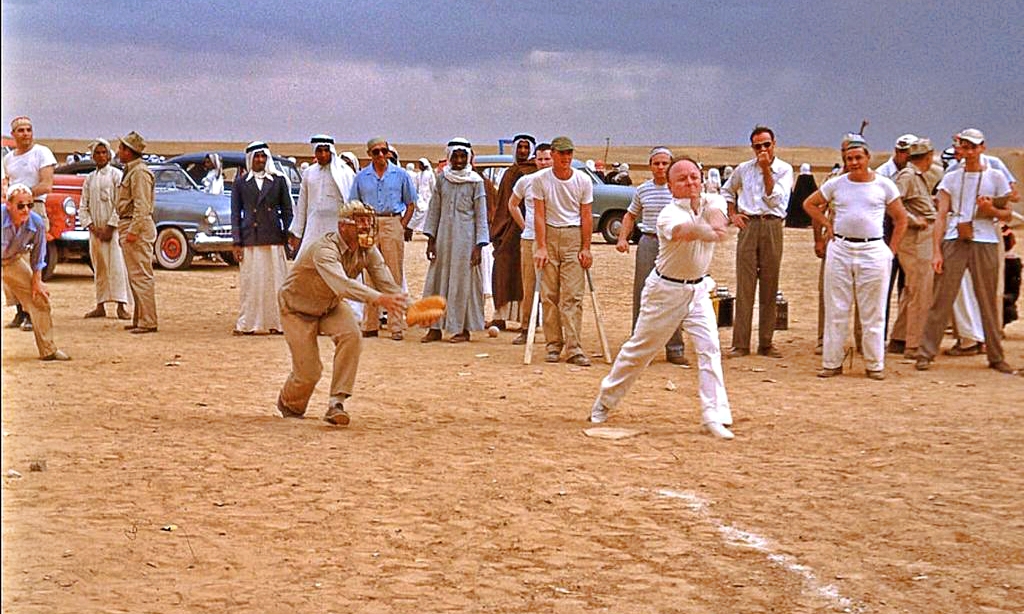
(Photo courtesy of Nayef bin-Humaid)
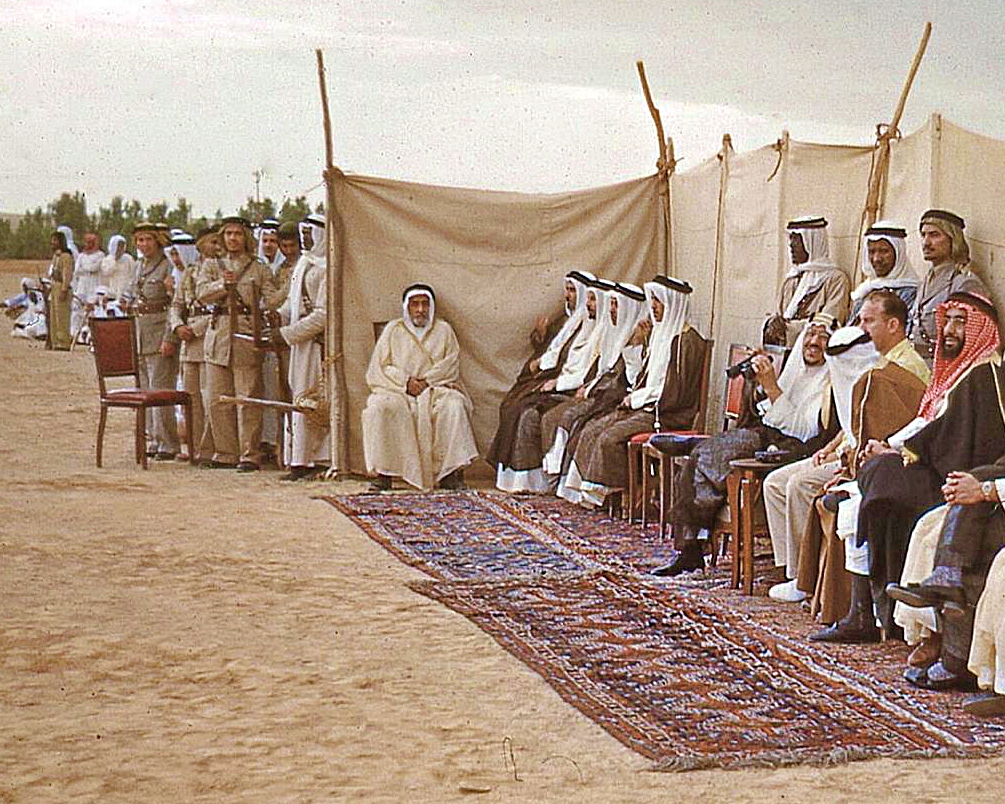
(Photo courtesy of Nayef bin-Humaid)
But now there is an effort to update the story for a larger audience. Much is yet to be written, but people from the governmental level on down are working to change the narrative.
In part, this reflects the pivot toward sports that some Middle East countries have made in recent years, the Saudi-sponsored LIV Golf Tour and Qatar’s hosting of the 2022 World Cup football (soccer) tournament being two examples. It also fits with Saudi Vision 2030, the goal of which is to increase diversification in the country economically, socially, and culturally.
The Saudi Baseball and Softball Federation (SBSF) was established in late 2019. Baseball United, the Dubai-based professional league that played its initial regular season late last year, is working with the federation to develop the sport, and the Dhahran Youth Baseball Association (DYBA) is rebuilding a program that had gone into decline.
It is unquestionably a long-term project, but it’s happening.
Nayef Bin-Humaid is president of the Saudi Baseball and Softball Federation. He lived for 10 years in the United States, mostly near Washington, D.C. His interest in baseball began when he would go with friends to games of MLB’s Washington Nationals. After returning to his home country, he eventually landed in a government job with a project for Vision 2030.
“I was approached in December 2019 by the Saudi Olympic Committee, which was interested in establishing a governmental body supporting baseball,” Bin-Humaid said. “That would feed into one of the pillars of Vision 2030 in terms of expanding sports activities in the country and, more importantly, expand the game for Saudis.”
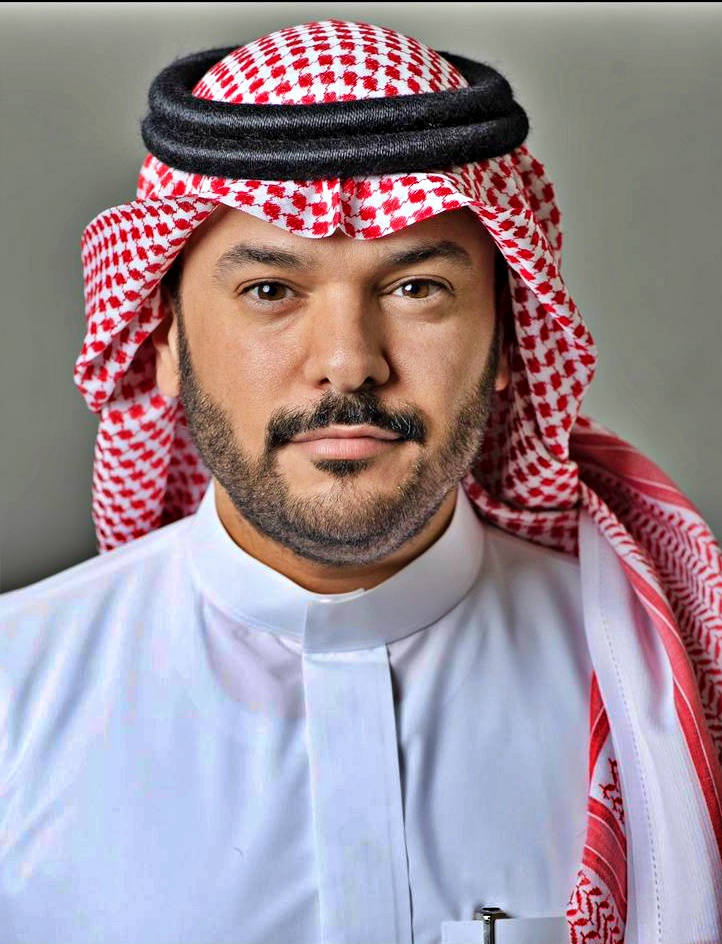
“Photo courtesy of Nayef bin-Humaid”
Bin-Humaid was elected president of the federation and got to work immediately, only to be delayed by the Covid-19 pandemic.
“We started in January 2020, and our first order of business was to find out who was playing the game in Saudi, who wants to play, and what could we do to expand the game within the country,” he said. “We started by going into American and Japanese communities, as well as others that we thought might include people who were interested in baseball. Though baseball is not that popular here, we were surprised to find that there were Saudis who loved the game, wanted to participate, and follow MLB teams closely.”
Covid-19 soon hit and put a lot of efforts on hold, but the working group was still able to develop a plan and the necessary steps. It connected the Saudi federation with the Asian Baseball Federation and the World Baseball Softball Confederation, while also obtaining seed funding from the Saudi Ministry of Sport.
“That enabled us to hire some employees, kick-start a marketing campaign, and get a few other things in motion,” Bin-Humaid said.
Jean-Michel Mayeur came on as technical director of the Saudi federation in 2024. The native of France has a long background as a player and coach, directing a baseball academy in Montpellier for nearly 20 years.
“I’m excited because I understand the potential here, but it’s going to take a while to develop,” he said. “It’s a big challenge. The main focus now is grassroots development.”
Bin-Humaid echoed that, saying, “We’re definitely working to develop at the grassroots levels. We’re very lucky to have someone like Jean-Michel who loves the game, is great with kids, and has run an academy. He took on the challenge of coming to a foreign country with the game in its very early stages and help put together a development plan that we can take to schools.”
The efforts currently focus on a number of areas, including:
- Working with schools to get baseball instruction into physical education curricula so that more Saudis will be exposed to the game
- A partnership with the Yokohama DeNA BayStars of Japan’s top professional league to bring some young Saudi players to clinics there
- Integrating Baseball5 programs into school curricula as a pathway to baseball
- Establishment of Saudi national teams in baseball, softball, and Baseball5
- Staging tournaments
- Working to develop leagues, so players can get consistent competition
“We’re working hard to get baseball into schools,” Mayeur said. “Getting people interested early on is key. First, we need to teach physical education teachers how to teach baseball. The goal is to have classes during the school days and then after-school activities involving baseball. Baseball5 should help people get interested, too, since you don’t need a ton of equipment or have to train pitchers.”
Mayeur also noted the need to establish academies; train coaches, players, scorekeepers, and umpires; organize tryouts and tournaments; build more fields that meet regulation standards; establish leagues; and … well, a lot of stuff.
“The list is long,” Mayeur acknowledged, “but we’ve made progress. We’ve established national teams in baseball, softball, and Baseball5, and having the partnership with the BayStars is really nice. We have four Saudi kids, ages 13-16, there to get instruction and observe the pro team’s practices. We hope to send more in the future, and also have some Saudi teams go there to compete against high school players.”
Owen Reid of Reid Baseball is an independent consultant who conducts clinics in various countries, many of which – such as Tunisia, Bangladesh, Thailand, Malaysia, Indonesia, and Kyrgyzstan – are not on the baseball map. He started holding clinics in Saudi Arabia in 2016 and made more than 30 visits before moving there with his family early in 2025.
“I’ve seen the game shift from being a novelty to an option, and now it’s more and more becoming an opportunity for families and Saudi kids eager to challenge themselves with something new,” Reid said. “It’s still true that most of the players I work with are expats, but I’ve seen encouraging growth in the number of Saudi ballplayers. And what excites me most is retention. Once they try it, they often stay with it. Curiosity is turning into commitment.”
Bin-Humaid said, “We have around 1,000 registered players in the country now. We focus on kids who are interested and show potential. We monitor them and work to keep them in the game, even when they go abroad to university and play. We’ve taken some to camps in places like eastern Europe, France, and the Dominican Republic, in addition to Japan. We hope to carry the torch for advancement of the game in western Asia.”
He added that there are now baseball coaches in about a dozen high-level private schools, since physical education classes in public schools mostly focus on football (soccer).
For his part, Reid has increasingly worked with coaches, as well as players, and said, “By equipping coaches in Saudi Arabia with the tools, language, and standards to create positive baseball environments, we multiply the impact. The more educated and empowered coaches are, the more impact they can have on the next generation of people and ballplayers.”
Under the terms of its partnership with the Saudi federation, announced in March 2024, Baseball United has the right to establish franchises in Riyadh, Jeddah, and Dammam. Baseball United will help promote the game across the region, develop local talent in Saudi Arabia, and design training programs and curricula for players, coaches, and umpires at both the amateur and professional levels. The league will also look to host future tournaments and league games in Saudi Arabia.
Kash Shaikh, who will leave his role as chairman and CEO of Baseball United effective March 1, has led the organization since its inception four years ago. He has a personal connection that helps drive his interest in bringing baseball to the region – he lived in Dhahran for three years while his parents worked in the oil industry, and he played Little League baseball there.
“For the longer term, we have a 15-year partnership to bring baseball to Saudi. This is the most under-developed region as far as baseball goes, so we’re doing as much as possible to help the sport grow. We’re helping with the Saudi national team program – we put a team on the field last fall for the Baseball United Arab Classic. We’re also helping from a resource and financial standpoint, as well as bringing expertise to the training and curriculum programs.”
Bin-Humaid added, “Baseball United has made a significant commitment to developing the game here. They sponsored one of our tournaments, which involved people from various embassies in Riyadh, and they also committed to sending expert coaches and trainers when we need them.”
Mayeur also sees Baseball United’s participation as a positive: “The partnership is huge. We need to make baseball fashionable for the kids. Once they get teams in Saudi, it will give people a reason to come watch. We need that kind of thing to push development.”
Bin-Humaid also noted the importance of the long-standing baseball community in Dhahran.
“Luckily, we connected with the baseball community in eastern Saudi – the Aramco people in Dhahran,” he said. “The coaches, parents, and kids there are very much into it.”
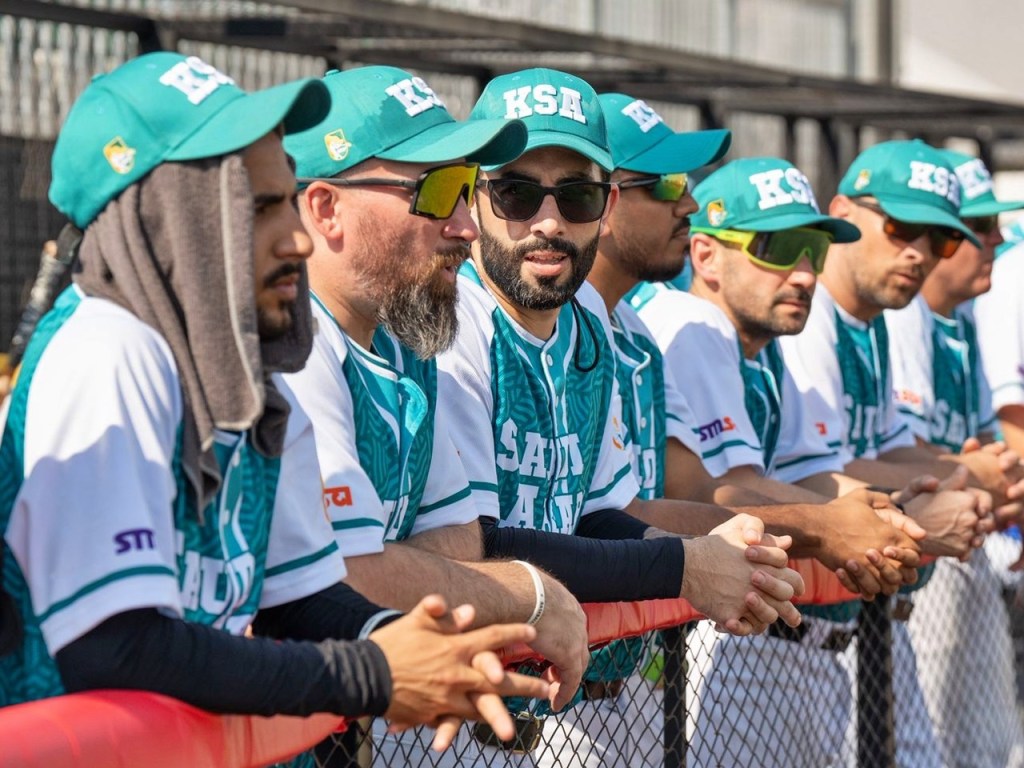
Erich Sutterlin, president of the Dhahran Youth Baseball Association (DYBA) and a school teacher in the Aramco community, added, “The federation identified us as an entry point for finding baseball talent in the Kingdom. Several of our players participate in international tournaments under the auspices of the federation and the Saudi Committee. We’re separate from an organizational standpoint, but our players benefit from being involved with their teams.
“The relationship with the SBSF has led to some interesting developments such as a Baseball5 club at our school, which has helped introduce the game to players from countries that don’t have strong baseball backgrounds,” Sutterlin continued. “And the SBSF has visited schools and encouraged the Saudi players in our leagues to invite their friends so they can learn about baseball.”
Getting more Saudis playing the game is a major part of the federation’s mission, of course, and there has been some progress in Dhahran. Sutterlin said that a 12-U team played in a tournament in the Czech Republic in September 2025, finishing second out of 12 teams, and a 15-U team comprised of expats and Saudis competed in a tournament in Italy in November. He noted, however, that “the expat and Saudi kids here don’t go to school together, so it’s more of a challenge to get the Saudis to play. The ones that do participate are often children of ‘mixed’ parentage.”
Still, there is progress. As Reid remarked, “I see Saudi families returning season to season and ballplayers coming back to the field each time I return to Dhahran.”
Glenn Makechnie, Sutterlin’s predecessor as head of the DYBA and a geologist with Aramco, said that there are Saudis playing in every age group, and also on the travel teams. “They’re still in the minority, but we’re inclusive of kids at all skill levels, not just the more interested ones. Recently, one team had 11 different nationalities among the 13 players. And while the number of Saudi participants is low, some of our best players are Saudis. There are some on our 12-U and 15-U travel teams who are performing very well.
“We also collaborate with the Little League in Qatar, which is very active and hosts regional tournaments. Two American high schools there have programs, as well.”
This comes after baseball interest in the Aramco community trended downward for more than a decade. After the long period of success from 1983-2011, the Dhahran Little League team was shifted to the Asia-Pacific region, which was more competitive. That, combined with a shrinking expat population at Aramco that reduced the pool of potential players and baseball-savvy parents, resulted in less success and dwindling interest in attending the Little League tournament.
After the 2017 season, when the program struggled to get nine players to fill out an all-star team, the DYBA’s board of directors let the association’s Little League charter expire. Overall participation fell off, and the Covid-19 pandemic exacerbated the decline. The program was completely shut down from the spring of 2020 until the fall of 2021.
“When we tried to reboot after Covid, we could barely field two teams for a 12-U kid-pitch division,” Makechnie said. “It’s taken a monumental effort from all involved to grow the league back to where it is today. We’ve had great support from parents internally and from external resources such as the SBSF and Reid Baseball.”
Makechnie said there are parallel programs within the Aramco community – youth baseball supported by Aramco and a chartered Little League initiative that “intertwines with the youth baseball program.” There are approximately 260 young people playing on the various teams, including T-ball, and there are 20-25 girls playing softball, with some of the latter also involved with baseball. In addition, there is a new senior league that utilizes pitching machines, rather than live pitchers. “There aren’t enough older people who can pitch,” he said wryly.
“We’ve really had to re-think our goals and organizational structure to create meaningful baseball experiences for all our membership,” Makechnie continued. “Even though the North American expat population is decreasing, overall baseball participation is about the same. That’s good in a way, but it also means we have fewer baseball-savvy people helping, so we’ve had to get creative. We’re probably the most unique baseball organization in the world.”
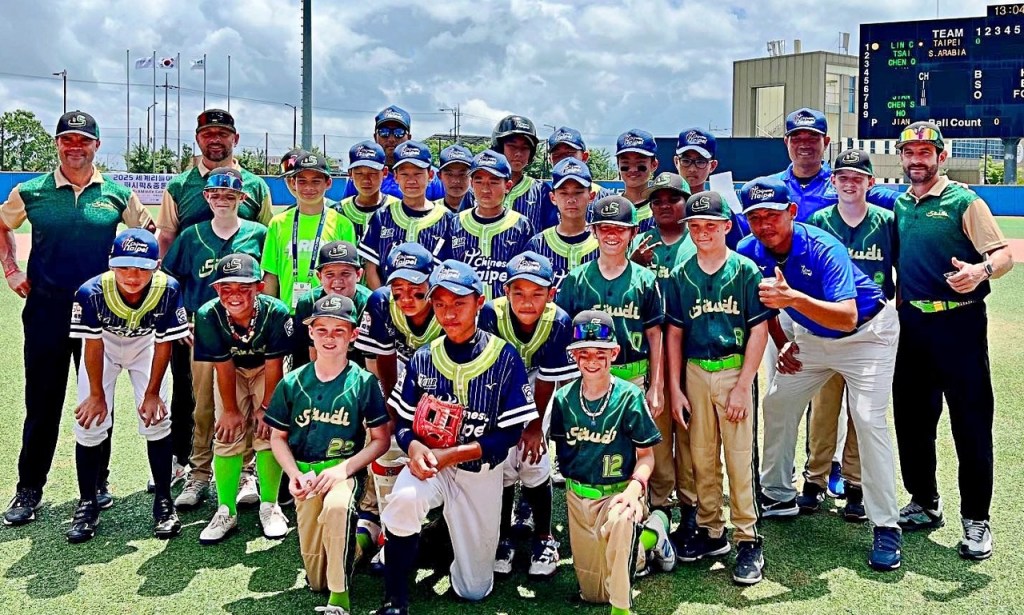
Now, interest is expanding again, although it hasn’t reached the levels of two or three decades ago. Saudi Arabia returned to international Little League action at the 2025 Asia-Pacific & Middle East Tournament in South Korea, though it failed to advance from pool play.
Reid has partnered with the DYBA since 2016, putting on multiple clinics each year, and he worked with this year’s Little League team.
As for the future, there is a need to continue building more fields, as well as establish leagues. There are perhaps 15 fields in the country now, including several at the Aramco facilities in Dhahran. About half are private, and not all meet regulation standards.
For the sport to grow and evolve, Reid sees the need for greater access within communities – i.e., more leagues at multiple levels – continued development of coaches, additional facilities that are multi-use and adapted to the hot climate, a clear league structure that provides pathways to greater competitive levels, and role models and greater visibility for the game.
“The foundation is there, and baseball here continues to build momentum,” Reid said.
Bin-Humaid said, “We’re committed to keep pushing forward. We will participate in the Asian Games in Qatar in 2030, and we’ll be the host nation of the Asian Games in 2034. By then, we want to have a team that not only participates but competes.”
Mayeur added, “We just need time and exposure. If we can show baseball to kids, we can get them interested. We just have to keep going, and things will happen.”
 SABR Asian Baseball Research Committee Blog