Tag: sports

  • An Introduction To NPB Baseball Cards

    An Introduction To NPB Baseball Cards

    by Dave McNeely (npbcardguy)

    This great introduction to current Japanese baseball cards was published on SABR’s Baseball Card Research Committee’s Blog earlier this week,. We have decided to repost it here as background for our zoom chat with Tatsuo Shinke the CEO of Mint Sport Cards to be held on Wednesday, January 28 at 8:30 pm EST. Please see the Asian Baseball blog for more information.

    https://sabrasianbaseball.com/2026/01/02/the-japanese-baseball-card-industry-january-28-830-est-zoom-talk-with-tatsuo-shinke-ceo-of-mint-sports-cards-in-japan/


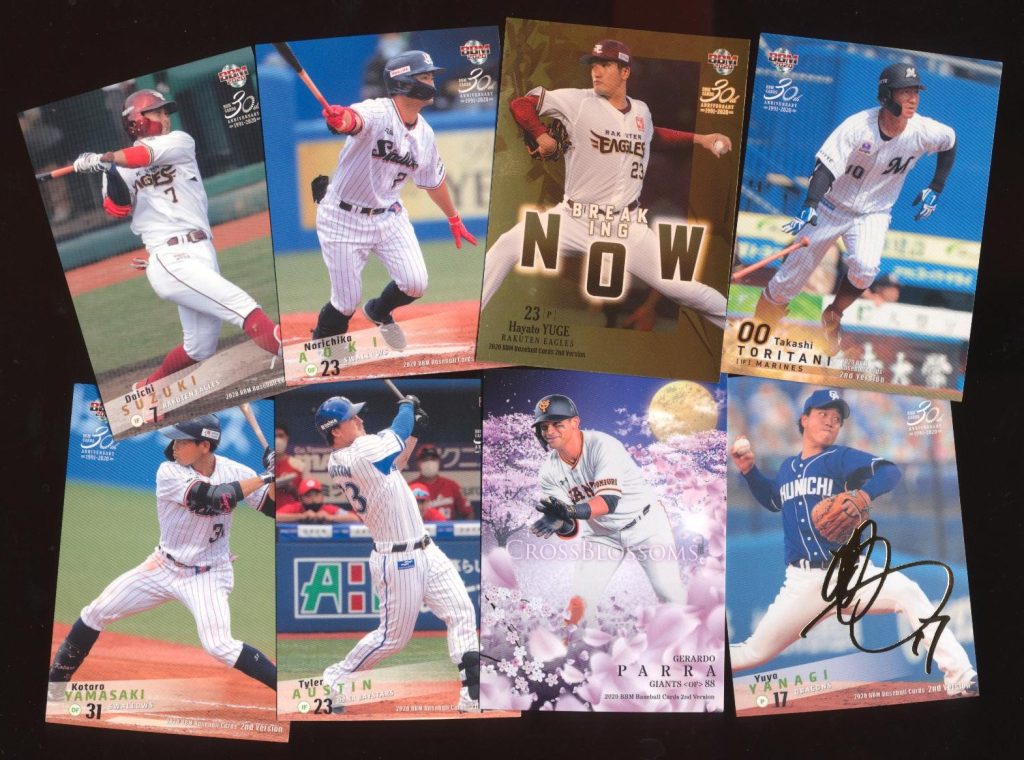
    Baseball has been played in Japan for over 150 years and professionally for the past 90.  There are known to be baseball cards depicting the sport in Japan as early as 1900 although little is known about many of the pre-World War II cards simply because few of them survived the war.  The post-war era featured an explosion in baseball card production that has continued to this day.

    Doing a search for “Japanese Baseball Cards” on Ebay will give you a huge number of results and it can be kind of overwhelming trying to make some sense of what you’re looking at.  How many card companies are there?  How many different sets are there?  Are Yomiuri and Hanshin places in Japan?  This post will attempt to answer some of these questions by giving an overview of the current state of the Japanese card market.

    Baseball In Japan

    Let’s start by giving a little bit of background information about professional baseball in Japan.  Generally when people talk about baseball in Japan, they are talking about Nippon Professional Baseball (NPB), the Japanese equivalent of MLB.  NPB consists of 12 teams in all that are split into two separate six team leagues – the Central League and the Pacific League.  The Central League teams are the Yomiuri Giants, the Tokyo Yakult Swallows, the Yokohama DeNA Baystars, the Chunichi Dragons, the Hanshin Tigers and the Hiroshima Toyo Carp.  The Pacific League teams are the Hokkaido Nippon-Ham Fighters, the Tohoku Rakuten Golden Eagles, the Chiba Lotte Marines, the Saitama Seibu Lions, the Orix Buffaloes and the Fukuoka Softbank Hawks.  The team names may seem a little confusing but the thing to remember is that all the team names contain the name of the company that owns the team (Yomiuri, Yakult, DeNA, Chunchi, etc) and several of the team names also feature either the city, prefecture (more or less the equivalent of a state) or region (think something like the “mid-Atlantic” but with a formal definition) that the team plays in (Chiba, Tokyo, Saitama, Tohoku, etc)..  

    Each team has a “70 man” roster which usually has fewer than 70 players on it.  28 of those players are on the top team’s roster (also known as ichi-gun which literally means “first troop”)  Of the 28, only 25 are active for any particular game. The remaining players are on the farm team (also known as ni-gun or “second troop”).  Each team has only one farm team.

    Most teams also have a handful of players who are not on the “70 man” roster.  These players are called “development” or “ikusei” players.  You can identify these players by the fact that they have three digit uniform numbers.  These players are allowed to play in farm team games but must be signed to the “70 man” roster to play at the top level.  A couple teams have enough development players to field an unofficial third team (“san-gun”) which will play corporate or independent league teams.  Every year there are a handful of players who “graduate” from being development players – the most famous one is probably Kodai Senga.

    Each fall NPB holds a draft for eligible players graduating from high school or college.  Players from the corporate and independent leagues can also be drafted if they haven’t previously been drafted in NPB.  There are two parts of the draft – a “regular” phase for players who will end up on their team’s “70 man” roster and an “ikusei” draft for development players.  

    Some Japanese Baseball Card Conventions

    Before we get too far down the road, we should mention a couple conventions of Japanese baseball cards.

    There is usually the same number of “regular” player cards for each team in each flagship set (one major exception is BBM’s Fusion set).  So if a set has 216 cards with no subsets, you’ll know that each team has 18 cards in the set.  If the subset is not for the previous year’s statistical leaders or award winners or the All Star lineup, it will also be evenly divided between the 12 teams.  Same for insert cards.  It’s kind of a nice change of pace from MLB sets with 30 Yankees and 5 Royals.

    For baseball card purposes, the players who are taken in a given year’s draft are referred to as rookies the following year.  For example all the players who have the “rookie” icon on their 2024 baseball cards were taken in the 2023 draft.  This is NOT the same as how NPB treats rookie status which is whether a player has exceeded a certain amount of playing time.  This is why the rookie cards for both 2023 “Rookie Of The Year” award winners were in 2021 (since both players were drafted in 2020).

    It is extremely rare for there to be baseball cards of college players and unheard of there to be any for high school players.  Any card you see of a high school player (or, more likely, a star player from their high school days) on Ebay is likely a “collector’s issue” and not an official card.  There are cards for corporate league and independent league players so it IS possible to find “pre-rookie” cards for certain players, but it’s not common.

    Because NPB teams treat their farm teams as an extension of the top teams, there are no separate “minor league” team sets for the NPB farm teams or the equivalent of the Topps Pro Debut set.

    One major way that NPB card sets differ from MLB sets is that it is extremely rare for a player to be depicted on a team other than the one he is on when the set goes to press.  It helps that players move much less frequently in NPB than they do in MLB but I have seen Japanese card companies pull cards from production when a player has been traded.  

    Japanese Baseball Card Makers

    There are currently four companies with a license to produce NPB baseball cards.  We’re going to run them down in order of how long they’ve been making cards.

    One quick note before we get started.  I’m going to mention the sets that each manufacturer typically releases each year but take that with a grain of salt.  Sometimes the companies will abruptly change what their releases are.  BBM, for example, published boxed sets for the All Star games and the Nippon Series annually for over 20 years before suddenly stopping in 2013.

    Calbee

    2024 Calbee Series One #018 (Tomoyuki Sugano)

    Calbee is a Japanese snack company that has been distributing baseball cards with bags of potato chips since 1973.  There was a lot of variety in the size of Calbee’s sets in the early years (and even what constituted a “set”) but things settled down somewhat in the late 90’s where Calbee would issue their “flagship” set in two or three series each year.

    Calbee’s sets are generally fairly small, and seem to be shrinking in recent years.  Their sets have been in the neighborhood of 160 cards in the past three years.  As a result, their sets feature most of the top players in NPB but not as many of the lesser players.  Whether or not the set includes many rookie players is very hit or miss as well.

    Calbee doesn’t offer any autograph or memorabilia cards with their sets.  “Hits” are the “Star” insert cards, especially the parallel versions that feature gold facsimile signatures.  It’s also possible to pull a “Lucky Card” which can be mailed to Calbee and exchanged for something.  There have been times when the prize has been a special baseball card or cards but frequently it’s simply a card album.

    It’s somewhat expensive to get unopened boxes of Calbee cards shipped overseas for the simple reason that the packs of cards are still attached to bags of potato chips!  While a typical box including 24 bags of chips that each have a pack of two cards doesn’t weigh a whole lot, it’s larger than you’d think.  And it’s very questionable if the expense is worth getting only 48 cards.

    BBM

    2024 BBM 1st Version #193

    BBM stands for “Baseball Magazine”.  BBM’s parent company is Baseball Magazine Sha which has been publishing sports magazines and books since the 1940’s but they didn’t start publishing baseball cards until 1991.  They were the first Japanese baseball cards that resembled American cards, with packs containing ten cards and issuing a factory set for their flagship set.  There are fewer cards to a pack these days and they haven’t issued a factory set for their flagship set since 1993 but they are unquestionably the largest card company in Japan.

    BBM issues a myriad of sets each year but I’m only going to highlight a small subset of them.  Their draft pick set – Rookie Edition – usually comes out in late-February and features all the players taken in the previous fall’s draft, both the regular and “ikusei” phases.  This is typically where a Japanese player will have his first ever baseball card.  The size of the base set is driven by the number of players drafted but is usually around 130.  Hits in this set are mostly facsimile signature parallels, some of which are numbered.  There are autographed cards available although I think they are mostly redemption cards which may be difficult to exchange from overseas.  

    BBM issues their flagship set in three parts – 1st Version comes out in April, 2nd Version comes out in August and Fusion comes out in November. It’s not quite like Topps’ Series One, Two and Update. The design of the “regular” player cards is different between 1st and 2nd Version (although 2nd Version has a “1st Version Update” subset using the same design as the 1st Version cards) while the Fusion set uses yet another card design and is kind of a review of the regular season (although it also has a “1st Version Update” subset).  The total size of the base set for the flagship set is around 600 cards although many players have multiple cards.  Because of that though, BBM’s flagship sets usually include not just the top stars but most of the regular players for each team.  The 1st Version set will also contain cards for all the rookies (i.e. the previous year’s draft picks) from all the team’s “70 man” rosters (so none of the ikusei players).  Hits for all three sets include the ubiquitous variety of facsimile signature parallels (including numbered ones) as well as a fair number of autographed cards and a handful of memorabilia cards.

    BBM also issues a “comprehensive” team set for each of the 12 teams.  What I mean by that is a set that will contain a card for every player on the team’s “70 man” roster or essentially everyone in the organization except the development players.  The base sets for these sets contain 81 cards – generally there’s 60-ish “regular” cards for the team’s manager and the players and then 12-15 subset cards to fill out the set.  The sets are typically issued between March and July.  Hits for the team sets are mostly some special serially numbered insert cards along with autograph and/or memorabilia cards possibly – it depends on the team.  For example, the Yomiuri Giants don’t allow their players to do autographs in card sets so the Giants team sets don’t have autographs.  

    BBM issues a “high end” set called “Genesis” every September.  The base set for this set contains 120 cards but no one is interested in this set for the base set.  This is the set that BBM has the most autograph and memorabilia cards associated with.  Besides the autograph and memorabilia cards, Genesis also has a plethora of numbered parallel cards.

    Epoch

    2024 Epoch NPB #101

    Epoch is a Japanese toy company that was founded in the 1950’s but didn’t do their first card set until 2000.  That might be stretching things a bit as it was actually a set of stickers that could be pasted into albums.  It would be another nine years before they issued their next set which was done in conjunction with what was then called the All Japan Baseball Foundation and is now the National Baseball Promotion Association or OB Club.  For the next few years, Epoch would release a handful of sets, usually in partnership with the OB Club and featuring retired (OB) players.

    Starting in 2015, Epoch started issuing sets with active players and in 2018 they got serious about competing with BBM, debuting a flagship set along with “comprehensive” team sets for a subset of the teams.  They’ve tweaked their offerings somewhat since then though.  And as was the case with BBM, I”m only going to highlight a couple of their sets here.

    Their flagship set is called NPB and is generally released in May or June.  The set had included 432 active players every year between 2018 and 2023, sometimes accompanied by 12 cards of retired players which may or may not have been short-printed.  The set has shrunk in size over the past two years, however, with the 2024 set dropping to 336 cards of active players plus the 12 retired players and the 2025 edition further shrinking to 240 cards.  Like BBM’s flagship sets, Epoch’s set is large enough to include both the star players and the more average ones.  The NPB set will also include cards of all the non-ikusei rookies.  Hits from the set include numbered parallels and inserts along with autographed cards.

    Epoch issued “comprehensive” team sets in 2018 and 2019 but in 2020 they shifted to team sets that only had 30 or 40 players in them.  Originally their team sets were dubbed “Rookies & Stars” but since 2022 they’ve been called “Premier Edition”.  Epoch only does these sets for a subset of the teams, although they appear to be adding more teams each year.  The sets will contain most of the starters for the team (including the stars obviously) along with (again) the team’s rookie class which may include “ikusei” players depending on the team.  The hits in the boxes include a variety of serially numbered parallels and inserts along with autograph cards.  

    Topps

    2024 Topps NPB #49

    While Topps has been publishing baseball cards in the US for over 70 years, they are relatively new to the NPB market.  They announced their NPB license at the beginning of October of 2021 and put their first set out two months later.  Because they’re so new it’s difficult to say for sure what their usual sets are.  

    They’ve issued a 216 card flagship set each year that uses a similar (but not necessarily identical) design as their MLB flagship set.  The set has more rookie cards than Calbee generally does but has never contained the year’s entire rookie class.  Hits have generally been a plethora of different parallels but they’ve recently started adding autographs.  For a while, the autographed cards were not for current NPB players but instead for both current and retired Japanese MLB players such as Ichiro, Hideki Matsui and Shohei Ohtani (although the players are depicted in their NPB uniforms).  They have started adding current NPB players more recently.

    Topps has also issued a Chrome set each year.  The first two iterations of this set were essentially a “Chrome” parallel of the flagship set although since then the set’s been different – a new checklist containing some different players and all new photos.  Hits again are parallels and autograph cards.

    Topps also issued NPB versions of their Bowman set in 2022 and 2023; their 206 set in 2023 and 2024; their Stadium Club set in 2024 and 2025; and their Finest set in 2025.  They’ve issued four sets a year since 2022 with only two in their initial year.

    So far, Topps has issued all of their NPB sets via packs.

    Both Epoch and Topps offer on demand cards for NPB.  Epoch’s are called Epoch One while Topps uses the Topps Now moniker for their Japanese cards as well.  It is extremely difficult to get these from overseas as neither company will ship these cards outside the country.  

    What I’ve listed here aren’t all the sets that these manufacturers put out but they’re most of the perennial ones and probably the most straightforward sets.  There are cards besides the ones from these companies but they are much more difficult to find from overseas.  Most if not all of the teams issue cards through their fan clubs and often give cards away with meals at the ballpark.  Like in the US, there may be cards given away with food products at stores and sometimes those cards are done in conjunction with BBM or Epoch.  

    There’s also usually some collectible card game (CCG) set available although the manufacturer seems to change every few years.  Bushiroad issued a CCG called DreamOrder in 2024 and 2025 but I’m not sure if they’re continuing this year.  Bandai is apparently issuing a CCG soon called “Fanstars League”.  Bandai had previously issued a CCG called “Owners League” in the 2010’s and both Takara and Konami have issued ones in the past.  

  • The School in Korea That Has Produced the Most MLB Players: The History of Gwangju Ilgo

    The School in Korea That Has Produced the Most MLB Players: The History of Gwangju Ilgo

    by Taein Chun

    Gwangju Jeil High School, known as Gwangju Ilgo, is located in Gwangju Metropolitan City in the southwestern region of Korea and is the school that has produced the greatest number of Major League Baseball players in the country. In the early 2000s, Jae Weong[c1]  Seo of the New York Mets and Los Angeles Dodgers, Byung-hyun Kim of the Arizona Diamondbacks and Boston Red Sox, and Hee-seop Choi of the Chicago Cubs and Los Angeles Dodgers reached the MLB stage one after another. Although the three played for different teams, they shared the distinction of being Gwangju Ilgo alumni, and they were called the Gwangju Ilgo Trio as they demonstrated the international competitiveness of Korean baseball. In the mid-2010s, Jung-ho Kang of the Pittsburgh Pirates became the first KBO hitter to move directly to MLB, opening a new path. In 2025, Kim Sung Joon signed with the Texas Rangers as the next emerging player. A total of five Gwangju Ilgo alumni have signed with MLB organizations, the most among Korean high schools. The school also ranks among the highest domestically for producing KBO league players, with 119 Gwangju Ilgo graduates appearing in first division games as of 2024.

    1924, The Spark of Anti-Japanese Spirit That Began on a Baseball Field

    Baseball at Gwangju Ilgo was not simply a sport from the beginning but a symbol of resistance and pride. The baseball team, founded in 1923, is one of the oldest in Korean high school baseball. In June of the following year, the baseball team of what was then Gwangju Higher Common School defeated a Japanese select team called Star by a score of 1 to 0 in an exhibition match. In colonial Korea, the victory of Korean students over a Japanese team was a rare moment of national joy. The field filled with cheers as players and spectators celebrated together, shouting manse. The atmosphere changed abruptly when Star’s manager, Ando Susumu, stormed onto the field in protest, causing chaos as spectators and players clashed, and the Japanese cheering section also joined. Japanese police intervened, and Ando claimed that he had been struck in the forehead by a spike, identifying nine Gwangju players as the attackers. They were immediately detained. Outraged students launched a schoolwide strike that lasted three months. This incident marked the first organized student protest against colonial rule and served as a catalyst for the 1929 Gwangju Student Independence Movement. A monument to the movement still stands on the school grounds. Before national tournaments, Gwangju Ilgo players bow their heads before the monument, renewing their resolve never to give up. This tradition grew into the team’s philosophy, and their strong fundamentals and concentration reflect this spirit.


    Gwangju Ilgo students reenacting the starting point of the Gwangju Student Independence Movement

    1980, The Silent Time That Baseball in Gwangju Protected

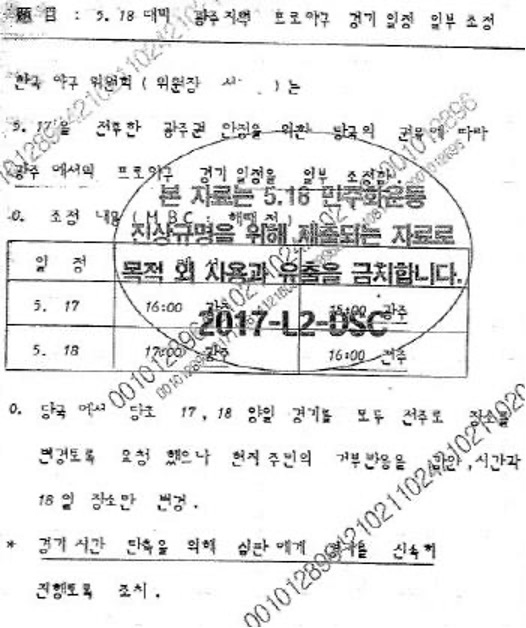
    If Gwangju Ilgo in the 1920s contained an anti-Japanese consciousness, then its baseball in the 1980s walked alongside the era of democratization. In the spring of 1980, citizen protests for democracy against the military regime took place in Gwangju. This event, which is called the May 18 Gwangju Democratization Movement, became a major turning point in modern Korean history. At the time, some Haitai Tigers players were still students, and that generation experienced up close the confusion and sacrifice that engulfed the entire city. The atmosphere of that time, when soldiers fired guns at citizens, left a deep impression on the team’s attitude. The more their home city, Gwangju, fell into turmoil, the more the Haitai Tigers players banded together and comforted the hearts of citizens with strong teamwork and hustle play. Former Haitai Tigers player Chae-geun Jang was in Gwangju on May 18. He remembers it as follows. “There were helicopters, soldiers, and the sound of gunfire. At night, we turned off the lights and stayed quiet. I even remember seeing bodies on the street.” Jang said that when May came, fans and players naturally spoke about those memories. For several years afterward, due to political instability, home games were not held in Gwangju around May 18. The government, concerned about large crowds in the Gwangju area around the May 18 memorial, requested that the Korea Baseball Organization adjust its schedule. As a result, throughout the 1980s, the Haitai Tigers had to play games in other regions around May 18. Only in 2000, the twentieth anniversary of the democratization movement, was a home game in Gwangju finally held again on May 18.

    In 1986, the military regime instructed the KBO to move the May 18 game in Gwangju to another region

    Even so, Haitai did not waver. Beginning with their first Korean Series championship in 1983, they went on to win four consecutive titles from 1986 to 1989, five championships in the 1980s, and four more in the 1990s, establishing what came to be called the Haitai dynasty. At the center of this dynasty were core players from Gwangju Ilgo such as Dong-yeol Sun, Lee[c1]  Kang-chul Lee, and Jong-beom Lee. With solid fundamentals and concentration as their weapons, they led the team and helped raise the overall standard of Korean professional baseball. In this way, baseball in Gwangju took root as a source of regional pride.


    The Characteristics and Development Environment of the Gwangju Region

    The intense baseball passion in Gwangju began during the golden age of the Haitai Tigers in the 1980s and 1990s. Haitai’s repeated championships became a source of pride for the region, and baseball took firm root as Gwangju’s representative sport. From this period on, parents increasingly tried to raise their children as baseball players, and Gwangju came to be recognized as a city where one could succeed through baseball. Gwangju is a mid-sized city with a population of around 1.4 million. In general, in a city of this size in Korea, maintaining elementary, middle, and high school baseball teams in a stable way is difficult, but Gwangju is an exception. Baseball teams at schools across the region operate on a steady basis, and youth baseball teams are also active. This environment has led to a youth baseball culture in which many players set Gwangju Ilgo as their target school. In addition to Gwangju Ilgo, there are other prestigious baseball schools in the city,such as Jinheung High School and Dongseong High School, the former Gwangju Commercial High School. These schools also have experience winning national tournaments, but in terms of the concentration of player resources and students who hope to advance, Gwangju Ilgo stands at the top. Former KBO technical committee chair In-sik Kim evaluated the situation by saying that while Busan divides its talent between Kyungnam High and Busan High, in Gwangju, the player pool is concentrated at Gwangju Ilgo. Gwangju Ilgo recruits players not only from Gwangju but from all across South Jeolla Province, and promising prospects from middle schools in the area, such as Mudeung Middle School and Chungjang Middle School, as well as nearby cities including Naju and Suncheon, also join the program. As a result, internal competition becomes very intense, and players who pass through that competition show a high level of fundamentals, physical conditioning, and game focus.

    Founding members of the Haitai Tigers

    Industrialization and economic growth in Korea have taken place mainly in the capital region, meaning Seoul and Gyeonggi, and in the Gyeongsang region, including Busan, Daegu, Ulsan, and the surrounding provinces. In contrast, the Honam region has had a relatively weaker economic base. Because of this, baseball has been seen as a realistic career path through which one can raise social status by effort and performance. In such an environment, when parents made decisions about their children’s future, they often favored sports, especially baseball. This culture has continued across generations up to the present. Gwangju Ilgo still supports the roots of Korean baseball today. Even as generations change, the philosophy of valuing fundamentals and mental strength has not changed. From its founding in 1923 to MLB advancement in 2025, Gwangju Ilgo has been both the place that has created the present of Korean baseball over a century and the site where its future is being prepared.


  • Rob Fitts Zoom Presentation, In the Japanese Ballpark: Behind the Scenes of Nippon Professional Baseball, November 5 at 7 pm

    Rob Fitts Zoom Presentation, In the Japanese Ballpark: Behind the Scenes of Nippon Professional Baseball, November 5 at 7 pm


    The Clyde Sukeforth Chapter (ME/NH) in conjunction with the Gardner-Waterman Chapter (VT) offers a special presentation with SABR Member Rob Fitts in a Zoom Meeting on Wednesday, November 5, 2025 at 7 PM Eastern, 4 PM Pacific. All baseball fans are welcome!

    Fitts will talk about his new book and provide an introduction to Japanese baseball.

    In the Japanese Ballpark: Behind the Scenes of Nippon Professional Baseball

    This book takes you deep inside the heart of Japan’s national pastime—far beyond the box scores and highlight reels.  To discover what truly sets Japanese baseball apart, author Robert Fitts went straight to the source: the players, managers, umpires, team owners, mascots, beer girls, and lifelong fans who live and breathe the sport. Through their personal stories and behind-the-scenes insights, you’ll get an insider’s look at how the game works, and what makes Japanese baseball unique—and so much fun. Get a front-row seat to the traditions, strategies, and spirit that define baseball in Japan. From the passion of the fans to the precision of the game, every page offers eye-opening stories and insights you won’t find anywhere else. Whether you’re a die-hard fan or just discovering the magic of the Japanese game, In the Japanese Ballpark can help you fully experience every pitch, hit, and cheer.

    Robert Fitts has published eleven books and numerous articles on the history of baseball in Japan and Japanese baseball cards. He received his Ph.D. in historical archaeology from Brown University and ran excavations in New York City before turning to baseball history. He is the founder and chair of the Society of American Baseball Research’s Asian Baseball Committee and recently received the society’s Chadwick Award for lifetime contributions to baseball history. He currently is a curatorial consultant for the Yakyu-Baseball exhibit at the National Baseball Hall of Fame in Cooperstown.

    Registration link: https://tinyurl.com/ydyc3uhy

  • “‘No Fear’ — The Legacy Royster Left in the KBO League”

    “‘No Fear’ — The Legacy Royster Left in the KBO League”

    by Taein Chun

    The First Foreign Manager in the KBO

    At the end of 2007, the Lotte Giants needed a breakthrough to end their long slump. The team’s performance was declining, and fans’ frustration was mounting. At that time, Bobby Valentine, who was managing the Chiba Lotte Marines in Japan, was asked by Lotte’s ownership to recommend a new manager. Without hesitation, Valentine introduced his longtime friend, Jerry Royster.

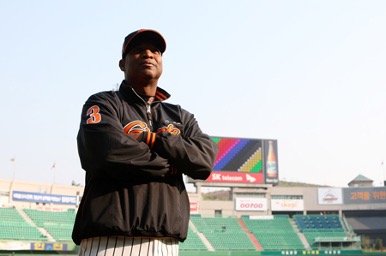
    Arriving in Busan, Royster became the first foreign manager in KBO history. A utility player who spent 16 years in Major League Baseball moving between the infield and outfield, he took on the Korean stage after retiring as a player and working as a coach and minor league manager. At that time, the idea of a foreign skipper was almost unthinkable, and the Korean baseball world viewed it with both curiosity and concern.When the 2008 season began, a new scene unfolded at Sajik Baseball Stadium in Busan. With the slogan “No Fear,” Lotte declared an aggressive brand of baseball under its new manager. Fans quickly embraced the American leader, calling him simply “Royster” instead of the formal “manager.” Beyond nationality, the very fact that a foreigner was officially holding the reins of a KBO team was a symbolic milestone.

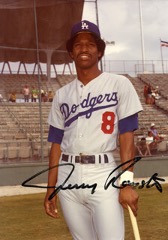
    Jerry Royster during his LA Dodgers days (1973–1975). He began his career debuting in the Major Leagues as a utility infielder.

    A Short but Powerful Three Years

    Royster stayed in Korea for only three years, but in that short time he left an indelible mark on the team and its fans. For years, Lotte had been mockingly nicknamed “8888577.” This number string represented their final standings from 2001 to 2007, mostly finishing dead last (8th place) in the eight-team league. Among fans, “8888577” became shorthand for failure and despair.

    But everything changed after Royster took over in 2008. Though Lotte never won a championship under him, the team reached the postseason three years in a row. A club long accustomed to losing now had the confidence that “we can win.” At a time when team identities in Korean baseball were fading, Lotte regained a strong identity: a team that fought until the last out, one that played bold, attacking baseball.

    After contract renewal talks broke down in 2010, Lotte fans raised funds themselves to publish a newspaper ad supporting manager Royster: ‘Why Not Royster?’

    The Philosophy of Fearless Play

    Royster’s baseball philosophy could be summed up in two words: “No Fear.” He valued bold attempts over results. Hitters were encouraged to swing aggressively, runners to take the extra base, and pitchers to trust their decisive pitch without shrinking back.

    This message, “don’t be afraid of failure,” stood in sharp contrast to the conservative, risk-averse approach typical of the KBO then, leaving a strong impression. Players experienced new freedom, and fans delighted in the refreshing style of play. “No Fear” became more than a slogan; it fused with Busan’s passionate cheering culture and grew into a symbol.

    His leadership also broke from the authoritarian style common in Korea. He shared emotions with players in the dugout and greeted fans first after games, rare sights in the KBO then. Rather than stressing authority, he emphasized communication and empathy. Asked “Who is the best player?” he always answered, “Every player is a good player.”While ordinary in the U.S., this philosophy was a fresh shock in Korea. In a culture of hierarchy, his trust-based, autonomy-driven style gave players a sense of ownership. That’s why players like Sung-hwan Jo, Dae-ho Lee, and Jae-gyun Hwang later called him a “mentor.”

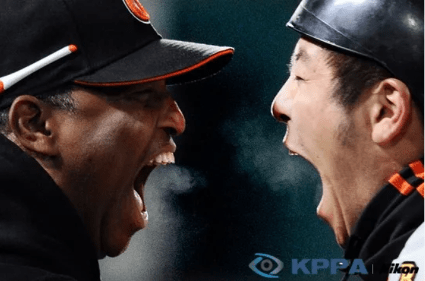
    Min-ho Kang and manager Jerry Royster celebrating after a game in 2008. This photo won the Golden Photo Award at the Golden Glove Ceremony that same year.

    Royster as a Cultural Keyword

    Royster became more than a figure in the dugout, he was tied to Korean society. Even after he left in 2010, whenever a managerial change loomed, the phrase “like Royster again” resurfaced in media and fan discussions.

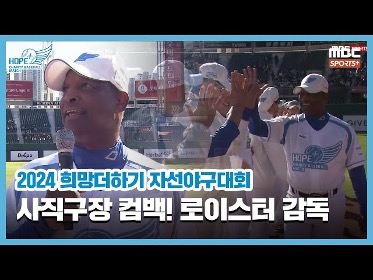
    The “No Fear” mantra became a cultural keyword shared across Korean baseball fandom. Even today, his name resurfaces in charity games, broadcasts, and YouTube interviews. At the 2024 Hope Plus Charity Baseball Game in Sajik Stadium, he returned as honorary manager, greeted with roaring applause as he once again shared the “No Fear” spirit. For fans, Royster remains a living presence, not just a figure of the past.

    Former manager Jerry Royster returned to Sajik Stadium for the 2024 Hope Plus Charity Baseball Game. Amid the passionate cheers of Busan fans, he once again shared the ‘No Fear’ spirit.

    A Black Leader in a Homogeneous Society

    Royster’s presence also influenced Korean society. Until the late 2000s, racially discriminatory expressions against Black people were often used casually in Korea. In 2008, a player posted a racial slur aimed at Royster on his personal SNS, which immediately sparked backlash. Unlike in the past, when such things might have been brushed aside, this time the player had to issue a public apology, because Royster was respected not just as a coach but as a leader.

    From that moment, such remarks were no longer tolerable. His presence became a real-life lesson for Korean baseball in diversity and respect, fostering an attitude of evaluating a leader beyond race.

    Royster’s impact continues today. Lotte has gone through many managers since, but every era is still compared to “the Royster years.” A style of baseball where players and fans breathe together and play fearlessly, that philosophy lives on as a benchmark beyond wins and losses. His name remains a reminder not of mere nostalgia, but of the direction Korean baseball should strive toward.

  • The 1913-1914 Chicago White Sox-New York Giants World Tour

    The 1913-1914 Chicago White Sox-New York Giants World Tour

    by Stephen D. Boren and James Elfers

    Every Tuesday morning we will post an article from SABR’s award-winning books Nichibei Yakyu: Volumes I and II. Each will present a different chapter in the long history of US-Japan baseball relations. Today Stephen D. Boren and James Elfers discuss the Chicago White Sox and New York Giants stop in Japan during their 1913-14 world tour.

    On January 27, 1913, John McGraw of the National League champion New York Giants and Charles Comiskey, owner of the American League Chicago White Sox, announced their plans for a world tour to be held after the 1913 World Series. The tour would be modeled after the 1888-1889 “Great Baseball Trip Around the World” when A.G. Spalding’s Chicago National League Club, led by captain Adrian “Cap” Anson, and a team selected from the National League and American Association by John M. Ward traveled the globe playing in New Zealand, Australia, Ceylon, (Egypt, and Europe. When Comiskey heard of the Spalding world trip he supposedly stated, “Someday I will take a team of my own around the world.”

    The tour would begin in Cincinnati and the teams would barnstorm across the country until they reached Vancouver, British Columbia, on November 19. From there, they would sail to Japan, China, the Philippines, Australia, Ceylon, Egypt, Italy, France, and the United Kingdom, before returning to New York on March 6, 1914. Comiskey’s close friend Ted Sullivan, a former manager and minor league executive, was named the advance scout to organize the tour, and sailed from San Francisco to Honolulu, Japan, and Australia. While Spalding’s tour had supposedly broken even, Sullivan felt that this one would make money. A few months later, Comiskey’s advance agent, Dick Bunnell, sailed for Europe to complete the arrangements on that continent.

    In June 1913, after White Sox manager James Callahan “called on President Woodrow Wilson to explain the proposed world tour … Wilson expressed his approval not only because he said he considered himself a base ball fan, but because he thought the movement might result in the creation of an international league.” Wilson also thought the tour might help advance international peace and amity.

    Many New York players were not enthusiastic about the proposed tour. The original plan required each person to personally put up $1,500 for expenses and for all to share equally in the profits. The players thought it would be a great trip but too expensive. The sponsors understood the players’ reluctance to make the financial commitment. McGraw initially refused to discuss the trip until the Giants were sure of winning the pennant and thus a share of the World Series money, until on July 29 he held a team meeting and for the first time officially informed his players of the world tour. He showed them the financial arrangements and received a large number of positive commitments, from Christy Mathewson and Chief Meyers among others. Meanwhile, Comiskey and Callahan began contacting players from other American League teams in case their players refused to go under the proposed conditions.

    On September 24 Charles Comiskey announced that 75 people would go on the World Tour. Each player would be required to post $300 to guarantee his appearance on the ship but once on board, the money would be refunded. For such an unprecedented tour with so many passengers, great logistic and fiscal planning was needed, and both Comiskey and McGraw were prepared to write checks of $100,000 to defray additional expenses.

    On October 7 Harry M. Grabiner, Comiskey’s personal representative, announced that he was finalizing the plans for the massive around-the-world trip. He said he expected the tour to be the largest sporting event ever. Preliminary reports from foreign countries suggested that baseball would be a worldwide topic before the players returned home. Grabiner said he had multiple requests for exhibition games from American Western cities. The tour was advertised like a circus with long billboard posters. Arrangements were made to film the games in foreign cities, as well as life on the ship and receptions with foreign monarchs and ambassadors.

    The tour left Chicago on the night of October 19 on a special train of five all-steel cars including an observation car and a combination baggage and buffet car. This traveling hotel was the party’s home as they barnstormed across the Midwest and West Coast, playing 31 games in 27 cities, before sailing for Japan from Vancouver a month later.

    By the time the teams reached Vancouver, their rosters had shrunk. Christy Mathewson and Chief Meyers decided not to accompany the teams across the Pacific. To even the squads, the White Sox loaned Urban “Red” Faber to the Giants. The final Giants roster consisted of pitchers Bunny Hearn (Giants), George Wiltse (Giants), and Faber (White Sox); catcher Ivey Wingo (Cardinals); first baseman Fred Merkle (Giants); second baseman Larry Doyle (Giants); third baseman Hans Lobert (Phillies); shortstop Mickey Doolin (Phillies); and outfielders Lee Magee (Cardinals), Jim Thorpe (Giants), and Mike Donlin (Giants).

    Of the 11 “New York” players, there were only three pitchers. There were no backup infielders, outfielders, or catchers. Counting Mike Donlin, who did not play in the major leagues in 1913 (he did return to the Giants in 1914), there were only six actual members of the New York Giants, and of those six, only Merkle and Doyle were regulars. Hearn had been in only two games (1-1 record) and Wiltse had not won a single game.

    In the end, few of the White Sox players were willing to go. Of the 13 players on the roster, only six were White Sox and one was manager Callahan, who had played in only six games all season. There were three pitchers but no backup infielders. The official “White Sox” roster consisted of pitchers Jim Scott (White Sox), Joe Benz (White Sox), and Walter Leverenz (St. Louis Browns); catchers Andy Slight (Des Moines, Western League) and Jack Bliss (Cardinals); first baseman Tom Daly (White Sox); second baseman Germany Schaefer (Washington Senators); shortstop Buck Weaver (White Sox); third baseman Dick Egan (Brooklyn Robins); and outfielders Tris Speaker (Red Sox), Sam Crawford (Tigers), and Steve Evans (Cardinals). Jack Bliss had previously been to Japan as a member of the 1908 Reach All-Americans.

    Besides the 24 players, the party included McGraw; Comiskey; umpires Bill Klem and Jack Sheridan; Chicago secretary N.L. O’Neil; A.P. Anderson (manager of the tour); Dick Bunnell (manager and director of the tour); Ted Sullivan (author and lecturer); and Chicago newspaper writers Gus Axelson (Record-Herald) and Joseph Farrell (Tribune). There were also wives, McGraw’s personal physician, Dr. Frank Finley, several children, and other friends.

    On November 19, 1913, the tourists boarded the RMS Empress of Japan in Vancouver and began their journey across the Pacific. For 17 days, the passengers endured tossing seas, driving rains, and even a typhoon. Most of the players suffered from seasickness and some, like Tris Speaker and Red Faber, could barely eat. On December 6 they finally arrived in Yokohama, three days behind schedule. Prior to their arrival, only three American college squads and one professional team had traveled to Japan. The lone professional team, the Reach All-Americans, consisted mostly of minor-league players with a smattering of undistinguished major leaguers. McGraw and Comiskey’s clubs would showcase major-league stars to the Japanese fans for the first time.

    Continue to read the full article on the SABR website

  • How to Follow Asian Professional Baseball

    How to Follow Asian Professional Baseball

    by Zac Petrillo, Jerry Chen, and Rob Fitts

    So how can English speakers follow Asian baseball? There are now numerous ways to track professional baseball in Japan, Korea, and Taiwan even if you don’t read the native languages. Let’s look at each country in turn.

    Japanese Baseball (NPB)

    Just five years ago, it was difficult for English speakers outside of Japan to follow NPB, but now there are so many ways and sites to follow Japanese baseball that I can only list a small number here. Numerous sites post daily results, standings, and statistics on the web. Some sites that I find useful include the official website of Nippon Professional Baseball (NPB.jp), yakyucosmo.comproeyekyuu.com, baseball reference.com, and flashscore.comJapan-baseball.jp, the home page of Samurai Japan, contains schedules, rosters, scores, and information on all the national baseball teams. Those seeking more advance statistics may want to look atNPBstats.com and Delta Graphs which have incredible databases of traditional and sabermetric stats covering the entire history of Japanese professional baseball.The r/NPB group on Reddit is the most active social media site in English dedicated to NPB, with thirty-one thousand members in 2024. Members post game scores, standings, video highlights, and links to stories on other platforms. It is also a great place to ask questions about the game, learn how to buy tickets, find memorabilia, and read about other topics. One can also browse Japanese-language sport sites, such as Sportsnavi, and individual team sites and use a translation Ap, although I have not had much luck with this approach as the translations are often poor.


    A great resource for following Japanese baseball is japanball.com, the home for the baseball tourism company JapanBall. Their site includes pages featuring each NPB team and stadium, articles on the history of the game and current players, exclusive interviews, current NPB news, game schedules and statistics, and information on their organized tours of Japan. You can also sign up for weekly updates on NPB via email. 

    One of the easiest ways to follow NPB is by subscribing to select YouTube channels. Pacific League TV Official is a Japanese-language channel that contains over twenty-two thousand videos, including game highlights, player profiles, and much more. Pacific League Marketing also has an English-language channel called Pacific League TV, with nearly two thousand videos. The channel contains highlights, features on top Japanese and foreign players, archived games with English commentary, a podcast, and my favorite: the top-ten plays of the week.

    There are two other can’t-miss YouTube channels for English-speaking fans. The Gaijin Baseball channel is one of my favorites. It contains about one hundred videos on the history of Japanese baseball. The stories are well researched and often contain compelling narratives with great graphics. This is the best place on the web for a beginner to learn about the history of the game in Japan. JapanBall has recently started a YouTube channel which contains updates of the current season as well as features on individual players and selected topics.

    In July 2025, former NPB and KBO player David McKinnon along with journalist Jasper Spanjaart created Pacificswings.com. This site features video discussions of Asian baseball along with interviews of current and past players.

    Full games, albeit with Japanese commentators, are also available. Pacific League games are easily viewed on Pacific League TV, a subscription service run by Pacific League Marketing that provides live games and archived games dating back to 2012. As the name suggests, the service only contains games from the Pacific League, along with interleague games held in Pacific League ballparks. Besides the games, the Pacificleague.com website contains thousands of videos, including game highlights, player profiles, news, and feature stories and league and player stats. The website and the games are in Japanese only, but there is an English-language page providing directions on how to join and navigate the site. As discussed above, Pacficleague.com also runs two YouTube channels, one in Japanese and one in English.


    There is no single location to watch Central League games, but one can subscribe to various teams’ streaming channels or subscribe to a Japanese cable TV package. For example, Nozomi provides over eighty Japanese channels, allowing one to watch many Central League games both live and archived for two weeks after the initial broadcast. Programs can also be recorded. More information on watching Japanese baseball games can be found in this excellent article on japanball.com

    Korean Baseball

    For English-speaking baseball fans, following the Korea Baseball Organization (KBO) is easier than ever, thanks to a growing number of platforms offering games, highlights, and stats in English or with minimal language barriers.

    The most comprehensive way to watch KBO games live in the U.S. is via SOOP, which streams every game live with Korean commentary. While it lacks English audio, it’s perfect for fans who want real-time access to all matchups.

    For English-language coverage, the best option is the KBO Channel on Plex. Each day, one game is streamed live with Korean play-by-play, followed by a 24/7 replay stream of recent games, all featuring English AI commentary. This makes it easy for fans to catch up at any time and follow the season in their time zone.

    If you prefer highlights, the official KBO YouTube channel is a reliable source. Although entirely in Korean, it features medium-form highlight packages for every game, with key hits, big strikeouts, full innings, and significant moments. The visual focus makes it easy to follow even without understanding the commentary.

    For real-time stats and box scores, MyKBO Stats is the top destination for English speakers. Created by Dan Kurtz, the site provides live box scores, team and player stats, and historical data going back to 2013. It’s a must-bookmark for serious fans. You can also follow Kurtz on X (formerly Twitter) for regular updates and news.

    For those looking for deeper analytics and historical data, STATIZ is a goldmine. Though the site is in Korean, it works well with browser-based translation tools and offers advanced stats and box scores all the way back to the league’s founding in 1982. It’s ideal for fans interested in diving into the numbers behind the game.

    A few Korean news organizations provide KBO coverage in English. The most notable is the Yonhap News Agency, which regularly publishes game recaps, player profiles, and league developments. Their best-known KBO reporter is Jee-ho Yoo, a respected Seoul-based journalist and KBO expert whose work is a go-to resource for international readers.

    Social media is another excellent way to stay connected. The X account “KBO in English” is run by an English-speaking fan based in Korea and offers regular updates and fan-friendly insights. It’s a great way to build familiarity with the league, players, and teams from a Western perspective. Also worth following is Daniel Kim (@DanielKimW), a bilingual baseball analyst who became widely known during ESPN’s KBO coverage in the early days of the COVID-19 pandemic. 

    While KBO content is still largely in Korean, English-speaking fans have options to follow the league. SOOP delivers every game live, Plex’s KBO Channel provides English commentary and 24/7 replays, MyKBO Stats covers real-time stats and historical data, and STATIZ offers deep analytics for those willing to use browser translation. Add in highlight reels on YouTube and fan-run social accounts, and there’s a whole ecosystem ready for English-speaking fans to dive into Korean baseball.

    Taiwanese Baseball (CPBL)

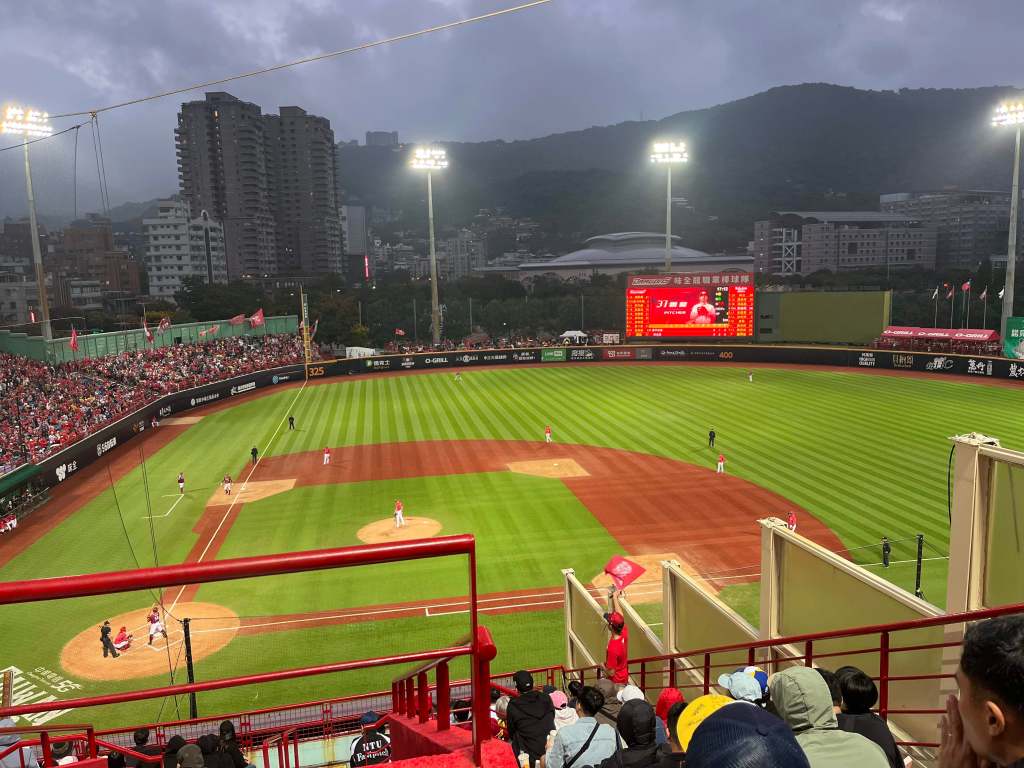
    Founded in 1989, the CPBL is more popular than ever, having recently benefited from the completion of Taipei Dome in 2023 and Taiwan’s Premier12 championship in 2024. The league currently consists of six teams who play most of their home games in six stadiums across the country:

    • CTBC Brothers – Intercontinental Stadium, Taichung (YouTube)
    • Fubon Guardians – Xinzhuang Stadium, New Taipei (YouTube)
    • Rakuten Monkeys – Rakuten Taoyuan Stadium, Taoyuan (YouTube)
    • TSG Hawks – Chengcing Lake Stadium, Kaohsiung (YouTube)
    • Uni-President Lions – Tainan Municipal Stadium, Tainan (YouTube)
    • Wei Chuan Dragons – Tianmu Stadium, Taipei (YouTube)

    Taiwanese baseball has very limited English-language coverage. The best source currently is the CPBL official website, which publishes real-time box scores, season schedule, standings, team rosters, and stats in English. Besides the CPBL website, the only major resources for English speakers are:

    • CPBL Stats – news and stats in English; the site’s X account (@gocpbl) regularly posts news and video clips
    • r/cpbl on Reddit – predecessor to CPBL Stats and a good place for updates and questions
    • The Taipei Sun – a newer initiative to cover Taiwanese baseball, including players abroad, in English

    To watch CPBL games, fans can stream via Twitch (available for some teams only) or purchase a CPBL TV subscription from HamiVideo. As of July 2025, subscription plans for home games for each team are ~$2.70/month, or for all games ~$10.30/month. CPBL Stats has an English Guide to CPBL TV that is a bit dated but should still be helpful.

  • MID-DECADE MILESTONES IN U.S.–JAPAN BASEBALL RELATIONS (1875–2025) 

    MID-DECADE MILESTONES IN U.S.–JAPAN BASEBALL RELATIONS (1875–2025) 

    by Bill Staples, Jr.

    A 150-Year Journey Through the Game That Bridges Nations

    Ichiro Suzuki’s induction into the National Baseball Hall of Fame on July 27, 2025 is a milestone worth celebrating—and an opportunity to reflect on the progress of U.S.–Japan baseball relations. From Ichiro’s enshrinement to the sandlot games played by Japanese school children during the 1870s, the history of baseball between the U.S. and Japan is a rich narrative of cultural exchange, perseverance, diplomacy, and innovation.

    With that in mind, I thought it would be fun to use Ichiro’s 2025 achievement as a springboard to explore key mid-decade milestones (years ending in five) in the U.S.–Japan baseball journey. Let’s look at how the sport evolved from a foreign curiosity into a shared national passion—and ultimately, a bridge between two nations.

    Let’s begin in the present and work our way backward.

    NOTE: The full version of this article with all illustrations and links is available on Bill Staples, Jr’s blog, International Pastime.

    https://billstaples.blogspot.com/2025/04/mid-decade-milestones-in-usjapan.html

    2025
    Ichiro Suzuki
    was inducted into the National Baseball Hall of Fame in 2025, receiving 393 out of 394 votes (99.75%) in his first year on the ballot. This made him the first Japanese-born position player elected to Cooperstown, though he fell one vote shy of unanimous selection—a distinction held by Mariano Rivera in 2019. In anticipation of his enshrinement, the Hall of Fame created a new exhibit titled Yakyu | Baseball: The Transpacific Exchange of the Game. The exhibit will open in July 2025 and remain on display for at least five years. Learn more at: https://baseballhall.org/yakyu.  

    2015
    Ichiro, now with the Miami Marlins, begins symbolically “passing the torch” to Shohei Ohtani, who is in the second year of his professional career with the Nippon Ham Fighters in Japan. The 2015 season marks Ichiro’s first appearance as a pitcher, setting the stage for a rare and unexpected future Hall of Fame connection between Ichiro and Ohtani—two Japanese-born players who both pitched and hit a grand slam during their MLB careers. Ichiro hit just one grand slam, while Ohtani has hit three (as of this post), and intriguingly, all of them against the Tampa Bay Rays.

    2005
    Tadahito Iguchi
    becomes the first Japanese-born player to compete in and win a World Series, contributing to the Chicago White Sox’s historic run. (Note: Hideki Irabu received a World Series ring as a member of the 1998 and 1998 New York Yankees but did not play in any postseason games). Check out Iguchi’s SABR Bio.

    1995
    Hideo Nomo
    joins the Los Angeles Dodgers, earning Rookie of the Year, an all-star game start, and igniting “Nomomania.” His success breaks open the modern pipeline between NPB and MLB and reshapes the perception of Japanese players on the global stage. Check out Nomo’s SABR Bio.

    1985
    Pete Rose
    breaks Ty Cobb’s all-time hit record using a Mizuno bat. After visiting Japan in 1978, Rose teamed up with sports agent Cappy Harada to sign a sponsorship deal with Mizuno in 1980. Rose’s partnership with Mizuno marked a significant moment in sports history, symbolizing Japan’s growing influence in global sports and helping to establish Japanese manufacturers as credible names in American dugouts and MLB clubhouses.

    1975
    The Chunichi Dragons, led by manager Wally Yonamine, and the Yomiuri Giants, led by manager Shigeo Nagashima, conduct spring training in Florida. Meanwhile, American-born manager Joe Lutz and Hall of Fame pitcher Warren Spahn contribute to Japanese baseball by joining the Hiroshima Carp. Lutz becomes the second U.S.-born manager in NPB history after WWII, following Hawaii-native Yonamine. However, Lutz’s time with the Carp is short-lived, as he steps down just weeks into the new season. Spahn continues his role with the Carp and states that he prefers working in Japan compared to the U.S.

    Joe Lutz, Hiroshima Carp 1975

    1965
    Masanori Murakami
    finishes his rookie season with the San Francisco Giants after debuting in 1964, becoming the first Japanese-born player in MLB. His success inspires generations of Japanese players to dream of American stardom.

    Masanori Murakami

    1955
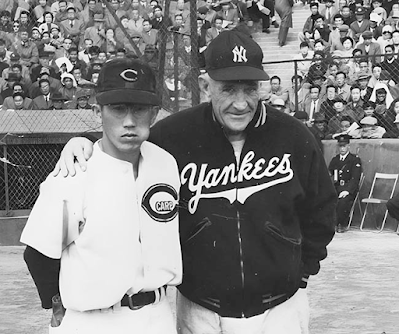
    After a season in the minor leagues and facing lingering post–World War II anti-Japanese sentiment, California native Satoshi “Fibber” Hirayama chose to continue his professional baseball career in Japan, signing with the Hiroshima Carp. That same season, the New York Yankees toured Japan, and afterward, former Japanese pitching star and Hawai‘i native Bozo Wakabayashi was hired as a scout for the team. However, Yankees manager Casey Stengel resisted the idea of signing Japanese players, citing concerns about adding new talent to an already talent-heavy roster.

    Fibber Hirayama with Casey Stengel, 1955

    1945
    In the aftermath of World War II, baseball became a source of healing and pride for Japanese Americans unjustly incarcerated behind barbed wire. At the Gila River camp in Arizona, the Butte High Eagles stunned the defending state champions, the Tucson High Badgers, with an 11–10 extra-innings victory. Coach Kenichi Zenimura called it “the greatest game ever played at Gila.” After graduating, Eagles second baseman Kenso Zenimura relocated to Chicago, where he attended the East-West All-Star Game at Comiskey Park and watched Kansas City Monarchs standout Jackie Robinson during his lone season in the Negro Leagues.

    Kenichi Zenimura at Gila River in 1945

    1935
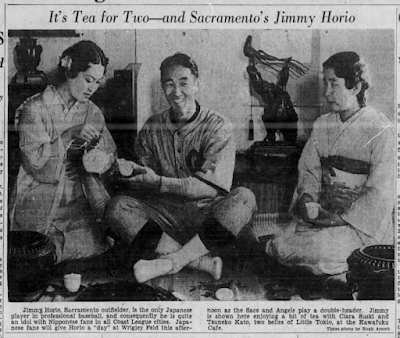
    The founding of the Tokyo Giants paved the way for the launch of the Japanese Professional Baseball League in 1936. During the team’s groundbreaking U.S. tour, four players — pitchers Victor Starffin and Eiji Sawamura, infielder Takeo Tabe, and outfielder Jimmy Horio — attracted interest from American professional clubs and may have received contract offers. However, the 1924 Immigration Act rendered Japanese-born players ineligible to sign with U.S. teams. Only one player—Hawaii-born Horio—was eligible under U.S. law. He signed with the Sacramento Solons of the Pacific Coast League for the 1935 season but returned to Japan the following year to join the Hankyu Braves in the new professional league.

    Jimmy Horio with Sacramento in 1935

    1925
    Sponsored by the Osaka Mainichi newspaper, a semipro team called Daimai was formed and sent on tour in the United States, where they faced American universities and semi-pro clubs, including the Japanese American Fresno Athletic Club (FAC). In early September, the FAC played a doubleheader at White Sox Park in Los Angeles—the first game against Daimai, and the second against the L.A. White Sox, the premier Negro Leagues team in Southern California. Behind the strong pitching of Kenso Nushida, FAC edged out the White Sox 5–4, setting the stage for rematches in 1926 and parallel tours of Japan in 1927. White Sox manager Lon Goodwin rebranded his team as the Philadelphia Royal Giants for the Japan tour, ushering in a new era of international baseball exchange.

    Catcher O’Neal Pullen and pitcher Jay Johnson of the Philadelphia Royal Giants in 1927. Negro Leagues Baseball Museum

    1915
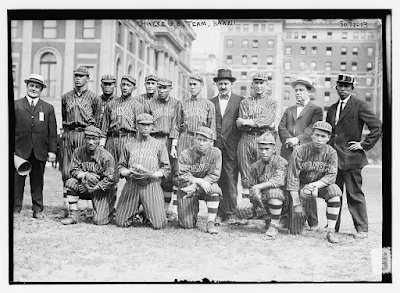
    The Hawaiian Travelers, a barnstorming team made up of Chinese and Japanese Americans from the Hawaiian Territories, toured the U.S. mainland in the early 20th century. Two Japanese players, Jimmy Moriyama and Andy Yamashiro, joined the team under assumed Chinese identities, playing as “Chin” and “Yim.” The Travelers impressed fans and opponents alike with victories over top Negro League clubs such as the Lincoln Giants and Brooklyn Royal Giants—both teams now designated as major league caliber by SABR. After a return tour, Yamashiro, still using the name Andy Yim, signed with the Gettysburg Ponies of the Class D Blue Ridge League in 1917, quietly becoming the first Japanese American to join an integrated professional team—though history recorded him only under his adopted identity. Meanwhile, an Osaka newspaper, Asahi Shinbun, sponsors a national tournament for high school teams that eventually becomes one of the most popular sporting events in Japan (known today as the Koshien Tournament).

    The Hawaiian Travelers in 1914

    1905
    The 1905 Waseda University baseball tour was the first time a Japanese college team traveled to the United States to compete, playing 26 games along the West Coast and finishing with a record of 7 wins and 19 losses. The team was led by Abe Isō, a Waseda professor, Unitarian minister, and politician who saw baseball as a powerful tool for international exchange and cultural diplomacy. Although Waseda struggled on the field, the tour was a landmark moment in U.S.–Japan relations, helping to lay the groundwork for future athletic and cultural connections between the two nations. Meanwhile, John McGraw of the New York Giants gave a tryout to a Japanese outfielder known as “Sugimoto.” However, shortly after Sugimoto’s arrival at spring training, discussions in the press about enforcing the color line surface. In response, Sugimoto chose to leave the tryout of his own accord.

    1905 Waseda University Baseball 

    1895
    Dunham White Stevens
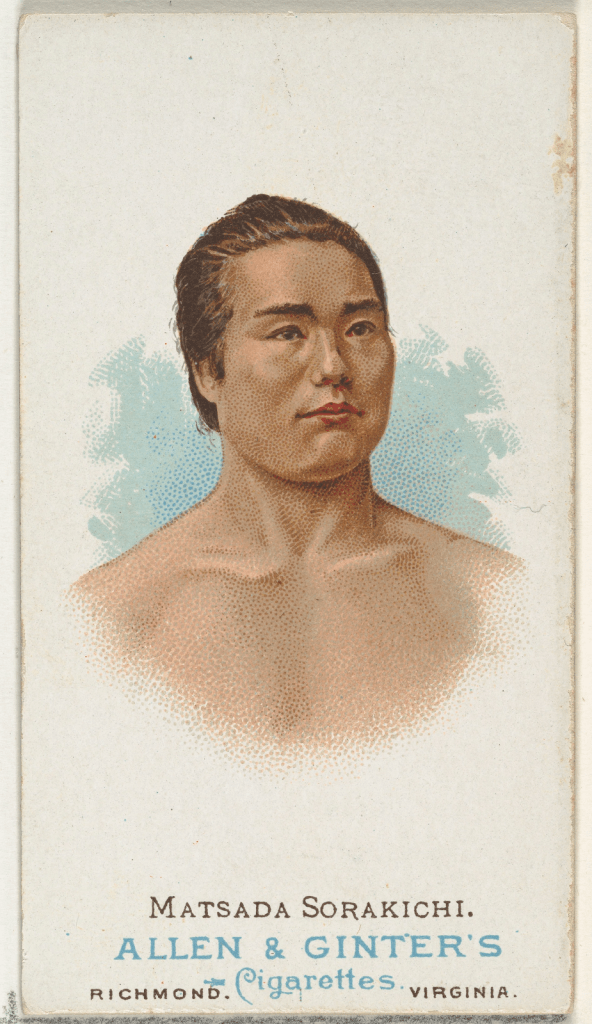
    , the American Secretary of the Japanese Legation in Washington, was described as “a baseball crank” and persuaded Japanese Minister Shinichiro Kurino to join him at several games. This gesture reflected one of the earliest examples of diplomatic engagement through sport. Meanwhile, Japanese American ballplayers were competing in amateur leagues in Chicago, and by 1897, a promising outfielder—identified in the press only as the cousin of wrestler Sorikichi Matsuda—was reportedly scouted by Patsy Tebeau, manager of the major league Cleveland Spiders.

    1887 Allen & Ginter trading card of Sorakichi Matsuda

    1885
    Sankichi Akamoto
    , a young Japanese acrobat and baseball enthusiast, played the game in America, blending cultural performance with sport. His presence foreshadowed the dual role many Japanese athletes would later assume—as both competitors and cultural ambassadors. Around the same time, at Wesleyan University in Middletown, Connecticut, Japanese student Aisuke Kabayama competed on the school’s tennis and baseball clubs, eventually earning a spot on the varsity baseball team the following season. His participation is believed to be the earliest recorded instance of a Japanese-born player in U.S. college baseball.

    The Akimoto Japanese Troupe, circa. 1885. Robert Meyers Collection

    1875
    The seeds of Japanese baseball began to take root in the early 1870s, as people of Japanese ancestry played the game on both sides of the Pacific. In 1873, Albert G. Bates, an American teacher in Tokyo, organized what’s considered the first formal school-level baseball game in Japan. According to Japanese sports historian Ikuo Abe, the game occurred on the grounds of the Zojiji Temple in Tokyo (image below). Tragically, in early 1875, Bates died at just 20 years old from accidental carbon monoxide poisoning while visiting a public bathhouse.

    “View of Zōjōji Temple at Shiba,” by Yorozuya Kichibei (1790-1848), Minneapolis Institute of Art