
by Thomas Love Seagull
A recent poll for a TV special saw more than 50,000 people in Japan vote for their favorite retired baseball players. 20 players emerged from a pool of 9,000. Yes, they could only vote for players who are no longer active, so you won’t see Shohei Ohtani or other current stars on this list. Which is probably smart because I’m sure Ohtani would win by default. There are, however, players who were beloved but not necessarily brilliant, and foreign stars who found success after coming to NPB. Unsurprisingly, the list leans heavily towards the past 30 years, with a few legends thrown in for good measure.
Over the next few weeks, I’ll be profiling each of these players. Some of these players I know only a little about, so this will be as much a journey for me as, hopefully, it will be for you. It’ll be a mix of history, stats, and whatever interesting stories I can dig up.
For now, have a look at the list below and see how the public ranked them. I’ve included the years they played in NPB in parentheses.
20. Alex Ramirez (2001-2013); 19. Yoshinobu Takahashi (1998-2015); 18. Warren Cromartie (1984-1990), 17. Takashi Toritani (2004-2021); 16. Suguru Egawa (1979-1987); 15. Katsuya Nomura (1954-1980); 14. Tatsunori Hara (1981-1995); 13. Kazuhiro Kiyohara (1985-2008); 12. Masayuki Kakefu (1974-1988); 11. Masumi Kuwata (1986-2006); 10. Atsuya Furuta (1990-2007); 9. Randy Bass (1983-1988); 8. Daisuke Matsuzaka (1999-2006, 2015-2016, 2018-2019, 2021); 7. Tsuyoshi Shinjo (1991-2000, 2004-2006); 6. Hiromitsu Ochiai (1979-1998); 5. Hideo Nomo (1990-1994); 4. Hideki Matsui (1993-2002); 3. Shigeo Nagashima (1958-1974); 2. Sadaharu Oh (1958-1980); 1. Ichiro Suzuki (1992-2000).
There are players who dominate their era, and then there are players who disrupt it.
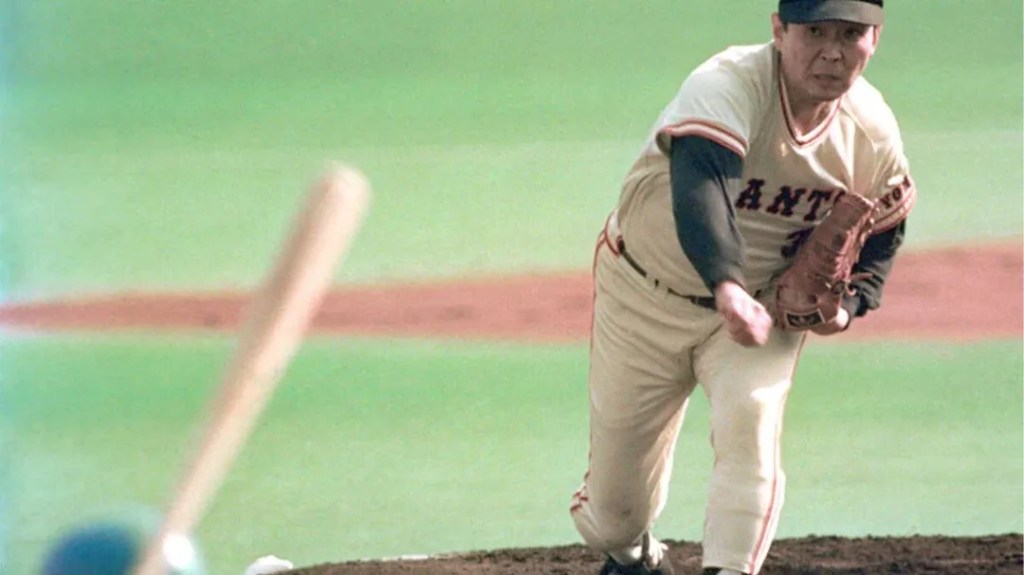
Suguru Egawa did both.
He finished his career with 135 wins, a 3.02 ERA, and one of the most overpowering fastballs Japanese baseball had ever seen. He led the Central League in wins twice, strikeouts three times, ERA once, and in 1981 captured the pitching Triple Crown while carrying the Yomiuri Giants to a championship. At his peak, he was the best pitcher in Japan. Americans who saw him said he was as good as Nolan Ryan.
And yet, for much of his career, he was treated not as a hero but as a problem.
Egawa was called “Dirty Egawa” and was labeled “The Enemy of the People.” A verb—egawaru—entered the language, meaning to forcefully impose one’s opinion on others without regard for custom or consequence. Newspaper articles questioned his character. Fans booed him. Team executives worried he was changing baseball in the wrong direction. In hindsight, much of what angered people about Egawa now feels familiar: he managed his workload, he listened to his body, and he believed a career was something to steward, not sacrifice. The problem was timing: he was behaving like a modern athlete in a baseball culture that still worshiped obedience and working oneself to exhaustion.
Long before he was framed as selfish or ungrateful, Egawa had already been turned into something other than a person. As a high school pitcher at Sakushin Gakuin*, he was labeled Kaibutsu—the Monster. The nickname began half as a joke, borrowed from a popular manga character, inspired by his ears as much as his velocity. But it stuck, and it hardened. In an era without video highlights or instant replay, rumors traveled faster than proof. Somewhere in Tochigi Prefecture, people said, there was a teenage pitcher throwing a fastball so violent that bats barely grazed it. Egawa threw no-hitters and perfect games. He piled up strikeouts in numbers that sounded implausible. Fans reacted audibly when hitters merely made contact. For years, he hovered at the edge of the national stage, not quite reaching Koshien, the national high school baseball championship, which only added to the mystique. By the time he finally arrived, crowds were not watching a pitcher so much as a legend.
*New Astros pitcher, Tatsuya Imai, led Sakushin Gakuin to the Summer Koshien title in 2016.
But he never won a Koshien championship. His final high school game in the tournament ended in a rain-soaked walk-off loss. Even then, the Monster felt unfinished. That sense—that Egawa was always incomplete and never quite fulfilling his potential—would follow him for the rest of his career.
At Hosei University, Egawa refined himself. Surrounded by one of the most talent-rich eras in collegiate baseball, he learned to pace his power. He no longer tried to overpower every hitter. He learned restraint, timing, and how to reach back only when it mattered most. He won 47 games in Tokyo Big6 play and struck out 443 batters.
There is a story from his university days that explains more than any stat line. When Egawa had a date scheduled on a day he pitched, he didn’t give a time like everyone else. He said things like, “Meet me three hours after first pitch.” And if the game moved too quickly, he would deliberately waste a few pitches to slow the game down. He wanted the game to end when he said it would end.
No one doubted what he would become. What complicated everything was that Egawa wanted only one thing: to pitch for the Yomiuri Giants.
That simple and stubborn desire would reshape Japanese professional baseball.
What became known as the “Blank Day” affair has often been portrayed as a clever loophole exploited by an arrogant young pitcher. Years later, even Egawa would quietly correct that version. A 23-year-old, he admitted, did not invent this plan.
During his senior year at Hosei, he was selected by the Crown Light Lions with the first pick of the 1977 draft. He turned down the Lions at the urging of relatives who begged him to stay in Tokyo, to play for the Giants or at least a Central League team. The following year, just before returning from baseball study in the United States*, his father called him. “There’s a way to get into the Giants,” he said.
*At the time, the Lions were based in Kyushu, far away from Tokyo.
Egawa signed a surprise contract with the Giants on November 21st, 1978, the day before the draft, claiming that the Lions’ exclusive negotiating year had expired. The Giants agreed. The Central League did not. The league declared the contract invalid, but the Giants boycotted the draft the following day. Four teams drafted him anyway; Hanshin won his negotiating rights by lottery but the Giants refused to recognize Hanshin’s right to negotiate with Egawa.
Finally, under pressure from the commissioner, Egawa signed with Hanshin—then, the same day, was traded to the Giants for ace pitcher Shigeru Kobayashi.
If you want to understand why so many people reacted so harshly, you just have to see what they saw: Kobayashi, who had won the Sawamura Award in 1977, was suddenly recast as the tragic hero in Egawa’s story. Kobayashi was traded without warning, but did not complain. At a late-night press conference, he said he needed no sympathy. The public adored him for it.
Egawa was framed as selfish, cold, and ungrateful. Few asked how much control he had truly exercised and fewer noticed that he never celebrated the outcome. He had arrived where he wanted to be, but became a villain before he threw a pitch.
What offended people most wasn’t the maneuvering and rule bending—it was Egawa’s attitude. At his first Giants press conference, reporters shouted accusations before the press conference even began. When Egawa tried to calm the room—asking everyone not to get so excited—the words were clipped, replayed, and transformed into evidence of arrogance. In a culture that prized ritual humility, plain speech became another offense. “Don’t get excited” turned into a national punchline.
Egawa’s rookie season was delayed and uneasy. He finished 9-10. Kobayashi won 22 games and took home the 1979 Sawamura Award. The contrast was unavoidable. Then Egawa settled in. In 1980, he won 16 games and led the league in strikeouts. In 1981, everything came together: 20-6, a 2.29 ERA, 221 strikeouts, the pitching Triple Crown, league MVP, and a Japan Series championship in which he captured the final out himself.
The Sawamura Award went to someone else. It went to his teammate Takashi Nishimoto.
Nishimoto represented everything Egawa was supposed to be: tireless, durable, unquestioning. He threw more innings. He made more starts. He embodied the virtue Japanese baseball prized above all else: availability. Egawa never complained publicly. But from that moment on, Nishimoto became his measuring stick. They avoided eating together. They avoided joint interviews. From 1979 through 1987, Nishimoto never finished a season with more wins than Egawa. Even when Egawa’s shoulder began to fail, even when Nishimoto absorbed heavier workloads, Egawa stayed ahead.
If Nishimoto represented the path Egawa rejected, Masayuki Kakefu represented the opponent Egawa chose. Egawa never pitched around Kakefu. Not once. Kakefu was Hanshin’s cleanup hitter, the emotional center of the Tigers, and everything Giants fans feared. On one occasion, the bench signaled for an intentional walk. Egawa ignored it and threw his best fastball. Kakefu later said Egawa’s pitches did not simply beat swings; they passed above them, forcing hitters to rethink what a fastball could do.
Egawa hated avoidance. He hated walks. He believed pitching around a hitter was dishonest, not only to the batter, but to the crowd. Fans had come to see something decisive and he felt he owed them that. Against the bottom of the order, he saved his shoulder. Against the heart of the lineup, he emptied it.
When Randy Bass chased history in the mid-1980s, Egawa refused to pitch around him. Bass would later call Egawa the best pitcher he ever faced, in Japan or America.
But by his sixth season, the shoulder was beginning to fail him. Even in university, he pitched through pain. As a professional, he hid it carefully. When the pain returned for good, he was mocked as having a “hundred-pitch arm.” When his shoulder hurt, he rested. When it didn’t respond, he adjusted. To many, that looked like weakness. To others, it was baseball heresy.
Egawa still had flashes—like the 1984 All-Star Game where he struck out eight consecutive hitters and nearly broke the record of nine—but the strain was constant. On September 20, 1987, in Hiroshima, he took a one-run lead into the ninth inning. Two outs, no one on. The batter was Takehiko Kobayakawa. The catcher signaled for a curveball but Egawa shook him off. He threw his best fastball: elevated and down the middle. Kobayakawa hit it into the right-field stands for a walk-off home run. As Kobayakawa circled the bases, Egawa sank to his knees on the mound, unable to move.
He knew.
Egawa retired at 32, fresh off a 13-win season. Critics called it selfish. They said he quit too early. They said he should have pitched until his arm fell off. Egawa said his shoulder was done.
Years later, when he finally reconciled publicly with Kobayashi in a television commercial, Kobayashi said only this: “It was hard, wasn’t it? It was hard for both of us.”
For a long time, Suguru Egawa was framed as a villain who won too easily and left too soon. What he never did was perform suffering on demand. Suguru Egawa did not pitch until his arm fell off.
He stopped.
In the end, Suguru Egawa was less a rebel than a mirror. He reflected back to Japanese baseball the things it did not yet want to see: that exhaustion was not virtue, that loyalty could coexist with self-preservation, that excellence did not require ruin. The anger he provoked said less about his choices than about the fear of what those choices implied. By the time the game accepted those truths*, Egawa was already gone, carrying the weight of having been right too soon.
Thomas Love Seagull’s work can be found on his Substack Baseball in Japan
 SABR Asian Baseball Research Committee Blog