
by Thomas Love Seagull
A recent poll for a TV special saw more than 50,000 people in Japan vote for their favorite retired baseball players. 20 players emerged from a pool of 9,000. Yes, they could only vote for players who are no longer active, so you won’t see Shohei Ohtani or other current stars on this list. Which is probably smart because I’m sure Ohtani would win by default. There are, however, players who were beloved but not necessarily brilliant, and foreign stars who found success after coming to NPB. Unsurprisingly, the list leans heavily towards the past 30 years, with a few legends thrown in for good measure.
Over the next few weeks, I’ll be profiling each of these players. Some of these players I know only a little about, so this will be as much a journey for me as, hopefully, it will be for you. It’ll be a mix of history, stats, and whatever interesting stories I can dig up.
For now, have a look at the list below and see how the public ranked them. I’ve included the years they played in NPB in parentheses.
20. Alex Ramirez (2001-2013); 19. Yoshinobu Takahashi (1998-2015); 18. Warren Cromartie (1984-1990), 17. Takashi Toritani (2004-2021); 16. Suguru Egawa (1979-1987); 15. Katsuya Nomura (1954-1980); 14. Tatsunori Hara (1981-1995); 13. Kazuhiro Kiyohara (1985-2008); 12. Masayuki Kakefu (1974-1988); 11. Masumi Kuwata (1986-2006); 10. Atsuya Furuta (1990-2007); 9. Randy Bass (1983-1988); 8. Daisuke Matsuzaka (1999-2006, 2015-2016, 2018-2019, 2021); 7. Tsuyoshi Shinjo (1991-2000, 2004-2006); 6. Hiromitsu Ochiai (1979-1998); 5. Hideo Nomo (1990-1994); 4. Hideki Matsui (1993-2002); 3. Shigeo Nagashima (1958-1974); 2. Sadaharu Oh (1958-1980); 1. Ichiro Suzuki (1992-2000).
The player who turned the diamond into a stage and never forgot whom he was performing for
Drafted fifth round in 1989, no Koshien tournament appearances to his name, Tsuyoshi Shinjo walked into his introductory press conference with the Hanshin Tigers sporting a shaved-sides flat-top haircut and the demeanor of a man with somewhere else to be. Someone asked him about his feelings joining one of Japan’s most storied franchises, the team that played at the great cathedral of Koshien, in front of the most passionate fan base in the country. Shinjo considered the question.
“I was more into soccer,” he said, “so I wasn’t that interested in professional baseball.”
The room erupted in laughter—the Kyushu accent, the artless delivery, the complete absence of the expected reverence. Nobody quite knew what to make of him.
That was, it would turn out, a feeling they would need to get used to.
His first year in the minors he batted .074. His arm, however, was something else entirely. During a fall camp that year, Yoshio Yoshida, the legendary shortstop and former manager who had become one of the most respected baseball minds in Japan, watched the teenager throw from the outfield and told the coaching staff: that athleticism belongs at shortstop. Shinjo converted. In his first call-up to the big league club the following year, he positioned himself at an almost comically deep shortstop, far deeper than anyone played the position, specifically and deliberately, so that the throws he made to retire runners would be long enough to make people notice his arm. He was nineteen years old and already managing his own image.
He had arrived. It just took him a little while to let everyone know.
Here is something worth understanding about Tsuyoshi Shinjo’s career. By the counting stats, he was good but not exceptional. Across thirteen NPB seasons, he batted .254 with 205 home runs, won ten Golden Gloves (tied for 4th all-time) after moving to centerfield, and made the Best Nine three times. In three seasons in MLB, he batted .245 with 20 home runs across 303 games. These are the numbers of a capable player, a fan favorite, a glove-first center fielder who could make your jaw drop and your heart sink in roughly equal measure.
And yet Tsuyoshi Shinjo is one of the most famous baseball players Japan has ever produced. He is famous in the way that certain athletes (think Jose Canseco, Dennis Rodman, or Deion Sanders) achieve a kind of celebrity that floats entirely free of their statistics. He is famous because he understood that a ballgame is a performance, and a performer’s first obligation is to the audience.
His manager towards the end of his tenure with Hanshin, the great Katsuya Nomura looked at Shinjo and arrived at a memorable conclusion. “I never thought of him as a student,” Nomura wrote. “Rather than teaching him anything, I used the feeling of flattering a pig into climbing a tree.” Nomura’s method with Shinjo was simple: ask him what batting order position he wanted, put him there, and watch him perform. Ask him what position he most wanted to play, then let him try it. “Leave him alone and he motivates himself,” Nomura concluded. “He was, for a manager, an easy player to handle.”
Nomura meant this as mild condescension. But there is another way to read it. Here was one of the most manipulative managers in baseball history, a man who turned psychology into an art form, and his technique with Shinjo was simply: give him a stage. That was the whole point of Shinjo.
Born in Nagasaki Prefecture on January 28, 1972, Shinjo grew up in Fukuoka, the son of a landscape gardener who had dreamed of his own baseball career and poured that dream into his son with an intensity that bordered on terrifying. By the time young Tsuyoshi was six years old, his father had already established that the boy could throw a stone farther than any adult in the neighborhood. Their daily training ritual involved Shinjo standing at the top of a hill while his father threw the ball up from the bottom, hard as he could and if the boy let it roll back down, he was ordered to chase it before it stopped. He chased it, crying, every time. But he never quit.
The competitive fury expressed itself early. In a town softball tournament at the age of eleven, Shinjo was so incensed by what he believed was a bad call that he argued with the umpire alone, weeping, long after his coaches had tried to pull him away. The coach was so struck by the sight that he made Shinjo an offer: if you feel that strongly, I’ll become your manager. Let’s start a baseball team and turn that frustration into something. Shinjo assembled enough players within two days, took charge of designing the uniforms, and within six weeks they had finished third in the Fukuoka prefectural tournament out of 64 teams. He was captain, ace pitcher, and cleanup hitter. He was eleven years old. He was already producing and directing his own story.
The team, by the way, was called the Nagaoka Fighters which, if you believe in that sort of thing, is either a coincidence or something else.
There is a moment from September 16, 1992, at Koshien Stadium, that the Hanshin faithful still remember.
The Tigers, coming off two last place finishes in a row, are improbably in the pennant race. The game against Hiroshima is scoreless going into the eighth inning. With two out and the bases loaded, Hiroshima’s Ryuzo Yamasaki hits a liner to right-center, a ball that looks like it is going to possibly end the season. No longer a shortstop, Shinjo, who has been a regular for less than three months, is already running. He runs a long way. He dives. He catches it.
Then, in the bottom of the ninth, with the score still 0-0, Shinjo steps in against future Hall of Famer Yutaka Ohno, and hits a walk-off home run.
In the hero’s interview afterward, Shinjo grabbed the microphone and announced: “We’re going to win the pennant!”
They did not win the pennant. They finished second, one game out, in what became another in a long list of heartbreaking near-misses in franchise history. But for one evening, standing in the lights at Koshien, Tsuyoshi Shinjo made everyone believe it was possible.
That year’s Tigers resurgence had two faces: center fielder Shinjo and left fielder Tsutomu Kameyama, whose names combined to give the phenomenon its name, Kame-Shin Fever. The city of Osaka lost its mind. Fan letters for Shinjo arrived at the team dormitory at the rate of one cardboard box per day. Young women, dubbed Shinjo Girlsby the press, gathered in such numbers outside the dormitory gates that getting home from the stadium became impossible, and the dormitory manager eventually put Shinjo in a hotel to relieve the congestion. His salary that offseason rose 323 percent, the largest single-season raise in Tigers history at the time.
He was twenty years old. He was driving a Lamborghini and receiving a cardboard box of love letters every day and playing center field for the most passionate fan base in Japanese baseball. The reasonable response to this situation would have been to become completely insufferable. Instead, Shinjo seems to have concluded that all of it—the letters, the fans, the noise, the love—was not something that was for keeps, but something he owed back. The fans gave him their passion. He would spend the rest of his career figuring out how to return it.
He dyed his hair. He began wearing the bright red wristbands that would become synonymous with his name. He developed his signature habit of adding a small hop to routine fly ball catches, a theatrical touch he had developed in high school by training himself to catch eggs dropped from the second floor without breaking them. The hop, it turned out, had genuine logic behind it, stilling his eye line at the moment of catch, absorbing the ball’s momentum, and loading him instantly for the throw. He explained all of this with complete seriousness when asked. No one ever quite knew what to do with the fact that his most flamboyant habit was also one of his most technically sophisticated.
He drove a Lamborghini Countach to contract negotiations in 1993. A Porsche in 1994. A Lamborghini Cheetah in 1995. Car reporters began staking out the parking lot of the Tigers front office because Shinjo’s arrival was better automotive content than anything else they were covering. He wore Versace. He sprayed perfume on his wristbands and towels because he couldn’t tolerate the smell of the dugout. He recorded a love song in 1994 that sold 8,000 copies. He married one of Japan’s top models. He was Tsuyoshi Shinjo, and he wanted everyone in the stadium to know it.
On June 12, 1999, in the twelfth inning of a tie game against Yomiuri at Koshien, the Giants decided to intentionally walk Shinjo to set up the force play.
Three days earlier, against the same Giants, Shinjo had been walked intentionally and let it go. But he had spent that time in the batting cage with his hitting coach, practicing swings at pitches thrown well outside the strike zone. He had arranged a signal with Nomura so that in the right situation, he would receive permission to swing. When the signal came, he repositioned himself to the far edge of the batter’s box, noted that the shortstop was shading toward second base, leaving a gap on the left side of the infield, and waited.
The second pitch was perhaps slightly less outside than the first. Shinjo swung and drove a single through the gap and sending home the winning run. The Giants protested that his foot had left the batter’s box. The home plate umpire ruled that his heel had remained on the chalk line. Shinjo walked off the hero of the game. He had pre-planned and pre-practiced a play that no rational person would have attempted, gotten managerial approval in advance, studied the defensive alignment, found the gap, and executed. A spaceman, Nomura had called him. It turned out that being a spaceman was occasionally a tactical advantage
He then announced, with a grin, that he would never do it again. The following day, before the same opponents, he took more batting practice on outside pitches, just in case.
In the winter of 2000, Shinjo made the most Shinjo decision of his career.
He had just completed his best NPB season: .278 average, 28 home runs, 85 RBIs, a team-best in virtually every offensive category, a Best Nine selection, a Golden Glove. The Tigers offered him a five-year contract extension worth approximately 1.2 billion yen. This was an extraordinary sum, security for life, in the city where he had become a star.
Shinjo turned it down to sign with the New York Mets for the major league minimum. At the press conference announcing the deal, he stepped to the microphone with the calm of a man who had been rehearsing this moment for years: “I’ve finally found a place where I can play the kind of baseball I envision. That team is the New York Mets.”
The reaction in Japan was divided along a single line. That same offseason, Ichiro Suzuki had finalized his move to the Seattle Mariners through the posting system. Ichiro’s move made sense. Shinjo’s move prompted something closer to seriously? He was not Ichiro. He had one excellent season and eight largely difficult ones. He was a defensive specialist with intermittent power and a .254 career average. The Mets’ offer was less than what Hanshin, Yokohama, and Yakult were each prepared to pay him, making the gamble look even stranger from the outside.
He only played in the majors for three seasons, with the Mets, San Francisco Giants, and then back with the Mets. But he did become the first Japanese player to appear in the World Series. The bat he used to record the first hit by a Japanese player in World Series history, a first-inning single off Jarrod Washburn in Game 1, sits in the Baseball Hall of Fame in Cooperstown. It is engraved TSU No. 5, in Shinjo’s own handwriting.
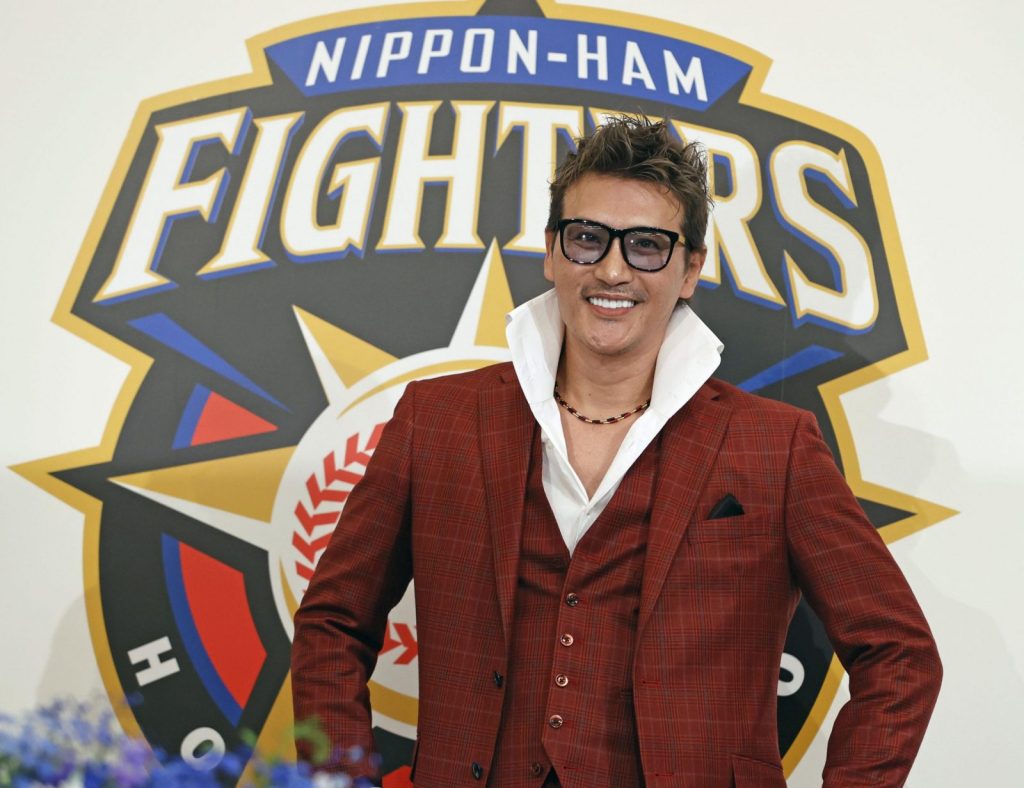
When Shinjo returned to Japan to play for the Nippon-Ham Fighters, the performances grew more elaborate.. In the first inning of the 2004 All-Star Game, Shinjo stepped to the plate, pointed dramatically toward left-center field—a called shot, straight out of Babe Ruth—and then dropped a surprise bunt on the first pitch. It failed. He returned to the dugout having accomplished nothing except making everyone in the stands laugh.
In the third inning, he doubled to left-center off the same pitcher, moved to third on a ground ball, and then, with the the catcher returning the ball to the pitcher, Shinjo broke from third base. He slid headfirst into home plate and was called safe on the closest of plays. He pounded the ground with both hands and feet, a grown man overcome with pure joy.
It was the first solo steal of home in All-Star Game history. The only one ever, to this day.
After collecting the MVP award, Shinjo was asked about the play. His answer was precise and, once you understood who he was, completely unsurprising: “If I weren’t in the Pacific League I wouldn’t have done it. I want to brighten things up. If players like this appear and get media coverage, fans will want to come to the ballpark.”
On Opening Day 2006, rather than jogging to his position in center field like a normal human being, Shinjo drove a Harley-Davidson trike across the playing surface of Sapporo Dome, circled the warning track, and parked at his position, while his fellow starters rode in the sidecars. The stadium held 43,000 people. It was sold out. He had promised it would be when he signed.
That same season, he appeared at a game wearing, under his Fighters uniform, his old Hanshin Tigers jersey. He had worn it to honor his former team during an interleague matchup. The Pacific League umpires ruled it a violation. He was warned. He removed the jersey. He did not particularly seem to regret it.
In April, after hitting a home run against Orix, he named the blast by announcing it had been hit with a special technique: “I enjoyed baseball fully for 28 years. This year I’ll take off my uniform” home run technique. He was announcing his retirement, mid-game, in a home run naming ceremony, while still playing the game. The press called it the Shinjo Theater. It was.
In June, before a game against the Tigers at the Sapporo Dome, he descended from the ceiling in a small gondola with a disco ball attached to it. In the All-Star game that year, he used a rainbow bat and wore an LED belt with the message “Never mind whatever I do, fan is my treasure.”
He wore a collared undershirt beneath his uniform in a game against the SoftBank Hawks. SoftBank’s manager Sadaharu Oh complained. The league ruled against it. The debate occupied sports media for days. Shinjo said he had thought the look was nice.
He declined to steal bases because, he said, he had no interest in it and because, more specifically, he didn’t want his legs to become too muscular, because muscular legs did not look attractive in jeans.
On September 27, 2006, in the final regular season game at the Sapporo Dome, Shinjo played in the number he had worn as an eighteen-year-old rookie: 63, the first number the Tigers had given him, the number stitched in black thread into the thumb of the glove he had used his entire career, the glove he had bought with his first paycheck, repaired four times, and refused to let anyone else touch. Before the retirement ceremony, the stadium went dark. A video of his baseball life played on the scoreboard. He watched it from center field, standing in his customary posture, his glove resting on top of his cap.
Then he removed his uniform and placed it on the ground, along with the glove and the wristbands. His undershirt had a message printed across the back: “Today, this day, this moment, I’m going to engrave it in the album of my heart, and from here on, I’ll keep doing things my way!”
He walked off the field without speaking. The scoreboard displayed a handwritten message he had prepared in advance: “With what little baseball life I have left, I promise everyone today that I’ll keep chasing the white ball with brightness and joy.”
Six weeks later, after the Fighters had won the Japan Series (the first championship for the franchise in 44 years) and after Shinjo had gone six for seventeen in the Series itself, his teammates did not toss manager Trey Hillman into the air first. They tossed Shinjo. He wept so completely that he could barely walk.
He had told them when he arrived in Hokkaido that he would fill the stadium and win the championship. He had done both.
In 2022, the Fighters hired Shinjo as their manager. He asked to be called Big Boss. He arrived at his first home game in a manner resembling professional wrestling. He designed alternate uniforms in black, red, and gold, with a V on the chest, labeled “New Age Games produced by SHINJO”. He banned the sacrifice bunt, in a league that treats the sacrifice bunt as something close to sacred. His first season the Fighters finished last. He gave 23 different hitters regular playing time. He developed young pitching. He built from nothing.
By his third year the Fighters were back in contention, and by his fourth they were among the Pacific League’s genuine powers. The critics who had spent thirty years saying Shinjo was all show and no substance looked at what he had built and found they had run out of things to say. He had always been serious. He had always been paying attention. He had just declined, then and now, to perform seriousness in the way that made other people comfortable.
There is a woman, a devoted Tigers fan, as so many people in Osaka were and are, who in 1992 listened to every Tigers game on the radio with her sister, because in those days almost nothing except Giants games made it to television. For two sisters who had grown up through the Tigers’ long dark years, Shinjo was one of the dazzling stars they had finally found. One evening, Shinjo was called to the hero’s interview platform. The sisters turned up the volume and leaned close. There was a pause. Then his voice:
“I smashed that white ball!”
The two sisters burst into applause, there in their living room, clapping for a radio.
The image they held in their minds was Shinjo’s smile, white teeth flashing.
He never met those two women. He never knew they existed. But he had spent his entire career performing for them and for every person in every living room who couldn’t make it to Koshien, who pressed their ear to a speaker and listened for something worth believing in. The disco ball and the wristbands and the LED belt buckle were the version of that smile scaled up for stadiums. The principle was always the same.
“Fan is my treasure.” He meant it.

