
by Satoshi Matsumiya and Yobun Shima
Every Tuesday morning we will post an article from SABR’s award-winning books Nichibei Yakyu: Volumes I and II. Each will present a different chapter in the long history of US-Japan baseball relations. This week Satoshi Matsumiya and Yobun Shima focus on the 1921 tour of Japan by the Vancouver Asahi.
The Vancouver Asahi team was formed in 1914 with players who were mostly graduates of the Vancouver Japanese Community National School. Ihachi Miyasaki (a.k.a. Matsujiro Miyasaki), who ran a transportation business, became the manager of the team, which was organized through the Shiga Prefecture network and Matsumiya stores’ connections. The team played and practiced in vacant lots near the school and at Powell Grounds.
In 1918, the Asahi was reorganized under the leadership of president Sotojiro Matsumiya by recruiting top players from nearby Japanese Canadian teams (such as the Yamato, Mikado, and Victoria Nippon) to form a stronger team now named the Asahi Baseball Club. In July 1918 they formed the Vancouver International League with Caucasian teams and started to play league games. That year, the Asahi finished second in the International League but lost the playoffs. The following year, they won the International League with an overwhelming record of 11 wins and 1 loss. Although the Asahi featured a full lineup of Japanese players against White teams who were bigger and more powerful, they showed that teamwork and smart game play could win the league championship. Japanese Canadian baseball fans were excited by the victory and gathered at the Powell Street Grounds to share their hopes for an Asahi tour to Japan. But team members said, “No, it’s too early for that. We will have to polish our team’s skills before demonstrating them to the Japanese people in our ancestral country.”
In 1920 the presidency of the Asahi team changed to Henry Masataro Nomura, who decided to rename the team the Asahi Athletic Club, withdraw from the International League, and join the higher-ranked Vancouver City League to improve Asahi’s performance. Nomura had relocated in 1917 from St. Louis to Vancouver, where he started practicing dentistry on the second floor of Royal Bank. He was a passionate advocate of a theory for healthy baseball and sports but some of the players did not agree with him and they sometimes rebelled.
Asahi finished third in the City League in the 1920 season with a record of 10 wins and 14 losses. At the end of the season, there was a resurgence of talk about a tour to Japan. Some Japanese Canadians enthusiastically proposed that the team should demonstrate their baseball ability in their ancestral country to help raise the spirits of the team’s players. It was around this time that Yuji Uchiyama, one of the Asahi players, had returned to Vancouver after accompanying the Seattle Mikado team on their Japan tour. Uchiyama told the Asahi players about the current baseball situation in Japan. The Japanese Canadian Nisei (second-generation) players, who hoped of visiting their motherland, listened to him with shining eyes, and the team’s expectations for a tour to Japan rose at once. Nomura, as the leader of the team, showed great interest in the idea of a Japan tour and told many people about the plan to help gain support. Nevertheless, six players (Barry Kiyoshi Kasahara, Harry Miyasaki, Junji George Ito, Bull Oda, Tom Nichi Matoba and Sotaro Matsumiya) decided to withdraw from the Asahi team to form a new baseball club named the Vancouver Asahi Baseball Team (also known as the Tigers). The two groups were not in agreement over whether to go on the Japan tour. It was also rumored that they were divided over Nomura’s management policy.
Nomura’s Asahi Athletic Club rejoined the City League while the new Vancouver Asahi Baseball Team (the Tigers) joined the Terminal League, which had been previously known as the International League. Therefore, the two Asahi teams played in separate leagues. At the end of the 1921 season, the Asahi Athletic Club decided to follow Nomura’s plan and go on a tour to Japan.
On August 24, the day of the departure for Japan, a send-off party for the team was held at the Yang Ming Lou restaurant. Tour leader Nomura said, “We have been negotiating with Makoto [Shin] Hashido of the Japan Athletic Association for a long time. And they decided to invite us to Japan officially, so here we are today. The games will be played mainly against the Japanese university teams. And we will also visit Hokkaido plus Kansai to foster friendship between Japan and Canada.”
The touring party consisted of 19 members: 12 Japanese players, four Caucasian players, and three leaders. These were Henry Masataro Nomura and his wife, Lovenda; scorer Yosomatsu (Nishizaki) Horii; umpire Dr. Fletcher; pitchers Mickey Kitagawa (captain), Tokikazu Tanaka, and Tat Larson; catchers Yo Horii, and Jack Wyard; first baseman Happy Yoshioka; second basemen Joe Nimi and Yuji Uchiyama (manager); third baseman Ernie Paepke (coach); shortstop George Iga; left fielders Joe Brown and Tamotsu Miyata; center fielder Eddie Kitagawa; right fielder Ted Furumoto; and substitute Takashi Kikukawa. The four Caucasian players were added to the Japan tour team for promotional reasons and to reinforce the squad.
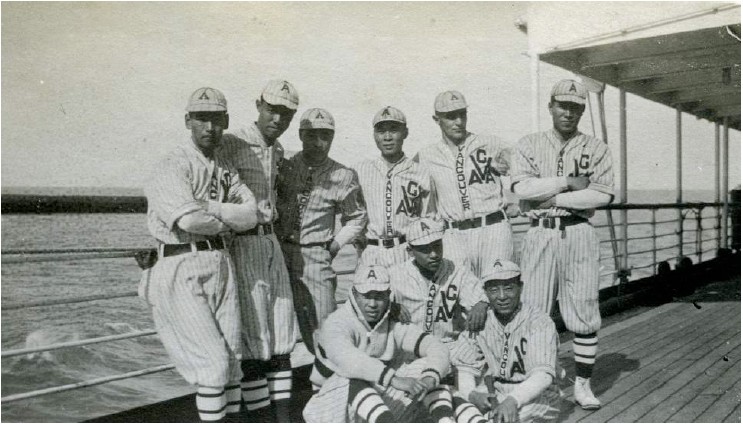
The players’ spirits were high because the Japan trip was not only a tour of their ancestral country but was also a mission to promote friendship between Canada and Japan and to introduce British Columbian industry. The players received new uniforms, enjoyed the send-off party, and each expressed his determination to do his best. At 11:30 P.M., about 200 Japanese Canadians and Caucasians gathered at the pier to see the team off. The players lined up on the deck of the Kashima Maru with bouquets of flowers in their hands, donated by volunteers, and shouted “Banzai! Banzai!” The ship sailed off with a whoosh that pierced the air. A series of reports about the tour were to be written by manager Yuji Uchiyama and sent to the Tairiku Nippo (Continental Daily Newspaper) in Vancouver under the title “The Baseball Tour.”
The trip to Japan took two weeks. Also traveling on the Kashima Maru was the University of Washington baseball team, which was also touring Japan. In all, 10 teams from North America and Hawaii toured Japan that year: the University of California, Washington University, the Hawaiian Nippon, the Hawaiian Hilo, the Hawaii All-Stars, the Canadian Stars, the Suquamish Indians, the Sherman Indians, the Seattle Asahi, and the Vancouver Asahi. All of them were hoping to play with Japanese university teams. This phenomenon showed how popular Japanese baseball had become and how active baseball exchanges between Japan and the United States were.
As the voyage progressed, the Asahis played catch, ran, and played pepper on the deck during the day to prevent their bodies from getting too slow. Sometimes, their precious baseballs flew overboard into the sea. In the evening they met to discuss strategy and learn the signs. There were some players, however, who could not get up from their beds owing to seasickness.
On September 9 in the evening, after the long voyage, the Kashima Maru at last dropped anchor at Yokohama Port.
Continue to read the full article on the SABR website
 SABR Asian Baseball Research Committee Blog