

by Taein Chun
It’s been over 40 years since professional baseball took root in Korea. It’s now gone beyond being just a sport and has deeply permeated Korean daily life and culture. Traces of baseball can be found not only in the cheers and songs at the stadium but also in everyday scenes outside the ballpark. One such example is the sight of students on university campuses wearing matching jackets as a group. This jacket, called the “gwajam,” actually originated from the “baseball jacket,” and today it has become the uniform of youth. More than just a fashion item, this jacket has found its place in Korean society. But how did it get there?
A Tradition Born with the Harvard Baseball Team
The roots of the baseball jacket trace back to 19th-century American college baseball traditions. At the time, Harvard’s baseball team awarded its starting players sweaters embroidered with the school’s initials. These were known as letterman sweaters. They weren’t just for warmth, they were symbols of honor, proof of one’s baseball skill and achievement.
Over time, the tradition evolved into a more practical jacket: wool for the body, providing warmth, and leather for the sleeves, offering durability against friction and wind. This combination was perfect for athletes braving cold weather on the field. At the same time, the two-tone design of wool and leather created a bold look that expressed school colors and identity. With its blend of function and symbolism, the “varsity jacket” became an iconic symbol of American college sports.

The Birth of the “Baseball Jacket” in Korea
This jacket entered Korea in the 1980s, coinciding with the launch of professional baseball. The two-tone design of wool body and leather sleeves resembled the thick warm-up jackets worn by players in the dugouts. In fact, players from the MBC Blue Dragons, one of the founding teams, were often seen wearing such jackets with their blue uniforms. This became a familiar sight to fans.
When combined with the popular image from American dramas and movies, “baseball teams wear varsity jackets,” Koreans naturally began calling this unfamiliar jacket yagujamba (baseball jacket). Unlike its difficult English name, the simple and catchy Korean nickname stuck instantly with the public.


From Campus to “Gwajam”
By the late 1990s, university sports teams and clubs began adopting baseball jackets as group uniforms. It’s said that Seoul National University’s rugby team was the first to make them, which is often cited as the origin of the Korean-style gwajam (short for “gwahak jamba,” or “department jacket”).The trend soon spread to academic departments, and the naming system took hold: school/department name on the front, and name/student ID/graduation year on the back. So widespread was the practice that almost every Korean university student came to own at least one. More than showing belonging, gwajam became a symbol of youth itself, carrying memories of that time.
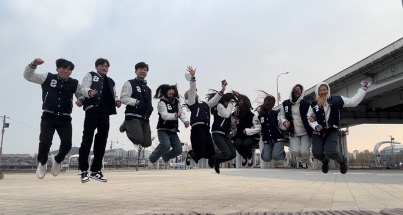
Over time, the gwajam branched out into more variations beyond the original baseball jacket: long padded coats for winter, hoodies for mobility, and custom jackets for individuality. Though the forms changed, the core remained the same: wearing the same jacket together to affirm belonging and share memories. Just as baseball teams express identity through uniforms, the gwajam became another kind of uniform showcasing the collective bonds of students.
Another Legacy Left by Baseball
In the U.S., the varsity jacket symbolized the achievements of outstanding athletes. In Korea, however, the gwajam was reborn as an expression of group solidarity. Though its direct link to baseball seems small, the survival of the name “baseball jacket” owes much to the cultural symbolism of professional baseball in Korea.
Baseball did not end at the stadium. Its name carried over into campus life, becoming part of the landscape of youth. Years later, when one pulls out a gwajam from the closet and wears it again, the cheers, laughter, and time spent with friends come rushing back.The name borrowed from baseball isn’t just a label, it’s proof that Korean baseball culture has deeply embedded itself beyond the game, into everyday life and memories of youth. That’s why even today, the baseball jacket remains the uniform of youth, a testament to the enduring power of baseball culture.
 SABR Asian Baseball Research Committee Blog
Leave a comment