
by Jongho Kim
Professional sports in Korea began in earnest in the 1980s. At the time, Korea had industrialized, and the economy was more stable than before, but the country was still under military rule. Before the voices for democracy and press freedom grew stronger, President Chun Doo-hwan’s government fostered the sports industry to divert public dissatisfaction (along with films and the sex industry, this was called the “3S Policy”).
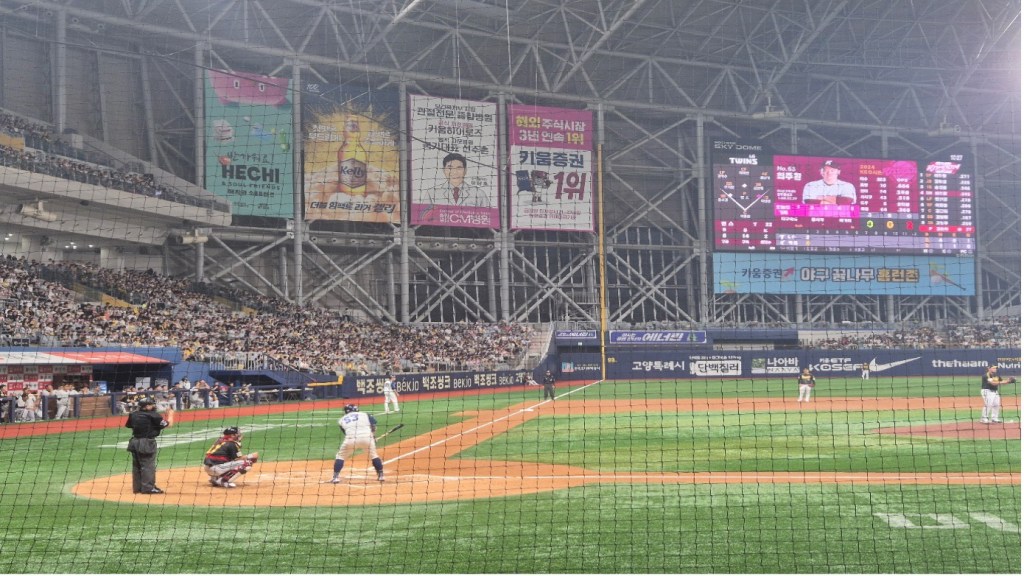
The government encouraged major corporations, which played a large role in the Korean economy, to establish professional baseball teams. Responding to this, corporations formed teams. On December 11, 1981, the Korea Baseball Organization (KBO) was founded. Soon after, in March 1982, the Korean Professional Baseball League (KBO League) opened. From then on, Korea’s international baseball exchange began to center around the KBO League.
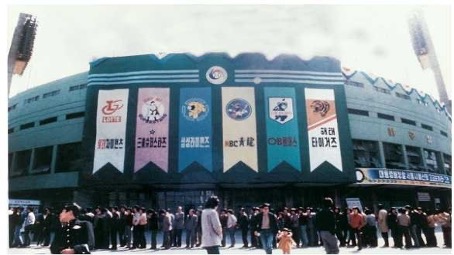
In its first year, six teams participated:
- MBC Blue Dragons (now LG Twins) – based in Seoul
- Sammi Superstars – based in Incheon/Gyeonggi-do/Gangwon-do/5 provinces of North Korea
- Lotte Giants – based in Busan/Gyeongsangnam-do
- Samsung Lions – based in Daegu/Gyeongsangbuk-do
- Haitai Tigers (now KIA Tigers) – based in Gwangju/Jeolla
- OB Bears (now Doosan Bears) – based in Daejeon/Chungcheong
In 1985, the OB Bears relocated to Seoul, and Binggrae Eagles (now Hanwha Eagles) filled the gap. In 1990, the Ssangbangwool Raiders (disbanded in 1999) joined, starting the true 8-team structure of the 1990s. However, during the 1997 financial crisis, ownership changes and team dissolutions created a turbulent history. Despite this, baseball’s popularity grew, leading to the creation of more teams. The current 10-team system was completed in 2015 with the founding of the Suwon-based kt wiz.
From its start in 1982 until the mid-1990s, the KBO League consisted only of Korean players. International exchange was minimal, and overseas Koreans or Koreans with Japanese pro experience filled the role of “foreign players.” Notable examples include pitcher Myeong-bu Jang (Japanese name: Hiroaki Fukushi) and player-manager In-chun Baek of MBC Blue Dragons.
At that time, the gap between Korean and Japanese baseball was far greater than today. In-chun Baek’s record of a .412 batting average in 1982 (still the KBO’s only .400 hitter) and Myeong-bu Jang’s 30-win season in 1983 both reflected that disparity.
In 1998, Korea finally introduced its foreign player system, about 15 years after the league’s founding. Since then, players from Japan, the United States, Mexico, the Dominican Republic, Venezuela, Puerto Rico, and Curaçao, among others, have joined. With superior physical ability, they brought powerful batting and dominant pitching.Korean players, competing with them, raised their skills to international levels. This led to global success: silver medals in the 2006 and 2009 World Baseball Classic, and a gold medal at the 2008 Beijing Olympics, proving Korea’s competitiveness in world baseball.

From the mid-1990s, more Korean student athletes also challenged foreign leagues. Some skipped the KBO and went directly abroad after graduation. In 1994, Chan Ho Park became the first to enter Major League Baseball. After him came pitchers Jin-ho Cho, Byung-hyun Kim, Jae-weong Seo, hitters Hee-seop Choi, Shin-soo Choo, Ji-man Choi, and others.
Meanwhile, many KBO players at that time went to Japan first instead of the U.S. Legends such as pitcher Dong-yeol Sun, shortstop Jong-beom Lee, pitcher Sang-hoon Lee, pitcher Dae-sung Koo, and slugger Seung-yeop Lee all advanced to Japanese baseball.
Direct movement of Korean pros to the U.S. began in the 2000s. Players like Hyun-jin Ryu, Jung-ho Kang, Byung-ho Park, Ha-seong Kim, and Jung Hoo Lee used the posting system to reach MLB. Student athletes also continue to pursue MLB directly after high school, examples include Hyun-il Choi, Jun-seok Shim, Ji-hwan Bae, Hyeong-chan Eom, and Won-bin Cho.

Recently, a unique trend has emerged: foreign players who played in the KBO return to MLB, a phenomenon called “reverse export” in Korea. Merrill Kelly, now a pitcher for the Texas Rangers, is a prime example. Others such as Chris Flexen, Erick Fedde, and Mike Tauchman also polished their skills in Korea before resuming MLB careers.
In the past, the KBO was just an option for players who failed to adjust in MLB. Now, it is positioned as a springboard for returning to MLB. Seeing these “reverse export” successes, many foreign players knock on the KBO’s door before directly attempting MLB.
Thus, the KBO has become not only a field of opportunity for Korean players but also for foreign players. Through this cross-border exchange, the league has become a stage where new baseball stories continue to unfold.
 SABR Asian Baseball Research Committee Blog
Leave a comment