
In his latest episode podcaster Dan Wallach focuses on the history of Japanese baseball with an interview with SABR’s Asian Baseball Committee Chair Rob Fitts.
Author: asianbaseballb45a112232
-
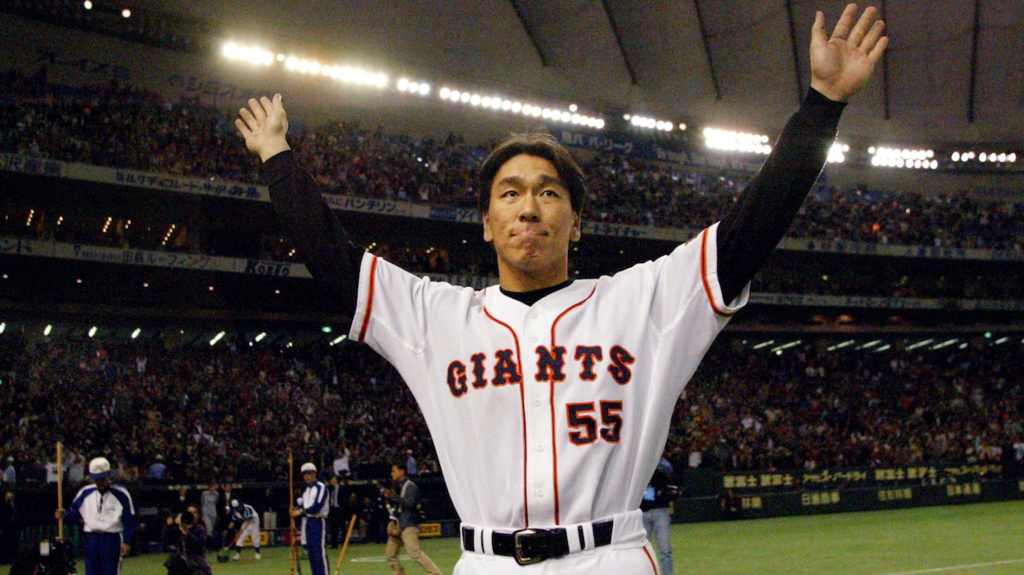
Japan’s Favorite Players: No. 4, Hideki Matsui
by Thomas Love Seagull
A recent poll for a TV special saw more than 50,000 people in Japan vote for their favorite retired baseball players. 20 players emerged from a pool of 9,000. Yes, they could only vote for players who are no longer active, so you won’t see Shohei Ohtani or other current stars on this list. Which is probably smart because I’m sure Ohtani would win by default. There are, however, players who were beloved but not necessarily brilliant, and foreign stars who found success after coming to NPB. Unsurprisingly, the list leans heavily towards the past 30 years, with a few legends thrown in for good measure.
Over the next few weeks, I’ll be profiling each of these players. Some of these players I know only a little about, so this will be as much a journey for me as, hopefully, it will be for you. It’ll be a mix of history, stats, and whatever interesting stories I can dig up.
For now, have a look at the list below and see how the public ranked them. I’ve included the years they played in NPB in parentheses.
20. Alex Ramirez (2001-2013); 19. Yoshinobu Takahashi (1998-2015); 18. Warren Cromartie (1984-1990), 17. Takashi Toritani (2004-2021); 16. Suguru Egawa (1979-1987); 15. Katsuya Nomura (1954-1980); 14. Tatsunori Hara (1981-1995); 13. Kazuhiro Kiyohara (1985-2008); 12. Masayuki Kakefu (1974-1988); 11. Masumi Kuwata (1986-2006); 10. Atsuya Furuta (1990-2007); 9. Randy Bass (1983-1988); 8. Daisuke Matsuzaka (1999-2006, 2015-2016, 2018-2019, 2021); 7. Tsuyoshi Shinjo (1991-2000, 2004-2006); 6. Hiromitsu Ochiai (1979-1998); 5. Hideo Nomo (1990-1994); 4. Hideki Matsui (1993-2002); 3. Shigeo Nagashima (1958-1974); 2. Sadaharu Oh (1958-1980); 1. Ichiro Suzuki (1992-2000).
Of course they walked him. It couldn’t be helped.
There is a scene from August 16, 1992, that tells you everything you need to know about Hideki Matsui.
Matsui is standing in the batter’s box at Koshien Stadium, the great cathedral of Japanese high school baseball, its ivy-covered walls gleaming in the summer heat. He is seventeen years old and enormous. He looks less like a high school student and more like something assembled in a factory to hit baseballs. His bat is on his shoulder. He is watching the Meitoku Gijuku pitcher, a kid named Kazuhiro Kouno, go into his windup.
The ball, when it comes, will not be aimed at the strike zone.
It never is.
The first walk comes in the first inning, two outs, a runner on third. Defensible. A dangerous hitter, a tight spot, the book says put him on. The crowd accepts it.
The second comes in the third inning, one out, runners on second and third. Still defensible, maybe. The game is close. You can tell yourself a story about it. You can justify it.
The third comes in the fifth inning, one out, a runner on first, and Meitoku Gijuku leading by two runs. This is when the crowd begins to murmur. The story is harder to tell now.
The fourth comes in the seventh inning, two outs, nobody on base. There is no story to tell. The stadium turns hostile. People are shouting. The atmosphere has changed. Koshien is about pitcher versus batter, but there will be no showdown.
The fifth, in the ninth inning, two outs, and a runner on third, is when the bottles and cans come onto the field. Empty cans, empty bottles, megaphones, anything people have in their hands. The game is stopped. The scene has turned ugly.
And Matsui says nothing. He does not slam his bat. He does not glare at the opposing dugout. He simply takes his base, all five times, and waits for a pitch that never comes.
Meitoku Gijuku wins, 3-2. During the winning school’s anthem, the crowd chants go home. The winning players have tears in their eyes. Their manager, Shiro Mabuchi, speaks to reporters afterward as if describing a crime he committed rather than a game he won. “I wanted to compete honestly,” he says. “But with the score close, this was the only way. I gave all the instructions myself.” The team’s hotel receives so many harassing phone calls that they are forced to change the number.
The Japan High School Baseball Federation calls an emergency press conference. Mabuchi is criticized in every newspaper in the country. He defends himself by saying he had watched Matsui in practice and seen something that disturbed him. “There was a professional player mixed in with the high school kids,” he says.
He meant it as a justification. It reads, in retrospect, as prophecy.
Afterward, when the reporters find Matsui, he is quieter than anyone expects. “I don’t remember,” he says at first, and then: “I’m fine. It’s thanks to that I became famous. And I’m glad I didn’t get angry in the batter’s box.”
Years later, he will say something more considered: “I wanted to become the kind of player where fans would say of course Matsui got walked five times in high school. It couldn’t be helped.“
That is the whole story, right there. Everything that follows, the ten years in Japan, ten years in America, the titles and the injuries and the consecutive games and the World Series, is Matsui trying to become that player. The player who made the walks make sense in retrospect. The player so obviously dangerous that refusing to face him was not cowardice but simply the smart thing to do.
He spent the next twenty years earning that description. He almost always succeeded.
He was, from the beginning, physically preposterous. The nursery school teachers thought he was eight years old when he was three. By the time he entered middle school, he stood 170 centimeters (5’7”) and allegedly weighed 95 kilograms (209 lbs). He was a thirteen-year-old with the frame of a sumo wrestler, which was not merely a metaphor, since he also won a local youth sumo championship that year. He could, honestly, have been almost anything physical. He chose baseball.
His father gave him a phrase to live by when he was in elementary school, written in brushwork on a piece of paper and hung above his desk: Effort itself is a talent. Matsui kept that idea his whole life, making it his guiding principle. He was gifted, yes—the swing was effortless, the power was outrageous, the instincts were those of someone born for the sport. But what the people around him noticed most was how hard he worked at things that weren’t natural to him, and how patiently he absorbed failure.
He arrived at Seiryo High School in Kanazawa, one of the legendary baseball programs in Japan, weighing over 100 kilograms, and the coach told him to lose weight before he touched a bat. So he ran. Every day, he just ran, until his body was ready.
He actually joined Seiryo as a pitcher. On his first day of practice, the coaches took one look at his pitching and asked him where else he’d like to play. His hitting in that same first session was something else entirely. He cleared the fence while the upperclassmen were still figuring out how to get the ball off the infield. His classmates, initially, worried that maybe they were supposed to be doing more. “Maybe the seniors aren’t trying,” Matsui thought. They were trying.
He was 15 years old and batting fourth for a team of 18-year-olds.
By his third year (and final since high school in Japan is equivalent to grades 10-12 in America), Matsui had hit 60 home runs in total. The way he counted them matters: he only counted balls that cleared the fence on the fly. No inside-the-park home runs. No cheap ones. A ball either went over the fence or it didn’t, and everything else was just running.
It’s a good thing he did so much of it when he joined the team.
The scouts who watched him compared him to Kazuhiro Kiyohara, the most celebrated power hitter of his generation, and then said Matsui might be even better. One scout, watching Matsui at the spring tournament of his final year, described the experience as watching a different species play the same sport. Matsui hit two home runs in his first at-bats of that tournament. When the Seiryo coaches were asked about his power, they mentioned that during summer practice, he routinely broke softballs with his swing and the team’s budget for replacement balls ran to over 100,000 yen in a single year.
There is more. Behind the right field wall at Seiryo, five meters past the 91-meter (299 feet) mark, stood a ten-meter net placed there specifically because Matsui’s practice shots kept clearing the fence. Beyond the net, some distance away, sat the home of the school principal. On more than one occasion, a baseball was found in his garden. On at least one occasion, a ball was discovered lodged in the snow guard on his roof. The estimated carry on some of these shots was over 150 meters (492 feet). The school, concerned about the liability, took out an injury insurance policy specifically to cover the possibility that Matsui’s batting practice might hurt someone outside the grounds.
Sometime in 1990, a first-year outfielder from Meiden High School named Ichiro Suzuki was playing a practice game against Seiryo. He reached base and found himself standing next to Matsui on first. Years later, when a reporter asked him about it, Ichiro laughed. “The thing I remember,” he said, “is that his ears were really big.”
His nickname came from a reporter named Misako Fukunaga who covered high school baseball for Nikkan Sports. She was watching Matsui before his third year and searching for words. She landed on Godzilla because of his lower body and his prominent canine teeth. Matsui initially protested. “Isn’t there something cuter?” he asked. There was not.
Then came August 16, 1992, and the five intentional walks.
Here is what Matsui did after that game, and this is the part that matters most.
He didn’t sulk. He didn’t complain to reporters. He went home and, somewhere in the weeks and months that followed, he turned the humiliation of being deemed too dangerous to face, of being denied the right to compete into fuel of the purest kind.
He said, years later, after he had retired: “When I went to the Giants and people knew me as the batter who was walked five times at Koshien, I felt I had to show them with my results.”
He was drafted by the Yomiuri Giants in November 1992, when the great Shigeo Nagashima was returning to manage the team. Four teams tried to draft Matsui: the Dragons, the Hawks, the Tigers, and the Giants. They drew slips in that order. The Giants drew last, and their slip was the winning one.
Nagashima called Matsui personally that same day. Matsui had wanted to play for the Hanshin Tigers his whole life (he had grown up a Tigers fan, his father’s influence) but when Nagashima called, something happened. He said yes.
Then, a few days later, a piece of handwritten calligraphy arrived in the mail. It was from Nagashima. It read: “Matsui-kun, you’re destined to be a star for the Giants. Let’s put in the work together and build something great. I’m counting on you.”
Matsui kept it.
At his signing press conference, while other young draftees talked about the players they idolized or the statistics they hoped to reach, Matsui said something different. Soccer, he noted, was growing in Japan. Sumo had its stars. Children were being pulled in other directions. “I want to give those children dreams,” he said. “I want them to come to the stadium to see baseball played live.” He was only eighteen years old.
His Giants career began poorly. The professional game was faster and harder and meaner than anything Matsui had ever seen, and in the spring of 1993 it showed. His first professional at-bat was in an exhibition game against a young Kazuhisa Ishii, who struck him out on a curveball. He went home and, by his own account, felt something close to fear. It wasn’t fear of failure exactly, but the dawning awareness that the distance between where he was and where he needed to be was real and large. He spent that spring hitting .094 in exhibition play, leading the team in strikeouts, and looking very much like what he was: a boy with enormous talent who had never been truly tested.
Nagashima demoted him in April. This was not a small thing. Matsui was the most celebrated young player in Japan, the boy from Koshien, the Godzilla of a thousand newspaper headlines, and now he was playing in the minor leagues because he couldn’t hit professional pitching. He responded in the characteristically Matsui fashion: he said he would make Nagashima regret the decision, and then he went out and hit .375 with four home runs in twelve minor league games before being promoted to the top team, ichi-gun, May 1.
His first professional home run came the following day, off Shingo Takatsu of the Yakult Swallows, a line drive into the right field stands at Tokyo Dome so pure and hard that teammates said you could hear the difference between that ball and the balls other people hit.
He finished that season with 11 home runs, a record for Giants rookies who had graduated high school, and Nagashima started making plans.
The plans were elaborate. Nagashima had a system he called the Thousand Day Plan. It gave him three years, starting from the moment he drafted Matsui, to turn him into the player Nagashima believed he could be. It began four days after Matsui joined the team. From then on, Nagashima worked with him almost every day: in the indoor batting cages at Tokyo Dome on home games, in hotel rooms on road trips, in the basement of Nagashima’s own home, and on days off, at whatever hotel Nagashima happened to summon him to. Matsui once described walking into the Seiyo Hotel in Ginza, one of the grandest hotels in Tokyo, carrying a bat, because Nagashima had called him in. He was, he noted, probably the only person in the history of that establishment to arrive that way.
One of the things Nagashima told him: calluses on your hands are not a sign of hard work. They are a sign of a flaw. If your palms are calloused, you are gripping the bat too tightly. If you are gripping too tightly, you are losing bat control. The goal was not to build calluses but to eliminate them.
When Matsui arrived at the Giants, his palms were covered in them. By the time he left Japan ten years later, after the home run titles and the MVP awards and the thousand consecutive games and all those swings in all those hotel rooms, his hands had become smooth. The calluses disappeared as the titles accumulated. He found this remarkable enough to mention at his retirement press conference, twenty years later, when a reporter asked him what he remembered most from his career.
He paused for a moment. Then he said: “Swinging the bat alongside Nagashima-kantoku. That might be what stays with me most.”
In 1994, in Matsui’s second year, the Giants were in the middle of one of the great pennant races in the history of Japanese baseball. The Central League came down to the final day: October 8th, a Sunday, the Giants against the Chunichi Dragons, winner takes all. It is remembered in Japan simply as “10.8” the way certain games are remembered only by their date*. Matsui, just twenty years old, hit a home run. Yomiuri won the pennant. He was not yet the best player on the team. He would be soon.
*Like one of the most famous double headers in Japanese baseball history, 10.19.By 1995 he was hitting .274 with 22 home runs and winning his first Best Nine award. By 1996 he was something else entirely.
That is the one that defined the first chapter of his career.
Matsui hit 38 home runs that year at age 22, a performance so good that it tied Sadaharu Oh’s then-record for home runs by a player that age. He was the engine of a Giants comeback that nobody had expected. They were trailing badly in the standings in midsummer, and Matsui almost single-handedly dragged them back into contention. He won the July and August monthly MVPs. He won the season MVP. He was, without question, the best player in the Central League.
But the home run title is the thing that got away, and the way it got away was somewhat familiar.
Going into the final game of the season, Matsui was one home run behind Takeshi Yamasaki of Chunichi for the league lead. So the Dragons, playing the Giants in the season finale, walked him intentionally in all four of his plate appearances. Nagashima had even batted Matsui leadoff in an attempt to give him as many chances to swing as possible and it didn’t matter. The Chunichi battery walked him when he stepped into the box in the first inning, and then again in the third, the sixth, and the seventh. Sixteen consecutive balls. Four straight intentional walks. The Tokyo Dome crowd erupted. Fans threw things onto the field, screamed obscenities at the Chunichi dugout, rained down a fury that the reporters would describe the next morning as unlike anything they had witnessed.
He was 22 years old, and it had happened again.
What nobody quite expected was how Matsui would respond. When the reporters found him after the game, they asked how he felt. He was, by multiple accounts, the calmest person in the building.
“They did it to me good,” he said. “But it can’t be helped. Not getting the title is frustrating, but that time was more frustrating.”
The reporters asked what he meant by that time.
He meant August 1992. He meant Koshien. He meant the five intentional walks in the summer tournament that had made him a national story and a national symbol and, in some ways, a national obligation. Four years into his professional career, standing in the ruins of his first serious chance at a batting title, he was still measuring his professional disappointments against that afternoon. As if nothing in the professional game could quite match what it felt like to be seventeen and refused.
In 1997, Kazuhiro Kiyohara, the great Kiyohara, the man every scout had compared Matsui to when Matsui was still in high school, came to the Giants as a free agent, and suddenly the team had two of the most feared hitters in Japan batting in the same lineup. They were called the MK Cannon, a portmanteau of their names, and the partnership was genuinely terrifying for opposing pitchers. Matsui hit 37 home runs. He lost the home run title by a single homer, again. It had become almost a joke. He kept hitting 37 or 38 home runs and kept finishing second.
In 1998, he injured his knee during spring training. He would spend the rest of his career managing his knee. But that same year, he finally won the home run title. He also won the RBI crown. He also won the on-base percentage title. It was the first time since Oh Sadaharu in 1977 that a Giants player had won both home runs and RBI in the same season. He was 24 years old.
The next year, he hit 42 home runs, the first time a Japanese player had hit 40 home runs in a season since Hiromitsu Ochiai in 1989, and the first time for the Giants since Sadaharu Oh in 1977.
By 2000, Matsui was the unquestioned best player in Japan. That season he did something that had not been done at Yomiuri since 1950: he played every inning of every game in the cleanup spot. Every inning. Every game. All 135 of them. He hit .316 with 42 home runs and 108 RBI. He won the regular season MVP, the All-Star Game MVP, the Japan Series MVP, and a Golden Glove in the outfield. His consecutive games streak, despite his injuries, stood at over a thousand.
His final season in Japan was 2002, and it was the greatest of his career.
For the first half of the season, his numbers were not remarkable. He had hit 18 home runs in the first 76 games. Then something changed.
In the second half of the season, over 64 games, he hit 32 home runs, a pace that would have given him 70 over a full year. He finished with 50 home runs, becoming only the eighth player in NPB history to reach that mark. He also hit .334 and drove in 107 runs and won the home run and RBI titles, and took home Central League MVP for the third and final time.
And then, after the Japan Series, after his Giants won the championship, sweeping the Seibu Lions in four games, he sat down with Nagashima, the man who had drafted him, the man who had developed him, the man who had listened to the sound of his swing in empty batting cages for ten years, and told him he was going to America.
He called it, later, the hardest decision of his life. He said he used the word “traitor” about himself, because that was how some Giants fans would see it, and he wanted to acknowledge the weight of what he was doing. He was leaving the team, the city, the league, the country that had made him. He was leaving Nagashima. He had won everything there was to win in Japan and he needed to know if he could win somewhere else.
He came to New York in December of 2002, signing with the New York Yankees. The tabloids announced his arrival with the headline: Godzilla Comes to the Bronx. He was 28 years old, and he was starting over.
His first game at Yankee Stadium started out ordinarily enough. Matsui grounded out and walked in his first two at-bats. But then in the fifth inning, with one out and the bases loaded, he ran the count full, and Twins starter Joe Mays threw a changeup. Matsui hit it into the right-center stands. Grand slam. First home run as a Yankee, in the first home game as a Yankee, with the bases loaded. It’s etched into my memory.
He came back to the dugout and manager Joe Torre nudged him back out. He stepped onto the top step and acknowledged the crowd. Godzilla lands in New York.
He played 518 consecutive games from his major league debut before a broken wrist ended the streak in 2006. He played through bad knees, through allergies that sabotaged his April numbers year after year, through the particular loneliness of being a man who spoke carefully through an interpreter in a clubhouse that moved fast and loud. He missed significant time due to a wrist injury. His teammates called him Mats. Derek Jeter called him one of his favorite players. Torre said he had never seen a player who treated his equipment with more respect.
Then came 2009.
He was 34 years old. His knees were shot. He had not played the outfield in more than a year. He was a full-time designated hitter, which in the National League parks where the World Series would partly be played meant he could only appear as a pinch hitter. He hit 28 home runs in the regular season. He had been brilliant in the playoffs.
The World Series was against the Philadelphia Phillies. He was relegated to pinch hitting in games 3 (he hit a home run), 4, and 5. In Game 6, back in the Bronx, with the Yankees needing a win to close it out, Matsui batted fifth. He hit a two-run home run off Pedro Martínez in the second inning. He singled up the middle in the third. He hit a two-run double to right-center in the fifth. When the game ended, he had gone 3-for-4 with 6 RBI, tying the World Series record for RBI in a single game. The Yankees won. The stadium chanted his name.
He was named the World Series MVP. He was the first Asian player to win it. The next morning, a column in the Asahi Shimbun compared him to Ichiro, finding their contrasting styles: “If Ichiro is a razor, Godzilla is a machete.” The Sankei Shimbun called them “the statistical Ichiro” and “the memorable Matsui.”
That second phrase is the one that stuck, and it stuck for a reason. Matsui’s career was not defined by its peaks but by the consistency, the seriousness, and the absolute refusal to ever be less than fully present, in good times and bad. He gave interviews after every game regardless of outcome. He polished his glove every day. He never said a bad word about another person. He never missed a game unless his body literally could not continue.
Matsui hit 502 home runs across two continents in his career. He played in 1768 consecutive games. He was inducted into the Japanese Baseball Hall of Fame in 2018 and became the youngest inductee at 43 years and 7 months, surpassing Hideo Nomo’s record of 45 years and 4 months in 2014.
He had learned something as a teenager, watching a pitcher throw balls deliberately outside the strike zone, and had carried it with him for the next twenty years: that the world would not always give you the chance to prove yourself. That sometimes the greatest insult was not the criticism but the refusal to compete. And that the only real answer was what you did when they finally threw you a strike.
By the end, the fans said exactly what he had hoped they would say:
Of course they walked him. It couldn’t be helped.
Thomas Love Seagull’s work can be found on his Substack Baseball in Japan
-
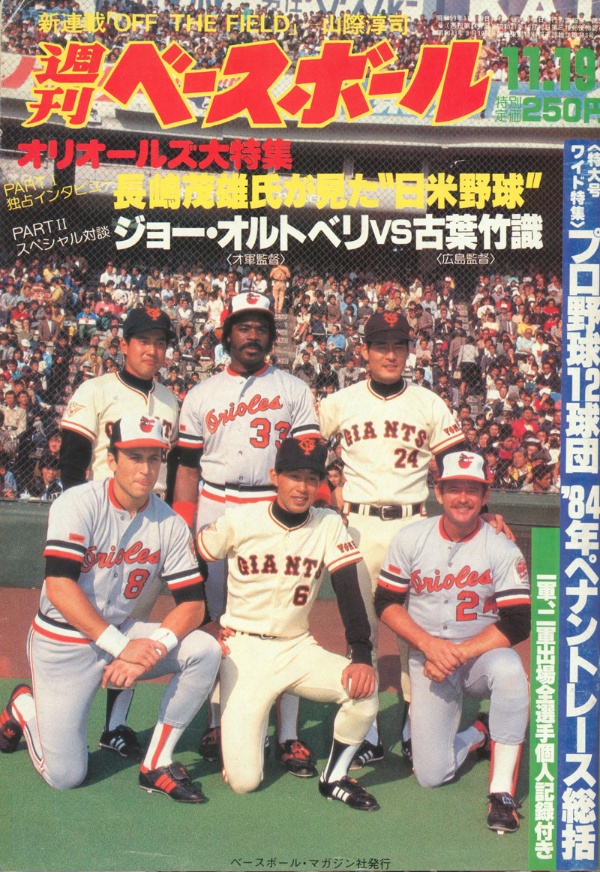
The 1984 Baltimore Orioles Tour in Japan: The Final Attempt at a True World Series
by Carter Cromwell
Every Monday morning we will post an article from SABR’s award-winning books Nichibei Yakyu: Volumes I and II. Each will present a different chapter in the long history of US-Japan baseball relations. This week Carter Cromwell tells us about the 1983 Baltimore Orioles visit to Japan.
When the idea arose of a major-league team making a tour of Japan after the 1984 regular season, the grand vision – the hope – was that a true world series could finally take place.
It didn’t quite work out that way.
Ideally, the major-league representative would have been the Detroit Tigers, who outpaced all comers from Opening Day and easily won the World Series. But the logistics weren’t workable, so the 1983 champion Baltimore Orioles were invited. It was envisioned that the Yomiuri Giants – essentially, the New York Yankees of Japanese baseball and owned by the tour sponsor, Yomiuri Shimbun media group – would easily win the Japan Series, as they had so often done.
It didn’t quite work out that way.
In 1984 the Orioles slid from World Series champions to fifth place in their division. And the Giants – runners-up in the Japan Series in 1983 – finished third in the Central League and did not make the postseason.
So the expectations were lowered, and the agenda was rewritten. Rather than two champions battling, the final schedule had the Orioles playing five games against the 1984 Japan Series champion Hiroshima Carp, five games against the Giants, two against a Japanese all-star team, and three against teams comprising players from two different clubs. The trip, spread over 22 days, coincided with the celebration of professional baseball’s 50thanniversary in Japan.
As one writer noted, “To many Japanese, it was if someone slipped in two glasses of Coke for the Pepsi Challenge.”
Still, the Japanese always took very seriously opportunities to play against American teams. In the years since, Japan has proved its baseball capabilities, winning the first two World Baseball Classics and the Gold Medal at the 2020 Summer Olympics, but at the time the country was still striving to equal the United States, and fans were looking for any evidence that the Japanese game was catching up.
When Baltimore had its first practice after arriving in Japan, the Japanese press reported on how much power the Orioles displayed. Sadaharu Oh, the former Yomiuri Giants star, Japan’s all-time home-run leader (868), and by then the Giants’ manager, said of the Orioles, “We are going to learn more from them than they get from us. … They are 75 years ahead of us.”
Many Japanese, though, including Nippon Professional Baseball Commissioner Takezo Shimoda, wondered if the gap was that yawning. While the Japanese didn’t have the power of the Americans, they felt that “like judo masters,” they “could turn the Americans’ strength against them.”
And, indeed, Baltimore did not have a cakewalk. The Orioles went 8-5-1 overall: 4-1 versus Hiroshima and 4-1 against Yomiuri, but 0-3-1 against the combined teams and all-star teams. The Japanese had certainly improved since the last time Baltimore had come to Japan. The 1971 Orioles, a powerhouse club that had been upset by Pittsburgh in the World Series, toured Japan after that season and posted a 12-2-4 record. Those Orioles were 8-0-3 against the Giants – who had just won their seventh consecutive Japan Series title – including four shutouts and a no-hitter.
It had been a month since the Orioles had completed their season, while the Carp had finished up their campaign just a week earlier with a victory over the Hankyu Braves in the Japan Series. It was hard to tell how seriously the Americans took the games. It was, after all, an exhibition tour, and a chance for the entourage to sightsee and experience Japan. And of course, the Orioles were getting paid – each player was to receive $22,500 (around $60,000 in 2022 dollars) plus expenses for his family.
Players said pitchers did not want to risk arm injuries in games that meant nothing as far as a pennant chase went. First baseman Eddie Murray said, “You just come over here to enjoy yourself and try to play a good game of baseball.”
Baltimore, though, did play five intrasquad games just before leaving home in an effort to stay sharp, and manager Joe Altobelli said, “It would be silly to come all the way over and not give them the best possible Baltimore Orioles.”
The games began on October 27 at Korakuen Stadium, the home of the Yomiuri Giants from 1937 until 1988, when the Tokyo Dome opened next door. Korakuen Stadium was also, for various periods of time, home to seven other Japanese professional teams, and it housed the Japanese Baseball Hall of Fame until the advent of the Tokyo Dome.
Game 1 was all about Hiroshima left-hander Kazuhisa Kawaguchi. He had just completed his fourth season in NPB with a middling 8-6 record and a 4.23 earned-run average, but he looked like a world-beater against Baltimore. He went the distance, allowed just six hits, and drove in the only run of the game with a second-inning single off Orioles starter Mike Boddicker, who had won 20 games and made the American League All-Star team in 1984.
Baltimore had three scoring threats. They loaded the bases in the first inning on a single by Cal Ripken Jr., a walk to Eddie Murray, and an infield hit by Gary Roenicke, but couldn’t push across a run. John Shelby got as far as third base in the fifth inning, but he could get no farther, and in the seventh they had runners on first and second with no outs and failed to score. Asked what he thought of the Orioles’ hitters, Kawaguchi said, “I don’t know. They all looked alike to me.” The Carp got only three hits against Boddicker, Bill Swaggerty, and Sammy Stewart, but Kawaguchi made the difference.
“I want[ed] to see a home run,” said disappointed fan Harumi Michikawa, who was watching American baseball for the first time.
Altobelli fell back on the tired-but-true cliché: “Good pitching will stop home runs every time. He’s a good kid, Kawaguchi.” “Our pitchers did very well,” Altobelli added. “Boddicker just got one ball up (against Kawaguchi). We’ll win tomorrow.”
His prediction was on the mark.
Infielder Todd Cruz, who in 1984 had hit only three home runs in what turned out to be his last season in the major leagues, smacked two the next day and made a diving catch from his third-base spot to lead the Orioles to a 5-3 victory over the Carp. Cruz’s solo shots came in the seventh and ninth innings before a reported crowd of 45,000 in Korakuen Stadium.
Hiroshima jumped out to a 1-0 lead in the third, but Murray tied the game with an RBI single in the fourth inning. After Cruz homered, Hiroshima rallied with two seventh-inning runs to take a 3-2 lead, but Baltimore regained the lead in the top of the eighth when Murray and Ripken hit RBI singles. Storm Davis went five innings for the Orioles, allowing just one run, and Mark Brown, Tom Underwood, and Nate Snell finished up.
The atmosphere surrounding the second game was spiced by a flap between managers Altobelli and Takeshi Koba of Hiroshima. Japanese rules at the time required lineups to be exchanged by both managers at the same time 30 minutes prior to a game. Japanese managers would usually reveal their starting pitchers at this time, forcing opposing managers to guess whether their players would be facing a left-handed or right-handed starter. Unaware of this rule, Altobelli brought two lineups to home plate two minutes before the start of game 2 and handed the umpires his preferred lineup once he determined that Koba was starting right-handed Kazuo Yamane.
“You call this major league?” Koba asked after the game. “We are playing here. We should play by our rules.” Altobelli, who took responsibility for the mix-up before the second game, said simply, “In our minds, all managers think alike. He’s looking for any advantage he can get and I’m doing the same thing.”
The Orioles gained the advantage, winning the next three games over Hiroshima by scores of 5-3, 7-5, and 5-2.
In Game 3 before just 15,000 fans on a cold, windy night at Seibu Stadium, the Carp scored on a first-inning sacrifice fly by Koji Yamamoto (an eventual Japanese Baseball Hall of Fame inductee) and a two-run home run off Ken Dixon in the fourth by outfielder Tatsuaki Ogawa. However, Larry Sheets helped the Orioles overcome the early deficit. His seventh-inning solo home run tied the game, 3-3, and the Orioles took the lead later in the inning when Ripken tripled and came on home on Murray’s sacrifice fly. In the next inning, Sheets doubled home Al Bumbry for an important insurance run.
Sheets, who had been called up late in the season after batting .302 at the Triple-A level, said the Japan series was “a proving time for me. Good play will give me a better chance to make the team next year.”His .400 average, 4 home runs, and 11 RBIs on the tour led to a long look in spring training of 1985 and an eventual eight-year big-league career.
The next night, October 31, before 20,000 fans in Yokohama Stadium, Baltimore again came from behind to win. The Orioles scored four times in the top of the ninth inning on a single by Jim Traber, a pinch-hit double by Ken Singleton, and a two-run single by Lenn Sakata. That rally came just after Hiroshima had scored twice in the bottom of the eighth inning on hits by Shinji Hara and Kiyoshi Yamanaka to take a short-lived 5-3 lead.
Hiroyuki Saito had given the Carp a 2-0 lead on a home run off Orioles starter Dennis Martinez. Sheets then doubled in a run in the third inning, and Sakata’s groundout in the fourth tied the score. Sheets hit another RBI double in the seventh inning, but Hiroshima tied the game in the bottom of the inning on a single by Yoshihiko Takahashi.
A day later, 16,000 spectators in Osaka saw Murray drive in three runs with two home runs and Vic Rodriguez hit a two-run shot to lead Baltimore to a 5-2 victory and a 4-1 series win over Hiroshima. Kawaguchi was less successful than in his first outing, giving up three runs and eight hits in five innings. Mike Flanagan started for the Orioles and allowed four hits over five scoreless innings. Stewart earned his first save of the series. Altobelli said afterward that “[a]fter the loss in the first game, I thought it would be a little tough. But we played the best game of the series today.”
The Orioles and Yomiuri Giants played the first of five games between the teams two days afterward, and Baltimore won, 7-4, on the strength of home runs by Murray, Ripken, and Sakata. Murray’s homer, a three-run shot, came in the first inning, and Ripken’s blast in the fifth gave the visitors a 5-1 advantage before 50,000 fans in Korakuen Stadium. Sakata homered in the sixth inning.
Davis allowed four runs and eight hits in his five innings, while Snell and Stewart combined to hold the Giants hitless in the final four innings. Yomiuri starter Takashi Nishimoto, who had posted a 15-11 record in the regular season, gave up five runs and seven hits in his five innings of work. Outfielder Sadaaki Yoshimura was 3-for-5 with an RBI for the Giants. (Yoshimura batted .433 in seven games during the tour.)
On November 4 Baltimore faced an all-star team made up of players from the 12 NPB teams and lost 5-4 as its three-run ninth-inning rally fell short. All-Japan scored single runs in each of the first three innings on a hit by Masayuki Kakefu of the Hanshin Tigers, a home run by Masaru Uno of the Chunichi Dragons, and another RBI single by Kakefu. Murray, who batted .367 with 9 home runs and 21 RBIs on the tour, homered in the seventh inning, but the all-stars scored twice in the eighth on run-scoring singles by Makoto Shimada of the Nippon Ham Fighters and Takayuki Kono of the Nankai Hawks. Baltimore got a two-run homer by Ripken and a solo shot from Murray in the ninth to get within a run, but reliever Kazuhiko Ushijima of the Dragons stopped the bleeding by striking out Sheets, Traber, and Singleton to end the game.
All-Japan took another one-run victory two days later in Okayama, scoring six runs in the eighth inning to erase a 7-2 deficit and win 8-7. Stewart, who had saved four games earlier in the Orioles’ tour, didn’t have it this time. With two out in the eighth, he walked two batters to force in a run, allowed a two-run single to Masataka Nashida of the Kintetsu Buffaloes, and later gave up a three-run home run to Yomiuri second baseman Kazunori Shinozuka, who had led the Japanese Central League that season with a .334 batting average. Baltimore had gained its lead largely on the strength of three runs in the seventh and two in the eighth. Sheets hit a two-run homer in the seventh.
The next game, played in a light drizzle before 16,000 fans in Hiroshima, featured Baltimore against a team comprising players from the Carp and the Giants. The game was called after nine innings and ended in a 5-5 tie. The Orioles scored twice in the first inning on Traber’s two-run homer, in the second on Gary Roenicke’s solo shot, and once in the fourth on Murray’s sixth homer of the series. Yoshimura hit a two-run homer in the third inning off Martinez and got another run in the fourth when third baseman Victor Rodriguez misplayed a groundball, allowing Kiyoyuki Nagashima to score from third base. Nagashima scored again in the sixth inning from third base when Orioles reliever Mark Brown dropped the ball while covering first base. Mitsuo Tatsukawa then hit a double to give the Japanese a 5-4 lead, but Traber hit his second home run of the game in the eighth to tie the score.
Next, on November 9, the Orioles played the Giants again, this time in Kumamoto, and won 11-6, capitalizing on a 14-hit attack and four Yomiuri errors. Ripken, who batted .315 on the tour, was 4-for-5 with a home run, and Sheets, Cruz, and Rick Dempsey also homered. The Giants scored five runs in the fourth inning to take a 5-2 lead, but Baltimore rallied with six runs in the fifth as Dempsey, Ripken, and Cruz homered, and two more runs scored on a wild pickoff attempt.
The teams traveled to Kokura, in southwestern Japan, for the next game. Playing before a crowd of 26,000, the Orioles held off a furious rally by Yomiuri to win 9-8. The Orioles jumped to a 4-0 lead after two innings – Rich Dauer’s two-run homer in the second was the highlight – and added five more in the fifth and sixth innings to lead, 9-3. Bumbry, a .360 hitter on the tour, homered in the fifth, and he and Floyd Rayford did the same in the sixth. The Giants nearly came all the way back, though, as Yasutomo Suzuki hit a two-run shot in the eighth inning and then two Baltimore errors in the ninth aided a three-run outburst that fell just short of tying the game. Though shaky, Swaggerty pitched the final two innings and managed to hold off the Giants, who outhit the Orioles 14 to 12.
The same teams played again the next day before 31,000 in Kokura, and Baltimore had to again hold off a Yomiuri rally. Three-run homers by Murray and Sheets helped the visitors to a 9-0 lead after 4½ innings, but Yomiuri scored five times in the last half of the fourth, the big hit being a two-run home run by Kenji Awaguchi. The Orioles got a run in the fifth on Mike Young’s homer and then three more in the eighth to lead 13-5. The Giants, however, scored four runs in the eighth and ninth innings against Stewart to make the final score 13-9. Snell, the second Baltimore pitcher, picked up his fourth win of the tour. Giants starter Hiromi Makihara took the loss. Shelby, Sheets, and Murray combined for 10 RBIs, and Sheets went 4-for-5 at the plate.
The next stop was Nagoya on November 13, where Baltimore played a team composed of players from the Dragons and Giants, who had finished second and third respectively in the Central League’s regular season. The Japanese team took a 5-1 lead after three innings, the big blow being a three-run homer in the third by Chunichi’s Masaru Uno. After Murray ripped a two-run shot in the sixth, Uno answered with a solo homer in the bottom of the inning. The Japanese scored twice more in the seventh, and Ripken homered for the Orioles in the eighth but it wasn’t enough as the Japanese won 8-4.
A couple of days later, the Giants got a measure of revenge by defeating Baltimore 10-5 at Kusanagi Stadium in Shizuoka. Yomiuri scored all its runs in the fifth, sixth, and seventh innings. The Orioles held a 2-0 lead going into the bottom of the fifth. Coincidentally, just as Altobelli was telling a Japanese television interviewer that he was impressed with how the Japanese teams could create big innings, the Giants got to Flanagan, the Orioles starter. Yoshimura’s three-run home run was the highlight of a five-run outburst that got a laugh out of Singleton. “I’ll always remember Flanny for his sense of humor,” Singleton said. “I’ll never forget … when Altobelli went to the mound to ask [Flanagan] what was wrong, and he said, ‘That’s the problem with being on this side of the earth. My pitches go the other way.’”
The Giants got three more runs in the sixth inning and then a two-run homer in the seventh by first baseman Kiyoshi Nakahata, who batted .571 in eight games during the tour. Cruz, Roenicke, and Murray all homered for Baltimore, but their efforts weren’t nearly enough, as the Orioles got only five hits off four Yomiuri pitchers.
Baltimore was to play the next day in Kawasaki against a combination team of Lotte Orions and Yokohama Taiyo Whales players, but bad weather canceled the game and ended the tour.
Statistically, the Orioles played somewhat better than their hosts. They had a .269 team batting average to .263 for the Japanese. Baltimore had a huge 35-12 advantage in home runs, but outscored the Japanese only 87-77 over the 14 games. Murray hit nine home runs for the Orioles, tied for the third highest total for a player during a single tour; only Babe Ruth with 13 in 1934 and Hank Sauer with 12 in 1953 had hit more. (Johnny Bench also hit nine in 1978.) The Orioles’ 35 home runs topped their 1971 tour total by one but did not come close to surpassing the team totals for the 1934 All-Americans (47), the 1953 Eddie Lopat All-Stars (42), or the 1956 Brooklyn Dodgers (40).
Singleton remembered the frustration Murray’s power display caused the Japanese pitchers. “Once we were playing in one of the old outdoor stadiums, and the opposing pitcher threw at Eddie’s head and knocked him down,” Singleton said. “Eddie got up, stared at the pitcher, and then ripped the next pitch. The fans all stood up, hoping someone would catch it, but it went completely out of the ballpark – 500-something feet.”
“He was deliberately slow rounding the bases; I bet he took 30 minutes to do it,” Singleton added with a laugh. “We were yelling at the Japanese pitcher to keep throwing at us.”
Uno led the Japanese in home runs with three in the three games in which he played. Awaguchi batted .429 in 14 at-bats. Hiroshima third baseman Sachio Kinugasa, an eventual Japanese Hall of Famer, hit just .136 in eight games. Kinugasa later surpassed Lou Gehrig’s consecutive-games streak and finished with 2,215.
On the pitching side, the Orioles posted a 4.83 earned-run average, while the Japanese had a 5.71 mark. Snell was the most impressive Orioles pitcher, going 4-0 with a 1.08 ERA. He had gone 1-1 with a 2.35 ERA in seven innings after a late-season call-up in 1984. Club officials had thought he was 29 years old, but when they arranged for his passport prior to the Japan trip, they discovered that he was 32. Nonetheless, he stuck with the Orioles in 1985 and went 3-2 with a 2.69 ERA, pitching 100 innings – all in relief. He then played two additional seasons in the majors.
Of the Japanese pitchers, 24-year-old Kazuhisa Kawaguchi had a 2.25 ERA in 16 innings over three games, and he struck out 16 batters. He went on to have an 18-season NPB career. Only two others – Suguru Egawa and Takashi Nishimoto, both of the Giants – pitched at least 10 innings. Egawa had a 3.00 ERA, and Nishimoto’s was 5.40. Two of the Japanese pitchers – Manabu Kitabeppu of Hiroshima and Masaki Saito of the Giants – later made the Japanese Baseball Hall of Fame. Kitabeppu, who had just completed the ninth of his eventual 19 NPB seasons, threw nine innings and posted a 4.00 ERA. Saito, who had just completed his rookie season, allowed seven hits and two walks in four innings and had an 11.25 ERA.
Inevitably, key topics of conversation were the differences between the US and Japanese styles of play and how well the Japanese matched up against the Americans. That is still true today, but it was even more so at that time, when fewer Americans were knowledgeable about Japanese baseball.
Orioles catcher Rick Dempsey noted the contrast between the small ball of the Japanese and the wait-for-the-big-inning Americans that still exists, saying, “The Japanese like to hit and run. They like to steal bases. They generally play a much more aggressive, a little quicker game than the Americans do.”
As previous American players had learned, the umpires’ strike zone for foreign players can be much wider. As Sakata remarked, “If you’ve got a strike zone from your neck to the ground, it’s hard to hit.”
Stan Isle explained in The Sporting News:
The Orioles’ exhibition tour of Japan provided some interesting contrasts in baseball technique. Ray Miller, Baltimore pitching coach, was surprised to learn that most Japanese pitchers throw hard every day and warm up much longer than their American counterparts. “The Japanese pitchers could throw a lot harder if they didn’t have them throwing 24 hours a day,” Miller said. He also noted that most Japanese pitchers have a hitch in the middle of their lengthy windups … [something major leaguers would discover 11 years later when Hideo Nomo debuted with the Los Angeles Dodgers]. Also, many Japanese hitters have hitches in their swings and lift their front feet in the manner of Sadaharu Oh. “They can get away with that stuff because the Japanese pitchers can’t throw hard enough,” said Ralph Rowe, Orioles batting instructor. Pitcher Sammy Stewart found Japanese hitters especially anxious to protect the plate on a two-strike count. “It’s like it’s a sin for them to strike out,” Stewart said, “but it’s OK to ground out.”
Clyde Haberman of the New York Times noted, “Japanese teams spend many more hours in practice than the Americans are used to. Players carry their own bags and bats. The Japanese put far more emphasis on fundamentals. … Americans who insist that they know more about the game usually find their suggestions ignored, and sometimes scorned. The concept of team play almost always overrides individual considerations. Displays of temper and hurt, regarded by many American players as marks of desire and hustle, tend to be viewed by Japanese as selfish.”
“A lot of guys get here thinking it will be easy [in Japan] hitting 30, 35 homers, batting .300,” said Tim Ireland, who played for the Carp in 1983 and ’84. “Then they find it’s a lot harder than they thought, and many just can’t deal with the Japanese way of doing things. I’ve gotten where I can tell in a few minutes whether someone is going to make it. … The biggest problem is communication. You’re isolated a lot of the time, with a language you don’t know and, for some families, it’s a style of living they can’t adjust to. In the States, if you’re a ballplayer, you’re just a commodity. But here you’re an imported commodity, and it’s worse.”
In the wake of the tour, opinions seemed to be leaning slightly toward the sentiment that the Japanese game was getting better vis-à-vis the American game. After the first game, Altobelli commented, “Our team is superior in power and the Carp in speed. A trade between the two teams would make the best team.”
Singleton, who had also played on the 1979 American League all-star team that toured Japan, said he wasn’t impressed with the Japanese pitchers at that time but “was more so when we went back there in 1984. They moved the ball around a lot and threw from different angles. And, certainly, they’ve had guys come over to the US since then and do well.”
The mass-circulation newspaper Yomiuri Shimbun, whose conglomerate owns the Yomiuri Giants, wrote that “the Orioles’ win-loss record shows that Japanese players’ abilities are almost the same as American players, but it is still true that Japanese pro baseball is behind the US in terms of power and speed of its players.”
The 31-year quest for an international world series by matching the Japanese and major league champions in an exhibition series had failed yet again. Beginning in 1953 Japanese organizers had tried to predict the World Series winner and invite that team to Japan. Although the predictions sometimes came close, a reigning World Series champion had never visited the Land of the Rising Sun. It was time for a change. The Orioles became the last major league club to face the Japanese champion in post-season exhibition series. The next time major leaguers visited Japan it would be under a new format.
Read the full version of this article on the SABR website
-
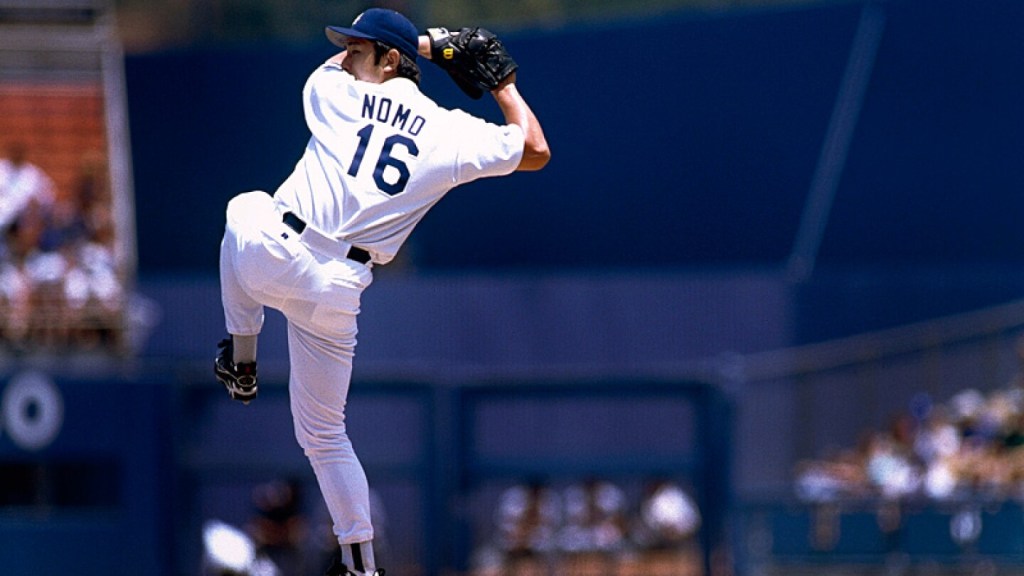
Japan’s Favorite Players: No. 5, Hideo Nomo
by Thomas Love Seagull
A recent poll for a TV special saw more than 50,000 people in Japan vote for their favorite retired baseball players. 20 players emerged from a pool of 9,000. Yes, they could only vote for players who are no longer active, so you won’t see Shohei Ohtani or other current stars on this list. Which is probably smart because I’m sure Ohtani would win by default. There are, however, players who were beloved but not necessarily brilliant, and foreign stars who found success after coming to NPB. Unsurprisingly, the list leans heavily towards the past 30 years, with a few legends thrown in for good measure.
Over the next few weeks, I’ll be profiling each of these players. Some of these players I know only a little about, so this will be as much a journey for me as, hopefully, it will be for you. It’ll be a mix of history, stats, and whatever interesting stories I can dig up.
For now, have a look at the list below and see how the public ranked them. I’ve included the years they played in NPB in parentheses.
20. Alex Ramirez (2001-2013); 19. Yoshinobu Takahashi (1998-2015); 18. Warren Cromartie (1984-1990), 17. Takashi Toritani (2004-2021); 16. Suguru Egawa (1979-1987); 15. Katsuya Nomura (1954-1980); 14. Tatsunori Hara (1981-1995); 13. Kazuhiro Kiyohara (1985-2008); 12. Masayuki Kakefu (1974-1988); 11. Masumi Kuwata (1986-2006); 10. Atsuya Furuta (1990-2007); 9. Randy Bass (1983-1988); 8. Daisuke Matsuzaka (1999-2006, 2015-2016, 2018-2019, 2021); 7. Tsuyoshi Shinjo (1991-2000, 2004-2006); 6. Hiromitsu Ochiai (1979-1998); 5. Hideo Nomo (1990-1994); 4. Hideki Matsui (1993-2002); 3. Shigeo Nagashima (1958-1974); 2. Sadaharu Oh (1958-1980); 1. Ichiro Suzuki (1992-2000).
The pitcher who refused to change, crossed an ocean, and altered baseball forever
On the night of September 17, 1996, Hideo Nomo did something that almost certainly will never be done again. He walked out to the mound at Coors Field in Denver—the most hitter-friendly ballpark in the history of of Major League Baseball, a place so absurdly hostile to pitchers that the team eventually had to store baseballs in a humidor just to keep fly balls from becoming souvenirs—and threw a no-hitter.
The Rockies that year were dangerous. They scored nearly 1000 runs. They hit 221 home runs. Three of their players hit 40 or more, including Ellis Burks, who led the league in runs scored and slugging percentage. They also led the league in attendance. The mile-high altitude thinned the air, making breaking balls misbehave and fastballs sail. Nomo himself had an 11.17 ERA in the park going into that game. He had never won there.
He threw nine innings. He walked four. He struck out eight. He won, 9-0.
No other pitcher has ever thrown a no-hitter at Coors Field. No one probably ever will. And that was just one night in the career of Hideo Nomo.
There is a version of Nomo’s story that starts with the statistics, and those statistics are genuinely remarkable: 201 wins across two leagues and nearly two decades, 3,122 strikeouts, two no-hitters, a Rookie of the Year award on each side of the Pacific. But the numbers don’t quite capture what Nomo was, or what he meant, or what it cost him to become what he became.
The better place to start is with a young man from Osaka who was told, at the age of 14, by the head coach of the top baseball high school in his city: “With that tornado windup, you’ll never make it.”
Nomo had invented the windup himself, as a kid trying to impress his father. He figured that twisting his body and coiling away from the batter until his back faced home plate, pausing there for a suspended, theatrical moment before releasing the ball allowed him to throw harder. He was correct. He was also never going to change it, no matter who told him to. When asked about the delivery later in his career, he would say that no one had taught it to him, though he did admit that one piece of it, the hip-first drive toward the plate, came from watching Masaji Hiramatsu* of the Taiyo Whales as a boy and wanting to move like him. Buried inside the most spectacular pitching motion in baseball was a child’s act of imitation. That stubbornness, that absolute certainty about who he was and how he pitched, is as important to understanding Nomo as anything that happened between the chalk lines.
*Hiramatsu won 201 games in his career, but his nickname was “The Glass Ace” because he missed so many games due to injuries and frequently catching colds.
He enrolled instead at a lesser-known high school, dominated the local competition, and pitched a perfect game. One year ahead of him in the Osaka baseball scene was Kazuhiro Kiyohara, already a legend at PL Gakuen High School, already being called the greatest hitter in the country. Kiyohara later said he had never even heard of Nomo. That is how anonymous Nomo was, invisible to the very generation he would come to dominate.
He joined a company team where he perfected his forkball with the kind of obsessive dedication that tends to separate the greats from mere mortals. The story goes that he taped a tennis ball between his index and middle fingers before bed each night, conditioning his grip while he slept.
In 1989, eight teams selected Nomo in the first round of the NPB draft. Eight. That had never happened before. The Kintetsu Buffaloes won the lottery and signed him, with one condition written into the contract at Nomo’s insistence: they would not try to change his pitching form.
The scouts and commentators who watched him in spring training of 1990 were not impressed. Even after the Tornado name was bestowed, the skeptics kept coming. Would he ever have real control? Could he hold up for a full season? Wouldn’t he break down eventually? In a rookie-year interview Nomo smiled faintly and said people had told him everything about his delivery was wrong. But, he added, once they actually watched him throw in a bullpen session, they tended to go quiet. After two early losses, he later recalled that stretch as the loneliest of his career; the dormitory felt like the only place he belonged. He said nothing publicly. He also changed nothing.
His first win came on April 29 against the Orix Braves, when he struck out 17 batters, tying the Japanese single-game record, while allowing only two runs in a complete game. Afterward, rather than celebrate, he deflected entirely: because his teammates had scored so many runs, it had given him a sort of rhythm. That was the version of Nomo the public would come to know, one who was private and guarded, but also generous toward others.
What followed was one of the greatest rookie seasons in Japanese baseball history. Nomo went 18-8 with a 2.91 ERA and 287 strikeouts, winning the Rookie of the Year, the MVP, and the Sawamura Award (the Japanese equivalent to the Cy Young) in the same breath. Oh, and he won the pitching Triple Crown. He was 21 years old. He led the Pacific League in wins and strikeouts for each of his first four seasons, a feat without precedent. The Tornado name was officially bestowed in late May, chosen by public contest from thousands of entries, arriving right in the middle of the season when he was still proving the critics wrong.
He also led the league in walks during his first four years, and in wild pitches two times. Tornado was an apt nickname in more ways than one.
The best part? He did nearly all of it with two pitches. A fastball and a forkball. That was essentially the entire arsenal. Shinichi Sato, who faced Nomo as a member of the Hawks, said there is simply no other starter who has ever gotten away with two pitches at that level.
What made the two pitches so devastating was the delivery that preceded them. Orestes Destrade, the Cuban-born slugger who played for the Seibu Lions, described the experience of standing in the batter’s box against Nomo this way: because Nomo turned his back to the plate and paused—that eerie, still moment where everything stopped, just like in the eye of a storm—timing him was nearly impossible. You couldn’t sync up with it. The ball came from nowhere and went somewhere unexpected. When reporters kept asking Nomo about strikeouts, he waved them off every time: “Strikeouts are just a result. What matters is the team winning.” It wasn’t false modesty. It was the same principle he had lived by since he was a boy twisting his body in a schoolyard. “If I change my own way,” he once said, “it’s over.”
His teammates from that era remember something else too: Nomo finished what he started. Eiji Kiyokawa, a reliever, said bluntly that Nomo was the kind of ace who pitched nine innings and left nothing for the bullpen. It wasn’t arrogance. It was a starter’s code, a sense of personal responsibility for the game he was given. He pitched 22 complete games in 1991—still the most by any pitcher in Japan since the end of the Showa era—and threw 3,996 pitches that season. Nearly four thousand pitches in a single year. Manager Akira Ohgi, an easygoing man who trusted his players and left them alone, simply kept handing Nomo the ball, start after start, around 145-150 pitches a time. Nomo, for his part, kept taking it. What else was an ace pitcher to do?
In 1991, Nomo set the all-time Japanese record by striking out ten or more batters in six consecutive starts. What makes the streak stranger, and more revealing, is his record during it: 2-4. He struck out at least ten batters in every one of those six games, threw complete games in five of them, and lost four times. He was unhittable and yet, the Buffaloes team kept losing anyway. That same year the All-Star Game offered a rare glimpse of a different Nomo entirely. In the second game, played in Hiroshima, the Pacific League ran out of position players in extra innings and had to send Nomo up as an emergency pinch-hitter. He borrowed an Orix helmet (remember, he played for Kintetsu*) put it on, and walked to the plate grinning. He never swung the bat. Three pitches later he took a called third strike and walked back to the dugout to a roaring ovation from the full stadium. It was the most cheerful strikeout anyone had ever seen. The crowd loved it. Nomo seemed to as well.
*Of course, Orix and Kintetsu would merge following the 2004 season to form the Orix Buffaloes. Foreshadowing, anyone?
He later said that his loyalty to Ohgi ran so deep precisely because Ohgi trusted him completely, never meddled, never second-guessed. Ohgi gave Nomo the ball and got out of the way. That relationship, more than anything else, is what made what came next so difficult. After two consecutive second place finishes, Ohgi resigned. His replacement was franchise legend and 300-game winner Keishi Suzuki. Suzuki’s management style was the complete opposite of Ohgi’s.
No game illustrated Nomo’s resilience more strangely than the one on July 1, 1994, against the Seibu Lions. Nomo walked 16 batters, a Japanese baseball record that stands to this day, with at least one walk in every single inning. The home plate umpire called a ball 105 times. Kazuhiro Kiyohara, who drew three of those walks, the same man who had never heard of Nomo growing up, shrugged afterward and said you couldn’t sit on any particular pitch when a pitcher was that wild; the wildness itself became a kind of weapon. The color commentator on the broadcast, former manager Senichi Hoshino, said simply that he was exhausted by the end of it. If he’d been managing, he would have pulled Nomo long ago. The patience on display, Hoshino noted with a laugh, belonged not to Nomo but to Suzuki. Nomo threw 191 pitches and finished with a complete-game win, allowing three runs. Afterward he was unapologetic but unsatisfied: “I wasn’t able to pitch my game at all.” That was Nomo. He stayed out there for 191 pitches in a game he considered a failure, and won.
Then the relationship with Suzuki soured entirely. The manager wanted Nomo to run more, throw more, and alter his mechanics. “Throw until you die” was, by one account, Suzuki’s actual philosophy of pitcher conditioning. He told a radio audience that Nomo’s form would never hold up. Meanwhile, the front office treated its franchise pitcher with a remarkable combination of condescension and indifference, offering no salary increase after four consecutive win and strikeout titles, trying to force him into voluntary retirement rather than grant him free agency, and telling him, flatly, that he was not considered the team’s ace.
Nomo would later say that he didn’t originally dream of playing in America. He just couldn’t play for Suzuki anymore. But the dream, it turned out, had been there all along. His locker at Fujiidera Stadium, the Buffaloes home, was covered wall to wall with baseball cards of Ken Griffey Jr., Roger Clemens, and other great American stars of the era. The training room down the hall looked the same. He had been staring at those faces for years, imagining what it would feel like to face them. When a reporter caught him in the summer of 1994, mid-rehabilitation, and Nomo told him quietly that he wanted to try the major leagues next year, he was smiling as he said it.
The loophole his agent Don Nomura found was elegant in its simplicity. The NPB’s voluntary retirement clause said nothing about foreign leagues. If Nomo retired from Japanese baseball, he could sign anywhere in the world. The clause had never been used this way before. It was a loophole that only existed because no one had ever thought to use it and because no Japanese star had ever wanted to leave badly enough, or been brave enough, to try.
The media was not kind about it. The conventional wisdom was that Nomo was running away, or chasing money, or both. He arrived in America with his reputation in Japan in tatters and his salary reduced from roughly $1.4 million to a minor-league contract worth $100,000. The Dodgers’ GM told him that a major league contract was not given but earned. Nomo nodded and said nothing. The strike was still ongoing when he arrived; if it dragged on, he faced the possibility of earning as little as $60,000 pitching in the minors. And this was for a man with a wife, children, and a salary back home that had been roughly 25 times that. He didn’t flinch. “It’ll start eventually,” he said. “Starting in the minors would be fine.”
Meanwhile, American baseball in the spring of 1995 was not in a great mood. The previous season had ended in a players’ strike that wiped out the World Series. Fans were furious. Attendance was cratering. The sport had spent years building goodwill and watched it drain away in a dispute that looked, to most observers, like very rich people arguing with slightly less rich people about money.
Into this particular moment stepped a 26-year-old pitcher from Osaka with a motion unlike anything American fans had ever seen, throwing a forkball that dropped off the table and a fastball that arrived from an angle that made no logical sense. He made his major league debut on May 2 at Candlestick Park in San Francisco, retiring Barry Bonds and Matt Williams along the way and pitching five shutout innings. Millions of people in Japan watched live on television, where the first pitch came at 5:33 in the morning. Only about 16,000 people were in the stadium.
By June, the stadiums were full. Nomo went 6-0 that month with a 0.89 ERA. He pitched at least eight innings in each of his six starts. He threw back-to-back complete-game shutouts with 13 strikeouts each, a feat no Dodger pitcher had ever accomplished. He was the starting pitcher for the National League in the All-Star Game, the first NL rookie to start since another Dodger sensation, Fernando Valenzuela, in 1981. His boyhood idol, Nolan Ryan, threw out the ceremonial first pitch. The term “Nomomania” entered the languages on both sides of the Pacific.
Before the season, someone had asked Nomo what he felt he owed to Japanese baseball. His answer was not what anyone expected. “I have to do this,” he said. “If I fail, it will brand all Japanese players who come after me as failures.” He was twenty-six years old, pitching on a continent where almost no one knew his name, and he had already accepted responsibility for an entire generation that hadn’t arrived yet.
Nomo finished the season 13-6 with a 2.54 ERA and a league-leading 236 strikeouts. He won the Rookie of the Year Award, edging out Chipper Jones. He finished 4th in Cy Young voting.
The years that followed were the full, complicated arc of a pitcher’s life, the brilliant stretches and the injured ones, the reinventions and the setbacks. He pitched an unfathomable game in Colorado. He had elbow surgery. He was traded. He was released. He became the first Japanese-born player to hit a home run in MLB*. He bounced from the Mets to the Brewers to the Tigers to the Red Sox, and then, in 2001, he did something that almost no pitcher in history has done: he threw a second no-hitter, this one in his Boston debut, against the Baltimore Orioles. Nomo became only the fourth pitcher ever to throw a no-hitter in both leagues. He was, briefly, a star again.
*The second was Dave Roberts. The third was Nomo’s former Kintetsu teammate Masato Yoshii, who was a big influence on his desire to join MLB. The two would be reunited on the Mets in 1998.
He returned to the Dodgers and had two more solid seasons before the body finally gave out. His tornado windup, that beautiful, impractical, singular motion he had invented as a child and refused to surrender his entire career, was diagnosed as the source of damage to his shoulder. Without it, he wasn’t Nomo anymore. He pitched a few more years, trying, and retired in 2008 at 39.
His place in history depends on where you’re standing. He received six votes for the Baseball Hall of Fame in his first year of eligibility. Six. He was inducted into the Japanese Baseball Hall of Fame the same year, in his first year of eligibility, becoming the youngest inductee in history.
Make of that what you will.
What Nomo really did, beyond the wins and the strikeouts and the two no-hitters, was open a door that had not existed before him. Since his arrival in 1995, more than 50 Japanese-born players have come to the major leagues. Ichiro. Matsui. Daisuke. Tanaka. Ohtani. None of it happens, or at least none of it happens when it did, without Nomo going first.
Ichiro recognized how important Nomo was. “Before Hideo came over here, everyone had an image of Major League Baseball and people looked at players over here as monsters because they were so big. We were able to watch more MLB games and were able to get an image of, ‘Maybe I can play in the big leagues.’”
Tommy Lasorda, who managed the Dodgers for two decades and knew a pioneer when he saw one, put it plainly: if Nomo had not succeeded, nowhere near as many Japanese players would be in the major leagues today. He had the talent for it, Lasorda said, and he had the character for it. Both were required.
When Ichiro announced in the fall of 2000 that he was coming to the major leagues, a reporter asked Nomo for his reaction. “Ichiro has to do this,” he said. The same words, the same logic, passed forward to the next man through the door that Nomo had opened.
He invented his delivery as a boy, was told it would ruin him, and refused to change it. He found a loophole in the rules, crossed an ocean under a cloud of criticism, and proceeded to help save baseball’s relationship with its own fans at one of the most fragile moments in the sport’s history. He threw a no-hitter at Coors Field. He is, by any honest accounting, one of the most important figures the game has produced in the last hundred years, and one of the most underappreciated.
During Ichiro’s Hall of Fame speech in Cooperstown, he thanked Nomo in Japanese, and pointed out his courage for challenging the majors.
But before all of that, before Dodger Stadium and the All-Star Game and Coors Field, there was a final night at Fujiidera Stadium. October 18, 1990. A meaningless late-season game, already out of the standings, and yet 16,000 fans showed up just to see him. Ohgi sent him out for one batter in the ninth, a one-run lead to protect. Nomo threw five pitches, all fastballs. The last one was clocked at 148 kilometers per hour (92 mph). Strike three. The crowd erupted: cheering, clapping, beating megaphones, confetti falling from the stands. Nomo wiped the sweat from his face, stepped off the mound, and turned to bow to the crowd. Then he walked back to the press room, answered questions in his characteristically flat, unhurried way, and as he was leaving, turned back one more time. “I hope for your continued support next year!” He smiled and added playfully, “Please keep things quiet during the off-season.”
The tornado touched down in 1990. The world of baseball was never the same.
Thomas Love Seagull’s work can be found on his Substack Baseball in Japan
-
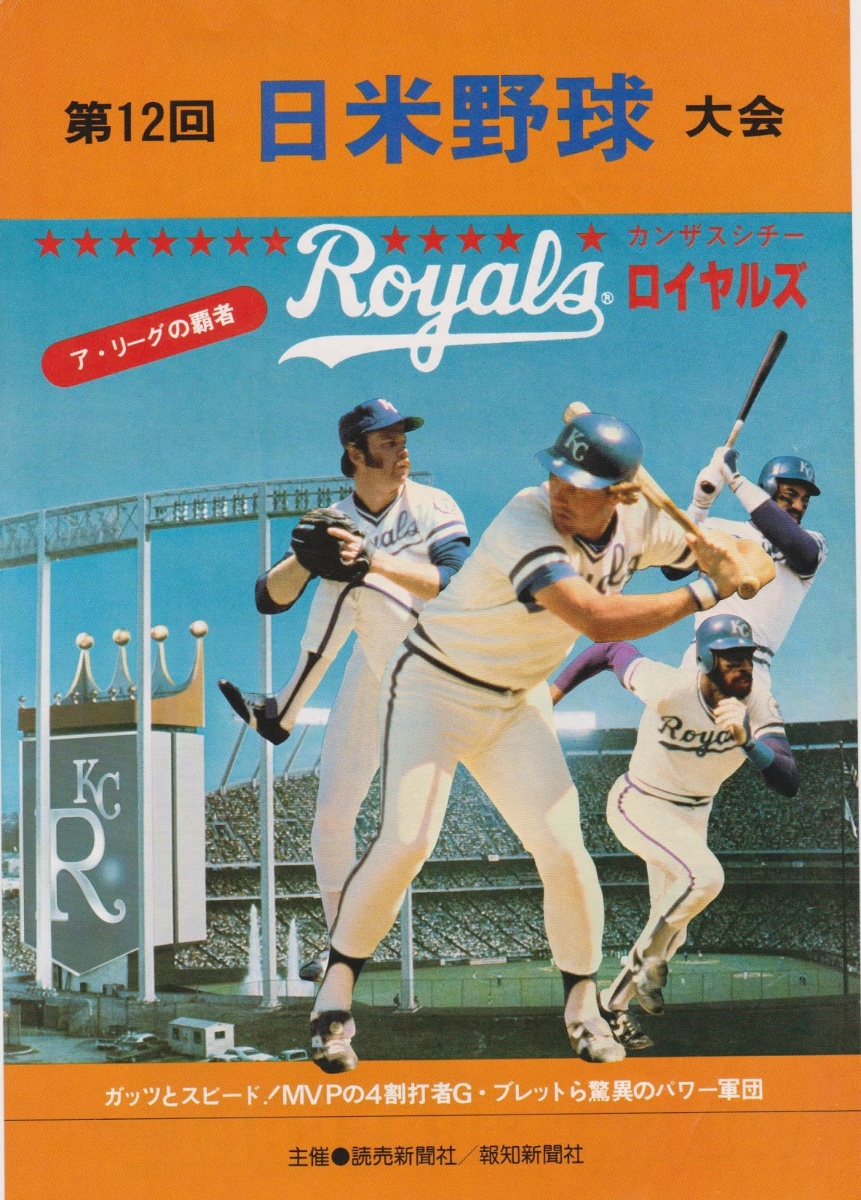
A Near Escape: the 1981 Kansas City Royals Tour of Japan
by Chris Hicks
Every Monday morning we will post an article from SABR’s award-winning books Nichibei Yakyu: Volumes I and II. Each will present a different chapter in the long history of US-Japan baseball relations. This week Chris Hicks tells us about the 1981 Kansas City Royals visit to Japan.
For decades it had been the hope of Matsutaro Shoriki, the owner of the Yomiuri Shimbun Group, a conglomerate that produces the Yomiuri Shimbunnewspaper and owns the Yomiuri Giants baseball team, that there would one day be a “true world series” played between the champions of the World Series and the Japan Series. After Matsutaro’s death in 1969, his son Toru continued the dream. The concept gained traction in 1971 when Commissioner Bowie Kuhn accompanied the Baltimore Orioles on their Japanese tour. When he returned to the States, Kuhn announced that he and the baseball commissioner of Japan, Nobumoto Ohama, had agreed to a “‘joint feasibility study’ of an international World Series.” Although no agreement emerged from the study, Shoriki continued to invite championship-caliber major-league teams to face off against the Japanese champion. Arrangements for the postseason tours, however, had to begin before the start of each season so Shoriki needed to guess which club would win the World Series. In 1974 he invited the New York Mets, a season after they had won the National League pennant, and in 1978 the Cincinnati Reds, but neither came to Japan as the reigning World Series champion.
Early in 1981, Shoriki invited the Kansas City Royals, the defending American League champions, gambling on their continued success. Should the Royals win the 1981 World Series and the Yomiuri Giants win the Japan Series, then the eight scheduled games between the teams would fulfill the dream of a “true world series.” The Royals’ full schedule in Japan consisted of 17 games played in 14 cities between October 28 and November 24,1981.
But the 1981 season was filled with frustration for the Royals. The team struggled in the first half of the season with a 20-30 record before the players union went on strike on June 12. The strike ended 50 days later. As the players returned to the field for the All-Star Game in Cleveland on August 9, the owners hammered out the logistics of the interrupted season. The division leaders when the strike began would face the division winners (based on records after the strike) of the post-strike season in the playoffs.
Not long after the season resumed, the Royals fired manager Jim Frey and replaced him with Dick Howser. The team went on to win 30 of its last 53 games and finish at the top of the AL West Division in the season’s second half. The season’s arbitrary break into unequal halves shut some teams with overall winning records out of the playoffs. In the AL West, the Royals, with an overall 50-53 season record, went to the postseason while the Texas Rangers (57-48) and Chicago White Sox (54-52) stayed home. Royals third baseman George Brett, commenting on the Royals’ inclusion in the playoffs, said, “We don’t belong. We know it.” Oakland swept the Royals to advance to the second round of the playoffs.
Looking for a better 1982 season, Howser used the games in Japan to test staff changes and prepare his team. Immediately after the season, the Royals had hired Cloyd Boyer as the pitching coach and Joe Nossek as the third-base coach so that these integral members of the coaching staff could use the trip to get to know the team’s players. Coach Jim Schaffer and minor-league instructor Gary Blaylock also accompanied the team.
The Royals took nearly all of their regular players to Japan, including stars Brett, Frank White, Willie Wilson, Dennis Leonard, and Dan Quisenberry. The only regular not making the trip was center fielder Amos Otis, who had just signed a new two-year contract and declined to go, stating that his priority was healing a leg injury and preparing for the 1982 season. Howser brought along a handful of young players who spent most of the 1981 season with Triple-A Omaha. The tour offered an ideal opportunity to evaluate Onix Concepcion, Tim Ireland, Pat Sheridan, Daryl Motley, and Atlee Hammaker.
For Hammaker, the Japan tour was not just about baseball. In 1954, after serving in the Korean War, his father, Col. Charles A. Hammaker, was stationed in Kyoto, where he met his future wife, Saeko. As a child, Atlee lived in Japan for a year with his grandparents, an aunt, and his mother while his father served in the Vietnam War. Hammaker’s grandmother was at the airport to greet her grandson and the rest of the Royals team when they arrived on October 28.
The team spent two days resting and practicing before beginning the 17-game series on Saturday, October 31. The first two games were against the Central League champion Yomiuri Giants in what the organizers had hoped would be the opening games of the unofficial international world series.
A crowd of 32,000 came to Korakuen Stadium in Tokyo to watch Jim Wright face Giants ace Suguru Egawa, who captured the 1981 Central League MVP honors with a 20-6 record and a 2.28 ERA. Despite giving up two hits in the first inning and six hits overall, Egawa pitched well, blanking the Royals though four innings. “[He] had good control today,” said Wilson. “He can make it in the majors.” By the fifth inning, however, Wilson noticed something. “He was running the same pattern on me, fastball, curveball, fastball, curveball. … [H]e threw the fastball, so I waited for the curve.” Wilson guessed right and sent the next pitch into the right-field stands to give the Royals a 2-0 lead. The Royals added another run in the seventh when Wilson singled to score Clint Hurdle. Meanwhile, Wright held the Giants to three hits before Hammaker entered the game in relief in the fifth inning. With his Japanese relatives in the stands watching, Hammaker pitched three one-hit, shutout innings to earn the 3-0 victory before Quisenberry closed out the game. Howser praised his pitchers’ performances: “Our pitchers were too good for the Giants.”
In the third inning Hal McRae collided with Giants second baseman Kazunori “Toshio” Shinozuka while breaking up a double play, injuring his calf. McRae was removed from the field on a stretcher and taken to the hospital. He missed the next four games and was not at full strength when he returned.
The second game between the Royals and Giants at Korakuen was an extra-inning nailbiter. The Royals scored in the fourth inning as Frank White doubled off Giants starter Takashi Nishimoto and later scored on a balk. The Giants came back with a vengeance in the bottom of the inning when Yasutomo Suzuki hit a two-run double and Takashi Yoshida hit a pitch from Rich Gale over the outfield wall to score three more runs, making it a 5-1 ballgame. The Royals responded with two in the fifth on a two-run home run by Onix Concepcion but missed an opportunity for a third run when Frank White was unable to knock in Willie Wilson, who tripled with two outs. Home runs by George Brett in the sixth and Jamie Quirk in the seventh tied the game, 5-5. The Giants had opportunities in the sixth and eighth innings but failed to score. Yomiuri reliever Mitsuo Sumi struck out seven Royals in a row in the eighth and ninth and the beginning of the 10th before Concepcion doubled, stole third, and scored on a single by Wilson. Renie Martin held the Giants scoreless in the bottom of the 10th for the thrilling 6-5 victory.
The Royals enjoyed the Japanese fans and their cheering sections with their rhythmic chants accompanied by horns, drums, and whistles. Quisenberry and Martin made up songs to the beat. “We kinda hot dog for them during batting practice and make them laugh,” said Quisenberry. They’re so much nicer than American fans. No fights in the stands, always polite, quick to laugh.”
The third game of the series had the Royals taking on a new opponent, the Japanese All-Stars, at Korakuen Stadium on Tuesday, November 3. Six future members of the Japanese baseball Hall of Fame appeared in the game: Yutaka Fukumoto, Tatsunori Hara, Choji Murata, Hiromitsu Ochiai, Tsutomu Wakamatsu, and Koji Yamamoto. The scoring got underway in the first on a two-run homer by Willie Aikens. But in the bottom of the first, Tomohisa Shoji began with a double off Larry Gura. Gura then walked Hiromichi Ishige and threw a wild pitch, allowing the runners to move up a base. Yamamoto singled Shoji home and Ochiai singled to score Ishige. Hara followed with a three-run inside-the-park home run to give the All-Stars a 5-2 lead. Shoji added another run with a solo homer in the second. Neither team scored again until the top of the seventh inning, when Brett hit a solo home run off reliever Tatsuo Komtasu. In the bottom of the inning, Ishige put the final nail in the Royals’ coffin with a solo homer of his own, handing the Royals their first defeat of the series. Japanese Crown Prince Akihito and Princess Michiko witnessed the 7-3 victory.
The Royals saw new surroundings but a familiar opponent when they played in Sendai’s Miyagi Baseball Stadium against the Yomiuri Giants on November 5. Yomiuri began with a run in the first inning as Yasuyuki Nakai doubled off Atlee Hammaker and came home on Kazunori Shinozuka’s single. The Giants scored three more in the third. Starting pitcher Shoji Sadaoka singled, Tadashi Matsumoto tripled, and Nakai hit another double before scoring on a fly out by Shinozuka. Yomiuri struck for three more runs off relief pitcher Jim Wright in the seventh inning to make the final score 7-0. Sadaoka gave up just one hit in six innings and reliever Hisao Niura pitched three innings of two-hit shutout ball to draw the series even at two wins and two losses. Yomiuri manager Motoshi Fujita noted, “Sadaoka succeeded in keeping the balls low and his balls were quite well controlled today.”
In the fifth game the Royals played southwest of Tokyo at Yokohama Stadium against a combined team of Taiyo Whales and Yomiuri Giants. The Royals had no trouble getting runners on base but struggled to get them across home plate in a 9-1 drubbing. In a sloppy first inning, the Japanese scored three runs on two walks, two errors by Brett, a sacrifice fly and a passed ball. The Royals pushed a run across in the second inning on Pat Sheridan’s sacrifice fly with the bases loaded but the Japanese added runs in the third and sixth innings to lead 5-1 before Tomio Tashiro sealed the game with a three-run homer in the seventh. The Giants-Whales added a final run in the eighth. The Royals offense left 13 runners on base. Howser noted, “Our boys are hitting well … but the ground is slippery resulting in many errors. We will try to win three straight games from Sunday.” While their husbands were playing, the wives did a little sightseeing. They visited Fuji-Hakone-Izu National Park and the Great Buddha, a 37-foot bronze statue dating from the thirteenth century, in Kamakura.
The series returned to Korakuen Stadium as the Royals took on the Giants in the sixth game on Sunday, November 8. Kansas City jumped out to an early lead as Brett hit a solo home run (his third of the series) in the first off Yomiuri starter Hajime Kato, but the lead was fleeting as starter Dennis Leonard gave up a grand slam to Kenji Awaguchi in the third inning. Willie Aikens and Yasutomo Suzuki also hit solo home runs as Yomiuri won, 6-2. The loss was the Royals’ fourth straight and the visitors had a dismal 2-4 record.
In Game 7 on Tuesday, November 10, at Seibu Stadium, a combined Yomiuri Giants-Seibu Lions team looked to hand the Royals their fifth straight loss. George Brett started things off with a two-run home run in the first inning off starter Masayuki Matsunuma. But the lead was lost in the second inning when the Japanese scored four against starter Paul Splittorff, highlighted by a two-run double by Hiromichi Ishige and a solo home run by Tatsunori Hara. Brett struck back with a solo homer in the third to narrow the score to 4-3. The Japanese however, solidified their lead in the next inning as Ishige doubled in two runs after a successful double steal by Yoshiie Tachibana and Takanori Okamura. Hara knocked in the final run in the fifth inning on a sacrifice fly to hand the Royals a 7-3 loss. With the loss, the Royals had dropped five straight, setting the record for the most consecutive losses by a major-league team in a postseason tour of Japan. After the game, Howser said he “regretted” being the first American pro manager to lose five straight in Japan. He noted that his pitching staff “was in poor condition” and that except for Brett the Royals “couldn’t buy a hit.”
The Giants and Royals left the Tokyo area the next day. The fans at Kusanagi Ballpark in Shizuoka were treated to a pitchers’ duel between the Royals’ Mike Jones and the Giants’ Hisao Niura in the eighth game. Over the first five innings, Jones blanked the Giants on one hit and Niura nearly matched him with two hits surrendered. Kazuaki Fujishiro replaced Niura in the top of the sixth and gave up a leadoff double to U.L. Washington. Washington moved to third on a fly out and scored on John Wathan’s single. Relievers Renie Martin and Dan Quisenberry locked down the game with four innings of one-hit shutout ball as the Royals won, 1-0. “I’m relieved,” said Howser after the win. “Our pitching has shaped up and [I] think we could play better in the remaining games.”
The next day, November 12, the teams traveled west to Nagoya, where Kansas City played a combined Yomiuri and Chunichi Dragons team in the ninth game of the series. Brett continued hitting the ball well, belting a solo homer off starter Tatsuo Komatsu in the first inning. From there on, however, the only scoring came from the Japanese squad. Royals starter Larry Gura struggled, giving up a two-run homer to Yasunori Oshima and two solo home runs to Masaru Uno. After the 5-1 loss, Howser noted, “A homer by George Brett isn’t enough to win a ballgame.”
Games 10 through 12 occurred in the area around Kyoto and Osaka. The schedule also allowed time for the Royals to do some sightseeing. The group shot the rapids on the Hozu River in traditional flat-bottomed boats steered with oars and powered by the current and bamboo poles. They also went to Nijo Castle in Kyoto, a home of the Shogun from the early 1600s, that was later named a UNESCO World Heritage Site. The touring party not only enjoyed the cultural sites but also shopping and eating. “The Royals are eating plenty of things they can’t spell and … some things they’d rather not have identified,” wrote Mike McKenzie of the Kansas City Star. “We’re eating like kings,” said Quisenberry. “Some guys are gaining weight. Not getting like Sumo wrestlers, but gaining.” During his brief time in Japan, Quisenberry became a Sumo fan. “They’re better than our pro wrestling. They psych each other out, and they’re for real. I can’t understand anything they’re saying, but it’s fun to watch.”
On Saturday, November 14, the Royals played a Yomiuri and Hankyu Braves combined team at Nishinomiya Stadium. The teams stayed locked in a pitching duel with the score tied 1-1 until the eighth inning. Royals starter Dennis Leonard surrendered just the one run and three hits in seven innings, while the Japanese used four pitchers to hold the Royals. In the top of the eighth, designated hitter Hal McRae clocked a two-run homer off reliever Tomoyuki Sekiguchi to take the lead. In the bottom half of the inning, Quisenberry relieved Leonard and gave up a two-run home run to Kenji Awaguchi that tied the game at 3-3. The game remained scoreless through the 10th inning and then was declared a tie.
With the 3-6-1 record, the Japanese media claimed the Royals were either not taking the tour seriously or were just not that good. After the 10 games, the Japanese had outhit them .238 (78-for-328) to .217 (74-for-341) and outscored them 49 to 23. Fans complained that they paid $22 to $25 a ticket to see “a feeble American team.”
“We are trying,” said Dennis Leonard. “They are just embarrassing us. We’ve been outhit, outpitched, outplayed. I think when we came over here, we thought it was going to be a cakewalk. Instead, we’re struggling.” George Brett said, “Nobody likes to lose. We’re professionals. We go out and try to win every game. We just can’t seem to get the big hit when we need it.”
“The team is mad,” said Quisenberry. “It’s depressing. A lot of guys 5-feet-6 and 150 pounds are hitting home runs against us. Their pitchers are throwing straight fastballs, letter high, and we’re popping up and striking out. The game is over, and we’re beaten 7-1, and we can’t figure out why or how. … Players come back to the bench after striking out or giving up a key hit, and they’re mad at the world. Not quite like the regular season, but almost. We don’t like to get embarrassed.”
Howser and some players blamed the losses on the lengthy layoff between the end of the Royals’ season and the start of the games in Japan, noting that the Japanese had ended their playoffs only days before the start of the tour. “Not working out before we came hurt us more than I thought it would,” noted McRae. “Personally, I’m not in good shape,” Leonard admitted. “In previous years, we probably could have overcome [the layoff],” said Frank White. “But the Japanese players have improved, especially their pitching.” Quisenberry agreed: “About 50 percent of the pitchers I’ve seen could play in the major leagues. They are much more surehanded than we are in the field. … Their hitters are very disciplined, hardly ever striking out with their short, compact swings.”
Read the full version of this article on the SABR website
-
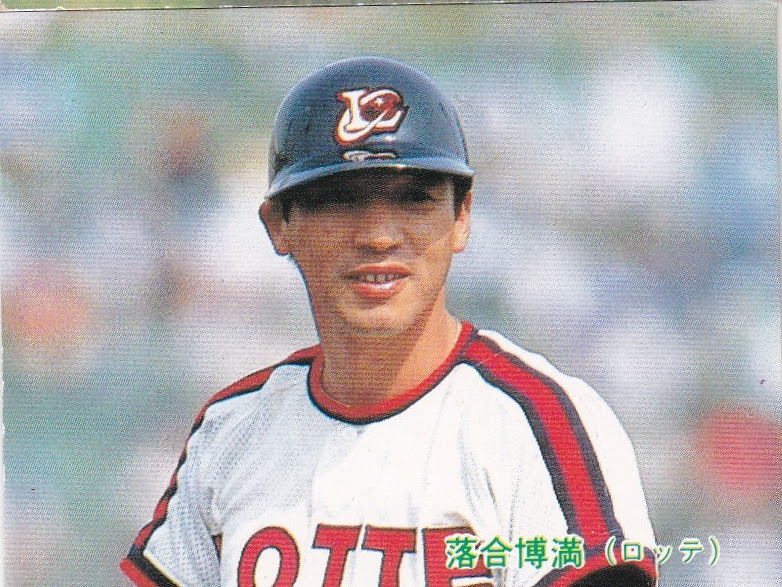
Japan’s Favorite Players: No. 6, Hiromitsu Ochiai
by Thomas Love Seagull
A recent poll for a TV special saw more than 50,000 people in Japan vote for their favorite retired baseball players. 20 players emerged from a pool of 9,000. Yes, they could only vote for players who are no longer active, so you won’t see Shohei Ohtani or other current stars on this list. Which is probably smart because I’m sure Ohtani would win by default. There are, however, players who were beloved but not necessarily brilliant, and foreign stars who found success after coming to NPB. Unsurprisingly, the list leans heavily towards the past 30 years, with a few legends thrown in for good measure.
Over the next few weeks, I’ll be profiling each of these players. Some of these players I know only a little about, so this will be as much a journey for me as, hopefully, it will be for you. It’ll be a mix of history, stats, and whatever interesting stories I can dig up.
For now, have a look at the list below and see how the public ranked them. I’ve included the years they played in NPB in parentheses.
20. Alex Ramirez (2001-2013); 19. Yoshinobu Takahashi (1998-2015); 18. Warren Cromartie (1984-1990), 17. Takashi Toritani (2004-2021); 16. Suguru Egawa (1979-1987); 15. Katsuya Nomura (1954-1980); 14. Tatsunori Hara (1981-1995); 13. Kazuhiro Kiyohara (1985-2008); 12. Masayuki Kakefu (1974-1988); 11. Masumi Kuwata (1986-2006); 10. Atsuya Furuta (1990-2007); 9. Randy Bass (1983-1988); 8. Daisuke Matsuzaka (1999-2006, 2015-2016, 2018-2019, 2021); 7. Tsuyoshi Shinjo (1991-2000, 2004-2006); 6. Hiromitsu Ochiai (1979-1998); 5. Hideo Nomo (1990-1994); 4. Hideki Matsui (1993-2002); 3. Shigeo Nagashima (1958-1974); 2. Sadaharu Oh (1958-1980); 1. Ichiro Suzuki (1992-2000).
The three-time Triple Crown winner who did everything his own way
There is a word, oreryu, that you need to know before any of this makes sense. It means, roughly, “my way.” Not a better way. Not the accepted way. Just: my way. The word exists because one man lived it so completely, so defiantly, across so many years and so many people who told him he was doing it wrong, that the language simply had to make room for it.
His name was Hiromitsu Ochiai. He was the greatest right-handed hitter in the history of Nippon Professional Baseball. He was also, for much of his career, the most inconvenient man in the room.
He would have taken both as compliments.
Let’s start at the beginning, because the beginning is almost too good.
Ochiai was born in 1953 in a small town in Akita Prefecture, in northern Japan, the youngest of seven children in a family that ran a Japanese sweets shop. He played baseball as a kid, hitting crumpled up newspapers with a stick in the yard, and joining the local team in fourth grade because his older brother did, but he was never, precisely, a baseball obsessive. His childhood idol, like nearly every other boy from his generation, was Shigeo Nagashima, but what he really loved were movies. By high school, he was going to the cinema roughly a hundred times a year, sneaking into theaters in his school uniform while other kids were at practice. His attendance record was so poor he nearly failed to advance each of his three years.
Robert Whiting noted that as a boy he saw My Fair Lady seven times and could recite whole lines from it in English, which is pretty remarkable for a man who later admitted his English test papers in junior high were left completely blank, and who failed the English section of his high school entrance exam the same way. The movies were not about English. The movies were about being somewhere that wasn’t practice.
He was good enough at baseball that every top high school program in Akita wanted him, but he chose a technical school specifically because he’d heard they didn’t push their players around too much. When the upperclassmen still pushed him around, he simply stopped showing up. He quit and rejoined the team eight separate times during high school but was always called back before tournaments because he was, inconveniently, the best player they had.
Toyo University came next, on a recommendation after he hit a mammoth home run at a tryout. He quit after less than a year. The freshman players were traditionally required to wash the underwear of the upperclassmen, give them massages, and light their cigarettes. Ochiai found it to be ridiculous.
He went back to Akita, worked part-time at his brother’s bowling alley, became a serious competitive bowler, and might have turned professional except that he forgot to put his new driver’s license sticker on his brother’s car, got pulled over, paid a fine, and no longer had the entry fee for the qualifying exam. Baseball it was, then. He joined an industrial league team, working days assembling transistor radio circuit boards and playing in the evenings. He hit 70 home runs in five official seasons, and in 1978 was selected as Japan’s starting first baseman for the Amateur World Series. He hit .265/.413/.519 in the tournament, drew nine walks in ten games, and led the entire Japanese squad with 13 RBI. That autumn, the Lotte Orions drafted him in the third round. He was 25 years old. The scout’s only stated reason: he could handle breaking balls and he was the kind of hitter pitchers found annoying.
In the minors the following year, he set an Eastern League record by homering in five consecutive games. No one had any idea what was coming.
What was coming started almost immediately with a problem. Lotte’s manager was Kazuhiro Yamauchi*, and he took one look at Ochiai’s stance—bat aimed toward the first base dugout, stepping firmly away from the plate when he swung—and said flatly: “That guy will never make it as a pro.” The other coaches agreed. Ochiai remained in the minor league system, his talent visible to almost no one in a position to act on it.
*Yamauchi had been a star for the Orions in the 1950s and early 1960s. He was the first player in NPB to reach 300 career home runs.
Almost no one. A batting coach named Michihiro Takabatake had been watching Ochiai in the farm system and couldn’t understand why he wasn’t on the first team. One morning in 1980, he pulled aside a veteran who had just joined the Lotte organization and brought him down to Kawasaki Stadium to watch. The veteran was Isao Harimoto, one of the greatest hitters in the history of Japanese baseball, a man who had spent his career in title races against Sadaharu Oh and Shigeo Nagashima, who had hit .319 over 23 professional seasons and finished with 3,085 career hits. If Harimoto said a hitter was good, the hitter was good.
Harimoto watched Ochiai for a while. Then he went to find Yamauchi.
“Why aren’t you using him?” he asked.
But getting Ochiai onto the field was only the first problem. Ochiai was slow, and his defense was unremarkable, and when he struggled early in games, Yamauchi moved quickly to pull him. Every time Harimoto would get up from the bench, walk to where Yamauchi was moving toward the field to make a substitution, grab the manager’s belt, and say: “One more chance.” He did this two or three times. Each time, Yamauchi stopped.
Eventually Ochiai started hitting. Once he started, he didn’t stop. In 1981, his first full season, he hit .326/.423/.629 and won the batting title. He came to Harimoto’s locker afterward.
“I got it,” he said. “Thank you.”
In 1982, at 28, Ochiai won the Triple Crown, the fourth player in NPB history to do so, and at the time the youngest ever. In 1983, he won his third consecutive batting title, joining an exclusive list alongside Nagashima himself. He was not done.
In 1984, Boomer Wells was making a serious run at the Triple Crown. Ochiai, who had spent years fighting Japanese baseball’s rigid culture on his own terms, now revealed something else entirely: a fiercely Japanese competitive pride about who should win the game’s highest individual honor. He declared publicly that a foreigner should not win the Triple Crown. He chased Wells all season in the home run race. Wells even alleged his teammates grooved pitches to help Ochiai. It wasn’t enough. Wells hit 37. Ochiai hit 33. He fell four home runs short.
He noted the result and filed it away. And then came 1985.
Before the season, Ochiai made his intentions plain: he was going to win the Triple Crown, and he was really going to win all three parts of it. But this was not simply another prediction. When he had won his first Triple Crown in 1982 (.325, 32 home runs, 99 RBI) some critics had called the numbers unimpressive, unworthy of the title. Not a real Triple Crown, they implied. Ochiai had heard every word. Now, three years later, he wanted to win it in a way that made argument impossible. He wanted numbers that would sit boldly on the page and be beyond any criticism.
He also told his batting coaches he didn’t want to swing a bat during spring camp. Not during practice. Not during exhibition games. He wanted to run and do fielding drills only so he could preserve his swing, keep it fresh and uncontaminated. His manager Kazuhisa Inao simply said yes. His teammates watched, bewildered. Ochiai ran and fielded and waited.
He was otherworldly that year. In August, he hit .411 with 10 home runs and 24 RBI. In September, .409 with 10 more home runs and 27 RBI. The final four days of the season were his exclamation mark. On October 18, against the Nippon-Ham Fighters, he went 4-for-4 with four RBI, hitting two home runs in a game for the eleventh time that season. The next day, another home run, three more RBI. The day after that, a run-scoring hit in the first inning, a double in the fifth, a three-run home run in the ninth; five RBI in a single game. On October 21, in the season’s final game, two hits, two RBI, and his 52nd home run, tying Katsuya Nomura’s Pacific League record.
The final line: .367 batting average — beating second place by 24 points. 52 home runs — beating second place by 12. 146 RBI — beating second place by 24. He had won the Triple Crown before. This time he had won it so that no one would ever say the wrong thing about it again. With runners in scoring position, he hit .492 across 122 at-bats, with 16 home runs and 98 RBI in those situations alone. The 146 RBI is still the Pacific League record. The .487 on-base percentage from 1986 is still the NPB record. The .492 average with runners in scoring position is still the Japanese record.
In 1986 he did it again: .360, 50 home runs, 116 RBI. He played through severe back pain. He became the only player in the history of Japanese professional baseball to win three Triple Crowns. He had predicted all three.
Here is what people who faced Ochiai remember most: he was almost impossible to fool, and not in the way you expected.
Harimoto, whose eye for hitting mechanics was as sharp as anyone’s in the game, described Ochiai’s essential nature this way: he was fundamentally a gap hitter who had developed the technique to pull the ball into Kawasaki’s short right field porch when the situation called for it. When he saw a pitcher tiring or losing his stuff, Ochiai could shift his contact point forward and turn on the ball like a true pull hitter, completely transforming his approach within a single at-bat. Harimoto said he could think of almost no one else in the long history of the game who could do this.
Of his 510 career home runs, 176 went to right field. Sportswriters gushed about his ability to take outside pitches the other way. A Yomiuri Giants catcher once asked him directly: “Are you aiming for right field on those?” Ochiai’s answer stopped him cold: “Don’t be ridiculous. Those are late swings. My swing path is just better than yours, so they still go out.”
Pitchers didn’t like facing him for another reason: he was aggressively patient. He led the league in walks nine times, including eight consecutive seasons from 1984 to 1991. He led the league in on-base percentage seven times in his career. He set a record with 6 walks in one game in 1991. His career total of 1,475 walks is second only to Oh all-time, and first among all right-handed hitters in NPB history.
The great pitcher Hisashi Yamada of the Hankyu Braves, after a young Ochiai went 2-for-4 against him in 1980, pulled aside some younger pitchers afterward: “A great hitter just arrived. He might win a Triple Crown one day.” Then, two years later, Ochiai came to Yamada directly and asked him how to hit his signature sinker. Yamada told him: aim for center field. Ochiai thanked him. On April 29, 1982, the day Yamada was chasing his 200th career win, Ochiai hit three home runs off him. All three were sinkers. Yamada still won the game, though.
There’s also the story about a batting cage.
When Ochiai joined the Chunichi Dragons before the 1987 season, the club had hastily converted a gymnasium into an indoor batting center. The ceiling was covered with nets. Balls kept getting stuck up there. Players tried throwing bats to knock them down. Nothing worked.
Ochiai watched this for a moment, then said: “I’ll get them.” Did he grab a ladder? No, he stepped into the cage, queued up a pitching machine, and began hitting balls precisely into the ceiling netting, each one landing with just enough angle and force to dislodge the stuck balls and knock them down, one after another. The Central League’s chief umpire was watching and said afterward it was like watching magic or a circus act.
Whiting described Ochiai as someone who “hardly ever practiced, laughed at the term fighting spirit, and said he played baseball only for the money.” That is a fair description, and Ochiai would not have disputed a word of it.
During the season, while teammates went through long pregame workouts that left them soaked with sweat, Ochiai would lounge on the sidelines. “Ten swings is all I need,” he would say. “Then a good massage and I’m ready to play.” He refused voluntary training in January after his first Triple Crown. He skipped practices he found useless. He did not see the point of exhausting yourself before the game you were supposed to win.
This, of course, was at odds with the dominant philosophy of Japanese baseball and with its greatest exemplar. Sadaharu Oh was famous for the crippling hours he put in on the training ground, even in his final seasons. When the two appeared in a magazine interview together, Oh said he was afraid Ochiai’s example would mislead the youth of the nation. Ochiai responded, as Whiting recorded it, that he had practiced hard in his semipro days, had built his body and developed his technique but that was then, and this was now. Americans did things their own way. Why couldn’t he?
If Oh’s motto was doryoku (effort) Ochiai said his own would be: “Enjoy yourself and get rich.”
Leron Lee, who played alongside him at Lotte, put it plainly: “He had trouble with the media because he told people exactly what he thought, and Japanese aren’t supposed to do that.” His American teammate Alonzo Powell called him simply “an American in a Japanese body.”
Whiting noted that writers at the time called Ochiai “The Gaijin Who Spoke Japanese.”* In a country where stardom came with expectations of humility, collective sacrifice, and visible suffering, Ochiai was bewildering. He was immodest. He talked about money. He predicted his own Triple Crowns. He won them.
*Gaijin, shortened from gaikokujin, is the word for foreigners.
One relationship was different from all the others.
Kazuhisa Inao managed Lotte from 1984 to 1986, and Ochiai came to regard him as something close to a father figure in baseball. He would later say he was one of only two managers from whom he actually learned the game. The first night Inao took over, Ochiai followed the coaches out for drinks, sat down across from his new manager, and asked directly: “Are you going to run a controlled operation, or are you going to trust the players?” Inao answered simply: he had grown up in the old Nishitetsu Lions, where no one had ever been managed tightly, and he wasn’t going to start now. That was enough.
When Ochiai was hitting barely .200 in the first half of the season and coaches were urging Inao to drop him from the cleanup spot, Inao refused. Ochiai hit over .400 after the All-Star break. There was a night when Ochiai practiced so long in the indoor cage that his fingers went numb and locked around the bat handle. From the shadows, a figure appeared, gently pried the fingers loose, and slipped away. It was Inao. Ochiai said afterward that was the moment he understood what kind of man his manager was.
The day Ochiai won the Shoriki Award in November 2007 (for leading Chunichi to the Japan Series championship for the first time in 53 years as manager) was also the day of Inao’s death. At the press conference, Ochiai spoke about his old manager: that they had talked about baseball as equals, beyond the boundaries of their roles, and that what Inao had taught him about the pitcher’s mindset—what a pitcher fears, what a pitcher hides—had become one of his most treasured possessions.
After the 1986 season ended, Inao was let go. The new Lotte manager was a former Orions infielder with a very different philosophy, and everyone understood that Ochiai’s days in the organization were numbered. On November 4, at a fan appreciation event in Fukuoka, Inao himself lit the fuse, revealing publicly that the Giants had approached Lotte the previous year offering anyone on their roster except Tatsunori Hara in exchange for Ochiai, a deal Lotte had turned down. Ochiai, standing nearby, went further. He said that without Inao, he saw no reason to stay at Lotte. If any team wanted to hire him and Inao as a package, he would follow wherever that led.
The next day, before a Japan-America All-Star game at Heiwadai Stadium, he was even more blunt: he wanted to sign with whichever team valued him most highly.
The sports papers erupted. Lotte summoned Ochiai for a meeting. Afterward, the club’s representative held a press conference and read a prepared statement: Ochiai had reflected on his remarks, recognized they lacked consideration, and regretted them. The matter was closed.
Ochiai stood beside him throughout, wearing a thin smile. When the statement was finished, he said only: “Well, something like that.”
Then he went home and told reporters the memo had been written before the meeting even started.
The Giants assumed they would get him. They had been circling for a year, and they calculated that Ochiai would fall into their laps. After all, a player with a high salary, at odds with his own organization, with a new manager coming in who had no patience for him, was essentially already gone. They made offers and they waited.
Chunichi’s new manager Senichi Hoshino had decided he would rather bleed than watch Ochiai put on a Giants uniform. Chunichi offered a package that included their young closer Kazuhiko Ushijima, still only 25, along with several other players, a package that Lotte valued more than Yomiuri’s counteroffer. On December 21, the Giants’ owner finally said he was ready to move seriously. He was two days too late. On December 23, the trade was announced: Ochiai to Chunichi. The century’s great trade, the papers called it. And so Hoshino got his man, and the Giants got to spend the next several years wondering what might have been. Ochiai would finally join Yomiuri in 1994.
Can you imagine a player coming off two consecutive Triple Crowns being traded?
Now in the Central League for the first time, facing unfamiliar pitchers, playing through an injured wrist for much of the year, and hitting in a pitcher’s park for home games, Ochiai saw his power numbers drop to 28 home runs. He still hit .331/.435/.602. He still led the league in doubles, runs, and walks. And then, that winter, he did something that seemed to contradict everything anyone thought they knew about him.
He went to Chunichi’s fall camp in Hamamatsu. Out in a forest clearing, baseball’s leading nonconformist ran sprints and fielded grounders like a fresh rookie, in rigorous sessions that lasted until the beginning of winter.
“It’s the least I can do,” he said, “after the kind of season that I had.”
This was the man who said effort was a word he couldn’t stand.
Oreryu didn’t mean laziness. It meant that the work he chose to do was his to choose and that no one else would decide for him what mattered and what didn’t.
He played his last game on October 7, 1998. He was 44 years old. His manager offered him a starting spot that day; Ochiai declined, asking instead to pinch hit, the same role as his very first professional at-bat. He grounded out to first against the Lotte Orions, the team where it all began.
The career numbers: a .311/.422/.564 line. 510 home runs, sixth all-time in NPB history. 1,564 RBI. 1,475 walks, second all-time behind only Oh. Ten Best Nine selections across three different positions—twice at second base, four times each at first and third base. Fifteen All-Star appearances, with a career All-Star batting average of .365. His 1,000th hit, 1,500th hit, and his 2,000th hit? All of them home runs. His milestone at 1,000 career games? A home run. At 2,000 career games? A home run. He was the first Japanese player to earn 100 million yen in a season, then 200 million, then 300 million, then 400 million.
The three Triple Crowns remain his alone. No one else in NPB history has ever won three. He also took home MVP in two of those Triple Crown years.
And yet, in 2009 and again in 2010, Ochiai fell one vote short of the 75 percent threshold required for the Japanese Baseball Hall of Fame. One vote. Both years. The man who had done everything his own way, who had been an inconvenience and a provocation and an embarrassment to the baseball establishment for twenty years, needed one more voter to come around. In 2011, they finally did.
There is a question worth sitting with: what would have happened if his batting coach hadn’t spotted Ochiai in the Lotte farm system, or if Harimoto hadn’t been willing to go to bat for a player he had watched for one morning at Kawasaki Stadium? What if Harimoto hadn’t grabbed Yamauchi’s belt those two or three times when the manager was ready to pull Ochiai from games before he’d had a fair chance to prove himself?
And beyond that, what would have happened if Ochiai had simply listened?
If, in 1979, he had flattened out his swing on command, adopted the level stroke, made himself into something the Lotte coaches could recognize and approve of. If he had conformed to the seniority culture in high school and university and never developed that fierce, private certainty that he knew better than the people telling him he was wrong. If he had stopped trusting himself at any of the dozen moments when it would have been easier and more convenient to do so.
The answer, probably, is that we would never have heard of him.
Instead, somewhere in Akita, a young man kept hitting wooden utility poles with a bat until the electricity went out and the neighbors complained. He watched a hundred movies a year instead of going to school. He quit baseball programs and returned to them and eventually built a swing that no coach had ever designed or sanctioned, out of pieces of other people’s technique filtered entirely through his own judgment, until it was the most feared swing in Japanese baseball.
He said he played for money. He said spirit and effort were words he couldn’t stand. He said ten swings was all he needed.
Then he went out to the autumn forest and ran until winter came, because he felt he hadn’t earned his salary.
Oreryu. My way.
It was the only way he ever knew.
Thomas Love Seagull’s work can be found on his Substack Baseball in Japan
-
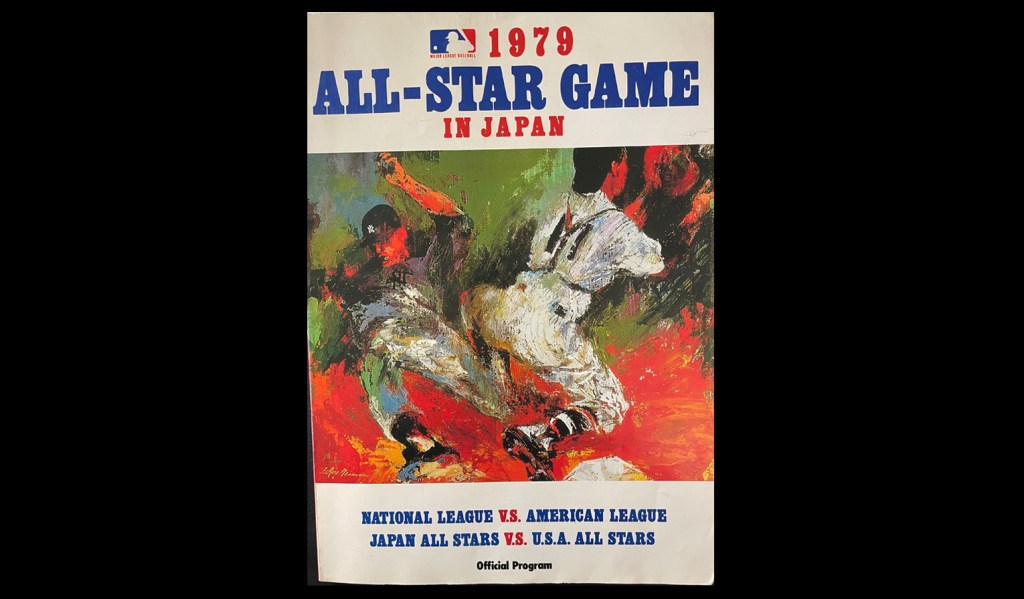
The 1979 Major League All-Star Series in Japan
by Carter Cromwell
Every Monday morning we will post an article from SABR’s award-winning books Nichibei Yakyu: Volumes I and II. Each will present a different chapter in the long history of US-Japan baseball relations. This week Carter Cromwell tells us about the 1979 MLB All-Stars visit to Japan.
When a group of major-league baseball all-stars traveled to Japan in November 1979 for a series of games, it represented a shift, of sorts. Since the end of World War II, most baseball tours of Japan had been by single teams. A US all-star team had not played in Japan since the Eddie Lopat All-Stars made the trek after the 1953 season.
The 1979 tour was dreamed up by Philadelphia Phillies Vice President Bill Giles and Cappy Harada, who was born in Santa Maria, California, to Japanese parents and at the time was director of the international division of the Major League Baseball Promotion Corporation. This was the first time the United States had sent complete American League and National League all-star teams to Japan for a series.
The American squad was divided evenly among American Leaguers and National Leaguers and was managed by the Orioles’ Earl Weaver and the Dodgers’ Tom Lasorda respectively. The schedule ran from November 7 to November 20, with the US teams playing seven games against each other and a combined US club playing twice against a team of Japanese players.
In the years since, the Japanese have consistently demonstrated their baseball prowess in various international competitions. But though it had made strides, the game in Japan in 1979 was still not the equal of the game in the United States, so the Japanese were eager to see the Americans play. Virtually every ticket for every game was sold in advance, with the most expensive costing $22,or about $89.79 in 2022 dollars.
Of course, the Japanese weren’t unfamiliar with US players, since they could watch videotaped highlights of US games on television on Sundays, and newspapers and magazines in the country reported on the major leagues. An Associated Press story noted, “[Pete] Rose is at least as familiar a name in Japan as Jimmy Carter. The escapades of Reggie Jackson and the salary hassles of [Dave] Parker are followed with keen interest. Ever since American teachers introduced the game to Japan in the 1870s, the Japanese have looked upon America as baseball’s holy land – at the same time aspiring to build their own version to match it.”
So actually seeing the Americans play in person was an exciting proposition.
Though some like Jim Rice, George Brett, and Jack Clark had to pull out of the tour beforehand for various reasons, the US roster was loaded. It included eventual Hall of Famers Rod Carew, Lou Brock, Ozzie Smith, Ted Simmons, Paul Molitor, and Phil Niekro. The California Angels’ Don Baylor was coming off the best season of his career, in which he had hit 36 home runs, driven in 139 runs, and was voted the American League’s Most Valuable Player. Others might be classified in the so-called Hall of the Very, Very Good – players like Parker, Cecil Cooper, Lance Parrish, Larry Bowa, Bill Madlock, Jim Sundberg, Dennis Martinez, Tug McGraw, and Ken Singleton. Singleton, in fact, finished second to Baylor in the MVP voting that year after hitting 35 home runs, driving in 111 runs, and posting a .938 OPS. There was also Rose, who would be in the Hall if not for his gambling issues.
“[Rose] is my favorite American player,” said Japanese Hall of Famer Sadaharu Oh, who holds the world career home-run record (868). “He never misses a game.”
Nonetheless, a spokesman for the Japanese baseball commissioner’s office said the Japan team will be “playing to win.” And there was no doubt that it was a strong club. Compiled by a vote of sportswriters, it included eight players who would eventually gain induction into the Japanese Baseball Hall of Fame – first baseman Oh, plus outfielders Yutaka Fukumoto, Koji Yamamoto, and Tsutomu Wakamatsu, and pitchers Choji Murata, Keishi Suzuki, Hisashi Yamada, and Manabu Kitabeppu.
Oh, of course, was the biggest name. He had even received a National Hero Award from the Japanese government after exceeding Hank Aaron’s career record of 755 home runs. Sometimes referred to as the Bamboo Bambino by the Japanese news media, he had a slash line of .301/.446/.634 over 22 seasons with the Yomiuri Giants. He drove in 2,170 runs in his career, even though the Nippon Professional Baseball season was 22 to 32 games shorter than that of the American majors.
“I really like to watch Oh swing,” Rose said. “He picks up his front leg but doesn’t go forward until he’s ready to commit himself. He keeps his hands and his weight back until he’s ready to swing.”
In 1979, at the age of 39, Oh had just completed his next-to-last season and had hit 33 home runs while batting .285, driving in 81 runs, and posting a .980 OPS. To many, that would have been very good, especially at that age, but Oh found it unacceptable. “I had a very disappointing year,” he said. “I hurt my side and missed several weeks. I had 33 home runs … but drove in only 81 runs. Five years ago, I had ‘only’ 33 home runs but drove in 118. And besides, the [Yomiuri] Giants finished 10½ games out this year. Very sad.”
Other Japanese players were nearly as transcendent as Oh, though not well known to most Americans. An 11-time all-star, Tsutomu Wakamatsu posted a .319/.375/.481 career slash line, won two batting titles, and as of 2023 still held the second-highest career batting average in Nippon Professional Baseball history for players with 4,000 or more at-bats. He was the Central League Most Valuable Player and MVP of the Japan Series in 1978. In 1979 he batted .306 with an .871 OPS. Koji Yamamoto was a 13-time all-star for the Hiroshima Carp, a 10-time winner of the Diamond Glove Award, and seven consecutive seasons the leader in assists among outfielders. At the time of the 1979 series, he was coming off a .293 season with a 1.002 OPS.
Yutaka Fukumoto played 20 seasons with the Hankyu Braves, a predecessor of today’s Orix Buffaloes, and posted a .291 batting average and .819 OPS, along with an otherworldly total of 1,065 stolen bases.
American Leon Lee, who played 10 seasons in Japan, observed that Fukumoto “was a great base runner, too, adding, “I remember many times he would lead off a game by getting on base, stealing second, getting sacrificed to third, and scoring on a sacrifice fly.”
On the pitching side, Choji Murata won 215 games over 23 seasons, 22 of them with the Lotte Orions. He was a three-time Pacific League ERA champion and threw five one-hitters. He had finished the 1979 season with 17 victories, a 2.96 earned-run average, and a 1.09 WHIP.
Leon Lee’s brother Leron, who played in Japan for 11 seasons, remembered, “Choji Murata was … fabulous. He was the best pitcher I’ve seen except for Bob Gibson. In 1979, he pitched against the American All-Stars, and Ted Simmons … told me that Choji Murata was the best pitcher he ever faced in his life, bar none. That’s how good Murata was. He could throw 90 to 96 miles an hour consistently, had a great forkball, and he had this really funky windup with a high kick. I saw him throw an inside pitch that hit the bat below the label, broke it in half, and the ball had so much power that it went through the bat, hit the batter on his back leg, and rolled out into fair territory along with the head of the bat. Everybody in the stadium stopped for two or three seconds and looked. It was unbelievable for a ball to go through a bat and still have enough momentum to hit the batter in the leg and roll forward.”
Though 1979 was a down year for Keishi Suzuki (10-8, 4.41 ERA), he spent 20 years with the Kintetsu Buffaloes and won 317 games with a 3.11 ERA and low 1.12 WHIP. He had eight 20-victory seasons and led the Pacific League in strikeouts eight times. Leron Lee learned about Suzuki very early on, the night before his first game in Japan, in fact. The team had a meeting to go over the opponents, and a scout went on and on about how good Suzuki was.
“I said to [teammate] Jim Lefebvre that if this guy pitches like the scout says, we’re not going to get any hits tomorrow,” Lee said. “And, sure enough, Suzuki pitched a one-hitter! That guy was the best left-handed pitcher I ever faced. I faced Steve Carlton and several pretty good pitchers in the big leagues, but this guy was unbelievable. He was an absolutely fabulous pitcher who could have pitched in the major leagues very easily.”
An interesting aside is that when he was the Kintetsu manager, Suzuki’s disputes with pitcher Hideo Nomo indirectly played a role in Nomo’s eventual signing with the Los Angeles Dodgers in 1995.
In 19 seasons with Hiroshima, Manabu Kitabeppu was 213-141 and ranks 17th all-time in pitching victories in NPB. He was an all-star seven times. In 1986 he won the ERA title, took the MVP and Gold Glove awards and was named to the “Best Nine,” which includes the best player at each position in both the Central and Pacific Leagues, as determined by a pool of journalists. During the 1979 season, just his fourth in the NPB, he had won 17 games and allowed an average of just 1.6 walks per nine innings.
Hisashi Yamada, Japan’s greatest submarine pitcher, was 284-166 in 20 seasons with the Hankyu Braves. His lifetime ERA was 3.18 and his WHIP a low 1.13. In the mid-1970s Yamada was the most dominant pitcher in Japanese baseball, winning three consecutive Pacific League MVP Awards (1976-1978). He was named to five Best Nine teams and 13 all-star squads, and won five Gold Glove Awards. In 1979 he had finished with a 21-5 record and a 2.73 ERA. Leon Lee said Yamada was the “toughest pitcher I ever faced in my 17-year professional career. He had great control and was never afraid to pitch inside. The biggest thing was that he completely controlled the tempo of the game and never gave the hitters time to get comfortable at the plate.” Leron Lee named players like Oh, Yamada, Murata, Suzuki, Yamamoto, and the Hanshin Tigers’ Masayuki Kakefu (also on the 1979 Japan All-Stars) among several he said could have been major leaguers.
The schedule began on November 7 with the American League battling the National League at Yokohoma Stadium. The teams played each other again on November 8 (Kusanagi Stadium in Shizuoka), November 11 (Korakuen Stadium in Tokyo), November 12 (Seibu Stadium in Tokorozawa), November 13 (Nagoya Stadium), November 17 (Seibu Stadium in Tokorozawa), and November 18 (Yokohama Stadium).
The NL stars won the first game 11-2 behind a 16-hit attack. The Chicago Cubs’ Dave Kingman hit a two-run homer, and Niekro picked up the win. In Game 2 the Nationals rallied from a 4-1 deficit to tie the game 5-5 on an eighth-inning sacrifice fly by Kingman. The contest was called after 10 innings because of a time limit in Japanese games.
Game 3 went to the American League, 6-3, and the AL followed that with a 6-5 victory in Game 4 before 21,000 fans at Seibu Stadium, as Kansas City’s Willie Wilson singled home the winning run in the bottom of the ninth inning. The National League had scored three runs in the first inning and another in the second to lead 4-0 before the AL rallied.
After that, though, the NL had its way, winning the last three games of the series by scores of 12-9 (after trailing by 7-0), 3-2, and 7-1 in the finale on a two-hitter by Niekro.
For the Japanese fans, though, the most anticipated games of the series were the two between the United States and Japan. A wire-service story just prior the tour noted that the US players would be “scrutinized, idolized and analyzed for what makes their game different from the Japanese national pastime of ‘besuboru.’” And there were differences. The Japanese relied more on small ball and fundamentals, and they utilized off-speed pitches more often. The Americans, on the other hand, focused more on the big inning, especially with a manager like Weaver. In addition, both the baseball itself and the ballparks in Japan were slightly smaller.
The first game took place November 14 before 31,000 fans in Nishinomiya, a city between Kobe and Osaka. Yamamoto, of the 1979 Japan Series champion Hiroshima Carp, hit a solo home run off US starter Niekro in the bottom of the second inning to give Japan a 1-0 lead. The Americans scored twice off Yamada in the top of the third inning, but the Japanese answered quickly with three runs in the bottom of the third to take a 4-2 lead.
The US team came back with a run in the fourth when Cooper tripled and scored on a sacrifice fly by Madlock, and the Americans got a two-run home run by Simmons off Suzuki in the sixth to lead 5-4. Bowa then hit a solo homer off Japan’s Shigeru Kobayashi in the seventh, and that proved to be the difference as Japan got an RBI single from Kakefu of the Hanshin Tigers in the bottom of the inning to account for the final 6-5 score.
Knuckleballer Niekro pitched three innings and allowed four hits, two walks, and two earned runs before being relieved by Oakland’s Rick Langford. Nonetheless, he baffled Oh, whom he struck out twice, once with the bases loaded and no one out. Oh said, “It felt like the ball was swaying left and right. I wasn’t able to hit it at all. It was a mysterious ball.” For the Japan side, Murata held the major leaguers hitless in the eighth and ninth innings, primarily with his forkball.
After the game, US manager Weaver said, “It was a close game. I was worried and felt relieved that we won. There was little difference today with the pitchers of either team. [The Japanese] certainly could play major league baseball.” That, of course, was 16 years before Nomo proved the point by signing with the Dodgers and earning All-Star and Rookie-of-the-Year honors in his first season.
Yukio Nishimoto, who had managed the Kintetsu Buffaloes to the 1979 Pacific League title and was leading the Japan All-Stars, said, “The Americans are speedier than the Japanese. … I’m afraid the difference is decidedly in their favor. We’d be lucky to win two games out of 10.”
They got one six days later.
A crowd of 42,000 at Tokyo’s Korakuen Stadium watched the Americans score single runs in the third inning (a home run by Parrish off the left-field foul pole against Japan starter Naoki Takahashi) and in the seventh (a sacrifice fly by the California Angels’ Carney Lansford) to lead 2-0. Six US pitchers held the Japanese scoreless until the bottom of the eighth inning, when Kinji Shimatani of the Hankyu Braves electrified the fans by ripping a 2-and-0 pitch from Cleveland’s Sid Monge for a three-run homer to give the Japanese a 3-2 lead. And that was enough, as Kitabeppu pitched the eighth inning and Tatsuo Komatsu of the Chunichi Dragons the ninth to get the save.
Since the US and Japanese teams played just two games against each other, the final statistics do not represent a large sample size. For the Americans, Cecil Cooper was 2-for-3 in the one game he played, and Ted Simmons was 2-for-7 in two games with a home run and two RBIs. They were the only Americans to get more than one hit in the two games, as the team batted a minuscule .172. The US pitchers posted a 3.18 earned-run average over 17 innings and held the Japan stars to a .210 batting average.
Virtually all the Japanese position players participated in both games, with Yasunori Oshima (Chunichi) batting .500 (1-for-2), Kakefu and Fukumoto each .429, and Hideji Kato (Hankyu) .333. On the pitching side, Murata did not allow a run in four innings while striking out five batters. Takahashi gave up just one run in four innings, while Yamada allowed two runs in three innings of work. The Japan ERA in the two games was 3.50.
Overall, the tour was considered a success, though there was some complaining by players about the travel. One day, for example, eight buses and trains were necessary to get the group from a hotel in Tokyo to a ballpark and then to Nagoya.
There was also some controversy when first Carew and then Rose went home early and Kingman had to be talked out of going home the same day Carew left. Japan’s Kyodo News Service quoted Rose as saying he had suffered a leg injury while going after a pop fly “and it’s been getting worse.” Rose had also arrived in Japan ahead of the others and had announced beforehand that he would not be staying until the end.
As for Carew, American League spokesman Bob Fishel said he had injured a tendon in his right heel before the trip. Carew, however, said that the injury was just part of the reason for his leaving after playing in two games. He also felt league officials had not come through on prior commitments for endorsement and appearance income. He said he had been hesitant to make the trip but did so because of promises that he could make $40,000 to $50,000 in endorsements and appearances, in addition to the base pay of $11,000 to players on the winning team and $8,500 to those on the losing club.
“Now I can’t help but feel that we were told these things simply so that we would say ‘yes’ to making the trip,” Carew said. “I definitely doubt that I’d ever make another. I had wanted to stay home, but they made it sound as if it was something I couldn’t pass up.”
The Pittsburgh Pirates’ Bill Madlock said, “We’d been led to believe there would be ways to pick up extra money for endorsements. It just didn’t happen.” Cecil Cooper added, “I really was disappointed. I thought we would be involved in a lot more endorsements and things like that. Only a few players got them. I don’t think I would come back.”
The expectation of ancillary income was due in part because Rose had been to Japan the previous year with the Cincinnati Reds and had been in demand for endorsements, television appearances, and autograph sessions. Joe Reichler, who at the time helped run the Major League Baseball Promotion Corporation, was quoted as saying, “I think a lot of the players saw how well [Rose] did and figured the same thing would happen to them. [But] there really were no firm commitments along these lines.”
Milwaukee Brewers pitcher Lary Sorensen felt that that it was “not a big issue teamwide. Maybe it was for a few of the main guys. But I was young and just happy to be there.” And Singleton said in a 2021 conversation that “it didn’t matter to me one way or the other. Some guys may have been concerned about it, and it would have been OK if it had happened to me, but it was no big deal that it didn’t.”
In the past there had been incidents of Americans going to Japan and behaving in a rude, arrogant, boorish manner. This time, they were generally considered to be well-behaved, though interpreter Toyo Kunimitsu sometimes saw them differently, as described in Robert Whiting’s seminal book about Japanese baseball, You Gotta Have Wa.
The [US] All-Stars were rather tacky and rude,” said Kunimitsu, who worked as translator for foreign players with the Yakult Swallows and, later, the Chunichi Dragons. “Once we were on a long bus ride [and] John Candelaria, the pitcher for the [Pittsburgh] Pirates, had been drinking a lot of beer and had to urinate. So he urinated into a bucket and threw it out the window. I was shocked. The driver was really angry. He wanted me to throw Candelaria off the bus, but finally agreed to let him stay when Candelaria said he would stop drinking beer. I saw a lot of bad examples of spoiled Americans on that tour.”
Nonetheless, the Americans took the games seriously, and many had positive memories.
Parker had not wanted to come on the tour because of a bad knee, but he finally agreed and played in most of the games, even playing some in center field and sliding on his bad knee. The New York Yankees’ Bobby Murcer was said to have been upset that he did not get more playing time. Kingman, usually not accommodating to the media, stood on the sidelines after the first US-Japan game and answered question after question from reporters through an interpreter. Simmons could have returned home after the last AL-NL contest, but he volunteered to stay for the second game against Japan and played the entire game.
“To me, this was the trip of a lifetime,” Simmons said. “I really have no complaints. I enjoyed it, and so did my wife. Japan is a country I [had] always wanted to visit, and to be able to do it this way is terrific.”
Singleton said, “It was a great trip. We were treated well and enjoyed it tremendously.” Pitcher Rick Langford of Oakland said, “It’s an honor and a pleasure to be here [in Japan].” And Sorensen and Angels pitcher Mark Clear, both newlyweds, considered the trip to be their honeymoons.
“I was just 23, had never been to Japan and had just gotten married, so I thought ‘Wow, what a great opportunity to travel and see some of the world,’” Sorensen said. “They treated us with great respect, and the games were great because the fans were so enthusiastic. It was like going to a football game in the U.S.
“The whole trip was an autograph session,” he added with a laugh. “Whenever we’d go out, people would point at us and then ask for autographs. For the majority of us, it was a fabulous tour, and we thoroughly enjoyed it. It was a lot of fun.”
Sorensen remembered a couple of amusing occurrences, one on the team plane. The Pirates had recently upset Weaver’s Baltimore Orioles to win the 1979 Word Series and, in the process, had adopted the Sister Sledge hit song “We Are Family” as their unofficial anthem. During a flight, Sorensen noticed Candelaria, Parker, and Madlock sneaking toward the front of the plane where Weaver was sitting.
“They had a big boom box and blasted out ‘We Are Family,’” Sorensen said. “It didn’t bother Earl, but we all thought it was funny.”
Sorensen recalled another time when a Japanese TV reporter was in the US dugout and providing live commentary during a game. As he was wont to do, Weaver got into a profanity-laced argument with a couple of the American umpires, and the reporter translated what was being said for his Japanese audience. However, when Weaver said something like “You’re a bleeping, bleep, bleep,” the reporter was stumped for a translation and simply repeated Weaver’s exact words over the air.
Lou Brock, who had retired after the just-completed 1979 season, was honored after the final game for his fine career, and Lasorda gave big thanks to the Japanese, in particular chief sponsor Junichi Wada. “It was a great gift Mr. Wada gave the Japanese people,” Lasorda said. After the final game, both teams paraded around the perimeter of the stadium, and the fans came as close as possible to the field to give them a standing ovation.
“Overall, it was a good experience,” Larry Bowa said. “There were problems with travel, and we all got tired. Going to Japan, however, was quite an experience.”
Had the Japanese game made up some ground in its quest of equaling or surpassing the Americans? Weaver said after the first game that Japanese baseball had made tremendous improvement since his previous visit in 1971. All the players, he added, looked like potential home-run sluggers.
Sorensen felt somewhat differently, though he could see that there was quality in the Japanese roster.
At the time, I think the Japanese game was at the Triple-A level. The biggest thing was the size difference; we had size and skill sets that, at the time, were noticeably different. They didn’t have any (Shohei) Ohtanis then, although that’s changed over time. But there’s no question that they had some really good players, were fundamentally sound, and were very well prepared. They took the game very seriously, probably more so than we did, and they were more aggressive with small ball than we were. Skillwise, they had some infielders that could probably have been major leaguers. And while most of their pitchers didn’t throw hard, they were tough because they could throw a bunch of different pitches with different deliveries and from several arm angles.
Singleton said he “wasn’t too impressed with the Japanese pitchers then, though they did a good job of mixing their offerings and using off-speed pitches.” He commented, “I was more impressed with them when I went back to Japan with the Orioles after the 1984 season. Since then, of course, they’ve had quite a few pitchers come over to the major leagues and do well. The two games were really competitive, though. We were more about power – the Japanese players would watch us in batting practice and were impressed. On the other hand, the Japanese played small ball really well.”
As the Japan Times noted, “the gap that existed between American and Japanese baseball has been narrowed by the two U.S.-Japanese games.”
Read the full version of this article on the SABR website
-
BK, Another Side That Continued After Retirement
By Tae-in Chun
When people think back to the 2001 World Series, many remember this scene: a game-tying home run with two outs in the ninth, and a pitcher collapsing on the mound. The man at the center of that moment was BK, Byung-hyun Kim. That year, he was the closer for the Arizona Diamondbacks. He took responsibility for finishing games in both the Division Series and the Championship Series, helping Arizona reach the World Series. In Games 4 and 5, he gave up two home runs. The series went all the way to Game 7, and in the end, the team won the championship. Kim became the first Korean player to appear in the World Series and experience winning it.
Byung-hyun Kim made his professional debut at twenty. At twenty-two, he was entrusted with the ninth inning of the World Series. His pitches, rising sharply from a low release point, felt unfamiliar to hitters. That unfamiliarity was his weapon.
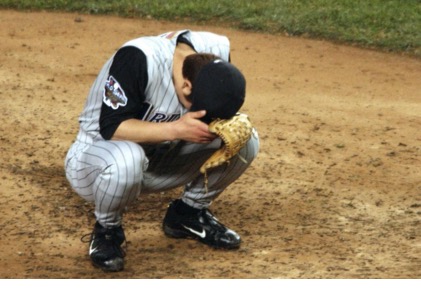
BK sitting down on the mound after recording a blown save A personality that stood out even more in the conservative culture of Korean baseball
Although Kim was an exceptional talent, the trait that made him even more famous in Korea was his “bad boy” image. In 2003, while playing for the Boston Red Sox, he was heavily booed by home fans and responded by raising his middle finger toward the stands, instantly causing controversy. He later apologized publicly. MLB media at the time also criticized the act as “unprofessional.” Still, after the apology and the club’s disciplinary action, the issue did not grow further there.
In Korea, however, the image lingered strongly. Even now, it is still remembered as the “beop-gyu incident.” The nickname grew out of the similar sound between the English swear expression and the Korean word beop-gyu meaning “regulation,” along with the trivial fact that he had studied law. It eventually became one of Kim’s best-known nicknames.
In one entertainment program, Byung-hyun Kim revealed the World Series ring he had found at home His choices after retirement, and an extension of his MLB experience
After retiring, Byung-hyun Kim entered the food business. It began with a sushi restaurant in San Diego. Later, he opened “Gwangju Jeil Hambaego” in Gwangju. His decision to focus on hamburgers goes back to his playing days. He said that when he visited Boston in 1995 for the World Youth Baseball Championship, he walked into a Burger King for the first time. That experience became one of the sparks, and he has said that the food culture he encountered while living in the United States also shaped his business ideas.
The idea of opening a restaurant inside a baseball stadium was something he had carried with him since his days with the Arizona Diamondbacks. He explained that he was inspired by Gonzo’s Grill at Chase Field. Seeing a stadium restaurant named after a player made him want to open a burger shop inside a ballpark using the name of his alma mater, Gwangju Jeil High School. His stores later opened in places such as Gocheok Sky Dome and Changwon NC Park, and at one point expanded to five branches, though only the main location is currently operating.
Later, he adjusted both the menu and the direction of the business. He now runs Metz Hannam, a German-style sausage restaurant in Hannam-dong, Seoul. To make sausages, he learned the process from a sausage meister in Korea. Afterward, he participated in a sausage competition held in Germany. The sausages he made received awards from the German Butchers’ Association.
He said, “Baseball was my world, and I poured all my passion into it. After retirement, there was an emptiness. So I started working in food service, and now I am pouring my passion into that work.” Even after retirement, he has continued baseball in another way.
He won six gold medals at a sausage competition in Germany Past that era, now in a place where he talks about MLB
Recently, he has been appearing on the MLB Korea talk show Meritalk. The program was created to introduce Major League Baseball to Korean baseball fans. Joining him are Johnny of the K-pop group NCT, Dustin Nippert, former Arizona and Texas pitcher, and Sun-woo Kim, who played for Montreal and Washington.
Although it is an entertainment program, it also covers how former MLB players adapted to the minor leagues and the major leagues, as well as the cultural differences they experienced.
Byung-hyun Kim moved to the United States at twenty. At the time, he was only the third Korean player ever to reach Major League Baseball. There was also very little environment for receiving advice on adapting to life and competition in another country. Looking back on his MLB days on Meritalk, he says this:
“MLB is not a system where someone takes care of you. If you set a goal, you have to fight for it yourself until the end. But rather than trying to force quick results, it is more important to adapt to the system first. English matters as much as baseball. You also should not isolate yourself, and it is important not to compare yourself with others.”
His advice mentions adaptation before baseball skills. It is the perspective he gained from experiencing the major leagues at a young age. Now, drawing on that experience, he shares entertaining stories that help Korean fans understand and enjoy Major League Baseball more deeply.
The talk show “Meritalk,” where K-pop stars and baseball figures introduce MLB together, has been receiving a positive response from a wide range of viewers.
-
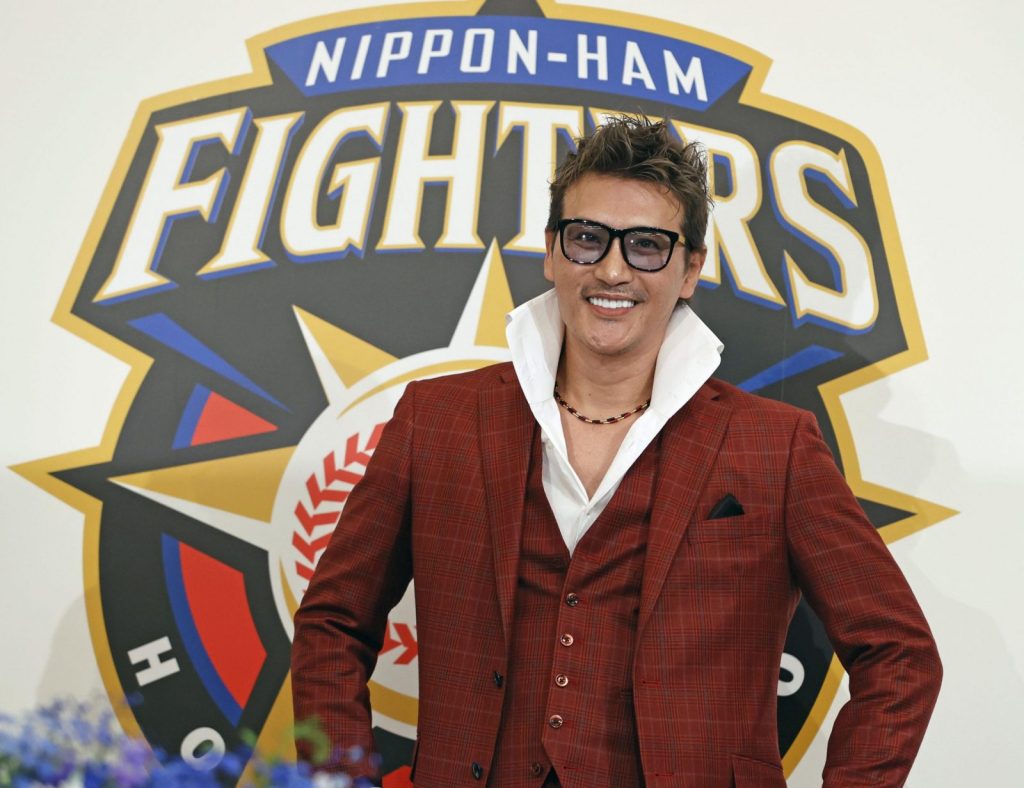
Japan’s Favorite Players: No. 7, Tsuyoshi Shinjo
by Thomas Love Seagull
A recent poll for a TV special saw more than 50,000 people in Japan vote for their favorite retired baseball players. 20 players emerged from a pool of 9,000. Yes, they could only vote for players who are no longer active, so you won’t see Shohei Ohtani or other current stars on this list. Which is probably smart because I’m sure Ohtani would win by default. There are, however, players who were beloved but not necessarily brilliant, and foreign stars who found success after coming to NPB. Unsurprisingly, the list leans heavily towards the past 30 years, with a few legends thrown in for good measure.
Over the next few weeks, I’ll be profiling each of these players. Some of these players I know only a little about, so this will be as much a journey for me as, hopefully, it will be for you. It’ll be a mix of history, stats, and whatever interesting stories I can dig up.
For now, have a look at the list below and see how the public ranked them. I’ve included the years they played in NPB in parentheses.
20. Alex Ramirez (2001-2013); 19. Yoshinobu Takahashi (1998-2015); 18. Warren Cromartie (1984-1990), 17. Takashi Toritani (2004-2021); 16. Suguru Egawa (1979-1987); 15. Katsuya Nomura (1954-1980); 14. Tatsunori Hara (1981-1995); 13. Kazuhiro Kiyohara (1985-2008); 12. Masayuki Kakefu (1974-1988); 11. Masumi Kuwata (1986-2006); 10. Atsuya Furuta (1990-2007); 9. Randy Bass (1983-1988); 8. Daisuke Matsuzaka (1999-2006, 2015-2016, 2018-2019, 2021); 7. Tsuyoshi Shinjo (1991-2000, 2004-2006); 6. Hiromitsu Ochiai (1979-1998); 5. Hideo Nomo (1990-1994); 4. Hideki Matsui (1993-2002); 3. Shigeo Nagashima (1958-1974); 2. Sadaharu Oh (1958-1980); 1. Ichiro Suzuki (1992-2000).
The player who turned the diamond into a stage and never forgot whom he was performing for
Drafted fifth round in 1989, no Koshien tournament appearances to his name, Tsuyoshi Shinjo walked into his introductory press conference with the Hanshin Tigers sporting a shaved-sides flat-top haircut and the demeanor of a man with somewhere else to be. Someone asked him about his feelings joining one of Japan’s most storied franchises, the team that played at the great cathedral of Koshien, in front of the most passionate fan base in the country. Shinjo considered the question.
“I was more into soccer,” he said, “so I wasn’t that interested in professional baseball.”
The room erupted in laughter—the Kyushu accent, the artless delivery, the complete absence of the expected reverence. Nobody quite knew what to make of him.
That was, it would turn out, a feeling they would need to get used to.
His first year in the minors he batted .074. His arm, however, was something else entirely. During a fall camp that year, Yoshio Yoshida, the legendary shortstop and former manager who had become one of the most respected baseball minds in Japan, watched the teenager throw from the outfield and told the coaching staff: that athleticism belongs at shortstop. Shinjo converted. In his first call-up to the big league club the following year, he positioned himself at an almost comically deep shortstop, far deeper than anyone played the position, specifically and deliberately, so that the throws he made to retire runners would be long enough to make people notice his arm. He was nineteen years old and already managing his own image.
He had arrived. It just took him a little while to let everyone know.
Here is something worth understanding about Tsuyoshi Shinjo’s career. By the counting stats, he was good but not exceptional. Across thirteen NPB seasons, he batted .254 with 205 home runs, won ten Golden Gloves (tied for 4th all-time) after moving to centerfield, and made the Best Nine three times. In three seasons in MLB, he batted .245 with 20 home runs across 303 games. These are the numbers of a capable player, a fan favorite, a glove-first center fielder who could make your jaw drop and your heart sink in roughly equal measure.
And yet Tsuyoshi Shinjo is one of the most famous baseball players Japan has ever produced. He is famous in the way that certain athletes (think Jose Canseco, Dennis Rodman, or Deion Sanders) achieve a kind of celebrity that floats entirely free of their statistics. He is famous because he understood that a ballgame is a performance, and a performer’s first obligation is to the audience.
His manager towards the end of his tenure with Hanshin, the great Katsuya Nomura looked at Shinjo and arrived at a memorable conclusion. “I never thought of him as a student,” Nomura wrote. “Rather than teaching him anything, I used the feeling of flattering a pig into climbing a tree.” Nomura’s method with Shinjo was simple: ask him what batting order position he wanted, put him there, and watch him perform. Ask him what position he most wanted to play, then let him try it. “Leave him alone and he motivates himself,” Nomura concluded. “He was, for a manager, an easy player to handle.”
Nomura meant this as mild condescension. But there is another way to read it. Here was one of the most manipulative managers in baseball history, a man who turned psychology into an art form, and his technique with Shinjo was simply: give him a stage. That was the whole point of Shinjo.
Born in Nagasaki Prefecture on January 28, 1972, Shinjo grew up in Fukuoka, the son of a landscape gardener who had dreamed of his own baseball career and poured that dream into his son with an intensity that bordered on terrifying. By the time young Tsuyoshi was six years old, his father had already established that the boy could throw a stone farther than any adult in the neighborhood. Their daily training ritual involved Shinjo standing at the top of a hill while his father threw the ball up from the bottom, hard as he could and if the boy let it roll back down, he was ordered to chase it before it stopped. He chased it, crying, every time. But he never quit.
The competitive fury expressed itself early. In a town softball tournament at the age of eleven, Shinjo was so incensed by what he believed was a bad call that he argued with the umpire alone, weeping, long after his coaches had tried to pull him away. The coach was so struck by the sight that he made Shinjo an offer: if you feel that strongly, I’ll become your manager. Let’s start a baseball team and turn that frustration into something. Shinjo assembled enough players within two days, took charge of designing the uniforms, and within six weeks they had finished third in the Fukuoka prefectural tournament out of 64 teams. He was captain, ace pitcher, and cleanup hitter. He was eleven years old. He was already producing and directing his own story.
The team, by the way, was called the Nagaoka Fighters which, if you believe in that sort of thing, is either a coincidence or something else.There is a moment from September 16, 1992, at Koshien Stadium, that the Hanshin faithful still remember.
The Tigers, coming off two last place finishes in a row, are improbably in the pennant race. The game against Hiroshima is scoreless going into the eighth inning. With two out and the bases loaded, Hiroshima’s Ryuzo Yamasaki hits a liner to right-center, a ball that looks like it is going to possibly end the season. No longer a shortstop, Shinjo, who has been a regular for less than three months, is already running. He runs a long way. He dives. He catches it.
Then, in the bottom of the ninth, with the score still 0-0, Shinjo steps in against future Hall of Famer Yutaka Ohno, and hits a walk-off home run.
In the hero’s interview afterward, Shinjo grabbed the microphone and announced: “We’re going to win the pennant!”
They did not win the pennant. They finished second, one game out, in what became another in a long list of heartbreaking near-misses in franchise history. But for one evening, standing in the lights at Koshien, Tsuyoshi Shinjo made everyone believe it was possible.
That year’s Tigers resurgence had two faces: center fielder Shinjo and left fielder Tsutomu Kameyama, whose names combined to give the phenomenon its name, Kame-Shin Fever. The city of Osaka lost its mind. Fan letters for Shinjo arrived at the team dormitory at the rate of one cardboard box per day. Young women, dubbed Shinjo Girlsby the press, gathered in such numbers outside the dormitory gates that getting home from the stadium became impossible, and the dormitory manager eventually put Shinjo in a hotel to relieve the congestion. His salary that offseason rose 323 percent, the largest single-season raise in Tigers history at the time.
He was twenty years old. He was driving a Lamborghini and receiving a cardboard box of love letters every day and playing center field for the most passionate fan base in Japanese baseball. The reasonable response to this situation would have been to become completely insufferable. Instead, Shinjo seems to have concluded that all of it—the letters, the fans, the noise, the love—was not something that was for keeps, but something he owed back. The fans gave him their passion. He would spend the rest of his career figuring out how to return it.
He dyed his hair. He began wearing the bright red wristbands that would become synonymous with his name. He developed his signature habit of adding a small hop to routine fly ball catches, a theatrical touch he had developed in high school by training himself to catch eggs dropped from the second floor without breaking them. The hop, it turned out, had genuine logic behind it, stilling his eye line at the moment of catch, absorbing the ball’s momentum, and loading him instantly for the throw. He explained all of this with complete seriousness when asked. No one ever quite knew what to do with the fact that his most flamboyant habit was also one of his most technically sophisticated.
He drove a Lamborghini Countach to contract negotiations in 1993. A Porsche in 1994. A Lamborghini Cheetah in 1995. Car reporters began staking out the parking lot of the Tigers front office because Shinjo’s arrival was better automotive content than anything else they were covering. He wore Versace. He sprayed perfume on his wristbands and towels because he couldn’t tolerate the smell of the dugout. He recorded a love song in 1994 that sold 8,000 copies. He married one of Japan’s top models. He was Tsuyoshi Shinjo, and he wanted everyone in the stadium to know it.
On June 12, 1999, in the twelfth inning of a tie game against Yomiuri at Koshien, the Giants decided to intentionally walk Shinjo to set up the force play.
Three days earlier, against the same Giants, Shinjo had been walked intentionally and let it go. But he had spent that time in the batting cage with his hitting coach, practicing swings at pitches thrown well outside the strike zone. He had arranged a signal with Nomura so that in the right situation, he would receive permission to swing. When the signal came, he repositioned himself to the far edge of the batter’s box, noted that the shortstop was shading toward second base, leaving a gap on the left side of the infield, and waited.
The second pitch was perhaps slightly less outside than the first. Shinjo swung and drove a single through the gap and sending home the winning run. The Giants protested that his foot had left the batter’s box. The home plate umpire ruled that his heel had remained on the chalk line. Shinjo walked off the hero of the game. He had pre-planned and pre-practiced a play that no rational person would have attempted, gotten managerial approval in advance, studied the defensive alignment, found the gap, and executed. A spaceman, Nomura had called him. It turned out that being a spaceman was occasionally a tactical advantage
He then announced, with a grin, that he would never do it again. The following day, before the same opponents, he took more batting practice on outside pitches, just in case.
In the winter of 2000, Shinjo made the most Shinjo decision of his career.
He had just completed his best NPB season: .278 average, 28 home runs, 85 RBIs, a team-best in virtually every offensive category, a Best Nine selection, a Golden Glove. The Tigers offered him a five-year contract extension worth approximately 1.2 billion yen. This was an extraordinary sum, security for life, in the city where he had become a star.
Shinjo turned it down to sign with the New York Mets for the major league minimum. At the press conference announcing the deal, he stepped to the microphone with the calm of a man who had been rehearsing this moment for years: “I’ve finally found a place where I can play the kind of baseball I envision. That team is the New York Mets.”
The reaction in Japan was divided along a single line. That same offseason, Ichiro Suzuki had finalized his move to the Seattle Mariners through the posting system. Ichiro’s move made sense. Shinjo’s move prompted something closer to seriously? He was not Ichiro. He had one excellent season and eight largely difficult ones. He was a defensive specialist with intermittent power and a .254 career average. The Mets’ offer was less than what Hanshin, Yokohama, and Yakult were each prepared to pay him, making the gamble look even stranger from the outside.
He only played in the majors for three seasons, with the Mets, San Francisco Giants, and then back with the Mets. But he did become the first Japanese player to appear in the World Series. The bat he used to record the first hit by a Japanese player in World Series history, a first-inning single off Jarrod Washburn in Game 1, sits in the Baseball Hall of Fame in Cooperstown. It is engraved TSU No. 5, in Shinjo’s own handwriting.
When Shinjo returned to Japan to play for the Nippon-Ham Fighters, the performances grew more elaborate.. In the first inning of the 2004 All-Star Game, Shinjo stepped to the plate, pointed dramatically toward left-center field—a called shot, straight out of Babe Ruth—and then dropped a surprise bunt on the first pitch. It failed. He returned to the dugout having accomplished nothing except making everyone in the stands laugh.
In the third inning, he doubled to left-center off the same pitcher, moved to third on a ground ball, and then, with the the catcher returning the ball to the pitcher, Shinjo broke from third base. He slid headfirst into home plate and was called safe on the closest of plays. He pounded the ground with both hands and feet, a grown man overcome with pure joy.
It was the first solo steal of home in All-Star Game history. The only one ever, to this day.
After collecting the MVP award, Shinjo was asked about the play. His answer was precise and, once you understood who he was, completely unsurprising: “If I weren’t in the Pacific League I wouldn’t have done it. I want to brighten things up. If players like this appear and get media coverage, fans will want to come to the ballpark.”
On Opening Day 2006, rather than jogging to his position in center field like a normal human being, Shinjo drove a Harley-Davidson trike across the playing surface of Sapporo Dome, circled the warning track, and parked at his position, while his fellow starters rode in the sidecars. The stadium held 43,000 people. It was sold out. He had promised it would be when he signed.
That same season, he appeared at a game wearing, under his Fighters uniform, his old Hanshin Tigers jersey. He had worn it to honor his former team during an interleague matchup. The Pacific League umpires ruled it a violation. He was warned. He removed the jersey. He did not particularly seem to regret it.
In April, after hitting a home run against Orix, he named the blast by announcing it had been hit with a special technique: “I enjoyed baseball fully for 28 years. This year I’ll take off my uniform” home run technique. He was announcing his retirement, mid-game, in a home run naming ceremony, while still playing the game. The press called it the Shinjo Theater. It was.
In June, before a game against the Tigers at the Sapporo Dome, he descended from the ceiling in a small gondola with a disco ball attached to it. In the All-Star game that year, he used a rainbow bat and wore an LED belt with the message “Never mind whatever I do, fan is my treasure.”
He wore a collared undershirt beneath his uniform in a game against the SoftBank Hawks. SoftBank’s manager Sadaharu Oh complained. The league ruled against it. The debate occupied sports media for days. Shinjo said he had thought the look was nice.
He declined to steal bases because, he said, he had no interest in it and because, more specifically, he didn’t want his legs to become too muscular, because muscular legs did not look attractive in jeans.
On September 27, 2006, in the final regular season game at the Sapporo Dome, Shinjo played in the number he had worn as an eighteen-year-old rookie: 63, the first number the Tigers had given him, the number stitched in black thread into the thumb of the glove he had used his entire career, the glove he had bought with his first paycheck, repaired four times, and refused to let anyone else touch. Before the retirement ceremony, the stadium went dark. A video of his baseball life played on the scoreboard. He watched it from center field, standing in his customary posture, his glove resting on top of his cap.
Then he removed his uniform and placed it on the ground, along with the glove and the wristbands. His undershirt had a message printed across the back: “Today, this day, this moment, I’m going to engrave it in the album of my heart, and from here on, I’ll keep doing things my way!”
He walked off the field without speaking. The scoreboard displayed a handwritten message he had prepared in advance: “With what little baseball life I have left, I promise everyone today that I’ll keep chasing the white ball with brightness and joy.”
Six weeks later, after the Fighters had won the Japan Series (the first championship for the franchise in 44 years) and after Shinjo had gone six for seventeen in the Series itself, his teammates did not toss manager Trey Hillman into the air first. They tossed Shinjo. He wept so completely that he could barely walk.
He had told them when he arrived in Hokkaido that he would fill the stadium and win the championship. He had done both.
In 2022, the Fighters hired Shinjo as their manager. He asked to be called Big Boss. He arrived at his first home game in a manner resembling professional wrestling. He designed alternate uniforms in black, red, and gold, with a V on the chest, labeled “New Age Games produced by SHINJO”. He banned the sacrifice bunt, in a league that treats the sacrifice bunt as something close to sacred. His first season the Fighters finished last. He gave 23 different hitters regular playing time. He developed young pitching. He built from nothing.
By his third year the Fighters were back in contention, and by his fourth they were among the Pacific League’s genuine powers. The critics who had spent thirty years saying Shinjo was all show and no substance looked at what he had built and found they had run out of things to say. He had always been serious. He had always been paying attention. He had just declined, then and now, to perform seriousness in the way that made other people comfortable.
There is a woman, a devoted Tigers fan, as so many people in Osaka were and are, who in 1992 listened to every Tigers game on the radio with her sister, because in those days almost nothing except Giants games made it to television. For two sisters who had grown up through the Tigers’ long dark years, Shinjo was one of the dazzling stars they had finally found. One evening, Shinjo was called to the hero’s interview platform. The sisters turned up the volume and leaned close. There was a pause. Then his voice:
“I smashed that white ball!”
The two sisters burst into applause, there in their living room, clapping for a radio.
The image they held in their minds was Shinjo’s smile, white teeth flashing.
He never met those two women. He never knew they existed. But he had spent his entire career performing for them and for every person in every living room who couldn’t make it to Koshien, who pressed their ear to a speaker and listened for something worth believing in. The disco ball and the wristbands and the LED belt buckle were the version of that smile scaled up for stadiums. The principle was always the same.
“Fan is my treasure.” He meant it.
-
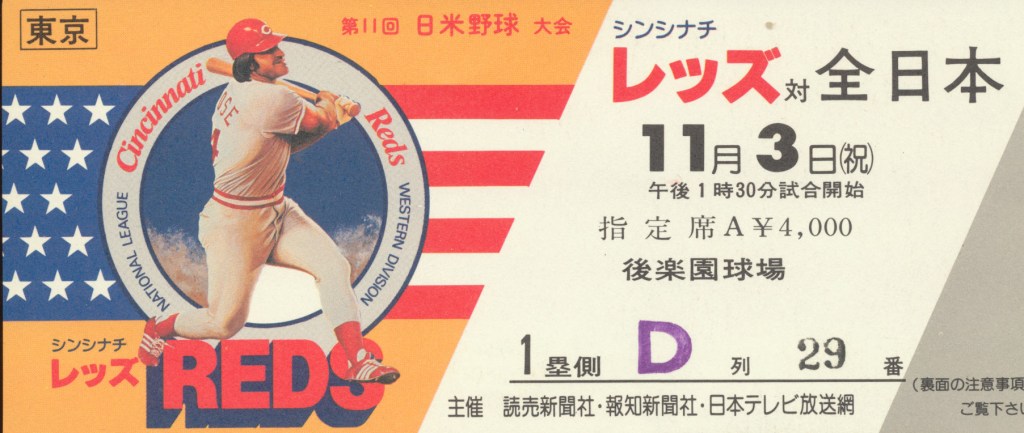
The Big Red Machine’s Last Hurrah: Cincinnati Reds Tour of Japan, 1978
by Robert Kiyoshi Shadlow
Every Monday morning we will post an article from SABR’s award-winning books Nichibei Yakyu: Volumes I and II. Each will present a different chapter in the long history of US-Japan baseball relations. This week Robert Kiyoshi Shadlow tells us about the Big red Machine’s 1978 visit to Japan.
Pete Rose basked in the attention he was receiving from the Japanese press on Opening Day, April 6, 1978. His Cincinnati Reds were facing the visiting Houston Astros in a game that was being broadcast live to Japan. Rose interrupted the Japanese interpreter by boisterously proclaiming, “Let me answer that. I speak Japanese well. No, I won’t do it today, but I’ll do it tomorrow.” Then the interpreter explained to Pete, that the question was, “How do you feel?”
The 11-man Japanese press corps was on a 10-day visit to Cincinnati, Dallas, New York, and San Francisco. Yasushi Matsui of Fuji Telecasting Company said, “[T]he demand and interest in American baseball is there (in Japan).” Two major-league baseball games per week were being broadcast to Japan for the first time in 1978. The Japanese reporters and photographers were also excited about the Big Red Machine’s coming 1978 postseason tour of Japan. Rose addressed Japanese fans, “Tell ’em we’re going to beat the hell out of their teams. … We want to win the World Series this year so we can go to Japan and win the world, world series.”
From 1970 through 1976, the Big Red Machine averaged 98 wins a season as they won five division titles and made four World Series appearances, winning two of them. The Reds featured Hall of Famers Johnny Bench, Joe Morgan, and Tony Perez along with Pete Rose, Dave Concepción, George Foster, César Gerónimo, and Ken Griffey Sr. The Reds declined a tour of Japan after winning the 1976 World Series. A few months later, Perez was traded from the Reds to the Montreal Expos and another future Hall of Famer, Tom Seaver, was sent to Cincinnati from the New York Mets in 1977.
In early December 1977, two or three major-league teams were being considered for a tour of Japan after the 1978 season. Commissioner Bowie Kuhn acknowledged, “There are a few teams who would like to go.” In October 1977, for example, Philadelphia Phillies traveling secretary Eddie Forenz was in Japan investigating accommodations for the Phillies. But on January 2, 1978, the Reds announced that the Japanese newspaper Yomiuri Shimbun would sponsor the team’s four-week tour of Japan beginning in late October 1978. They would face the Yomiuri Giants as well as combined teams throughout Japan.
On May 26, 1978, Kuhn left for Japan for discussions about the Saturday and Monday Game of the Week broadcasts as well as This Week in Baseball. All three shows were being broadcast for the first time in Japan in 1978. The All-Star Game, league championships, and World Series were also scheduled to be shown in Japan that year. Kuhn was also preparing the way for the Reds’ postseason tour of Japan. Seventeen games were to be played in 13 cities: Tokyo, Sapporo, Sendai, Yokohama, Nagoya, Toyama, Nishinomiya, Osaka, Hiroshima, Kumamoto, Fukuoka, Kita-Kyushu, and Shizuoka.
In 1978 Cincinnati had a strong 28-18 start by Memorial Day and was 49-37 at the All-Star break. A hard-fought season left them 2½ games behind the Los Angeles Dodgers in the National League West Division despite a 92-69 record before they embarked on the excursion to Japan. Cincinnati finished second in runs scored in the National League. The Big Red Machine’s offense was led by George Foster’s 40 home runs and 120 RBIs. There was hopeful speculation of a home-run-hitting contest between Foster and Japanese home-run king Sadaharu Oh. Johnny Bench hit 23 home runs while 37-year-old Pete Rose tied the 44-game National League single-season hitting streak record and recorded his 3,000th career hit. Tom Seaver won 16 games in 36 starts with a 2.88 ERA while Doug Bair had 28 saves with an ERA of 1.97.
The Reds’ roster for the trip to Japan consisted of a 10-man pitching corps of Doug Bair, Bill Bonham, Pedro Borbón, Dan Dumoulin, Tom Hume, Mike LaCoss, Fred Norman, Mario Soto, Dave Tomlin, and Tom Seaver. Catchers were Johnny Bench and Vic Correll. Their six infielders were Dan Driessen, Mike Grace, Junior Kennedy, Ray Knight, Ron Oester, and Pete Rose. Outfielders Mickey Duval, George Foster, Ken Griffey, Mike Lum, and Champ Summers made the trip. Reds manager Sparky Anderson brought six coaches: Alex Grammas, Ted Kluszewski, Russ Nixon, Ron Plaza, George Scherger, and Larry Shepard.
Technically, Mike Lum and Pete Rose, who had filed for free agency, were not members of the Reds. The Japan tour was significant for Lum, the first American-born player of Japanese ancestry in the majors. His mother was Japanese. Mike acquired the Lum surname when he was adopted by a Chinese couple.
Paul Moskau was enraged when he found out that he was left off the Reds’ roster for the Japan tour. Moskau, already disenchanted after being sent to the minors at the end of spring training, exclaimed, “You feel like you are part of the team and twice they do this. Is Bonham going? Last time I talked to him, he was, with his arm in a cast.”
Four other Reds players not making the trip were Davey Concepción, César Gerónimo, Ken Henderson, and Joe Morgan. Concepción wanted to stay in Venezuela to play winter baseball, while the other three were healing from injuries.
Cincinnati farmhand Mickey Duval was one lucky guy. “[T]he Nashville Sounds (Double A) brought me to extended fall baseball in Tampa … and I did get to play with the big club for a month, but it was in Japan. When I was in Tampa, I was crushing it. I had a good year in Double A, and then [the Reds] said, ‘Do you feel like going to Japan? Gerónimo can’t make it.’ I got $9,000 for that month; I was only making $850 a month!”
Accompanying the Reds was a delegation led by Kuhn, National League President Charles Feeney, and Reds President Dick Wagner along with six members of the Cincinnati front-office staff. National League umpire Lee Weyer also went along.
As they left, comedian Bob Hope said, “The only advice I have for them is have their kimonos made here. They’ll fit better. I can’t wait to see Johnny Bench in a kimono with rice in his hair.”
On October 25, 1978, the Reds flew off to Japan and landed with Pete Rose sliding headfirst into commercial endorsements from Japanese companies like Mizuno. Pete acknowledged that he was accompanying the team despite being a free agent because he had business commitments in Japan. He even observed, “[The Japanese] might want me to play there next year too.” The Associated Press reported that at least one member of the Reds was in discussions about playing in Japan in 1979.
The Reds contingent was greeted by cheering fans at Tokyo’s Narita Airport. At the welcoming press conference, Rose said, “I’m very happy to be here. I’m very curious to see and watch the reaction of Japanese fans and baseball players.” Sparky Anderson declared, “The Japanese are going to see some super baseball. I’m sure we will show some real fine baseball. … Japanese ballplayers and fans will agree that we were one of the finest major league teams to ever visit here.” Bench added, “Fans here will be in for some fine baseball, and it will be hard for (the Japanese) to believe the way Foster hits balls over the wall.” For his part, Foster promised, “I’ll give it my best shots.”
The Big Red Machine started working out in smoggy Korakuen Stadium in Tokyo less than 24 hours after landing in Japan. “Ohayo Gozai Masu (Good Morning),” Johnny Bench greeted Japanese photographers. Anderson warned the players who were still suffering from jet lag, “Nobody will get crazy.” Infielder Dan Driessen remarked about the jet lag, “It’s manageable right now. It’s totally a new experience (to play in Japan).” Reds coach Alex Grammas promised, “[The Japanese fans] are expecting us to win, and we are going to win.” Meanwhile, Pete Rose boasted that he had turned down an offer to play for the Seibu Lions for “more than a million dollars.” He added, “Yes, I’ll play in Japan … 17 games (for the tour).”
Read the rest of the article on SABR.org
-
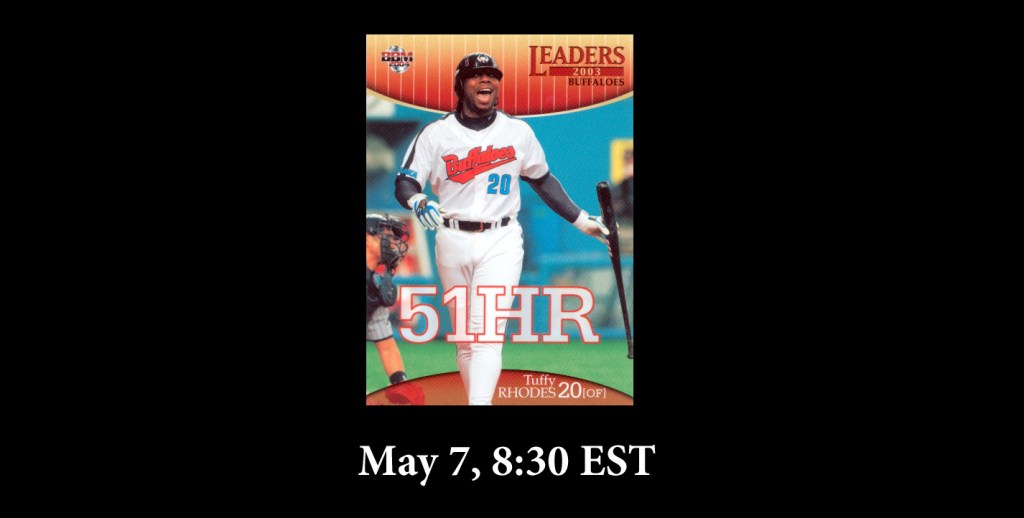
Meet Karl “Tuffy” Rhodes on May 7 at 830 pm EST
SABR’s Asian Baseball Committee is thrilled to host former NPB star Karl “Tuffy” Rhodes for a zoom discussion on May 7 at 8:30 pm EST. Mr. Rhodes will talk about his experiences in NPB and then answer your questions.
Sign Up for this free event below– Open to non-SABR members, All are welcome
Asian Baseball Committee meeting
When: May 7, 2026 08:30 PM Eastern Time (US and Canada)
Register in advance for this meeting:
https://us02web.zoom.us/meeting/register/rBkEkX2eRgCNcfDJEFtb8wAfter registering, you will receive a confirmation email containing information about joining the meeting.
Karl “Tuffy” Rhodes had a six-year Major League career before signing with the Kintetsu Buffaloes of NPB before the 1996 season. He played 13 seasons in Japan for the Buffaloes and Yomiuri Giants. A ten-time NPB All-Star and seven-time Best Nine Award winner, Rhodes also led his league in RBI three times, and home runs four times. His 55 home runs in 2001 tied Sadaharu Oh’s single-season HR record and earned him the Pacific League MVP. He retired with 1792 NPB hits and 464 NPB home runs.
-

A Brief History of the Asia Series
by Tim Sokol
In many sports, the journey doesn’t end when you win your national championship. Continental, or sometimes even intercontinental glory beckons for the strongest and most ambitious teams. Look at the success of the UEFA Champions League, the Copa Libertadores, and the other continental trophies in club football. Look at EuroLeague basketball, which is far more prestigious than any domestic league in Europe. The idea of competing against teams from outside your own league is an appealing one. There is both excitement in reaching an even higher level of competition and also a novelty in playing new opponents. High level baseball leagues have largely never embraced this idea, with the most notable exception being the Caribbean Series for top winter league teams, but even that is somewhat of an all-star series when you dig into the roster rules and circumstances surrounding winter league ball. The Caribbean Series is awesome, but I don’t think it is quite the same thing as a “Champions League” type tournament between full-length season national champions. The WBSC has recently organized an Americas Champions League and found minimal success so far. There has basically been one honest effort at a “Champions League” style tournament as we generally understand the idea, and so I would like to look back at the now-defunct Asia Series.
The first Asia Series was in 2005, but the lineage can actually be traced back a decade earlier, to a 1995 tournament sometimes known in English as the “Asia Pacific Super Baseball Championship” or the Asian Pacific Cup. This was a tournament hosted by the Daiei Hawks, who came in 5th place in the Pacific League that year. They invited teams from Taiwan, Korea, and Australia to participate in a two-day single elimination tournament. The Hawks were upset in the first round by the Uni-President Lions (CPBL) and wound up in 3rd place. The Hanwha Eagles (KBO) defeated the Australian League All-Stars in the other first round game. The Lions would go on to win the title, though only a few Lions fans seem to remember or care these days. This tournament received limited media coverage at the time and is largely forgotten today, but it is worth mentioning as an early foray into continental competition.
A decade later, baseball executives decided to try the idea again in a more official capacity. The Asia Series was created for the 2005 season with Konami announced as the title sponsor, making the official name of the competition the Konami Cup Asia Series. The Chiba Lotte Marines, the tournament favorites, won all of their games without too much difficulty and capped it off with a 5-3 victory over the Samsung Lions in the final. The event, hosted at the Tokyo Dome, produced mixed crowds. When the Marines were playing, fans showed up, including over 37,000 people at the final. When the other teams were playing, attendance was paltry. Only 6,340 were on hand for the decisive group game between the Sinon Bulls and Samsung Lions that would determine who advanced to the championship.
In 2006, with the tournament once again at the Tokyo Dome, attendance dropped sharply as NPB was represented by Hokkaido rather than the more locally based Chiba. This edition saw the favorites threatened for the first time, with Taiwan’s La New Bears losing to Hokkaido by just one run in both the group stage and in the final. And in 2007, the breakthrough was finally made when the KBO’s SK Wyverns beat the Chunichi Dragons in the group stage, handing NPB its first loss in the Asia Series. Chunichi would go on to get revenge over the Wyverns in the final, 6-5. Attendance remained closer to 2006 levels rather than the heights of 2005.
While these tournaments produced some good games, there was also an inherent problem with this format. Though there was a vast gulf in talent between the three premier Asian leagues, they were still all stocked with professional players and the weaker teams were still capable of competing with the stronger ones over a short tournament like this. The same cannot be said for the China Stars, who were a representative all-star team from the Chinese Baseball League. The CBL was not a professional league and was of such inferior quality to the other three leagues that even an all-star team proved completely uncompetitive; the China Stars played nine games in these three years and lost all nine, mostly by very large margins. In 2008 the CBL sent the champion Tianjin Lions rather than an all-star team, and the Lions also went 0-3.
2008 marked a big turning point for the competition. Evidently unhappy with how things were going, title sponsor Konami ended their partnership with the tournament, leaving the name as just the Asia Series. Other sponsors followed suit. And perhaps most importantly, in Japan the tournament was moved off of terrestrial television to satellite channels with a much smaller reach. The competition had never been on the firmest financial ground, but now it found itself in an untenable situation. Amidst further declining attendance despite the presence of the Saitama Seibu Lions, the tournament produced some gripping baseball including a nailbiter final in which Seibu walked off the Uni-President 7-Eleven Lions in the 9th for a 1-0 victory. And so despite the 2008 edition ending on a high note, the tournament’s future looked bleak.
In 2009, due to lack of funding and willing sponsors, the Asia Series was cancelled. The general understanding around the industry seems to have been that this was a temporary cancellation rather than a permanent one, and there was clearly still some appetite for the idea. That year administrators organized the NPB-KBO Club Championship, a single game winner-take-all replacement for the Asia Series to be held in Nagasaki. A half-filled stadium watched the Yomiuri Giants beat the Kia Tigers 9-4.
In 2010, though there were originally plans to revive the Asia Series in Taiwan, this idea was shelved due to a conflict with the 2010 Asian Games. But the interleague clashes continued. This time the KBO Champion SK Wyverns tied a two-game series 1-1 with the CPBL’s Brother Elephants. No game three was scheduled. Then the Wyverns headed to the Tokyo Dome for another NPB-KBO Championship where they were blanked by the Marines. These games were once again moderately but not overwhelmingly successful, and as shown by the scheduling of a two game series, were thought of closer to exhibitions than to any serious continental competition.
In 2011, the Asia Series made its formal return, back to the original format with four teams. Gone was the Chinese League, having been replaced by the previous champion of the Australian League. The tournament was hosted in Taichung and Taoyuan and once again saw limited attendance outside of when the home team played. Just 4,000 people showed up to watch the Samsung Lions defeat the Fukuoka SoftBank Hawks to become the first non-Japanese team to win the competition. The theory that Taiwanese fans would come out in big numbers to watch NPB teams seemed to have been proven wrong. But still, the tournament trudged on, expanding to six teams in 2012.
That expansion led to a new format with two groups of three. Participating teams were the champions from Japan, Korea, Taiwan and Australia, as well as an extra team from Korea (the Lotte Giants, who qualified as hosts) and the return of the China Stars. The Lamigo Monkeys and Yomiuri Giants topped the groups, with the Giants winning 6-3 in the final.
The 2013 Asia Series would be the last, and kept the six team format, though the China Stars were replaced by an Italian club, Fortitudo Bologna, who were the reigning winners of the European Cup. This time Taiwan hosted and thus received two bids rather than one. The Italians performed as expected, but the shock came when neither Japan nor Korea were represented in the final. Instead, it was the Canberra Cavalry who claimed the first trophy for Australia, defeating the Uni-Lions in Taichung.
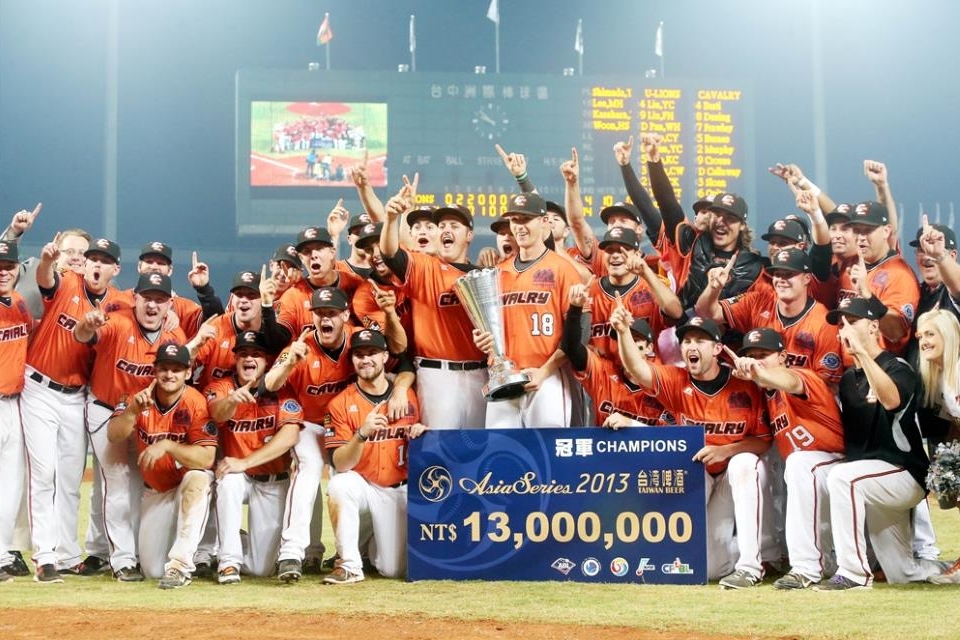
The tournament ended on a strange note, with Canberra player Matt Blazynski claiming that he had been offered money to throw the semifinal match against Samsung. The CPBL and Taiwanese police investigated the claim and determined that Blazynski’s story was full of inconsistencies, and the CPBL released a statement calling it “a fabricated lie.” Without really having any details we can only speculate, but the CPBL does have a long history of match-fixing scandals, and it seems like an unusual story for a player to lie about. On the other hand, athletes do tell strange lies sometimes. Ryan Lochte comes to mind. In any case, Blazynski didn’t even play in the tournament and obviously Canberra, the eventual champions, did not throw any games. We didn’t know it at the time, but this saga was basically the end of the Asia Series. The tournament did not return in 2014, and has not been played again since.
So where does that leave us? Undoubtedly the idea of the Asia Series sounds neat in theory, so why didn’t it work? I think there are quite a few reasons we can point to. The fourth league (after NPB/KBO/CPBL) was never a perfect fit. China (and Italy) simply didn’t have the quality to be competitive, and Australia has the problem of being a winter league and thus the tournament takes place at a strange time for them. A European invite does not move the needle, though there were rumors of eventually inviting teams from stronger leagues such as Mexico. The calendar also became too crowded with other events. We saw one tournament cancelled to make room for the Asian Games, and NPB at this time was still playing their exhibition series against MLB All-Stars in some years. Nowadays we have the Premier12 in this window sometimes. All of those events are higher profile and much more lucrative than the Asia Series.
All that said, obviously if viewership was booming the powers that be would have found a way to make it work. The number one reason that the Asia Series is not around today is that not enough people watched, not enough people cared, and not enough money was made. Fans I heard from all gave me a variation of the same answer: The tournament was a cool idea, but we (the fans) only *kind-of* cared and the teams and players only *kind-of* took it seriously. Undoubtedly, there were great moments. Look at the scenes of Chiba clinching the 2005 title and it is obvious that the result mattered to people. But despite the highs, the tournament was never truly elevated to the place of being a serious trophy on par with winning your domestic league. Major media outlets didn’t give it much credence. Attendance was not great. Some players and managers gave good PR answers when asked about the competition, while others were open about the fact that they weren’t interested.
And so the natural follow up question: Could this type of tournament work in the future? Never say never, but for now a return seems unlikely. National team baseball is a much more financially sound usage of that calendar space and there isn’t really a lot of clamor for another Asia Series outside of the hardcore baseball nerd demographic. I would love to see it but it’s really hard to pull off as you need full buy-in from players (especially pitchers) and organizations and fans. If everyone involved doesn’t treat it as a serious continental championship, then it becomes nothing more than a glorified exhibition. So you’d probably need a lot of prize money and a lot of prestige associated with the tournament to get everyone to care. Maybe that prestige comes over time as you host the series and it gets slightly more and more important with each passing year, but you need to be able to survive that build-up period without folding. And as we saw with the Asia Series’ original run(s), that is the tricky part.
 SABR Asian Baseball Research Committee Blog