by Robert K. Fitts
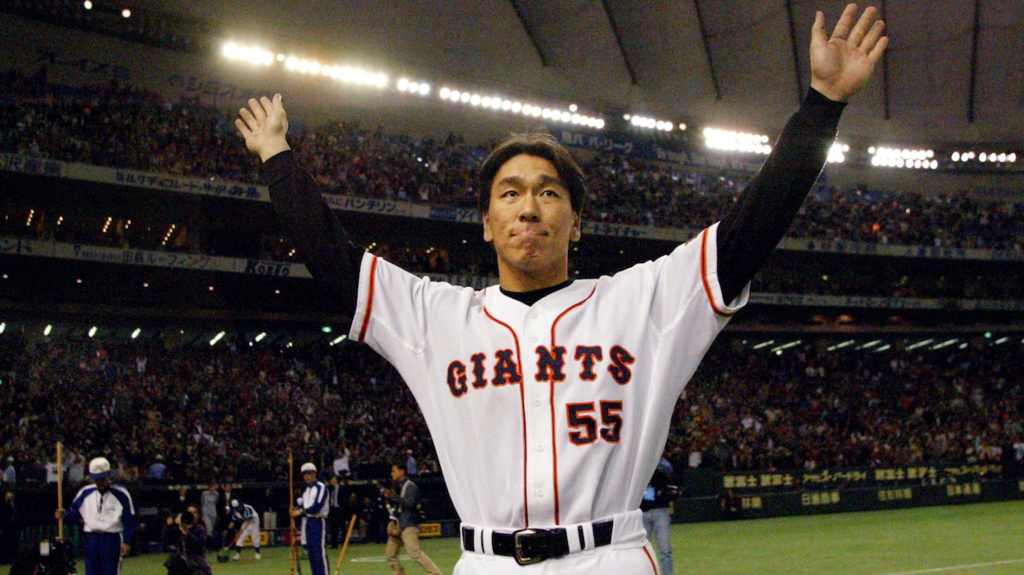
Every Monday morning we will post an article from SABR’s award-winning books Nichibei Yakyu: Volumes I and II. Each will present a different chapter in the long history of US-Japan baseball relations. This week Robert Fitts tells us about Hideki Matsui’s triumphant return to Japan with the 2004 New York Yankees.
“The Yankees are coming! The Yankees are coming!” wrote Marty Kuehnert in the Japan Times. “If you haven’t heard, you’re not a resident who has paid even the slightest attention to TV or radio broadcasts, or print media. It’s hard to miss the news that the New York Yankees are coming to Japan. … Media reports liken it to the arrival of Babe Ruth and Lou Gehrig who led a MLB All-Star team to Japan in 1934, and was the catalyst for Japanese professional baseball. … Others are saying it is even bigger … and more along the lines the arrival of U.S. Admiral Matthew Perry in 1853 which helped spur the Meiji Restoration.”
“This is the [Yomiuri] Giants’ 70th anniversary, and also the 70th anniversary of Japanese professional baseball,” noted Kota Ishijima, head of Yomiuri’s overseas operations. “And for that 70th, who comes back? The Yankees, and our beloved son, Hideki Matsui.”
On November 1, 2002, two days after leading the Yomiuri Giants to the Japan Series championship, Hideki Matsui announced that he would leave Japanese baseball for the major leagues. At the height of his career, he was the most popular player in Japan, outshining even all-time great Ichiro Suzuki. The 28-year-old free agent had played 10 seasons with the Giants, winning three Central League MVP Awards as he hit .304 with 332 home runs. “It was painful to tell my coaches, but my personal desire to go over there and play didn’t go away,” he told reporters at an early-morning press conference. “I’m proud to have played in Japanese baseball and I think it will reinvigorate Japanese baseball if I go over there and play well. I also think new stars will emerge in Japan.”
The New York Yankees became early favorites to sign the slugger, nicknamed Godzilla because of acne scarring on his face and his tremendous power with the bat, and on December 19, 2002, they agreed to a three-year, $21 million deal. Although Yomiuri fans were disappointed with the news, nearly all supported Matsui’s decisions. “It’s a bit disappointing that he will be gone from Japan’s ballparks,” said Japan’s Chief Cabinet Secretary Yasuo Fukuda. “On the other hand, there are increasingly more global major stages for Japanese players, so I feel proud in that regard. I have mixed feelings.” “I’m looking forward to seeing how many home runs he will hit in the majors,” added Prime Minister Junichiro Koizumi.
Matsui’s major-league career began on Opening Day, March 31, 2003, as he hit the first pitch he saw for an RBI single off Roy Halladay. A week later, at the Yankees’ home opener, he hit a dramatic grand slam. Although his production dipped in late April and May, he hit .394 with a 1.157 OPS in June, catapulting him into the All-Star Game as a fan-elected starter. He finished the season having played in all 163 of the Yankees’ games, hitting .287 with 16 home runs and finishing second in the American League Rookie of the Year Award voting.
But Matsui’s true impact came off the field. “He’s not only helping us win games on the field,” Yankees general manager Brian Cashman explained, “he’s helping the business side. He generates money not just in New York for us, but overseas.” Soon after the signing, the Yankees and the Yomiuri Corporation established a joint venture called “Yomiuri YankeeNets Marketing” in Tokyo designed to attract Japanese sponsors and sell Yankees tickets to Japanese tourist agencies. “Japanese fly in on package tours from Japan to watch a three-game series in New York, buy Yankees jerseys and Matsui bobblehead dolls, then fly back,” noted Japanese baseball expert Bob Whiting. Japanese attendance at Yankee Stadium increased from around 1,000 per game in 2001 to 5,000 per game in 2003. Sales of Matsui jerseys, T-shirts, and souvenirs soared in early 2003. The Dentsu Consumer Research Center concluded that “Matsui’s overall economic effect for the New York area (including travel, hotels, restaurants, etc.) would reach $500 million for five years.” “Matsui has made a large enough impact on New York’s economy to be hired to promote it by the city’s convention and visitors bureau,” Whiting added.
Major League Baseball decided to capitalize on Matsui’s popularity to promote the league’s brand in Japan. In mid-November of 2003, Bob DuPuy, MLB’s chief operating officer, wrote to the Yankees asking them to shift their 2004 season-opening series against the Tampa Bay Devil Rays from New York to Tokyo. The Yankees had not played in Japan since 1955 and George Steinbrenner had forbidden his players to join the major-league all-star teams traveling to the country (until 2002, when he sent Bernie Williams and Jason Giambi with the goal of wooing Matsui to the Yankees). After a few weeks of negotiations, the Yankees agreed to the trip if they could be the away team in Tokyo and the Devil Rays would play their previously scheduled first homestand against the Yankees at Yankee Stadium. But not all of the Yankees were in favor of the trip. Mike Mussina was particularly vocal in his opposition, complaining about how the trip would disrupt his routine and how the long flights could adversely affect the Yankees.
As ballclubs, the Yankees and Devil Rays were polar opposites. New York had won 101 games in 2003, finishing first in the American League East Division, but lost a frustrating World Series to the Florida Marlins. After the season the team lost starting pitchers Roger Clemens, Andy Pettitte, and David Wells to free agency. Determined to produce a champion, the Yankees reshaped the roster through blockbuster trades and free-agent signings. In December they acquired starting pitchers Kevin Brown from the Dodgers and Javier Vazquez from the Expos. In February they traded for superstar Alex Rodriguez and took on most of his 10-year, $252 million contract – an amount that dwarfed all other sports contracts at the time. The Yankees supplemented these stars by signing All-Star free agents Gary Sheffield, Ruben Sierra, Kenny Lofton, and Tom Gordon. In all, the team opened spring training with 17 former All-Stars on the roster. When they arrived in Japan, the team’s payroll stood at $182.8 million.
In contrast, the Devil Rays’ payroll was a measly $29.2 million. The team had finished last in the American League East for every season since its creation in 1998. Its highest-paid player was former Yankee Tino Martinez at $7.5 million, followed by Aubrey Huff at $2.66 million, although the team’s most talented player was undoubtedly 22-year-old outfielder Carl Crawford, who would emerge as a star during the 2004 season. Martinez was not the only former Yankee on Tampa’s roster. In January, the team had hired former Yankees bench coach Don Zimmer, who had a long history with Japanese baseball. Zimmer first arrived in Japan in 1956 as a 25-year-old member of the Brooklyn Dodgers. On June 23 Hal Jeffcoat had hit Zimmer in the face with a high and inside fastball, shattering his cheekbone. The severe injury ended his season, but the Dodgers took Zimmer to Japan to help him regain his form. Zimmer hit only .091 in 22 at-bats but the experience helped him rebound to become the team’s utility infielder in 1957. After leaving the majors in 1965, Zimmer played a year with the Toei Flyers. It was a tough season, both on and off the diamond. Zimmer did not adapt well to Japanese culture or cuisine and hit a measly .182 in 203 at-bats. Twenty-four years later, he returned to Japan as the manager of the 1990 major-league all-stars. Once again, Japan was unkind to Zimmer as his squad became the first American professional team to have a losing record in a postseason goodwill tour.
The teams left Florida on separate charter flights around 5 P.M. on Thursday, March 25. After the 17-hour flight, five busloads of Yankees, including Yogi Berra and Reggie Jackson, arrived at their hotel shortly after 2 A.M. on Saturday, March 27. (The extra “day” was accounted for by their crossing the international date line.) The Devil Rays checked in about an hour later. “I went to sleep at 4,” explained Derek Jeter, “got up at 5:30. Then I went back to sleep for about an hour, ate, [and] went back to sleep for 45 minutes.”
The jet-lagged and weary players arrived at Tokyo Dome in the early afternoon for a public workout. 34,500 fans, mostly children in baseball uniforms, “shrieked for hours” as “six aisles filled with cheerleaders wearing Yankees and Devil Rays jerseys and hot pants, shaking silver and gold pompoms,” cheered along. The kids, who were primarily there to see Matsui, “squealed with delight as the video board focused on the … star … as soon as he emerged from the third base dugout to stretch.” “We had a chance to see some of their faces when Matsui walked by,” said Jeter. “It was something special. I think it’s something they’re going to remember for the rest of their lives.”
“Hideki is like Michael Jordan; he’s the man when it comes to Japan. … He is as big as anybody on the planet over there,” noted Jason Giambi. “It’s a little bit like the Beatles arriving in New York,” added assistant general manager Jean Afterman. “I guess it was J.F.K. who said, ‘I’m the man who accompanied Jacqueline Kennedy to Paris.’ Well, we’re the team that’s accompanying Hideki Matsui back to Tokyo.” “[W]e are proud of Hideki as a representative of the Japanese people,” explained Gaku Tashiro of Sankei Sports. “He’s very gentle, a very good guy. Japanese fans understand what he wanted to do. I know some Giants fans love him still. I’m sure he will hear big cheers in the Tokyo Dome.”
“Because of Hideki, other Yankees are famous now,” said Tashiro. “Japanese fans recognize who they are – Giambi, A-Rod, Jeter. They are going to have big cheers, too.” “The Yankees were like rock stars in this baseball crazy land,” the Associated Press’s Ronald Blum observed. “Everywhere they went, people looked at them with awe, as if they were larger than life creatures.” “I didn’t know what to expect,” Jeter said. “But it’s kind of amazing – you go somewhere and people recognize you. It’s kind of overwhelming, considering how far away we are.”
After the workout, the teams, their families, and Commissioner Bud Selig joined other dignitaries at a reception thrown by Yomiuri Chairman Tsuneo Watanabe. Dressed in festive happi coats, players used baseball bats to break open sake barrels to start the party. Then, none too soon for many of the jet-lagged visitors, the players staggered back to the hotel and did their best to get a full night’s rest before the exhibition games the next day.
The exhibition games began at noon on March 28 with the Devil Rays playing the Hanshin Tigers at Tokyo Dome. Former Yankee Hideki Irabu took the mound for the Tigers. Irabu, who had starred for the Lotte Chiba Marines, had signed a four-year, $12.8 million contract with the Yankees in 1997. Despite tantalizing flashes of brilliance, he had three disappointing seasons in New York, drawing the ire of George Steinbrenner, who called him a “fat pussy toad.” In disgrace, he was traded to Montreal after the 1999 season, where his mediocrity continued. After playing for the Texas Rangers in 2002, he returned to Japan to play for Hanshin. When a reporter asked if he wanted to see his old teammates while the Yankees were in Tokyo, Irabu curtly responded, “No, I don’t.”
Against Tampa, Irabu once again flashed his potential brilliance. Relying on control and breaking balls instead of power, he began by striking out Carl Crawford and Julio Lugo, then retired six of the next seven batters. In six innings he scattered six hits (including two solo home runs), walked nobody, and stuck out five. “He was mixing up his pitches,” Lugo commented. “He threw some tough curves, and I couldn’t pick up his split at the beginning. I think he’s a big leaguer. He’s got great stuff.” Devil Rays manager Lou Piniella noticed, “He looked much more relaxed pitching here than he did before, especially when he pitched for the Yankees. … He seemed like he was in control of the ball game. He pitched exceedingly well.”
Meanwhile the Tigers had little trouble with the Devil Rays’ pitching. Starter Doug Waechter lasted just three innings, giving up seven hits and a walk. The Tigers struck for three runs in the third on five singles and an error. They added two more runs in the fifth as Hanshin’s George Arias homered off Jorge Sosa and another in the sixth, giving Irabu a 6-1 lead as he left the game.
Hanshin’s bullpen, however, could not hold the lead. Tampa scored three in the eighth as Rocco Baldelli hit a two-out, three-run homer off Tomoyuki Kubota, and tied the game, 7-7, when Lugo hit a two-run blast with two outs in the top of the ninth off Yuya Ando. After the Tigers failed to score in the bottom of the ninth, the game ended in a 7-7 tie. “That’s a good team,” Piniella said after the game. “They got good pitching and played well in the field. They’re not a power-hitting club but they hit it to all areas of the field.”
The enthusiasm of the Hanshin fans surprised the American players. Their famous oendan (cheering club) blew their horns and whistles, pounded their drums, waved their flags, and chanted their players’ fight songs. “It was sort of, um … interesting, with the festivities going on in the stands the whole time,” said Piniella. “With the drums going and the banners, it took a while to get used to. But it was fun. It was a fun atmosphere.” “I thought it was pretty cool,” added Rocco Baldelli. “I was bobbing my head in the outfield. It was pretty catchy. … They support their team. It must be nice. Every guy that comes up for their team, regardless of if he’s coming off the bench or pitching, they’re all for him, screaming his name. That must feel pretty good as a player.”
That evening 55,000 fans congregated at Tokyo Dome. A fair-like atmosphere pervaded the plaza in front of the main gate. In the background, the Ferris wheel at the Dome’s amusement park lit up the dark sky as the roller coaster rumbled along, occasional shrieks from the passengers clearly audible over the dull murmur of the crowd. Throngs surrounded the souvenir stands as fans bought Yankees and Giants caps and jerseys, plastic orange clapping sticks, and other mementos.
For many Japanese fans, this night’s exhibition game between the Yankees and Giants was the most important game of the tour. “It’s not [just] an exhibition game,” explained the Giants’ American outfielder Tuffy Rhodes. “It’s an international World Series game. It’s Game 7 of the international World Series.”
The game began with Masaichi Kaneda, Japan’s only 400-game winner, throwing out the ceremonial first pitch to catcher Yogi Berra. The two had faced each other during the 1953 Eddie Lopat and 1955 Yankees tours. The stiff-moving 71-year-old Kaneda, dressed in a gray suit with tie, bounced the pitch to Berra, who, wearing his pinstriped Yankees uniform, spryly fielded the errant throw on one hop.
The sold-out crowd watched Yankees starter Jose Contreras take on Yomiuri’s back-of-the-rotation starter Hisanori Takahashi. To honor Matsui, Torre started him in center field and placed him in the cleanup spot, his spots when he played for Yomiuri. Both teams went down in order in the first with Contreras striking out the side.
The fans rose to their feet and roared as Matsui came to the plate to lead off the top of the second. Blue Oyster Cult’s “Godzilla” bared over the loudspeakers. As he dug in, the ballpark sparkled as thousands of camera flashes went off. The Giants’ oendan drummers in left field banged out a rhythm: boom, boom, boom, boom-boom. The fans responded: “Home run, Mat-sui!” Home run, Mat-sui!” Boom, boom, boom, boom-boom, answered the drums. The deafening cheer continued throughout the at-bat.
Takahashi wounded up and threw a high fastball. Ball one. Next came a wicked curve, breaking down as Matsui swung over it for a strike. He swung through the next pitch as well. One ball, two strikes. Another high fastball, Matsui checked his swing. Two and two. On the fifth pitch, Takahashi went for the outside corner, but Matsui sliced it foul. Matsui stepped out of the batter’s box, adjusted his belt, and dug back in.
The fans grew louder, pounding their orange plastic sticks in time with the drums. The upper deck felt as though it was shaking. The chant, “Home run, Mat-sui!” intensified. On the Yankees bench Joe Torre turned to coach Rob Thomson and said, “Wouldn’t it be something if he hit a home run here?”
Takahashi wound up and tried to sneak a 63-mph curveball by Matsui, but it hung up over the plate. Matsui connected with a loud pop, driving the pitch deep into the right-center-field bleachers. The crowd erupted as the stony-faced Matsui calmly trotted around the bases, only allowing himself to smile after he reached the safety of the crowded dugout.
Godzilla had returned to Tokyo.
“Knowing this guy,” backup catcher John Flaherty had told catching coach Gary Tuck, “he’ll probably go deep the first at-bat. You almost have to expect it now,” he added later. “We saw it last year when he hit the grand slam on Opening Day in New York. It’s his personality. You expect it, and he delivers.” But, “it’s hard to do,” added Jeter. “It’s hard enough to hit a home run in batting practice, let alone in a game. He’s a special player to be able to deal with all the attention and scrutiny and deliver like that.”
Yomiuri tied the ballgame in the third, but the Yankees surged ahead in the fourth as Matsui led off with a single, an out later Giambi singled, and Posada hit a three-run homer. New York tacked on another two runs in the fifth; Jeter led off with a home run, Matsui walked and then scored as a deep drive by Giambi popped out of center fielder Tuffy Rhodes’s glove. The Giants staged a brief comeback attempt in the bottom of the ninth as a single, an error, and a groundout led to a run, but Mariano Rivera closed out the 6-2 victory. “I was really happy to receive such a warm welcome and it gave me power today,” Matsui told reporters after the game. “I just felt like I did what I was expected to do and it’s all thanks to the fans. I just want to keep playing well as the season gets started.”
Early the next morning, the exhausted and jet-lagged Yankees straggled into Tokyo Dome to prepare for their noon game with the Hanshin Tigers. To please the 52,000 spectators, Torre started most of his regulars, but they made little difference in the game’s outcome as the Yankees’ starter, Donovan Osborne, could not hold back the Tigers’ offense.
With the Tigers down 1-0 in the bottom of the second, George Arias led off with a single. After Takashi Toritani struck out, Osborne surrendered consecutive singles to Akihiro Yano, Atsushi Fujimoto, and Makoto Imaoka to give the Tigers a 2-1 lead. The next batter, Norihiro Akahoshi, laid down a perfect bunt for a hit as Fujimoto scored. Osborne then walked Mike Kinkade before Tomoaki Kanemoto drove in Imaoka and Akahoshi with a broken-bat single to right-center field. Arias, in his second at-bat of the inning, singled in Kinkade and Kanemoto to put Hanshin ahead 7-1.
New York retaliated with three runs in the fourth on a two-run homer by John Flaherty and Jeter’s RBI single, and another run in the fifth on a mammoth, 521-foot Tony Clark home run to narrow the gap to 7-5. The Tigers, however, padded their lead in the fifth with an inside-the-park home run as Darren Bragg misjudged Akihiro Yano’s fly ball. After falling to the turf, the ball bounded away from Bragg as Yano circled the bases. Hanshin added three more in sixth on a three-run homer by Arias. Trailing 11-5, the Yankees attempted a two-out comeback in the top of the ninth, scoring twice before Jeff Williams closed out the game for the Tigers’ 11-7 victory.
Matsui, who was removed after the fourth inning along with most of the Yankees stars, told reporters, “I would have loved to play more for the fans, but the opening game is tomorrow. … I feel good about how I am hitting now. … I’m looking forward to the opener tomorrow.”
Although the game received scant coverage in the next morning’s newspapers, 47,000 fans packed Tokyo Dome in the evening to watch the Yomiuri Giants take on the Devil Rays. The game began well for the Giants as Toshihisa Nishi singled and Takayuki Shimizu walked to start the game. An out later, Yoshinobu Takahashi singled to drive in Nishi. But that ended the scoring for the home team. Tampa starter Mark Hendrickson gave up just one more hit over the next four innings before relievers Dewon Brazelton and Jesus Colome pitched four innings of shutout ball.
Yomiuri starter Masanori Hayashi held the major leaguers scoreless, surrendering just one hit while striking out five, in three innings before Tampa took advantage of the Giants’ bullpen. In the fourth inning, the Devil Rays went ahead on a two-run home run by Jose Cruz Jr. Cruz drove in another run with a sacrifice fly in the sixth before Robert Fick drove the ball over the right-field fence with a runner on to give Tampa a 5-1 lead. The Devil Rays tacked on two more runs in the seventh to win 7-1.
After the warm-up games, the Yankees and Devil Rays readied themselves for the start of the regular season on Tuesday, March 30.
Following the Opening Day ceremonies, which included first pitches thrown by Japanese Prime Minister Koizumi and former New York Mayor Rudolph Giuliani, the 2004 major-league season began at 7:14 P.M. Tokyo time (5:14 A.M. EST). The Yankees, acting as the visiting team but wearing their home pinstripes with the addition of a three-inch sleeve patch bearing the sponsor Ricoh’s name in red, batted first against Victor Zambrano.
The new-look Yankees’ season started off well. After Derek Jeter grounded out, Matsui ripped a fastball into the right-center-field gap for a double. Alex Rodriguez came to the plate in his first at-bat as a Yankee and struck out looking. With two outs, Jason Giambi hit a 1-and-0 pitch into the left-field stands to give New York a 2-0 lead.
Mike Mussina took the mound for New York. Even after arriving in Japan, he continued to carp about the trip. Suffering from jet lag, he had not slept well, and rather than seeing Tokyo had cloistered himself in his hotel room except for “three quick trips for food.” He later told reporters that he had “subsisted mostly on Ritz crackers and chips.” “It’s a mindset,” Gary Sheffield commented. “If you think negative, it’s going to be negative. If you think you’re tired, you know you’re going to be tired.”
Although the game started out well for Mussina as he retired the Devil Rays in order in the first, Torre noted that “Mussina wasn’t as sharp as he can be.” He gave up two hits in the second inning and another in the third before Tampa Bay tied the game in the fourth as Mussina walked Cruz and Martinez ahead of a two-run, broken-bat single by Toby Hall.
The score remained deadlocked until the sixth, when Rodriguez and Sheffield both doubled to put New York ahead 3-2. The lead, however, did not last long as Cruz led off the bottom of the inning with a homer to right. Martinez then doubled off his old teammates before Julio Lugo followed with a double to deep center field, scoring Martinez. Hall stroked another double to score Lugo, giving the Devil Rays a 5-3 lead, which chased Mussina from the game. Tampa Bay scored three more in the bottom of the seventh on an RBI single by Huff and a Martinez home run to seal an 8-3 victory.
The upset headlined sports pages across the United States: “Yankees Look Lost in Tokyo”; “Tampa Too Much”; “Sluggish Yanks Roughed Up.” “We looked flat,” said Yankees special adviser Reggie Jackson. “But how do you look good when you give up 15 hits? You don’t look good. You don’t pitch good, you don’t look good. … If we lose tomorrow we won’t be in a 747 going home. It will be B&O, the Baltimore & Ohio Railroad.”
The following evening Kevin Brown took the mound for the Yankees against Geremi Gonzalez. Brown struggled early as Carl Crawford led off the bottom of the first with a single, stole second, and two outs later came home on Aubrey Huff’s single. But Brown settled down and shut out the Devil Rays for the next six innings, surrendering just four more hits before leaving the game after throwing just 77 pitches. “He was awesome,” exclaimed Jorge Posada after the game. “He got a lot of one- and two-pitch ground-ball outs, and that’s why he was in the game so long. He got better and he got stronger. He’s got very good movement on his pitches, a lot of depth, and that’s why he got a lot of ground balls.”
Tampa Bay maintained its 1-0 lead until the top of the third when Lofton singled with two outs and stole second before Gonzalez walked Jeter. Matsui then knocked Gonzalez’s first pitch into right field, scoring Lofton. With runners at the corners, Rodriguez came to the plate with a chance to put the Yankees to top but instead grounded to third to end the inning.
The next inning, New York took the lead as Tony Clark hit a two-run homer into the right-center-field seats. With one out and one on in the fifth, Matsui padded the score by slamming an 89-mph fastball over the right-field wall. Giambi was then hit by a pitch and Sheffield walked before Posada homered to put the Yankees ahead 8-1. They added four more runs in the seventh on five hits capped by Posada’s second homer of the night.
At the end of the 12-1 Yankees victory, Matsui was declared the star of the game (despite Posada’s two home runs and six RBIs). In a ceremony held at home plate, Godzilla received a samurai helmet. He held the prize aloft “slowly turning his body as if he were a figurine in a music box as 55,000 fans chanted his name.” “Hopefully, we can have many more games like this,” he said during the ceremony. “I’m the happiest man in the world.”49 “He’s unbelievable,” said Posada. “He can come home and do all the things he did in front of people waiting for him to do it. That’s tough to do.”
The two teams left Japan the next morning, arriving back in Florida on Thursday, April 1. Most of the players enjoyed the trip. “This town’s fun,” said Jason Giambi about Tokyo. “You’ve got to experience this town. It’s like Vegas and New York rolled into one.” Some sampled the nightlife in Roppongi, bought electronics in Akihabara, dined on sushi and sake, explored the city. “Tokyo is a beautiful city to visit,” concluded Lou Piniella. “I was shocked that there’s no trash,” said Derek Jeter. “Even though there’s thousands and thousands of people, millions of people, walking the streets, there is no trash. That was amazing to me.” “I don’t like being in a plane such a long time,” said Julio Lugo. “But to tell you the truth, it was worth it … to come over here. I had a nice experience. I love it. I love the fans here. I think they’re great.”
From a marketing perspective, the trip was an overwhelming success. Matsui’s heroics and modest demeanor increased the popularity of the already popular New York Yankees. “[Matsui] did an unbelievable job of handling everything he’s had to go through over here,” observed Kevin Brown. “He’s so completely focused and comfortable. You tip your hat for a very professional effort.” “It’s mission accomplished as far as the state of the game,” added Rodriguez. “When you talk about growing the game, I think the New York Yankees can do that better than any other team in the world.”
But not everyone praised the endeavor. In a vitriolic condemnation of the Opening Day tour, Thomas Boswell of the Washington Post objected to the early start times and blatant commercialism. Calling the trip “baseball’s grab-a-yen travesty,” he wrote:
How trashy can baseball get? This Opening Day was surely a tip-off. … Baseball’s traditional spring showcase game – one of its supposed jewels – has now shared the same pre-dawn TV time slot as “this channel is not yet available” and a religious infomercial.
The start of the baseball season is supposed to be a spirit-lifting American institution, an announcement of spring. Instead, what may be remembered from this game was that, for the first time in big league history, the players themselves were used as human billboards. … [R]ight there on the Yankees hats and jerseys – the ones that are considered too elegantly traditional to have the players’ own names on the back – were garish ads for various companies, both in English and in Japanese kanji.
Let’s hope those Japanese fans bought plenty of Hideki Matsui bobble-head dolls because the price baseball paid to sell more trinkets and TV ads in Asia was high – in self-respect.
The editors of the Japan Times, however, argued that Boswell had missed the more important issue. “[Boswell’s] displeasure strikes us as misplaced and unfortunate. … The truth is, baseball may be America’s national pastime, as it is Japan’s and some other countries’ as well, but the game’s future is a global one. … It makes sense to celebrate that fact rather than alternatively deny and decry it. Besides, … to watch the Japanese fans joyously root for an American team (the Yankees, of course, along with revered Hideki Matsui) is to realize the potential of sports as an instrument of friendship.”
Read the full version of this article on the SABR website
https://sabr.org/journal/article/godzilla-returns-the-2004-mlb-opening-series-in-japan