
by Thomas Love Seagull
A recent poll for a TV special saw more than 50,000 people in Japan vote for their favorite retired baseball players. 20 players emerged from a pool of 9,000. Yes, they could only vote for players who are no longer active, so you won’t see Shohei Ohtani or other current stars on this list. Which is probably smart because I’m sure Ohtani would win by default. There are, however, players who were beloved but not necessarily brilliant, and foreign stars who found success after coming to NPB. Unsurprisingly, the list leans heavily towards the past 30 years, with a few legends thrown in for good measure.
Over the next few weeks, I’ll be profiling each of these players. Some of these players I know only a little about, so this will be as much a journey for me as, hopefully, it will be for you. It’ll be a mix of history, stats, and whatever interesting stories I can dig up.
For now, have a look at the list below and see how the public ranked them. I’ve included the years they played in NPB in parentheses.
20. Alex Ramirez (2001-2013); 19. Yoshinobu Takahashi (1998-2015); 18. Warren Cromartie (1984-1990), 17. Takashi Toritani (2004-2021); 16. Suguru Egawa (1979-1987); 15. Katsuya Nomura (1954-1980); 14. Tatsunori Hara (1981-1995); 13. Kazuhiro Kiyohara (1985-2008); 12. Masayuki Kakefu (1974-1988); 11. Masumi Kuwata (1986-2006); 10. Atsuya Furuta (1990-2007); 9. Randy Bass (1983-1988); 8. Daisuke Matsuzaka (1999-2006, 2015-2016, 2018-2019, 2021); 7. Tsuyoshi Shinjo (1991-2000, 2004-2006); 6. Hiromitsu Ochiai (1979-1998); 5. Hideo Nomo (1990-1994); 4. Hideki Matsui (1993-2002); 3. Shigeo Nagashima (1958-1974); 2. Sadaharu Oh (1958-1980); 1. Ichiro Suzuki (1992-2000).
Of course they walked him. It couldn’t be helped.
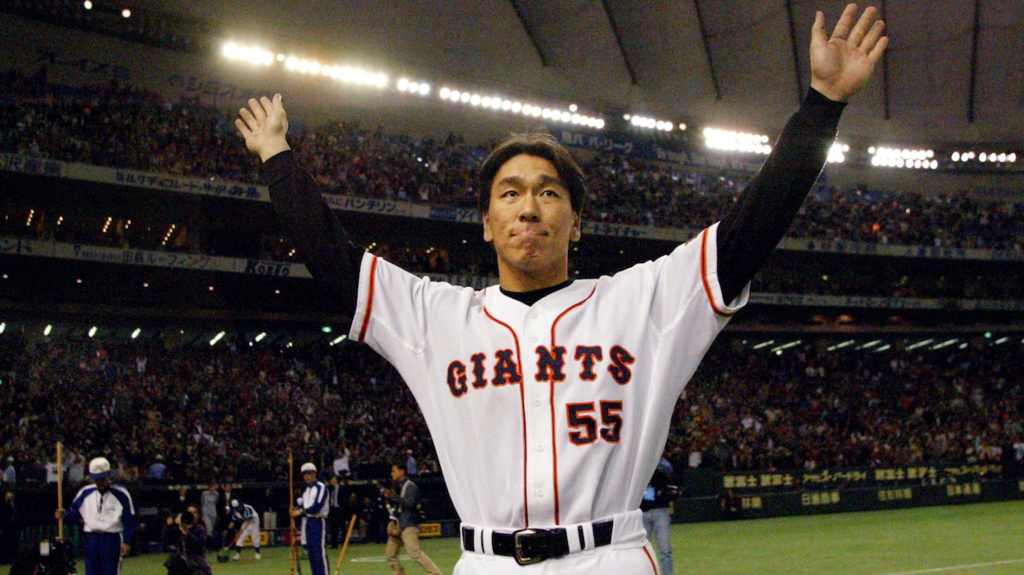
There is a scene from August 16, 1992, that tells you everything you need to know about Hideki Matsui.
Matsui is standing in the batter’s box at Koshien Stadium, the great cathedral of Japanese high school baseball, its ivy-covered walls gleaming in the summer heat. He is seventeen years old and enormous. He looks less like a high school student and more like something assembled in a factory to hit baseballs. His bat is on his shoulder. He is watching the Meitoku Gijuku pitcher, a kid named Kazuhiro Kouno, go into his windup.
The ball, when it comes, will not be aimed at the strike zone.
It never is.
The first walk comes in the first inning, two outs, a runner on third. Defensible. A dangerous hitter, a tight spot, the book says put him on. The crowd accepts it.
The second comes in the third inning, one out, runners on second and third. Still defensible, maybe. The game is close. You can tell yourself a story about it. You can justify it.
The third comes in the fifth inning, one out, a runner on first, and Meitoku Gijuku leading by two runs. This is when the crowd begins to murmur. The story is harder to tell now.
The fourth comes in the seventh inning, two outs, nobody on base. There is no story to tell. The stadium turns hostile. People are shouting. The atmosphere has changed. Koshien is about pitcher versus batter, but there will be no showdown.
The fifth, in the ninth inning, two outs, and a runner on third, is when the bottles and cans come onto the field. Empty cans, empty bottles, megaphones, anything people have in their hands. The game is stopped. The scene has turned ugly.
And Matsui says nothing. He does not slam his bat. He does not glare at the opposing dugout. He simply takes his base, all five times, and waits for a pitch that never comes.
Meitoku Gijuku wins, 3-2. During the winning school’s anthem, the crowd chants go home. The winning players have tears in their eyes. Their manager, Shiro Mabuchi, speaks to reporters afterward as if describing a crime he committed rather than a game he won. “I wanted to compete honestly,” he says. “But with the score close, this was the only way. I gave all the instructions myself.” The team’s hotel receives so many harassing phone calls that they are forced to change the number.
The Japan High School Baseball Federation calls an emergency press conference. Mabuchi is criticized in every newspaper in the country. He defends himself by saying he had watched Matsui in practice and seen something that disturbed him. “There was a professional player mixed in with the high school kids,” he says.
He meant it as a justification. It reads, in retrospect, as prophecy.
Afterward, when the reporters find Matsui, he is quieter than anyone expects. “I don’t remember,” he says at first, and then: “I’m fine. It’s thanks to that I became famous. And I’m glad I didn’t get angry in the batter’s box.”
Years later, he will say something more considered: “I wanted to become the kind of player where fans would say of course Matsui got walked five times in high school. It couldn’t be helped.“
That is the whole story, right there. Everything that follows, the ten years in Japan, ten years in America, the titles and the injuries and the consecutive games and the World Series, is Matsui trying to become that player. The player who made the walks make sense in retrospect. The player so obviously dangerous that refusing to face him was not cowardice but simply the smart thing to do.
He spent the next twenty years earning that description. He almost always succeeded.
He was, from the beginning, physically preposterous. The nursery school teachers thought he was eight years old when he was three. By the time he entered middle school, he stood 170 centimeters (5’7”) and allegedly weighed 95 kilograms (209 lbs). He was a thirteen-year-old with the frame of a sumo wrestler, which was not merely a metaphor, since he also won a local youth sumo championship that year. He could, honestly, have been almost anything physical. He chose baseball.
His father gave him a phrase to live by when he was in elementary school, written in brushwork on a piece of paper and hung above his desk: Effort itself is a talent. Matsui kept that idea his whole life, making it his guiding principle. He was gifted, yes—the swing was effortless, the power was outrageous, the instincts were those of someone born for the sport. But what the people around him noticed most was how hard he worked at things that weren’t natural to him, and how patiently he absorbed failure.
He arrived at Seiryo High School in Kanazawa, one of the legendary baseball programs in Japan, weighing over 100 kilograms, and the coach told him to lose weight before he touched a bat. So he ran. Every day, he just ran, until his body was ready.
He actually joined Seiryo as a pitcher. On his first day of practice, the coaches took one look at his pitching and asked him where else he’d like to play. His hitting in that same first session was something else entirely. He cleared the fence while the upperclassmen were still figuring out how to get the ball off the infield. His classmates, initially, worried that maybe they were supposed to be doing more. “Maybe the seniors aren’t trying,” Matsui thought. They were trying.
He was 15 years old and batting fourth for a team of 18-year-olds.
By his third year (and final since high school in Japan is equivalent to grades 10-12 in America), Matsui had hit 60 home runs in total. The way he counted them matters: he only counted balls that cleared the fence on the fly. No inside-the-park home runs. No cheap ones. A ball either went over the fence or it didn’t, and everything else was just running.
It’s a good thing he did so much of it when he joined the team.
The scouts who watched him compared him to Kazuhiro Kiyohara, the most celebrated power hitter of his generation, and then said Matsui might be even better. One scout, watching Matsui at the spring tournament of his final year, described the experience as watching a different species play the same sport. Matsui hit two home runs in his first at-bats of that tournament. When the Seiryo coaches were asked about his power, they mentioned that during summer practice, he routinely broke softballs with his swing and the team’s budget for replacement balls ran to over 100,000 yen in a single year.
There is more. Behind the right field wall at Seiryo, five meters past the 91-meter (299 feet) mark, stood a ten-meter net placed there specifically because Matsui’s practice shots kept clearing the fence. Beyond the net, some distance away, sat the home of the school principal. On more than one occasion, a baseball was found in his garden. On at least one occasion, a ball was discovered lodged in the snow guard on his roof. The estimated carry on some of these shots was over 150 meters (492 feet). The school, concerned about the liability, took out an injury insurance policy specifically to cover the possibility that Matsui’s batting practice might hurt someone outside the grounds.
Sometime in 1990, a first-year outfielder from Meiden High School named Ichiro Suzuki was playing a practice game against Seiryo. He reached base and found himself standing next to Matsui on first. Years later, when a reporter asked him about it, Ichiro laughed. “The thing I remember,” he said, “is that his ears were really big.”
His nickname came from a reporter named Misako Fukunaga who covered high school baseball for Nikkan Sports. She was watching Matsui before his third year and searching for words. She landed on Godzilla because of his lower body and his prominent canine teeth. Matsui initially protested. “Isn’t there something cuter?” he asked. There was not.
Then came August 16, 1992, and the five intentional walks.
Here is what Matsui did after that game, and this is the part that matters most.
He didn’t sulk. He didn’t complain to reporters. He went home and, somewhere in the weeks and months that followed, he turned the humiliation of being deemed too dangerous to face, of being denied the right to compete into fuel of the purest kind.
He said, years later, after he had retired: “When I went to the Giants and people knew me as the batter who was walked five times at Koshien, I felt I had to show them with my results.”
He was drafted by the Yomiuri Giants in November 1992, when the great Shigeo Nagashima was returning to manage the team. Four teams tried to draft Matsui: the Dragons, the Hawks, the Tigers, and the Giants. They drew slips in that order. The Giants drew last, and their slip was the winning one.
Nagashima called Matsui personally that same day. Matsui had wanted to play for the Hanshin Tigers his whole life (he had grown up a Tigers fan, his father’s influence) but when Nagashima called, something happened. He said yes.
Then, a few days later, a piece of handwritten calligraphy arrived in the mail. It was from Nagashima. It read: “Matsui-kun, you’re destined to be a star for the Giants. Let’s put in the work together and build something great. I’m counting on you.”
Matsui kept it.
At his signing press conference, while other young draftees talked about the players they idolized or the statistics they hoped to reach, Matsui said something different. Soccer, he noted, was growing in Japan. Sumo had its stars. Children were being pulled in other directions. “I want to give those children dreams,” he said. “I want them to come to the stadium to see baseball played live.” He was only eighteen years old.
His Giants career began poorly. The professional game was faster and harder and meaner than anything Matsui had ever seen, and in the spring of 1993 it showed. His first professional at-bat was in an exhibition game against a young Kazuhisa Ishii, who struck him out on a curveball. He went home and, by his own account, felt something close to fear. It wasn’t fear of failure exactly, but the dawning awareness that the distance between where he was and where he needed to be was real and large. He spent that spring hitting .094 in exhibition play, leading the team in strikeouts, and looking very much like what he was: a boy with enormous talent who had never been truly tested.
Nagashima demoted him in April. This was not a small thing. Matsui was the most celebrated young player in Japan, the boy from Koshien, the Godzilla of a thousand newspaper headlines, and now he was playing in the minor leagues because he couldn’t hit professional pitching. He responded in the characteristically Matsui fashion: he said he would make Nagashima regret the decision, and then he went out and hit .375 with four home runs in twelve minor league games before being promoted to the top team, ichi-gun, May 1.
His first professional home run came the following day, off Shingo Takatsu of the Yakult Swallows, a line drive into the right field stands at Tokyo Dome so pure and hard that teammates said you could hear the difference between that ball and the balls other people hit.
He finished that season with 11 home runs, a record for Giants rookies who had graduated high school, and Nagashima started making plans.
The plans were elaborate. Nagashima had a system he called the Thousand Day Plan. It gave him three years, starting from the moment he drafted Matsui, to turn him into the player Nagashima believed he could be. It began four days after Matsui joined the team. From then on, Nagashima worked with him almost every day: in the indoor batting cages at Tokyo Dome on home games, in hotel rooms on road trips, in the basement of Nagashima’s own home, and on days off, at whatever hotel Nagashima happened to summon him to. Matsui once described walking into the Seiyo Hotel in Ginza, one of the grandest hotels in Tokyo, carrying a bat, because Nagashima had called him in. He was, he noted, probably the only person in the history of that establishment to arrive that way.
One of the things Nagashima told him: calluses on your hands are not a sign of hard work. They are a sign of a flaw. If your palms are calloused, you are gripping the bat too tightly. If you are gripping too tightly, you are losing bat control. The goal was not to build calluses but to eliminate them.
When Matsui arrived at the Giants, his palms were covered in them. By the time he left Japan ten years later, after the home run titles and the MVP awards and the thousand consecutive games and all those swings in all those hotel rooms, his hands had become smooth. The calluses disappeared as the titles accumulated. He found this remarkable enough to mention at his retirement press conference, twenty years later, when a reporter asked him what he remembered most from his career.
He paused for a moment. Then he said: “Swinging the bat alongside Nagashima-kantoku. That might be what stays with me most.”
In 1994, in Matsui’s second year, the Giants were in the middle of one of the great pennant races in the history of Japanese baseball. The Central League came down to the final day: October 8th, a Sunday, the Giants against the Chunichi Dragons, winner takes all. It is remembered in Japan simply as “10.8” the way certain games are remembered only by their date*. Matsui, just twenty years old, hit a home run. Yomiuri won the pennant. He was not yet the best player on the team. He would be soon.
*Like one of the most famous double headers in Japanese baseball history, 10.19.
By 1995 he was hitting .274 with 22 home runs and winning his first Best Nine award. By 1996 he was something else entirely.
That is the one that defined the first chapter of his career.
Matsui hit 38 home runs that year at age 22, a performance so good that it tied Sadaharu Oh’s then-record for home runs by a player that age. He was the engine of a Giants comeback that nobody had expected. They were trailing badly in the standings in midsummer, and Matsui almost single-handedly dragged them back into contention. He won the July and August monthly MVPs. He won the season MVP. He was, without question, the best player in the Central League.
But the home run title is the thing that got away, and the way it got away was somewhat familiar.
Going into the final game of the season, Matsui was one home run behind Takeshi Yamasaki of Chunichi for the league lead. So the Dragons, playing the Giants in the season finale, walked him intentionally in all four of his plate appearances. Nagashima had even batted Matsui leadoff in an attempt to give him as many chances to swing as possible and it didn’t matter. The Chunichi battery walked him when he stepped into the box in the first inning, and then again in the third, the sixth, and the seventh. Sixteen consecutive balls. Four straight intentional walks. The Tokyo Dome crowd erupted. Fans threw things onto the field, screamed obscenities at the Chunichi dugout, rained down a fury that the reporters would describe the next morning as unlike anything they had witnessed.
He was 22 years old, and it had happened again.
What nobody quite expected was how Matsui would respond. When the reporters found him after the game, they asked how he felt. He was, by multiple accounts, the calmest person in the building.
“They did it to me good,” he said. “But it can’t be helped. Not getting the title is frustrating, but that time was more frustrating.”
The reporters asked what he meant by that time.
He meant August 1992. He meant Koshien. He meant the five intentional walks in the summer tournament that had made him a national story and a national symbol and, in some ways, a national obligation. Four years into his professional career, standing in the ruins of his first serious chance at a batting title, he was still measuring his professional disappointments against that afternoon. As if nothing in the professional game could quite match what it felt like to be seventeen and refused.
In 1997, Kazuhiro Kiyohara, the great Kiyohara, the man every scout had compared Matsui to when Matsui was still in high school, came to the Giants as a free agent, and suddenly the team had two of the most feared hitters in Japan batting in the same lineup. They were called the MK Cannon, a portmanteau of their names, and the partnership was genuinely terrifying for opposing pitchers. Matsui hit 37 home runs. He lost the home run title by a single homer, again. It had become almost a joke. He kept hitting 37 or 38 home runs and kept finishing second.
In 1998, he injured his knee during spring training. He would spend the rest of his career managing his knee. But that same year, he finally won the home run title. He also won the RBI crown. He also won the on-base percentage title. It was the first time since Oh Sadaharu in 1977 that a Giants player had won both home runs and RBI in the same season. He was 24 years old.
The next year, he hit 42 home runs, the first time a Japanese player had hit 40 home runs in a season since Hiromitsu Ochiai in 1989, and the first time for the Giants since Sadaharu Oh in 1977.
By 2000, Matsui was the unquestioned best player in Japan. That season he did something that had not been done at Yomiuri since 1950: he played every inning of every game in the cleanup spot. Every inning. Every game. All 135 of them. He hit .316 with 42 home runs and 108 RBI. He won the regular season MVP, the All-Star Game MVP, the Japan Series MVP, and a Golden Glove in the outfield. His consecutive games streak, despite his injuries, stood at over a thousand.
His final season in Japan was 2002, and it was the greatest of his career.
For the first half of the season, his numbers were not remarkable. He had hit 18 home runs in the first 76 games. Then something changed.
In the second half of the season, over 64 games, he hit 32 home runs, a pace that would have given him 70 over a full year. He finished with 50 home runs, becoming only the eighth player in NPB history to reach that mark. He also hit .334 and drove in 107 runs and won the home run and RBI titles, and took home Central League MVP for the third and final time.
And then, after the Japan Series, after his Giants won the championship, sweeping the Seibu Lions in four games, he sat down with Nagashima, the man who had drafted him, the man who had developed him, the man who had listened to the sound of his swing in empty batting cages for ten years, and told him he was going to America.
He called it, later, the hardest decision of his life. He said he used the word “traitor” about himself, because that was how some Giants fans would see it, and he wanted to acknowledge the weight of what he was doing. He was leaving the team, the city, the league, the country that had made him. He was leaving Nagashima. He had won everything there was to win in Japan and he needed to know if he could win somewhere else.
He came to New York in December of 2002, signing with the New York Yankees. The tabloids announced his arrival with the headline: Godzilla Comes to the Bronx. He was 28 years old, and he was starting over.
His first game at Yankee Stadium started out ordinarily enough. Matsui grounded out and walked in his first two at-bats. But then in the fifth inning, with one out and the bases loaded, he ran the count full, and Twins starter Joe Mays threw a changeup. Matsui hit it into the right-center stands. Grand slam. First home run as a Yankee, in the first home game as a Yankee, with the bases loaded. It’s etched into my memory.
He came back to the dugout and manager Joe Torre nudged him back out. He stepped onto the top step and acknowledged the crowd. Godzilla lands in New York.
He played 518 consecutive games from his major league debut before a broken wrist ended the streak in 2006. He played through bad knees, through allergies that sabotaged his April numbers year after year, through the particular loneliness of being a man who spoke carefully through an interpreter in a clubhouse that moved fast and loud. He missed significant time due to a wrist injury. His teammates called him Mats. Derek Jeter called him one of his favorite players. Torre said he had never seen a player who treated his equipment with more respect.
Then came 2009.
He was 34 years old. His knees were shot. He had not played the outfield in more than a year. He was a full-time designated hitter, which in the National League parks where the World Series would partly be played meant he could only appear as a pinch hitter. He hit 28 home runs in the regular season. He had been brilliant in the playoffs.
The World Series was against the Philadelphia Phillies. He was relegated to pinch hitting in games 3 (he hit a home run), 4, and 5. In Game 6, back in the Bronx, with the Yankees needing a win to close it out, Matsui batted fifth. He hit a two-run home run off Pedro Martínez in the second inning. He singled up the middle in the third. He hit a two-run double to right-center in the fifth. When the game ended, he had gone 3-for-4 with 6 RBI, tying the World Series record for RBI in a single game. The Yankees won. The stadium chanted his name.
He was named the World Series MVP. He was the first Asian player to win it. The next morning, a column in the Asahi Shimbun compared him to Ichiro, finding their contrasting styles: “If Ichiro is a razor, Godzilla is a machete.” The Sankei Shimbun called them “the statistical Ichiro” and “the memorable Matsui.”
That second phrase is the one that stuck, and it stuck for a reason. Matsui’s career was not defined by its peaks but by the consistency, the seriousness, and the absolute refusal to ever be less than fully present, in good times and bad. He gave interviews after every game regardless of outcome. He polished his glove every day. He never said a bad word about another person. He never missed a game unless his body literally could not continue.
Matsui hit 502 home runs across two continents in his career. He played in 1768 consecutive games. He was inducted into the Japanese Baseball Hall of Fame in 2018 and became the youngest inductee at 43 years and 7 months, surpassing Hideo Nomo’s record of 45 years and 4 months in 2014.
He had learned something as a teenager, watching a pitcher throw balls deliberately outside the strike zone, and had carried it with him for the next twenty years: that the world would not always give you the chance to prove yourself. That sometimes the greatest insult was not the criticism but the refusal to compete. And that the only real answer was what you did when they finally threw you a strike.
By the end, the fans said exactly what he had hoped they would say:
Of course they walked him. It couldn’t be helped.
Thomas Love Seagull’s work can be found on his Substack Baseball in Japan
 SABR Asian Baseball Research Committee Blog
Leave a comment