Tag: history

  • 1966: The Dodgers Return to Japan

    1966: The Dodgers Return to Japan

    by Andy McCue

    Every Monday morning we will post an article from SABR’s award-winning books Nichibei Yakyu: Volumes I and II. Each will present a different chapter in the long history of US-Japan baseball relations. This week Andy McCue focuses on the 1966 Los Angeles Dodgers tour of Japan.

    By 1966, the bloom was coming off the chrysanthemum of Japan tours by major-league teams. Rebuilding US-Japan relations was less worrisome as the Japanese economy surged and Tokyo proved a stout ally for American fears about Russian and Chinese policies in Asia. Concerns about whether the tour would make money thrust themselves into the picture. The strain of major-league pennant races made more players reluctant to travel, and the lure of “exotic” Japan had dimmed.

    The changes showed up between the lines for the first time as an American team barely outlasted its Japanese rivals. Still, the 1966 tour provided the venue to regularize the official relationship between American and Japanese professional baseball.

    It had been a decade since the last Dodgers’ tour of Japan. That had been a Brooklyn Dodgers team that had just dropped a seven-game World Series to the New York Yankees after defeating them the previous year. This time it was a Los Angeles Dodgers team, which had just been swept in the World Series by the Baltimore Orioles a year after winning it all. The hoped-for match between the American and Japanese champions, a consistent hope of the Tokyo promoters, was thwarted yet again.

    The tour followed in the wake of a contentious battle between the San Francisco Giants and the Japanese Pacific League’s Nankai Hawks over pitcher Masanori Murakami. Murakami, whom Nankai lent to the Giants for American-style training, proved such a sensation that the Giants called him up late in the 1964 season. He pitched so well that they refused to return him to Nankai and kept him for the 1965 season. The Japanese team thought the two clubs had a gentleman’s agreement, the Giants thought they had a binding contract for Murakami’s services. After much negotiation and bitterness, he had returned to Nankai for 1966

    The bad feelings over Murakami hovered in June 1965 as the Yomiuri Shimbun withdrew its offer to sponsor a tour that fall by the Pittsburgh Pirates. For the Japanese newspaper, sponsoring a tour was a commercial venture and “[t]he Pirates are unknown in Japan and we did not want to risk going into the red,” said Kanzo Hashimoto, head of the company’s promotions department.

    Commissioner Ford Frick was holding to the contract he had worked out with the Japanese in 1955. Under that agreement, a major-league team could visit every two years, with the selection alternating between the National and American Leagues. The Pirates had been the first team to volunteer for the 1965 trip, Frick said, so they were chosen. The last team to visit Japan had been the Detroit Tigers in 1962, and the 1964 trip had been postponed because Tokyo was hosting the summer Olympics that year.

    Yomiuri, which also owned the Yomiuri Giants, Japanese professional baseball’s dominant team, turned to the Dodgers. Walter O’Malley had been steadily building a relationship with Japanese professional baseball in the years since his team’s 1956 visit. Japanese players and coaches had been hosted at spring training in Vero Beach as well as in Los Angeles. Dodger instructors, including Al Campanis and Tommy Lasorda, had made spring-training visits to conduct clinics in Japan. The newspaper executives knew the Dodgers would be a strong draw.

    Frick was annoyed at Yomiuri’s end run to the Dodgers and The Sporting News editorialized that it would not work. But by the spring of 1966, O’Malley and Toru Shoriki, president of the Yomiuri Group and its Giants, were negotiating terms for the trip. In a little over a month, the formal invitation was announced. A few weeks later, baseball owners approved the tour, rubber-stamping Yomiuri’s end run. Both the Dodgers and Shoriki’s Giants had been champions in 1965, and the matchup offered promising opportunities for promotion and to see how much Japanese professional baseball was progressing.

    Clouds appeared on the tour’s horizon even before the formal invitation. Dodgers shortstop Maury Wills, the prime offensive engine of a team that did not score well, was planning a career as an entertainer when his baseball career ended. The 33-year-old had permission to arrive a week late at 1965 spring training while he toured Japan playing his banjo and singing. But, general manager Buzzie Bavasi claimed he had revoked that permission during salary negotiations. Hard things were said on both sides before an agreement was reached for a $35,000 raise to $80,000 for 1966.

    Wills’s negotiations were overshadowed that spring by the revolutionary holdout of Dodgers aces Sandy Koufax and Don Drysdale. Drysdale’s appreciation of his value had been sparked by an offer from Japan of a $500,000 multiyear pact in late 1965. Frick threatened both Drysdale and the Japanese for a move he said would break Drysdale’s contract and jeopardize both the pitcher’s future and Japanese baseball’s relationship with the major leagues. The offer’s detail and whether it was real were never revealed as Drysdale chose to try to increase his salary and stay in the United States.

    In two innovations anathema to baseball owners, and especially Walter O’Malley, Drysdale and Koufax held out together and hired an agent. They asked for three years, with $200,000 annually for Koufax and $150,000 for Drysdale. Drysdale had earned a reported $75,000 in 1965, with Koufax slightly less. At first, Bavasi and O’Malley scoffed. But the hurlers hired an entertainment industry agent and began to work on deals for their own Japan tour and for movie studio and television contracts. The first movie opportunity fizzled, but Drysdale and Koufax ultimately appeared as actors. The leverage had its effect. Eventually, Koufax signed for $125,000 and Drysdale for $110,000.

    But the ripples went further. New Major League Baseball Players Association Executive Director Marvin Miller watched the holdout closely and pointed to the inequities of the process and the value of agents as he educated the board of the Players Association to the problems and the opportunities of negotiations. Within the Dodger organization, it gave Koufax and Drysdale much more freedom from management dictates. They would use that power to decline to accompany the team to Japan that fall.

    As the season progressed, there were increasing signs that other Dodgers were not enamored of the trip. The 1966 season was a grueling pennant race. The 1965 World Series winners led the league for only one day before gaining first place permanently on September 11. Their lead was never bigger than 3½ games. The season came to a close in a rain-splattered East Coast trip that included multiple doubleheaders. The Pittsburgh Pirates were not out of it until they lost the second game of a twin bill on October 1. The San Francisco Giants were eliminated only when Koufax won the second game of the Dodgers’ doubleheader in Philadelphia on October 2, the last day of the season. “Thank God it’s over,” said Koufax, echoing the sentiments of his teammates.

    The team’s exhaustion was clearly exhibited in the four-game World Series sweep at the hands of the Baltimore Orioles. The Dodgers’ offense managed only four runs in the four games.

    All this played into existing disenchantment with the Japan trip. As early as June, Phil Collier of the San Diego Union was reporting that Koufax, Drysdale, catcher John Roseboro, and outfielder Ron Fairly, the team’s player representative, were balking. “All we know is what we’ve read in the newspaper. The club hasn’t told us a thing,” Fairly told Collier. O’Malley had done all the negotiations with Shoriki without consulting the players. By August, Maury Wills’s name was added to the reluctants’ list.

    The front office brought pressure and most players fell into line. Ron Fairly said it was made clear to him that he would have to go. Wills tried to beg off with a sore knee. He’d twisted it beating out a bunt in July but had played on what was feared to be torn cartilage for the rest of the season. On the day he twisted his knee, he had 30 stolen bases. He would steal only eight the remainder of the season and had to be hypnotized to be willing to endure the pain from the knee and the raw patches on his legs from sliding. He too was told he had to go, but was promised he would play minimal amounts. Wes Parker told Walter O’Malley he had been to Japan before and wasn’t interested in seeing it again. Besides, he was sore and tired after the season. Parker was allowed to join Koufax and Drysdale with the stay-at-homes. Don Sutton, who had arm trouble surface in September, was held back on medical advice.

    The pitching situation was a severe blow as the Dodgers left California. Koufax, Drysdale, Claude Osteen, and Sutton had started 154 of the team’s 162 games. Only Osteen was on the trip, and manager Walter Alston suggested he was tired as well.Pitching had carried them to the pennant, giving up three runs a game, more than a run lower than the league average. Meanwhile, the offense was scoring 3.7 runs a game, third worst in the league. The Dodgers would face Japanese teams with the same anemic offense but a heavy sprinkling of arms from the bullpen and their minor-league system.

    The players who did go each received $3,000 and the equivalent of another $750 in yen from Yomiuri. The players talked of buying cameras and other electronics.

    The team left on the trip under a cloud of skepticism in the wake of the World Series. Typical was the Los Angeles Times’s Frank Finch’s story previewing the trip: “Having endeared themselves forevermore in the hearts of Marylanders with their peaceful visit to Baltimore last weekend, the Dodgers depart today for a goodwill tour of Japan.” Snide references to the World Series would populate headlines and stories throughout the trip.

    The team stopped in Honolulu for two exhibition games against teams of local major and minor leaguers with Bo Belinsky and Don Larsen brought in to provide the pitching. The Dodgers won both handily.

    While with the Dodger party in Honolulu, Commissioner William Eckert discussed a deal with his Japanese counterpart, Toshiyoshi Miyazawa, to cover future trips to Japan and, he hoped, avoid the disagreements that had clouded the Pirates’ proposed visit and the Dodgers’ eventual trip. They tentatively agreed that no team could visit Japan more than once in a six-year period and “no two teams from the same league can visit Japan more than two years in succession.”

    In Japan, expectations were high. “United States-Japan Battle of Champions” headlined the Yomiuri newspaper amid talk of a “real World Series.” The American military’s Far East Network announced it would broadcast most of the games. The 80-person Dodger delegation arrived in Tokyo on October 20 to the expected lavish greeting and a full slate of social events as well as ballgames. O’Malley blamed Koufax’s absence on a sore arm and said Drysdale had to attend to “business interests.” Asked by reporters if he foresaw a Japan-US International Series, O’Malley said, “I don’t see how you can prevent it. Japanese baseball is progressing admirably and the ballplayers are skillful. The public will demand it.” And, asked if the Dodgers would make a special effort to beat the Japanese champion Yomiuri Giants, O’Malley said, “definitely so.” Added Alston, “We’re on a four-game losing streak and want to win here.”

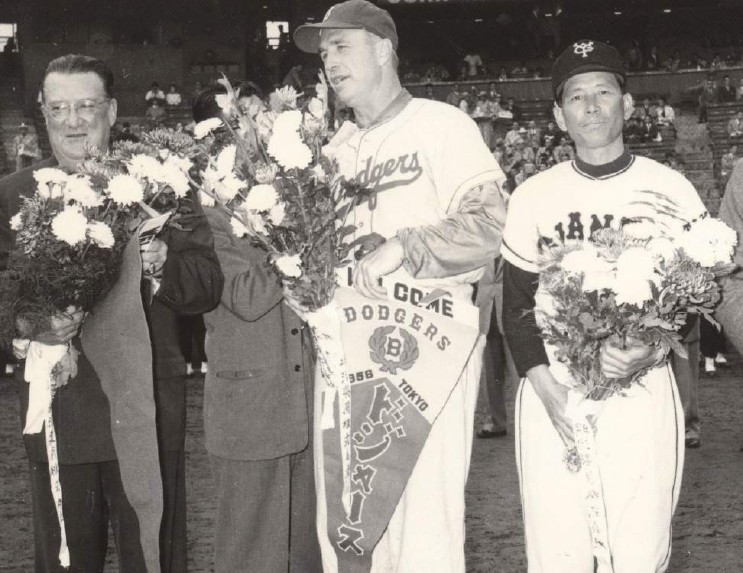
    The next day, Eckert presented Shoriki with a bronze plaque bearing an engraved message and signature from President Lyndon Johnson. After handing the message to Shoriki, Eckert also presented him with a World Series championship ring. It was the first World Series ring ever presented to a person not connected with a team participating in a World Series. “I myself and other Japanese concerned would like to further continue to promote Japan-U.S. friendly ties and contribution to peace, through baseball,” Shoriki said. The Dodgers worked out at Tokyo’s Korakuen Stadium in anticipation of the next day’s opener.

    Game 1: October 22, Tokyo

    The Dodgers started the tour with a bang, 21 hits including six homers in a 16-5 drubbing of the Yomiuri Giants. Willie Davis and Jim Lefebvre hit two homers apiece while Tommy Hutton and Osteen each hit one before 40,000 people at Korakuen. Yomiuri provided a 7,000 yen ($19.44 in those days) reward for each home run. The game story noted that the 21 hits were four more than the Dodgers had managed in the entire World Series. Outfielders Toshimitsu Suetsugu and Akira Kunimatsu each had two hits to lead the Giants. The Giants had wrapped up a Japan Series championship over the Nankai Hawks on Wednesday October 19, while the Dodgers had not played a serious game since October 9.
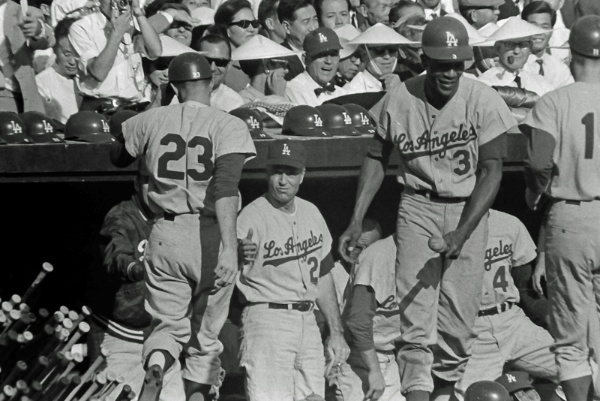
    Claude Osteen, Walt Alston and Willie Davis during the 1966 tour of Japan (Robert Fitts Collection)

    Game 2: October 23, Tokyo

    The Giants evened up the series as left-hander Akio Masuda shut out the visitors, 5-0, allowing just three singles. Another crowd of 40,000 saw Suetsugu provide the key hit with a triple. “We were just no good today,” said Alston. “The boys just couldn’t touch the Japanese southpaw. He had a sneaky fastball plus a good assortment of other pitches.”

    The defeat echoed loudly in the United States the following Saturday (October 29). ABC had sent Red Barber to Tokyo for its weekly Wide World of Sports. The segment reported on the Dodgers’ tour and focused on Masuda’s gem. He “made the Dodgers look like sleepwalkers, groping blindly and mechanically on the road to nowhere,” wrote Arthur Daley in the New York Times.

    Game 3: October 25, Sapporo

    The Dodgers returned to the victory column with a 3-1 win over the Giants at Maruyama Stadium in Japan’s northernmost major city. Despite a steady rain, a crowd of 30,000 watched left-hander Kazumi Takahashi, who was chosen to start because of his similarity to Masuda, give up run-scoring hits to Maury Wills, Lou Johnson, and Willie Davis. Davis’s RBI was aided by Sadaharu Oh’s error. Katsutoyo Yoshida drove in the Giants’ run. In an incident that would echo for several years, Wills sprained his injured knee rounding third base when a rain-soaked patch of grass gave way. He was immediately replaced by pinch-runner Tommy Dean.

    Game 4: October 26, Sendai

    The Giants evened up the series yet again, mowing down the Dodgers 13-6 at Miyagi Stadium before 32,000 fans. The 13 runs set a record for the most tallies by a Japanese team against an American professional club. Jim Barbieri gave the Dodgers an optimistic start with a leadoff home run, but Yukinobu Kuroe matched him in the bottom of the first. The Dodgers’ second featured four runs on a parade of singles, but it was the bottom of the second that proved decisive. The Giants pounded Osteen and young Joe Moeller for six runs on five hits and two walks with two outs. Dodger minor leaguer Leon Everitt gave up another four runs in the seventh inning.

    October 27 was a travel day and the Dodgers stopped in Tokyo on their way to Osaka. While there, Wills asked Walter O’Malley’s permission to return to the United States for medical treatment on his knee. O’Malley, already missing Koufax and Drysdale, refused. Wills said he had been promised he would only have to play a couple of innings a game but had played almost full games early in the series. He decided he needed to go and jumped on a flight to the United States.

    O’Malley was incensed. “As the captain of the team, a higher degree of devotion to duty was expected of Maury,” the owner said. Then, adding a subtle threat about Wills’s post-playing future, O’Malley added: “I thought this particular boy showed evidence of having executive ability, and so did others.” The Wills story would come to dominate US coverage of the trip.

    Game 5: October 28, Osaka

    After a travel day, the Dodgers faced off with a team of players chosen from the Giants and the Nankai Hawks, champions of Japan’s Pacific League. (The Giants were champions of the rival Central League.) Alan Foster, who had spent the 1966 season with the Dodgers’ Albuquerque farm club, shut out the Japanese team 5-0 in front of 19,000 fans at Osaka Stadium. Utility infielder John Kennedy contributed two home runs. (He had hit three during the regular season.) The game featured the Dodgers’ first meeting with Murakami in Japan. In his two years in the National League, Murakami had pitched 13 innings against the Dodgers, giving up only one earned run. For Nankai in 1966, Murakami had gone 6-4 with a 3.08 ERA. That day in Osaka, he gave up three runs in 1⅔ innings, including one of Kennedy’s blasts and another by Barbieri.

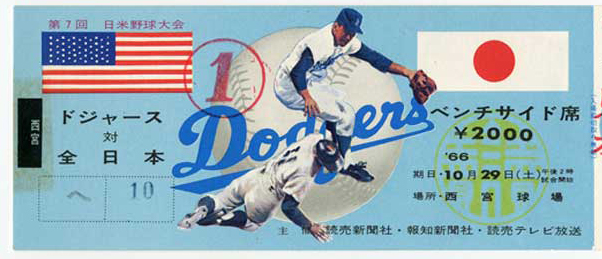
    Game 6: October 29, Nishinomiya

    The Dodgers’ bats livened up in a second game against an all-star squad, winning 7-1 in this Osaka suburb. Jim Brewer, Bob Miller, and Phil Regan stifled the Japanese team, while Lou Johnson and Tommy Davis contributed their first home runs of the tour. The crowd of 30,000 at Nishinomiya Stadium saw the Dodgers frustrate the All-Stars by turning four double plays.

    Game 7: October 30, Osaka

    The Dodgers got a measure of revenge against Masuda, their nemesis in the second game, as Dick Stuart and Nate Oliver reached him for home runs to key a five-run ninth inning and a 9-7 Dodgers victory at historic Koshien Stadium, home to Japan’s annual high-school tournament. Murakami started the game and pitched 3⅓ shutout innings, but the bullpen could not hold the lead. The All-Stars had taken the lead by beating up on Joe Moeller and Ron Perranoski for four runs in the seventh inning. Phil Regan and Nick Willhite restored order and shut out the Japanese team for the rest of the day. John Kennedy also homered for the Dodgers, while Teruyuki Takakura of the Nishitetsu Lions hit one for the All-Stars before 43,000 people.

    Game 8: November 1, Toyama

    The Giants rejoined the campaign in this seaside resort city and the Dodgers prevailed with a 5-2 victory. The score was tied 2-2 in the top of the eighth inning. Akio Masuda was brought in yet again, but pinch-hitter Dick Stuart drove in a run and Al Ferrara singled to drive in two more. Phil Regan shut down the Giants in the eighth and ninth for the win at Toyama Stadium before 23,000 fans.

    November 2 was a travel day and the Wills story was thickening. In Tokyo, an “embarrassed” O’Malley said he would be meeting Japanese Prime Minister Eisaku Sato on Friday and “try to explain and apologize for Wills.” O’Malley sought to frame it as a larger issue: “The United States is more or less involved in this loss of face caused by Wills’ defection.” O’Malley felt his long commitment to developing baseball as an international sport and building close ties with Japanese baseball was being undermined by Wills. The US government had not officially sponsored the trip but President Lyndon Johnson had sent a message of encouragement to the team.

    Wills, meanwhile, was proving elusive. He had gotten off his US-bound flight at a refueling stop in Honolulu. The Dodgers’ team physician, Dr. Robert Kerlan, said he had not heard from Wills. The shortstop/musician was soon spotted playing his banjo with Don Ho at Duke’s, a Honolulu night club, and at other spots around the city.

    In Japan, four groups of Dodgers visited four US military hospitals in the Tokyo area. The cultural and social obligations of the tour demanded time nearly every day with receptions, cocktail parties, golf outings, visits to tourist sites, and other diversions taking up the Dodgers’ between-games time. It was not a restful vacation.

    Game 9: November 3, Tokyo

    It was a Dodger homer barrage in an 8-5 victory over the Japan All-Stars as a crowd of 39,000 celebrated the Culture Day holiday at Korakuen Stadium. Ron Fairly hit bases-empty and three-run homers while Jeff Torborg and Jim Lefebvre slugged two-run shots. It would prove the high point of the trip, with the Americans now 7-2.

    Game 10: November 5, Tokyo

    After a day to reflect, the Japan All-Stars regrouped for an 8-2 win before 34,000 at Korakuen Stadium. Shinichi Eto of the Chunichi Dragons started the parade with a two-run homer in the first. The Giants’ Sadaharu Oh, who had led the Central League with 48 homers, contributed two more round-trippers. Jim Lefebvre’s bases-empty homer was the only protest by the Dodgers. “Too much Eto and too much Oh,” said Alston. “The barnstorming major leaguers never looked more listless,” wrote Pacific Stars and Stripes sports editor Lee Kavetski.

    Game 11: November 6, Tokyo

    The next day the Dodgers played at Korakuen Stadium before 34,000 people including Emperor Hirohito and Empress Nagako. The team was not up to royal scrutiny, losing 11-3 to the Japan All-Stars. Alan Foster’s first pitch was deposited in the left-field stands by the Giants’ Shigeo Nagashima. Yukinobu Kuroe of the Giants and pitcher Tetsuya Yoneda of the Hankyu Braves also homered. Ron Fairly and John Roseboro homered for the Dodgers. After the game, the Dodgers emerged from their dugout to tip their caps and wave to the royal couple, who had never seen a visiting American team before and had not been to a Japanese professional league game since 1959.

    Eckert and O’Malley made their visit to Prime Minister Sato. During a five-minute meeting at Sato’s official residence, the Americans presented a baseball with O’Malley’s signature and a pass good for all major-league games for the 1967 season. They also presented O’Malley’s apologies for Wills’s absence.

    “The Dodgers may have drawn blanks elsewhere, but they are diplomatic successes in Japan,” reported the Los Angeles Times’s Frank Finch. “No matter where they go, to a shrine, a restaurant or a ball park, they are besieged by the friendly grins of red-hot baseball fans. The official badge issued by Walter O’Malley to the touring troupe is like an open sesame. People who can’t read English instantly recognize the familiar ‘Dodgers’ name in its script form. ‘Doh-jars,’ with the accent on the second syllable, is one of the most popular words in Tokyo, Sapporo, Osaka, Sendai, Nagoya and other cities where the team has appeared.”

    Wills was still in Honolulu, although Bavasi, who was also in Hawaii on a cruise, said he thought the shortstop was in California. Wills was reported at a Democratic fundraiser starring Sammy Davis Jr. but brushed aside any questions about the situation. Kerlan said he still had not heard from Wills. Bavasi said there would be no discipline until all the facts were known. He said a post-World Series examination had found there was no need for an operation, but that if something had happened subsequently, Wills should be seeing Kerlan. “If he’s off playing the banjo somewhere, he must think the banjo is more important than baseball,” Bavasi said.
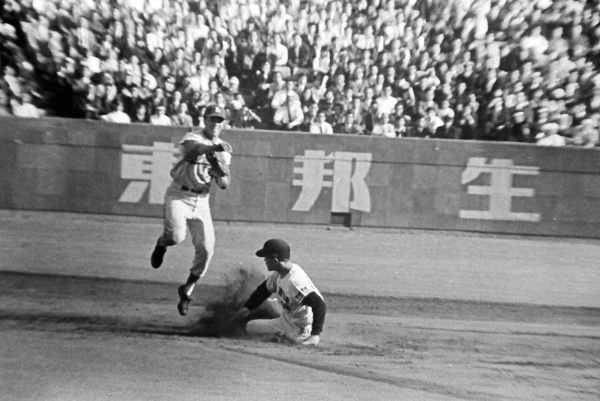
    Maury Wills attempts to turn a double play against the Yomiuri Giants (Robert Fitts Collection)

    Game 12: November 8, Okayama

    The combined Yomiuri-Nankai team returned as the Dodgers’ opponents and fell 10-2. Ron Fairly and Nate Oliver hit home runs, but the Dodgers’ biggest contributor was John Roseboro with a double, two singles, and four RBIs. The 20,000 fans in Okayama Stadium saw the Dodgers score six runs, including Oliver’s home run, in the ninth inning to blow the contest open.

    Game 13: November 9, Hiroshima

    The Japanese opposition was now a team combining the Giants and members of the hometown Hiroshima Carp. The teams played to a 10-inning 10-10 tie before 18,000 at Hiroshima Municipal Stadium. Earlier in the day, a 25-person Dodger delegation had placed a wreath on the site of the atomic bomb’s impact. The game was called because of the need to meet the travel schedule. The Dodgers built an early lead, 10-4 after seven innings, but the home team rallied with six runs in the eighth and ninth innings off Claude Osteen, Phil Regan, and Ron Perranoski. “Something is wrong with Osteen,” said Alston. “He just can’t seem to hit his stride on this tour. With 10 runs, we shouldn’t have had any trouble.” Dick Stuart, with two, John Kennedy, and Jim Lefebvre hit home runs to build the Dodgers’ early lead.

    Game 14: November 11, Kumamoto

    The series moved to the island of Kyushu, the Dodgers’ first move off the main island of Honshu. The opponent at Fujisaki Stadium was a team combined from the Giants and the Nishitetsu Lions, based in the nearby city of Fukuoka. Alan Foster and Ron Perranoski held down the locals while Jim Lefebvre produced two run-scoring doubles to propel the offense. Foster limited the Japanese to one hit until he tired in the eighth inning. With the 6-3 win, the Dodgers’ record stood at 9-4-1. They would not win another game.

    Game 15: November 12, Fukuoka

    The teams moved to Fukuoka’s Heiwadai Ball Park and the Japanese shut down the Dodgers, 4-0. Joe Moeller gave up all the runs in the first four innings. It was the National League champions’ fifth loss of the tour, the most by any visiting American professional club.

    Game 16: November 14, Kokura

    Moving to the northern tip of Kyushu, the Dodgers dropped a 3-1 game to the Yomiuri Giants, moving their record to 9-6-1. Eighteen-year-old Tsuneo Horiuchi of the Giants held the Dodgers to six hits before 20,000 at Kokura Stadium. In the third inning, Dodgers starter Nick Willhite walked two batters before Sadaharu Oh came to the plate. Oh blasted one over the fence, but then was called out for passing the runner who had started at first base, limiting the benefit to two runs. The Giants’ final run scored three innings later when Akira Kunimatsu doubled in Oh. The defeat left the Dodgers’ record against the Giants at 3-3.

    Game 17: November 15, Nagoya

    Now facing a combined team from the Giants and the Chunichi Dragons, the Dodgers dropped their third in a row before 28,000 at Chunichi Stadium. Home runs by Sadaharu Oh and Toshimitsu Suetsugu powered the Japanese team. The Dodgers’ third loss in a row marked the first time an American team had suffered such a streak.

    Also that day, the Japanese government awarded O’Malley its highest honor for a non-Japanese – the Order of the Sacred Treasure, Gold Rays with Neck Ribbon, recognizing his efforts to foster Japan-United States friendship through professional baseball.

    The Dodger wives felt rewarded as well. The spouses of Tommy Dean, Bob Miller, Ron Perranoski, John Roseboro, Dick Stuart, and Jeff Torborg had made the trip and seen the sights and the cultural performances. And done some shopping. “I must have visited and bought out every department store in Japan,” said Sue Ellen Perranoski. “I bought a pearl ring, Christmas cards, kimonos, toys and a truckload of other things.”

    Game 18: November 16, Shizuoka

    The tour, the worst by an American club in the history of the exchange, wound up with a 7-3 loss to the Yomiuri Giants, a game mercifully ended after seven innings because of darkness at Kusanagi Ball Park. It was the Dodgers’ eighth loss (9-8-1 overall) and their fourth straight defeat. Both were records for futility by an American team. For those viewing the tour as an international World Series, it meant the Giants had prevailed 4-3. The Giants jumped on Joe Moeller for four runs in the first inning and never looked back. The 21,000 in attendance saw Sadaharu Oh hit a grand slam, which would have been his third game in a row with a homer (and sixth for the series) except for his baserunning blunder in the 16th game. Al Ferrara homered in the Dodgers’ three-run sixth. Akio Masuda started and closed out his work with 3⅔ shutout innings.

    The post-mortems started immediately. Giants manager Tetsuharu Kawakami said the series clearly showed that the gap between Japanese and American professional baseball had narrowed.

    Comparing the 1966 tour to the one a decade earlier, he said, “We have learned a lot since then. Our baseball is at least 50 percent improved. Our bunting is better, the base runners are smarter now, and we play more inside baseball like the Americans.” Others were not so encouraged. Tokumi Matsumoto, a columnist for the Mainichi Daily News, quoted a fellow Japanese baseball writer: “It is obviously dangerous for the Japanese to believe the 9 win-8 loss-1 tie result indicates the Japanese pro ball standard is almost equal with that of the major leagues.”

    Dodgers manager Walter Alston said he was sorry over his team’s performance and offered specific praise for Oh, Masuda, and Horiuchi. He said he felt Japanese hitters, especially for power, had improved more than their pitchers since the Dodgers’ 1956 trip. Both managers noted that the absence of Koufax and Drysdale had had a big impact on the tour.

    After a day of relaxation and shopping on the 19th, the Dodgers’ charter plane left for Los Angeles on the 20th.

    For the Dodgers, the consequences were coming. Some came directly from the tour. Others had been pending over the season.

    The Dodgers party was still in Tokyo when the biggest blow fell. On November 18, Sandy Koufax announced that he was retiring. He knew he could keep competing and winning, but he also knew he risked permanent damage from an excruciatingly painful elbow that required extensive treatment before and after each start. O’Malley, still in Tokyo, wished him well.

    As baseball’s Winter Meeting started on November 28, Bavasi started other planned changes. Former batting champion Tommy Davis, who had been on the trip, was traded to the New York Mets for the second baseman the Dodgers thought they needed – Ron Hunt. Three days later, the inevitable consequence of the Japan trip fell into place. Wills was traded to the Pittsburgh Pirates for Bob Bailey and Gene Michael. Wills eventually had left Hawaii and visited Kerlan in Los Angeles. Kerlan said the knee was no worse than it had been at the end of the season. He prescribed extended rest, which had been the basis of Wills’s request to miss the Japan trip. Bavasi said this was the only time Walter O’Malley had forced his hand on a baseball decision. Wills, evidently forgiven, returned to the Dodgers in 1969.

    The remake of the Dodgers’ roster would not work well. The team fell into the second division for two years and wouldn’t win another pennant for eight years, or another World Series until 1981.

    Walter, and later Peter, O’Malley worked hard to improve and deepen relations with Japanese baseball. Yomiuri sent the Giants (and 21 Japanese reporters) to Vero Beach for joint spring training with the Dodgers in 1967. The Giants, or individual players, returned many times in the future and other Japanese professional and college teams would come for spring training. The Dodgers did not return to Japan until 1993, but these decades-long contacts were instrumental in the Dodgers’ ability to sign Hideo Nomo when he became the first major Japanese star to join an American major-league team in 1995.

    The agreement between the two commissioners had sparked Japanese dreams that they were evolving toward parity with the US major leagues. The relationships the O’Malleys and the Dodgers forged with Japanese baseball were instrumental in giving them the opportunity to sign Nomo, and effectively confirm Japanese baseball as a second-tier operation as its major stars could dream of better salaries and the satisfaction of competing successfully at the highest levels of professional baseball.

    ANDY McCUE, a former Board President of SABR, won the Seymour Medal for Mover and Shaker: Walter O’Malley, the Dodgers, and Baseball’s Westward Expansion. He is also the author of Baseball by the Books: A History and Complete Bibliography of Baseball Fiction and Stumbling Around the Bases: The American League’s Mismanagement in the Expansion Eras (University of Nebraska Press, 2022). He holds a master’s degree in Chinese history.

    Continue to read the full article on the SABR website
  • DEVELOPMENT OF BASEBALL IN SAUDI ARABIA

    DEVELOPMENT OF BASEBALL IN SAUDI ARABIA

    by Carter Cromwell

    Probably few are aware of it, but baseball has a history in Saudi Arabia. Until recently, though, it was like an old, rarely perused book that had long gathered dust in the attic. 

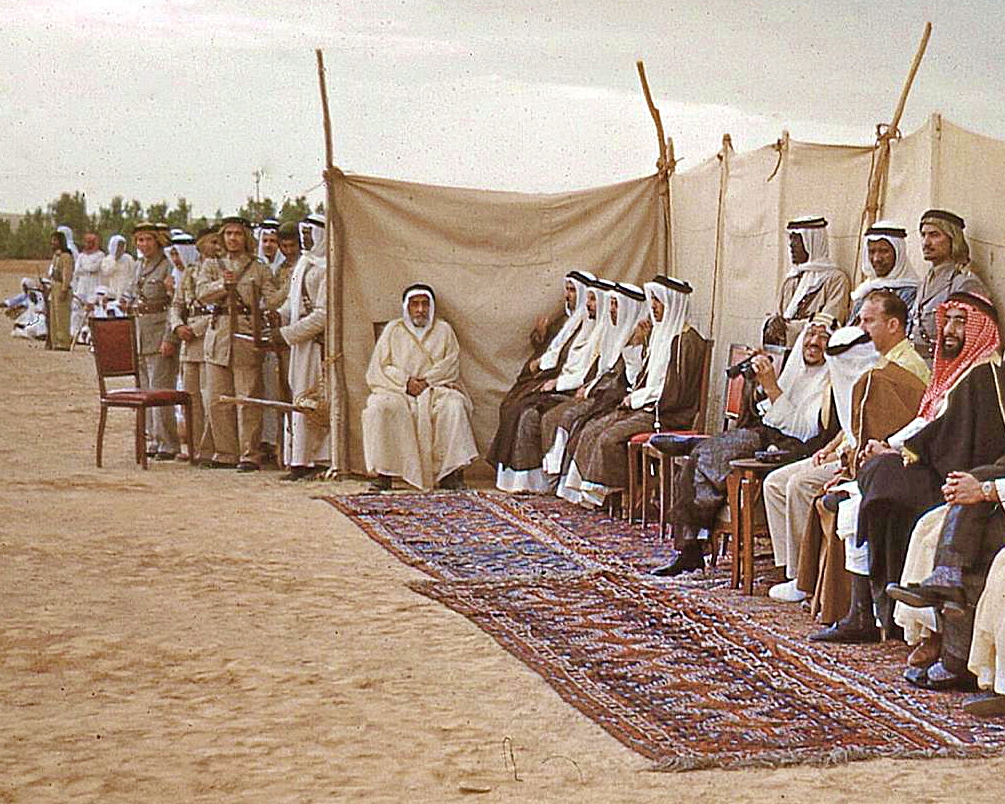
    Not many know that Americans brought baseball to Saudi Arabia in the early 1930s when companies began searching there for oil, which was finally discovered in 1938. Then-king Saud even attended a game in 1954. Children of expat employees of the Arabian American Oil Company (Aramco) played baseball in Dhahran, whose team advanced to the Little League World Series 23 times before interest slackened for a number of years. 

    But now there is an effort to update the story for a larger audience. Much is yet to be written, but people from the governmental level on down are working to change the narrative. 

    In part, this reflects the pivot toward sports that some Middle East countries have made in recent years, the Saudi-sponsored LIV Golf Tour and Qatar’s hosting of the 2022 World Cup football (soccer) tournament being two examples. It also fits with Saudi Vision 2030, the goal of which is to increase diversification in the country economically, socially, and culturally. 

    The Saudi Baseball and Softball Federation (SBSF) was established in late 2019. Baseball United, the Dubai-based professional league that played its initial regular season late last year, is working with the federation to develop the sport, and the Dhahran Youth Baseball Association (DYBA) is rebuilding a program that had gone into decline.

    It is unquestionably a long-term project, but it’s happening.

    Nayef Bin-Humaid is president of the Saudi Baseball and Softball Federation. He lived for 10 years in the United States, mostly near Washington, D.C. His interest in baseball began when he would go with friends to games of MLB’s Washington Nationals. After returning to his home country, he eventually landed in a government job with a project for Vision 2030.

    “I was approached in December 2019 by the Saudi Olympic Committee, which was interested in establishing a governmental body supporting baseball,” Bin-Humaid said. “That would feed into one of the pillars of Vision 2030 in terms of expanding sports activities in the country and, more importantly, expand the game for Saudis.”

    Nayef bin-Humaid
    “Photo courtesy of Nayef bin-Humaid”

    Bin-Humaid was elected president of the federation and got to work immediately, only to be delayed by the Covid-19 pandemic.

    “We started in January 2020, and our first order of business was to find out who was playing the game in Saudi, who wants to play, and what could we do to expand the game within the country,” he said. “We started by going into American and Japanese communities, as well as others that we thought might include people who were interested in baseball. Though baseball is not that popular here, we were surprised to find that there were Saudis who loved the game, wanted to participate, and follow MLB teams closely.”

    Covid-19 soon hit and put a lot of efforts on hold, but the working group was still able to develop a plan and the necessary steps. It connected the Saudi federation with the Asian Baseball Federation and the World Baseball Softball Confederation, while also obtaining seed funding from the Saudi Ministry of Sport. 

    “That enabled us to hire some employees, kick-start a marketing campaign, and get a few other things in motion,” Bin-Humaid said. 

    Jean-Michel Mayeur came on as technical director of the Saudi federation in 2024. The native of France has a long background as a player and coach, directing a baseball academy in Montpellier for nearly 20 years. 

    “I’m excited because I understand the potential here, but it’s going to take a while to develop,” he said. “It’s a big challenge. The main focus now is grassroots development.”

    Bin-Humaid echoed that, saying, “We’re definitely working to develop at the grassroots levels. We’re very lucky to have someone like Jean-Michel who loves the game, is great with kids, and has run an academy. He took on the challenge of coming to a foreign country with the game in its very early stages and help put together a development plan that we can take to schools.”

    The efforts currently focus on a number of areas, including:

    • Working with schools to get baseball instruction into physical education curricula so that more Saudis will be exposed to the game
    • A partnership with the Yokohama DeNA BayStars of Japan’s top professional league to bring some young Saudi players to clinics there
    • Integrating Baseball5 programs into school curricula as a pathway to baseball
    • Establishment of Saudi national teams in baseball, softball, and Baseball5
    • Staging tournaments
    • Working to develop leagues, so players can get consistent competition

    “We’re working hard to get baseball into schools,” Mayeur said. “Getting people interested early on is key. First, we need to teach physical education teachers how to teach baseball. The goal is to have classes during the school days and then after-school activities involving baseball. Baseball5 should help people get interested, too, since you don’t need a ton of equipment or have to train pitchers.”

    Joan Bonhaure, Karim Mejri, and Jean-Michael Mayeur

    Mayeur also noted the need to establish academies; train coaches, players, scorekeepers, and umpires; organize tryouts and tournaments; build more fields that meet regulation standards; establish leagues; and … well, a lot of stuff.

    “The list is long,” Mayeur acknowledged, “but we’ve made progress. We’ve established national teams in baseball, softball, and Baseball5, and having the partnership with the BayStars is really nice. We have four Saudi kids, ages 13-16, there to get instruction and observe the pro team’s practices. We hope to send more in the future, and also have some Saudi teams go there to compete against high school players.”

    Owen Reid of Reid Baseball is an independent consultant who conducts clinics in various countries, many of which – such as Tunisia, Bangladesh, Thailand, Malaysia, Indonesia, and Kyrgyzstan – are not on the baseball map. He started holding clinics in Saudi Arabia in 2016 and made more than 30 visits before moving there with his family early in 2025.

    “I’ve seen the game shift from being a novelty to an option, and now it’s more and more becoming an opportunity for families and Saudi kids eager to challenge themselves with something new,” Reid said. “It’s still true that most of the players I work with are expats, but I’ve seen encouraging growth in the number of Saudi ballplayers. And what excites me most is retention.  Once they try it, they often stay with it. Curiosity is turning into commitment.”

    Bin-Humaid said, “We have around 1,000 registered players in the country now. We focus on kids who are interested and show potential. We monitor them and work to keep them in the game, even when they go abroad to university and play. We’ve taken some to camps in places like eastern Europe, France, and the Dominican Republic, in addition to Japan. We hope to carry the torch for advancement of the game in western Asia.”

    He added that there are now baseball coaches in about a dozen high-level private schools, since physical education classes in public schools mostly focus on football (soccer). 

    For his part, Reid has increasingly worked with coaches, as well as players, and said, “By equipping coaches in Saudi Arabia with the tools, language, and standards to create positive baseball environments, we multiply the impact. The more educated and empowered coaches are, the more impact they can have on the next generation of people and ballplayers.”

    Under the terms of its partnership with the Saudi federation, announced in March 2024, Baseball United has the right to establish franchises in Riyadh, Jeddah, and Dammam. Baseball United will help promote the game across the region, develop local talent in Saudi Arabia, and design training programs and curricula for players, coaches, and umpires at both the amateur and professional levels. The league will also look to host future tournaments and league games in Saudi Arabia.

    Kash Shaikh, who will leave his role as chairman and CEO of Baseball United effective March 1, has led the organization since its inception four years ago.  He has a personal connection that helps drive his interest in bringing baseball to the region – he lived in Dhahran for three years while his parents worked in the oil industry, and he played Little League baseball there.

    “For the longer term, we have a 15-year partnership to bring baseball to Saudi. This is the most under-developed region as far as baseball goes, so we’re doing as much as possible to help the sport grow. We’re helping with the Saudi national team program – we put a team on the field last fall for the Baseball United Arab Classic. We’re also helping from a resource and financial standpoint, as well as bringing expertise to the training and curriculum programs.”

    Bin-Humaid added, “Baseball United has made a significant commitment to developing the game here. They sponsored one of our tournaments, which involved people from various embassies in Riyadh, and they also committed to sending expert coaches and trainers when we need them.”

    Mayeur also sees Baseball United’s participation as a positive: “The partnership is huge. We need to make baseball fashionable for the kids. Once they get teams in Saudi, it will give people a reason to come watch. We need that kind of thing to push development.”

    Bin-Humaid also noted the importance of the long-standing baseball community in Dhahran. 

    “Luckily, we connected with the baseball community in eastern Saudi – the Aramco people in Dhahran,” he said. “The coaches, parents, and kids there are very much into it.”

    Erich Sutterlin (third from left) and teammates from the Saudi Arabia national team. Photo courtesy of Erich Sutterlin

    Erich Sutterlin, president of the Dhahran Youth Baseball Association (DYBA) and a school teacher in the Aramco community, added, “The federation identified us as an entry point for finding baseball talent in the Kingdom. Several of our players participate in international tournaments under the auspices of the federation and the Saudi Committee. We’re separate from an organizational standpoint, but our players benefit from being involved with their teams.

    “The relationship with the SBSF has led to some interesting developments such as a Baseball5 club at our school, which has helped introduce the game to players from countries that don’t have strong baseball backgrounds,” Sutterlin continued. “And the SBSF has visited schools and encouraged the Saudi players in our leagues to invite their friends so they can learn about baseball.” 

    Getting more Saudis playing the game is a major part of the federation’s mission, of course, and there has been some progress in Dhahran. Sutterlin said that a 12-U team played in a tournament in the Czech Republic in September 2025, finishing second out of 12 teams, and a 15-U team comprised of expats and Saudis competed in a tournament in Italy in November. He noted, however, that “the expat and Saudi kids here don’t go to school together, so it’s more of a challenge to get the Saudis to play. The ones that do participate are often children of ‘mixed’ parentage.”

    Still, there is progress. As Reid remarked, “I see Saudi families returning season to season and ballplayers coming back to the field each time I return to Dhahran.”

    Glenn Makechnie, Sutterlin’s predecessor as head of the DYBA and a geologist with Aramco, said that there are Saudis playing in every age group, and also on the travel teams. “They’re still in the minority, but we’re inclusive of kids at all skill levels, not just the more interested ones. Recently, one team had 11 different nationalities among the 13 players.  And while the number of Saudi participants is low, some of our best players are Saudis.  There are some on our 12-U and 15-U travel teams who are performing very well. 

    “We also collaborate with the Little League in Qatar, which is very active and hosts regional tournaments. Two American high schools there have programs, as well.”

    This comes after baseball interest in the Aramco community trended downward for more than a decade. After the long period of success from 1983-2011, the Dhahran Little League team was shifted to the Asia-Pacific region, which was more competitive. That, combined with a shrinking expat population at Aramco that reduced the pool of potential players and baseball-savvy parents, resulted in less success and dwindling interest in attending the Little League tournament. 

    After the 2017 season, when the program struggled to get nine players to fill out an all-star team, the DYBA’s board of directors let the association’s Little League charter expire. Overall participation fell off, and the Covid-19 pandemic exacerbated the decline.  The program was completely shut down from the spring of 2020 until the fall of 2021.

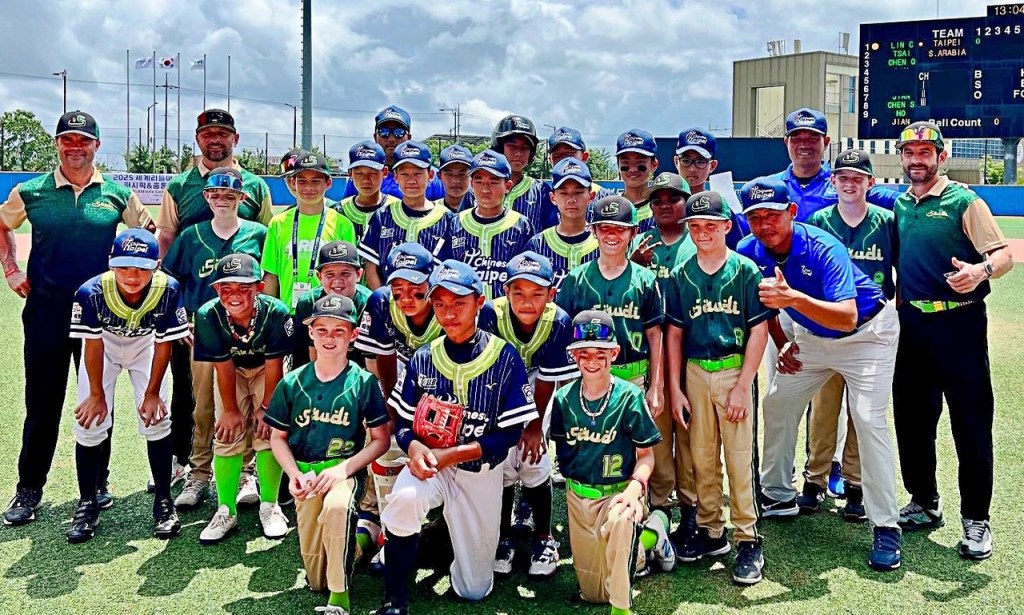
    The DYBA Little League just after playing Chinese Taipei in the 2025 Asia-Pacific & Middle East Tournament in South Korea.  Photo courtesy of Erich Sutterlin

    “When we tried to reboot after Covid, we could barely field two teams for a 12-U kid-pitch division,” Makechnie said. “It’s taken a monumental effort from all involved to grow the league back to where it is today. We’ve had great support from parents internally and from external resources such as the SBSF and Reid Baseball.”

    Makechnie said there are parallel programs within the Aramco community – youth baseball supported by Aramco and a chartered Little League initiative that “intertwines with the youth baseball program.” There are approximately 260 young people playing on the various teams, including T-ball, and there are 20-25 girls playing softball, with some of the latter also involved with baseball. In addition, there is a new senior league that utilizes pitching machines, rather than live pitchers. “There aren’t enough older people who can pitch,” he said wryly.

    “We’ve really had to re-think our goals and organizational structure to create meaningful baseball experiences for all our membership,” Makechnie continued. “Even though the North American expat population is decreasing, overall baseball participation is about the same. That’s good in a way, but it also means we have fewer baseball-savvy people helping, so we’ve had to get creative. We’re probably the most unique baseball organization in the world.”

    Now, interest is expanding again, although it hasn’t reached the levels of two or three decades ago. Saudi Arabia returned to international Little League action at the 2025 Asia-Pacific & Middle East Tournament in South Korea, though it failed to advance from pool play. 

    Reid has partnered with the DYBA since 2016, putting on multiple clinics each year, and he worked with this year’s Little League team.

    As for the future, there is a need to continue building more fields, as well as establish leagues. There are perhaps 15 fields in the country now, including several at the Aramco facilities in Dhahran. About half are private, and not all meet regulation standards.

    For the sport to grow and evolve, Reid sees the need for greater access within communities – i.e., more leagues at multiple levels – continued development of coaches, additional facilities that are multi-use and adapted to the hot climate, a clear league structure that provides pathways to greater competitive levels, and role models and greater visibility for the game.

    “The foundation is there, and baseball here continues to build momentum,” Reid said. 

    Bin-Humaid said, “We’re committed to keep pushing forward. We will participate in the Asian Games in Qatar in 2030, and we’ll be the host nation of the Asian Games in 2034. By then, we want to have a team that not only participates but competes.”

    Mayeur added, “We just need time and exposure. If we can show baseball to kids, we can get them interested. We just have to keep going, and things will happen.”

  • Japan’s Favorite Players: No. 13, Kazuhiro Kiyohara

    Japan’s Favorite Players: No. 13, Kazuhiro Kiyohara

    by Thomas Love Seagull

    A recent poll for a TV special saw more than 50,000 people in Japan vote for their favorite retired baseball players. 20 players emerged from a pool of 9,000. Yes, they could only vote for players who are no longer active, so you won’t see Shohei Ohtani or other current stars on this list. Which is probably smart because I’m sure Ohtani would win by default. There are, however, players who were beloved but not necessarily brilliant, and foreign stars who found success after coming to NPB. Unsurprisingly, the list leans heavily towards the past 30 years, with a few legends thrown in for good measure.

    Over the next few weeks, I’ll be profiling each of these players. Some of these players I know only a little about, so this will be as much a journey for me as, hopefully, it will be for you. It’ll be a mix of history, stats, and whatever interesting stories I can dig up.

    For now, have a look at the list below and see how the public ranked them. I’ve included the years they played in NPB in parentheses.

    20. Alex Ramirez (2001-2013); 19. Yoshinobu Takahashi (1998-2015); 18. Warren Cromartie (1984-1990), 17. Takashi Toritani (2004-2021); 16. Suguru Egawa (1979-1987); 15. Katsuya Nomura (1954-1980); 14. Tatsunori Hara (1981-1995); 13. Kazuhiro Kiyohara (1985-2008); 12. Masayuki Kakefu (1974-1988); 11. Masumi Kuwata (1986-2006); 10. Atsuya Furuta (1990-2007); 9. Randy Bass (1983-1988); 8. Daisuke Matsuzaka (1999-2006, 2015-2016, 2018-2019, 2021); 7. Tsuyoshi Shinjo (1991-2000, 2004-2006); 6. Hiromitsu Ochiai (1979-1998); 5. Hideo Nomo (1990-1994); 4. Hideki Matsui (1993-2002); 3. Shigeo Nagashima (1958-1974); 2. Sadaharu Oh (1958-1980); 1. Ichiro Suzuki (1992-2000).

    The Controversial Slugger who Never Ruled a Season

    Japanese baseball has produced many great hitters, but it has produced very few figures like Kazuhiro Kiyohara.

    From the beginning, Kiyohara was never simply a player. Before he was a professional baseball player, before he was a slugger or a symbol or a problem, he was already famous. He was famous in a way that made the rest of his career almost beside the point, in the way that only a high school baseball star could be. He arrived carrying more narrative weight than any teenager reasonably could, and for a long time he appeared strong enough to carry it.

    Until he wasn’t.

    This is not a story of wasted talent. Kiyohara’s numbers make that argument impossible. More than 500 home runs. More than 1,500 runs batted in. Over two decades in uniform. Championships in both leagues. He remains one of the most productive hitters Japanese professional baseball has ever known.

    And yet his name does not rest easily.

    In the mid-1980s, Japanese high school baseball revolved around a single axis, and that axis ran through PL Gakuen High School. Every summer, every spring, the cameras found the same faces, the same uniforms, the same two players whose names were already inseparable. They were called the KK Combo, a pairing so complete that it functioned as a unit rather than a rivalry: Masumi Kuwata, the ace pitcher, and Kazuhiro Kiyohara, the star slugger.

    Kiyohara arrived at PL Gakuen as a prodigy with a body that already seemed finished. He was large, broad, powerful in a way that made adults uneasy. As a freshman, he was handed the cleanup spot and treated as such. That alone told you everything about what the program believed him to be.

    From his first summer, Kiyohara’s presence at Koshien felt preordained. He did not simply appear in the tournament; he seemed to belong to it. His bat made a sound that separated itself from the noise of the crowd, and his home runs did not merely sneak over fences or ride the wind. They soared through the air. By the time his high school career ended, he had appeared in five consecutive Koshien tournaments* and set a record with thirteen home runs.

    *PL Gakuen qualified for the summer tournament in his first year, and for both the spring and summer tournaments in his second and third years. Japanese high school lasts three years.

    As a first-year player, PL Gakuen won it all. As a second-year, they reached the final and lost. As a third-year player, the pattern repeated. Kiyohara was productive in those runs, but he was never unaware of the comparison standing beside him. Kuwata, smaller, calmer, relentlessly precise, pitched complete games, dominated opposing lineups, and carried an aura of control that Kiyohara himself seemed to envy.

    In interviews years later, Kiyohara admitted as much. He did not want to be the second name. He wanted the order reversed. He wanted “Kiyohara and Kuwata,” not “Kuwata and Kiyohara.” Power alone was not enough to make that happen.

    By his final summer, something snapped into place. Over five games, Kiyohara went 10-for-16. Over the final three games, he was nearly untouchable, blasting five home runs and turning every at-bat into an event. In the championship game, he hit two more, prompting the call that would trail him for the rest of his life: “Is Koshien made for Kiyohara?”

    He was not simply good. He was supposed to be good.

    That distinction mattered. When the Yomiuri Giants, the team of national narrative, passed on him in the draft and selected Kuwata instead, the moment was framed not as a baseball decision but as a disruption of his identity. Kiyohara cried openly. His tears were later read as entitlement or weakness, but they were merely the normal response of a teenager whose future had been narrated for him by adults, and then suddenly revised.

    Kiyohara would say that the pain never left him, that the shock of that moment stayed with him no matter how many home runs he hit or how many championships he won. His mother* told him to stop feeling sorry for himself and prove them wrong. He listened. He just never forgot.

    *At PL Gakuen, first-years weren’t allowed sweets. His mother, trying to sneak comfort into a place where comfort was prohibited, hid caramel candies in the toes of socks.

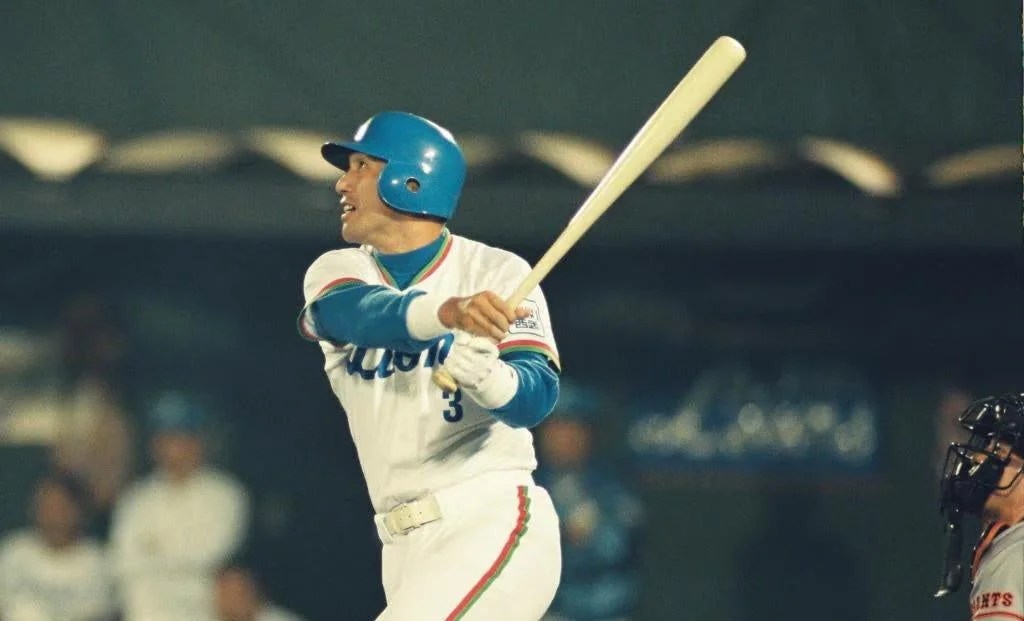
    Instead of Tokyo, he went just outside of it to Saitama and the Seibu Lions. And almost immediately, he became something else again.

    On April 5, 1986, in the second game of the season, he stepped to the plate for just the second time in his professional career. He was eighteen years old. The stadium was full, the expectation already unreasonable. The pitcher was Shuji Fujimoto of the Nankai Hawks, working toward what looked like a complete-game victory.

    Kiyohara turned on an inside fastball and sent it screaming into the left-field seats.

    As he rounded first base, he leapt into the air. Not the restrained hop of a veteran, but a full-bodied jump, the kind you make when something you have imagined for years suddenly becomes real. The Lions lost the game 4-2, but it didn’t matter. The home run swallowed the night whole. Fujimoto, still the winning pitcher, walked into the postgame interview and muttered, “I won, but…”

    After the opening blast, reality arrived quickly. Pitchers adjusted. Night games under unfamiliar lights exposed timing issues. He went hitless for stretches long enough that whispers began to circulate about a demotion to the minors. Coaches debated it openly. Mori listened and declined.

    Instead, he waited.

    By midsummer, the waiting paid off. Kiyohara’s swing slowed down just enough to find its shape. His hands stayed back. His balance improved. The results followed in waves. In August, he hit over .320. In September, over .360. By October, he looked unstoppable.

    By the end of the season, the line looked unreal: .304 average, 31 home runs, 78 runs batted in. Rookie of the Year. The most home runs ever hit by a Japanese rookie. Attendance surged. Merchandise exploded. Television found a new face. Seibu’s patience with him, especially during his early struggles, proved decisive.

    For a brief moment, he was not “the uncrowned king,” not “the problem child,” not a symbol of anything larger than himself. He was Kiyoma, a nickname that captured youth, novelty, and something almost cartoonish in its brightness. He lived in the Seibu dormitory, his small room filled with gifts from fans after road trips. His monthly allowance was modest. His favorite meal was champon, a noodle dish, from the Ringer Hut near the dorm, eaten with teammates who treated him less like a prodigy than a younger brother who happened to hit the ball very far.

    The Lions won relentlessly and celebrated loudly. Robert Whiting once described a championship celebration that looked less like Japanese baseball tradition and more like controlled chaos: beer sprayed, cake smashed into faces, teammates dumped into barrels of sake, Kiyohara wearing a Ronald Reagan mask while pouring alcohol on a cameraman. Fans loved it. One woman said the Giants were too proper, too dull. The Lions, she said, were interesting. Kiyohara was the youngest player on the team and spoke like he belonged to no hierarchy at all.

    But even during those years, something was already slipping. During the 1987 Japan Series, Seibu was one out away from defeating the Giants. Kiyohara was at first base and he was crying. Not after the final out but before it. His legs shook. Teammates yelled at him to focus. He later said the tears came without warning, that once he took the field his body gave way. When the final fly ball settled into an outfielder’s glove, Seibu celebrated another title. Two years earlier, the Giants had passed on him. Now he was beating them on the sport’s biggest stage, as the cleanup hitter for a team that had become a dynasty almost overnight. The tears were victory and vindication tangled together, indistinguishable.

    From 1986 through the mid-1990s, the Lions captured league titles with such regularity that seasons began to blur together. Eight league championships in nine years. Six Japan Series titles. A dynasty for a franchise that had been an afterthought for nearly two decades.

    Kazuhiro Kiyohara stood at the center of it.

    He was not alone. Koji Akiyama ran the bases like a man late for something important. Orestes Destrade brought a foreigner’s blunt force to the middle of the order. Behind them, the pitching staff turned games into negotiations between balls and outs. But Kiyohara was the constant cleanup hitter who arrived first and stayed longest.

    From the outside, the numbers piled up neatly. Twenty-one consecutive seasons with double-digit home runs, beginning his rookie year. Thirteen straight seasons of twenty or more. Sixteen total seasons clearing that mark. Walks in bulk. Balls crushed to all fields. Hits absorbed by his body—196 of them, more than anyone in league history. Twelve walk-off home runs. Twenty walk-off hits. Eleven grand slams.

    He led the league in on-base percentage twice. He won Gold Gloves at first base five times, more than any Pacific League first baseman had before him, and contemporaries would later say that, at his peak, he was the best defensive first baseman in Japan. Jim Allen once put it plainly: Kiyohara saved more runs with his glove than people noticed because they were too busy watching his bat.

    And yet, for all of it, the major individual titles never arrived. No batting title. No home run crown. No RBI title. Not once.

    On paper, Kiyohara was one of the most productive hitters in the sport every year. In memory, he was something more complicated. He was the cleanup hitter for a dynasty who never ruled a season outright.

    Even Sadaharu Oh framed it this way: Kiyohara, he suggested, was too versatile for his own good. A hitter who drove the ball to all fields would never pile up the kind of pull-heavy totals that win home run titles. From Oh’s perspective, power requires commitment. From Kiyohara’s, a home run was simply a perfectly struck hit that kept carrying.

    Free agency turned him into the center of gravity of Japanese baseball. The Tigers were willing to say they would change their stripes to get him. Shigeo Nagashima told him to leap into his chest and even floated the idea of handing over number 3, a gesture Kiyohara understood was too heavy to accept. But he accepted the Giants uniform. It was, finally, the dream.

    In his first season, the numbers were solid: 32 home runs, 95 RBIs. On paper, it looked like the continuity of his Seibu years. In reality, it felt like insufficiency. The batting average dipped. The strikeouts climbed: 152 of them, a Central League record at the time. Each miss drew commentary. Each slump fed the idea that the player who once looked unstoppable was now fighting gravity.

    The criticism poured in. Too heavy. Too slow. Too emotional. Too indulgent. He had piercings in his ears. His skin was permanently tanned. His body looked different than it had in Seibu. He didn’t fit the Yomiuri aesthetic.

    There were moments when it almost worked. Early in the season, he shared the field with Kuwata again, this time as teammates. When Kuwata returned from injury, Kiyohara hit a home run in his comeback game, the two of them standing together afterward like an echo from another life. For a brief instant, the story felt complete. KK, reunited.

    But nostalgia does not protect you from fastballs inside. He tinkered with his swing. He altered his stance, his weight training, his body composition. The more he tried to adjust, the further he drifted from the hitter who had once trusted himself to react rather than plan. His body grew heavier. His legs betrayed him. Knee pain became chronic. Seasons fractured into stretches of usefulness interrupted by injury and recovery.

    In early March of 2000, in cold, wet conditions during an exhibition game, he tore a muscle in his leg. For the first time in his professional life, Kiyohara opened the season in the minors. The reaction from above was brutal. The team’s owner remarked that the Giants’ chances of winning had improved in his absence.

    And yet, something unexpected happened.

    When Kiyohara returned in July, the atmosphere at Tokyo Dome had changed. He was no longer announced as the centerpiece of a championship machine. He was introduced as a pinch hitter and when his name was called, the stadium rose. Fans sang. They cheered not because he would save the team, but because he was still there. A home run in his first game back triggered something close to collective release. Even when he failed, the applause remained.

    But still, the relationship with the Giants frayed. His body could no longer support the version of himself he needed to be in Tokyo. Playing time shrank. In 2005, he refused a high-five from the bench after a home run, a small act of defiance that became a large symbol. Not long after, the Giants told him he was no longer part of their plans.

    The dream ended quietly. In a parked car, alone, he cried. The call that changed things came from Akira Ohgi.

    Ohgi, already gravely ill, had taken on the thankless task of leading the newly merged Orix Buffaloes, a team born from contraction and resentment. He believed stubbornly that stars still mattered, that baseball owed something to memory and spectacle. He called Kiyohara directly.

    “Come home to Osaka,” he said. “Let me give you your last stage.”

    Kiyohara hesitated. His body was failing, his confidence was fragile. But Ohgi kept calling, speaking not of contracts but of responsibility and unfinished business. When Kiyohara finally agreed, it felt less like a comeback than an acceptance. Ohgi, tragically passed away before the 2006 season.

    When he hit a walk-off home run in May 2006, he spoke afterward not about himself, but about Ohgi and the fans.

    “This might be the happiest home run of my career,” he said. “It didn’t feel like it was just mine.”

    His body, however, would not cooperate. Knee surgeries followed. In 2007, he did not appear in a single game, the first such season of his professional life. He decided 2008 was going to be the end.

    His final game came in Osaka. Sadaharu Oh managed the opposing team. Ichiro watched from the stands. In his final at-bat, he struck out, swinging hard, fully committed.

    Afterward, with his two sons beside him, he apologized to the fans, the media, and the game itself.

    “I wasn’t always strong,” he said. “But I gave everything I had.”

    Oh took his hand and said, “In the next life, let’s be teammates. Let’s hit home runs together.”

    For a moment, improbably, it felt like closure.

    He left with 525 home runs, fifth all-time, without ever leading the league. Twenty-one seasons with double-digit home runs. Records everywhere. A shape no one else quite matched.

    But after baseball, everything fell apart.

    His marriage ended amid reports of domestic violence. He was arrested in 2016 for possession and use of stimulants. The trial revealed years of addiction. He admitted to using drugs after retirement, denied using them as a player, and spoke of emptiness, of having no next step. He was convicted and given a suspended sentence. His Hall of Fame candidacy was withdrawn. His finances collapsed. His health deteriorated. His arrest shocked the country not because it was unimaginable, but because it retroactively contaminated everything people wanted to believe about him.

    Kazuhiro Kiyohara will never be a clean legend. How should baseball remember someone like him?

    Thomas Love Seagull’s work can be found on his Substack Baseball in Japan

    https://thomasloveseagull.substack.com

  • No Alibis: The Detroit Tigers’ 1962 Tour of Japan

    No Alibis: The Detroit Tigers’ 1962 Tour of Japan

    by Andrew Forbes

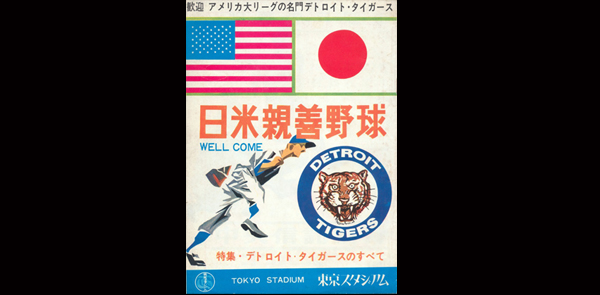
    Every Monday morning we will post an article from SABR’s award-winning books Nichibei Yakyu: Volumes I and II. Each will present a different chapter in the long history of US-Japan baseball relations. This week Andrew Forbes focuses on the Detroit Tigers 1962 visit to Japan.

    For the Detroit Tigers 1962 was a year to forget. They finished the season in fourth place, 10½ games behind the pennant-winning Yankees, with 16 fewer wins than the second-place 1961 Detroit club. The best the Tigers could muster in 1962 was second spot in the United Press International baseball experts’ poll of the season’s “No. 1 disappointment,” a single vote behind Roger Maris, who followed up his historic Babe-besting homer total with “only” 33 in 1962.

    As the Yankees and Giants were renewing hostilities in a rain-soaked World Series, the tired and disappointed Tigers limped off to Asia for a monthlong goodwill tour. As foul weather blanketed the Pacific, a coterie of Tigers trainers, wives, the traveling secretary, and team owner and President John E. Fetzer accompanied a scaled-back squad (just three outfielders and a nine-man pitching staff), first to Hawaii, where they squeezed in two games, and then on to Japan. The schedule called for excursions to Seoul and Okinawa before 17 matches against the best competition Japan could offer. Commissioner Ford C. Frick had planned to join the traveling party in Honolulu, but was held up stateside while inclement weather and stingy pitching stretched the World Series out to seven games over two weeks.

    The Tigers touched down in Tokyo on October 18 and participated in a press conference before heading off to the Imperial Hotel. On October 20 the players, executives, and wives were the guests of Japanese Foreign Minister Masayoshi Ohira at a cocktail party thrown in their honor. The Americans were formally introduced by Yetsuo Higa, the Hawaiian businessman who, along with the Mainichi newspaper corporation, was instrumental in planning the tour. Tigers President Fetzer gifted Ohira a set of silver cufflinks fittingly adorned with the heads of tigers.

    Commissioner Frick, having finally joined the group in Tokyo, revealed to the press the secondary – or perhaps even primary – reason for his presence, telling the Associated Press that he would meet with Japanese baseball officials to codify regulations surrounding the movement of players between the United States and Japan. “Before I leave we hope to agree on a definite set of rules under which American players can come to Japan,” Frick said, perhaps unintentionally signaling his belief that no Japanese player would ever be skilled enough to play pro ball in America.

    After successful tune-ups in Okinawa (where they “whipped a servicemen’s team,” 9-0, largely on the strength of Jim Bunning’s five no-hit innings) and Seoul (beating up on an all-star team, 8-0, thanks to a three-run shot by Bubba Morton), the Tigers returned to Tokyo and prepared to begin competition against Japanese squads.

    But the Detroiters would not be at full strength. Much of the Tigers’ trouble during the regular season could be chalked up to injuries, with starter Frank Lary (sore arm), outfielders Al Kaline (broken collarbone) and Billy Bruton (sore leg; broken jaw), and first baseman Norm Cash (broken finger) all missing significant time. By the time the team landed in Japan, Bruton was still unable to play, and Kaline was touch-and-go due to torn ligaments in his foot suffered during one of the games at Honolulu. The injury “definitely has slowed me up,” said Kaline. “It’s a real tough problem. But I’ll play with it taped up and do the best I can.” Given the injuries, and the fact that only three regular outfielders made the trans-Pacific journey (with Rocky Colavito remaining stateside to be by his wife’s side as she battled illness), manager Bob Scheffing would be doing a lot of juggling.

    On the eve of the slate’s first game, the Tigers made their first public appearance, taking in a night of entertainment at the Nichigeki Theater in downtown Tokyo. The players and their wives enjoyed a two-hour show by the Nichigeki’s dancers before the boys donned happi coats and took the stage. Scheffing introduced his players to the crowd, and each was presented with a bouquet of flowers. The appearance concluded with the athletes tossing rubber balls into the crowd; those who caught select balls adorned with a Tigers logo would be admitted to the next day’s game free of charge.

    The next afternoon Jim Bunning took the Tokyo Stadium mound for the Tigers in front of 27,000 spectators, including Crown Prince Akihito and Princess Michiko. After the ceremonial first pitch was handled by Japanese Foreign Minister Ohira to US Ambassador Edwin O. Reischauer, the Tigers wasted no time providing their starter some run support. Detroit’s hitters roughed up Daimai Orions starter Tomoo Wako, who did not make it out of the first. The Tigers put up eight runs in the opening frame, including a three-run homer by Jake Wood, to cruise to a 12-1 victory. Bunning contributed 5⅓ perfect innings before giving up four hits and giving way to reliever Terry Fox.

    Neither the Tigers nor the Orions came away unscathed, however. In the sixth inning, Detroit first baseman Norm Cash was struck behind the ear by Daimai lefty Shoichi Ono’s errant pitch, necessitating a hospital visit for X-rays, which showed no lasting damage. “I hope to play tomorrow,” said Cash. And Kaline reaggravated his foot injury in the first inning, toughing it out until the sixth when he was replaced by Bobo Osborne. Meanwhile, in the other clubhouse, Orions manager Mitsuo Uno was relieved of his duties by club President Masaichi Nagata. In his two years as manager, Uno had led Daimai to a 132-136-4 record and a pair of fourth-place finishes, so his employers may simply have seen the lopsided loss as the final straw.

    Scheduled games on Sunday against the Yomiuri Giants and Monday versus a combined team containing members of the Orions, the Kokutetsu Swallows, and the Taiyo Whales were washed out by rain, but the layoff allowed Frick and his officers to hammer out an agreement with their Japanese counterparts. Meeting at the Imperial Hotel, Frick, Tigers owner Fetzer, and AL President Joe Cronin sat down with Japanese Commissioner Yushi Uchimura, Pacific League President Fujio Nakazawa, and Central League President Ryuji Suzuki to formalize a deal that would “prohibit direct trades between Japanese clubs and American players, and vice versa by American major league clubs and Japanese players, without the commissioners’ approval.” In Frick’s view, the pact promised “smooth relations” across the Pacific, though it would take only two years for the commissioner to be proved wrong. The 1964 dispute between the San Francisco Giants and Nankai Hawks over the contract status of lefty reliever Masanori Murakami led Frick to write Uchimura decreeing that “all agreements, all understandings and all dealings and negotiations between Japanese and American baseball are cancelled.”

    The Tigers players also kept busy during the rainy days, as pitcher Phil Regan gave a Bible reading at Kawasaki Baptist Church, while Bunning, Cash, Scheffing, Kaline, and Dick McAuliffe, along with Hanshin Tigers pitcher (and Central League MVP) Minoru Murayama, appeared on the NHK-TV program My Secret.

    The Tigers – including Cash, recovered from his beaning, and Kaline – returned to the field after the two rainouts to face the recently crowned Japanese champion Toei Flyers at Korakuen Stadium. The Flyers outhit and outpitched Detroit, and played sharper defense. Knotted, 3-3, after nine innings, the game was declared a tie in keeping with an agreement struck at the tour’s commencement that forbade extra-inning games. Scheffing, however, complained that he would “prefer to let these exhibition games go into extra innings to settle it one way or another.”

    Things got worse the next day as the Tigers met the Yomiuri Giants in a makeup of their washed-out game, and the Giants “took a liking to the slow curves of right-hander Phil Regan,” and held on for a 3-2 win behind starter Minoru Nakamura, who tossed a complete game. “We have no alibis,” said Scheffing, whose squad now had only one win to show for their first three games in Japan. “We weren’t hitting and their pitcher had good control.”

    It was likely with some relief, then, that the Tigers greeted the opportunity to escape Tokyo and begin the road leg of their excursion, alighting first in Sapporo, where they handled a team consisting of Orions and Giants, 6-2, behind the bat of Bubba Morton and the pitching of Don Mossi. Thence to Osaka did the Tigers fly, where their game against the Hanshin Tigers at Koshien Stadium was rained out. But the visit did allow John Fetzer to invite their namesake club to their 1963 spring-training camp at Lakeland, Florida, with the American Tigers picking up all expenses accrued in the United States.

    Scheffing’s distaste for tie games might have been a factor in the decision to enter extra innings the next day, a Sunday afternoon at Nishinomiya Stadium. The Tigers and a mixed team of Japanese all-stars were tied, 3-3, after nine, but Detroit exploded for four runs in the 10th, with Flyers rookie hurler Yukio Ozaki the victim.

    Events in Nagoya on November 5, though, might have had the Tigers wishing they’d banked a couple of those runs, as Chunichi Dragons outfielder Shinichi Eto slugged two homers, added a pair of singles, and reached on an error, and the All-Stars (composed of Dragons, Giants, Orions, and Kintetsu Buffaloes) downed Detroit 6-4. Hank Aguirre surrendered five of the All-Stars’ runs, including Eto’s homer on the first pitch of the afternoon. If there was good news for the Americans it was that Billy Bruton’s jaw had healed to the point that he was able to pinch-hit – just in time to strike out to end the game.

    Said Scheffing, “Japanese baseball is a lot better than we were led to believe before we came over here.”

    Blasts by Cash, Kaline, and McAuliffe helped matters on November 6, when improving weather allowed Detroit to play Hanshin in Osaka after the earlier postponement. The American Tigers cruised, 11-4, with Cash contributing four RBIs. Chico Fernandez and Mike Roarke chipped in homers to help the Tigers blank the Nankai Hawks 3-0 on November 7. It appeared the Tigers were beginning to recall that they had led all of big-league baseball in home runs in 1962 with 209. The pleasing trend continued in Tokyo, as Detroit added four more homers – including another apiece for Cash and Kaline – to best a Swallows/Orions/Whales squad, 13-8, in a contest called in the top of the ninth due to darkness. At Hiroshima, homers from Cash, Kaline, and McAuliffe were more than enough to overcome the amassed strength of a Hiroshima Carp/Hankyu Braves/ Hanshin Tigers/Daimai Orions team, 8-1, with Jim Bunning going the distance for Detroit.

    For all their power, the Tigers had not yet hit a grand slam on Japanese soil. Norm Cash fixed that on November 10 at Fukuoka, against a side made up of Orions and Nishitetsu Lions. The clout helped Detroit come from behind to win, 6-4, improving the visitors’ record to 8-2 with a tie.35 The fireworks continued at Shimonoseki against the Taiyo Whales, as Detroit strolled to a 10-0 win that featured homers by Morton, McAuliffe, Cash (his sixth in seven games), and catcher Dick Brown.

    The big hits kept on coming after the Tigers landed in Shizuoka to face a team of Giants and Orions. Kaline notched another homer, and Bobo Osborne’s grand slam in the top of the ninth put the game away for Detroit, 12-7, with the last half-frame called due to darkness. Osborne’s shot was the Tigers’ 27th homer in 13 games on the Japanese tour. The ball left a mark on more than just the scoreboard; spectator Saku Masuda was gifted an autographed ball to go along with a bruise on her shoulder.

    Kaline homered yet again in Utsunomiya against the amalgamated might of the Giants and Orions, but it proved just about all the offense the Tigers could summon in a 6-3 loss, dropping their record to 10-3 with a tie – not shabby, but not the walk in the park they might have expected. Jim Bunning went seven innings but gave up four earned runs in the first and took the loss. Kaline homered again – his seventh – the ensuing afternoon at Miyagi Stadium in Sendai, and it was just enough to beat an all-star agglomeration of Flyers, Giants, and Orions, 4-3.

    An offday preceded the final games of the tour in Tokyo, but it apparently did Detroit little good. On an autumn Saturday afternoon at Korakuen Stadium, Hanshin Tigers ace Minoru Murayama, hurling for the All-Stars, turned in what Japanese baseball officials called “the greatest pitching performance by a Japanese since the late Eiji Sawamura lost a [one-run game] to Connie Mack’s All-Stars back in 1934,” a legendary outing that saw Sawamura strike out Charlie Gehringer, Ruth, Lou Gehrig, and Jimmie Foxx in a row. Surrendering just two hits, Murayama became the first Japanese pitcher to shut out a visiting American big-league team over a full nine innings. The Tigers’ first hit didn’t come until there were two out in the eighth, when Mike Roarke collected a cheap single to left. “We have no alibis for losing,” said Scheffing. “We just couldn’t hit that fella Murayama.” With the loss, the Tigers joined the 1956 Dodgers and the 1960 Giants as the only major-league squads to lose four games in Japan.

    “We gotta be tired,” said Scheffing. “It’s been a tiring trip after a long regular season.”

    The next day brought only moderately better results. Once again facing an All-Japan team, the Tigers registered a 3-3 tie in a game called after 10 innings due to darkness. McAuliffe homered for Detroit; Sadaharu Oh and the Orions’ Takao Katsuragi cleared the fence for the All-Stars. When play ceased, “a band played ‘Auld Lang Syne’ to close the series,” as the game marked the end of the scheduled exhibition itinerary. But officials announced one additional game between the Tigers and Japan’s All-Stars, to be played two days later, “a parting gesture of goodwill.” All proceeds of the bonus game were to be “donated to the 1964 Tokyo Olympics fund,” an “unparalleled” move, according to Japan’s Olympic Committee.

    Billy Bruton homered in the finale, and the Tigers rolled to a 7-2 win. For the purposes of the record books, however, the tour was officially over two days earlier, after the tie game, meaning that Detroit’s 11 wins, four losses, and two ties earned them “the worst record ever for a major league club coming to Japan.” The Tigers – “the big flops this year in the American League” – couldn’t even catch a break at the turnstiles; Detroit’s “total attendance of 383,370 for 17 games in Japan didn’t measure up to the 16-game attendance of the San Francisco Giants’ [441,000] and St. Louis Cardinals’ [430,000] tours in 1960 and 1958 respectively,” though in all fairness it should be noted that the Tigers battled soggy weather just about every step of the way.

    Before departing, Joe Cronin summed up what the American baseball emissaries had discovered in Japan in 1962. “The Japanese might be able to challenge American major league baseball in the next generation of players,” he told the press. “They are really something to see.

    Having been in Japan for over a month, the Tigers had seen enough. The schedule concluded, they flew home to lick their wounds, rest up, and prepare for the 1963 season.

    Continue to read the full article on the SABR website
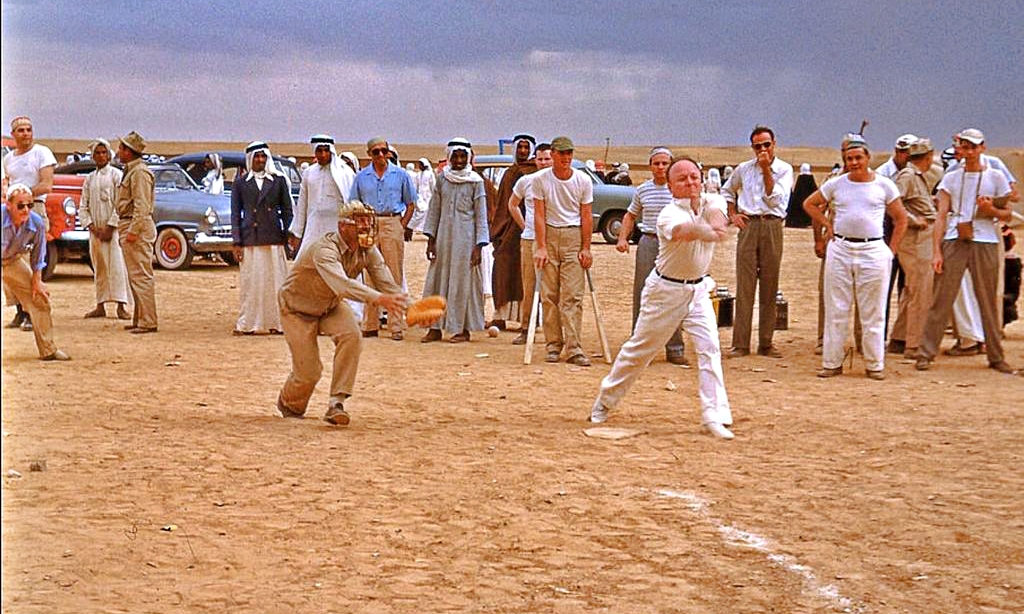
  • Excerpt: In the Japanese Ballpark: Behind the Scenes of Nippon Professional Baseball

    Excerpt: In the Japanese Ballpark: Behind the Scenes of Nippon Professional Baseball

    Chapter 26: Bobby Valentine, Manager.

    from Off Base with Howard Cole, originally posted February6, 2026

    Because of their rich history in Los Angeles, the Dodgers (and their fans) know something about Japanese baseball. And so does the Robert K. Fitts, the author of several books on the subject. We excerpted his “Mashi: The Unfulfilled Baseball Dreams of Masanori Murakami, the First Japanese Major Leaguer” ahead of Shohei Ohtani’s L.A. debut in 2024, and are happy to tell you about his latest work now. It is “In the Japanese Ballpark: Behind the Scenes of Nippon Professional Baseball,” University of Nebraska Press, November 1, 2025, $21.99 Hardcover, $20.89 Kindle.

    Fitts devoted chapters about his interview subjects from every aspect of Japanese baseball under the sun. Twenty-six of them, including a player, umpire, manager, fan, cheerleader, beer girl, data analyst, general manager, assistant general manager, commissioner, agent and team owner.

    In fact, chapters regarding two managers, both with Dodgers connections, are included in the work: Trey Hillman, who was Don Mattingly’s bench coach from 2011 to 2013, and Bobby Valentine, a Dodgers minor and major leaguer from1968 through 1972, when he was included in a blockbuster trade which also sent Billy Grabarkewitz, Frank Robinson, Bill Singer and Mike Strahler to Anaheim for Andy Messersmith and Ken McMullen.

    Chapter 26: Bobby Valentine, Manager

    Former Major League player Bobby Valentine managed the Texas Rangers, New York Mets, and Boston Red Sox as well as the Chiba Lotte Marines in 1995 and 2005–2009. He led the Marines to the championship in 2005.

    I went to Japan for the first time in the early 1980s. I was invited by Mizuno Sporting Goods because at that time I was thought to be the first player to use a Mizuno glove in the Major Leagues. In 1978 Mizuno’s master glove maker, Nobuyoshi Tsubota, came to spring training in Florida and set up a little workshop in a Winnebago he parked on the street right outside the players’ parking lot. I was riding by on my bike, and I stopped in, and Tsubota-san made me a glove. I used it from that day on. Later that season, I was going to be in the starting lineup for some reason and the game was going to be on national television. Joe Torre was our manager, and his brother Frank was the vice president of Rawlings. The game was on a Saturday, and Frank came to the stadium on Friday night. When I arrived on Saturday morning to get ready for the game, the Mizuno label was ripped off my glove! But I used it, and it was the first time a Mizuno glove was used in the Majors— or so I thought. Later, we found out that Lou Gehrig had his glove stolen during the 1934 tour, and Mizuno made him a replacement that he used when he returned to the States.

    Then in 1986 I went over as a coach on the postseason All- Star tour. My first impression was that the players looked better than I thought they would. Then in 1989 I went over as part of the Japan- U.S. baseball summit that Tatsuro Hirooka put together. I got to meet a lot of the baseball hierarchy, including Shigeo Nagashima, Katsuya Nomura, and Hirooka-san. Once again, I was impressed, especially by a young player named Hiromitsu Ochiai. So, by the time I got there in 1995 to manage the Chiba Lotte Marines, I already had a good impression of Japanese baseball. Then in that first year, I got to work with Hirooka-san. I was amazed at his knowledge and his understanding of the game. He was as spectacular a baseball man as I had ever been around. And I had been around a lot of the older baseball guys in America. I had played baseball and been a young coach on the same staff as Frank Howard and George Bamberger, and I was really close to Tommy Lasorda and Al Campanis and then later Bobby Bragan.

    In the early 1990s most Americans’ understanding of Japanese baseball was totally misconceived. It was based on Tom Selleck and Mr. Baseball— almost totally based on that and the stories that guys told from their experiences. Most of the guys were bad storytellers, and most of them had an ugly American’s perspective. I think that some of the guys who could have told the story properly were never asked, or it never got into the mainstream media, which was presenting a very opinionated and uneducated view of Japanese baseball, in my opinion. 

    There was a lot of resistance to acknowledging the baseball culture of Japan. There was still prejudice, probably hangover effects from the war. I knew some Americans who had actually experienced World War II and had a preconceived prejudice of the Japanese being the enemy. It wasn’t acceptable by my standards, but I thought it to be natural. They were very comfortable having a predetermined opinion of what the culture was and what the baseball culture was in Japan. When I went over with the Major League All-Star team in 1986, to a man they played and respected the Japanese players. They said, “Hey man, that pitcher is pretty good. Hey, this guy can hit. Hey, they’re throwing from the outfield just like we are.” There was a reckoning from those who were seeing without blinders on. 

    When I got there in ’95, Japanese baseball culture had an inferiority complex. Nearly everyone believed that it was a lesser league, a lesser brand of baseball. A lot of that was based on a size and speed comparison. There wasn’t that really fast guy, and there wasn’t that really big guy who was born from Japanese parents. So, there was that physical inferiority, but there was also just the idea of watching a championship game from the United States on TV and having it called the World Championship and then watching your championship on TV and having it called the Japan Championship that lends itself to an inherent inferiority situation. 

    The same year that I first managed the Marines, Hideo Nomo came over to the States. I always thought of that as an exchange, basically the first player coming over here and the first manager going over there. We did a crossover. What I was expecting when I got to Japan was an enthusiastic fandom for Nomo, a superhero trying to do something that no one had ever done before. But instead, he was treated like an outsider, and the fans and the baseball community, mainly the older baseball community, were pulling against him at the beginning and saying he would fail. I remember having conversations with Hirooka-san and others, and they thought he was going to fall on his face, and they weren’t really rooting for him, which I found really amazing. Or maybe, in their hearts they were pulling for him, but they were embarrassed to come out and say it in case he failed. So, I’m not sure what the true mentality of the baseball hierarchy in Japan was at the beginning of Nomomania. I know what I heard, and I know what they said, but it’s such a different culture that sometimes you have to get an interpreter to understand what’s really meant. 

    After managing in Japan, I had an even greater appreciation of the Japanese game. I always thought it was real baseball, and then I got to experience it and I was like, “Holy cow!” When I brought the Marines to Arizona to practice in the spring of 1995, I had Nolan Ryan and Tom House come out to watch Hideki Irabu throw. He wasn’t like Nomo with the whirlwind windup and the split finger that confused everyone. He was actually someone who stood out there and had a fastball better than everyone else. And he was from Japan! 

    When I was the Mets manager in 1997, I went to Shigeo Nagashima’s spring camp, which started two weeks before we did, and I asked him if he could give me a pitcher who was not going to make the Yomiuri Giants ichi-gun (main team) so that I could take him to spring training and have him pitch for the Mets. He was like, “Why would you want to do that?” And I said because I want to show the Japanese community, as well as the U.S. community, that a guy who can’t pitch for your team can pitch for mine. So, I brought over Takashi Kashiwada, and he actually pitched for the Mets and did a decent job. 

    Measuring change is one of the hardest things in the world to do. You look back twenty years, and you realize that things have really changed, right? When I came back to manage the Marines in the mid-2000s, it seemed that the decade between my two stints was like the 1975 to 1985 decade in the States when times were changing. There had been a kind of cultural swing. I think that Nomo going to the States allowed a freedom of spirit to be attached to baseball in Japan.

    In 1995 I misunderstood why I was there. I thought I was there to teach the Japanese how to play the game, because that’s what I was told when I was being interviewed for the job. They said that Hirooka knew how to play the game, but the Japanese players really didn’t. As it turned out, they knew how to play the game. They just needed someone to let them know that they knew how to play the game. Ten years later when I went back, that was my mission, not teaching them how to play the game, but letting them understand that they knew it well enough to compete at any level. But by that time, Ichiro was doing his thing, and Matsui was on the Yankees, and that inferiority complex that I thought they had was no longer there. 

    There have been several noticeable changes since 1995, both on and off the field. One of the most challenging times of my life was getting the Japanese hierarchy to understand one thing that I thought they needed to change. They thought that a hitter should always swing down on the ball and hit ground balls because they weren’t big enough and strong enough to hit home runs. I argued, “How could you say that when the guy who hit more home runs than anybody on earth was a Japanese and my size?” You don’t have to be a big guy to hit it over the fence. What you need is a good swing. 

    But even Sadaharu Oh thought you should swing down at the ball. In 1995 I had weekly debates with Hirooka-san, who was on the same team with Oh and saw how Oh developed the swing that made him hit more home runs than anybody else who ever lived. And it was a downswing. So one time, after showing me videos in slow motion and stop action, Hirooka-san brought in a wonderfully fine-tuned samurai sword and a bundle of sticks bounded by a rope. In one of the great training exercises that Oh did with the sword, they hang this bundle of sticks, and you swing the sword, and if you swing properly, at the right angle with the right velocity, you go through that bundle as though it was a piece of paper. And if you don’t, then the sword ricochets back and it might hit you in the forehead and cut your head open! They had me try it. And they were right. If you went in at the right angle, and it was a bit of a downswing with the sword, it would go through. It went through on my first attempt. Then they had me swing up at it, and it bounced off, and the ricochet almost stabbed me in my backside!

    Bobby Valentine with former MLB pitcher Masato Yoshii. Courtesy of Jim Allen.

    That was all cool, but then I needed another two months to explain to Hirooka how a sword has no weight at the end of it, and a bat has a weight at the end of it. These interpretive conversations were multiple and always the same. I said the same thing, and he would always agree that he understood what I was saying, but that he didn’t agree with what I was saying. Then finally at the end of the year, and it was one of the most satisfying moments, he said to me, “I understand what you’re saying, and I understand that you are right, but I just don’t want the players to know that.” There was so much time and effort invested into this philosophy of hitting in Japan that they didn’t want to reverse it, so they just let it be. Luckily, some of the players kind of got the message. Today, many of the hitters in Japan, and in Korea for that matter, definitely have an upswing.

    The other major change is on the field. The Japanese now have incorporated the backhand as a standard way of fielding. In 1995 there was a rite of passage for those who entered the professional ranks of baseball in Japan. You had to field one thousand ground balls at one time without leaving the field, and while fielding them if you went to your right, you had to go so hard that you got in front of the ball. That was the way you fielded. When you went to your right, you always got in front of the ball, so the ball hit you in the chest if it didn’t go into the glove. But from about 1995, some of the infielders started to incorporate the backhand, and that made a big difference in their range factor and in their ability to throw the ball across the diamond more efficiently. 

    Those are the two technical things that changed from the first time I got there. The hitting one is rather large and the fielding one is a little more subtle. By incorporating those two changes, the players now look very similar to the professional players in the States. 

    Another thing that’s changed— Japanese baseball now leans toward recovery, not only toward effort. The idea that doing more, and more was better, has changed just a little. When I got to Japan in 1995, to miss a minute of practice while your teammates were practicing, even if you had to go to the bathroom, would be frowned upon. Everyone played all the time, and there was no pitch limit. I instituted a 15 pitch-per- inning goal and a 135-per- game maximum. You would have thought that I was asking families to give away their first-born child! Suggesting that a pitcher should have a limitation on his pitches per inning and per game was unheard of in Japan. 

    While I was managing there, Masahiro Tanaka pitched twelve innings in the 2006 Koshien final that ended in a tie and then came back the next day and pitched seven innings. I mean, are you kidding me? It was some of the greatest stuff I’ve ever seen in my life. It was a badge of honor to leave it all out on the field. The idea that you had to come back and do it again the next day wasn’t necessarily part of the equation.

    A crazy example of this happened in my first year. After a game we lost, I got showered and dressed and then came out, and Hirooka, the general manager, was standing behind the batting cage, and my third baseman was taking batting practice. It’s about 11:30 at night. Sweat is pouring off of his chin, and he had just played nine innings. And the pitcher is throwing curveballs. I watched for a while because I figured, well, he needed practice hitting curveballs. And I watched for a little longer. I guess he needed a little more practice hitting curveballs. Then, I went over to Hirooka-san and asked, “So how long is he going to be hitting here tonight?” 

    And he said, “Until he can hit the curveball.” 

    Of course! I thought. There was no consideration that the next day was a day game, and it was going to be 93 degrees, and this guy had to go home, come back, and then play nine more innings. 

    That has changed. The players are not wearing themselves down as much, and that’s why I think the athletes now are bigger and stronger. They have time to recover and build rather than just breaking their bodies down through constant work.

    I have to touch on this. Somewhere it should be said, or maybe it shouldn’t be said, but it took Japan about twenty years to discourage players from smoking cigarettes. In traditional Japanese baseball culture, that was what you were supposed to do. If you looked at the back of a magazine, all the stars in the ads were smoking. And if they were smoking, you had to smoke. When I first got there in 1995, right behind the dugout there was something like a table with a grid on the top where you put your cigarette out and then just dropped it into this long ashtray. The guys would come in from the field and line up like it was buffet line, eight or nine of them smoking cigarettes. It was crazy! But that has changed as well. 

    You know that doing the same thing over and over again and expecting different results is insanity, but businesswise the Japanese teams had a way of doing the same thing over and over again and being very satisfied with the same result. So, when I came back in 2005, I was hired to do more than the managing. I was also there to help them transition into more of a Major League–type business, to help them run the club as a standalone business instead of an advertising vehicle for the international company that lends its name to the team.

    Akio Shigemitsu, who ran the club, was the son of the owner of Lotte, and he was only part Japanese, so he was seen as an outsider. I think that’s what gave him the idea to give Hirooka-san the go ahead to find a foreign manager. Shigemitsu-san wasn’t getting the weekly memo from Watanabe-san (the president of the Yomiuri Giants) that everything in Japanese baseball is great and don’t try to change a thing until I call and give you the go-ahead. He didn’t totally follow the marching orders. All of the interaction we ever had was at these very formal geisha dinners: private room, sitting on the floor, geisha gals pouring your sake, talking about the weather and all the other really important things that we could definitely agree on to make sure there wasn’t going to be any confrontation at this social event. But we would also talk about doing things a little differently to make the Marines a better team and business. 

    When Shigemitsu-san gave me the go-ahead to talk with people about marketing, it was marketing the mascot and the team brand. It was never marketing the players. Japanese baseball, just like Japanese culture, in my opinion, is such a closed culture. They treated baseball as an entertainment vehicle that was closed to the public. There was an idea that players should not interact with the fans. It was as if it would lower your image if you didn’t keep a barrier between the players and those who paid to see them play. I think what they wanted was the secretive, aloof, no-contact kind of superstar, the Joe DiMaggio type. But, marketing the player and promoting the player and letting the fans have contact with the player have changed for the better over the years. It’s now part of the business side that they’re trying to sell, not only the brand but also the talent. 

    Between-inning entertainment has also become part of the business. The teams always had the mascots, but now there are mascots, cheerleaders, plus other events between innings to entertain fans. Japanese teams have become more cognizant that they need the fans to have the game. At one time, the fans needed the game, so they provided the game. The mentality changed a little so that now the game needs the fans. I think they’re getting it now. It’s a different ownership situation. 

    But it was tough to change the marketing. Marketing is one of those weird concepts in Japan. People are supposed to want to buy your product, right? Having to persuade consumers is a newer concept, and baseball is one of the older and more conservative businesses there. For example, I almost needed an act of Congress to allow kids to come on the field after Sunday games and run around the bases.

    I’m concerned that NPH will become like the Negro Leagues. I tried to tell players that the good players should stay there and that the medium players should go to the States and make more money. But don’t take the stars away from their teams because that’s what MLB did to the Negro Leagues. The Negro Leagues were great leagues for their fans. The last Negro World Series was in 1949, two years after Jackie Robinson came to the Dodgers. That’s a whole story for another day, right? But that’s always my fear, that MLB is going to do that to another great league.

    I think a lot has been taken away from NPB because the players want to go where the grass is greener. They need to plant a few new lawns, and the beginning is to get new venues. You can then charge more money for suites and generate revenue from within the business itself rather than from the parent company. Then that money can be reinvested in R&D (research and development) and the minor leagues and in major league salaries and talent. 

    It looks like NPB is actually moving to do it with the Hokkaido new dome and the plans to renovate Jingu and make that into a spectacular downtown venue. The Giants are going to be forced to do something. Chiba, I hear, is going to spend over a billion dollars to build a new stadium along with Lotte and ZoZo in partnership. 

    One solution for NPB would be to increase their minor league system and their R&D. The problem with their system has been that they have eighty players in each organization. Thirty of them are basically on the ichi-gun (top team), and fifty of them are in the single ni-gun (minor league) team. The ni-gun manager has to keep sharp the guys who might come up to the big leagues as temporary replacements. Since there’s only one team, there is no room to develop young players. Sometimes, players are in the minor leagues for years without playing in a game. But they go to practice every day, five and six hours a day of practice. That’s the mentality: keep practicing, and you’ll get better. Well, I kept trying to tell them that they need to play to get better. It’s a game of playing, not just a game of hitting and throwing. Three of the organizations now have more than one minor league team, so that’s a start. 

    NPB also has to improve their feeder system. When you have four thousand high schools and eighty colleges playing baseball and then you draft only seventy or eighty kids a year, that is not forward thinking. They’ve got to spend more on developing players because there are a lot of players who fall through the cracks. Japanese kids develop physically later, and basically when they’re seventeen, they’re being judged whether or not they’re going to be a professional player. The feeder system has changed a little bit. It used to be Koshien to contract. Star in high school Koshien, and you get a contract. You’re one of the eighty players selected by a team. But now, teams are giving more opportunities for college and even industrial and independent league players to play professionally.

    Still, Japan needs to embrace the independent leagues. We have Minor League teams in the States that allow fans who aren’t close to a Major League franchise to go out and watch a professional baseball game. In Japan, there are independent league teams in all these little country towns. As in America, these should be seen as the place to go in the community. One could go to a baseball game with your kid and enjoy it and then go home without worrying about catching the last train out of Tokyo to get home. But the independent leagues haven’t built up a strong fan base. I was trying to expand the independent leagues when I was there because a stronger independent league system would produce more players for NPB. In 2006 when I was managing the Marines, I scouted independent teams, and I took a kid named Katsuya Kakunaka from an independent team in the draft. After I left, he wound up leading the league in hitting in 2012. 

    So anyway, that’s what I think NPB needs to do. They need to improve their facilities, create more minor league teams and more independent teams, and then they need to get together on what they’re doing. I think what they need to do eventually is change the baseball hierarchy. 

    And I think that’s already starting to change. And I think they should at least explore the possibility of having a division of Major League Baseball in Asia— not where teams are traveling back and forth between Asia and the United States, but where the winner of an Asian division enters the playoffs for a true world championship. Now, of course, that would change the model in Japan, and I don’t know that change is what they would really like to do. But I think that if baseball wants to expand and continue to grow worldwide, it would be better to merge and grow rather than just have MLB handpick talent and eliminate the competition.

    Of course, we have the WBC. But it interrupts the season. I don’t think that you’re ever going to get the best brand of baseball being played before the season. If it’s a true all-star situation, then I think it should be played midseason with everyone taking a break. Or it should be an Olympic sport played during the Winter Olympics. I always thought that would be the sensible thing to do, play the tournament in a dome during the Winter Olympics because it’s the off-season. 

    But you know, after winning the first one, and winning it often, I feel that Japan should get a bigger cut of the pie. I thought that they should have negotiated that from day one, but they didn’t. I felt and feel that it could be a big boost economically for the players. Also with the WBC, people will continue to say, “Oh, yeah, Japan only won because they take it more seriously. Japan only won because they practiced more before it started.” Well, if they’re going to practice more and use better players and be better prepared, which makes it a better event, then they should be rewarded economically for that. 

    My advice to American fans seeing their first Japanese game? Well, they should understand that the food is going to be better than they’ve ever had at a baseball park, so order properly: that the kegs are on legs and you’re going to get a very cold and foam-filled glass of beer that you absolutely have to have, and that you should pay attention to the game just like everyone else around you, because they won’t miss a pitch or an inning regardless of the score or who’s at the plate. The Japanese give the game that respect when they’re in the stands. There’s a better understanding of the game from the fans. It’s not necessarily vocalized or transmitted through action. If someone thinks something is good here in the States, they stand up in front of the person behind them and start yelling and waving their hands, regardless of whether the guy behind them can see. It’s a little different in Japan. But if you turn to the seventy-year- old woman to your left and ask what the count is, she’ll probably know. That should be appreciated. 

    The Japanese players will look and act in a very similar way, and they do that out of respect for the game. They feel that there’s a certain way to dress, a certain way to act when they’re on the field, a certain way to swing and miss in a very dramatic fashion. There are little moments of drama in a Japanese game that are kind of unique, but you have to know what you’re looking at to actually see them. There’s a little bit of Kabuki theater when they have a collision or get hit by a pitch or swing violently and miss or dive for a ball. Also, the idea of the count going full is respected a little more in Japan, that the battle has taken place and now it comes to this crescendo and the outcome will be on the next pitch. That’s Japanese baseball in its truest, purest form. The game is built around those moments. That’s why they love it.

    Off Base with Howard Cole is available on Substack

  • Baseball at the 1964 Tokyo Olympics

    Baseball at the 1964 Tokyo Olympics

    by Dave McNeely

    The 1964 Tokyo Olympics were the fifth time that baseball was included as a demonstration sport, following the 1912, 1936, 1952 and 1956 Olympiads.  The 1964 games, however, were different than the games before them in that more than one game would be played.

    Until recently, most English-language accounts of the 1964 Olympic baseball events described it as a single game played between a US team made up of college players against “a Japanese amateur all-star team”.  The game was played at Meiji Jingu Stadium in Tokyo on October 11th,1964 in front of 50,000 fans and was won by the US team by a score of 6-2.  One of the US players, Shaun Fitzmaurice, hit a home run on the first pitch of the game.

    As it turns out, this account is not entirely accurate.  There were actually TWO games that Team USA played in at Jingu Stadium that day – one against a team of Japanese collegiate players and one against a team of Japanese corporate league players.  Neither Japanese team should really be considered an “all-star” team.  The collegiate team was essentially the Komazawa University team (which had just won the All-Japan University Baseball Championship four months earlier) which was fortified with seven players from other colleges in Tokyo.  Similarly, the corporate league team was the Nippon Express team (which had won the Intercity Baseball Tournament – essentially the corporate league championship – two and a half months earlier) that was bolstered by seven players from other corporate league teams.

    Rod Dedeaux, the legendary USC baseball coach, was the manager of the US team.  He’d put together an all-star team of collegiate players for a 14-game tour of Japan and South Korea that included these two games in Tokyo.  The tour was organized to drum up interest in having baseball added to future Olympics.  The team would include eight players who would go on to play in the major leagues – Mike Epstein, Gary Sutherland, Chuck Dobson, Alan Closter, Dick Joyce, Jim Hibbs, Ken Suarez and the previously mentioned Shaun Fitzmaurice.  

    The baseball team was not considered part of the official US Olympic team and was not quartered in the Olympic Village.  Neither were they allowed to participate in the Opening Ceremony.  On the plus side, however, they were not subject to the curfew that the other athletes had and were able to enjoy the Tokyo nightlife deeper into the evening.  Similarly, the Japanese teams were not considered part of the official Japanese team and also did not take part in the Opening Ceremony.  

    The Japanese collegiate team (seen above with Team USA) was managed by Akihito Kobayashi, the head coach of the Komazawa University team.  Eleven of the eighteen players on the roster were from Komazawa with another two players coming from one of the University’s Tohto League rivals, Chou University.  The other five players came from Tokyo Big Six league schools – two from Hosei, two from Keio and one from Rikkio.  All the players wore Komazawa uniforms.

    Twelve members of this team would go on to have professional careers in NPB.  Tokuji “Atsushi” Nagaike of Hosei University was the biggest name here – he won two Pacific League MVP awards (1969 & 1971) and led the league in home runs and RBIs three times each.  Shozo Doi (Rikkio) and Toshimitsu Suetsugu (Chuo) were key members of the Yomiuri Giants team that won nine straight Nippon Series between 1965 and 1973 (known as the V9 Giants).  Doi managed the Orix BlueWave in the early 1990s and is most famous (infamous?) for saying that Ichiro Suzuki would never be able to hit with that batting stance.  Taisuke Watanabe (Keio) had thrown the first perfect game in Tokyo Big Six history five months before these games.

    The corporate league team (seen above with Team USA) was managed by Seiji Inaba, the head coach of Nippon Express.  Like the collegiate team, the corporate league team’s eighteen player roster featured eleven players from their manager’s team.  The other seven players consisted of two players each from Nippon Oil and Nippon Steel Pipe and one each from Sumitomo Metal, Nippon Columbia and Kanekalon Kaneka.  All the members of the team wore Nippon Express uniforms.

    Only three of these players would have professional careers.  The most interesting story of any of these players is Shigeo Kondo of Nippon Columbia who, after an eleven-year corporate league career, was taken by the Lotte Orions in the 1971 NPB draft.  At 29 years and one month, he was the oldest player drafted, a record he would hold for eleven years until 30-year and five-month-old Norio Ichimura was drafted by the Dragons in 1982.

    With the smoke of the Olympic cauldron (which had been lit during the Opening Ceremony the previous evening) at the National Stadium visible just beyond the left field stands of Jingu Stadium, the teams held their own “opening ceremony” before the two collegiate teams faced off in the first game.  While there’s no record of whether Fitzmaurice did indeed hit a home run on the first pitch of the game, the US team did score a run in the top of the first inning.  Japan matched that run in the bottom of the inning and went ahead 2-1 with a single run in the fifth inning.  Team USA tied the score in the top of the ninth and that’s how the game ended – a 2-2 tie.  The corporate league team proved no match for Team USA in the nightcap with Dedeaux’s squad shutting out Inaba’s by a score of 3-0.

    Team USA’s tour of Japan would conclude two weeks later with a doubleheader in Urawa.  Their first game against “a selected team from Saitama Prefecture” ended in a 3-3 tie while Nippon Express got their revenge by winning the second game 3-2.  The collegiate team would finish the Japanese portion of their tour with a record of 5-2-2. 

    Baseball would not return to the Olympics for twenty years when it was again a demonstration sport for the 1984 Los Angeles games.  Unlike the previous instances, the 1984 games featured an eight-team tournament rather than a single day event.  The only connection to the 1964 games was Rod Dedeaux, who would again manage Team USA.  The Japanese team took the “unofficial” gold medal with Team USA taking silver.  The two nations would swap spots at the 1988 Seoul games, the last that baseball would be played in as a demonstration sport.  It would become an official sport at the 1992 Barcelona games.

    Note – the photos for this post were taken from the “Japan National Team Uniform Catalog”, a book/magazine published by Baseball Magazine She in April of 2020.  The baseball cards are from the author’s personal collection.

    Dave McNeely has been collecting Japanese Baseball cards for more than 25 years and has been blogging about them since 2007.  His blog can be found at Japanese Baseball Cards.

  • Japan’s Favorite Players: No. 15 Katsuya Nomura

    Japan’s Favorite Players: No. 15 Katsuya Nomura

    by Thomas Love Seagull

    A recent poll for a TV special saw more than 50,000 people in Japan vote for their favorite retired baseball players. 20 players emerged from a pool of 9,000. Yes, they could only vote for players who are no longer active, so you won’t see Shohei Ohtani or other current stars on this list. Which is probably smart because I’m sure Ohtani would win by default. There are, however, players who were beloved but not necessarily brilliant, and foreign stars who found success after coming to NPB. Unsurprisingly, the list leans heavily towards the past 30 years, with a few legends thrown in for good measure.

    Over the next few weeks, I’ll be profiling each of these players. Some of these players I know only a little about, so this will be as much a journey for me as, hopefully, it will be for you. It’ll be a mix of history, stats, and whatever interesting stories I can dig up.

    For now, have a look at the list below and see how the public ranked them. I’ve included the years they played in NPB in parentheses.

    20. Alex Ramirez (2001-2013); 19. Yoshinobu Takahashi (1998-2015); 18. Warren Cromartie (1984-1990), 17. Takashi Toritani (2004-2021); 16. Suguru Egawa (1979-1987); 15. Katsuya Nomura (1954-1980); 14. Tatsunori Hara (1981-1995); 13. Kazuhiro Kiyohara (1985-2008); 12. Masayuki Kakefu (1974-1988); 11. Masumi Kuwata (1986-2006); 10. Atsuya Furuta (1990-2007); 9. Randy Bass (1983-1988); 8. Daisuke Matsuzaka (1999-2006, 2015-2016, 2018-2019, 2021); 7. Tsuyoshi Shinjo (1991-2000, 2004-2006); 6. Hiromitsu Ochiai (1979-1998); 5. Hideo Nomo (1990-1994); 4. Hideki Matsui (1993-2002); 3. Shigeo Nagashima (1958-1974); 2. Sadaharu Oh (1958-1980); 1. Ichiro Suzuki (1992-2000).

    No. 15, Katsuya Nomura:

    He caught nearly 3,000 games, hit 657 home runs, and never believed he was gifted


    If you were playing bar trivia and the category was baseball catchers, the answers would feel obvious.

    Who hit the most home runs?

    Mike Piazza.

    Who finished with the most hits?

    Ivan “Pudge” Rodríguez.

    Those are good answers. They are also incomplete.

    Because in Japan, one man redefined what a catcher could be—hitting more home runs than any catcher in baseball history, winning a Triple Crown at the position, and changing how the job itself was understood.

    And the irony is this: Katsuya Nomura never believed he was a natural home run hitter.

    That may sound like false modesty coming from a man who hit 657 of them—more than any catcher in the history of professional baseball, second-most in Japanese history behind Sadaharu Oh—but Nomura was serious. He believed power was borrowed, not owned. Something earned through preparation, positioning, and timing, but never brute force.

    He believed that if you wanted to understand baseball, you had to understand why the ball went where it did, and why people behaved the way they did under pressure.

    Those beliefs did not come from theory: they came from survival.

    Nomura’s father went to war when he was two years old and never came home. By three, his father was dead. What followed was not tragedy in the cinematic sense, but something quieter and more exhausting: illness, poverty, and responsibility arriving too early. His mother battled cancer—first uterine, then colon—and spent long stretches hospitalized in Kyoto. Nomura and his older brother Yoshiaki were sent to live with neighbors.

    Nomura would later say that poverty itself was survivable. Even hunger was survivable. What stayed with him was learning that in someone else’s house, you could not say you were hungry at all.

    When his mother finally returned, he waited for her train hours in advance at a tiny rural station surrounded by rice fields. Only a few trains passed each day. He waded into a nearby stream and chased fish to pass the time. When the train arrived, she stepped down supported by another woman, her face white, her body spent. There was no car so they borrowed a handcart, loaded her onto it, and walked home together—three people, a cart, and a future that suddenly felt very heavy.

    At home, she sat silently in front of a small dresser inside their equally small room. She didn’t move and she didn’t say anything. Nomura asked what was wrong. Still, she said nothing. Only later did he understand: she was trying to figure out how to keep her children alive.

    Help came from unexpected places. A local factory manager offered her work spinning yarn for carpets. Nomura learned, early, the value of kindness and the necessity of endurance. He delivered newspapers. He babysat. In summer, he sold ice candy wherever people gathered: factory lunch breaks, school fields, festivals.

    Without realizing it, he was learning how information worked. If you went where people were, the ice candy sold. If you guessed wrong, it melted in your hands. 

    When Nomura showed promise in middle school, he aimed for high school baseball. His mother told him to abandon the idea and apprentice somewhere after graduation. It was Yoshiaki who intervened, offering to give up his own plans for college so that Katsuya could continue. Nomura never forgot that trade. 

    He attended a small, obscure high school—so obscure that, by his own account, they sometimes had to bring in a university student just to hit fungoes before games. Nomura was everything at once: catcher, cleanup hitter, captain, and de facto manager. They barely won. Scouts did not come. He cheated on exams to keep the team alive. He did not know what pitch calling really was. He was, in his own words, just a wall.

    That turned out to be enough.

    When it came time to chase baseball seriously, he did so practically. He studied the player directory and looked for teams with aging catchers. Two teams fit the bill, Nankai and Hiroshima. Nomura entered professional baseball as a test player for the Nankai Hawks, one of hundreds trying out. Seven were selected. Four were catchers, all from rural areas. Nomura didn’t understand why until later: test catchers were cheap bullpen labor and country boys were thought to be obedient. No one expected them to matter.

    His first contract was ¥84,000, paid over twelve months. ¥7,000 a month. ¥3,000 went straight back to the team for dormitory fees. He only took home ¥4,000. When his hometown celebrated him as a professional player and people asked about his signing bonus, he smiled and deflected. “Use your imagination,” he said.

    After his first year, having barely played, a team official told him he was being released.

    Nomura went back to his dorm room, sat in the dark, and thought of home.

    The next day, he returned and begged for one more year. He even offered to play for free.

    The team relented and gave him another chance.

    His second year nearly ended the same way. Coaches suggested he abandon catching and move to first base; his arm wasn’t strong enough to behind the plate. Nomura accepted the logic but refused the conclusion. He stayed late, throwing long toss every day in an empty stadium. For months, nothing changed.

    Then one day, veteran outfielder Kazuo Horii noticed how Nomura gripped the ball.

    “That’s a breaking-ball grip,” he said. “You’re a pro and you don’t know how to hold the ball? Turn the seams sideways.”

    The throw changed instantly. Nomura had been teaching himself baseball from its first principles and had gotten one of the most basic ones wrong. He laughed about it later and remembered it forever.

    He returned to catching because he had done the math. Beating a star first baseman was impossible. Beating a mediocre catcher was not.

    He began to watch everything. How hitters reacted to pitches. How pitchers repeated mistakes. How counts shaped decisions. A former journalist working as a scorer agreed to chart pitch sequences for him. Nomura studied them obsessively. He discovered patterns where others saw randomness.

    That is the version of Katsuya Nomura that explains everything that followed: the refusal to rest, the obsession with preparation, the willingness to endure being unseen. Baseball did not teach him how to survive. Baseball merely gave survival a uniform.

    The numbers followed. Then the power, improbably. Nomura was never built like a slugger. He shortened his swing, widened his grip, focused on contact and rotation. “A home run that barely clears the fence counts the same,” he said.

    Catching every day, hitting every day, Nomura became something Japan had never seen: a catcher who did not wear down. A catcher who hit in the middle of the order. A catcher who led the league in home runs.

    During a Japan–U.S. exhibition series, Willie Mays nicknamed Nomura “Moose,” not for his size or speed, but because he stood still, watched everything, and reacted instantly when it mattered.

    He moved from sixth in the order to fifth to fourth. He won batting titles as a catcher—something no one thought was supposed to happen. He led the league in home runs eight straight years. In 1965, he became the first catcher in professional baseball history to win the Triple Crown.

    He thought it was terrifying. He had never believed the batting title was meant for him. He had won home run and RBI titles before, but batting average felt different. It depended too much on luck. The batting title arrived because other great hitters like Isao Harimoto and Kihachi Enomoto slumped.

    Late in the season, the final obstacle was Daryl Spencer, a former big leaguer playing for the Hankyu Braves. Nankai had already clinched the pennant. Manager Kazuto Tsuruoka was away scouting for the Japan Series. Acting manager Kazuo Kageyama* pulled Nomura aside before a crucial doubleheader.

    *In 1965, Tsuruoka stepped down and Nankai named Kageyama manager. Four days later, he was dead. The shock forced Tsuruoka’s return and left a lasting impression on Nomura.

    “I’ll take responsibility,” he said. “Walk Spencer every time.”

    Nomura hated it.

    He was the catcher. He had to call those pitches. Spencer grew visibly angry, eventually holding his bat upside down in protest. Days later, before the race could resolve itself cleanly, Spencer was injured in a motorcycle accident and ruled out for the season.

    When reporters congratulated him, he didn’t celebrate. He said only that he wasn’t the kind of person who could rejoice in another man’s misfortune. Later, he admitted something closer to the truth:

    “If I’m the only one allowed to be this lucky,” he wondered, “is that really okay?”

    He decided the only acceptable response was more work. More swings and more gratitude expressed through effort.

    “I am a second-rate hitter,” he said. “That’s why I work.”

    He whispered to hitters. He studied their lives. He categorized their minds. He manipulated timing and doubt. Some ignored him. Some rattled. Some fought back. Nomura accepted all of it. This was work.

    He worked for 26 seasons. He was behind the plate until he was 45, catching 2,921 games. He became player-manager when he was 35. He was named MVP five times. He endured doubleheaders, summer heat, stolen bases he could no longer stop. He believed the catcher did what no one else could: give shape to baseball’s scriptless drama. 

    The catcher sees everything first. The catcher absorbs every mistake. The catcher makes decisions that never appear in the box score and lives with consequences that always do. When things go wrong, it is the catcher’s fault. When things go right, it is simply how the game was supposed to go.

    When Nomura reached 600 home runs in 1975, the moment barely registered nationally. Nomura played for the Hawks, who played in the Pacific League, and everybody knew that what happened in the PL didn’t matter. Oh and Shigeo Nagashima were dominating headlines for the Giants in the Central League. Nomura understood. He prepared a line in advance.

    “If they are sunflowers,” he said, “then I am a moonflower, blooming quietly along the Sea of Japan.”

    It became his most famous quote. He even jumped rounding the bases, a rare display. The moonflower, it turned out, wanted to be seen, even if only once.

    When his playing career finally ended in 1980, it happened in a way that felt fitting. With the bases loaded and his team trailing by one, Nomura was lifted for a pinch hitter. Sitting on the bench, he caught himself hoping the substitution would fail.

    It did.

    On the drive home, Nomura realized something unforgivable had happened: he had put himself ahead of the team. That night, he decided to retire. After all, a player who no longer put the team first had already retired in spirit.

    Katsuya Nomura caught more pitches than anyone in the history of Japanese professional baseball. He endured more innings, more games, more seasons than anyone should have had to. He also grounded into more double plays than anyone in NPB history.

    At his retirement ceremony, Nomura put on his catcher’s gear one last time. His teammates lined up between first and third base. One by one, they stepped onto the mound, said a few words into a microphone, and threw him a ball.

    Nomura caught every one.

    Nomura once said that if you take baseball away from him, nothing remains.

    Zero.

    But that was never quite true. Because even when the uniform came off—when the knees finally stopped cooperating, when the dugout door closed for the last time after stints of managing Yakult, Hanshin, and the newly formed Rakuten, Nomura kept doing the same thing he had always done.

    He watched.

    Because to Nomura, baseball was never a game solely for the gifted.

    It was a game for the people who noticed.

    Thomas Love Seagull’s work can be found on his Substack Baseball in Japan

    https://thomasloveseagull.substack.com

  • San Francisco Baseball Returns to Japan: The 1960 Giants Goodwill Tour

    San Francisco Baseball Returns to Japan: The 1960 Giants Goodwill Tour

    by Robert Garratt

    Every Monday morning we will post an article from SABR’s award-winning books Nichibei Yakyu: Volumes I and II. Each will present a different chapter in the long history of US-Japan baseball relations. This week Rob Garratt tells us about Willie Mays and the San Francisco Giants 1960 visit to Japan.

    The San Francisco Giants enjoyed a banner year in 1960. After almost five years of planning by the city’s mayor and Board of Supervisors and two years of problem-plagued construction, the Giants’ new ballpark, Candlestick Park, opened in time for the 1960 season. It was a dream come true for Giants owner Horace Stoneham and it justified his move from New York at the end of the 1957 season. The Giants, with a new identity as a West Coast team, now had a permanent location in a new ballpark. The team drew well in its first year at Candlestick, and Stoneham was pleased. And while the Giants would miss out on the National League pennant in 1960, they did manage an exciting postseason, nonetheless. In October 1960, the San Francisco Giants traveled to Japan on a goodwill tour, carrying on a tradition of the city’s connection with Japanese baseball.

    San Francisco baseball was known to the Japanese public first through the energy of Frank “Lefty” O’Doul, a San Francisco native who visited Japan in the 1930s with American baseball teams, fell in love with the country and its people, and saw the potential there for good baseball.  O’Doul, who is enshrined in Japan’s Baseball Hall of Fame for his contribution to the Japanese game, took his San Francisco Seals Pacific Coast League team to Japan in 1949 (O’Doul was the Seals manager), the first time after World War II that an American team toured Japan. The team’s visit was endorsed by General Douglas MacArthur, the American administrator of Occupied Japan, who felt that the game would lift the spirits of the Japanese people and do wonders for diplomacy between two former foes. The Seals’ visit was a resounding success, with the team greeted by some of the largest crowds that had assembled publicly in Japan since the end of the war. By all accounts it was a successful diplomatic venture with the added bonus that it increased the popularity of the game in Japan.

    The Giants’ 1960 tour was the second postwar visit for a San Francisco ballclub and the second for Horace Stoneham as well. Stoneham took his New York Giants to Japan for an exhibition tour in 1953, the first single major-league team to do so. The Giants dominated the 1953 series with Japan, drubbing the Yomiuri Giants 11-1 in the opening game and going on to win nine straight games, finishing the series with 12 victories against one loss and one tie. The Japanese players may have lost on the field, but the Japanese people won their way into Stoneham’s heart. The tour itself made a great impression on the Giants’ boss, who was overwhelmed by the enthusiasm of the Japanese fans, and by the gracious hospitality of the Japanese officials. Treated as an international celebrity, he was moved by the attention and honor paid to the Giants as foreign guests and he was charmed by the country itself – its sights, its food, and its ceremonies and rituals that reflected a deep sense of culture. Stoneham was quoted as recognizing the goodwill gesture of the tour, especially its importance in strengthening the ties between the two countries.

    Those 1953 memories were dancing in Stoneham’s head in late 1959 when he received an invitation from Japanese officials for the Giants to return to Japan in the fall of 1960. The proposal was backed by Matsutaro Shoriki, owner of the Yomiuri Shimbun, one of the leading newspaper conglomerates in Japan, and brokered by Tsuneo “Cappy” Harada, a Nisei Japanese American who was helping develop Japanese baseball in the 1950s. Stoneham was so enthusiastic about the invitation that he sent Lefty O’Doul to Japan in the winter of 1959-60 to work with Harada and Shoriki to firm up the plans; O’Doul had been working for the Giants as a consultant since their arrival in San Francisco and Stoneham wanted to take full advantage of O’Doul’s ties with Japanese baseball. The initial discussions went well and by the summer of 1960, Shoriki and Harada presented the Giants with a formal plan for a tour of Japan.

    The proposed invitation called for the Giants to play a 16-game exhibition schedule in 10 Japanese cities, under Japanese rules and officiated by Japanese umpires, with participation by San Francisco’s “star players.” Shoriki was careful to insist on Giants star power, knowing that the likes of Willie Mays, Willie McCovey, and Orlando Cepeda would appeal to Japanese fans eager to see great hitting. Stoneham was more than happy to accept and returned the signed agreement in late August 1960. Twenty-two players agreed to travel to Japan, including Mays, McCovey, Cepeda, and a young Juan Marichal, all of them future Hall of Famers. Most of the Giants starters joined the tour as well, among them Felipe Alou, Jim Davenport, and pitchers Jack Sanford and Sam Jones. Included were club officials, headed by Stoneham and his wife, Valleda, acting manager Tom Sheehan, club secretary Eddie Brannick, team publicist Garry Schumacher, and O’Doul.

    The organizing Japanese committee pulled out all the stops. The schedule of events upon arrival was nothing short of breathtaking, with almost no hour unaccounted for in the daily routines. Everything was meticulously planned from a television press conference at the airport to a celebrity parade from the airport to the city. Crowds lined the 10-mile parade route and packed the rain-soaked streets in downtown Tokyo as the Giants made their way to the hotel. That evening a welcoming dinner reception was held at the Imperial Hotel and Stoneham read a message from San Francisco Mayor George Christopher, a special greeting to “[our] ‘sister city,’ expressing best wishes to the Japanese people on the 100th anniversary of US-Japan diplomatic relations.” On the second day more ceremonial activities took place as the Giants toured Yomiuri’s headquarters, visited the Nihon Television Studios, where the players were interviewed and introduced to Japan’s national TV audience, practiced for 1½ hours at Korakuen Stadium, and attended a reception in their honor at the US Embassy, hosted by Ambassador Douglas MacArthur II, the nephew of General MacArthur. Japanese planners had thought of every probability, working in “alternatives” for events and sightseeing, in case of changes due to bad weather. In what must have seemed a whirlwind pace of parades, receptions, and ceremonial lunches and dinners, the Giants, with very little time for themselves, might have thought that a game of baseball was almost anticlimactic.

    The 1960 San Francisco Giants arrive in Japan (National Baseball Hall of Fame Library, Cooperstown, New York)

    On the third day, the time finally came for the Giants to face the Yomiuri Giants in the inaugural game of the tour. But the visiting players would wait again as the game provided the Japanese with yet another opportunity for pregame pageantry, described by one source as part parade, part theater spectacle, as “shapely Japanese models and the Tokyo police band led the Japanese and American Giants around Korakuen Stadium as fireworks exploded, and balloons and pigeons soared skyward.”  Once the teams had finished the procession and the air had cleared, Ambassador MacArthur read a greeting from President Dwight Eisenhower that recalled the long history of exchanges between Japanese and American baseball players, noting the important role of the national pastime in both countries. The president’s message stressed the importance of this year’s exhibition series as a promotion of “the spirit of international understanding and co-operation essential to the peace of the world.” Then Matsutaro Shoriki threw out the traditional first ball and the game officially began, at last.

    Initially things did not fare well for the visitors, who were perhaps weary from international travel and overwhelmed by welcoming ceremonies. In the first two games of the scheduled 16-game tour, the Japanese beat San Francisco, much to the surprise and chagrin of some of the local sportswriters, who expressed a tinge of disappointment over the Japanese success. Writing for the Japan Times, Katsundo Mizuno labeled the Giants’ start as the “worst of any major league outfit” that ever visited Japan, and he wondered what was wrong with them. The headlines in the local coverage of the opening game reflected a mixture of shock with a dash of hyperbole: “Tokyo’s Yomiuri Giants Bomb San Francisco, 1-0” although the Japanese managed only two hits against Giants pitching.

    The first game was the only one in which San Francisco faced players from a single team. For the rest of the exhibition tour, the Giants played squads of all-stars drawn from the two Nippon Professional Baseball leagues. The Giants lost the second game, but managed a win in Game 3, prompting the Japanese journalists to collect their breath, astonished by the Americans’ poor start. “By squeaking past the Japan All-Stars 1-0 at Tokyo’s Korakuen stadium yesterday, the Giants have averted unheard of catastrophe for major league baseball. No visiting U.S. big league team has ever lost three games in a row in Japan.”  Hisanori Karita, a veteran Japanese baseball commentator, was quoted as demanding more “major-style action” from the visitors.

    When questioned by the Japanese press about their slow start, Giants players and team officials responded politely and diplomatically, although privately they must have wondered what the fuss was about, given that they were adjusting to international travel, a frenetic welcome schedule, and a foreign cultural environment. Interim Giants manager Tom Sheehan tried some American tongue-in-cheek humor, “I understand we’ve set a new record for major leaguers by losing two games in a row. We may lose all the remaining games, too, you know.” “We’ll play better tomorrow,” he added.

    The folksy Sheehan proved a truthful prognosticator. Games 4 and 5 were on the road, in Sapporo and Sendai, and the San Franciscans won them both, with plenty of offense including four home runs, three of them by Willie McCovey. The Giants then returned to Tokyo for two more games at Korakuen Stadium, which they split with the host team, giving them a 4-3 record for the series as they prepared to play the rest of the tour “on the road.” One highlight for the American squad was the attendance of Japanese royalty in Game 6 at Korakuen. Crown Prince Akihito and Crown Princess Michiko, guests of Matsutaro Shoriki, watched the Japanese all-stars erupt for 10 runs – the most they would score in any game of the tour – and beat the Giants, 10-7, before 32,000 fans. The crown prince and princess saw Willie Mays homer in the game, and then watched All-Star Isao Harimoto answer with a two-run blast of his own.

    For the remainder of the exhibition tour, the Giants played outside of Tokyo, on a swing throughout southern Japan taking them to seven cities: Toyama; a three-game series in Osaka; Fukuoka; Shimonoseki; Hiroshima; Nagoya; and finishing in Shizuoka. It was on this road trip that the Giants found their mojo, winning seven straight games. But it was the manner in which they won that was impressive. Unlike the games played in Tokyo, which were usually low-scoring and tight, most of the road games were one-sided, with the Giants’ bats coming alive, much to the delight of the Japanese fans, who expected to see home run fireworks from the likes of Mays, McCovey, and Cepeda.

    After an unusual game in Toyama in which the Giants banged out three home runs in the first inning to take a seven-run lead, only to see the All-Stars claw their way back, highlighted by a three-run homer by Kenjiro Tamiya off Mike McCormick – the game ended in 10 innings in a 7-7 tie – it was on to Osaka. The Giants found this stop to their liking, sweeping the three-game series in front of enthusiastic Osaka fans (the three games drew 90,000). During the Osaka series, they also enjoyed a day off touring the historic city of Kyoto.

    Then it was on to Fukuoka, where the Giants won decisively, 8-4, and then to Shimonoseki, where they beat the all-star team, 11-5, in a demonstration of offensive fire, hitting four home runs. In an example of the goodwill that underscored and permeated the entire baseball tour, there was a somber and emotional moment when the Giants arrived in Hiroshima. Prior to the game, which the Giants won, 4-1, Stoneham led the players and team officials to the Hiroshima Peace Memorial Park, where both Stoneham and Sheehan placed bouquets of flowers by the Memorial Cenotaph in a solemn ceremony honoring the memory of those Hiroshima citizens who died in the final days of World War II. After Hiroshima, the Giants traveled to Nagoya and put up big numbers once again in a 14-2 win. The last game of the tour was played at Shizuoka’s Kusanagi Stadium on November 13, won by the Japanese All-Stars, 3-2. The Giants totals for the series were 11 wins, 4 losses and 1 tie. After the game, the Giants boarded a train to Tokyo for three days of sightseeing before they flew home on Friday, November 18.

    *****

    Despite their slow start, the Giants finished their exhibition goodwill tour of Japan with a flurry and put up impressive numbers for the series, hitting 31 homers over 16 games, much to the delight of the Japanese fans; McCovey hit eight home runs, Mays seven, and Cepeda five. Mays hit .393 for the tour and was named by the all-star and Giants managers as the series’ Most Valuable Player. Giants pitching was strong as well, with an overall 2.41 ERA and 92 strikeouts in 142 innings. Sam Jones had a 3-0 record with an amazing 0.82 ERA; Juan Marichal posted a 1.55 ERA with a 2-0 record and a complete game; Mike McCormick had 22 strikeouts in 23 ⅔ innings.  In a memorable and significant moment for Japanese fans, Jones displayed his own version of goodwill when he went over to first base after hitting a batter and apologized to the hitter. There were other friendly exchanges between the Giants players and the all-stars throughout the tour, some of which involved discussions of techniques for hitting and pitching. Overall, the relations between the two teams were positive and gracious, with a healthy sense of mutual respect. The Japanese fans were also captivated by the tour and turned out in all the cities to welcome the Giants and attend the games. The fans’ enthusiasm was evident in the exhibition tour’s great success at the turnstiles. The Giants drew 441,000 for the 16 games, according to the Japan Baseball Commission and the Yomiuri Shimbun.

    *****

    For all the goodwill that came of the Giants’ visit, the tour was not without its controversy, however. Buoyed by the games and the enthusiastic Japanese response – both the total attendance and the ticker-tape parades in various cities that drew huge crowds – and heady about the future of cooperation between the United States and Japan, Ambassador MacArthur spoke at a farewell reception at the US Embassy of more baseball competition between the two countries. MacArthur was specific in his proposal; he envisioned a future world series between the American champion and the Japanese champion and even had a date in mind. He thought an initial exhibition series could be played in 1964, in concert with the Tokyo Olympic Games, which could lead to a more established series a few years later.

    His idea was immediately supported by Nobori Inouye, the commissioner of Japanese baseball. Both Lefty O’Doul and Cappy Harada also favored the idea and thought that with reasonable planning an international world series could take place perhaps in five or six years. Both men felt that Japanese baseball was improving rapidly and would offer good competition. So did Stoneham. In a press conference upon his return to San Francisco, the Giants boss remarked that he was “amazed” at the improvement of the Japanese players in the seven years since he first visited Japan. Moreover, Stoneham wanted a continued connection with Japanese baseball.

    But when Harada, who was working as a consultant to the Giants, brought the idea to Commissioner Ford Frick in New York, it was dead-on-arrival. Perhaps it was an idea that was too embryonic, requiring planning, research, and co-operation between organizations. Possibly Frick accepted the prevailing view of Japanese baseball as inferior to the American game. Or it might have been the process by which the idea took flight that Frick objected to, coming out of the blue from an American ambassador in Japan. What was certain, however, was that Frick wanted to assert his authority about such matters. He fired off an official statement indicating that no decision can be made about any international baseball series without input from the commissioner’s office, and suggested that he had no immediate plans to entertain such a proposal.

    Another controversy emerged during the tour involving the Giants’ interest in Japanese players. Upon Stoneham’s arrival in Japan, in an uncharacteristic slip of the tongue – Stoneham usually was tight-lipped about personnel matters, especially when it came to player acquisitions – the Giants’ owner commented that there were “several Japanese players we have heard about and are anxious to see.” Explaining that he would like to reach some formal agreement with a few Japanese clubs, he hoped to invite some players to the Giants’ spring training. These were just casual remarks folded into his words of appreciation of the Japanese invitation and nothing much was spoken about any plans or arrangements for the first 10 days of the tour. By the end of the second week, however, word had leaked to some in the press that Stoneham was interested in signing some Japanese players, or at least having them affiliate in some fashion with his organization, including a spring-training visit.

    While the newspapers were speculating, Stoneham was working quietly behind the scenes. When the Giants arrived in Osaka on November 3 for the three-game series, Stoneham extended an invitation to the Nankai Hawks, to have pitcher Tadashi Sugiura attend their 1961 spring training in Arizona. The Japanese responded almost immediately to the offer. Makoto Tachibana, the president of the Nankai Hawks, issued a statement to the local press rejecting Stoneham’s invitation and made it clear he was suspicious of the Giants’ motives.

    “I feel it isn’t only a case of having [Sugiura] attend the camp, but an underlying intention to hire him,” Tachibana said. “Even if this isn’t true, it can be considered that they may want to learn something from him, to – I hate to say it – steal his techniques.” Tachibana’s paranoia tended somewhat to the bizarre – “there is a possibility they want to use Sugiura for experiments” – but the Nankai owner’s root cause for worry was evident in his closing remarks to the press. He feared that Sugiura would be “separated from his team,” that is, playing for the Giants, “and we cannot permit a man as valuable to Japanese baseball to be used to his disadvantage.” The concern that Japanese baseball might lose some of its best players to American clubs was clear. There was also an invitation extended to a position player, Takeshi Kuwata, a third baseman for the Taiyo Whales, but that, too, came to nothing. The invitations and their subsequent refusals were minor incidents in the larger story of the tour, the games, the associations between players and the Japanese fans’ excitement over the competition, but they provided an interesting subplot to the 1960 Giants’ visit.

    Once home from Japan, Stoneham more or less confirmed Tachibana’s suspicions. In remarks to a local sportswriter at a post-tour press conference, the Giants boss praised the Japanese players, taking care to emphasize the improvements in the quality of play, the skill, and the athleticism of many Japanese players since his 1953 visit with his New York Giants team. He implied that a few of the Japanese players, chiefly pitchers, might be able to have good results immediately in the major leagues, something that Tom Sheehan had noticed on the tour. That Stoneham saw the potential of Japanese players is not surprising; he had become a keen observer of major-league talent over the years. What is surprising is how prescient his notions were in the fall of 1960. The thinking behind those public remarks would take shape quickly, much to the surprise of both the major leagues and Nippon Professional Baseball. Just three years later, Stoneham’s musings on Japanese players would materialize with a radical move that would change baseball history.

    In the fall of 1963, Cappy Harada, working for Stoneham as a scout and on the payroll with the Nankai Hawks as a consultant, came up with a proposal for cooperation between the two clubs. With Stoneham’s blessing, Harada arranged for three Hawks players – third baseman Tatsuhiko Tanaka, catcher Hiroshi Takahashi, and pitcher Masanori Murakami – to come to the United States for 1964 spring training and a chance to develop within the Giants’ minor-league system. According to the agreement, the Japanese players would participate in general spring training and then be assigned to minor-league teams for the rest of the season, Murakami at single A, and Tanaka and Takahashi at lower levels. Once the minor-league season was finished, the Giants sent the position players home to Japan, but kept Murakami, who had progressed so well in Fresno that he was called up to the big club in September. On Tuesday evening, September 1, 1964, in Shea Stadium, New York, Murakami made history as a baseball pioneer, pitching one inning of scoreless relief, the first Japanese national to play in the majors. He would pitch through the month of September and would return to the Giants for the 1965 season.

    Horace Stoneham has many achievements on his résumé as a baseball owner. After Jackie Robinson broke the color barrier with the Brooklyn Dodgers, Stoneham was soon to follow with the signing of African American players. He led the way in breaking a second barrier in the signing of Latino players. Along with Bill Veeck, he was responsible for founding the Cactus League in 1948. With his signing of Murakami, he broke another barrier in baseball, making the game global. It is tempting to think that this last achievement germinated in the stands at Japanese ballparks in 1960, as the Giants boss watched the Japanese players, especially the pitchers. He was certainly impressed enough with the players’ abilities to extend an invitation for two of them to come to spring training, even though the gesture did not bear fruit. Nonetheless, he sensed the latent talent in Japanese baseball. And perhaps on that 1960 tour, he saw the immediate future: a Japanese national wearing the uniform of the San Francisco Giants and playing in the major leagues.

    Continue to read the full article on the SABR website

  • Japan’s Favorite Players: No. 16 Suguru Egawa

    Japan’s Favorite Players: No. 16 Suguru Egawa

    by Thomas Love Seagull

    A recent poll for a TV special saw more than 50,000 people in Japan vote for their favorite retired baseball players. 20 players emerged from a pool of 9,000. Yes, they could only vote for players who are no longer active, so you won’t see Shohei Ohtani or other current stars on this list. Which is probably smart because I’m sure Ohtani would win by default. There are, however, players who were beloved but not necessarily brilliant, and foreign stars who found success after coming to NPB. Unsurprisingly, the list leans heavily towards the past 30 years, with a few legends thrown in for good measure.

    Over the next few weeks, I’ll be profiling each of these players. Some of these players I know only a little about, so this will be as much a journey for me as, hopefully, it will be for you. It’ll be a mix of history, stats, and whatever interesting stories I can dig up.

    For now, have a look at the list below and see how the public ranked them. I’ve included the years they played in NPB in parentheses.

    20. Alex Ramirez (2001-2013); 19. Yoshinobu Takahashi (1998-2015); 18. Warren Cromartie (1984-1990), 17. Takashi Toritani (2004-2021); 16. Suguru Egawa (1979-1987); 15. Katsuya Nomura (1954-1980); 14. Tatsunori Hara (1981-1995); 13. Kazuhiro Kiyohara (1985-2008); 12. Masayuki Kakefu (1974-1988); 11. Masumi Kuwata (1986-2006); 10. Atsuya Furuta (1990-2007); 9. Randy Bass (1983-1988); 8. Daisuke Matsuzaka (1999-2006, 2015-2016, 2018-2019, 2021); 7. Tsuyoshi Shinjo (1991-2000, 2004-2006); 6. Hiromitsu Ochiai (1979-1998); 5. Hideo Nomo (1990-1994); 4. Hideki Matsui (1993-2002); 3. Shigeo Nagashima (1958-1974); 2. Sadaharu Oh (1958-1980); 1. Ichiro Suzuki (1992-2000).

    There are players who dominate their era, and then there are players who disrupt it.

    Suguru Egawa did both.

    He finished his career with 135 wins, a 3.02 ERA, and one of the most overpowering fastballs Japanese baseball had ever seen. He led the Central League in wins twice, strikeouts three times, ERA once, and in 1981 captured the pitching Triple Crown while carrying the Yomiuri Giants to a championship. At his peak, he was the best pitcher in Japan. Americans who saw him said he was as good as Nolan Ryan. 

    And yet, for much of his career, he was treated not as a hero but as a problem.

    Egawa was called “Dirty Egawa” and was labeled “The Enemy of the People.” A verb—egawaru—entered the language, meaning to forcefully impose one’s opinion on others without regard for custom or consequence. Newspaper articles questioned his character. Fans booed him. Team executives worried he was changing baseball in the wrong direction. In hindsight, much of what angered people about Egawa now feels familiar: he managed his workload, he listened to his body, and he believed a career was something to steward, not sacrifice. The problem was timing: he was behaving like a modern athlete in a baseball culture that still worshiped obedience and working oneself to exhaustion.

    Long before he was framed as selfish or ungrateful, Egawa had already been turned into something other than a person. As a high school pitcher at Sakushin Gakuin*, he was labeled Kaibutsu—the Monster. The nickname began half as a joke, borrowed from a popular manga character, inspired by his ears as much as his velocity. But it stuck, and it hardened. In an era without video highlights or instant replay, rumors traveled faster than proof. Somewhere in Tochigi Prefecture, people said, there was a teenage pitcher throwing a fastball so violent that bats barely grazed it. Egawa threw no-hitters and perfect games. He piled up strikeouts in numbers that sounded implausible. Fans reacted audibly when hitters merely made contact. For years, he hovered at the edge of the national stage, not quite reaching Koshien, the national high school baseball championship, which only added to the mystique. By the time he finally arrived, crowds were not watching a pitcher so much as a legend.

    *New Astros pitcher, Tatsuya Imai, led Sakushin Gakuin to the Summer Koshien title in 2016.

    But he never won a Koshien championship. His final high school game in the tournament ended in a rain-soaked walk-off loss. Even then, the Monster felt unfinished. That sense—that Egawa was always incomplete and never quite fulfilling his potential—would follow him for the rest of his career.

    At Hosei University, Egawa refined himself. Surrounded by one of the most talent-rich eras in collegiate baseball, he learned to pace his power. He no longer tried to overpower every hitter. He learned restraint, timing, and how to reach back only when it mattered most. He won 47 games in Tokyo Big6 play and struck out 443 batters. 

    There is a story from his university days that explains more than any stat line. When Egawa had a date scheduled on a day he pitched, he didn’t give a time like everyone else. He said things like, “Meet me three hours after first pitch.” And if the game moved too quickly, he would deliberately waste a few pitches to slow the game down. He wanted the game to end when he said it would end.

    No one doubted what he would become. What complicated everything was that Egawa wanted only one thing: to pitch for the Yomiuri Giants.

    That simple and stubborn desire would reshape Japanese professional baseball.

    What became known as the “Blank Day” affair has often been portrayed as a clever loophole exploited by an arrogant young pitcher. Years later, even Egawa would quietly correct that version. A 23-year-old, he admitted, did not invent this plan. 

    During his senior year at Hosei, he was selected by the Crown Light Lions with the first pick of the 1977 draft. He turned down the Lions at the urging of relatives who begged him to stay in Tokyo, to play for the Giants or at least a Central League team. The following year, just before returning from baseball study in the United States*, his father called him. “There’s a way to get into the Giants,” he said.

    *At the time, the Lions were based in Kyushu, far away from Tokyo.

    Egawa signed a surprise contract with the Giants on November 21st, 1978, the day before the draft, claiming that the Lions’ exclusive negotiating year had expired. The Giants agreed. The Central League did not. The league declared the contract invalid, but the Giants boycotted the draft the following day. Four teams drafted him anyway; Hanshin won his negotiating rights by lottery but the Giants refused to recognize Hanshin’s right to negotiate with Egawa.

    Finally, under pressure from the commissioner, Egawa signed with Hanshin—then, the same day, was traded to the Giants for ace pitcher Shigeru Kobayashi.

    If you want to understand why so many people reacted so harshly, you just have to see what they saw: Kobayashi, who had won the Sawamura Award in 1977, was suddenly recast as the tragic hero in Egawa’s story. Kobayashi was traded without warning, but did not complain. At a late-night press conference, he said he needed no sympathy. The public adored him for it.

    Egawa was framed as selfish, cold, and ungrateful. Few asked how much control he had truly exercised and fewer noticed that he never celebrated the outcome. He had arrived where he wanted to be, but became a villain before he threw a pitch.

    What offended people most wasn’t the maneuvering and rule bending—it was Egawa’s attitude. At his first Giants press conference, reporters shouted accusations before the press conference even began. When Egawa tried to calm the room—asking everyone not to get so excited—the words were clipped, replayed, and transformed into evidence of arrogance. In a culture that prized ritual humility, plain speech became another offense. “Don’t get excited” turned into a national punchline.

    Egawa’s rookie season was delayed and uneasy. He finished 9-10. Kobayashi won 22 games and took home the 1979 Sawamura Award. The contrast was unavoidable. Then Egawa settled in. In 1980, he won 16 games and led the league in strikeouts. In 1981, everything came together: 20-6, a 2.29 ERA, 221 strikeouts, the pitching Triple Crown, league MVP, and a Japan Series championship in which he captured the final out himself.

    The Sawamura Award went to someone else. It went to his teammate Takashi Nishimoto.

    Nishimoto represented everything Egawa was supposed to be: tireless, durable, unquestioning. He threw more innings. He made more starts. He embodied the virtue Japanese baseball prized above all else: availability. Egawa never complained publicly. But from that moment on, Nishimoto became his measuring stick. They avoided eating together. They avoided joint interviews. From 1979 through 1987, Nishimoto never finished a season with more wins than Egawa. Even when Egawa’s shoulder began to fail, even when Nishimoto absorbed heavier workloads, Egawa stayed ahead.

    If Nishimoto represented the path Egawa rejected, Masayuki Kakefu represented the opponent Egawa chose. Egawa never pitched around Kakefu. Not once. Kakefu was Hanshin’s cleanup hitter, the emotional center of the Tigers, and everything Giants fans feared. On one occasion, the bench signaled for an intentional walk. Egawa ignored it and threw his best fastball. Kakefu later said Egawa’s pitches did not simply beat swings; they passed above them, forcing hitters to rethink what a fastball could do.

    Egawa hated avoidance. He hated walks. He believed pitching around a hitter was dishonest, not only to the batter, but to the crowd. Fans had come to see something decisive and he felt he owed them that. Against the bottom of the order, he saved his shoulder. Against the heart of the lineup, he emptied it. 

    When Randy Bass chased history in the mid-1980s, Egawa refused to pitch around him. Bass would later call Egawa the best pitcher he ever faced, in Japan or America.

    But by his sixth season, the shoulder was beginning to fail him. Even in university, he pitched through pain. As a professional, he hid it carefully. When the pain returned for good, he was mocked as having a “hundred-pitch arm.” When his shoulder hurt, he rested. When it didn’t respond, he adjusted. To many, that looked like weakness. To others, it was baseball heresy.

    Egawa still had flashes—like the 1984 All-Star Game where he struck out eight consecutive hitters and nearly broke the record of nine—but the strain was constant. On September 20, 1987, in Hiroshima, he took a one-run lead into the ninth inning. Two outs, no one on. The batter was Takehiko Kobayakawa. The catcher signaled for a curveball but Egawa shook him off. He threw his best fastball: elevated and down the middle. Kobayakawa hit it into the right-field stands for a walk-off home run. As Kobayakawa circled the bases, Egawa sank to his knees on the mound, unable to move.

    He knew.

    Egawa retired at 32, fresh off a 13-win season. Critics called it selfish. They said he quit too early. They said he should have pitched until his arm fell off. Egawa said his shoulder was done. 

    Years later, when he finally reconciled publicly with Kobayashi in a television commercial, Kobayashi said only this: “It was hard, wasn’t it? It was hard for both of us.”

    For a long time, Suguru Egawa was framed as a villain who won too easily and left too soon. What he never did was perform suffering on demand. Suguru Egawa did not pitch until his arm fell off. 

    He stopped.

    In the end, Suguru Egawa was less a rebel than a mirror. He reflected back to Japanese baseball the things it did not yet want to see: that exhaustion was not virtue, that loyalty could coexist with self-preservation, that excellence did not require ruin. The anger he provoked said less about his choices than about the fear of what those choices implied. By the time the game accepted those truths*, Egawa was already gone, carrying the weight of having been right too soon.

    Thomas Love Seagull’s work can be found on his Substack Baseball in Japan

    https://thomasloveseagull.substack.com

  • Crossroads: The 1958 St. Louis Cardinals Tour of Japan

    Crossroads: The 1958 St. Louis Cardinals Tour of Japan

    by Adam Berenbak

    Every Monday morning we will post an article from SABR’s award-winning books Nichibei Yakyu: Volumes I and II. Each will present a different chapter in the long history of US-Japan baseball relations. This week Adam Berenbak focuses on Stan Musial, Shigeo Nagashima, and the Cardinals 1958 visit to Japan.

    Game Seven of the 1958 Japan Series featured a winner-take-all finish to a classic contest between two storied franchises.

    In the bottom of the ninth, with a six-run lead, 21-year-old Kazuhisa Inao stared down at Shigeo Nagashima, ready to wrap up one the most famous pitching feats in Japan Series history. He had earned the win in the previous three games for the Nishitetsu Lions and was prepared to win his fourth in a row, and with it the championship. With such a comfortable lead, Inao had little to worry about, even though he faced Nagashima, the star rookie of the Yomiuri Giants. The Rookie of the Year hit a high fly ball deep into Korakuen Stadium that the Lions center fielder couldn’t make a play on. Nagashima displayed his blazing speed and sailed around the bases for an inside-the-park home run. Inao then finished off the remaining Giants and took the crown.

    Though Nagashima’s home run had little effect on the outcome of the game, the matchup represented the best of baseball in Japan and the future of the sport. At the same moment, roughly 680 miles (1,100 kilometers) away in Seoul, the St. Louis Cardinals were playing a Korean all-star team in preparation for a 16-game tour against Japan’s best. A few days later, they would face an all-star team built around Nagashima and Inao, assembled by tour sponsor Mainichi Shimbun and tour organizer Yetsuo Higa, to showcase the young talent that would be the future of Japanese baseball.

    THE TOUR STARTS

    To quote Jim Brosnan, who was splitting duties by pitching for the Cardinals and covering the tour for the St. Louis Post Dispatch, “From one of the longest runways in the world, San Francisco, we took off on the longest trip of this or any other year. By sunrise on the tenth we gained four hours changing time zones and explaining to the stomach wha’ hoppen [sic] in our 28-hour day.” The tour began in earnest the next day in front of a mere 3,000 fans at the Maui County Fairgrounds in Kahului, on the island of Maui. They faced a team that featured Bob Turley, Lew Burdette, and Eddie Mathews bolstering a collection of local ballplayers that Higa put together.

    Two years before, Commissioner Ford Frick had helped arrange for the two major Japanese papers, Yomiuri Shimbun and Mainichi Shimbun, to host US tours, after each paper had tried to host teams in 1955. The solution was to alternate responsibility every other year, beginning with the 1956 Dodgers tour. Yomiuri had hosted first and it was no surprise that the Giants had played a big role. This time Higa, a Nisei businessman representing Mainichi, had arranged the tour to be unlike previous tours, pitting a Japanese all-star team against the Cardinals.

    Although formidable, St. Louis was a team in transition. The Cardinals in 1958 had finished fifth in the National League. The only real highlights of the season were Stan Musial’s 3,000th hit and the debut of Curt Flood, who eventually helped the team to three pennants. Most of the team’s regulars made the trip, including Musial, Don Blasingame, Ken Boyer, Vinegar Bend Mizell, Wally Moon, Hal Smith, and Gene Green. However, last-minute substitutions, even after the vaccination shots had been administered, gave rise to a team that much more resembled the 1959 Cardinals. Gene Freese, Billy Muffett, and Hobie Landrith had already received their shots and clearances when they received trade notices just days before the team left. The 1958 coaching staff was set to go, too, but they were let go at the end of the season, two weeks after manager Fred Hutchinson received his pink slip.

    Instead, newly minted Cardinals Alex Grammas, Bob Blaylock, and Ernie Broglio, along with brand- new manager Solly Hemus, made the trip. The pitching corps included Sam Jones, Mizell, Larry Jackson, and newcomers Blaylock and Broglio, the latter a promising rookie who was later (infamously) traded for Lou Brock. After tours by the San Francisco Seals in 1949 and all-star teams in 1951 and 1953, Japan had been visited by all three teams from New York. It was not shocking that the Cardinals were the third choice for 1958, behind the AL and NL pennant winners. Higa had made his play, but when major stars on both the Yanks and Braves decided against making the trip overseas, Higa was forced to reassess and offer the tour to St. Louis. His relationship with Cardinals, and the involvement of J.G. Taylor Spink, drove the decision, as well as an ability to exploit Musial’s stardom against an all-star team designed to showcase Japan’s youth.

    Also along on the tour was Cardinals broadcaster Joe Garagiola. He was at the mike to broadcast a select number of games aired via tape-delay over KMOX Radio in St. Louis. The Sporting News claimed it was the first time a domestic radio station had broadcast baseball from overseas.

    After the Kahului game, which the Cardinals took, 4 1, on Larry Jackson’s strong arm and his third-inning home run off Burdette, the two teams met twice in Honolulu. The Cardinals won the first game in a 9-1 rout, collecting six runs in five innings off Bob Turley, fresh off his historic Game Seven World Series win. St. Louis tacked on three more runs off Len Kasparovitch. The sole run for the Hawaiian All-Stars came when Ken Kimura drove in Wally Dupont, who had reached third when his base hit skipped past center fielder Bobby Gene Smith and rolled to the fence. In the final game, St. Louis edged the Hawaiian All-Stars, 5-4. Mathews tied the game, 4-4, with a home run off Broglio in the fourth, but two consecutive Hawaiian errors in the fifth allowed the Cardinals to regain the lead. The true star of the game was former Dartmouth pitcher Jimmy Doole, a schoolteacher who held the Cardinals to one hit during the final three innings. Strong seasonal rain forced the cancellation of a game in Guam, but otherwise the Cardinals soundly defeated the opposition in games at Manila and the Air Force Base in Kadena, Okinawa, before boarding the plane to Japan.

    JAPAN

    The touring group arrived in Tokyo on October 20 to a 1,500-person welcome party at Tokyo International Airport. In 13 open-topped cars, the team then paraded through streets packed with fans before arriving at the Imperial Hotel. They caught Game Six of the Japan Series and then set out on a two-day trip to South Korea to play before 25,000 fans in Seoul, including President Syngman Rhee. After they returned to Japan, there was a workout in Tokyo attended by nearly as many fans, before the real contests against the Japan All-Stars began on October 24 in a sold-out Korakuen Stadium, where the 1,200-yen seats were going for 10,000 yen on the side.

    The Cardinals faced a formidable foe. The Mainichi newspaper distributed a supplement to advertise the tour that listed a Japanese roster that averaged just 24 years old—a whole generation of players coming into their own. Nankai Hawks ace Matsuo Minagawa was described as “specializing in terrific shoots,” an ode to his side-arm screwball, which, along with his slider, baffled hitters into the late 1960s. He was one of the 23 future Japanese Hall of Famers on the squad,joining several players not bom in Japan, like the Cuban Roberto “Chico” Barbon and Bill Nishida, a Nisei born in Hawaii. But it was Shigeo Nagashima who was the real sensation of Nippon Professional Baseball and would be “the most watched player in the coming series against the Cardinals.” He was already a “national hero,” even before joining the Giants due to his turning Rikkyo University into champions. Nagashima signed the largest contract for a rookie in Japanese history (to that date) and came through with a spectacular performance, leading the Central League in home runs and winning the Rookie of the Year Award. As the series got under way, Nagashima was praised by both Japanese and touring Cardinals as being a “major-league third baseman.” Besides Nagashima, the young All-Stars included Futoshi Nakanishi, Tatsuro Hirooka, and Katsuya Nomura, as well as aces Inao, Tadashi Sugiura, Takao Kajimoto, Motoshi Fujita, and 20-year-old Tetsuya Yoneda. Added to that core was one of the best pitchers in the history of the game, Japan’s only 400-game winner, Masaichi Kaneda, who was already well known to US fans as the man who had struck out Mickey Mantle three times in the second game of the Yankees’ 1955 tour. These players formed the core of Japanese baseball for the next decade as the sport moved into its own, with Nagashima at its center, epitomizing both youth and progress.

    With the stadium full and the cameras broadcasting across Japan, the tour was underway. The Cardinals took the game, 5-2, but the star of the day was Nagashima, who hit a home run in a game that saw no homers from the Americans. Stan Musial went hitless. The two All-Star runs came on home runs by Nagashima and Chunichi Dragons sure-hitting second baseman Noboru Inoue. Mizell got the win thanks to Don Blasingame, who notched three hits off Tetsuya Yoneda and Masaaki Koyama.

    The next day’s game featured a start by Kazuhisa Inao, who did not pitch in the first game, possibly because he needed rest after his recent performance in the Japan Series. Inao, in his third full season, had attained a superhuman veneer after capturing all four of the Lions’ wins in the Japan Series. The press referred to him as the “Iron Man” and “Superman.”The sellout crowd, including Foreign Minister Aiichiro Fujiyama, who threw out the first pitch, appeared thin due to a steady rain that eventually led to the game’s premature end. Nonetheless, countless fans cheered on the All-Star team from home on television.

    The rain started falling in the second inning, which saw Inao, along with Nishita and future Hall of Famer Takao Kajimoto, give up 13 hits over six innings to lose 8-2. The Cardinals broke out in the fourth, knocking in four runs, all off Inao, who gave up seven hits. Larry Jackson pitched six innings, giving up four hits—though one was a 390-foot homer off Nakanishi’s bat. The driving rain eventually forced the umpires to call the game at the end of six innings.

    About 185 miles (300 kilometers) away in Sendai on October 27, the All-Stars won their first game, as Kazuhisa Inao showed off his ironman stuff. Coming back on only two days’ rest, Inao pitched three innings in a relief to grab the win after southpaw Atsushi Aramaki had allowed the Cardinals to knot the game, 2-2, in the top of the seventh. In the bottom of the seventh, the Japanese surged ahead on “three walks, a wild pitch, a sacrifice bunt and two costly errors for four runs” to win, 6-3.

    The tour then moved to Sapporo, where on October 28, before 30,000 fans, the Cardinals won 9-1. Blaylock pitched a brilliant seven-inning stretch, giving up only an inside-the-park homer to Nagashima along with one other hit. Two days later, the Cardinals won another behind Bobby Smith’s two doubles, a single, and a homer, just barely missing the cycle. However, Smith didn’t leave the stadium without claiming one—he was awarded a motorcycle as MVP of the game, and then proceeded to drive around the infield as the crowd cheered him on. The Cardinals won again, 7-2, in Nagoya before another game scheduled for November 1 in Osaka was rained out. On November 2 the Cardinals faced Aramaki in Nishinomiya. Aramaki held the Americans to one run in five innings before being removed for a pinch-hitter. Inao came in but the Cardinals scored three in the seventh and won handily 6-1.

    According to The Sporting News, the “Cardinals were in formal dress more than baseball flannels” as they moved from party to party, highlighted by an audience with Prime Minister Nobusuke Kishi and Ambassador Douglas MacArthur II (the general’s nephew).

    The tour’s largest crowd showed up at Koshien Stadium on November 3. Each August, Koshien is home to the National High School Championship, which, along with the spring invitational, showcases the future of Japanese baseball. The 1957 tournament had featured a legendary performance by Sadaharu Oh, and the August 1958 tournament had seen the first team from Okinawa to participate—a great step forward in the relationship between the occupied island and mainland Japan. Before the game, a home run contest was held. Shigeo Nagashima paced the All-Stars with seven home runs, matched only by Musial. In the end, the All-Stars eked out a 15-14 victory, though the crowd cheered each and every dinger, proving the old adage “you can’t boo a home run.” Before roughly 50,000 energized fans at Koshien, Masaaki Koyama pitched brilliantly over eight innings holding the Cardinals to two runs. Ken Boyer proved to be the heavy hitter, tying the game in the ninth with a home run and then winning it in the 10th by driving in Blasingame.

    Sitting in the crowd that day was Haruki Murakami. The future award-winning writer recalled:

    When I was nine, in the fall, the St. Louis Cardinals played a goodwill game against an All-Star Japanese team. The great Stan Musial was at his peak then, and he faced two top Japanese pitchers, Kazuhisa Inao and Tadashi Sugiura, in an amazing showdown. My father and I went to Koshien Stadium to see the game. We were in the infield seats along first base, near the front. Before the game began, the Cardinals’ players made a circuit of the whole stadium, tossing signed soft rubber tennis balls to the crowd. People leapt to their feet, shouting, vying to grab the balls. But I just sat in my seat, vacantly watching all of this happen. I figured that a little kid like me had no chance of getting one of those signed balls. The next instant, however, I suddenly found one of them in my lap. By total chance, it just happened to land there. Plop—like some divine revelation.

    “Good for you,” my father told me. He sounded half shocked, half admiring. Come to think of it, when I became a novelist at age thirty, he said almost the same thing to me. Half shock, half admiration. That was probably the greatest, most memorable thing that happened to me when I was a boy. Maybe the most blessed event I ever experienced. Could it be that my love for baseball stadiums sprang from this incident? I took that treasured white ball back home, of course, but that’s all I remember about it. What ever happened to that ball? Where could it have possibly gone?

    The second game in Osaka saw half the crowd but provided twice the thrill as the Japanese All-Stars punished the Cardinals for their second win of the series. Futoshi Nakanishi, whom the Cardinals nicknamed “Big Buffalo,” hit a grand slam after Blaylock loaded the bases in the fourth inning, and added a two-run double in the sixth off Brosnan, driving in six of the All-Stars’ nine runs. “Too much Buffalo,” quipped Cardinals manager Solly Hemus after the game. Tadashi Sugiura allowed two runs over nine innings to earn the victory.

    The home-run derby wasn’t the only exhibition that Mainichi had planned for the tour’s stop in Osaka. At their broadcast studio, the paper arranged for four members of each team, including Nakanishi and Brosnan, to participate in a singing contest live on- air.Joe Garagiola taped the contest for future broadcast and referred to it as “the highlight of the whole tour.” Brosnan noted that the real entertainment was the lack of musical talent among professional ballplayers, and there was a general sense of teasing and self-deprecation.

    While the broadcast ended up a fun goodwill gesture, in the vein of so many vaudeville appearances by pro ballplayers dating back nearly a century, an undercurrent of racial insensitivity by poking fun at cross-cultural differences persisted in other aspects of the tour. The American press often contained racially insensitive terms, images, and innuendos. The St. Louis Post-Dispatch mocked stereotypical Japanese English with the headline “So-Sorry Cards Make Sad Sam at Home in Japan, Boot Game.” The Sporting News ran cartoons featuring buck-toothed and squinty- eyed Japanese fans—a style now called yellowface that was commonly used in American propaganda during World War II. Even Garagiola at times expressed a giddy fondness for poking fun at cultural differences, such as insensitive quips about how bowing was just a way for businessmen to check the size of your bankroll.

    National League Secretary-Treasurer Fred Fleig proclaimed that the Japanese All-Stars were the equivalent of Triple-A players and that they lacked “quick judgment and alertness for unexpected situations.” He praised Koshien Stadium as ranking with Yankee Stadium and Municipal Stadium. His comments reflected the patronizing and racially insensitive viewpoints of many in the US traveling party and press in postwar Japan. These evolving racial and national identities exemplify both countries at a crossroads, as the prejudices of the Second World War era evolved into the coming challenges of the 1960s. Though toned down from the racist rhetoric of previous times, it was still problematic. This in turn was juxtaposed with the team’s solemn visit to Hiroshima.

    On November 6 the teams went to Hiroshima and were greeted by Mayor Tadao Watanabe and a flower-throwing crowd in front of the Hotel New Hiroshima. Before the game, Musial and Hemus held a baseball clinic at the American Cultural Center for 250 Japanese players and fans.  Before 20,000 excited fans, Atsushi Aramaki faced Ernie Broglio, who pitched a complete game despite two first-inning wild pitches that led to a run. The Cardinals hit Aramaki hard, going ahead 6-1 in the top of the sixth inning. Once again it was the rookie Nagashima who provided the punch for the All-Stars. After Kenjiro Tamiya reached base in the bottom of the ninth, Nagashima patiently waited for his pitch before hitting a 3-and-2 meatball over the left-field stands. However, it wasn’t enough, and the All-Stars fell, 6-3.

    Earlier in the day, the American visitors had visited the Memorial Monument for Hiroshima and placed floral bouquets at the base of the arch. Then the club physician, Dr. L.C. Middleman, trainer Bob Bauman, coach Johnny Keane, and players Don Blasingame and Alex Grammas visited the 72 patients at the Hiroshima Atomic-Bomb Survivors Hospital signing autographs and offering kind words.  Solly Hemus kept a video diary of the trip to Hiroshima, but his camera was stolen from the dugout during pregame ceremonies. Before he returned home, local fan Tsutomu Hayashi presented Hemus with a gift of over 150 feet of footage taken in Hiroshima, “in the interest of better US-Japan relations.”

    The next day an earthquake hit while the team was waiting for a train to Fukuoka, but the players did not feel the tremors. At Heiwadai Stadium on November 8, Bishop Seiemon Fukahori of the Fukuoka Catholic Church, presented the Cardinals with a silk pennant embroidered with the team’s logo. This was a thank-you from leprosy patients at the Biwasaki Leprosarium, who were expressing their gratitude for Christmas gifts the Cardinals sent to the hospital in 1941. Attendance up to this point was 338,000 in addition to the millions who tuned in at home. Stan Musial had knocked out 12 hits for a .324 average—however, he had yet to smack a home run. (Some of the Cardinals players complained that the Japanese balls used during the tour were dead.) Meanwhile Nagashima had three, in addition to his seven from the home-run contest. Fukuoka fans came out to Heiwadai Stadium 30,000 strong on November 8, cheering Cardinals starter Phil Paine, who had pitched for the Nishitetsu Lions for a few games in 1953 while he served with the US Fifth Infantry Division stationed at Camp Drake in Fukuoka. The crowd saw him pitch out of a jam in the first by striking out Nakanishi, and then witnessed Musial finally slam his first home run, as the Cardinals won 5-1.

    After a 7-1 St. Louis victory in Shimonoseki, Broglio then nearly no-hit the All-Stars the next game, played three days later in Shizuoka. Supported by home runs from Wally Moon and Gene Green and 15 hits off Sugiura, Zenjiro Tadokoro, and Hiroomi Oyane, Broglio held the All-Stars hitless for 6⅔ innings. With two outs in the seventh, Kenjiro Tamiya eked out a single for Japan’s only hit of the afternoon. Sam Jones finished it off with two hitless innings to hand the All-Stars their only shutout of the tour.

    HOME

    The last game before heading back to Tokyo was played in Mito on November 13. Masayuki Dobashi started for All-Japan but was relieved in the fifth by Bill Nishita, the Nisei who had played on and off in Japan since joining Yomiuri in 1952. Nishita pitched in the International League, the American Association, and the Pacific Coast League, as well as in the Central and Pacific Leagues in Japan, and with UC Berkeley—a true journeyman. The Cardinals won 5-1, thanks to Blasingame, who repeated his four-hit day from November 9, and also Gene Green, who homered twice. Green’s good fortune continued into the trip home and December, when he married St. Louis model Mari-Frances Rosenthal, a match The Sporting News dubbed a “wedding of blond and blond.”

    It was back to Tokyo on the next to last day of the tour, in front of 20,000 shivering fans at Korakuen Stadium. Though they were treated to a 400-foot, two-run homer off the bat of Nakanishi, the Cardinals eventually walked away with the game, 9-2, as they racked up 16 hits. Blasingame nearly hit for the cycle: After hitting a single and triple, he homered to deep center off Tetsuya Yoneda.

    November 16 marked the final day of the tour. A doubleheader at Korakuen Stadium attracted 80,000 fans. In the morning Takashi Suzuki faced off against Sam Jones. A pair of solo home runs by Green highlighted the 8-2 victory for the Cardinals.  In the second game Japan was up 2-0 in the sixth when Boyer homered off Inao to cut the lead in half. The Cardinals took the lead in the seventh behind Lee Tate’s two-run double and another Boyer RBI. This brought the tour to a close with 14 wins for the Cardinals against only two wins for the Japan All-Stars, bucking the prediction by “Japanese baseball experts” that the Cardinals would match the 1956 Dodgers and lose four or five games. Yet each game was a display of the young talent in the Japanese game, and an affirmation that the Japanese were becoming strong enough to complete with talent from the major leagues. Nagashima lived up to the hype and was awarded the trophy as MVP of the Japanese team, which was donated by J.G. Taylor Spink. In the eyes of many Giants fans, Nagashima would be the heart of a Yomiuri team that announced during the tour that it would no longer sign foreign players, stating, “Japanese baseball should be played by Japanese players.”

    Stan Musial hung on for a few more seasons, but it was a new generation of players who would take St. Louis to heights in the 1960s. And despite Yomiuri’s announcement that it would no longer recruit foreign players, other teams leapt at the chance. During the trip, three Cardinals pitchers—Phil Paine, Bill Wight, and Jim Brosnan—were even offered contracts to pitch in Japan during the 1959 season. All three declined, though only Brosnan was still officially a Cardinal after Wight was released and Paine demoted in the middle of the tour. Don Blasingame’s performance over the course of the tour cemented his visage in the minds of Japanese fans, and was the start of a long-lasting relationship between him and Japan. He would spend a decade and a half playing, coaching, and managing in Japan after a long major-league career.

    Though the Cardinals seemed to represent the end of an era, the young talent represented in the Japanese All-Star team signaled a new beginning. The 1958 tour was at the crossroads of postwar bridge-building, straddling the end of the American occupation with the 1960s and beyond. Wally Yonamine made way for Sadaharu Oh, who joined the Giants in 1959, creating the “Oh-Nagashima Cannon” that drove the golden era of baseball in Japan. Sugiura, another rookie in 1958, won both Pacific League MVP and Japan Series MVP honors in 1959 on his way to a Hall of Fame career. And though Inao would not win another MVP after his back-to-back awards in 1957 and 1958, he won 30 games in 1959 and continued to dominate batters in Japan for the next decade. The tours of Japan that followed continued to strengthen the relationship between the two countries and their baseball leagues. When Ichiro is inducted into Cooperstown, he will have players like Nagashima and Blasingame in his baseball DNA, as well as the strong bonds engendered by 1958’s new direction.


    Continue to read the full article on the SABR website
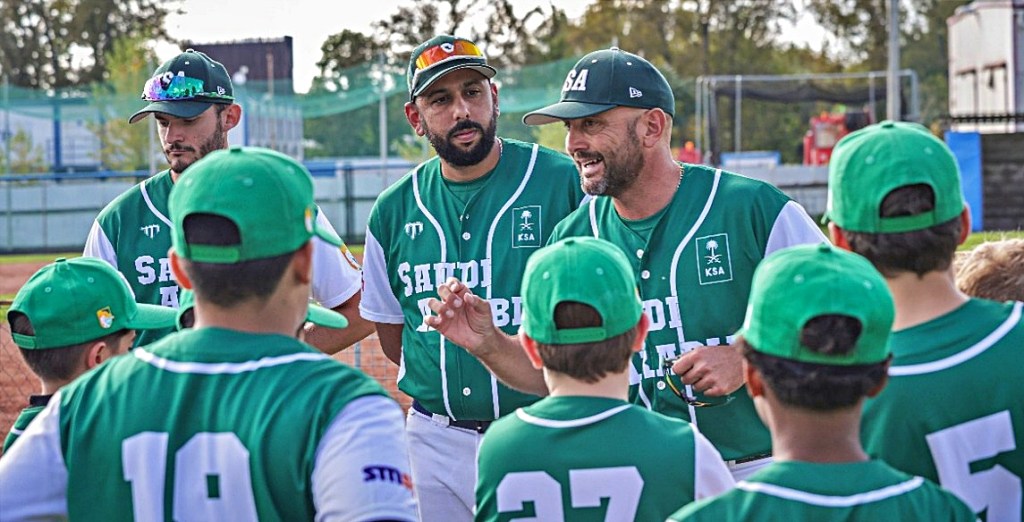
  • Sailor Turned General Manager by a Single Book

    Sailor Turned General Manager by a Single Book

    by Tae-in Chun

    The baseball film Moneyball depicts a moment when one club tried to understand baseball in a completely different way. The 2002 Oakland Athletics questioned the conventional wisdom that permeated the baseball world. By acquiring undervalued players through sabermetrics, they redesigned their team. Similar attempts did not appear only in the United States.

    In Korean baseball history, the 1990s were a time when even the word “data” was unfamiliar. Even in this environment, there were people who questioned an operating style that relied on intuition. The starting point was not a front office meeting or a research report. It was a single book written by a baseball fan.

    Lotte at the end of the 1980s, having lost its direction

    In the late 1980s, Korean professional baseball still remained a “people’s game.” A manager’s experience and instincts, trust in veteran players, and internal organizational inertia were the standards for team operations. When results were bad, the manager was replaced, and when momentum was good, existing methods were maintained. Long term development and structural reform were always pushed to the back. The Lotte Giants, who finished last in 1989 and stayed in the lower ranks in 1990, were likewise a team that had lost its way amid this inertia. The fandom was overwhelming, but the team had no explanation for why it was losing.

    A perspective formed outside baseball

    Around this time, there was one person who looked at the team from a completely different angle. His name was Jeong-gyu Song. He was born in Busan and studied at Korea Maritime University, which trains navigators. He then began his career as a deck officer on merchant ships. Later, he was promoted to captain at a U.S. shipping company, making the sea his workplace. Baseball was not his profession, but his interest ran deep.

    Baseball fan Jeong-gyu Song (front center), who chose the path of a navigator under the influence of his father, a professor at Korea Maritime University

    Long voyages gave him time to study baseball. Through Japanese professional baseball newspapers, American sports magazines, and Major League related books, he naturally came to place Korean baseball alongside overseas baseball and compare their structures. The differences became increasingly clear. At the time, player usage in Korean baseball relied excessively on intuition, and team management lacked a consistent philosophy. There was no system to systematically develop prospects, and responsibility for poor performance always fell on the field staff. Jeong-gyu Song began recording and accumulating the problems he felt while thinking about the Lotte Giants.

    Choosing records instead of protests

    Jeong-gyu Song did not initially intend to write a book. He called the club several times to explain the team’s problems. However, the opinions of an “ordinary fan” were repeatedly brushed aside. Deciding that conveying things verbally no longer worked, he chose to organize his thoughts and leave them as a written record. After seven months, during which he even set up his own publishing company, The Winning Formula: Lotte Giants’ Top Secret was released into the world.

    A book that is still talked about among Korean baseball fans today

    It was self published, and sales were not high. However, the contents were concrete. The role of the front office, standards for player usage, and the necessity of a long term development system were organized by topic. From today’s perspective, these are not unfamiliar ideas, but at the time they were novel problem statements in Korean baseball. The book gradually spread by word of mouth. Unexpectedly, it reached the hands of Lotte owner Jun-ho Shin.

    Becoming a general manager with a single book

    In 1991, the Lotte Giants made a radical choice. Jeong-gyu Song was appointed general manager. Former sailor, late 30s, no practical experience in baseball team operations. In the front office culture of the time, it was a highly unusual appointment. Internal reactions were cold. Open turf battles and exclusion followed, and there were even times when, because budget cooperation was not provided, he had to go out personally to look for sponsors.

    Jeong-gyu Song greeting the players after taking office

    His operating philosophy was also different. He spoke about statistical analysis, the strong number two hitter theory, and the need for a development system. Concepts that are familiar now were met then with reactions like “that sounds like baseball comics.” However, change quickly appeared in results. In his first year, 1991, Lotte rose to fourth place and advanced to the postseason. They surpassed one million spectators in a single season for the first time in professional baseball history. In 1992, they even won the Korean Series.

    The experiment ended, but the questions remained

    The championship was not the end. Internal conflicts still remained. An assessment arose that he “damaged organizational harmony.” This evaluation was reported to club management. Jeong-gyu Song, who encountered this while on his honeymoon, resigned voluntarily after returning home. Since then, Lotte has gone more than 30 years without another championship.

    He is also known as Korea’s top expert in the field of maritime economics, combining practice and theory

    He returned to the shipping industry. Afterward, he continued working in key positions in shipping and port related organizations. Even after mandatory retirement, he has continued to advise on and contribute to major issues in Korea’s shipping and port sectors. His distance from baseball grew, but his perspective remained sharp. In 2024, he appeared on a Busan regional radio broadcast and became a topic of conversation again after predicting Lotte’s preseason ranking with considerable accuracy. Decades have passed, but he left the impression that his eye for the team had not changed.

    The Winning Formula: Lotte Giants’ Top Secret is now an out of print book. Rather than a theoretical text, it is closer to a record of one fan asking questions and working through the answers. Attempts similar to Moneyball clearly existed in Korean baseball as well. However, they did not take root as a successful management strategy, nor did they expand into a popular narrative. Even so, this attempt showed a brief but meaningful possibility in Korean baseball.

  • The Bums in the Land of the Rising Sun: How the 1956 Dodgers’ Tour of Japan Marked the End of a Dynasty

    The Bums in the Land of the Rising Sun: How the 1956 Dodgers’ Tour of Japan Marked the End of a Dynasty

    by Robert Fitts

    Every Monday morning we will post an article from SABR’s award-winning books Nichibei Yakyu: Volumes I and II. Each will present a different chapter in the long history of US-Japan baseball relations. This week Rob Fitts focuses on the Brooklyn Dodgers 1956 tour of Japan where Jackie Robinson played his final game.

    The Brooklyn Dodgers straggled into Idlewild Airport in Jamaica, Queens, on the morning of October 11, 1956. It had been a long, grueling season, ending the day before with a 9-0 shellacking by the Yankees in the seventh game of the World Series. Now, less than 18 hours later, the Dodgers were leaving for a four- week goodwill tour of Japan.

    The subdued party of 60 consisted of club officials, players, family members, and an umpire. Although participation was voluntary, most of the team’s top players had decided to take advantage of the $3,000 bonus that came with the all-expenses-paid trip.1 Noticeably absent were Sandy Koufax, who was sharpening his game in Puerto Rico; Sandy Amoros, who was playing in Cuba; and World War II vet Carl Furillo who proclaimed, “I want no part of it. I’ve seen Japan once and there’s nothing there I want to see again.”2

    As they readied to board the private flight to Los Angeles, Don Newcombe and his wife were missing. The Dodgers ace had won 27 games during the season and would win both the National League Most Valuable Player and Cy Young Awards. But he had failed spectacularly in the World Series, getting knocked out in the second inning of Game Two, and in the fourth inning of Game Seven. When asked about the up-coming trip after the Game Seven loss, Newcombe snapped, “Nuts to the trip to Japan!” “There’ll be trouble if he’s not on that plane!” countered Dodgers General Manager Buzzie Bavasi.3

    Just after 11 A.M. the big pitcher arrived at the airport without wife or luggage. “The Tiger is here!” he announced as he boarded. He had spent the morning at the Brooklyn Courthouse to answer a summons on an assault charge for punching a parking attendant who had made a wisecrack about his Game Two performance. The plane left on time and after a stop in Los Angeles arrived in Honolulu at 5:30 P.M. on October 12.4

    The Dodgers spent five days in Hawaii, attending banquets, sightseeing, sunbathing on Waikiki Beach, and playing three games against local semipro teams. As expected, Brooklyn won the first two contests comfortably, beating the Maui All-Stars, 6-0, behind 20-year-old Don Drysdale’s seven perfect innings on October 13 and the Hawaii Milwaukee All-Stars, 19-0, the next day. On the 15th, Don Newcombe took the mound against the Hawaii Red Sox. Spectators serenaded him with boos and jeers as the Red Sox scored three times in the second inning and chased him from the game in the fourth. “I can’t believe that I am still the target for abuse after getting 5,000 miles away from Brooklyn. I never want to come back here again! I didn’t want to make this trip in the first place,” he complained after Brooklyn pulled out a 7-3 win in the 10th inning. “This abuse thing has me worried,” he added. “I am afraid the emotional effect might continue to grow and become a detriment to my future career.”5 After a day of sightseeing, the Dodgers left for Japan on a 10 P.M. overnight flight.

    The plane touched down at Tokyo’s Haneda Airport at 3:25 P.M. the following day, five hours behind schedule after mechanical trouble forced a seemingly endless stopover on Wake Island. A light rain fell from the gray sky. The weary players trudged off the plane and down the metal stairs to the tarmac where they were greeted by the first group of dignitaries and reporters. “Man, we’re beat,” Jackie Robinson complained as he left the plane. “We are all very tired,” Duke Snider added, “but we’re glad to be here. If we have a chance to shower and clean up, we’ll feel much better.”6

    Japanese dignitaries and 40 kimono-clad actresses, bearing bouquets of flowers, welcomed the Dodgers as a crowd of fans waved from the airport’s spectator ramp. During a brief press conference, team owner Walter O’Malley proclaimed that “his players would play their best … and hoped that the visit would contribute to Japanese-American friendship.” “We hope to give the Japanese fans some thrills,” said Robinson.7

    Despite the delay and relentless drizzle, thousands of flag-waving fans lined the 12-mile route from Haneda Airport to downtown Tokyo. Although many of the players longed for a shower, a warm meal, and a soft bed, they would not see their hotel for hours. After a brief stop at the Yomiuri newspaper’s headquarters, the team went straight to a reception at the famous Chinzanso restaurant. As they arrived, the hosts presented each visitor with a happi coat made to resemble a Dodgers warmup jacket and a hachimaki (traditional headband). Dressed in their new garb, the Dodgers mingled with baseball officials, diplomats, and Japanese ballplayers for several hours. Exhausted, the Dodgers finally checked into the Imperial Hotel around 9 P.M. Some of the younger players, however, went back out, attending “a giddy round of parties” before staggering back to the hotel in the wee hours of the morning.8

    Fred Kipp, Gil Hodges, Wally Yonamine, Vin Scully, Roy Campanella and Don Demeter at the October 18 reception at Chinzanso, Tokyo. (Rob Fitts Collection)

    Weary from the trip and the late night, the players struggled to get out of bed the next morning for the opening game against the Yomiuri Giants at Korakuen Stadium. Ceremonies began at 1 P.M. with the two teams parading onto the field in parallel lines behind a pair of young women clad in fashionable business suits. Each woman held a large sign topped with balloons, bearing the team’s name in Japanese. As the Giants marched on the field, some of the Dodgers gaped in surprise. “We went over there with typical American misconceptions,” Vin Scully later wrote. “We expected the local teams to be stocked with little yellow, bucktooth men wearing thick eyeglasses. When they first walked onto the field in Tokyo, I heard one of our players yell, ‘Hey fellas, we’ve been mousetrapped!’ One of the first ballplayers out of the dugout was a pitcher who was six feet four. … They averaged five feet ten or so, and they were all built like athletes.”9

    Like the Dodgers, the Yomiuri Giants had just finished an exhausting season topped with a defeat in the Japan Series two days earlier. The Japan Timesnoted, “The Giants, battered and worn in their losing bid for the Japan championship …, are regarded as a pushover for the Bums. The Brooklyn club is expected to win their opener by a margin of over ten runs.”10 But that is not what happened.

    The Giants jumped out to a quick 3-0 lead off Don Drysdale. At 6-feet-5 he towered over most of his Japanese opponents and expected to dominate them with his overpowering side-arm fastball. But as Scully noted, “Another misconception we had was that our big pitchers would be able to blow them down with fastballs. We were dead wrong. They murdered fastball pitching. Our guys would rear back and fire one through here and invariably the ball would come back even harder than it was thrown. They hit bullets.”11

    Brooklyn battled back to take a 4-3 lead in the fourth on five hits, including homers by Robinson and Gil Hodges. But that would be all for Brooklyn as relief pitcher Takumi Otomo, who had beaten the New York Giants in 1953, stifled the Dodgers for 5 2/3 innings. Homers by Kazuhiko Sakazaki and Tetsuharu Kawakami in the eighth gave Yomiuri a 5-4 upset victory. “The fans,” wrote Leslie Nakashima of the Honolulu Advertiser, “could hardly believe the Dodgers had been beaten.”12 Otomo had struck out 10 in his second win over a major-league team.

    Since the major-league tours began in 1908, the game was just the fifth victory by a Japanese team against 124 loses.13 After the loss, manager Walt Alston made no excuses, “They just beat us. They hit and we didn’t.” Duke Snider had a particularly bad day, striking out three times and being caught off base for an out. “We’re pretty tired,” he explained. “But that’s no excuse. We’re all in good physical shape and should have won. A good night’s sleep tonight and we’ll roll.” “We’ll snap out of it,” predicted Robinson. Pee Wee Reese agreed: “We don’t expect to lose any more. But,” he added, “we didn’t expect to lose this one either.”14

    As predicted, the Dodgers bounced back the next day. Masaichi Kaneda, recognized by most experts as Japan’s all-time greatest pitcher, began the game for the Central League All-Stars by loading the bases on two walks and a single before being removed from the game with a sore elbow. Roy Campanella greeted relief pitcher Noboru Akiyama with a towering drive into the last row of the left-field bleachers to put the Dodgers up, 4-0. Campy added another home run in the third inning to pace Brooklyn to an easy 7-1 victory as Clem Labine pitched a four-hit complete game.15

    On Sunday, October 21, approximately 45,000 fans packed Korakuen Stadium to watch Don Newcombe face the All-Japan team—a conglomeration of the top Japanese professionals. Newcombe’s outing lasted just 17 pitches. He began by walking Hawaiian Wally Yonamine, then surrendered a home run and three consecutive singles before Alston took the ball.16 The former ace “stormed from the hill” and stumbled into the clubhouse “like a sleepwalker … jerkily, almost aimlessly. He wore the frozen expression of a kid who’s just seen his puppy run over. Wonder, shock, disbelief, hurt. Pinch me, I’m dreaming. … Slowly he picked up his shower shoes, detoured a sportswriter to get to his jacket. Then out the back door, back to the hotel.”17

    After the eventual 6-1 loss, manager Walter Alston noted, “Newk wasn’t right again today. … He’s not throwing natural.”18 Reese explained, “He’s still got it (the World Series) on his mind. It’s getting to be a terrible thing. Not only does he feel he’s letting himself down, he feels he’s letting the club down. … Don doesn’t say much, but it’s building up and building up inside him. It could run him out of baseball.”19

    Unfortunately, Reese’s assessment was prophetic. The next day, Newcombe announced that he had injured his elbow in the final game of the regular season. It hurt to throw curveballs. He had kept the injury to himself, hoping that rest would cure the ailment. Although his arm may have healed, Newcombe never fully recovered from the psychological injury of the blown 1956 World Series. He had begun drinking heavily in the early 1950s and his alcohol abuse intensified after the loss. After a mediocre 1957 season, he was traded to Cincinnati in 1958 and would be out of the major leagues after the 1960 season. He played his final season with the Chunichi Dragons of Japan in 1962—coached by Wally Yonamine, who had begun the onslaught on that fateful day in Tokyo.

    With the loss, the Dodgers became the first professional American club to lose two games on a Japanese tour. Criticism came from both sides of Pacific. “The touring Flatbushers once again were disemboweled by a band of local samurai,” wrote Bob Bowie of the Japan Times.20 “The Dodgers are known for their fighting spirit,” noted radio quiz-show host Ko Fujiwara, “but they have shown little spirit in the games here thus far.”21 The Associated Press reported that “most Japanese fans have been disappointed in the caliber of ball played so far by the Brooklyns,” but Yoshio Yuasa, the former manager of the Mainichi Orions, offered the harshest criticisms.22 “I can sympathize that the Dodgers are in bad condition from fatigue after a hectic pennant race, the World Series and travel to Japan and that they are in a terrific slump, but they are even weaker than was rumored at bat against low, outside pitches and we are very disappointed to say the least. … It would not be an overstatement to say that we no longer have anything to learn from the Dodgers.”23

    Roy Campanella, Jakie Robinson, and Duke Snider signing autographs for Japanese fans. Cappy Harada is in the dugout. (Rob Fitts Collection)

    The US media picked up these criticisms, reprinting the stories in large and small newspapers across the country. “Japanese Baseball Expert Hints Brooks Are Bums,” screamed a headline in the New York Daily News on October 23.24 Three days later, a Daily News headline noted, “Bums ‘Too Dignified,’ Say Japanese Hosts.” The accompanying article explained that some Japanese experts believed that the Dodgers were “too quiet and dignified on the playing field … and … were acting like they were all trying to win good conduct medals” rather than playing hard-nosed baseball.25

    After a day of rest, the Dodgers flew to Sapporo in northern Japan for a rematch against the Yomiuri Giants. Before the game, Walter O’Malley addressed the team. Starting pitcher Carl Erskine recalled, “Mr. O’Malley was very upset. He thought it was a scar on the name of the Dodgers to have gone to Japan and lost two games.”26 “He was embarrassed. He held a team meeting and read the riot act. He said, ‘I know this is a goodwill tour and I want you to be gentlemen. Sign autographs and be cordial. However, when you put on that Dodger uniform, I want you to remember Pearl Harbor!’”27

    Erskine was near perfect, giving up three hits and a walk but never allowing a runner to reach second base as he faced just 27 batters. But the Dodgers continued to struggle at the plate, failing to score until Duke Snider led off the ninth inning with a 380-foot homer over the right-center-field wall to give Brooklyn a 1-0 victory.28

    Despite the win, many Japanese were not pleased with the Dodgers’ performance. An Associated Press article noted that Tokuro Konishi, a broadcaster and former manager, “and other experts agreed that most Japanese fans have been disappointed in the caliber of ball played so far by the Brooklyns. … Konishi said he believed the two losses could be chalked up to the fatigue from the grueling National League pennant race and seven game World Series.”29 “The Dodgers’ ‘old men’ are tired,” noted Bob Bowie of the Pacific Stars and Stripes. “Pee Wee Reese and Jackie Robinson and Gil Hodges and Duke Snider and Roy Campanella are so weary it’s an effort for them to put one foot before another. It’s been a long season and they are anxious to get back home and relax before heading for spring training in February.”30

    Indeed, the “Boys of Summer” were aging. The core of the team had been together nearly a decade. The starting lineup averaged 32 years old with Robinson and Reese both at 37. Their weariness showed on the playing field. After four games, the team was hitting just .227 against Japanese pitching. Both management and fans knew it was time to change, and the team had plenty of young talent. At the top of the list were power hitters Don Demeter, who hit 41 home runs in 1956 for the Texas League Fort Worth Cats, and his teammate, first baseman Jim Gentile, who hit 40. Outfielder Gino Cimoli had ridden Brooklyn’s bench in 1956 and was now ready for a more substantial role. Smooth-fielding Bob Lillis from the Triple-A affiliate in St. Paul seemed to be the heir of Pee Wee Reese at shortstop while his teammate Bert Hamric would fight for a role in team’s crowded outfield. On the mound, knuckleballer Fred Kipp hadjust won 20 games for the Montreal Royals and looked ready to join Brooklyn’s rotation. The tour of Japan was an ideal chance try out these players. As the tour progressed, Alston moved more prospects into the starting lineup.

    In the fifth game, held in Sendai, Alston gave Kipp the start and backed him up with Gentile at first, Demeter in center and Cimoli in left. For seven innings Kipp baffled the All-Kanto All-Stars, a squad drawn from the Tokyo-area teams, with his knuckleball—a pitch rarely used in the Japanese leagues, while the hurler’s fellow rookies racked up five hits during an easy 8-0 win.31

    Don Drysdale started game six in Mita, a small city about 60 miles northeast of Tokyo. For seven innings the promising young pitcher dominated the Japanese. Then, the Japanese erupted for three runs in the bottom of the eighth inning, breaking a streak of 29 straight shutout innings by Dodger pitching. With the scored tied, 3-3, after nine innings, the Dodgers requested that they end the game so that the team could catch their scheduled train back to Tokyo.32 Although it was not a win, an Associated Press writer called the result “a moral victory for Japanese baseball.”33 After six contests, the National League champions were 3-2-1—the worst record of any visiting American professional squad.

    Despite the Dodgers’ poor start, the Japanese fans adored the team packed with household names. About 150,000 spectators attended the first five games while hundreds of thousands more, if not millions, watched the games on television or listened to them on the radio.34 “There is widespread interest in the Dodgers and their style of play,” an Associated Press article noted. All of the sports dailies and many of the mainstream newspapers covered each game in detail—often including exclusive interviews and pictorial spreads of the players. Many dailies ran “sequence shots of various Dodgers in action.”35

    Although the Dodgers were winning over the Japanese fans, their opponents on the diamond were unimpressed. Ace pitcher Masaichi Kaneda noted, “The pitchers this time were not as good as [on the previous major-league tours]. … On the bench, I was looking forward to hitting. I had never had that feeling before.”36 Shortstop Yasumitsu Toyoda agreed: “Even their fastballs didn’t look fast enough.”37 Kazuhiro Yamauchi, the star outfielder for the Mainichi Orions who hit .313 in 48 at-bats during the tour, complained that the Dodgers lacked hustle. “The Yankees [during the 1955 tour] would always try for an extra base on a hit, while some Dodger runners stopped dead.”38 Yamauchi also noted that the Dodgers had trouble with low, outside pitches. “All our pitches have been aiming for the outside comer.” Yomiuri right-hander Takehiko Bessho added, “Most of them were not good at hitting curveballs. …I wasn’t [even] scared of Campanella. He looked huge, but only he could hit in one spot … the high inside corner. … If an umpire called [a low outside pitch] a strike, he complained. He was just desperate.”39

    During a November 11 round-table interview moderated by Masanori Ochi, several Japanese players bristled when asked about a training session run by Dodgers coach Al Campanis. Campanis was actively promoting his book, The Dodgers’ Way to Play Baseball, which had been translated into Japanese. “We attended it, but we already knew ‘how to throw a slider,’” Tetsuharu Kawakami snidely told Ochi. “They only told us what we already knew. I think we practice small tactics more than they do.” “Al Campanis only talked about general things,” Takehiko Bessho added, “and nothing was new.”40

    Oblivious to the Japanese players’ feelings, after the tour Campanis told Dan Daniels of The Sporting News, “For the good of Japanese ball, it would be well to send several American coaching staffs there for the purpose of staging clinics rather than having a different team visit each year. Of course, that wouldn’t be the sort of spectacle the fans would want, but it would be more helpful to the progress of Japanese ball. We held one clinic while we were over there, and I never had a more attentive audience. They want to learn our methods and a few clinics would help them tremendously.”41

    Underwhelmed by the Dodgers, some of the Japanese players began to jeer their opponents. The Dodgers were undoubtedly unaware as the “rudeness” consisted mainly of addressing the visitors by their first names—an offensive act in Japan, especially in the mid-1950s. The players confessed during the November 11 round table interview:

    Yasumitsu Toyoda: (Looking at Kaneda,) Remember you jeered at him [Newcombe] in Mito, something like ‘Come on, Don!’ He was offended by that.

    Masaichi Kaneda: We became good at jeering. Our pronunciation became better.

    Takehiko Bessho: You [Kaneda] were best at it. You called the first baseman [Gino] Cimoli, ‘Gino, Gino,’ and he turned and smiled at you. When the game is over, you were like ‘Goodbye Gino.’

    Masaichi Kaneda: ‘Come on, Don’ was a good one!

    Masanori Ochi: Did you jeer at the other major leaguers like the Yankees?

    Masaichi Kaneda: No, we just did it this year.

    Takehiko Bessho: That was because we were winning.

    Masaichi Kaneda: Alright, I will say ‘Hey Don!’ to his face. If he gets angry, I will hide quickly!42

    Undoubtedly sensing the players’ distain, Fujio Nakazawa, a commentator and future member of the Japan Baseball Hall of Fame, cautioned his countrymen. “The two victories over the Dodgers should be no reason for jubilation among the players here. They should by no means become conceited. Japanese ballplayers have much to learn from the Dodgers, who have not complained about their busy schedule which started the day after their arrival. The Dodger players are always cheerful and play hard. A defeat does not discourage them.”43

    Perhaps sparked by the ongoing criticism, perhaps finally rested, the Dodgers began winning in late October as the rookies led the way. On October 27 in Kofu, Gentile hit two home runs and Demeter and Cimoli each hit one during a 12-1 romp over an allstar squad of players drawn from the Tokyo-area professional teams. The next day, Gentile went 5-for-5 with another home run as the Dodgers beat All-Japan, 6-3, in Utsunomiya.44 On October 31 Kipp pitched two-hit ball and Gentile and Demeter each homered to pace Brooklyn to a 4-2 win over All-Japan. During these games the players began showing a little fighting spirit. Somehow, they learned the Japanese word “mekura,” meaning “blind,” and began shouting it at the umpire after questionable calls.45

    “Some of those ballparks were small, [holding] 20,000 or 25,000,” Carl Erskine remembers. “There were acres of bicycles in the parking lots. After the games were over, the men were all lined up along the ditch by the side of the road relieving themselves. I guess they had a couple of beers. So, it was a little unusual leaving the ballpark and passing rows and rows of men. That was a strange sight!”46

    On the evening of October 31, the team arrived in Hiroshima and checked into the Hotel New Hiroshima, an ultra-modem structure near the Peace Park and ballpark. Local officials warned the players not to leave the hotel unescorted at night as gang-related crime made the area unsafe for tourists. The following morning the team visited the Peace Park and posed with their hats in their hands in front of the Memorial Cenotaph, the saddle-shaped concrete arch that bears the name of each person killed in the atomic bomb blast.

    In a solemn ceremony before the start of the 2 P.M. game, the Dodgers presented city officials with a bronze plaque reading: “We dedicate this visit in memory of those baseball fans and others who died by atomic action on Aug. 6, 1945. May their souls rest in peace and with God’s help and man’s resolution peace will prevail forever, amen.”47

    Walter O’Malley, Walt Alston, and Yomiuri Giants manager Shigeru Mizuhara. (Rob Fitts Collection)

    Walter O’Malley, Walt Alston, and Yomiuri Giants manager Shigeru Mizuhara. (Rob Fitts Collection)

    The emotion from the morning boiled over during the game against the Kansai All-Stars. In the bottom of the third inning with the Japanese already up 1-0 and one out and a runner on second, future Hall of Fame umpire Jocko Conlon called Kohei Sugiyama safe at first on what looked to be a groundout. Incensed, Jackie Robinson walked over to first to protest the call. “Everybody knew Jocko had missed the play because he was in back of the plate and couldn’t see clearly,” Robinson explained.48 Conlon, of course, did not reverse his decision so Robinson persisted, eventually arguing “so loud and so long” that Conlon tossed him from the game. “I never told him how to play ball,” Conlon said after the game, “and he, or anybody else, can’t tell me how to run a ball game.”49

    Kansai padded its lead to 4-1 before Brooklyn tied the game in the sixth on Roy Campanella’s three-run homer. The Dodgers went ahead in the seventh in a bizarre inning. After recording an out, reliever Yukio Shimabara walked Jim Gilliam, who stole second base and then moved to third on a passed ball. Shimabara then walked both Reese and Snider. With the bases loaded, Campanella fouled out to the catcher. Gilliam decided to take matters into his own hands. With two outs and the bases still jammed, he stole home to give the Dodgers the 5-4 lead. Rattled, Shimabara then made a mistake to Jim Gentile, who pounded the ball into the stands for a three-run homer. Brooklyn tacked on another two in the ninth for a 10-6 victory.50

    After the Dodgers won 14-0 on November 2, the Japanese squads rebounded. On the 3rd the Dodgers and the All-Japan team entered the eighth inning knotted 7-7 before Brooklyn erupted for another seven to win 14-7. The following day, Japanese aces Takehiko Bessho and Masaichi Kaneda held the Dodgers to just one run for eight innings as the hosts entered the ninth leading 2-1. The Dodgers rallied in the ninth as Snider led off with a 480-foot home run to tie the game. Two outs later with the bases loaded, Robinson tried to steal the lead with a surprise two-out squeeze play. But Jackie missed the bunt and Demeter was tagged out on his way to the plate. In the bottom of the inning, Tetsuharu Kawakami, the hero of the opening game, came through again with a bases-loaded single to win the game.51

    On the 7th the Dodgers squeaked out a 3-2 win over the All-Japan squad in Nagoya. Gil Hodges, however, stole the headlines. Alston started the normally staid first baseman in left field and to keep himself amused Hodges “pantomimed the action after almost every play for five innings. He mimicked the pitcher and the ball’s flight through the air, the catcher and the umpire. When a Dodger errored, Hodges glowered and pointed his finger. He made his legs quiver, shook his fist, stamped on the ground, swung his arms, frowned and smiled in the fleeting instant between pitches.” The fans loved it, cheering him so loudly as he left the game in the eighth inning that “[y]ou’d have thought it was Babe Ruth leaving.”52

    Vin Scully recalled how Hodges’s antics eased a tense moment. “During a game before an overflow crowd, one of our players was called out on strikes and, in a childish display of petulance, dropped his bat on the plate, took off his helmet and hurled it to the ground with such force that it bounced up on top of the Dodger dugout. The crowd was shocked. The Japanese had never seen an umpire held up to such humiliation and it was an embarrassing moment for us in the Brooklyn party. Gil saved the day. While the crowd still sat in stunned silence, Gil suddenly appeared, jumped up on the dugout roof and approached the helmet as if it was a dangerous snake. He circled it warily, made a couple of tentative stabs at it, and quickly pounced on it, tossed it back on the field and then it did a swan dive off the top of the dugout. The fans beat their palms and shouted until they were hoarse.”53

    The Dodgers and All-Japan met again the next day at Shizuoka, a small town at the foot of Mt. Fuji, where 22 years earlier the All-Nippon behind 17-year-old Eiji Sawamura nearly beat Babe Ruth’s All-Americans. Once again the Japanese team thrilled the fans of Shizuoka as pinch-hitter Kohei Sugiyama of the All-Japan squad broke a 2-2 tie in the bottom of the ninth with a walk-off single.54 With their fourth loss, criticism of the Dodgers’ performance continued. An International News Service article headlined, “Fans Debate Reasons for Dodger Losses” asked, “Are Japanese baseball teams improving, major leaguers getting careless or the Brooklyn Dodgers just getting old?”55

    On November 9 the Dodgers returned to Tokyo for a rematch with their hosts the Yomiuri Giants. Once again, the game was tight. Home runs by Jim Gentile and Herb Olson as well as an inside-the-park homer by Giants catcher Shigeru Fujio left the score tied up after nine innings. Jim Gilliam led off the top of the 11th with a single and two outs later stood on second base as Jackie Robinson strode to the plate. Yomiuri manager Shigeru Mizuhara called for an intentional walk but Giants ace Takehiko Bessho refused. After some discussion, Mizuhara allowed Bessho to challenge Robinson. Jackie jumped on the first pitch, pounding it foul “far over the left-field stands.” On the next offering, he “drove a hot grounder through the pitcher’s box,” bringing Gilliam home to win the game.56

    The win seemed to energize both the Dodgers and Robinson. They won the next two games easily, 8-2 and 10-2, as Jackie went 2-for-5 with two runs and two RBIs. After the game in Tokyo on November 12, the Dodgers flew to the southern city of Fukuoka to make up a game that had been rained out on October 30.

    Fittingly, the final meeting of the 19-game series was tight. Nineteen-year-old phenom Kazuhisa Inao and Kipp dueled for eight innings, each surrendering one run. The score remained tied as Duke Snider led off the top of the ninth with a groundball to first, which the usually sure-handed Tokuji Iida muffed, allowing Snider to advance to third base. Robinson strode to the plate—unknowingly for the last time in his professional career—and grounded a single between third and short to score Snider and give the Dodgers the lead. After two outs and a walk, Don Demeter singled and Robinson crossed home plate for the final time. Immediately after the 3-1 victory, the Dodgers flew back to Tokyo and after a day of rest, returned to the United States.

    Brooklyn’s tour of Japan marked the end of an era. Robinson retired soon after returning to the United States. The team’s troubles on the diamond continued in 1957 as they finished in a distant third place. It was time to rebuild. The games in Japan allowed many of the younger players to display their skills. Jim Gentile, for example, led the team with a .471 batting average, 8 home runs, and 19 RBIs, while Fred Kipp won three games and posted a 1.26 ERA in 43 innings.

    Although Alston and others claimed that fatigue had led to the Dodgers’ poor showing on the diamond, they also conceded that the greatly improved Japanese had put up stiff competition. National League President Warren Giles, who accompanied the Dodgers to Japan, noted, “[T]he quality of baseball in that country is improving steadily and the day may come when the ablest players of Japan will compete on even terms with the best the United States has to offer.”57 Walter O’Malley concurred, telling reporters that the Japanese clubs would be nearly even with US ballclubs in the not-too-distant future. “Their pitchers have uncanny accuracy. They rarely walk anyone. In fielding, particularly in the infield, the Japanese teams are really excellent. Some Japanese players could play on teams in contention in pennant races here, or at least on the better minor league clubs.”58

    When asked if any of the Japanese players were ready for the majors, Al Campanis responded:

    There’s one fellow who must have been really good in his prime. He’s 38 years old now [actually 36] and they tell me he hasn’t hit under .300 for 18 straight years [actually eight]. I would have liked to [have] got a crack at him a few years back. His name is Kawakami. … High in my book were three others. A shortstop named Toyoda … was the best hitter in his league. His arm might have been a little short, but he had everything else. Then there was a catcher, Fujio, in his first year of pro ball. Never saw anyone with a better arm. Man, he had a rifle. Good receiver, too, and a fair hitter. But the number one prospect in my judgment was a pitcher named Sho Horiuchi, a 21-year-old right hander with the Yomiuri Giants.59

    The following spring, the Dodgers invited Fujio and Horiuchi along with their manager Shigeru Mizuhara, to spring training at Dodgertown to help them mature as players. The invitation began a long friendship between the two clubs. The Giants would be the Dodgers’ guests at Vero Beach in 1961, 1967, 1971, and 1975 and the two clubs would maintain close relations for over 65 years.

    NOTES

    1 “All Dodgers’ O’Malley Gets Is Ride,” New York Daily News, October 13, 1956: 36.

    2 “Dodgers Invited to Tour Japan in Fall; Most Favor Trip, but Furillo Votes No,” New York Times, May 2, 1956: S36.

    3 Ed Wilks, Newcombe ‘Gets Lost’ After Humiliation,” Monroe (Louisiana) News-Star, October 11, 1956: 12.

    4 United Press, “Dodgers Arrive at 5:30 P.M. Today,” Honolulu Advertiser, October 12, 1956: 14; Carl Lundquist, “Flatbushers Full of Frolic as They Leave For Japan,” The Sporting News, October 17, 1956: 13.

    5 Tom Hopkins, “Sportraitures,” Honolulu Star-Bulletin, October 18, 1956: 38; Red McQueen, “Dodgers Outdraw Yankees,” Honolulu Advertiser,October 16, 1956: 14.

    6 Associated Press, “Bums Arrive in Tokyo,” Passaic (New Jersey) Herald-News, October 18, 1956: 46.

    7 United Press, “Japanese Fans Defy Rain to Hail Dodgers,” New York Daily News, October 19, 1956: 155.

    8 Vin Scully, “The Dodgers in Japan,” Sport, April 1957: 92; Bob Bowie, “Actresses, Flowers, Cheers Welcome Tourists to Tokyo,” The Sporting News,October 24, 1956: 9.

    9 Scully.

    10 “Bums Open Game with Giants Today,” Japan Times, October 19, 1956: 5.

    11 Scully.

    12 Leslie Nakashima, “Dodgers Beaten 5-4 by Yomiuri Giants in Japan,” Honolulu Advertiser October 20, 1956: 14.

    13 >Other victories came in 1922, 1951, 1953 against the Eddie Lopat All-Stars, and 1953 against the New York Giants. The Royal Giants’ tours are excluded from these figures as not all of their results are known.

    14 Mel Derrick, “Alston Explains: ‘They Hit, and We Didn’t,’” Pacific Stars and Stripes, October 20, 1956: 23.

    15 Bob Bowie, “Dodgers Belt Central Loop Stars 7-1,” Pacific Stars and Stripes, October 21, 1956: 24.

    16 Mel Derrick, “Newcombe a Study in Dejection After Loss,” Pacific Stars and Stripes, October 22, 1956: 24.

    17 Bob Bowie, “All-Stars Rout Brooks 6-1,” Pacific Stars and Stripes, October 22, 1956: 24; Derrick, “Newcombe a Study,” 24.

    18 Derrick.

    19 Derrick.

    20 Bowie, “All-Stars Rout Brooks 6-1.”

    21 United Press, “Dodgers’ Good Behavior Mystifies Japanese Fan,” Honolulu Advertiser, October 26, 1956: 14.

    22 Associated Press, “Japanese Can Learn from Bums,” Hawaii Tribune-Herald (Hilo, Hawaii), October 23, 1956: 7.

    23 United Press, “Banzais Changed to Brickbats for Dodgers on Japanese Tour,” New York Times, October 23, 1956: 42.

    24 United Press, “Japanese Baseball Expert Hints Brooks Are Bums,” New York Daily News, October 23, 1956: 124.

    25 United Press, “Bums ‘Too Dignified,’ Say Japanese Hosts,” New York Daily News, October 26, 1956: 125.

    26 Carl Erskine, telephone interview with author, February 10, 2020.

    27 Carl Erskine, Tales from the Dodger Dugout (Champaign, Illinois: Sports Publishing, 2000), 65.

    28 United Press, “Brooks Nip Giants 1-0 on Snider’s Home Run,” Pacific Stars and Stripes, October 24, 1956: 24.

    29 Associated Press, “Japanese Can Learn from Bums,” Hawaii Tribune-Herald, October 23, 1956: 7.

    30 Bob Bowie, “Newk’s Tribulations,” Pacific Stars and Stripes, October 24, 1956: 22.

    31 “Brooks Whitewash All-Kanto Nine, 8-0,” Japan Times, October 25, 1956: 8.

    32 Associated Press, “Kanto All-Stars Tie Dodgers 3-3,” Pacific Stars and Stripes, October 27, 1956: 24.

    33 Associated Press, “Kanto All-Stars Tie Dodgers 3-3.”

    34 Bob Bowie, “Gates Spin as Bums Battle for Wins in Japan,” Sporting News, October 31, 1956: 7.

    35 Associated Press, “Japanese Can Learn from Bums.”

    36 “A Round Table Talk,” Baseball Magazine, 11, no. 12 (December 1956): 76-83.

    37 “A Round Table Talk.”

    38 Associated Press, “Yankees Showed More Hustle Than Dodgers,” Honolulu Star Bulletin, November 14, 1956: 44.

    39 “A Round Table Talk.”

    40 “A Round Table Talk.”

    41 Dan Daniel, “Over the Fence,” The Sporting News, November 28, 1956: 12.

    42 “A Round Table Talk.”

    43 United Press, “Japanese Warned against ‘Conceit,’” Pacific Stars and Stripes, October 28, 1956: 20.

    44 Although English-language sources list Gentile going 4 for 4, official Japanese sources have him at 5 for 5.

    45 >Associated Press, “Japan’s Pitchers Surprise Brooks,” Pacific Stars and Stripes, October 30, 1956: 19.

    46 Erskine, telephone interview.

    47 Associated Press, “Dodgers to Dedicate Game to Bomb Victims,” Pacific Stars and Stripes, October 29, 1956: 24.

    48 “Dodgersvs. Kansai All Stars at Hiroshima Stadium, Hiroshima—November 1, 1956,” walteromalley.com. https://www.walteromalley.com/en/dodger-history/international-relations/1956-Summary_November-1-1956. Retrieved October 25, 2020.

    49 “Jackie Drops Verbal Bomb at Hiroshima—Gets Thumb,” The Sporting News, November 14, 1956: 4.

    50 Hochi Sports, November 2, 1956: 2; “Dodgers vs. Kansai,” United Press, “Dodgers Top Kansai, 10-6; Robby Chased,” New York Daily News,November 2, 1956: 175.

    51 Associated Press, “Bums Win 14-7 Before 60,000,” Honolulu StarBulletin, November 3, 1956: 11; Associated Press, “Labine of Dodgers Loses in Japan, 3-2,” New York Times, November 5, 1956: 44.

    52 Associated Press, “Hodges Delights Fans with Baseball Performance,” Pacific Stars and Stripes, November 8, 1956: 22.

    53 Scully.

    54 United Press, “Dodgers Downed by Japanese, 3-2,” New York Times, November 9, 1956: 37.

    55 International News Service, “Fans Debate Reasons for Dodger Losses,” Pacific Stars and Stripes, November 8, 1956: 19.

    56 United Press, “Dodgers Edge Tokyo Giants 5-4,” Pacific Stars and Stripes, November 10, 1956: 24.

    57 Tom Swope, “‘Japanese Players Gaining Major Status Fast’—Giles,” The Sporting News, November 21, 1956: 2.

    58 United Press, “O’Malley Praises Japanese Baseball,” Pacific Stars and Stripes, November 30, 1956: 24.

    59 Daniel.

    60 Yoshikazu Matsubayashi, Baseball Game History: Japan vs, U.S.A. (Tokyo: Baseball Magazine, 2004), 92; Nippon Professional Baseball Records, https://www.2689web.com/nb.html; “Dodgers Individual Batting Results,” Baseball Magazine, 11, no. 12 (December 1956): 64.

    Continue to read the full article on the SABR website
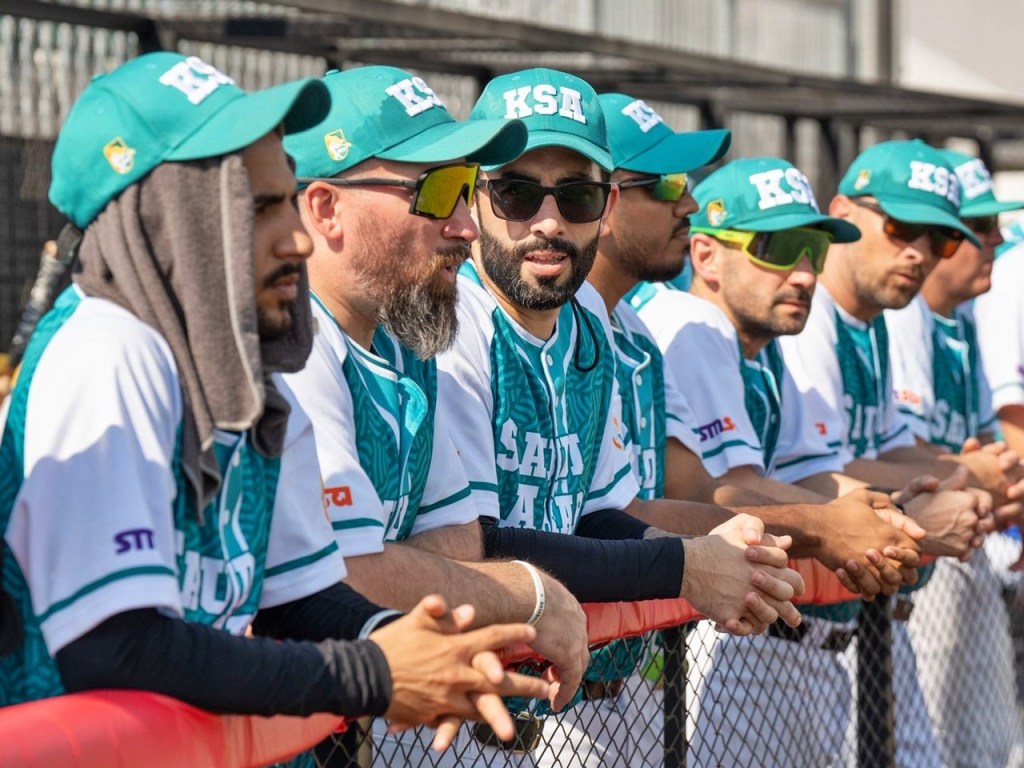
    https://sabr.org/journal/article/the-bums-in-the-land-of-the-rising-sun-how-the-1956-dodgers-tour-of-japan-marked-the-end-of-a-dynasty/