NHK World-Japan’s Deeper Look host Del Irani visited the Yakyu-Baseball exhibit at the National Baseball Hall of Fame and Museum in Cooperstown to examine the history of Japan- U.S. relations through baseball.
In this two-part series, Irani interviews SABR’s Asian Research Committee Chair Robert Fitts about the the long history of Japan-U.S. baseball interaction, baseball diplomacy, and the cultural importance of Japanese playing in Major League Baseball.
Every Tuesday morning we will post an article from SABR’s award-winning books Nichibei Yakyu: Volumes I and II. Each will present a different chapter in the long history of US-Japan baseball relations. In this article Robert Fitts describes the first professional baseball tour of Japan.
The “King of Baseball” was on the prowl for a new opportunity. Mike Fisher, known by everybody as Mique, was a bom promoter and bom self-promoter. He was a risk taker, tackling daunting projects with enthusiasm and usually succeeding. He was the quintessential late-nineteenth-century American man; through hard work and gumption this son of a poor Jewish immigrant transformed himself into a West Coast baseball magnate.
Bom in New York City in 1862, Fisher grew up in San Francisco. Renowned for his speed, he played baseball in the California League during the 1880s before an industrial accident in March 1889 damaged his left hand and sidelined his career. Fisher soon became a policeman in Sacramento, rising to the rank of detective. During his time away from the game, he put on weight and by 1903 was a repeat champion in the fat men’s races held at local fairs.
In February 1902, a new opportunity presented itself when the California League offered Fisher the Sacramento franchise. Fisher pounced on it. In December 1902, the league transformed into the Pacific Coast League, but within a year Fisher relocated his franchise to Tacoma, Washington. Hampered by poor attendance, despite winning the 1904 championship, Fisher sold his share in the team but stayed on as manager as the franchise moved to Fresno in 1906. But his stay in Fresno was short as he left the team after the 1906 season. Without a franchise, Fisher turned to promoting and, in the fall of 1907, took a squad of PCL all-stars to Hawaii.
“So pleased is Mike Fisher with the reception that his team has met with here,” reported the Hawaiian Gazette, “that he is already planning for more worlds to conquer. He is now laying his lines for a trip to be made … next year, which will extend farther yet from home. … The plan, as outlined by Fisher, will include a start from San Francisco, with a team composed exclusively of players from the National and American leagues,” and a stop in Hawaii before continuing on to Japan, China, and the Philippines. It was the first time an American professional squad headed to the Far East.
By early December 1907, Fisher had teamed up with Honolulu athlete and sports promoter Jesse Woods to organize the trip. Woods sent a flurry of letters to Asian clubs to gauge their interest. In February, John Sebree, the president of the Manila Baseball League, responded “that Manila would meet any reasonable expense in order to see some good fast baseball by professional players.” In early March, Woods received a letter from the Keio University Baseball Club stating that they would help arrange games in Japan for the American team. The Hawaiian Gazette noted, “This was good news for Woods, who has been in doubt as how such a trip would be received by the Japanese. There has been so much war talk that Woods was afraid that Japanese might refuse to play baseball with us.” A letter in early April from T. Matsumura, the captain of the Yokohama Commercial School team, confirmed the enthusiasm for the tour in Japan: “When you visit our country, you would certainly receive a most hearty welcome from our baseball circles.” Isoo Abe, the manager of the Waseda University team, added, “We are preparing to give you a grand ovation. We are going to make you feel at home, and we will strive to make your visit to Japan to be one that will linger long in your memories.”
In late June, Woods sailed for Asia to finalize the details for the tour. The touring team was now known as the Reach All-Americans. With the name change, it is likely that the A.J. Reach Company sponsored the team but despite extensive research, the nature of the sponsorship is unknown. Woods’s reports from the Far East were encouraging. “I have all the arrangements made. Forfeit money is up everywhere, and everything is on paper. The team will take in Japanese and Chinese ports and Manila.”
While Woods was working out the itinerary, Fisher built his roster. As usual, he thought big. It would be “a galaxy of the best players in the country.” He began by engaging Jiggs Donahue, the Chicago White Sox’ slick-fielding first baseman, to manage and help recruit the team. “I do not know why Mike Fisher came to me to ask me to get up the team, for I did not know him,” Donahue told a reporter. “I will willingly undertake the work, however, for I believe it will prove to be a grand trip and a success.” Donahue quickly recruited fellow Chicagoans Frank Chance, Orval Overall, and Ed Walsh and began working on the leagues’ two biggest stars, Honus Wagner and Napoleon Lajoie. “Both Wagner and Lajoie are said to be enthusiastic over the plan,” reported the Inter Ocean of Chicago, “but cannot decide whether or not they will be able to arrange their affairs in such a way as to make the trip, which will last two or three months.” By June, Fisher had added New York Highlanders star Hal Chase, Chicago’s Doc White, and Bill Bums of the Senators. Although Wagner and Lajoie declined the invitation, Fisher’s team received a boost on August 23 when Ty Cobb announced that he would join the tour. The recently married star planned to take his bride on the trip as a honeymoon.
Continue to read the full article on the SABR website
Every Tuesday morning we will post an article from SABR’s award-winning books Nichibei Yakyu: Volumes I and II. Each will present a different chapter in the long history of US-Japan baseball relations. In this article Carter Cromwell discusses the first US university baseball team to tour Japan.
Links between Japan and the Seattle area are nothing new. They were first forged in the late nineteenth century when Japanese began immigrating to the Pacific Northwest, and they’ve strengthened over the years. One of the consequential connections has been baseball.
In 1905 a team from Japan’s Waseda University toured the American West Coast and played against various US teams. That led to a trip to Japan three years later by a group of a dozen University of Washington players, and those two journeys set the stage for frequent travels by Japanese and Seattle teams. The 1914 Seattle Nippon was the first Japanese American club to go to Japan, and the 1921 Suquamish Tribe became the first Native American team to do so. Teams from the University of Washington also made trips to Japan in 1913, 1921, and 1926 (and then returned 55 years later, in 1981). Before World War II, 13 clubs from the Pacific Northwest traveled to Japan, and about a dozen Japanese university teams made the reverse trip. The 1908 University of Washington tour was the first US collegiate tour of Japan and the first by a mainland US team. It was made possible by arrangements completed by Professor Isoo Abe, a Japanese college athletic instructor who had been the driver behind Waseda’s trip to the United States in 1905. Professor Abe—known in Japan as the “Father of University Baseball”—had been impressed by the hospitality shown by the University of Washington and the Seattle residents during the 1905 visit. In addition, the University of Washington had accepted the largest number of Japanese students in the United States at the time and was familiar to the Japanese people.
Abe had persuaded his university to subsidize the 1905 tour, despite the fact that Japan was fighting a war with Russia at the time. Baseball historian Kerry Yo Nakagawa said, “From a baseball standpoint, [Waseda was] the best team in Japan, and they wanted to test the water of American baseball at the university level. They wanted to dissect the American game, use it as a laboratory to learn.”
Three years later, that still held true, and Waseda invited the University of Washington to come to Japan. Washington did not send its official team, but all 11 players making the trip had played for the Huskies and were from the state of Washington. They included first baseman Webster Hoover of Everett, pitcher Huber Grimm of Centralia, right fielder Byron Reser of Walla Walla, second baseman Arthur Hammerlund of Spokane, catcher Roy Brown and pitcher Earle Brown of Bellingham, third baseman Ralph Teats and center fielder Leo Teats of Tacoma, and shortstop Walter Meagher, pitcher Ed Hughes, and left fielder Percy Logerlof of Seattle. Howard Gillette managed the team.
Continue to read the full article on the SABR website
The Baseball’s Bridge Across the Pacific exhibit made a powerful return at the 2025 MLB All-Star Game in Atlanta, drawing thousands of fans to Truist Park from July 12–15. Presented by the Nisei Baseball Research Project with Major League Baseball, the Japanese American Citizens League, and MLB’s Diverse Business Partners program, the showcase celebrated the enduring legacy of Japanese American baseball, U.S.-Japan baseball relations, and its influence on the global game. This year’s edition featured new Georgia connections in Japanese baseball, rare artifacts, tributes to baseball pioneers Hank Aaron and Sadaharu Oh, and thought-provoking art by Ben Sakaguchi, while honoring the late MLB Ambassador Billy Bean. With its blend of history, culture, and human stories, the exhibit strengthened its call for a permanent exhibit in a museum and teased plans for the 2026 All-Star Game in Philadelphia during America’s 250th birthday celebration.
The KBO League was founded in 1982. But long before its launch, baseball was already part of Korean life. From the first known instance of baseball on the Korean Peninsula in 1894 to 1981, how did Korean baseball connect with the wider world?
The first established baseball team with a primarily Korean roster was the Hwangseong YMCA Baseball Team, founded in 1904. Philip L. Gillette (1872–1938), an American Protestant missionary, evangelized various Western sports to Korea: basketball, skating, baseball, and more. Among them, baseball captured the attention of many young Koreans. A game played by catching a ball with a large glove and hitting it with a wooden bat to score runs was unlike anything Koreans had seen before.Gillette formed the team, ordered baseball equipment directly from the United States, and trained the players himself. Their first game, against the German School team in 1906, marked the beginning of competition beyond Seoul, as the YMCA squad traveled to Kaesong, Pyongyang, and other cities to face school teams there.
Poster from the 2002 film “YMCA Baseball Team”
Full-scale international exchange began in 1912. From November 5 to 12 of that year, the team traveled to Japan to play a series of games against Japanese students. On November 7, 1912, they recorded their first-ever victory against a Japanese school. In an era when Korea was under Japanese colonial rule, news of a win over Japan gave great encouragement to Koreans enduring those dark times.
However, the following year, missionary Gillette was expelled, and several players were wrongfully arrested. The team was ultimately disbanded.
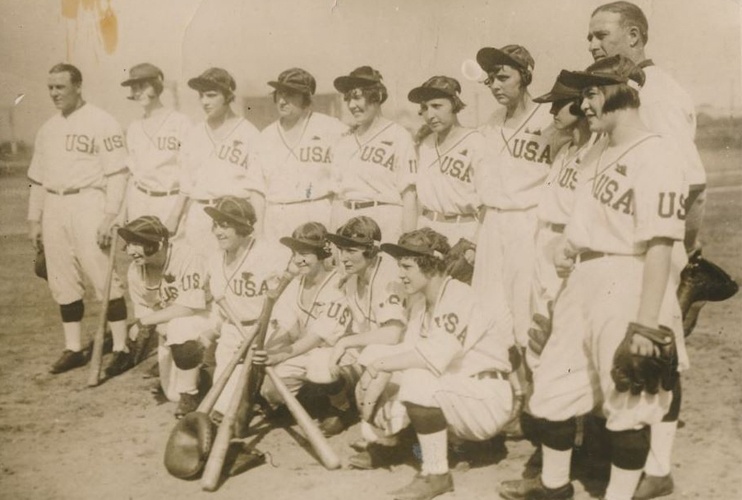
Despite ongoing Japanese colonial rule, baseball persisted. In 1922, a Major League All-Star team visited Korea. In 1925, the University of Chicago baseball team and an American women’s baseball team also came to play, keeping the spirit of international baseball alive. Another milestone came on May 23, 1923, when Heo Seong, fresh from studying in the U.S., founded the Joseon Baseball Umpires’ Association, Korea’s first organized umpiring body.
The real turning point came in 1925 with the construction of Dongdaemun Baseball Stadium (then called Gyeongseong Baseball Stadium, demolished in 2007). With a dedicated ballpark in place, numerous amateur clubs sprang up, mostly led by young Koreans.
After liberation from Japan in 1945, eight industrial-league teams were founded: the Financial Union Baseball Team, Joseon Transportation Baseball Team, Gyeongseong Electric Baseball Team, Joheung Bank Baseball Team, Namsun Electric Baseball Team, Joseon Electric Baseball Team, Samguk Coal Baseball Team, and Jungang Industrial Baseball Team. In the fall tournament of 1946, six more teams joined – such as the Post Office (Communications Bureau) Baseball Team, the Railway Bureau Baseball Team, and the Seoul City Bureau Baseball Team, further expanding the industrialz`-league ecosystem.
Even during the post–Korean War slump in baseball, change was in the air. In 1956, a Zainichi Korean student team visited from Japan, followed by a Japanese industrial-league team in 1961. These exchanges opened the door for Japanese players to come to Korea, and for Korean players to go to Japan’s professional leagues.
One famous case was Baek In-chun, a former industrial-league player who joined Japan’s Toei Flyers (now the Nippon-Ham Fighters). In the opposite direction, Kim Sung-keun came from Japan to continue his baseball career in Korea’s industrial league. Whereas industrial teams before the 1960s were mostly run by public institutions, Korea’s rapid industrialization in the 1960s–70s saw banks and private companies forming and operating their own corporate teams.
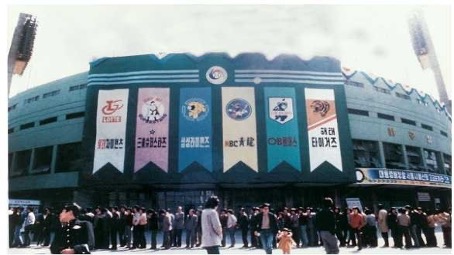
Industrial-league baseball reached its peak in 1975, the year the Lotte Giant (precursor to today’s Lotte Giants) was formed. These industrial teams didn’t compete in a regional-franchise-based league like modern pro teams; instead, they were company teams made up largely of employees, operating in a kind of workplace baseball system.It wasn’t until the spring of 1982 that professional baseball, the KBO League, officially began. While industrial-league baseball gradually faded into history after that, baseball as a sport became deeply woven into everyday Korean life.
Every Tuesday morning we will post an article from SABR’s award-winning books Nichibei Yakyu: Volumes I and II. Each will present a different chapter in the long history of US-Japan baseball relations.
We will begin with the first foreign baseball club to visit Japan: the St. Louis team from Hawaii which arrived in 1907 and played ten games.
Located on the pathway between the US mainland and Japan, Hawaii was important in the history of US-Japan baseball exchanges. The baseball ties between the two islands began in 1907, triggered by a rivalry between two Tokyo universities.
In June 1907, Suejiro Ito was dispatched to Hawaii by the Toyo Migration Company to survey the labor situation of the 50,000 Japanese immigrants working in the sugar and pineapple fields. There, he came across a rumor that Waseda University was negotiating with Stanford University for a baseball team tour of Japan. Ito, a graduate of Keio University, thought, “I wanted my alma mater to be the first to invite a foreign team to Japan. Before Waseda.”
For many years the college teams were the pinnacle of baseball in Japan. Right after the turn of the twentieth century, a group of teams in the Tokyo area, Waseda, Keio, Gakushuin University, First Higher School, and the Yokohama Cricket and Athletic Club (YC&AC: a sports club of foreign residents), battled to be the top team in Japan. The two universities, Waseda and Keio, developed a fierce rivalry. The Waseda-Keio match was called the Sokei-sen (the abbreviation for Waseda-Keio game), and it was watched with great interest by baseball fans across the country.
The history of the Sokei-sen began as follows. Keio University founded its official university baseball club in 1892. Waseda, on the other hand, had to wait for nine years, until 1901, for its baseball club to be bom. In 1903 the latecomer Waseda University sent a written challenge to Keio University. Following proper etiquette, Waseda asked in a humble manner for the more experienced Keio team to teach them baseball. The letter read, “Our team is still underperforming, and our players are still immature. We would be honored to have a lesson from you in the near future.” The first game of the Sokei-sen was played on November 21, 1903, with Keio beating Waseda, 11-9.
However, things changed in 1905. Waseda upset Keio, not on the field but in the international scene. Waseda carried out a monumental tour of North America, becoming the first Japanese team to visit the United States. The Waseda team, led by baseball director Isoo Abe, swung around the US West Coast, winning seven games and losing 19 against colleges, high schools, and semipros. Although the results were not encouraging, Waseda brought back to Japan the latest in baseball techniques and strategies, known as “scientific baseball,” including the hit-and-run, second-shortstop cooperative play, and pregame warmup, as well as equipment such as baseball shoes and gloves. Waseda willingly shared the new knowledge with other teams. With this, Waseda became the leaders of Japanese baseball.
After the US tour, the Waseda-Keio rivalry flared up even more. In the fall of 1906, the two teams planned a three-game series. After Keio won the first game, the school’s cheering group congregated outside the home of Waseda’s founder, Count Shigenobu Okuma, and shouted, “Banzai Keio!” The Waseda students viewed this as an extreme insult. At the second game, Waseda packed the stands with 1,200 cheerers, in clear violation of the agreement that limited the cheering groups to 250. The horde celebrated Waseda’s victory by marching to the former home of the late Keio founder Yukichi Fukuzawa (who had died in 1901) and yelling, “Banzai Waseda!” Fearing a riot at the third game, Keio president Eikichi Kamata and Isoo Abe of Waseda agreed to cancel the final match. The Sokei-sen would not be played for years to come.
The void left by the extinction of the Sokei-sen caused a sense of crisis in Japan’s top baseball world. A number of attempts were made to revive the Sokei- sen, but all failed. For example, at the end of 1906, the Tokyo Sports Press Club made a vain effort to mediate between the two schools. Another attempt was made in the summer of 1907 when Leroy E. McChesney, baseball captain of the YC&AC, proposed a formation of Japan’s first baseball league “Keihin Yakyu Domei,” but Keio refused to join. Waseda won the first and last championship, as the league lasted only one fall season.
Ito was annoyed that Waseda had been the first Japanese team to travel abroad so he wanted to make sure that Keio would be the first to invite a foreign team to Japan. Luckily enough for Ito’s plan, Kakugoro Inoue, a graduate of Keio University and member of Japan’s House of Representatives, stopped in Honolulu on the way back from a four-month tour of Europe and the United States. On August 22, Ito met with Inoue to ask for his cooperation for Keio to bring over a baseball team from Hawaii. Inoue gave his word (“I will give my all for our alma mater”) and left for Japan.
Ito selected the St. Louis College alumni team for the Japan tour, because it had recently won the 1907 championship of the Honolulu Baseball League. The Pacific Commercial Advertiser thought highly of the team: “The makeup of this team is nearly as strong as any aggregation which could be picked up in the Territory [of Hawaii].” The Hawaiian Star noted that a Japanese student who had seen St. Louis play believed that the team would be a very attractive drawing card if it came to Japan.
The captain of the St. Louis team, Pat Gleason, brimmed with confidence and excitement: “We will certainly show those Japs something that they do not know about baseball, and the chances are we will come back with another championship tacked on our pennant.” It was a once-in-a-lifetime chance for many of the St. Louis players who had never been away from the islands.
Continue to read the full article on the SABR website
This YouTube video contains a hodgepodge of colorized footage from various 1950s MLB tours. This 13 minutes, 30 second video has scenes from the 1949 San Fransisco Seals tour, the 1953 New York Giants tour, the 1955 New York Yankees tour, and the 1956 Brooklyn Dodgers tour, as well as some Tokyo Big Six University action. Keep your eyes open for some rare footage of Hawaiian superstar Wally Yonamine.
After throwing out the first pitch at Yankee Stadium prior to the game on July 29, 2025, Masanori Murakami, the first Japanese to play in the Major Leagues, held a press conference at the stadium. Now 81 years old, Murakami recalled his days with the San Francisco Giants in 1964 and 1965 and recounted his interactions with MLB stars.
David Adler of MLB.com covered the event and penned this fun article.
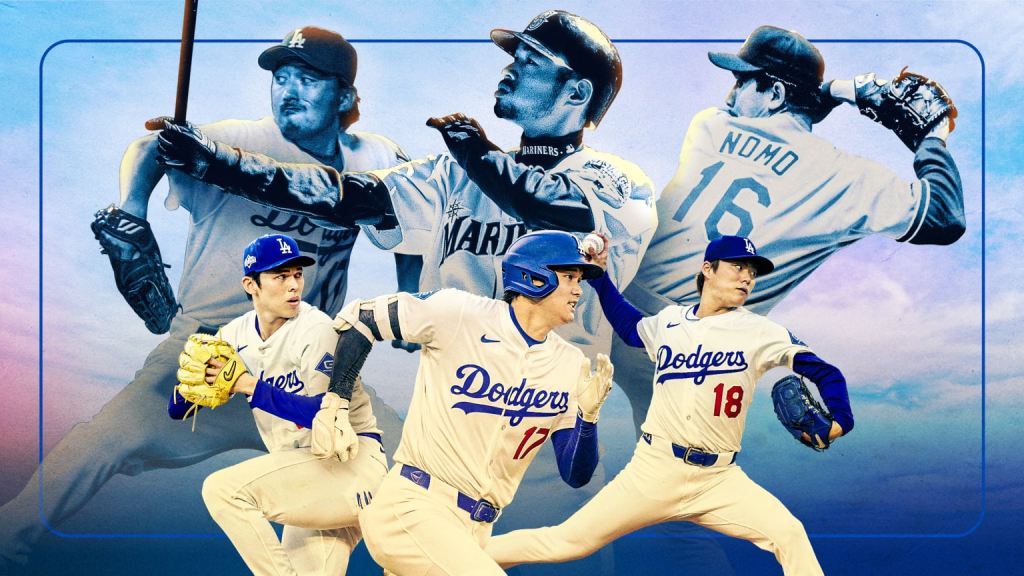
The Los Angeles Dodgers have just released a fantastic video on Youtube called The Story of Nomomania. With great game footage and exclusive interviews with Hideo Nomo, Peter O’Malley, Mike Piazza, and Don Nomura, I think fans will truly enjoy watching.
In 2022 Japanese baseball celebrated its official 150th birthday. Most officials and historians date the introduction of baseball to Japan to 1872 when American teacher Horace Wilson taught the game to his Japanese students. Recent research, however, has shown that the crew of the U.S.S. Colorado played against American residents of Yokohama in October 1871, and perhaps against Japanese residents of Osaka in January 1871[1] Now, a newspaper article shows that baseball was played as early as July 1869 in Kobe.
A few years ago, historian Aaron M. Cohen began sending me clippings about Japanese baseball from his files. Among the clippings was an article written by Harold S. Williams in 1976 discussing the origins of Japanese baseball. Williams was an Australian who lived in Kobe, Japan, from 1917 to his death in 1987, except for the war years. Williams wrote extensively about the early history of Kobe and Japanese culture.
In his article, “Shades of the Past: The Introduction of Baseball into Japan,” Williams argued “the names of those who actually first introduced the game into Japan is something which never will be known. Furthermore nobody knows, nobody can ever know, exactly where or precisely when the first game was played. Certainly it would have been a very modest and informal affair”[2] A sentence in the article caught my attention. He wrote: “in Kobe, on 4th August, 1869, about eighteen months after the port was opened, The Hiogo News reported: …one evening last week we saw as many as 7 or 8 men playing cricket and a still larger number playing baseball.”
Intrigued, I shared this with my colleague from Kawasaki, Japan, Yoichi Nagata. Yoichi went to the National Diet Library in Tokyo to track down the original source. The text of the article, appearing on page 434, is as follows.
“The exuberant spirit of youthful Kobe has been disporting itself for some days past a little out of the beaten track. This is a fact that, in spite of all kinds of adverse circumstances, the enthusiasm of a few cricketers has burst through the bonds that hitherto bound it, and bat, ball and stumps have been paraded through our streets. …The practice ground—no, it would not be right to call it by that name—the ball–splitting ground, or the ground upon which play has been carried on, has been the N.E. corner of the “sand patch” of a year ago—now well overgrown with weeds, grass, etc., etc. The best of this has been selected, the grass has been cut, and it makes a fair ground for practice. If anyone is skeptical on this point, he should join in an evening’s play, but novices should be fairly warned of the surrounding dangers, or the drains and stakes may cause a nasty tumble. The stakes are the corner posts of the different unsold lots, and those who have run against them say they are pretty firmly driven in. These are minor disadvantages, and the cricketeers say that a man never runs against them twice,—memory acts as a kindly warning, and one proof of their stability has hitherto been found quite sufficient.Truly, the “sand patch” has been used for purposes never dreamed of, and that it was apparently least fitted for. Two successful Race Meetings have been held on this non-elastic turf, and one evening last week we saw as many as 7 or 8 men playing cricket, and a still larger party playing baseball.We are pleased to hear it is the intention of the cricketeers to form a club, and wish them every success. Although there is sufficient talent here to form a good club, we fear the obstacles in the way of success are greater than are anticipated, unless the promoters are fortunate enough to secure a plot of ground at a very small expense, such, for instance, as an unused portion of a Race Course (should a Race Course be made here.) To buy or rent a piece of ground will entirely will be entirely beyond the means of such a club as can be formed here. A large piece of ground is required—say from 3,500 to 4,000 tsubos, and this at the lowest Japanese rental will amount to a very considerable figure yearly, to say nothing of the cost of preparing and keeping it in repair. The most feasible plan we have heard proposed is that permission should be obtained to use a certain portion of the N.E. corner of the Concession, level it, and cover it with mould, turf, &c. This scheme has few objections. The cost will be trifling, and in a few months, a decent practice grounds can be made. As the land is not likely to be required for some time, we think the Native Authorities would have very little objection to it being used for the purpose. We are aware the ground would be anything but perfect, and far from what a fine player would desire… .”
In March 2025 Yoichi and I returned to the Diet Library to search the Hiogo News for more early references to baseball. Unfortunately, we came up empty.
The “sand patch” mentioned in the Hiogo News article was not a particular location within Kobe but rather was a nickname for the entire area allocated for the foreign settlement. With a few exceptions, Japan was closed to foreigners from the beginning of the seventeenth century until American Admiral Matthew Perry entered Tokyo Bay with his Black Ships in 1853 and demanded access to the country for trade. The subsequent 1854 Convention of Kanagawa and 1858 Treaty of Amity and Commerce opened seven ports for trade and allowed for a foreign settlement, or Concession, at each port.
The Kobe Concession was opened on January 1, 1868. The land set aside for the foreign settlement was a barren sandy plain with poor drainage. Soon dubbed the “Sand Patch,” it became a swamp with knee deep quicksand during the rainy season and a dusty wasteland during the dry season. Early settlers began reclaiming the land and constructing trading houses and homes. By mid 1868, the area had been surveyed and laid out with staked plots ready for sale. Within the first year, the settlement’s small population (it contained about 200 Westerners in 1871) established two newspapers, social clubs, and on March 1, 1869, a horse racing club.
1868 map of Kobe showing the foreign concession on the right
An 1870 plan of the Kobe Concession shows the location of the staked plots for sale and the approximate location of the ground used for cricket and baseball in July 1869. As the article clearly states that the ground was in the northeast corner of the concession and contained stakes marking the unsold lots, we can place the area just to the west of modern Kobe City Hall between Kyomachisuji Street on the west, Hanadokeisen Street on the north, Higashimachi-Suji Street on the east, and Kitamachi Street on the south.
1870 Plan of Kobe’s Foreign Settlement Detail of the 1870 plan showing location of ball groundsLocation of ball grounds on modern map
Sadly, Williams is correct that we may never know the identities of these early ballplayers. A complete list of early Kobe settlers that includes nationalities does not seem to exist. Therefore, we cannot identify the American residences who may have played in this July 1869 game.
In September 1870 the foreign residents of Kobe established the Kobe Regatta & Athletic Club and in 1872 reached an agreement with the Japanese authorities to create a recreation ground on the land just east of the concession where future cricket and baseball games were held.
With the digitization of newspapers and other sources from Meiji Japan, I expect that future researchers will find more evidence of early baseball in Japan. But Williams is probably correct that we will never know the exact date and location of first baseball game in Japan.
[1] Nobby Ito’s research on the 1871 game in Osaka is summarized in Michael Clair’s August 17, 2024, article on MLB.com “Search for Japan’s baseball origins unearths new possibility.”
[2] Williams’s article was originally published in the 1976 Journal of the American Chamber of Commerce in Japan and was republished in Culture, Power & Politics in Treaty Port Japan, 1854-1899: Key Papers, Press and Contemporary Writings, edited by J.E. Hoare (Amsterdam University Press, 2028).
A 150-Year Journey Through the Game That Bridges Nations
Ichiro Suzuki’s induction into the National Baseball Hall of Fame on July 27, 2025 is a milestone worth celebrating—and an opportunity to reflect on the progress of U.S.–Japan baseball relations. From Ichiro’s enshrinement to the sandlot games played by Japanese school children during the 1870s, the history of baseball between the U.S. and Japan is a rich narrative of cultural exchange, perseverance, diplomacy, and innovation.
With that in mind, I thought it would be fun to use Ichiro’s 2025 achievement as a springboard to explore key mid-decade milestones (years ending in five) in the U.S.–Japan baseball journey. Let’s look at how the sport evolved from a foreign curiosity into a shared national passion—and ultimately, a bridge between two nations.
Let’s begin in the present and work our way backward.
NOTE: The full version of this article with all illustrations and links is available on Bill Staples, Jr’s blog, International Pastime.
2025 Ichiro Suzuki was inducted into the National Baseball Hall of Fame in 2025, receiving 393 out of 394 votes (99.75%) in his first year on the ballot. This made him the first Japanese-born position player elected to Cooperstown, though he fell one vote shy of unanimous selection—a distinction held by Mariano Rivera in 2019. In anticipation of his enshrinement, the Hall of Fame created a new exhibit titled Yakyu | Baseball: The Transpacific Exchange of the Game. The exhibit will open in July 2025 and remain on display for at least five years. Learn more at: https://baseballhall.org/yakyu.
2015 Ichiro, now with the Miami Marlins, begins symbolically “passing the torch” to Shohei Ohtani, who is in the second year of his professional career with the Nippon Ham Fighters in Japan. The 2015 season marks Ichiro’s first appearance as a pitcher, setting the stage for a rare and unexpected future Hall of Fame connection between Ichiro and Ohtani—two Japanese-born players who both pitched and hit a grand slam during their MLB careers. Ichiro hit just one grand slam, while Ohtani has hit three (as of this post), and intriguingly, all of them against the Tampa Bay Rays.
2005 Tadahito Iguchi becomes the first Japanese-born player to compete in and win a World Series, contributing to the Chicago White Sox’s historic run. (Note: Hideki Irabu received a World Series ring as a member of the 1998 and 1998 New York Yankees but did not play in any postseason games). Check out Iguchi’s SABR Bio.
1995 Hideo Nomo joins the Los Angeles Dodgers, earning Rookie of the Year, an all-star game start, and igniting “Nomomania.” His success breaks open the modern pipeline between NPB and MLB and reshapes the perception of Japanese players on the global stage. Check out Nomo’s SABR Bio.
1985 Pete Rose breaks Ty Cobb’s all-time hit record using a Mizuno bat. After visiting Japan in 1978, Rose teamed up with sports agent Cappy Harada to sign a sponsorship deal with Mizuno in 1980. Rose’s partnership with Mizuno marked a significant moment in sports history, symbolizing Japan’s growing influence in global sports and helping to establish Japanese manufacturers as credible names in American dugouts and MLB clubhouses.
1975 The Chunichi Dragons, led by manager Wally Yonamine, and the Yomiuri Giants, led by manager Shigeo Nagashima, conduct spring training in Florida. Meanwhile, American-born manager Joe Lutz and Hall of Fame pitcher Warren Spahn contribute to Japanese baseball by joining the Hiroshima Carp. Lutz becomes the second U.S.-born manager in NPB history after WWII, following Hawaii-native Yonamine. However, Lutz’s time with the Carp is short-lived, as he steps down just weeks into the new season. Spahn continues his role with the Carp and states that he prefers working in Japan compared to the U.S.
Joe Lutz, Hiroshima Carp 1975
1965 Masanori Murakami finishes his rookie season with the San Francisco Giants after debuting in 1964, becoming the first Japanese-born player in MLB. His success inspires generations of Japanese players to dream of American stardom.
Masanori Murakami
1955 After a season in the minor leagues and facing lingering post–World War II anti-Japanese sentiment, California native Satoshi “Fibber” Hirayama chose to continue his professional baseball career in Japan, signing with the Hiroshima Carp. That same season, the New York Yankees toured Japan, and afterward, former Japanese pitching star and Hawai‘i native Bozo Wakabayashi was hired as a scout for the team. However, Yankees manager Casey Stengel resisted the idea of signing Japanese players, citing concerns about adding new talent to an already talent-heavy roster.
Fibber Hirayama with Casey Stengel, 1955
1945 In the aftermath of World War II, baseball became a source of healing and pride for Japanese Americans unjustly incarcerated behind barbed wire. At the Gila River camp in Arizona, the Butte High Eagles stunned the defending state champions, the Tucson High Badgers, with an 11–10 extra-innings victory. Coach Kenichi Zenimura called it “the greatest game ever played at Gila.” After graduating, Eagles second baseman Kenso Zenimura relocated to Chicago, where he attended the East-West All-Star Game at Comiskey Park and watched Kansas City Monarchs standout Jackie Robinson during his lone season in the Negro Leagues.
Kenichi Zenimura at Gila River in 1945
1935 The founding of the Tokyo Giants paved the way for the launch of the Japanese Professional Baseball League in 1936. During the team’s groundbreaking U.S. tour, four players — pitchers Victor Starffin and Eiji Sawamura, infielder Takeo Tabe, and outfielder Jimmy Horio — attracted interest from American professional clubs and may have received contract offers. However, the 1924 Immigration Act rendered Japanese-born players ineligible to sign with U.S. teams. Only one player—Hawaii-born Horio—was eligible under U.S. law. He signed with the Sacramento Solons of the Pacific Coast League for the 1935 season but returned to Japan the following year to join the Hankyu Braves in the new professional league.
Jimmy Horio with Sacramento in 1935
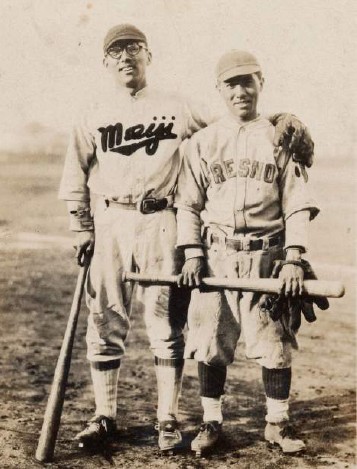
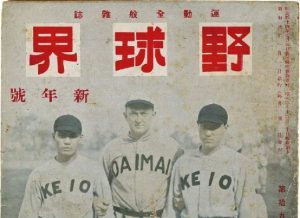
1925 Sponsored by the Osaka Mainichi newspaper, a semipro team called Daimai was formed and sent on tour in the United States, where they faced American universities and semi-pro clubs, including the Japanese American Fresno Athletic Club (FAC). In early September, the FAC played a doubleheader at White Sox Park in Los Angeles—the first game against Daimai, and the second against the L.A. White Sox, the premier Negro Leagues team in Southern California. Behind the strong pitching of Kenso Nushida, FAC edged out the White Sox 5–4, setting the stage for rematches in 1926 and parallel tours of Japan in 1927. White Sox manager Lon Goodwin rebranded his team as the Philadelphia Royal Giants for the Japan tour, ushering in a new era of international baseball exchange.
Catcher O’Neal Pullen and pitcher Jay Johnson of the Philadelphia Royal Giants in 1927. Negro Leagues Baseball Museum
1915 The Hawaiian Travelers, a barnstorming team made up of Chinese and Japanese Americans from the Hawaiian Territories, toured the U.S. mainland in the early 20th century. Two Japanese players, Jimmy Moriyama and Andy Yamashiro, joined the team under assumed Chinese identities, playing as “Chin” and “Yim.” The Travelers impressed fans and opponents alike with victories over top Negro League clubs such as the Lincoln Giants and Brooklyn Royal Giants—both teams now designated as major league caliber by SABR. After a return tour, Yamashiro, still using the name Andy Yim, signed with the Gettysburg Ponies of the Class D Blue Ridge League in 1917, quietly becoming the first Japanese American to join an integrated professional team—though history recorded him only under his adopted identity. Meanwhile, an Osaka newspaper, Asahi Shinbun, sponsors a national tournament for high school teams that eventually becomes one of the most popular sporting events in Japan (known today as the Koshien Tournament).
The Hawaiian Travelers in 1914
1905 The 1905 Waseda University baseball tour was the first time a Japanese college team traveled to the United States to compete, playing 26 games along the West Coast and finishing with a record of 7 wins and 19 losses. The team was led by Abe Isō, a Waseda professor, Unitarian minister, and politician who saw baseball as a powerful tool for international exchange and cultural diplomacy. Although Waseda struggled on the field, the tour was a landmark moment in U.S.–Japan relations, helping to lay the groundwork for future athletic and cultural connections between the two nations. Meanwhile, John McGraw of the New York Giants gave a tryout to a Japanese outfielder known as “Sugimoto.” However, shortly after Sugimoto’s arrival at spring training, discussions in the press about enforcing the color line surface. In response, Sugimoto chose to leave the tryout of his own accord.
1905 Waseda University Baseball
1895 Dunham White Stevens, the American Secretary of the Japanese Legation in Washington, was described as “a baseball crank” and persuaded Japanese Minister Shinichiro Kurino to join him at several games. This gesture reflected one of the earliest examples of diplomatic engagement through sport. Meanwhile, Japanese American ballplayers were competing in amateur leagues in Chicago, and by 1897, a promising outfielder—identified in the press only as the cousin of wrestler Sorikichi Matsuda—was reportedly scouted by Patsy Tebeau, manager of the major league Cleveland Spiders.
1887 Allen & Ginter trading card of Sorakichi Matsuda
1885 Sankichi Akamoto, a young Japanese acrobat and baseball enthusiast, played the game in America, blending cultural performance with sport. His presence foreshadowed the dual role many Japanese athletes would later assume—as both competitors and cultural ambassadors. Around the same time, at Wesleyan University in Middletown, Connecticut, Japanese student Aisuke Kabayama competed on the school’s tennis and baseball clubs, eventually earning a spot on the varsity baseball team the following season. His participation is believed to be the earliest recorded instance of a Japanese-born player in U.S. college baseball.
The Akimoto Japanese Troupe, circa. 1885. Robert Meyers Collection
1875 The seeds of Japanese baseball began to take root in the early 1870s, as people of Japanese ancestry played the game on both sides of the Pacific. In 1873, Albert G. Bates, an American teacher in Tokyo, organized what’s considered the first formal school-level baseball game in Japan. According to Japanese sports historian Ikuo Abe, the game occurred on the grounds of the Zojiji Temple in Tokyo (image below). Tragically, in early 1875, Bates died at just 20 years old from accidental carbon monoxide poisoning while visiting a public bathhouse.
“View of Zōjōji Temple at Shiba,” by Yorozuya Kichibei (1790-1848), Minneapolis Institute of Art