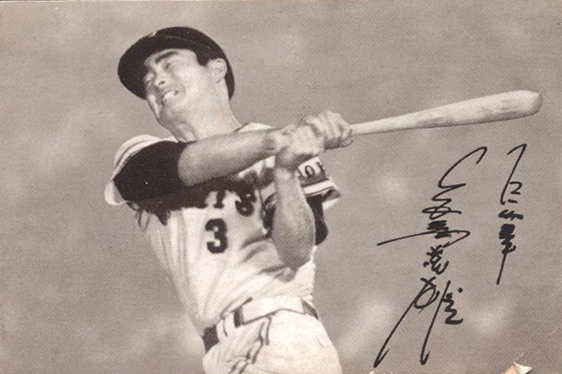
Tag: Shigeo Nagashima

  • Japan’s Favorite Players: No. 3, Shigeo Nagashima

    Japan’s Favorite Players: No. 3, Shigeo Nagashima

    by Thomas Love Seagull

    A recent poll for a TV special saw more than 50,000 people in Japan vote for their favorite retired baseball players. 20 players emerged from a pool of 9,000. Yes, they could only vote for players who are no longer active, so you won’t see Shohei Ohtani or other current stars on this list. Which is probably smart because I’m sure Ohtani would win by default. There are, however, players who were beloved but not necessarily brilliant, and foreign stars who found success after coming to NPB. Unsurprisingly, the list leans heavily towards the past 30 years, with a few legends thrown in for good measure.

    Over the next few weeks, I’ll be profiling each of these players. Some of these players I know only a little about, so this will be as much a journey for me as, hopefully, it will be for you. It’ll be a mix of history, stats, and whatever interesting stories I can dig up.

    For now, have a look at the list below and see how the public ranked them. I’ve included the years they played in NPB in parentheses.

    20. Alex Ramirez (2001-2013); 19. Yoshinobu Takahashi (1998-2015); 18. Warren Cromartie (1984-1990), 17. Takashi Toritani (2004-2021); 16. Suguru Egawa (1979-1987); 15. Katsuya Nomura (1954-1980); 14. Tatsunori Hara (1981-1995); 13. Kazuhiro Kiyohara (1985-2008); 12. Masayuki Kakefu (1974-1988); 11. Masumi Kuwata (1986-2006); 10. Atsuya Furuta (1990-2007); 9. Randy Bass (1983-1988); 8. Daisuke Matsuzaka (1999-2006, 2015-2016, 2018-2019, 2021); 7. Tsuyoshi Shinjo (1991-2000, 2004-2006); 6. Hiromitsu Ochiai (1979-1998); 5. Hideo Nomo (1990-1994); 4. Hideki Matsui (1993-2002); 3. Shigeo Nagashima (1958-1974); 2. Sadaharu Oh (1958-1980); 1. Ichiro Suzuki (1992-2000).

    The man who became more than the sport itself.

    The date is June 25, 1959. The place is Korakuen Stadium in Tokyo, and for the first time in the history of professional baseball in Japan, the Emperor is watching. Emperor Hirohito and Empress Nagako have come to see the Giants play the Tigers, and the country has paused. The game means something different now. The players have walked onto the field and into a kind of myth.

    The atmosphere inside the stadium is unlike any baseball game before or since. Noisemakers have been banned. The drums are silent. The crowd sits in something closer to the hush of a concert hall than the roar of a ballpark. The Giants’ manager purified himself twice that morning and barely spoke all day. Everyone understands that the normal rules of this sport are suspended for the evening.

    In the owner’s box, Matsutaro Shoriki watches with particular satisfaction. He is the man who made this night happen, who lobbied the imperial household for months, outmaneuvering the Pacific League, which had its own designs on an imperial game, steering the Emperor toward a Giants-Tigers matchup specifically. He has arranged everything. He sits near the Emperor and watches his team fall behind, then tie, then fall behind again, the score knotting itself back up as if the game understands its own significance and refuses to end undramatically. 

    By the ninth inning, it’s 4-4. The Giants are at home, which means the bottom of the ninth belongs to them. The Emperor is scheduled to depart at 9:15. It is past nine o’clock. The first batter due up is a twenty-three-year-old third baseman in only his second professional season, a young man from Chiba Prefecture with a swing like a screen door blowing open in a storm.

    Shigeo Nagashima steps to the plate.

    Shoriki leans over to the man sitting beside him and whispers: “Nagashima looks like he might hit a home run. Let’s watch.”

    The pitcher for the Tigers is Minoru Murayama, a rookie, a young man who will go on to become one of the finest pitchers in Japanese baseball history, who will strike out two thousand batters before he is done, who will be remembered as one of the greats. At this particular moment, he is twenty-one years old and standing sixty feet from the greatest stage his sport has ever offered him.

    Before we get to what happened, there is something you should know about the bat.

    Nagashima had a bat he preferred: a slim, light Al Simmons model, built for a hitter who wanted to make contact. He did not use it that day. That morning he had put it aside and picked up something heavier: a Ralph Kiner model, built for a man who hit 54 home runs in a single major league season. Nagashima had never used it in a game. He broke it out for the Emperor.

    This is who Shigeo Nagashima was. He did not come to that game hoping something dramatic would happen. He came prepared for it.

    The count is even at 2-2 in the ninth. Murayama’s fifth pitch, a fastball up and in. Nagashima’s bat flashed and the ball sailed toward the left-field foul pole, curling just inside it, and landed in the upper deck. A sayonara home run—a walk-off, in the American parlance—in front of the Emperor of Japan, in the game that more than any other single moment announced to the Japanese public that professional baseball was no longer minor, no longer secondary, no longer a sport for weekday afternoons. It was the national pastime now. It was now the thing Japan watched.

    Shoriki—the man who had engineered the entire evening, who had whispered his prediction to his neighbor thirty seconds earlier—stood there looking like he couldn’t believe it.

    As Nagashima rounded third base, he looked up. The Emperor was leaning forward out of his seat. His Majesty had been scheduled to depart at 9:15. It was 9:12.

    Murayama spent the rest of his life insisting the ball was foul. “That was absolutely a foul ball,” he maintained for decades, with the particular conviction of a man who has decided that history got something wrong and intends to correct it. When he struck out Nagashima for his 1,500th career strikeout, years later, he said: “Now I’ve repaid the debt from the Emperor’s Game.” He went to his grave still arguing. In 2023, 64 years after the home run, NHK colorized the original footage using artificial intelligence, and the ball appeared on screen in crisp, undeniable clarity: fair, passing to the right of the foul pole. Murayama had been wrong for six decades. He was not alive to hear it*.

    *This game sparked the famous rivalry between Murayama and Nagashima. Murayama also recorded his 200th strikeout against Nagashima. His fixation on Nagashima even appeared in his personal life: when he noticed that the last four digits of his home telephone number, “3279,” could be read as a pun meaning “crying over 3” (Nagashima’s jersey number), he pushed to have it changed.

    Years later, Nagashima reflected that the game had changed everything, not just for him personally, but for the sport itself. Professional baseball, he said, had until that night been something minor in the lives of Japanese people. After that, baseball became everything.

    That is about as modest as a man can be while describing the moment he changed his country. He does not mention the bat.

    That same night, after the stadium had emptied and the Emperor had gone home and the newspapers were already setting their front pages, Shigeo Nagashima almost certainly went home and swung a bat in the dark.

    No, this is not a metaphor. He had built a practice room in his house specifically for this purpose, and the ritual was absolute: he did not sleep until the swing felt right. Some nights that took fifteen minutes. Other nights he was still in there when the sky began to lighten. It did not matter whether the Giants had won or lost, whether he had gone four-for-four or oh-for-four. On game days, especially, he would skip his bath at the stadium entirely, unwilling to let the physical memory of the day’s at-bats fade from his body, and come home still in his game-day sweat to stand alone in that room and swing.

    He turned the lights off. Darkness was not an obstacle; it was the point. In the dark, there was only the sound of the bat.

    “When the bat speed is too fast,” he explained once, “it means my body is opening up and my contact point has drifted too far back. The sound tells me everything.” A short, sharp crack at the right moment in the swing meant the mechanics were correct. He would not stop until he heard that sound.

    This is the man Japan called a natural. The man they called effortless. The man they held up, for decades, as the contrast to his teammate Sadaharu Oh. “The effort of Oh, the genius of Nagashima,” went the saying, as though genius and effort were opposites, as though one person could not contain both. Nagashima heard that characterization throughout his career and seems to have done nothing to correct it. He had, by all accounts, a strong aesthetic preference for making difficulty look easy, for concealing the machinery behind the performance. If people believed the swing was God-given, he was not going to argue with them.

    But the sweat-soaked work gloves told a different story.

    He was born on February 20, 1936, in Usui, a small town in Chiba Prefecture near the shores of Lake Inba. 1936 is also the year professional baseball in Japan began, a coincidence that feels less like coincidence and more like something out of mythology. His father was a local government official; his mother was, by all accounts, a woman of formidable will. She sewed his first baseball glove herself. When there were no real baseballs, she made one from marbles and hard cloth. His first bat was a length of green bamboo, split and shaped by hand.

    He grew up idolizing Fumio Fujimura, the great Osaka Tigers slugger, and covered the walls of his room with Fujimura’s photographs which made him, as a boy in the Tokyo suburbs, an unusual Hanshin fan. He would imitate Fujimura’s long, sweeping swing, the one they called the “clothesline pole.” In high school he was not particularly well known. He moved from shortstop to third base after committing four errors in a single game at a practice match; his coach converted him mid-game and Nagashima immediately looked like he had been born to play third.

    He attracted serious attention for the first time with one swing: a rocket at a regional tournament that the newspaper of the day estimated at three hundred and fifty feet, a line drive that hit the grass beyond the warning track and stayed low. That home run was seen by a scout, who told a journalist, who told another scout, and the chain of conversations that followed eventually led to a recommendation that Nagashima visit Rikkyo University and speak with its baseball coach, a man named Kuninobu Sunaoshi.

    What happened at Rikkyo would set the template for everything that followed. Sunaoshi saw Nagashima’s talent immediately and subjected him to what was later recalled as special-treatment brutal training: running thirty minutes each day after team practice to arrive at the coach’s house, where a bat twice the normal weight was waiting. One thousand swings a day. There were no batting gloves in that era, so Nagashima wore cotton work gloves, and the work gloves soaked through with blood from his burst blisters, and when they did, he rinsed them out and put them back on and kept swinging.

    The model for those swings was a sequence of photographs that Sunaoshi had obtained of Joe DiMaggio. They were frame-by-frame stills of DiMaggio’s mechanics, showing a lower-body-led swing that had not yet been theorized or systematized in Japan. Nagashima studied those photographs obsessively. He used American-made Louisville Slugger bats, imported through a trading company, for nearly his entire professional career. He won two batting titles in the Tokyo Big6 University League. He led Japan’s national team to the Asian Championship in 1955. Every team in Japan wanted him, and the Nankai Hawks offered more money than the Yomiuri Giants. But his mother asked him to stay in Tokyo, and that was that.

    His rookie season, 1958, was extraordinary.

    He won the home run title and the RBI title. He was the first rookie in Japanese baseball history to do both simultaneously. His 92 RBI were a Central League rookie record. His 34 doubles were a Central League rookie record that stood for seven decades. His 153 hits were a Central League rookie record until 2019. He played every inning of every game, the first player in Central League history to accomplish that. He stole 37 bases while batting cleanup.

    And in that first season, there was the debut against Masaichi Kaneda.

    Kaneda was the greatest pitcher in Japanese baseball, a lefthander of intimidating velocity and contempt, and he had heard a radio analyst praise Nagashima so effusively before the season that he had spent weeks in special preparation, timing his arm to peak precisely for their first meeting. On April 5, 1958, Nagashima came to the plate four times and struck out four times, each swing a full-commitment lunge that accomplished nothing except to make an enormous sound and send his helmet flying. The crowd roared at the strikeouts.

    Nagashima came back the next year and hit a home run off Kaneda on Opening Day, and their career duel ended with Nagashima hitting .313 against Kaneda with 18 home runs.

    Here is something worth sitting with: Shigeo Nagashima was not supposed to be the most popular player in Japanese baseball history. The logic of statistics would have assigned that distinction elsewhere. His teammate Sadaharu Oh hit 868 home runs, the most in professional baseball history, on earth, ever. Oh won fifteen consecutive home run titles. By almost any measure you choose to apply, Oh’s numbers were more dominant, his peak more extreme, his production more consistent.

    Even in America, Sadaharu Oh is well-known. Nagashima is unheard of.

    And yet.

    Ask anyone in Japan who grew up watching them both, and the answer comes back the same way, with a particular warmth that data cannot explain. Nagashima. Always Nagashima.

    There is a debate to be had here, and it is not entirely comfortable, because part of the explanation is simply that Nagashima was ethnically Japanese and Oh was the son of a Taiwanese father, and Japan in the 1960s was not a country that offered its full embrace to those it considered outsiders. That is a real part of the story. It would be dishonest to leave it out.

    But it’s not the whole story. Consider the batting order. During the sixteen seasons they played together, Oh batted third and Nagashima fourth in 1,061 games, the most common arrangement. And 146 times, opposing pitchers intentionally walked Oh in order to face Nagashima instead. Think about that. The man with 868 career home runs was being bypassed so the pitcher could take his chances with the cleanup hitter. Oh never won a Japan Series MVP award, while Nagashima won four, and Oh once addressed this with characteristic grace: “The pressure I put on opponents was enormous. I think I fulfilled my role. I just never got the car.” 

    He meant the car that came with the MVP prize. He was smiling when he said it.

    The pair won 11 Japan Series titles together as teammates, including 9 in a row from 1965-1973. The dynasty became known as V9.

    The statistics bear out what the pitchers feared. Batting fourth, Nagashima hit .314 with 314 home runs across 1,460 games. Batting third, the numbers fell to .291 with 112. The cleanup spot summoned something from him that no other position in the order could. Manager Tetsuharu Kawakami understood this intuitively, that the home run king could fulfill his role by drawing walks and setting the table, while the burning man needed to bat fourth, needed the runners on base, needed the stadium holding its breath. The V9 Giants had two cleanup hitters. Kawakami was wise enough to know which one should wear the title.

    The people who loved Nagashima most were not loving him out of prejudice. They were loving him for something that statistics have never been built to capture.

    Watch the way he played third base. He stood a step and a half deeper than most third basemen, which let him cover extraordinary ground going to his right — he was famous for ranging into the shortstop’s territory — and when he threw, his arm followed through with a flourish, a little wave of the hand, a gesture borrowed from kabuki, the Japanese theatrical tradition in which every movement is a declaration. His throws, according to Oh himself, were the easiest in the league to catch: perfect rotation, perfect carry, a baseball thrown the way a textbook would throw it if a textbook could throw. And then the little wave.

    He calculated where his helmet would land when he swung and missed, so that it would fly off at the right angle to thrill the crowd. He thought about that. He worked on it. He believed, deeply and professionally, that even a strikeout was a performance he owed the fans.

    Katsuya Nomura, the great catcher who spent his career crouching behind home plate and whispering doubt into opposing batters’ ears, attempted his trademark psychological destabilization on Nagashima once, pointing out a supposed flaw in his batting stance. Nagashima stopped, took a practice swing, and hit the next pitch for a home run. As he crossed home plate, he turned to Nomura and said, “Thank you for the tip.”

    The most authoritative summary of what made Nagashima different came from Isao Harimoto, the man who holds the all-time NPB hits record. Harimoto looked at the career statistics—.305 average, 2,471 hits, 444 home runs, 190 stolen bases—and noted that none of them were records, and that his own numbers were higher in most categories. Then he said this: Oh could hit home runs but was not fast. Harimoto himself produced hits in great quantities but his right hand was damaged and his defense suffered for it. “But Nagashima had no weaknesses,” Harimoto wrote. “He had everything.” If you want to picture him, Harimoto suggested, think of Ichiro, just one size larger, and able to hit home runs, too.

    Harimoto also noted something about Nagashima’s character that several of his contemporaries observed independently: he never spoke badly of anyone. In the normal social life of a professional baseball clubhouse, when conversation drifted toward gossip about other players, Nagashima simply did not engage. “In one word,” Harimoto wrote, “he was like the sun. Always bright. That’s why he could draw fans to him.” Oh and Harimoto, between them, held records that Nagashima could not match. Neither of them, they both understood, could match what he was.

    Over seventeen seasons, Nagashima collected 2,471 hits and 444 home runs and won six batting titles and five Most Valuable Player awards and became the only player in the history of Nippon Professional Baseball to be named to the Best Nine in every single season he played. Not most seasons. Every season. All seventeen. He hit .305 for his career; .343 in the Japan Series; .313 in All-Star Games. He is the only player in NPB history to hit .300 in all three categories simultaneously.

    He was intentionally walked 205 times, the most ever by a right-handed batter in Central League history. In his first season alone, opponents walked him intentionally six games in a row. There is a moment from 1968 that captures what it meant to be pitched around in that era: in a game against the Dragons, Nagashima put down his bat after two consecutive intentional-ball pitches, walked to the plate and stood in the batter’s box with his bare hands raised. No bat. The pitcher threw two more balls and walked him anyway.

    His four Japan Series MVP awards are the most in history. His career totals in the Japan Series—91 hits, 25 home runs, 66 RBI, 184 total bases—are all-time records.

    The 1974 season had been the first in which he looked mortal. It would be his last. His average fell to .244, the worst of his career. His perfectly struck balls, which for sixteen years had found gaps as if directed by some internal compass, now flew straight at fielders. Nagashima noticed and made it into a small joke. “My hits have become honest,” he said, using a Japanese word, sunao, that means obedient, straightforward, no longer tricky. He smiled when he said it. That was the whole of his public complaint.

    His retirement had almost happened on October 13th. The Giants were scheduled to play a Chunichi doubleheader at Korakuen, and the plan was set: Nagashima would play, the ceremony would follow, and seventeen seasons of number 3 would come to an end. But it rained all day, and the games were postponed, and that night the Giants’ public relations director stood outside looking up at the sky, praying for it to clear.

    October 14th came in clear and cool, a bright autumn Monday. The Giants took the field for game one of the doubleheader against the Chunichi Dragons, the same Dragons who had clinched the pennant two days earlier, ending the V9 and completing one of the most historic achievements in Japanese baseball. The next morning’s newspapers barely mentioned it. The front pages were about Nagashima. Most of Chunichi’s stars were in Nagoya for the championship parade. Nagashima batted third and played third, and in his second at-bat he hit his 444th career home run, added two more hits, and finished with the 186th multi-hit game of his career. The Giants won 7-4.

    After the final out, both teams went to their dugouts. The field emptied. For a moment, Korakuen Stadium held forty thousand people in silence.

    Then Nagashima came back out.

    This was not in the script. The team had asked him not to do it but he had refused. “The ceremony won’t take me close to the outfield,” he said. “I want to greet my fans.” So he walked out of the first-base dugout and turned toward right field, alone on the grass, and began to move along the warning track. The stands erupted. People were screaming his name, and crying, and screaming his name again.

    He was smiling. And then, somewhere along the track, his feet stopped.

    He reached into his pocket and took out a small towel and brought it to his face. His shoulders moved. The crowd, which had been roaring, went quiet to let a man cry. And then they were crying too, all of them, the stadium full of people weeping in the autumn afternoon with Shigeo Nagashima standing alone on the warning track with a towel over his face.

    He played the second game. He batted fourth and played third. His last hit was a single to center field. His last at-bat was a double-play grounder to short.

    The Giants won 10-0. By the time the ceremony began, the stadium lights had taken over for the sun, and when the moment arrived, the lights around the field were switched off one by one until a single spotlight remained, cutting through the October dark, finding the man in the number 3 jersey. 


    The scoreboard glowed: MR. G, GLORIOUS NUMBER 3.

    Nagashima raised his voice and said: “I retire here today but our Giants will live forever.”

    In the stadium and in living rooms across Japan, people wept again.

    He later wrote: “I was called ‘The Burning Man’ by my fans. But nothing keeps burning forever. The more intensely something burns, the bigger the sense of loss after it is extinguished.”

    He was known by many other names: Mr. Giants, Golden Boy, Mr. Professional Baseball, and even just Mr.

    He went on to manage the Giants twice, winning two more Japan Series championships.

    The second championship came in 2000, when Nagashima’s Giants faced Oh’s Hawks in the Japan Series, the two old teammates meeting as opposing managers to close out the century. For fans who had grown up watching them both, the outcome was almost beside the point. The confrontation itself was the thing. The sport had begun in 1936, the year Nagashima was born, and now here were its two greatest players, grey-haired in dugouts on opposite sides of the field, finishing the century together the way they had filled it.

    Here is what I keep coming back to: the swing room, the light offs, and the sound.

    There are players who practice in secret because they are ashamed of their weaknesses. Nagashima practiced in secret because he was protective of his image, yes, but also because the dark was simply where the work got done. In the dark there was no audience to perform for, no helmet to angle correctly, no kabuki flourish to calibrate. There was only the question of whether the swing was right, and the sound that answered it, and the willingness to keep going until the answer was yes.

    Japan called him a natural. The genius, not the worker. The flame, not the fuel. And he let them, because that was part of the performance too, because he understood that what the country needed from him was not evidence of struggle but evidence that excellence was possible, that a young man from Chiba could step to the plate in front of the Emperor and hit the ball over the fence and make the whole nation feel, for a moment, that it was capable of anything.

    He played every season in the Best Nine. He batted .514 in games attended by the Imperial Family. He thanked Nomura for the strikeout tip. He swung in the dark until the sound was right, and then he went to bed, and the next day he made it look easy.

    Some players have careers. Nagashima had a whole country.

    Thomas Love Seagull’s work can be found on his Substack Baseball in Japan
    https://thomasloveseagull.substack.com

  • Crossroads: The 1958 St. Louis Cardinals Tour of Japan

    Crossroads: The 1958 St. Louis Cardinals Tour of Japan

    by Adam Berenbak

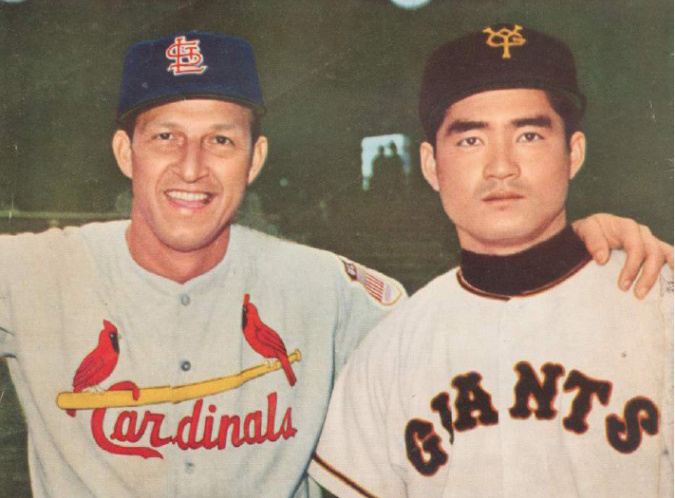
    Every Monday morning we will post an article from SABR’s award-winning books Nichibei Yakyu: Volumes I and II. Each will present a different chapter in the long history of US-Japan baseball relations. This week Adam Berenbak focuses on Stan Musial, Shigeo Nagashima, and the Cardinals 1958 visit to Japan.

    Game Seven of the 1958 Japan Series featured a winner-take-all finish to a classic contest between two storied franchises.

    In the bottom of the ninth, with a six-run lead, 21-year-old Kazuhisa Inao stared down at Shigeo Nagashima, ready to wrap up one the most famous pitching feats in Japan Series history. He had earned the win in the previous three games for the Nishitetsu Lions and was prepared to win his fourth in a row, and with it the championship. With such a comfortable lead, Inao had little to worry about, even though he faced Nagashima, the star rookie of the Yomiuri Giants. The Rookie of the Year hit a high fly ball deep into Korakuen Stadium that the Lions center fielder couldn’t make a play on. Nagashima displayed his blazing speed and sailed around the bases for an inside-the-park home run. Inao then finished off the remaining Giants and took the crown.

    Though Nagashima’s home run had little effect on the outcome of the game, the matchup represented the best of baseball in Japan and the future of the sport. At the same moment, roughly 680 miles (1,100 kilometers) away in Seoul, the St. Louis Cardinals were playing a Korean all-star team in preparation for a 16-game tour against Japan’s best. A few days later, they would face an all-star team built around Nagashima and Inao, assembled by tour sponsor Mainichi Shimbun and tour organizer Yetsuo Higa, to showcase the young talent that would be the future of Japanese baseball.

    THE TOUR STARTS

    To quote Jim Brosnan, who was splitting duties by pitching for the Cardinals and covering the tour for the St. Louis Post Dispatch, “From one of the longest runways in the world, San Francisco, we took off on the longest trip of this or any other year. By sunrise on the tenth we gained four hours changing time zones and explaining to the stomach wha’ hoppen [sic] in our 28-hour day.” The tour began in earnest the next day in front of a mere 3,000 fans at the Maui County Fairgrounds in Kahului, on the island of Maui. They faced a team that featured Bob Turley, Lew Burdette, and Eddie Mathews bolstering a collection of local ballplayers that Higa put together.

    Two years before, Commissioner Ford Frick had helped arrange for the two major Japanese papers, Yomiuri Shimbun and Mainichi Shimbun, to host US tours, after each paper had tried to host teams in 1955. The solution was to alternate responsibility every other year, beginning with the 1956 Dodgers tour. Yomiuri had hosted first and it was no surprise that the Giants had played a big role. This time Higa, a Nisei businessman representing Mainichi, had arranged the tour to be unlike previous tours, pitting a Japanese all-star team against the Cardinals.

    Although formidable, St. Louis was a team in transition. The Cardinals in 1958 had finished fifth in the National League. The only real highlights of the season were Stan Musial’s 3,000th hit and the debut of Curt Flood, who eventually helped the team to three pennants. Most of the team’s regulars made the trip, including Musial, Don Blasingame, Ken Boyer, Vinegar Bend Mizell, Wally Moon, Hal Smith, and Gene Green. However, last-minute substitutions, even after the vaccination shots had been administered, gave rise to a team that much more resembled the 1959 Cardinals. Gene Freese, Billy Muffett, and Hobie Landrith had already received their shots and clearances when they received trade notices just days before the team left. The 1958 coaching staff was set to go, too, but they were let go at the end of the season, two weeks after manager Fred Hutchinson received his pink slip.

    Instead, newly minted Cardinals Alex Grammas, Bob Blaylock, and Ernie Broglio, along with brand- new manager Solly Hemus, made the trip. The pitching corps included Sam Jones, Mizell, Larry Jackson, and newcomers Blaylock and Broglio, the latter a promising rookie who was later (infamously) traded for Lou Brock. After tours by the San Francisco Seals in 1949 and all-star teams in 1951 and 1953, Japan had been visited by all three teams from New York. It was not shocking that the Cardinals were the third choice for 1958, behind the AL and NL pennant winners. Higa had made his play, but when major stars on both the Yanks and Braves decided against making the trip overseas, Higa was forced to reassess and offer the tour to St. Louis. His relationship with Cardinals, and the involvement of J.G. Taylor Spink, drove the decision, as well as an ability to exploit Musial’s stardom against an all-star team designed to showcase Japan’s youth.

    Also along on the tour was Cardinals broadcaster Joe Garagiola. He was at the mike to broadcast a select number of games aired via tape-delay over KMOX Radio in St. Louis. The Sporting News claimed it was the first time a domestic radio station had broadcast baseball from overseas.

    After the Kahului game, which the Cardinals took, 4 1, on Larry Jackson’s strong arm and his third-inning home run off Burdette, the two teams met twice in Honolulu. The Cardinals won the first game in a 9-1 rout, collecting six runs in five innings off Bob Turley, fresh off his historic Game Seven World Series win. St. Louis tacked on three more runs off Len Kasparovitch. The sole run for the Hawaiian All-Stars came when Ken Kimura drove in Wally Dupont, who had reached third when his base hit skipped past center fielder Bobby Gene Smith and rolled to the fence. In the final game, St. Louis edged the Hawaiian All-Stars, 5-4. Mathews tied the game, 4-4, with a home run off Broglio in the fourth, but two consecutive Hawaiian errors in the fifth allowed the Cardinals to regain the lead. The true star of the game was former Dartmouth pitcher Jimmy Doole, a schoolteacher who held the Cardinals to one hit during the final three innings. Strong seasonal rain forced the cancellation of a game in Guam, but otherwise the Cardinals soundly defeated the opposition in games at Manila and the Air Force Base in Kadena, Okinawa, before boarding the plane to Japan.

    JAPAN

    The touring group arrived in Tokyo on October 20 to a 1,500-person welcome party at Tokyo International Airport. In 13 open-topped cars, the team then paraded through streets packed with fans before arriving at the Imperial Hotel. They caught Game Six of the Japan Series and then set out on a two-day trip to South Korea to play before 25,000 fans in Seoul, including President Syngman Rhee. After they returned to Japan, there was a workout in Tokyo attended by nearly as many fans, before the real contests against the Japan All-Stars began on October 24 in a sold-out Korakuen Stadium, where the 1,200-yen seats were going for 10,000 yen on the side.

    The Cardinals faced a formidable foe. The Mainichi newspaper distributed a supplement to advertise the tour that listed a Japanese roster that averaged just 24 years old—a whole generation of players coming into their own. Nankai Hawks ace Matsuo Minagawa was described as “specializing in terrific shoots,” an ode to his side-arm screwball, which, along with his slider, baffled hitters into the late 1960s. He was one of the 23 future Japanese Hall of Famers on the squad,joining several players not bom in Japan, like the Cuban Roberto “Chico” Barbon and Bill Nishida, a Nisei born in Hawaii. But it was Shigeo Nagashima who was the real sensation of Nippon Professional Baseball and would be “the most watched player in the coming series against the Cardinals.” He was already a “national hero,” even before joining the Giants due to his turning Rikkyo University into champions. Nagashima signed the largest contract for a rookie in Japanese history (to that date) and came through with a spectacular performance, leading the Central League in home runs and winning the Rookie of the Year Award. As the series got under way, Nagashima was praised by both Japanese and touring Cardinals as being a “major-league third baseman.” Besides Nagashima, the young All-Stars included Futoshi Nakanishi, Tatsuro Hirooka, and Katsuya Nomura, as well as aces Inao, Tadashi Sugiura, Takao Kajimoto, Motoshi Fujita, and 20-year-old Tetsuya Yoneda. Added to that core was one of the best pitchers in the history of the game, Japan’s only 400-game winner, Masaichi Kaneda, who was already well known to US fans as the man who had struck out Mickey Mantle three times in the second game of the Yankees’ 1955 tour. These players formed the core of Japanese baseball for the next decade as the sport moved into its own, with Nagashima at its center, epitomizing both youth and progress.

    With the stadium full and the cameras broadcasting across Japan, the tour was underway. The Cardinals took the game, 5-2, but the star of the day was Nagashima, who hit a home run in a game that saw no homers from the Americans. Stan Musial went hitless. The two All-Star runs came on home runs by Nagashima and Chunichi Dragons sure-hitting second baseman Noboru Inoue. Mizell got the win thanks to Don Blasingame, who notched three hits off Tetsuya Yoneda and Masaaki Koyama.

    The next day’s game featured a start by Kazuhisa Inao, who did not pitch in the first game, possibly because he needed rest after his recent performance in the Japan Series. Inao, in his third full season, had attained a superhuman veneer after capturing all four of the Lions’ wins in the Japan Series. The press referred to him as the “Iron Man” and “Superman.”The sellout crowd, including Foreign Minister Aiichiro Fujiyama, who threw out the first pitch, appeared thin due to a steady rain that eventually led to the game’s premature end. Nonetheless, countless fans cheered on the All-Star team from home on television.

    The rain started falling in the second inning, which saw Inao, along with Nishita and future Hall of Famer Takao Kajimoto, give up 13 hits over six innings to lose 8-2. The Cardinals broke out in the fourth, knocking in four runs, all off Inao, who gave up seven hits. Larry Jackson pitched six innings, giving up four hits—though one was a 390-foot homer off Nakanishi’s bat. The driving rain eventually forced the umpires to call the game at the end of six innings.

    About 185 miles (300 kilometers) away in Sendai on October 27, the All-Stars won their first game, as Kazuhisa Inao showed off his ironman stuff. Coming back on only two days’ rest, Inao pitched three innings in a relief to grab the win after southpaw Atsushi Aramaki had allowed the Cardinals to knot the game, 2-2, in the top of the seventh. In the bottom of the seventh, the Japanese surged ahead on “three walks, a wild pitch, a sacrifice bunt and two costly errors for four runs” to win, 6-3.

    The tour then moved to Sapporo, where on October 28, before 30,000 fans, the Cardinals won 9-1. Blaylock pitched a brilliant seven-inning stretch, giving up only an inside-the-park homer to Nagashima along with one other hit. Two days later, the Cardinals won another behind Bobby Smith’s two doubles, a single, and a homer, just barely missing the cycle. However, Smith didn’t leave the stadium without claiming one—he was awarded a motorcycle as MVP of the game, and then proceeded to drive around the infield as the crowd cheered him on. The Cardinals won again, 7-2, in Nagoya before another game scheduled for November 1 in Osaka was rained out. On November 2 the Cardinals faced Aramaki in Nishinomiya. Aramaki held the Americans to one run in five innings before being removed for a pinch-hitter. Inao came in but the Cardinals scored three in the seventh and won handily 6-1.

    According to The Sporting News, the “Cardinals were in formal dress more than baseball flannels” as they moved from party to party, highlighted by an audience with Prime Minister Nobusuke Kishi and Ambassador Douglas MacArthur II (the general’s nephew).

    The tour’s largest crowd showed up at Koshien Stadium on November 3. Each August, Koshien is home to the National High School Championship, which, along with the spring invitational, showcases the future of Japanese baseball. The 1957 tournament had featured a legendary performance by Sadaharu Oh, and the August 1958 tournament had seen the first team from Okinawa to participate—a great step forward in the relationship between the occupied island and mainland Japan. Before the game, a home run contest was held. Shigeo Nagashima paced the All-Stars with seven home runs, matched only by Musial. In the end, the All-Stars eked out a 15-14 victory, though the crowd cheered each and every dinger, proving the old adage “you can’t boo a home run.” Before roughly 50,000 energized fans at Koshien, Masaaki Koyama pitched brilliantly over eight innings holding the Cardinals to two runs. Ken Boyer proved to be the heavy hitter, tying the game in the ninth with a home run and then winning it in the 10th by driving in Blasingame.

    Sitting in the crowd that day was Haruki Murakami. The future award-winning writer recalled:

    When I was nine, in the fall, the St. Louis Cardinals played a goodwill game against an All-Star Japanese team. The great Stan Musial was at his peak then, and he faced two top Japanese pitchers, Kazuhisa Inao and Tadashi Sugiura, in an amazing showdown. My father and I went to Koshien Stadium to see the game. We were in the infield seats along first base, near the front. Before the game began, the Cardinals’ players made a circuit of the whole stadium, tossing signed soft rubber tennis balls to the crowd. People leapt to their feet, shouting, vying to grab the balls. But I just sat in my seat, vacantly watching all of this happen. I figured that a little kid like me had no chance of getting one of those signed balls. The next instant, however, I suddenly found one of them in my lap. By total chance, it just happened to land there. Plop—like some divine revelation.

    “Good for you,” my father told me. He sounded half shocked, half admiring. Come to think of it, when I became a novelist at age thirty, he said almost the same thing to me. Half shock, half admiration. That was probably the greatest, most memorable thing that happened to me when I was a boy. Maybe the most blessed event I ever experienced. Could it be that my love for baseball stadiums sprang from this incident? I took that treasured white ball back home, of course, but that’s all I remember about it. What ever happened to that ball? Where could it have possibly gone?

    The second game in Osaka saw half the crowd but provided twice the thrill as the Japanese All-Stars punished the Cardinals for their second win of the series. Futoshi Nakanishi, whom the Cardinals nicknamed “Big Buffalo,” hit a grand slam after Blaylock loaded the bases in the fourth inning, and added a two-run double in the sixth off Brosnan, driving in six of the All-Stars’ nine runs. “Too much Buffalo,” quipped Cardinals manager Solly Hemus after the game. Tadashi Sugiura allowed two runs over nine innings to earn the victory.

    The home-run derby wasn’t the only exhibition that Mainichi had planned for the tour’s stop in Osaka. At their broadcast studio, the paper arranged for four members of each team, including Nakanishi and Brosnan, to participate in a singing contest live on- air.Joe Garagiola taped the contest for future broadcast and referred to it as “the highlight of the whole tour.” Brosnan noted that the real entertainment was the lack of musical talent among professional ballplayers, and there was a general sense of teasing and self-deprecation.

    While the broadcast ended up a fun goodwill gesture, in the vein of so many vaudeville appearances by pro ballplayers dating back nearly a century, an undercurrent of racial insensitivity by poking fun at cross-cultural differences persisted in other aspects of the tour. The American press often contained racially insensitive terms, images, and innuendos. The St. Louis Post-Dispatch mocked stereotypical Japanese English with the headline “So-Sorry Cards Make Sad Sam at Home in Japan, Boot Game.” The Sporting News ran cartoons featuring buck-toothed and squinty- eyed Japanese fans—a style now called yellowface that was commonly used in American propaganda during World War II. Even Garagiola at times expressed a giddy fondness for poking fun at cultural differences, such as insensitive quips about how bowing was just a way for businessmen to check the size of your bankroll.

    National League Secretary-Treasurer Fred Fleig proclaimed that the Japanese All-Stars were the equivalent of Triple-A players and that they lacked “quick judgment and alertness for unexpected situations.” He praised Koshien Stadium as ranking with Yankee Stadium and Municipal Stadium. His comments reflected the patronizing and racially insensitive viewpoints of many in the US traveling party and press in postwar Japan. These evolving racial and national identities exemplify both countries at a crossroads, as the prejudices of the Second World War era evolved into the coming challenges of the 1960s. Though toned down from the racist rhetoric of previous times, it was still problematic. This in turn was juxtaposed with the team’s solemn visit to Hiroshima.

    On November 6 the teams went to Hiroshima and were greeted by Mayor Tadao Watanabe and a flower-throwing crowd in front of the Hotel New Hiroshima. Before the game, Musial and Hemus held a baseball clinic at the American Cultural Center for 250 Japanese players and fans.  Before 20,000 excited fans, Atsushi Aramaki faced Ernie Broglio, who pitched a complete game despite two first-inning wild pitches that led to a run. The Cardinals hit Aramaki hard, going ahead 6-1 in the top of the sixth inning. Once again it was the rookie Nagashima who provided the punch for the All-Stars. After Kenjiro Tamiya reached base in the bottom of the ninth, Nagashima patiently waited for his pitch before hitting a 3-and-2 meatball over the left-field stands. However, it wasn’t enough, and the All-Stars fell, 6-3.

    Earlier in the day, the American visitors had visited the Memorial Monument for Hiroshima and placed floral bouquets at the base of the arch. Then the club physician, Dr. L.C. Middleman, trainer Bob Bauman, coach Johnny Keane, and players Don Blasingame and Alex Grammas visited the 72 patients at the Hiroshima Atomic-Bomb Survivors Hospital signing autographs and offering kind words.  Solly Hemus kept a video diary of the trip to Hiroshima, but his camera was stolen from the dugout during pregame ceremonies. Before he returned home, local fan Tsutomu Hayashi presented Hemus with a gift of over 150 feet of footage taken in Hiroshima, “in the interest of better US-Japan relations.”

    The next day an earthquake hit while the team was waiting for a train to Fukuoka, but the players did not feel the tremors. At Heiwadai Stadium on November 8, Bishop Seiemon Fukahori of the Fukuoka Catholic Church, presented the Cardinals with a silk pennant embroidered with the team’s logo. This was a thank-you from leprosy patients at the Biwasaki Leprosarium, who were expressing their gratitude for Christmas gifts the Cardinals sent to the hospital in 1941. Attendance up to this point was 338,000 in addition to the millions who tuned in at home. Stan Musial had knocked out 12 hits for a .324 average—however, he had yet to smack a home run. (Some of the Cardinals players complained that the Japanese balls used during the tour were dead.) Meanwhile Nagashima had three, in addition to his seven from the home-run contest. Fukuoka fans came out to Heiwadai Stadium 30,000 strong on November 8, cheering Cardinals starter Phil Paine, who had pitched for the Nishitetsu Lions for a few games in 1953 while he served with the US Fifth Infantry Division stationed at Camp Drake in Fukuoka. The crowd saw him pitch out of a jam in the first by striking out Nakanishi, and then witnessed Musial finally slam his first home run, as the Cardinals won 5-1.

    After a 7-1 St. Louis victory in Shimonoseki, Broglio then nearly no-hit the All-Stars the next game, played three days later in Shizuoka. Supported by home runs from Wally Moon and Gene Green and 15 hits off Sugiura, Zenjiro Tadokoro, and Hiroomi Oyane, Broglio held the All-Stars hitless for 6⅔ innings. With two outs in the seventh, Kenjiro Tamiya eked out a single for Japan’s only hit of the afternoon. Sam Jones finished it off with two hitless innings to hand the All-Stars their only shutout of the tour.

    HOME

    The last game before heading back to Tokyo was played in Mito on November 13. Masayuki Dobashi started for All-Japan but was relieved in the fifth by Bill Nishita, the Nisei who had played on and off in Japan since joining Yomiuri in 1952. Nishita pitched in the International League, the American Association, and the Pacific Coast League, as well as in the Central and Pacific Leagues in Japan, and with UC Berkeley—a true journeyman. The Cardinals won 5-1, thanks to Blasingame, who repeated his four-hit day from November 9, and also Gene Green, who homered twice. Green’s good fortune continued into the trip home and December, when he married St. Louis model Mari-Frances Rosenthal, a match The Sporting News dubbed a “wedding of blond and blond.”

    It was back to Tokyo on the next to last day of the tour, in front of 20,000 shivering fans at Korakuen Stadium. Though they were treated to a 400-foot, two-run homer off the bat of Nakanishi, the Cardinals eventually walked away with the game, 9-2, as they racked up 16 hits. Blasingame nearly hit for the cycle: After hitting a single and triple, he homered to deep center off Tetsuya Yoneda.

    November 16 marked the final day of the tour. A doubleheader at Korakuen Stadium attracted 80,000 fans. In the morning Takashi Suzuki faced off against Sam Jones. A pair of solo home runs by Green highlighted the 8-2 victory for the Cardinals.  In the second game Japan was up 2-0 in the sixth when Boyer homered off Inao to cut the lead in half. The Cardinals took the lead in the seventh behind Lee Tate’s two-run double and another Boyer RBI. This brought the tour to a close with 14 wins for the Cardinals against only two wins for the Japan All-Stars, bucking the prediction by “Japanese baseball experts” that the Cardinals would match the 1956 Dodgers and lose four or five games. Yet each game was a display of the young talent in the Japanese game, and an affirmation that the Japanese were becoming strong enough to complete with talent from the major leagues. Nagashima lived up to the hype and was awarded the trophy as MVP of the Japanese team, which was donated by J.G. Taylor Spink. In the eyes of many Giants fans, Nagashima would be the heart of a Yomiuri team that announced during the tour that it would no longer sign foreign players, stating, “Japanese baseball should be played by Japanese players.”

    Stan Musial hung on for a few more seasons, but it was a new generation of players who would take St. Louis to heights in the 1960s. And despite Yomiuri’s announcement that it would no longer recruit foreign players, other teams leapt at the chance. During the trip, three Cardinals pitchers—Phil Paine, Bill Wight, and Jim Brosnan—were even offered contracts to pitch in Japan during the 1959 season. All three declined, though only Brosnan was still officially a Cardinal after Wight was released and Paine demoted in the middle of the tour. Don Blasingame’s performance over the course of the tour cemented his visage in the minds of Japanese fans, and was the start of a long-lasting relationship between him and Japan. He would spend a decade and a half playing, coaching, and managing in Japan after a long major-league career.

    Though the Cardinals seemed to represent the end of an era, the young talent represented in the Japanese All-Star team signaled a new beginning. The 1958 tour was at the crossroads of postwar bridge-building, straddling the end of the American occupation with the 1960s and beyond. Wally Yonamine made way for Sadaharu Oh, who joined the Giants in 1959, creating the “Oh-Nagashima Cannon” that drove the golden era of baseball in Japan. Sugiura, another rookie in 1958, won both Pacific League MVP and Japan Series MVP honors in 1959 on his way to a Hall of Fame career. And though Inao would not win another MVP after his back-to-back awards in 1957 and 1958, he won 30 games in 1959 and continued to dominate batters in Japan for the next decade. The tours of Japan that followed continued to strengthen the relationship between the two countries and their baseball leagues. When Ichiro is inducted into Cooperstown, he will have players like Nagashima and Blasingame in his baseball DNA, as well as the strong bonds engendered by 1958’s new direction.


    Continue to read the full article on the SABR website