
by Thomas Love Seagull
A recent poll for a TV special saw more than 50,000 people in Japan vote for their favorite retired baseball players. 20 players emerged from a pool of 9,000. Yes, they could only vote for players who are no longer active, so you won’t see Shohei Ohtani or other current stars on this list. Which is probably smart because I’m sure Ohtani would win by default. There are, however, players who were beloved but not necessarily brilliant, and foreign stars who found success after coming to NPB. Unsurprisingly, the list leans heavily towards the past 30 years, with a few legends thrown in for good measure.
Over the next few weeks, I’ll be profiling each of these players. Some of these players I know only a little about, so this will be as much a journey for me as, hopefully, it will be for you. It’ll be a mix of history, stats, and whatever interesting stories I can dig up.
For now, have a look at the list below and see how the public ranked them. I’ve included the years they played in NPB in parentheses.
20. Alex Ramirez (2001-2013); 19. Yoshinobu Takahashi (1998-2015); 18. Warren Cromartie (1984-1990), 17. Takashi Toritani (2004-2021); 16. Suguru Egawa (1979-1987); 15. Katsuya Nomura (1954-1980); 14. Tatsunori Hara (1981-1995); 13. Kazuhiro Kiyohara (1985-2008); 12. Masayuki Kakefu (1974-1988); 11. Masumi Kuwata (1986-2006); 10. Atsuya Furuta (1990-2007); 9. Randy Bass (1983-1988); 8. Daisuke Matsuzaka (1999-2006, 2015-2016, 2018-2019, 2021); 7. Tsuyoshi Shinjo (1991-2000, 2004-2006); 6. Hiromitsu Ochiai (1979-1998); 5. Hideo Nomo (1990-1994); 4. Hideki Matsui (1993-2002); 3. Shigeo Nagashima (1958-1974); 2. Sadaharu Oh (1958-1980); 1. Ichiro Suzuki (1992-2000).
The man who became more than the sport itself.
The date is June 25, 1959. The place is Korakuen Stadium in Tokyo, and for the first time in the history of professional baseball in Japan, the Emperor is watching. Emperor Hirohito and Empress Nagako have come to see the Giants play the Tigers, and the country has paused. The game means something different now. The players have walked onto the field and into a kind of myth.
The atmosphere inside the stadium is unlike any baseball game before or since. Noisemakers have been banned. The drums are silent. The crowd sits in something closer to the hush of a concert hall than the roar of a ballpark. The Giants’ manager purified himself twice that morning and barely spoke all day. Everyone understands that the normal rules of this sport are suspended for the evening.
In the owner’s box, Matsutaro Shoriki watches with particular satisfaction. He is the man who made this night happen, who lobbied the imperial household for months, outmaneuvering the Pacific League, which had its own designs on an imperial game, steering the Emperor toward a Giants-Tigers matchup specifically. He has arranged everything. He sits near the Emperor and watches his team fall behind, then tie, then fall behind again, the score knotting itself back up as if the game understands its own significance and refuses to end undramatically.
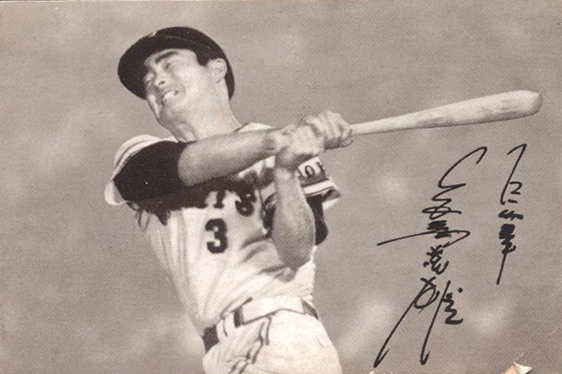
By the ninth inning, it’s 4-4. The Giants are at home, which means the bottom of the ninth belongs to them. The Emperor is scheduled to depart at 9:15. It is past nine o’clock. The first batter due up is a twenty-three-year-old third baseman in only his second professional season, a young man from Chiba Prefecture with a swing like a screen door blowing open in a storm.
Shigeo Nagashima steps to the plate.
Shoriki leans over to the man sitting beside him and whispers: “Nagashima looks like he might hit a home run. Let’s watch.”
The pitcher for the Tigers is Minoru Murayama, a rookie, a young man who will go on to become one of the finest pitchers in Japanese baseball history, who will strike out two thousand batters before he is done, who will be remembered as one of the greats. At this particular moment, he is twenty-one years old and standing sixty feet from the greatest stage his sport has ever offered him.
Before we get to what happened, there is something you should know about the bat.
Nagashima had a bat he preferred: a slim, light Al Simmons model, built for a hitter who wanted to make contact. He did not use it that day. That morning he had put it aside and picked up something heavier: a Ralph Kiner model, built for a man who hit 54 home runs in a single major league season. Nagashima had never used it in a game. He broke it out for the Emperor.
This is who Shigeo Nagashima was. He did not come to that game hoping something dramatic would happen. He came prepared for it.
The count is even at 2-2 in the ninth. Murayama’s fifth pitch, a fastball up and in. Nagashima’s bat flashed and the ball sailed toward the left-field foul pole, curling just inside it, and landed in the upper deck. A sayonara home run—a walk-off, in the American parlance—in front of the Emperor of Japan, in the game that more than any other single moment announced to the Japanese public that professional baseball was no longer minor, no longer secondary, no longer a sport for weekday afternoons. It was the national pastime now. It was now the thing Japan watched.
Shoriki—the man who had engineered the entire evening, who had whispered his prediction to his neighbor thirty seconds earlier—stood there looking like he couldn’t believe it.
As Nagashima rounded third base, he looked up. The Emperor was leaning forward out of his seat. His Majesty had been scheduled to depart at 9:15. It was 9:12.
Murayama spent the rest of his life insisting the ball was foul. “That was absolutely a foul ball,” he maintained for decades, with the particular conviction of a man who has decided that history got something wrong and intends to correct it. When he struck out Nagashima for his 1,500th career strikeout, years later, he said: “Now I’ve repaid the debt from the Emperor’s Game.” He went to his grave still arguing. In 2023, 64 years after the home run, NHK colorized the original footage using artificial intelligence, and the ball appeared on screen in crisp, undeniable clarity: fair, passing to the right of the foul pole. Murayama had been wrong for six decades. He was not alive to hear it*.
*This game sparked the famous rivalry between Murayama and Nagashima. Murayama also recorded his 200th strikeout against Nagashima. His fixation on Nagashima even appeared in his personal life: when he noticed that the last four digits of his home telephone number, “3279,” could be read as a pun meaning “crying over 3” (Nagashima’s jersey number), he pushed to have it changed.
Years later, Nagashima reflected that the game had changed everything, not just for him personally, but for the sport itself. Professional baseball, he said, had until that night been something minor in the lives of Japanese people. After that, baseball became everything.
That is about as modest as a man can be while describing the moment he changed his country. He does not mention the bat.
That same night, after the stadium had emptied and the Emperor had gone home and the newspapers were already setting their front pages, Shigeo Nagashima almost certainly went home and swung a bat in the dark.
No, this is not a metaphor. He had built a practice room in his house specifically for this purpose, and the ritual was absolute: he did not sleep until the swing felt right. Some nights that took fifteen minutes. Other nights he was still in there when the sky began to lighten. It did not matter whether the Giants had won or lost, whether he had gone four-for-four or oh-for-four. On game days, especially, he would skip his bath at the stadium entirely, unwilling to let the physical memory of the day’s at-bats fade from his body, and come home still in his game-day sweat to stand alone in that room and swing.
He turned the lights off. Darkness was not an obstacle; it was the point. In the dark, there was only the sound of the bat.
“When the bat speed is too fast,” he explained once, “it means my body is opening up and my contact point has drifted too far back. The sound tells me everything.” A short, sharp crack at the right moment in the swing meant the mechanics were correct. He would not stop until he heard that sound.
This is the man Japan called a natural. The man they called effortless. The man they held up, for decades, as the contrast to his teammate Sadaharu Oh. “The effort of Oh, the genius of Nagashima,” went the saying, as though genius and effort were opposites, as though one person could not contain both. Nagashima heard that characterization throughout his career and seems to have done nothing to correct it. He had, by all accounts, a strong aesthetic preference for making difficulty look easy, for concealing the machinery behind the performance. If people believed the swing was God-given, he was not going to argue with them.
But the sweat-soaked work gloves told a different story.
He was born on February 20, 1936, in Usui, a small town in Chiba Prefecture near the shores of Lake Inba. 1936 is also the year professional baseball in Japan began, a coincidence that feels less like coincidence and more like something out of mythology. His father was a local government official; his mother was, by all accounts, a woman of formidable will. She sewed his first baseball glove herself. When there were no real baseballs, she made one from marbles and hard cloth. His first bat was a length of green bamboo, split and shaped by hand.
He grew up idolizing Fumio Fujimura, the great Osaka Tigers slugger, and covered the walls of his room with Fujimura’s photographs which made him, as a boy in the Tokyo suburbs, an unusual Hanshin fan. He would imitate Fujimura’s long, sweeping swing, the one they called the “clothesline pole.” In high school he was not particularly well known. He moved from shortstop to third base after committing four errors in a single game at a practice match; his coach converted him mid-game and Nagashima immediately looked like he had been born to play third.
He attracted serious attention for the first time with one swing: a rocket at a regional tournament that the newspaper of the day estimated at three hundred and fifty feet, a line drive that hit the grass beyond the warning track and stayed low. That home run was seen by a scout, who told a journalist, who told another scout, and the chain of conversations that followed eventually led to a recommendation that Nagashima visit Rikkyo University and speak with its baseball coach, a man named Kuninobu Sunaoshi.
What happened at Rikkyo would set the template for everything that followed. Sunaoshi saw Nagashima’s talent immediately and subjected him to what was later recalled as special-treatment brutal training: running thirty minutes each day after team practice to arrive at the coach’s house, where a bat twice the normal weight was waiting. One thousand swings a day. There were no batting gloves in that era, so Nagashima wore cotton work gloves, and the work gloves soaked through with blood from his burst blisters, and when they did, he rinsed them out and put them back on and kept swinging.
The model for those swings was a sequence of photographs that Sunaoshi had obtained of Joe DiMaggio. They were frame-by-frame stills of DiMaggio’s mechanics, showing a lower-body-led swing that had not yet been theorized or systematized in Japan. Nagashima studied those photographs obsessively. He used American-made Louisville Slugger bats, imported through a trading company, for nearly his entire professional career. He won two batting titles in the Tokyo Big6 University League. He led Japan’s national team to the Asian Championship in 1955. Every team in Japan wanted him, and the Nankai Hawks offered more money than the Yomiuri Giants. But his mother asked him to stay in Tokyo, and that was that.
His rookie season, 1958, was extraordinary.
He won the home run title and the RBI title. He was the first rookie in Japanese baseball history to do both simultaneously. His 92 RBI were a Central League rookie record. His 34 doubles were a Central League rookie record that stood for seven decades. His 153 hits were a Central League rookie record until 2019. He played every inning of every game, the first player in Central League history to accomplish that. He stole 37 bases while batting cleanup.
And in that first season, there was the debut against Masaichi Kaneda.
Kaneda was the greatest pitcher in Japanese baseball, a lefthander of intimidating velocity and contempt, and he had heard a radio analyst praise Nagashima so effusively before the season that he had spent weeks in special preparation, timing his arm to peak precisely for their first meeting. On April 5, 1958, Nagashima came to the plate four times and struck out four times, each swing a full-commitment lunge that accomplished nothing except to make an enormous sound and send his helmet flying. The crowd roared at the strikeouts.
Nagashima came back the next year and hit a home run off Kaneda on Opening Day, and their career duel ended with Nagashima hitting .313 against Kaneda with 18 home runs.
Here is something worth sitting with: Shigeo Nagashima was not supposed to be the most popular player in Japanese baseball history. The logic of statistics would have assigned that distinction elsewhere. His teammate Sadaharu Oh hit 868 home runs, the most in professional baseball history, on earth, ever. Oh won fifteen consecutive home run titles. By almost any measure you choose to apply, Oh’s numbers were more dominant, his peak more extreme, his production more consistent.
Even in America, Sadaharu Oh is well-known. Nagashima is unheard of.
And yet.
Ask anyone in Japan who grew up watching them both, and the answer comes back the same way, with a particular warmth that data cannot explain. Nagashima. Always Nagashima.
There is a debate to be had here, and it is not entirely comfortable, because part of the explanation is simply that Nagashima was ethnically Japanese and Oh was the son of a Taiwanese father, and Japan in the 1960s was not a country that offered its full embrace to those it considered outsiders. That is a real part of the story. It would be dishonest to leave it out.
But it’s not the whole story. Consider the batting order. During the sixteen seasons they played together, Oh batted third and Nagashima fourth in 1,061 games, the most common arrangement. And 146 times, opposing pitchers intentionally walked Oh in order to face Nagashima instead. Think about that. The man with 868 career home runs was being bypassed so the pitcher could take his chances with the cleanup hitter. Oh never won a Japan Series MVP award, while Nagashima won four, and Oh once addressed this with characteristic grace: “The pressure I put on opponents was enormous. I think I fulfilled my role. I just never got the car.”
He meant the car that came with the MVP prize. He was smiling when he said it.
The pair won 11 Japan Series titles together as teammates, including 9 in a row from 1965-1973. The dynasty became known as V9.
The statistics bear out what the pitchers feared. Batting fourth, Nagashima hit .314 with 314 home runs across 1,460 games. Batting third, the numbers fell to .291 with 112. The cleanup spot summoned something from him that no other position in the order could. Manager Tetsuharu Kawakami understood this intuitively, that the home run king could fulfill his role by drawing walks and setting the table, while the burning man needed to bat fourth, needed the runners on base, needed the stadium holding its breath. The V9 Giants had two cleanup hitters. Kawakami was wise enough to know which one should wear the title.
The people who loved Nagashima most were not loving him out of prejudice. They were loving him for something that statistics have never been built to capture.
Watch the way he played third base. He stood a step and a half deeper than most third basemen, which let him cover extraordinary ground going to his right — he was famous for ranging into the shortstop’s territory — and when he threw, his arm followed through with a flourish, a little wave of the hand, a gesture borrowed from kabuki, the Japanese theatrical tradition in which every movement is a declaration. His throws, according to Oh himself, were the easiest in the league to catch: perfect rotation, perfect carry, a baseball thrown the way a textbook would throw it if a textbook could throw. And then the little wave.
He calculated where his helmet would land when he swung and missed, so that it would fly off at the right angle to thrill the crowd. He thought about that. He worked on it. He believed, deeply and professionally, that even a strikeout was a performance he owed the fans.
Katsuya Nomura, the great catcher who spent his career crouching behind home plate and whispering doubt into opposing batters’ ears, attempted his trademark psychological destabilization on Nagashima once, pointing out a supposed flaw in his batting stance. Nagashima stopped, took a practice swing, and hit the next pitch for a home run. As he crossed home plate, he turned to Nomura and said, “Thank you for the tip.”
The most authoritative summary of what made Nagashima different came from Isao Harimoto, the man who holds the all-time NPB hits record. Harimoto looked at the career statistics—.305 average, 2,471 hits, 444 home runs, 190 stolen bases—and noted that none of them were records, and that his own numbers were higher in most categories. Then he said this: Oh could hit home runs but was not fast. Harimoto himself produced hits in great quantities but his right hand was damaged and his defense suffered for it. “But Nagashima had no weaknesses,” Harimoto wrote. “He had everything.” If you want to picture him, Harimoto suggested, think of Ichiro, just one size larger, and able to hit home runs, too.
Harimoto also noted something about Nagashima’s character that several of his contemporaries observed independently: he never spoke badly of anyone. In the normal social life of a professional baseball clubhouse, when conversation drifted toward gossip about other players, Nagashima simply did not engage. “In one word,” Harimoto wrote, “he was like the sun. Always bright. That’s why he could draw fans to him.” Oh and Harimoto, between them, held records that Nagashima could not match. Neither of them, they both understood, could match what he was.
Over seventeen seasons, Nagashima collected 2,471 hits and 444 home runs and won six batting titles and five Most Valuable Player awards and became the only player in the history of Nippon Professional Baseball to be named to the Best Nine in every single season he played. Not most seasons. Every season. All seventeen. He hit .305 for his career; .343 in the Japan Series; .313 in All-Star Games. He is the only player in NPB history to hit .300 in all three categories simultaneously.
He was intentionally walked 205 times, the most ever by a right-handed batter in Central League history. In his first season alone, opponents walked him intentionally six games in a row. There is a moment from 1968 that captures what it meant to be pitched around in that era: in a game against the Dragons, Nagashima put down his bat after two consecutive intentional-ball pitches, walked to the plate and stood in the batter’s box with his bare hands raised. No bat. The pitcher threw two more balls and walked him anyway.
His four Japan Series MVP awards are the most in history. His career totals in the Japan Series—91 hits, 25 home runs, 66 RBI, 184 total bases—are all-time records.
The 1974 season had been the first in which he looked mortal. It would be his last. His average fell to .244, the worst of his career. His perfectly struck balls, which for sixteen years had found gaps as if directed by some internal compass, now flew straight at fielders. Nagashima noticed and made it into a small joke. “My hits have become honest,” he said, using a Japanese word, sunao, that means obedient, straightforward, no longer tricky. He smiled when he said it. That was the whole of his public complaint.
His retirement had almost happened on October 13th. The Giants were scheduled to play a Chunichi doubleheader at Korakuen, and the plan was set: Nagashima would play, the ceremony would follow, and seventeen seasons of number 3 would come to an end. But it rained all day, and the games were postponed, and that night the Giants’ public relations director stood outside looking up at the sky, praying for it to clear.
October 14th came in clear and cool, a bright autumn Monday. The Giants took the field for game one of the doubleheader against the Chunichi Dragons, the same Dragons who had clinched the pennant two days earlier, ending the V9 and completing one of the most historic achievements in Japanese baseball. The next morning’s newspapers barely mentioned it. The front pages were about Nagashima. Most of Chunichi’s stars were in Nagoya for the championship parade. Nagashima batted third and played third, and in his second at-bat he hit his 444th career home run, added two more hits, and finished with the 186th multi-hit game of his career. The Giants won 7-4.
After the final out, both teams went to their dugouts. The field emptied. For a moment, Korakuen Stadium held forty thousand people in silence.
Then Nagashima came back out.
This was not in the script. The team had asked him not to do it but he had refused. “The ceremony won’t take me close to the outfield,” he said. “I want to greet my fans.” So he walked out of the first-base dugout and turned toward right field, alone on the grass, and began to move along the warning track. The stands erupted. People were screaming his name, and crying, and screaming his name again.
He was smiling. And then, somewhere along the track, his feet stopped.
He reached into his pocket and took out a small towel and brought it to his face. His shoulders moved. The crowd, which had been roaring, went quiet to let a man cry. And then they were crying too, all of them, the stadium full of people weeping in the autumn afternoon with Shigeo Nagashima standing alone on the warning track with a towel over his face.
He played the second game. He batted fourth and played third. His last hit was a single to center field. His last at-bat was a double-play grounder to short.
The Giants won 10-0. By the time the ceremony began, the stadium lights had taken over for the sun, and when the moment arrived, the lights around the field were switched off one by one until a single spotlight remained, cutting through the October dark, finding the man in the number 3 jersey.
The scoreboard glowed: MR. G, GLORIOUS NUMBER 3.
Nagashima raised his voice and said: “I retire here today but our Giants will live forever.”
In the stadium and in living rooms across Japan, people wept again.
He later wrote: “I was called ‘The Burning Man’ by my fans. But nothing keeps burning forever. The more intensely something burns, the bigger the sense of loss after it is extinguished.”
He was known by many other names: Mr. Giants, Golden Boy, Mr. Professional Baseball, and even just Mr.
He went on to manage the Giants twice, winning two more Japan Series championships.
The second championship came in 2000, when Nagashima’s Giants faced Oh’s Hawks in the Japan Series, the two old teammates meeting as opposing managers to close out the century. For fans who had grown up watching them both, the outcome was almost beside the point. The confrontation itself was the thing. The sport had begun in 1936, the year Nagashima was born, and now here were its two greatest players, grey-haired in dugouts on opposite sides of the field, finishing the century together the way they had filled it.
Here is what I keep coming back to: the swing room, the light offs, and the sound.
There are players who practice in secret because they are ashamed of their weaknesses. Nagashima practiced in secret because he was protective of his image, yes, but also because the dark was simply where the work got done. In the dark there was no audience to perform for, no helmet to angle correctly, no kabuki flourish to calibrate. There was only the question of whether the swing was right, and the sound that answered it, and the willingness to keep going until the answer was yes.
Japan called him a natural. The genius, not the worker. The flame, not the fuel. And he let them, because that was part of the performance too, because he understood that what the country needed from him was not evidence of struggle but evidence that excellence was possible, that a young man from Chiba could step to the plate in front of the Emperor and hit the ball over the fence and make the whole nation feel, for a moment, that it was capable of anything.
He played every season in the Best Nine. He batted .514 in games attended by the Imperial Family. He thanked Nomura for the strikeout tip. He swung in the dark until the sound was right, and then he went to bed, and the next day he made it look easy.
Some players have careers. Nagashima had a whole country.
Thomas Love Seagull’s work can be found on his Substack Baseball in Japan


Leave a comment