
by Tom Hawthorn
Every Tuesday morning we will post an article from SABR’s award-winning books Nichibei Yakyu: Volumes I and II. Each will present a different chapter in the long history of US-Japan baseball relations. This week Tom Hawthorn tells us about Ty Cobb’s visit to Japan.
On an off-day on the road in Cleveland, Tyrus Raymond Cobb, hailed for much of his career as the greatest player the game had ever known, announced his impending retirement. It was September 17, 1928. He had last been a starter in late July when he batted second for the Philadelphia Athletics before trotting out to right field. He went 2-for-5 that day with a single and a double, scoring what would be the winning run in a 5-1 game on a passed ball. Since then, he had been used sparingly as a pinch-hitter, going 1-for-9.
The Georgia Peach was in his 24th season, a 41-year-old man who was now caught stealing more often than not. He appeared in only 95 games for Connie Mack’s team. While his .323 batting average was far from disgraceful, it was still his poorest performance in two decades.
Many of his younger teammates spent the rare offday at the racetrack. Cobb invited reporters to gather in his room at the glamorous Hollenden Hotel, where he handed each of them a typewritten statement in which he announced his retirement even “while there still may remain some base hits in my bat.” The player spoke informally with the writers for hours, examining his career (he called Carl Weilman the toughest pitcher he faced) and expressing a desire to do nothing but enjoy his family’s company for a year. The only item on his agenda was some winter hunting near his home in Augusta, Georgia.
“I am just baseball tired and want to quit,” Cobb said. “I will be leaving baseball with a lot of regrets and still with a light heart. It’s hard to pull away from a game to which one has given a quarter-century of his best manhood and which paved the road to lift me to a place of prominence and affluence.”
He had been for a time the highest-paid player in the game, earning nearly a half-million dollars in salary over the seasons, while investments in a car company later absorbed by General Motors, as well as in Coca-Cola from his home state, ensured that he faced few future privations.
The news of his pending retirement was greeted by newspapers as the passing of an era.
“He is worth more than a million dollars,” noted the Morning Call of Allentown, Pennsylvania, “and is not worrying about his future or the price of pork chops.”The newspaper predicted that he might become a minority owner of a franchise in the high minors.
Cobb recorded his 4,189th hit, a double, against the Washington Senators as a pinch-hitter on September 3. He played what would be his final game in the majors eight days later, popping out to Mark Koenig at shortstop to lead off the ninth in a 5-3 loss at Yankee Stadium. He would get his final two hits in an A’s uniform in Toronto in an exhibition game at Maple Leaf Stadium on September 14. Then it was on to Cleveland to sit on the bench.
For a player reputed to be ill-tempered, he was wistful about spending time with his family.
“Guess it’s time to get out of the game and play with my kids before they grow up and leave me,” he said in announcing his pending retirement. “And there’s that trip to Europe that I promised Mrs. Cobb this year.”
His wife, Charlotte Marion Lombard, known as Charlie, did not get to see Europe in 1928. Three weeks after the hotel room session to announce his retirement, Cobb was traveling through Virginia on his way home to Georgia when he told friends of plans to play baseball overseas. In Japan.
The news broke nationally on October 7 when the Associated Press carried on its wires a news item based on a Richmond Times-Dispatch story. The report said Cobb would spend seven weeks in Asia, accompanied by former pitcher Walter Johnson, the manager of the Newark Bears of the International League.
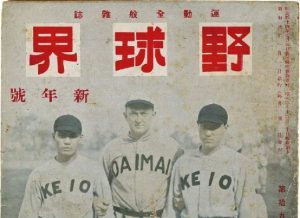
Three days later, George A. Putnam, secretary-owner of the San Francisco Seals and a friend of Cobb’s, offered further details. The player was going to give lectures on the game. He was also going to suit up and play with university teams. The tour was sponsored by the Osaka newspaper Mainichi Shimbun and four universities—Waseda, Meiji, Osaka, and Keio, whose own baseball team had toured the United States for six weeks earlier in the year.
The Pittsburgh Press had a scoop on the pending trip by several days. Sporting editor Ralph Davis, who was in New York to cover the first game of the World Series on October 4, slipped in a final paragraph at the end of his lengthy report on the Yankees’ 4-1 victory over the St. Louis Cardinals. He noted that Cobb had popped into the press box at Yankee Stadium and mentioned that he was off to Japan later in the month with two players on a tour organized by Herb Hunter.
Hunter, whose own major-league career as a weak-hitting infielder-outfielder lasted 39 games with four different teams, first traveled to Japan with Doyle’s 1920 All-Americans and ended up coaching at several Japanese universities after the tour. In 1922, after what was his final season as a player, he led an all-star team of players, including Waite Hoyt, Herb Pennock, Casey Stengel, and George “High Pockets” Kelly, on a successful tour of Japan, Korea, China, the Philippines, and Hawaii. Hunter would go on to become a baseball ambassador, making at least 10 goodwill trips to Japan between 1920 and 1937.
A month before Cobb made his announcement, Hunter got a cablegram from Japan inviting him to bring over another team of major leaguers. The assignment was going to be difficult, as active players were now banned from playing exhibition games after October 31. Hunter hoped whatever disappointment the hosts might feel would be assuaged by bringing the greatest all-around player the game had seen. According to Cobb biographer Charles C. Alexander, Hunter offered Cobb $15,000 for his services.
Also joining the tour were Bob Shawkey, a savvy right-hander who had gone 195-150 over 15 seasons as a starter in the majors, mostly with the Yankees. When they released him after the 1927 season, Shawkey held team records for wins, shutouts, strikeouts, and innings pitched. He was a pitching coach and starter with the Montreal Royals in 1928, going 9-9.
His catcher was former Yankees teammate Fred Hofmann, a 34-year-old journeyman who when once asked how he batted (right, left, or switch), responded, “Poor.” He was nicknamed “Bootnose” for an obvious facial feature. Hofmann hit .226 for the Boston Red Sox in 1928 in what proved to be his final major-league campaign, though he continued playing in the minors until age 43.
Joining the three players was Ernest Cosmos “Ernie” Quigley, a stocky umpire bom in the Canadian province of New Brunswick. Quigley lettered at the University of Kansas as a football player and hurdler in track and field for the Jayhawks. A limited minor-league career gave way to coaching football and officiating in three sports. By the time he retired, he estimated he had worked 400 college football games, 1,400 college basketball games (as well as the 1936 US Olympic qualifying tournament), and more than 3,000 major-league games. He officiated three Rose Bowl games and six World Series, the most notable being the one remembered as the 1919 Black Sox series.
Tagging along were Seals owner Putnam and travel agent Frank Ploof of Tacoma, Washington, described as a sponsor of the trip. The latter, who stood nearly 6-feet tall though weighing just 150 pounds, posed for a photograph in a baseball uniform with the three players.
After traveling across the continent to Seattle, Cobb met with Japanese consul Suemasa Okamoto and his wife. He also led his tour mates, bolstered by local players, in defeating an amateur team from West Seattle by 12-5. Cobb went 4-for-6.
The baseball tourists boarded the steamship SS President Jefferson of the American-Oriental Mail Line in Seattle on October 20, the ship departing at 11 A.M. Cobb was accompanied by his wife and three youngest children, Herschel, Beverly, and James. Quigley and Hunter were also joined by their families. Although some newspapers were still reporting that Johnson was on the tour, the old pitcher had backed out after signing days earlier to manage the Washington Senators.
Continue to read the full article on the SABR website
 SABR Asian Baseball Research Committee Blog
Leave a comment