
by Dave McNeely
The 1964 Tokyo Olympics were the fifth time that baseball was included as a demonstration sport, following the 1912, 1936, 1952 and 1956 Olympiads. The 1964 games, however, were different than the games before them in that more than one game would be played.
Until recently, most English-language accounts of the 1964 Olympic baseball events described it as a single game played between a US team made up of college players against “a Japanese amateur all-star team”. The game was played at Meiji Jingu Stadium in Tokyo on October 11th,1964 in front of 50,000 fans and was won by the US team by a score of 6-2. One of the US players, Shaun Fitzmaurice, hit a home run on the first pitch of the game.
As it turns out, this account is not entirely accurate. There were actually TWO games that Team USA played in at Jingu Stadium that day – one against a team of Japanese collegiate players and one against a team of Japanese corporate league players. Neither Japanese team should really be considered an “all-star” team. The collegiate team was essentially the Komazawa University team (which had just won the All-Japan University Baseball Championship four months earlier) which was fortified with seven players from other colleges in Tokyo. Similarly, the corporate league team was the Nippon Express team (which had won the Intercity Baseball Tournament – essentially the corporate league championship – two and a half months earlier) that was bolstered by seven players from other corporate league teams.
Rod Dedeaux, the legendary USC baseball coach, was the manager of the US team. He’d put together an all-star team of collegiate players for a 14-game tour of Japan and South Korea that included these two games in Tokyo. The tour was organized to drum up interest in having baseball added to future Olympics. The team would include eight players who would go on to play in the major leagues – Mike Epstein, Gary Sutherland, Chuck Dobson, Alan Closter, Dick Joyce, Jim Hibbs, Ken Suarez and the previously mentioned Shaun Fitzmaurice.
The baseball team was not considered part of the official US Olympic team and was not quartered in the Olympic Village. Neither were they allowed to participate in the Opening Ceremony. On the plus side, however, they were not subject to the curfew that the other athletes had and were able to enjoy the Tokyo nightlife deeper into the evening. Similarly, the Japanese teams were not considered part of the official Japanese team and also did not take part in the Opening Ceremony.
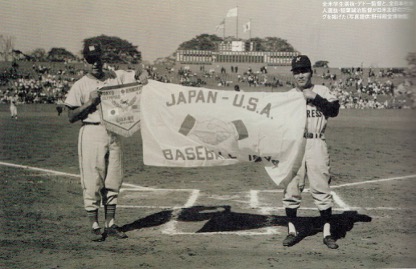
The Japanese collegiate team (seen above with Team USA) was managed by Akihito Kobayashi, the head coach of the Komazawa University team. Eleven of the eighteen players on the roster were from Komazawa with another two players coming from one of the University’s Tohto League rivals, Chou University. The other five players came from Tokyo Big Six league schools – two from Hosei, two from Keio and one from Rikkio. All the players wore Komazawa uniforms.
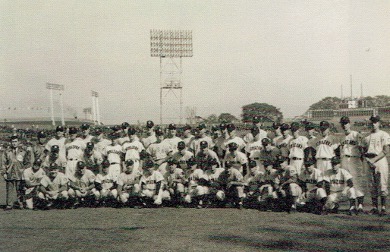
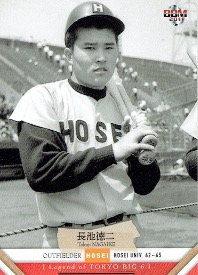
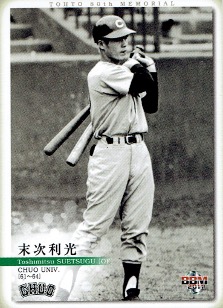
Twelve members of this team would go on to have professional careers in NPB. Tokuji “Atsushi” Nagaike of Hosei University was the biggest name here – he won two Pacific League MVP awards (1969 & 1971) and led the league in home runs and RBIs three times each. Shozo Doi (Rikkio) and Toshimitsu Suetsugu (Chuo) were key members of the Yomiuri Giants team that won nine straight Nippon Series between 1965 and 1973 (known as the V9 Giants). Doi managed the Orix BlueWave in the early 1990s and is most famous (infamous?) for saying that Ichiro Suzuki would never be able to hit with that batting stance. Taisuke Watanabe (Keio) had thrown the first perfect game in Tokyo Big Six history five months before these games.
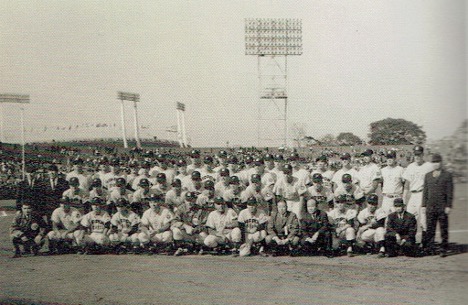
The corporate league team (seen above with Team USA) was managed by Seiji Inaba, the head coach of Nippon Express. Like the collegiate team, the corporate league team’s eighteen player roster featured eleven players from their manager’s team. The other seven players consisted of two players each from Nippon Oil and Nippon Steel Pipe and one each from Sumitomo Metal, Nippon Columbia and Kanekalon Kaneka. All the members of the team wore Nippon Express uniforms.
Only three of these players would have professional careers. The most interesting story of any of these players is Shigeo Kondo of Nippon Columbia who, after an eleven-year corporate league career, was taken by the Lotte Orions in the 1971 NPB draft. At 29 years and one month, he was the oldest player drafted, a record he would hold for eleven years until 30-year and five-month-old Norio Ichimura was drafted by the Dragons in 1982.
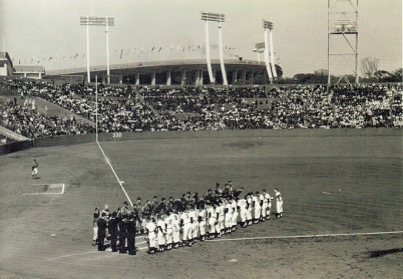
With the smoke of the Olympic cauldron (which had been lit during the Opening Ceremony the previous evening) at the National Stadium visible just beyond the left field stands of Jingu Stadium, the teams held their own “opening ceremony” before the two collegiate teams faced off in the first game. While there’s no record of whether Fitzmaurice did indeed hit a home run on the first pitch of the game, the US team did score a run in the top of the first inning. Japan matched that run in the bottom of the inning and went ahead 2-1 with a single run in the fifth inning. Team USA tied the score in the top of the ninth and that’s how the game ended – a 2-2 tie. The corporate league team proved no match for Team USA in the nightcap with Dedeaux’s squad shutting out Inaba’s by a score of 3-0.
Team USA’s tour of Japan would conclude two weeks later with a doubleheader in Urawa. Their first game against “a selected team from Saitama Prefecture” ended in a 3-3 tie while Nippon Express got their revenge by winning the second game 3-2. The collegiate team would finish the Japanese portion of their tour with a record of 5-2-2.
Baseball would not return to the Olympics for twenty years when it was again a demonstration sport for the 1984 Los Angeles games. Unlike the previous instances, the 1984 games featured an eight-team tournament rather than a single day event. The only connection to the 1964 games was Rod Dedeaux, who would again manage Team USA. The Japanese team took the “unofficial” gold medal with Team USA taking silver. The two nations would swap spots at the 1988 Seoul games, the last that baseball would be played in as a demonstration sport. It would become an official sport at the 1992 Barcelona games.
Note – the photos for this post were taken from the “Japan National Team Uniform Catalog”, a book/magazine published by Baseball Magazine She in April of 2020. The baseball cards are from the author’s personal collection.
Dave McNeely has been collecting Japanese Baseball cards for more than 25 years and has been blogging about them since 2007. His blog can be found at Japanese Baseball Cards.
 SABR Asian Baseball Research Committee Blog
Leave a comment