
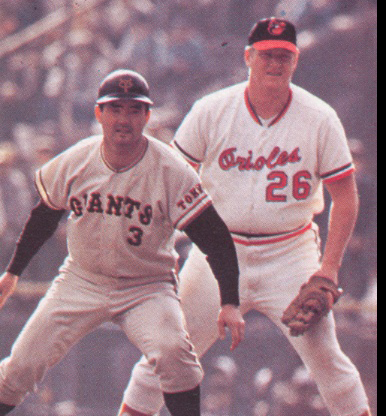
by Dennis Snelling
Every Monday morning we will post an article from SABR’s award-winning books Nichibei Yakyu: Volumes I and II. Each will present a different chapter in the long history of US-Japan baseball relations. This week DENNIS SNELLING tells us about what was supposed to be a true World Series: the 1971 Baltimore Orioles visit to Japan
Matsutaro Shoriki spent four decades dreaming of an international World Series matching the champion team of American baseball and that of the Japanese. He created Japan’s greatest team, sponsored by his newspaper and known over the years as either the Tokyo or Yomiuri Giants, as a means to fulfilling that dream.
Beginning in the 1950s, serious attempts were made to bring a World Series champion to Japan, but it never quite worked out. Because of the lead time necessary for planning such an event, guesses as to a potential World Series champion had to be made. These proved wrong every time, almost as if a curse. The New York Giants seemed a good possibility in 1953, but Brooklyn instead captured the National League pennant. Two years later, the New York Yankees – a sure bet during the 1950s – accepted an invitation. That turned out to be the year they finally lost to the Dodgers in the fall classic. So Brooklyn was chosen the next year and, of course, lost the 1956 World Series to the Yankees.
The Los Angeles Dodgers, champions twice in three years, were invited after the 1966 season – and lost the World Series, once again dashing the hopes of those wanting to see two champions play in Japan. Two years later the St. Louis Cardinals, winners of the 1967 World Series, were invited to tour in October 1968, and they too lost the subsequent fall classic, to the Detroit Tigers.
Shoriki died in October 1969, and his son took up the cause. Six months after Shoriki’s death, the San Francisco Giants visited Japan for spring training and lost six of nine games against Japanese competition. Despite not facing a World Series champion, the Japanese were gaining confidence that they measured up – 3½ years earlier they had won eight of 18 games against the Dodgers.
The Yomiuri Giants were invited to Florida in the spring of 1971 to play six exhibition games against major-league competition. They were the best Japan had to offer – the 1970 season marked the sixth consecutive championship the Giants had captured, with three more still to come.
The roster was impressive, featuring three of the biggest names in Japanese baseball. Foremost was Sadaharu Oh, the legendary left-handed slugger and by far the most famous Japanese player among American fans. He was widely known for his distinctive batting style, highlighted by balancing on his back leg while swinging, a style that drew comparisons to Mel Ott. It reminded others of a flamingo. Oh had hit 40 or more home runs eight straight years through 1970, including 55 in 1964, despite seasons 20 games shorter than in the United States. Through the 1971 season, the 31-year-old Oh had hit 486 career home runs and would play nine more years, ultimately slugging at least 30 home runs for an incredible 19 consecutive years, and 868 home runs for his career.
The most famous and popular player among Japanese fans was charismatic 34-year-old third baseman Shigeo Nagashima. A hero thanks to his dramatic game-winning walk-off, or “Sayonara,” home run in the first game Emperor Hirohito ever attended, Nagashima was exceptional both at bat and in the field, hitting 444 career home runs with a .305 batting average.
The manager of the Giants, Tetsuharu Kawakami, was known as the “God of Batting.” The winner of five batting titles and the first Japanese player to reach 2,000 hits, he took over as manager in 1961, three years after his retirement as a player, and never suffered a losing season at the helm. After winning pennants in 1961 and 1963 but losing the Japan Series both times, Kawakami had captured Japan Series wins in six straight seasons. It was time to measure Japanese baseball against the best – the mighty Baltimore Orioles, American League standard-bearers two years running and defending World Series champions. They were favorites to repeat in 1971 and finally bring the late Matsutaro Shoriki’s dream one step closer to reality.
The Orioles, fresh off a fall classic victory over the Cincinnati Reds, accepted an invitation in January 1971 for a monthlong tour after the next World Series. The schedule included 18 games, 11 of them against the Yomiuri Giants.
A couple of weeks after the invitation was accepted, the Japanese sports newspaper Hochi Shimbun commissioned a computer simulation of a theoretical seven-game series between the Orioles and the Giants. The computer results had the Orioles winning four of the seven games, with the Giants winning two and one game ending in a 12-inning tie.
The Giants and Orioles previewed their postseason matchup during spring training in Miami on March 11, one of the half-dozen exhibition games Yomiuri played in Florida. Players mingled before the game, seven Giants surrounding Brooks Robinson behind the batting cage, including 5-foot-7, 140-pound pitcher Akira Tanaka, who could not resist measuring his hand against that of the Orioles third baseman in comparison.
The Japanese were particularly impressed by the sight of 6-foot-4 Boog Powell, who was introduced to Sadaharu Oh. During their conversation, Powell leaned his massive frame against Oh and whispered, “Fella, you make more money than I do.” Oh replied, “47 home runs,” his total for the 1970 season.
Brooks Robinson told reporters that Lee Walls, a former All-Star outfielder who played in Japan in 1965, thought Oh to be one of the five best hitters he had ever seen. Scout Gordon Windhorn, recently retired as a player after six seasons with the Hankyu Braves, recalled his advice to American pitchers facing Oh after they saw his stance and curious one-legged pause during his swing. “You think you can change speeds on him, but you can’t. He’ll just stand there and wait and keep that right leg balanced.”
For his part, Oh said he enjoyed playing against Americans. “Friendships are very important to me,” he declared. “I also benefit from the spirit of the American players – the way they slide, the way they make double plays. The Japanese are much more conservative.”
The game played that day was competitive. Both teams scored in the first inning, with the Orioles adding runs in the fourth and sixth to take a 3-1 lead. After some back-and-forth, Baltimore was ahead, 6-3, going into the last frame.
Sadaharu Oh slapped a run-scoring single in the ninth, his second of the day. Then, with two out and one on, Shigeo Nagashima hit a long fly ball down the line that appeared to have tied the game. “I thought it was a home run,” said Nagashima “But the wind helped it go foul.” He was then retired and Baltimore won, 6-4.
The Giants took heart that they had held their own, although several of Baltimore’s stars, including Frank and Brooks Robinson and Boog Powell, played only portions of the game. Tetsuharu Kawakami said of the Orioles, “Their physical superiority seemed indeed overwhelming before the game, but I found later they were not as powerful as I thought.” The Giants came away confident that they belonged on the same field, and looked forward to October.
Relations between Japan and the United States grew tense in the late 1960s and early 1970s, and Japan’s sensitivity always surfaced when the United States courted the attention of a rival. In July 1971, President Richard Nixon announced that his secretary of state, Henry Kissinger, had completed a secret trip to the People’s Republic of China that resulted in Nixon being invited to meet with Mao Zedong. The invitation was accepted, with the meeting to take place within a year. This sent shock waves through Japan, which feared being abandoned by the United States. A month earlier, it was thought that all differences had been resolved through a negotiation aimed at returning Japanese territories seized during World War II, with Okinawa reverting to Japanese control in 1972.
But the Japanese government was embarrassed by Nixon’s actions, the lack of forewarning about an earthshaking shift in American foreign policy considered a lack of respect, especially with Japan openly entrenched in a policy – thought to be shared by the United States – banning relations with China.
Then, a month after announcing he was going to Beijing, Nixon announced a 10 percent import surcharge as part of an economic recovery package, further straining relations with Japan. Japanese students, unhappy with a continued military presence of the United States on Okinawa beyond 1972, began rallying against the US and the agreement, which delayed Japanese ratification of the deal until late November, after the Orioles had left the country.
That fall, Emperor Hirohito, in his 45th year on the throne, became the first reigning emperor to travel abroad, returning from Europe a week prior to the arrival of the Orioles. He visited briefly with President Nixon during his first stop, in Anchorage, Alaska, as the Northern Lights danced overhead, punctuating Nixon’s attempt to mend fences.
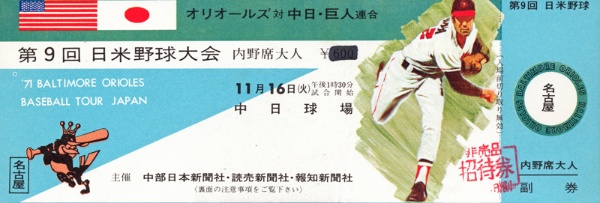
While the 1966 Dodgers visited without Sandy Koufax and Don Drysdale, the Orioles brought everyone. Frank and Brooks Robinson and Boog Powell were the offensive stars and Baltimore boasted a pitching staff featuring 20-game winners Jim Palmer, Dave McNally, Mike Cuellar, and Pat Dobson. Of course, the curse continued, with the Orioles dropping the 1971 World Series to Pittsburgh in seven games. So once again, the Japanese were frustrated in their attempt to stage an informal world championship series. The 72-person traveling party also included Commissioner Bowie Kuhn, American League President Joe Cronin, and umpire Jim Honochick. Pitching coach George Bamberger remained home, having suffered a recent heart attack.
The Orioles arrived in Japan on October 21, greeted by several hundred fans and dozens of newspaper photographers. The next day they headed out to Korakuen Stadium for their first workout and were surprised by 5,000 rabid Japanese fans, digesting their every move. They seemed most in awe of the 260-pound Powell.
Each Orioles player received $4,000 plus another $1,000 in spending money; meal tabs at the hotel were picked up by their Japanese hosts. Earl Weaver, legendary for his intensity, relaxed many of the rules for the trip. Players were allowed to grow mustaches, banned during the regular season, and to drink at the hotel bar, a domain traditionally restricted to the manager and coaching staff. Brooks Robinson grew a mustache. So did Mark Belanger, Mike Cuellar, Curt Motton, and Andy Etchebarren. By the end of the tour, reliever Eddie Watt sported a full beard. Frank Robinson opted for a Fu Manchu.
Weaver also relaxed his strictly enforced dress code of coats and ties, and surprised many by drinking and playing cards with his men. “I told the players I would relax the rules … as long as they did not abuse the privileges. I also told them once we put the uniforms on, I expect the same performance and effort as in the regular season.”
Two days after the team arrived in Japan, 15 of the Orioles wives held a shopping party where outfielder Curt Motton and his wife were staying, Room 1208 at the New Otani Hotel, which became an impromptu store thanks to George Speccks, who billed himself as George the Silk Man. He had been passing out his business card in the lobby, and Motton’s wife, Jackie, took him up on his offer, inviting the other wives to sift through a collection of silks, kimonos, watches, and cameras.
“You can imagine the bedlam in my room with all these girls crowded in,” said Jackie Motton, shaking her head. “We went through thirty bottles of (Coca-Cola) and by the time it was over, I felt like I had thrown some kind of wild party.” She spent more than $250, buying 19 kimonos and happi coats. The nonstop hard-sell of George the Silk Man ultimately broke down just about everyone at some point during the tour. If you wanted it, George and his associates would sell it to you.
Korakuen Stadium was the second largest in Japan and home of the Yomiuri Giants, who had played before more than 2.3 million paying customers in 1971, their ninth straight year topping two million, and more than twice the number drawn in Baltimore. The facility had its challenges. The outfield distances were short (295 feet down the lines, 380 to center) and the clubhouse was tiny, with no toilets or showers, so players dressed at the hotel. Catered meals were provided before games, served by tuxedo-clad waiters.
Before the first game, Bowie Kuhn met with Japanese Prime Minister Eisaku Sato, while Earl Weaver told reporters he hoped to win six to seven of the 11 games against the Giants. Kuhn threw out the first ball and read a message from President Nixon, and the Orioles appeared wearing uniforms bearing their names in both English and Japanese.
Baltimore easily won the first two games, knocking Japanese baseball experts back on their heels a bit. Jim Palmer won the opener, 8-4, despite allowing home runs to Yukinobu Kuroe and Koji Ano in the sixth inning. The Giants seemed shaky, committing five errors leading to four unearned runs. Brooks Robinson homered to spark a five-run second inning for Baltimore. Neither Oh nor Nagashima managed to get a hit, while Boog Powell slugged one over the fence for the Orioles.
The second game matched Orioles veteran southpaw Mike Cuellar against Giants ace Tsuneo Horiuchi. Don Buford robbed Sadaharu Oh of a home run, keeping the Japanese star hitless in the first two contests. Frank Robinson, battling a strained Achilles tendon, homered on a Horiuchi changeup, one of three Baltimore round-trippers during an easy 8-2 win. Robinson praised the umpiring while noting that the strike zone was a bit high. He also suggested that Horiuchi, who allowed six runs in six innings, should rely more on his fastball.
The Orioles were amused, but at the same time honored by the ceremonial atmosphere surrounding the contests. Before every game, a group of young women in kimonos presented Earl Weaver with a bouquet. During games, tuxedo-clad waiters served coffee and tea in the dugout. Even writers were treated well, provided with hot towels after the fourth inning.
Read the rest of the article on SABR.org
 SABR Asian Baseball Research Committee Blog
Leave a comment