
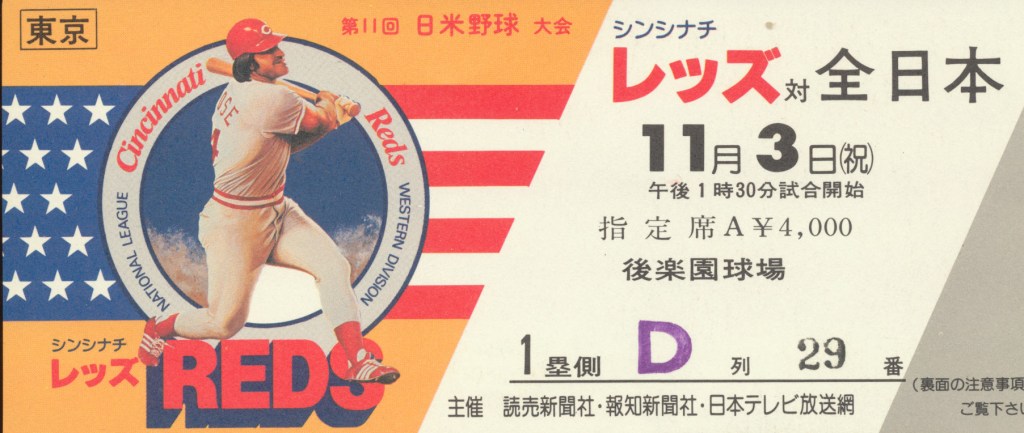
by Robert Kiyoshi Shadlow
Every Monday morning we will post an article from SABR’s award-winning books Nichibei Yakyu: Volumes I and II. Each will present a different chapter in the long history of US-Japan baseball relations. This week Robert Kiyoshi Shadlow tells us about the Big red Machine’s 1978 visit to Japan.
Pete Rose basked in the attention he was receiving from the Japanese press on Opening Day, April 6, 1978. His Cincinnati Reds were facing the visiting Houston Astros in a game that was being broadcast live to Japan. Rose interrupted the Japanese interpreter by boisterously proclaiming, “Let me answer that. I speak Japanese well. No, I won’t do it today, but I’ll do it tomorrow.” Then the interpreter explained to Pete, that the question was, “How do you feel?”
The 11-man Japanese press corps was on a 10-day visit to Cincinnati, Dallas, New York, and San Francisco. Yasushi Matsui of Fuji Telecasting Company said, “[T]he demand and interest in American baseball is there (in Japan).” Two major-league baseball games per week were being broadcast to Japan for the first time in 1978. The Japanese reporters and photographers were also excited about the Big Red Machine’s coming 1978 postseason tour of Japan. Rose addressed Japanese fans, “Tell ’em we’re going to beat the hell out of their teams. … We want to win the World Series this year so we can go to Japan and win the world, world series.”
From 1970 through 1976, the Big Red Machine averaged 98 wins a season as they won five division titles and made four World Series appearances, winning two of them. The Reds featured Hall of Famers Johnny Bench, Joe Morgan, and Tony Perez along with Pete Rose, Dave Concepción, George Foster, César Gerónimo, and Ken Griffey Sr. The Reds declined a tour of Japan after winning the 1976 World Series. A few months later, Perez was traded from the Reds to the Montreal Expos and another future Hall of Famer, Tom Seaver, was sent to Cincinnati from the New York Mets in 1977.
In early December 1977, two or three major-league teams were being considered for a tour of Japan after the 1978 season. Commissioner Bowie Kuhn acknowledged, “There are a few teams who would like to go.” In October 1977, for example, Philadelphia Phillies traveling secretary Eddie Forenz was in Japan investigating accommodations for the Phillies. But on January 2, 1978, the Reds announced that the Japanese newspaper Yomiuri Shimbun would sponsor the team’s four-week tour of Japan beginning in late October 1978. They would face the Yomiuri Giants as well as combined teams throughout Japan.
On May 26, 1978, Kuhn left for Japan for discussions about the Saturday and Monday Game of the Week broadcasts as well as This Week in Baseball. All three shows were being broadcast for the first time in Japan in 1978. The All-Star Game, league championships, and World Series were also scheduled to be shown in Japan that year. Kuhn was also preparing the way for the Reds’ postseason tour of Japan. Seventeen games were to be played in 13 cities: Tokyo, Sapporo, Sendai, Yokohama, Nagoya, Toyama, Nishinomiya, Osaka, Hiroshima, Kumamoto, Fukuoka, Kita-Kyushu, and Shizuoka.
In 1978 Cincinnati had a strong 28-18 start by Memorial Day and was 49-37 at the All-Star break. A hard-fought season left them 2½ games behind the Los Angeles Dodgers in the National League West Division despite a 92-69 record before they embarked on the excursion to Japan. Cincinnati finished second in runs scored in the National League. The Big Red Machine’s offense was led by George Foster’s 40 home runs and 120 RBIs. There was hopeful speculation of a home-run-hitting contest between Foster and Japanese home-run king Sadaharu Oh. Johnny Bench hit 23 home runs while 37-year-old Pete Rose tied the 44-game National League single-season hitting streak record and recorded his 3,000th career hit. Tom Seaver won 16 games in 36 starts with a 2.88 ERA while Doug Bair had 28 saves with an ERA of 1.97.
The Reds’ roster for the trip to Japan consisted of a 10-man pitching corps of Doug Bair, Bill Bonham, Pedro Borbón, Dan Dumoulin, Tom Hume, Mike LaCoss, Fred Norman, Mario Soto, Dave Tomlin, and Tom Seaver. Catchers were Johnny Bench and Vic Correll. Their six infielders were Dan Driessen, Mike Grace, Junior Kennedy, Ray Knight, Ron Oester, and Pete Rose. Outfielders Mickey Duval, George Foster, Ken Griffey, Mike Lum, and Champ Summers made the trip. Reds manager Sparky Anderson brought six coaches: Alex Grammas, Ted Kluszewski, Russ Nixon, Ron Plaza, George Scherger, and Larry Shepard.
Technically, Mike Lum and Pete Rose, who had filed for free agency, were not members of the Reds. The Japan tour was significant for Lum, the first American-born player of Japanese ancestry in the majors. His mother was Japanese. Mike acquired the Lum surname when he was adopted by a Chinese couple.
Paul Moskau was enraged when he found out that he was left off the Reds’ roster for the Japan tour. Moskau, already disenchanted after being sent to the minors at the end of spring training, exclaimed, “You feel like you are part of the team and twice they do this. Is Bonham going? Last time I talked to him, he was, with his arm in a cast.”
Four other Reds players not making the trip were Davey Concepción, César Gerónimo, Ken Henderson, and Joe Morgan. Concepción wanted to stay in Venezuela to play winter baseball, while the other three were healing from injuries.
Cincinnati farmhand Mickey Duval was one lucky guy. “[T]he Nashville Sounds (Double A) brought me to extended fall baseball in Tampa … and I did get to play with the big club for a month, but it was in Japan. When I was in Tampa, I was crushing it. I had a good year in Double A, and then [the Reds] said, ‘Do you feel like going to Japan? Gerónimo can’t make it.’ I got $9,000 for that month; I was only making $850 a month!”
Accompanying the Reds was a delegation led by Kuhn, National League President Charles Feeney, and Reds President Dick Wagner along with six members of the Cincinnati front-office staff. National League umpire Lee Weyer also went along.
As they left, comedian Bob Hope said, “The only advice I have for them is have their kimonos made here. They’ll fit better. I can’t wait to see Johnny Bench in a kimono with rice in his hair.”
On October 25, 1978, the Reds flew off to Japan and landed with Pete Rose sliding headfirst into commercial endorsements from Japanese companies like Mizuno. Pete acknowledged that he was accompanying the team despite being a free agent because he had business commitments in Japan. He even observed, “[The Japanese] might want me to play there next year too.” The Associated Press reported that at least one member of the Reds was in discussions about playing in Japan in 1979.
The Reds contingent was greeted by cheering fans at Tokyo’s Narita Airport. At the welcoming press conference, Rose said, “I’m very happy to be here. I’m very curious to see and watch the reaction of Japanese fans and baseball players.” Sparky Anderson declared, “The Japanese are going to see some super baseball. I’m sure we will show some real fine baseball. … Japanese ballplayers and fans will agree that we were one of the finest major league teams to ever visit here.” Bench added, “Fans here will be in for some fine baseball, and it will be hard for (the Japanese) to believe the way Foster hits balls over the wall.” For his part, Foster promised, “I’ll give it my best shots.”
The Big Red Machine started working out in smoggy Korakuen Stadium in Tokyo less than 24 hours after landing in Japan. “Ohayo Gozai Masu (Good Morning),” Johnny Bench greeted Japanese photographers. Anderson warned the players who were still suffering from jet lag, “Nobody will get crazy.” Infielder Dan Driessen remarked about the jet lag, “It’s manageable right now. It’s totally a new experience (to play in Japan).” Reds coach Alex Grammas promised, “[The Japanese fans] are expecting us to win, and we are going to win.” Meanwhile, Pete Rose boasted that he had turned down an offer to play for the Seibu Lions for “more than a million dollars.” He added, “Yes, I’ll play in Japan … 17 games (for the tour).”
Read the rest of the article on SABR.org
 SABR Asian Baseball Research Committee Blog
Leave a comment