
by CARTER CROMWELL
Every Monday morning we will post an article from SABR’s award-winning books Nichibei Yakyu: Volumes I and II. Each will present a different chapter in the long history of US-Japan baseball relations. This week CARTER CROMWELL explains how the MLB All-Star team exacted revenge for their 1990 loss.
For the MLB All-Star team, the 1992 series was all about redemption. Nothing less.
Two years earlier, an American team boasting stars like Randy Johnson, Roberto Alomar, Barry Bonds, Lenny Dykstra, and Ken Griffey Jr. had won just three of eight games to become the first major-league all-star team to lose an exhibition series against their Japanese hosts. Along the way, the team “played and behaved like ugly Americans … with nonchalance and arrogance.” In short, it was not pretty. It was memorable mostly for the bad taste it left, and Cecil Fielder was determined that there would be no repeat performance in 1992.
As a member of the 1990 team, Fielder had witnessed the disappointment firsthand. It had come a year after his single season with the Hanshin Tigers of the Japanese Central League, in which he hit 38 home runs, drove in 81 runs, and posted a 1.031 OPS in only 106 games. Though he’d left after that season and made a triumphant return to the US majors in 1990 with 51 homers and 132 RBIs for the Detroit Tigers, he had remained a hero – almost a god – to the Hanshin fans. One article about the 1992 series described people in a train station seeing him sitting in one of the cars. They rushed over and, reverentially, covered his window with their palms. “I think they view me as a son they sent off to America who has done extremely well,” Fielder was quoted as saying. “They feel responsible for me doing well, like maybe Japanese baseball helped me to do some things. If that’s what they want to think, hey, beautiful.”
Since he’d learned to respect the culture and the style of play in Japan, the 1990 experience was even more galling. “I think we came over here [in 1990] with an attitude that, because of our names and who we were, we just had to lower our gloves out there and we’d win,” Fielder said before the 1992 series began. “We got beat up, and it was not a good feeling.” “I don’t think everybody who came here really believed that the Japanese players could play baseball.” “I hope this team understands that they’re going to beat you if you just go through the motions.”
It did, according to Mark Langston, then a California Angels pitcher. “There’s no doubt that the loss in 1990 made us more focused when we went over there,” said Langston, who pitched well in two starts against the all-Japan club in 1992. “The series came a month or so after our season had ended, so we all had to get back into the competitive mode, but there was a sense of urgency. Cecil talked a lot about it. He said we should enjoy Japan but be prepared to play well and get the job done on the field.” Fielder, who was said to have been embarrassed by his teammates’ attitudes in 1990, added, “I didn’t want this time [1992] to be like last time.”
It wasn’t.
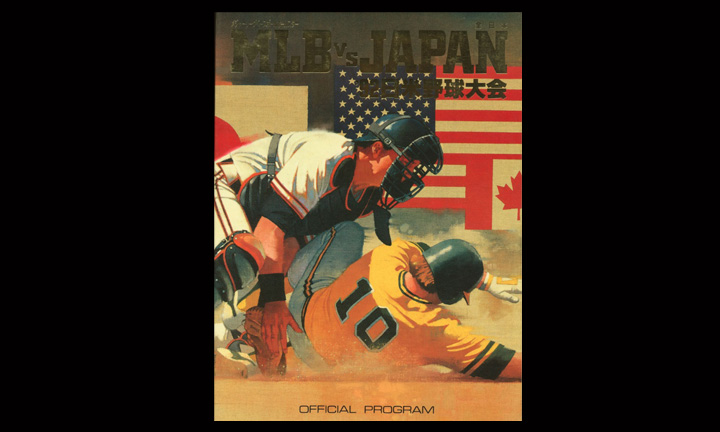
In his welcome statement in the official series program, Ichiro Yoshikuni, commissioner of Nippon Professional Baseball, said, “I hope that these top major league players … are ready to avenge their defeat since the MLB team lost two years ago.”
They were.
The series opened with a game against the Yomiuri Giants that was followed by seven games against a Japanese all-star team. Beforehand, an American columnist for the English-language Japan Times newspaper predicted “the Giants to beat the jet-lagged MLB stars, then a 3-3 split with one tie between MLB and the All-Japan team.”
He was right about the tie.
Otherwise, the Americans showed little evidence of letdown. They opened with an 11-0 thrashing of the Yomiuri Giants, with Fielder hitting a homer, and followed that by going 5-1-1 against the All-Japan team. Their only loss came in the fourth game after a day off taken up by shopping with their wives. “Man, playing a doubleheader was easier than that,” infielder Dave Hollins of the Philadelphia Phillies cracked.
And the Americans were playing a very talented Japanese team, one that included seven players who would eventually earn induction into the Japanese Baseball Hall of Fame: catcher Atsuya Furuta, outfielder Koji Akiyama, infielders Hiromitsu Ochiai and Kazuyoshi Tatsunami, and pitchers Masaki Saito, Kazuhiro Sasaki, and Hideo Nomo.
Sasaki later pitched four seasons for the Seattle Mariners, winning Rookie of the Year honors in 2000 and twice making the American League All-Star team. At the time of the 1992 series, he was 24 and had just completed a season in which he had been voted Fireman of the Year in the Central League thanks to his 12-6 record, 21 saves, and 135 strikeouts in 87⅔ innings.
Nomo, of course, was later a trailblazer when, in 1995, he leveraged a loophole in the rules to sign with the Los Angeles Dodgers and become the first Japanese to play in the major leagues since Masanori Murakami pitched for the San Francisco Giants in 1964-1965. At the time of this series, though, he was just 24 years old and coming off his third season with the Kintetsu (now Orix) Buffaloes. He had gone 53-27 in those first three campaigns, leading the league in victories and strikeouts each time, and taken Rookie of the Year and MVP honors.
The others were just as transcendent. One of the finest hitters in Japanese baseball history, Ochiai played with four teams over 20 seasons, batting .311 with 510 homers, 1,564 RBIs, and a .987 OPS. He was three times a Triple Crown winner and 15 times an all-star. Furuta played 18 seasons with the Yakult Swallows, batting .294 for his career, winning two Central League MVP Awards, and becoming the first catcher to win a batting title in the Central League. Tatsunami was a .285 hitter over 22 seasons with the Chunichi Dragons. He had 2,480 hits, the eighth-best total in NPB history.
Akiyama played 20 seasons. He was a 12-time Gold Glover and an eight-time selection to the Best Nine, while hitting 437 home runs. Saito pitched 18 seasons for the Yomiuri Giants, posting a 180-96 record with a 2.77 earned-run average and 1.105 WHIP. He led the Central League in victories five times and in ERA three times. He was an all-star and a Best Nine selection five times each and won four Gold Glove Awards.
Before the series began, Griffey Jr. had said he thought the Japanese players were as good as major leaguers. “My dad (Ken Griffey Sr.) warned me about them,” said Griffey Jr. “[So] I took them seriously.” Langston added, “We knew the Japanese were very good. They had a few power hitters and a good running game. They were extremely sound fundamentally, were good at putting the ball in play, and wouldn’t beat themselves.”
Manager Tom Kelly’s squad was more than simply a group of players with big names and flashy statistics. His two brightest stars – Fielder and Griffey Jr. – had been on the 1990 team. Fielder had finished second in the American League MVP Award voting in 1990 and 1991. From 1990 to 1992, he had hit 130 home runs and driven in 389 runs, becoming the first player in 71 years to lead the majors in RBIs three consecutive seasons. Griffey Jr. was coming off his fourth major-league season, in which he batted .308 with 27 home runs, 103 RBIs, and an .896 OPS.
The roster also included Hollins and Darren Daulton of the Philadelphia Phillies, Travis Fryman and Mickey Tettleton of the Tigers, the Minnesota Twins’ Shane Mack, Bob Tewksbury of the St. Louis Cardinals, the Pittsburgh Pirates’ Bob Patterson, and Eric Karros of the Los Angeles Dodgers (winner of the 1992 National League Rookie of the Year Award). They were all very good players who complemented bigger names: Fielder; Griffey Jr.; Langston; Mark Grace of the Chicago Cubs; Craig Biggio of the Houston Astros; Larry Walker of the Montreal Expos; Roger Clemens and Wade Boggs of the Boston Red Sox; Ozzie Smith of the Cardinals; Jack McDowell of the Chicago White Sox; and Dennis Martinez of the Montreal Expos. “Our roster was stacked,” Langston said. “The team we went over there was going to be very hard to beat. We had too many weapons for them all to be held in check.”
And that proved to be the case.
The series got underway on October 30, 1992, when the Americans played the Yomiuri Giants in the Tokyo Dome. The Giants occupy a position in Japanese baseball much like the one the New York Yankees do in the major leagues. It is the oldest of the current Japanese teams and the most successful, having won 17 Japan Series (Japan’s equivalent of the World Series), 26 Central League championships prior to 1992, and nine titles in the Japanese Baseball League, the forerunner of Nippon Professional Baseball (NPB). Also on that night, Shigeo Nagashima – considered by some to be the greatest player in Japanese history – was returning as the Giants manager after having managed the club from 1975 to 1980.
Before the game, Kevin Costner, who has starred in several baseball-themed movies, took batting practice with the American team, and he and Langston had a reunion of sorts. “A couple of years before, I’d played in a celebrity softball game in which he’d played third base,” Langston said. “I’d just signed with the Angels, and he’d tell me after every inning that he thought I was going to have a great season. Instead, I had the worst year of my career. So when I saw him in Tokyo, I reminded him of that, and he said, ‘Oh yeah, I lived and sweated every game you pitched that year.’ It was funny that he remembered that.” Costner, in Tokyo to promote his new film The Bodyguard, hit some good line drives off Martinez in batting practice before missing terribly at a curveball.
Once the game began, though, the US team didn’t miss many. The Americans rolled to an 11-0 victory behind a three-run homer by Grace, solo shots by Fielder and Griffey Jr., and a combined one-hitter by Clemens and Greg Swindell of the Cincinnati Reds. Langston recalled Clemens setting the tone early on. “There was some sort of a screen behind home plate – not like the netting we had back home – and he deliberately threw his last warm-up pitch hard and high over the catcher’s head. The ball stuck in the screen, and the crowd went nuts,” Langston said with a laugh.
The US team led just 2-0 after five innings, but a five-run sixth highlighted by Grace’s home run put the game out of reach. Clemens and Swindell allowed just three baserunners – a walk to catcher Shinichi Murata, an error by Smith that let third baseman Kaoru Okazaki reach base, and a third-inning single by Kazunori Shinozuka on a hard shot just past Clemens. “I would really have liked to have been alert and picked up that ball that went up the middle,” Clemens said afterward. “[W]ith what Swindell did, we would have had a no-hitter.”
As the Japan Times reported, “The Major League baseball all-stars showed the Japanese fans and players they mean business this time around after losing the 1990 series … [and] … the Giants completely avoided living up to their nickname in front of 43,000 noisy fans.” Kelly remarked with vast understatement, “I think [the US team is] a little bit better prepared than they were two years ago.”
Clemens, in particular, had taken the series seriously. Known as “Rocket-san” to the Japanese fans, he had worked hard get used to the generally smaller Japanese strike zone by throwing back home to his 5-foot-5 wife, Debbie. “But I only threw 70 or 75 miles an hour to her,” he said.
Read the full version of this article on the SABR website
 SABR Asian Baseball Research Committee Blog
Leave a comment