
by Thomas Love Seagull
A recent poll for a TV special saw more than 50,000 people in Japan vote for their favorite retired baseball players. 20 players emerged from a pool of 9,000. Yes, they could only vote for players who are no longer active, so you won’t see Shohei Ohtani or other current stars on this list. Which is probably smart because I’m sure Ohtani would win by default. There are, however, players who were beloved but not necessarily brilliant, and foreign stars who found success after coming to NPB. Unsurprisingly, the list leans heavily towards the past 30 years, with a few legends thrown in for good measure.
Over the next few weeks, I’ll be profiling each of these players. Some of these players I know only a little about, so this will be as much a journey for me as, hopefully, it will be for you. It’ll be a mix of history, stats, and whatever interesting stories I can dig up.
For now, have a look at the list below and see how the public ranked them. I’ve included the years they played in NPB in parentheses.
20. Alex Ramirez (2001-2013); 19. Yoshinobu Takahashi (1998-2015); 18. Warren Cromartie (1984-1990), 17. Takashi Toritani (2004-2021); 16. Suguru Egawa (1979-1987); 15. Katsuya Nomura (1954-1980); 14. Tatsunori Hara (1981-1995); 13. Kazuhiro Kiyohara (1985-2008); 12. Masayuki Kakefu (1974-1988); 11. Masumi Kuwata (1986-2006); 10. Atsuya Furuta (1990-2007); 9. Randy Bass (1983-1988); 8. Daisuke Matsuzaka (1999-2006, 2015-2016, 2018-2019, 2021); 7. Tsuyoshi Shinjo (1991-2000, 2004-2006); 6. Hiromitsu Ochiai (1979-1998); 5. Hideo Nomo (1990-1994); 4. Hideki Matsui (1993-2002); 3. Shigeo Nagashima (1958-1974); 2. Sadaharu Oh (1958-1980); 1. Ichiro Suzuki (1992-2000).
The Controversial Slugger who Never Ruled a Season
Japanese baseball has produced many great hitters, but it has produced very few figures like Kazuhiro Kiyohara.
From the beginning, Kiyohara was never simply a player. Before he was a professional baseball player, before he was a slugger or a symbol or a problem, he was already famous. He was famous in a way that made the rest of his career almost beside the point, in the way that only a high school baseball star could be. He arrived carrying more narrative weight than any teenager reasonably could, and for a long time he appeared strong enough to carry it.
Until he wasn’t.
This is not a story of wasted talent. Kiyohara’s numbers make that argument impossible. More than 500 home runs. More than 1,500 runs batted in. Over two decades in uniform. Championships in both leagues. He remains one of the most productive hitters Japanese professional baseball has ever known.
And yet his name does not rest easily.
In the mid-1980s, Japanese high school baseball revolved around a single axis, and that axis ran through PL Gakuen High School. Every summer, every spring, the cameras found the same faces, the same uniforms, the same two players whose names were already inseparable. They were called the KK Combo, a pairing so complete that it functioned as a unit rather than a rivalry: Masumi Kuwata, the ace pitcher, and Kazuhiro Kiyohara, the star slugger.
Kiyohara arrived at PL Gakuen as a prodigy with a body that already seemed finished. He was large, broad, powerful in a way that made adults uneasy. As a freshman, he was handed the cleanup spot and treated as such. That alone told you everything about what the program believed him to be.
From his first summer, Kiyohara’s presence at Koshien felt preordained. He did not simply appear in the tournament; he seemed to belong to it. His bat made a sound that separated itself from the noise of the crowd, and his home runs did not merely sneak over fences or ride the wind. They soared through the air. By the time his high school career ended, he had appeared in five consecutive Koshien tournaments* and set a record with thirteen home runs.
*PL Gakuen qualified for the summer tournament in his first year, and for both the spring and summer tournaments in his second and third years. Japanese high school lasts three years.
As a first-year player, PL Gakuen won it all. As a second-year, they reached the final and lost. As a third-year player, the pattern repeated. Kiyohara was productive in those runs, but he was never unaware of the comparison standing beside him. Kuwata, smaller, calmer, relentlessly precise, pitched complete games, dominated opposing lineups, and carried an aura of control that Kiyohara himself seemed to envy.
In interviews years later, Kiyohara admitted as much. He did not want to be the second name. He wanted the order reversed. He wanted “Kiyohara and Kuwata,” not “Kuwata and Kiyohara.” Power alone was not enough to make that happen.
By his final summer, something snapped into place. Over five games, Kiyohara went 10-for-16. Over the final three games, he was nearly untouchable, blasting five home runs and turning every at-bat into an event. In the championship game, he hit two more, prompting the call that would trail him for the rest of his life: “Is Koshien made for Kiyohara?”
He was not simply good. He was supposed to be good.
That distinction mattered. When the Yomiuri Giants, the team of national narrative, passed on him in the draft and selected Kuwata instead, the moment was framed not as a baseball decision but as a disruption of his identity. Kiyohara cried openly. His tears were later read as entitlement or weakness, but they were merely the normal response of a teenager whose future had been narrated for him by adults, and then suddenly revised.
Kiyohara would say that the pain never left him, that the shock of that moment stayed with him no matter how many home runs he hit or how many championships he won. His mother* told him to stop feeling sorry for himself and prove them wrong. He listened. He just never forgot.
*At PL Gakuen, first-years weren’t allowed sweets. His mother, trying to sneak comfort into a place where comfort was prohibited, hid caramel candies in the toes of socks.
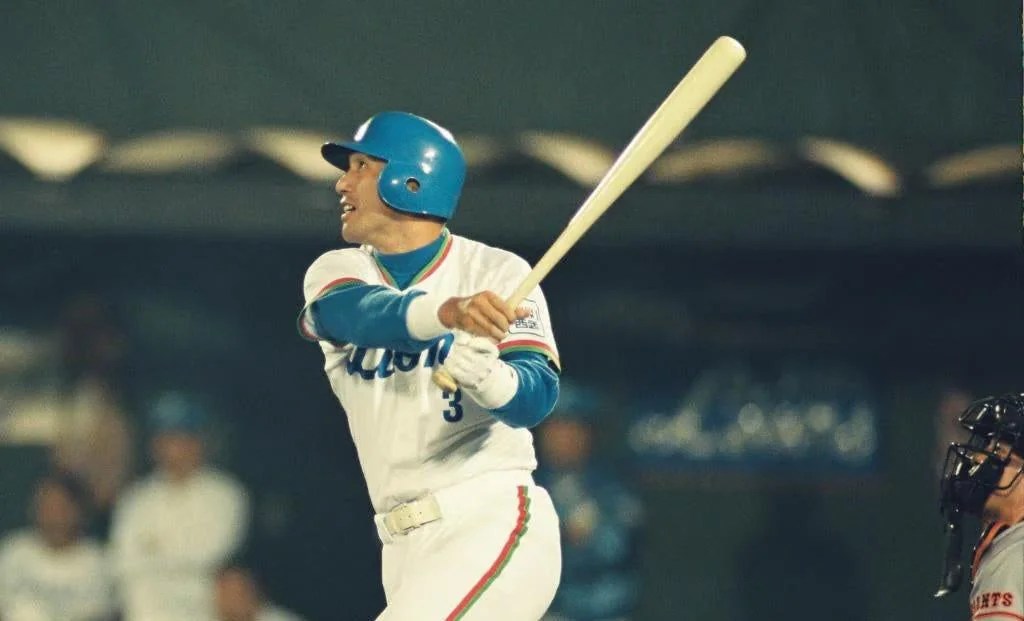
Instead of Tokyo, he went just outside of it to Saitama and the Seibu Lions. And almost immediately, he became something else again.
On April 5, 1986, in the second game of the season, he stepped to the plate for just the second time in his professional career. He was eighteen years old. The stadium was full, the expectation already unreasonable. The pitcher was Shuji Fujimoto of the Nankai Hawks, working toward what looked like a complete-game victory.
Kiyohara turned on an inside fastball and sent it screaming into the left-field seats.
As he rounded first base, he leapt into the air. Not the restrained hop of a veteran, but a full-bodied jump, the kind you make when something you have imagined for years suddenly becomes real. The Lions lost the game 4-2, but it didn’t matter. The home run swallowed the night whole. Fujimoto, still the winning pitcher, walked into the postgame interview and muttered, “I won, but…”
After the opening blast, reality arrived quickly. Pitchers adjusted. Night games under unfamiliar lights exposed timing issues. He went hitless for stretches long enough that whispers began to circulate about a demotion to the minors. Coaches debated it openly. Mori listened and declined.
Instead, he waited.
By midsummer, the waiting paid off. Kiyohara’s swing slowed down just enough to find its shape. His hands stayed back. His balance improved. The results followed in waves. In August, he hit over .320. In September, over .360. By October, he looked unstoppable.
By the end of the season, the line looked unreal: .304 average, 31 home runs, 78 runs batted in. Rookie of the Year. The most home runs ever hit by a Japanese rookie. Attendance surged. Merchandise exploded. Television found a new face. Seibu’s patience with him, especially during his early struggles, proved decisive.
For a brief moment, he was not “the uncrowned king,” not “the problem child,” not a symbol of anything larger than himself. He was Kiyoma, a nickname that captured youth, novelty, and something almost cartoonish in its brightness. He lived in the Seibu dormitory, his small room filled with gifts from fans after road trips. His monthly allowance was modest. His favorite meal was champon, a noodle dish, from the Ringer Hut near the dorm, eaten with teammates who treated him less like a prodigy than a younger brother who happened to hit the ball very far.
The Lions won relentlessly and celebrated loudly. Robert Whiting once described a championship celebration that looked less like Japanese baseball tradition and more like controlled chaos: beer sprayed, cake smashed into faces, teammates dumped into barrels of sake, Kiyohara wearing a Ronald Reagan mask while pouring alcohol on a cameraman. Fans loved it. One woman said the Giants were too proper, too dull. The Lions, she said, were interesting. Kiyohara was the youngest player on the team and spoke like he belonged to no hierarchy at all.
But even during those years, something was already slipping. During the 1987 Japan Series, Seibu was one out away from defeating the Giants. Kiyohara was at first base and he was crying. Not after the final out but before it. His legs shook. Teammates yelled at him to focus. He later said the tears came without warning, that once he took the field his body gave way. When the final fly ball settled into an outfielder’s glove, Seibu celebrated another title. Two years earlier, the Giants had passed on him. Now he was beating them on the sport’s biggest stage, as the cleanup hitter for a team that had become a dynasty almost overnight. The tears were victory and vindication tangled together, indistinguishable.
From 1986 through the mid-1990s, the Lions captured league titles with such regularity that seasons began to blur together. Eight league championships in nine years. Six Japan Series titles. A dynasty for a franchise that had been an afterthought for nearly two decades.
Kazuhiro Kiyohara stood at the center of it.
He was not alone. Koji Akiyama ran the bases like a man late for something important. Orestes Destrade brought a foreigner’s blunt force to the middle of the order. Behind them, the pitching staff turned games into negotiations between balls and outs. But Kiyohara was the constant cleanup hitter who arrived first and stayed longest.
From the outside, the numbers piled up neatly. Twenty-one consecutive seasons with double-digit home runs, beginning his rookie year. Thirteen straight seasons of twenty or more. Sixteen total seasons clearing that mark. Walks in bulk. Balls crushed to all fields. Hits absorbed by his body—196 of them, more than anyone in league history. Twelve walk-off home runs. Twenty walk-off hits. Eleven grand slams.
He led the league in on-base percentage twice. He won Gold Gloves at first base five times, more than any Pacific League first baseman had before him, and contemporaries would later say that, at his peak, he was the best defensive first baseman in Japan. Jim Allen once put it plainly: Kiyohara saved more runs with his glove than people noticed because they were too busy watching his bat.
And yet, for all of it, the major individual titles never arrived. No batting title. No home run crown. No RBI title. Not once.
On paper, Kiyohara was one of the most productive hitters in the sport every year. In memory, he was something more complicated. He was the cleanup hitter for a dynasty who never ruled a season outright.
Even Sadaharu Oh framed it this way: Kiyohara, he suggested, was too versatile for his own good. A hitter who drove the ball to all fields would never pile up the kind of pull-heavy totals that win home run titles. From Oh’s perspective, power requires commitment. From Kiyohara’s, a home run was simply a perfectly struck hit that kept carrying.
Free agency turned him into the center of gravity of Japanese baseball. The Tigers were willing to say they would change their stripes to get him. Shigeo Nagashima told him to leap into his chest and even floated the idea of handing over number 3, a gesture Kiyohara understood was too heavy to accept. But he accepted the Giants uniform. It was, finally, the dream.
In his first season, the numbers were solid: 32 home runs, 95 RBIs. On paper, it looked like the continuity of his Seibu years. In reality, it felt like insufficiency. The batting average dipped. The strikeouts climbed: 152 of them, a Central League record at the time. Each miss drew commentary. Each slump fed the idea that the player who once looked unstoppable was now fighting gravity.
The criticism poured in. Too heavy. Too slow. Too emotional. Too indulgent. He had piercings in his ears. His skin was permanently tanned. His body looked different than it had in Seibu. He didn’t fit the Yomiuri aesthetic.
There were moments when it almost worked. Early in the season, he shared the field with Kuwata again, this time as teammates. When Kuwata returned from injury, Kiyohara hit a home run in his comeback game, the two of them standing together afterward like an echo from another life. For a brief instant, the story felt complete. KK, reunited.
But nostalgia does not protect you from fastballs inside. He tinkered with his swing. He altered his stance, his weight training, his body composition. The more he tried to adjust, the further he drifted from the hitter who had once trusted himself to react rather than plan. His body grew heavier. His legs betrayed him. Knee pain became chronic. Seasons fractured into stretches of usefulness interrupted by injury and recovery.
In early March of 2000, in cold, wet conditions during an exhibition game, he tore a muscle in his leg. For the first time in his professional life, Kiyohara opened the season in the minors. The reaction from above was brutal. The team’s owner remarked that the Giants’ chances of winning had improved in his absence.
And yet, something unexpected happened.
When Kiyohara returned in July, the atmosphere at Tokyo Dome had changed. He was no longer announced as the centerpiece of a championship machine. He was introduced as a pinch hitter and when his name was called, the stadium rose. Fans sang. They cheered not because he would save the team, but because he was still there. A home run in his first game back triggered something close to collective release. Even when he failed, the applause remained.
But still, the relationship with the Giants frayed. His body could no longer support the version of himself he needed to be in Tokyo. Playing time shrank. In 2005, he refused a high-five from the bench after a home run, a small act of defiance that became a large symbol. Not long after, the Giants told him he was no longer part of their plans.
The dream ended quietly. In a parked car, alone, he cried. The call that changed things came from Akira Ohgi.
Ohgi, already gravely ill, had taken on the thankless task of leading the newly merged Orix Buffaloes, a team born from contraction and resentment. He believed stubbornly that stars still mattered, that baseball owed something to memory and spectacle. He called Kiyohara directly.
“Come home to Osaka,” he said. “Let me give you your last stage.”
Kiyohara hesitated. His body was failing, his confidence was fragile. But Ohgi kept calling, speaking not of contracts but of responsibility and unfinished business. When Kiyohara finally agreed, it felt less like a comeback than an acceptance. Ohgi, tragically passed away before the 2006 season.
When he hit a walk-off home run in May 2006, he spoke afterward not about himself, but about Ohgi and the fans.
“This might be the happiest home run of my career,” he said. “It didn’t feel like it was just mine.”
His body, however, would not cooperate. Knee surgeries followed. In 2007, he did not appear in a single game, the first such season of his professional life. He decided 2008 was going to be the end.
His final game came in Osaka. Sadaharu Oh managed the opposing team. Ichiro watched from the stands. In his final at-bat, he struck out, swinging hard, fully committed.
Afterward, with his two sons beside him, he apologized to the fans, the media, and the game itself.
“I wasn’t always strong,” he said. “But I gave everything I had.”
Oh took his hand and said, “In the next life, let’s be teammates. Let’s hit home runs together.”
For a moment, improbably, it felt like closure.
He left with 525 home runs, fifth all-time, without ever leading the league. Twenty-one seasons with double-digit home runs. Records everywhere. A shape no one else quite matched.
But after baseball, everything fell apart.
His marriage ended amid reports of domestic violence. He was arrested in 2016 for possession and use of stimulants. The trial revealed years of addiction. He admitted to using drugs after retirement, denied using them as a player, and spoke of emptiness, of having no next step. He was convicted and given a suspended sentence. His Hall of Fame candidacy was withdrawn. His finances collapsed. His health deteriorated. His arrest shocked the country not because it was unimaginable, but because it retroactively contaminated everything people wanted to believe about him.
Kazuhiro Kiyohara will never be a clean legend. How should baseball remember someone like him?
Thomas Love Seagull’s work can be found on his Substack Baseball in Japan
 SABR Asian Baseball Research Committee Blog
Leave a comment