
by Thomas Love Seagull
A recent poll for a TV special saw more than 50,000 people in Japan vote for their favorite retired baseball players. 20 players emerged from a pool of 9,000. Yes, they could only vote for players who are no longer active, so you won’t see Shohei Ohtani or other current stars on this list. Which is probably smart because I’m sure Ohtani would win by default. There are, however, players who were beloved but not necessarily brilliant, and foreign stars who found success after coming to NPB. Unsurprisingly, the list leans heavily towards the past 30 years, with a few legends thrown in for good measure.
Over the next few weeks, I’ll be profiling each of these players. Some of these players I know only a little about, so this will be as much a journey for me as, hopefully, it will be for you. It’ll be a mix of history, stats, and whatever interesting stories I can dig up.
For now, have a look at the list below and see how the public ranked them. I’ve included the years they played in NPB in parentheses.
20. Alex Ramirez (2001-2013); 19. Yoshinobu Takahashi (1998-2015); 18. Warren Cromartie (1984-1990), 17. Takashi Toritani (2004-2021); 16. Suguru Egawa (1979-1987); 15. Katsuya Nomura (1954-1980); 14. Tatsunori Hara (1981-1995); 13. Kazuhiro Kiyohara (1985-2008); 12. Masayuki Kakefu (1974-1988); 11. Masumi Kuwata (1986-2006); 10. Atsuya Furuta (1990-2007); 9. Randy Bass (1983-1988); 8. Daisuke Matsuzaka (1999-2006, 2015-2016, 2018-2019, 2021); 7. Tsuyoshi Shinjo (1991-2000, 2004-2006); 6. Hiromitsu Ochiai (1979-1998); 5. Hideo Nomo (1990-1994); 4. Hideki Matsui (1993-2002); 3. Shigeo Nagashima (1958-1974); 2. Sadaharu Oh (1958-1980); 1. Ichiro Suzuki (1992-2000).
The unlikely star who learned what it meant to carry Hanshin
Some players arrive in professional baseball destined to be stars due to their size or abilities or knack for performing in big moments. Some were already on the national stage due to legendary performances in high school tournaments or breaking records in university leagues. And still some other players grow into greatness slowly enough that, even while it is happening, nobody quite realizes what they are watching.
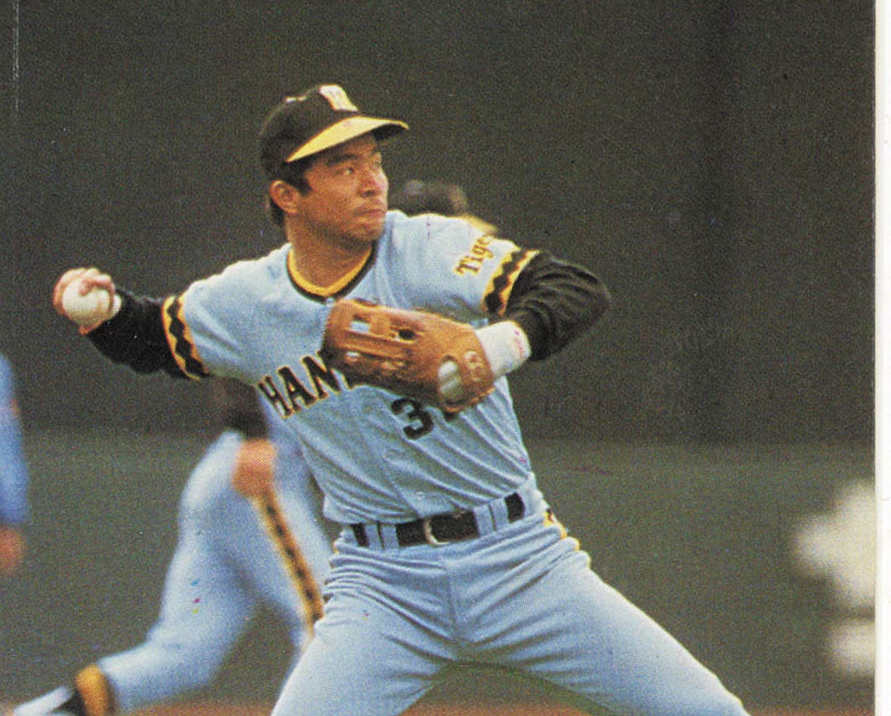
Masayuki Kakefu was not supposed to become “Mr. Tigers.”
The men who carried that title before him had all entered professional baseball as celebrities. Fumio Fujimura was a Koshien* hero. Minoru Murayama was a national collegiate ace. Koichi Tabuchi arrived as the prince of university baseball, already famous for hitting home runs before he wore a professional uniform. The title belonged to players who were known long before they reached Hanshin.
*Koshien refers to the high school baseball championship tournament that takes place every summer, held at Koshien Stadium, which is also the home of the Hanshin Tigers.
Kakefu was different. He had reached Koshien once as a second-year student, but by his senior year there were no professional offers. He was small for a power hitter, 168 or 170 centimeters (around 5 feet 7 inches for my fellow Americans), and few scouts imagined him surviving in professional baseball. It is almost impossible, knowing what came later, to imagine that the boy who would eventually hit 349 home runs was once considered an unlikely prospect.
His path opened only through chance and persistence. Through a connection to Hanshin’s Motoo Andoh arranged by his father Taiji, who had coached amateur baseball, Kakefu was allowed to participate in Hanshin’s autumn camp, effectively as a tryout. Manager Masayasu Kaneda saw something others had missed and insisted the young infielder be kept close to the first team. The Tigers selected him in the sixth round of the 1973 draft, not as a future centerpiece but as a hopeful project.
After Kakefu’s rookie season, during a gathering with team officials, his father made a simple request: “Masayuki has been trained to endure anything. Please give my son a chance to become a regular.” It was a simple request, but it captured something essential. Before Kakefu became known for power or popularity, he had been prepared to withstand difficulty. That would prove to be his defining trait.
Even after being drafted, nothing came easily. He was not taken to the main spring camp in Aki City and instead remained behind at Koshien with the leftover group. When he first watched the regular players train, he later recalled that everyone looked like monsters. Koichi Tabuchi in particular seemed enormous, “like he was two meters tall*,” and Kakefu wondered whether he truly belonged in that world. Unsure of himself, he asked Tabuchi whether someone with such a small body could survive as a professional. Tabuchi answered simply: professional baseball was interesting precisely because even smaller players could become great. Then he handed Kakefu one of his own bats. The words and the bat became treasures.
*About 6’7” for my American friends.
When he signed, he did not yet have a uniform number. Only later was he handed number 31. Stories would eventually claim the number combined Shigeo Nagashima’s 3 and Sadaharu Oh’s 1, or symbolized working three times harder to become number one. Kakefu laughed at those explanations. “All after-the-fact,” he said. It was simply the lowest number available. But he intended to make it his own.
Opportunity arrived by accident. During an open-season stretch, injuries and personal absences forced the Tigers to summon him from the minors. Used first as a pinch hitter, he produced results immediately, then continued hitting when given a start at shortstop. Against expectations, he made the Opening Day roster. Chunichi Dragons pitcher Senichi Hoshino later remembered facing him early and noticing a violent full swing that produced a sharp foul tip. Even in an ordinary groundout, Hoshino felt instinctively that this was a future star.
Strong performances earned him a roster spot, and by his second season he was locked in a fierce competition at third base with first-round draft pick Noriyoshi Sano. Endless defensive drills under coach Andoh pushed him to exhaustion: he once fell asleep during practice and was sharply reprimanded. Nothing about his rise was smooth. Errors came, confidence wavered, and his rookie numbers were modest at best. Yet he kept working. Even after nights out, he returned to the dormitory and swung a bat on the rooftop until one or two in the morning. Practice, he believed, was the only thing he possessed that others could not take away.
By 1976, only his third professional season, now a little taller at 175 centimeters, he broke through with a .325 batting average, 27 home runs, Best Nine honors, and the confidence that came from finishing ahead of Sadaharu Oh in the batting rankings. At twenty-one years old, he became the face of a phenomenon. “Kakefu calls” echoed through Koshien Stadium. Banners bearing the number 31 appeared in the stands. Young fans and women in particular were drawn to the shy young player whose gentle smile disappeared the moment he stepped into the batter’s box, replaced by an intense, almost feral focus. A song titled “GO! GO! Kakefu” was even released, and the excitement surrounding him became known as the “Kakefu Fever.”
Then came 1978. Tabuchi, the third Mr. Tigers, was traded away at the end of the season. Soon afterward he phoned Kakefu with advice that would follow him for the rest of his life: “Finish your career in the striped uniform.”
Suddenly the responsibility of the franchise shifted. Kakefu did not ask for it, but he felt it immediately. When he struggled, newspaper headlines blamed him directly. When he struck out four times, his name filled the front pages. “Hitting and becoming a headline anyone can do,” he later said. “But becoming the headline when you fail is different. That’s when I understood what Tabuchi had been carrying.”
In 1979 he responded with 48 home runs, breaking Fujimura’s long-standing franchise record and winning his first home run title. Yet the transformation required reinvention. Kakefu had been a gap-to-gap batter by nature. Now he was expected to be a slugger in Koshien, a park hostile to left-handed power.
He engineered power through mechanics. By striking the ball millimeters underneath its center, he created spin that allowed the hamakaze, the sea breeze at Koshien, to carry drives toward left field. “Home runs are something you aim for,” he believed. “A single is often just a missed home run.”
Of course, there were drawbacks to his transformation. The swing demanded violent rotation from his lower body and placed enormous strain on him physically.
His rivalry with Giants ace Suguru Egawa soon became the defining confrontation of the era. Kakefu believed a cleanup hitter’s duty was to defeat an ace’s best pitch. Egawa’s rising fastball represented the ultimate risk. “You either win or you lose,” he said. “That’s the job of the fourth batter.” Their duels became the centerpiece of the Tigers-Giants rivalry.
Fame, however, carried darker consequences. During slumps in 1980, fans shouted for him to return to Chiba. Harassing phone calls arrived at home and even letters containing knives were mailed to him. Newspapers, as they tend to do, speculated about trades. The pressure broke his trust in people outside a small inner circle.
After injuries disrupted 1980, he returned in 1981 and made a radical decision. He abandoned the pursuit of home runs and returned to being what he believed he truly was: a line-drive hitter. He hit .341, rediscovering joy in baseball.
He later described that season as a return to his original self and to the hitter he believed he had always been. But fans were dissatisfied. A supporter once asked why he had hit “only” 23 home runs.
“I realized then,” he said, “if I didn’t hit home runs, I wouldn’t be forgiven.”
So he changed and rebuilt his swing once again. The results were immediate: home run and RBI titles in 1982, another home run crown in 1984, and the elegant opposite-field blasts became known as the “Kakefu Arch.”
More than statistics, he embraced durability. Advice from Japan’s ironman Sachio Kinugasa convinced him that the fourth hitter must appear every day, to endure in front of fans whether succeeding or failing. From 1981 through 1985, Kakefu played every game, anchoring the lineup without interruption.
After years of shouldering expectations, the moment he had been preparing for finally arrived in 1985. Coming off of consecutive 4th place finishes, it was supposed to be a rebuilding year. Yoshio Yoshida, in his second stint as manager, described it as laying a foundation, and few were imagining a championship. That changed early in the season at home against the hated Yomiuri Giants.
Randy Bass launched a towering home run toward the backscreen. Kakefu followed calmly with one of his own. Akinobu Okada completed the unforgettable sequence with a third blast to nearly the same spot. The three consecutive backscreen home runs felt like an announcement. Something had changed.
Suddenly, Hanshin’s lineup was dangerous. Bass dominated pitchers, Okada broke out, and veterans like Akinobu Mayumi stabilized the offense. At the center stood Kakefu, the longest-tenured Tiger, redefining the cleanup role. Sometimes he forced pitchers to face Bass, sometimes he extended innings, and sometimes he accepted walks instead of chasing glory.
Hanshin hit a league-leading 219 home runs and captured its first pennant in twenty-one years before winning the franchise’s first Japan Series title. Yoshida later credited victory to having the best cleanup hitter in Japan. Kakefu, hitting fourth every game, combined power with patience, drawing league-leading walks while driving in runs and protecting teammates in the lineup. At thirty years old, in his twelfth season, Kakefu finally experienced the reward that responsibility had promised.
The celebration revealed his personality as much as his performance. During the beer-soaked victory party, teammates found him smiling while sitting inside a ceremonial sake barrel, drenched but joyful. It was a rare glimpse of playfulness from a player otherwise known for seriousness and responsibility.
But men called Mr. Tigers rarely live peaceful careers. In 1986 a hit-by-pitch shattered his wrist and ended his streak of 663 consecutive games. More injuries followed—shoulder, back, hand—and the powerful swing that had defined him and carried the franchise began to fade. He later admitted something inside him changed after that first fracture, as if the tension that drove him loosened all at once. Criticism returned. Doubt followed. Personal struggles and declining performance marked his final seasons, and by 1988, still only thirty-three, he knew the end had come.
Other teams offered opportunities to continue playing. Even Shigeo Nagashima suggested rebuilding quietly before returning. But Kakefu remembered something Tabuchi had told him years earlier after being traded: never take off the striped uniform midway. Kakefu chose to retire as a Tiger.
His final appearance at Koshien came in October 1988 against Yakult. He started, as he had so many times, batting fourth and playing third base. The symbolism was unmistakable: the role remained even as the body no longer could. In his last plate appearance, he drew a walk. The opposing catcher reportedly urged him to swing, to give the crowd one last moment, but Kakefu did not. He accepted first base quietly.
He left with 349 home runs, 1,656 hits, a .292 average, three home run titles, an RBI crown, seven Best Nine selections, six Golden Gloves, and ten consecutive All-Star appearances. Yet numbers alone never explained his meaning.
I asked Trevor Raichura, a social media content creator who occasionally serves as an interpreter for the club, why Kakefu still means so much to Tigers fans. He didn’t hesitate. Kakefu had not arrived as a prodigy but as a late draft pick who forced his way into the lineup. He practiced relentlessly, played dependable defense, and appeared every day. Trevor noted that Randy Bass later said his own success depended on hitting in front of Kakefu, a reminder that the cleanup hitter’s role was not only to shine but to make others dangerous. He never celebrated at an opponent’s expense or carried himself as larger than the game, and when injuries shortened his career, fans saw not decline but sacrifice: a smaller player who had spent every ounce of himself generating power in a ballpark that rarely rewarded left-handed hitters. In that sense, Kakefu’s legend rests as much on how he played as on what he achieved.
He once refused an offer to change his number to 3 out of respect for Nagashima, insisting that 31 should become his own identity. Later he said numbers should live on players still competing rather than be preserved in tribute. Baseball, to him, belonged on the field.
Masayuki Kakefu never hit a walk-off home run in regular-season play. It feels oddly fitting. His career was less about single dramatic moments than about sustained responsibility and the daily weight of expectation carried through effort and endurance. He was not born a star, nor was he destined for greatness in the way earlier “Mr. Tigers” had been. He became one through relentless work, adaptation, and acceptance of a role larger than himself.
For years, when Hanshin fans looked toward the batter’s box in moments that mattered most, they saw number 31 standing there, shoulders squared against impossible expectations.
Because once he accepted what it meant to be the cleanup hitter of Hanshin, there was nowhere else he believed he could stand.
Thomas Love Seagull’s work can be found on his Substack Baseball in Japan
 SABR Asian Baseball Research Committee Blog
Leave a comment