
By Carter Cromwell
The outlook – mostly sunny. The temperatures – around 20 C (70 F). Wind – gentle breezes for the most part. Shirt-sleeve weather. Perfect for having a snack, enjoying a favorite beverage, and casually observing a spring-training baseball game.
In Okinawa.
Not in Florida, nor Arizona. Not Major League Baseball, but Nippon Professional Baseball (NPB) – the wellspring of talent for Samurai Japan, winner of three World Baseball Classic titles and the favorite of many to win the 2026 tournament currently under way.
Nine of the 12 NPB teams trained this February in the more or less tropical environs of Okinawa – the Yomiuri Giants, Hanshin Tigers, Rakuten Golden Eagles, Chiba Lotte Marines, Chunichi Dragons, Hiroshima Carp, Yokohama DeNA BayStars, Nippon-Ham Fighters, and Tokyo Yakult Swallows. Absent are the SoftBank Hawks, Seibu Lions, and Orix Buffaloes, who train in Miyazaki.
In addition, the Korean Baseball Organization’s (KBO) Kia Tigers and Samsung Lions and the farm club of the KBO’s Doosan Bears trained here this year, along with the Korean team in the World Baseball Classic.
The NPB teams had workouts and games on Okinawa from February 1 until late in the month, after which they moved to the mainland for preseason games that continue until March 20. The regular season begins March 27.
Traveling to the other side of the world to see spring training might seem as a stretch to many fans, but the experience can be worth it. The days are often pleasant in mid-to-late February. Though bounded by the East China Sea and the Philippine Sea, at this time of year Okinawa lacks the heat and humidity of Florida and the dryness of Arizona. The experience in Okinawa is more relaxed and less commercialized than MLB spring training. There, fans won’t pay regular-season prices for tickets to exhibition games. Put another way, they won’t pay big league prices to (often) see minor league players.
Also, the spring training map in Okinawa is pretty compact, making it easier for fans to see multiple teams. The farthest distance between any two sites is 47 miles (76 km), which makes it very similar to the Cactus League in Arizona where the 10 spring training ballparks are all in the Phoenix area and the greatest distance between any two is also 47 miles.[i] Florida’s Grapefruit League is much more spread out, with many of the stadiums more than 100 miles apart and the longest distance between any of the two is 217 miles (350 km).[ii]
Some observations from a week-long sojourn in Okinawa last month:
- It was interesting to see pitchers Kenta Maeda and Shintaro Fujinami – who established themselves in NPB before playing in the United States – trying to revive their careers. The two started for Rakuten and Yokohama, respectively, at Ginowan Municipal Stadium, the spring home of the BayStars.
Maeda had 10-season stint in MLB but had a rough time during his two seasons with Detroit. The Tigers released him early in the 2025 season, and he then spent time in both the Chicago Cubs and New York Yankees organizations.
Fujinami was with the Athletics and Baltimore in 2023, in the New York Mets minor league system in 2024, and began last season in Seattle’s organization before being released and signing with the BayStars, for whom he was 1-0 with a 4.09 ERA in six appearances. At all his stops, he displayed a triple-digit fastball combined with difficulty throwing strikes.
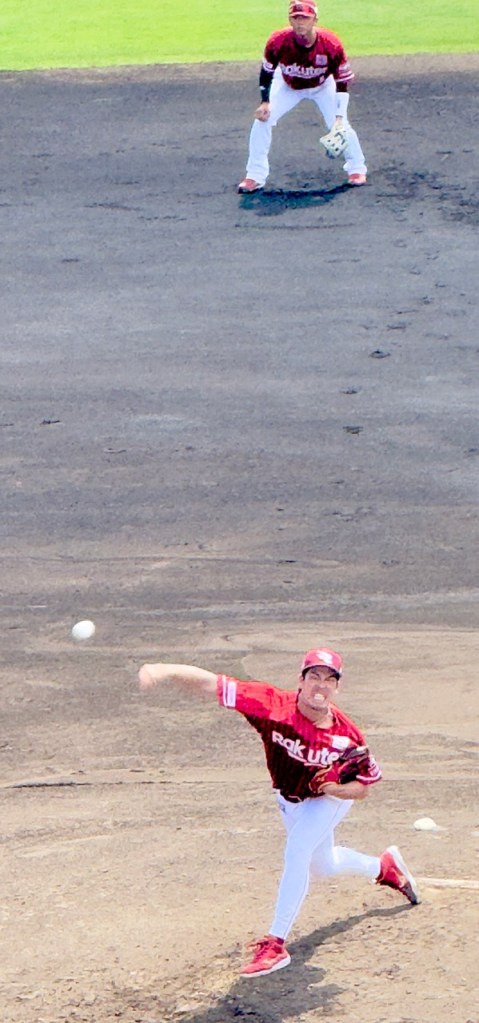
Maeda pitched two innings against Yokohama, retiring the first four batters he faced before running into trouble in the second inning. With one out, he gave up a four-pitch walk, a flare single, and two RBI singles. Fujinami went three innings, allowing a run on three hits and – surprisingly – no bases on balls.
- Hanshin Stadium, regular-season home of the Tigers, is the only NPB facility with an all-dirt infield, but all the spring training ballparks feature these. It means the grounds crew must rake around the bases and the mound after the third, fifth, and seventh innings, and they water down the entire infield after the fifth inning. At MLB ballparks, smoothing of the infield usually happens just once during a regulation-length game, and there is no need to water down the dirt areas during a game.
- Despite these being merely exhibitions, the teams’ cheering sections were at each game, with noisemakers and cheers for each batter just like in regular-season contests.
- The largest of the spring training facilities is Okinawa Cellular Stadium, which hosts the Yomiuri Giants. It has 15,000 fixed seats in addition to – it is said – room for another 15,000 either standing or sitting on the grassy area beyond the outfield. The official attendance for a game there against the Swallows was 7,400.
- During the Giants – Swallows contest, a foul ball hit a nearby seat and bounced off a young boy’s face. Interestingly, the alert mom made sure to grab the ball before attending to her son, who, fortunately, did not need medical attention.
- It’s always interesting to see import players here. Bobby Dalbec, once a top prospect for the Boston Red Sox and now 30, is in his first year with the Giants. He singled in his only at-bat against the Swallows. Another MLB alum – Trey Cabbage (Angels, Astros, Pirates) – is in his second season with Yomiuri. He was 1-2 in the game.
- A contest between the Marines and Dragons included ex-MLB players such as Miguel Sano (Twins, Angels), Gregory Polanco (Pirates), Jason Vosler (SF Giants, Reds, Mariners), Orlando Calixte (Royals, SF Giants), and Andre Jackson (Pirates, Dodgers). Polanco also spent three years with the Yomiuri Giants, and Jackson two seasons with the BayStars. In this particular game, Sano hit a long home run to right-center field in his first at-bat.
- Luke Voit, who played for five MLB teams over seven seasons, is back with Rakuten after a successful half-season in 2025 in which he hit .300 with 13 home runs in 67 games. He’s the team’s primary first baseman and sometimes designated hitter.
- Each NPB team is allowed to have as many as four import players on the active roster at any one time.
- A number of key players were not in Okinawa, instead playing for Samurai Japan as it ramped up for the WBC that began in early March: pitchers Hiromi Ito (Fighters), Taisei Ota (Giants), Yumeto Kanemaru (Dragons), Atsuki Taneichi (Marines), Hiroto Takahashi (Dragons), Shoma Fujihira (Golden Eagles), and Koki Kitayama (Fighters); catchers Seishiro (Sakamoto (Tigers) and Yuhei Nakamura (Swallows); infielders Shugo Maki (BayStars), Kaito Kozono (Carp), and Teruaki Sato (Tigers); and outfielder Shota Morishita (Tigers).
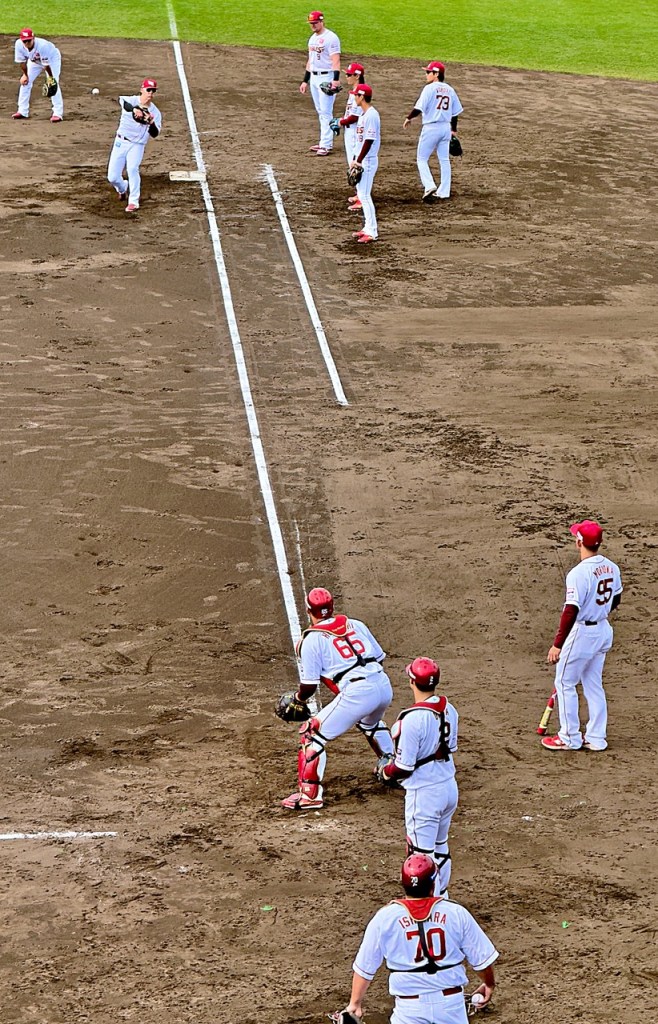
- Teams in the U.S. nowadays rarely take infield before a game, but it remains a staple of all the Japanese teams. It’s just one indication of their focus on fundamentals, and it’s entertaining to see them go through it so crisply. Infield ends with a foul popup to the catcher, and the fans always cheer when he catches it.
- As mentioned earlier, there is not as much commercialization of spring training here, but one can still find the usual caps, jerseys, and other paraphernalia for sale. Most of the food is outside the stadiums under tents or in food trucks, rather than inside. You’ll find corn dogs, but also yakisoba, takoyaki (octopus balls), bento boxes, curry rice, yakitori (grilled chicken skewers), and long potatoes. Other options include gyukatsu (fried beef cutlet) rice bowls, edamame, ramen, and more.
- In the Marines – Dragons game, the Marines pitcher struck the leadoff hitter in the head with his first pitch in the bottom of the first inning and was immediately ejected. An NPB rule calls for an ejection whenever a batter is hit in the head with a pitch, regardless of whether it was intentional.
- One will see quite a few players with three-digit numbers on the backs of their uniforms. Those designate players on the farm teams.
- During workouts, one can observe players practicing tagging up on fly balls. Hitters also practice fouling balls off, a skill that helps them stay alive on two-strike counts. These are “small” things that can make a difference between success and failure.
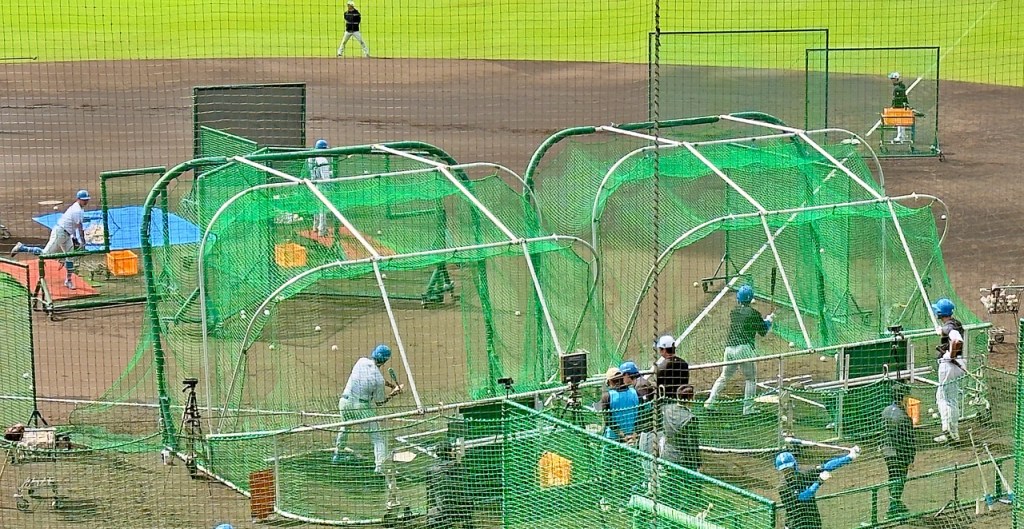
- The teams also utilize two cages side by side during batting practice. Hitters in one work on pulling the ball, while the batters in the other practice going to the opposite field.
- Outfielder/designated hitter Franmil Reyes, who appeared for four MLB teams, has hit 57 home runs the last two seasons for Nippon-Ham. The Fighters’ spring training home is in Nago and right next to the ocean. During one batting practice session, Reyes launched seven home runs into the water – a different take on the “splash hit” made famous at San Francisco’s Oracle Park.
- Teams often will work out in the mornings and then have intra-squad games in the afternoons. It’s surprising to see how many fans come to see what might seem like mundane workouts. At the Fighters’ camp, large crowds stood by the fence just to watch pitchers go through fielding practice.
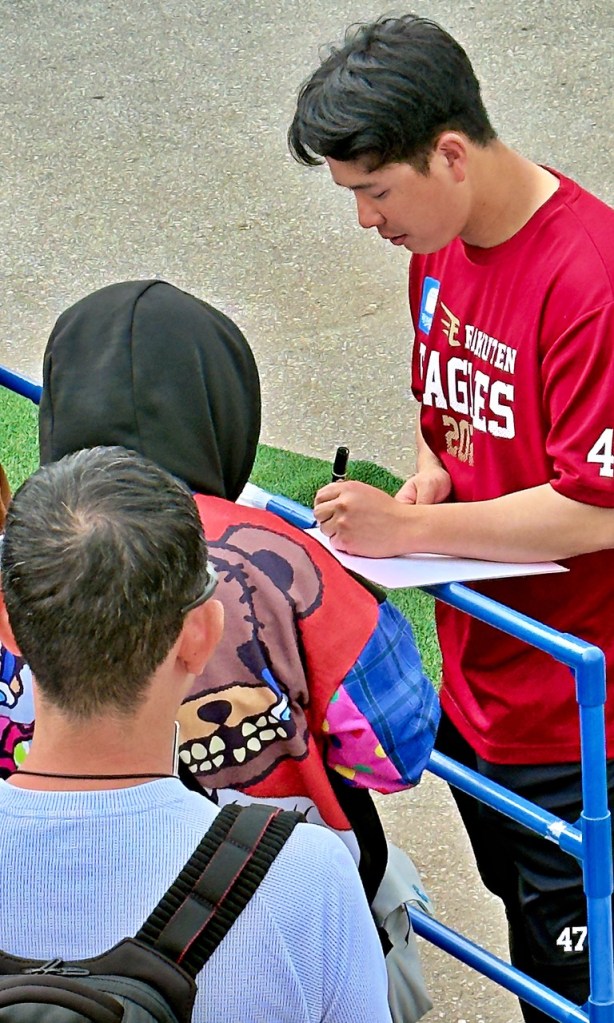
- When workouts are over, fans hoping for autographs will rush to line up at gates they know players will be exiting through. Many of the players comply.
Away from the ballparks, there are other attractions that are worth one’s time. Okinawa has more history than many realize. Often, Westerners think of Okinawa only in terms of World War II or the many current U.S. military installations there, if they think about it at all.
Okinawa was officially annexed by Japan in 1879 when the Meiji government forcibly abolished the Ryukyu Kingdom, deposed the king, and established Okinawa Prefecture. This finalized years of increasing control by the Satsuma Domain, which had controlled the region as a vassal state since 1609.
Consider the following:
- Churaumi Aquarium – one of the top tourist attractions in Okinawa, featuring whale sharks and one of the largest aquarium tanks in the world
- Shurijo Castle – completed in the 15th century, it was the royal residence for the king and his family, and it also functioned as the government house of what was the Kingdom of Ryukyu prior to Japan’s takeover.
- Okinawa World, a theme park featuring a massive natural cave, a craft village and snake museum
- Okinawa Prefectural Peace Memorial Museum & Cornerstone of the Peace, established in 1975 next to the spot where the World War II Battle of Okinawa ended
- Kokusai St. & Makishi Market
- Tsushima-maru Memorial Museum – Dedicated to a Japanese passenger/cargo ship that was sunk by the submarine USS Bowfin during World War II, while carrying approximately 1,800 passengers, including many schoolchildren
- Surfing is a year-round activity on Okinawa, but it’s recommended only for intermediate to advanced surfers because of shallow, sharp coral reef breaks. Newbies who often fall from their boards will get their feet cut by the coral.
[i] https://www.springtrainingconnection.com/distances.html
[ii] https://www.springtrainingconnection.com/distances.html
 SABR Asian Baseball Research Committee Blog
Leave a comment