
by Carter Cromwell
Africa isn’t on most radar screens when it comes to baseball, but it’s beginning to show up – at least as a speck – in Japan.
On one hand, Africa was the last of the six major continents to develop the sport and the most recent one to have produced a major league player, which happened in 2017 when South African Gift Ngoepe made his debut.
However, baseball is being played in Africa, and it’s growing, albeit on a small scale and often hindered by minimal resources and infrastructure. Estimates are that 20 or so African countries have baseball programs, with Uganda and South Africa the furthest ahead. Baseball/softball academies exist in Cameroon, Kenya, Uganda, South Africa, Nigeria, Botswana, and Zimbabwe – the most prominent being the one in Uganda operated by the Los Angeles Dodgers. People on the ground in countries such as Malawi, Benin, Tanzania, Mozambique, and Niger are working with youngsters to cultivate interest in the game.
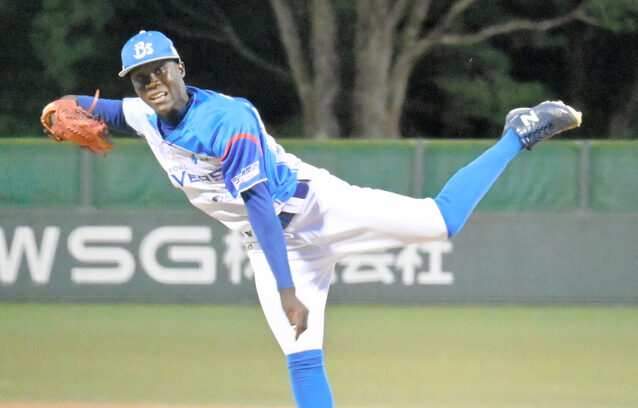
Additional evidence of progress is the growing number of Africans playing in the Japanese independent leagues. Last year, Ugandans Fred Kyazze, Allan Kabenge, and Isabirye Musa Azed – all pitchers – and Dennis Kasumba, a catcher, played for the Asahikawa Be:Stars of the Hokkaido Frontier League. At the same time, Ugandan Kato Edrine pitched for the Hyogo Bravers of the Kansai Independent League.
Kyazze had a couple of saves and a strikeout rate of 13.9 per nine innings, while Musa had an earned-run average of 2.98 and held opposing batters to a .185 average.
The number has grown this season, as the Be:Stars have seven Africans on the team. Besides Kasumba and Kabenge, they have infielders Twaise Geiven and Bernard Eluk, pitchers Morris Ogwal and Erick Ojara from Uganda, and pitcher Dau John Wol Deng of South Sudan. The Be:Stars also signed Mouki Kora from Benin, but he has yet to be placed on the roster. Edrine, 19, has moved on to the Tokushima Indigo Socks of the Shikoku Island League.
Eluk, 18, Geiven, 16, Ogwal, 17, and Ojara, 18, represented Uganda at the U-18 Baseball World Cup African Qualifier in 2023. Edrine, Kyazze, Azed, Ojara, Ogwal, and Eluk previously trained at the Dodgers’ academy.
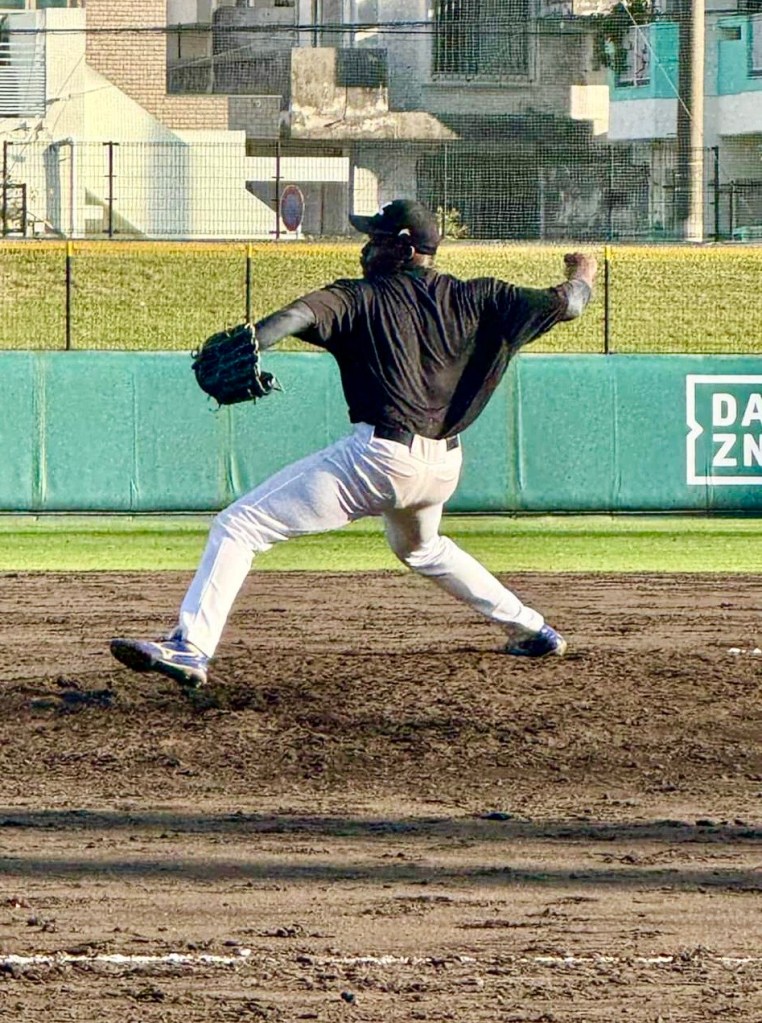
Rather than returning to their home countries at the end of the season, the players are spending the entire year in Japan to continue training and developing.
In addition, the Saitama Seibu Lions of Japan’s Nippon Professional Baseball (NPB) signed the pitchers Azedand Kyazze and will have them play for their developmental club Shinano in the Baseball Challenge League – another indication of clubs broadening their scouting and development efforts.
In fact, the Lions have developed a stated overseas strategy with the objective of strengthening the scouting, acquisition, and development of foreign players “who are expected to play an active role in the future in NPB.”
Other NPB teams, such as the SoftBank Hawks, Yomiuri Giants, and Orix Buffaloes, have expanded their lower division systems as a way to compete for international talent, but none so far has had the geographic focus of the Lions. While NPB teams have usually concentrated on the Americas and Taiwan when recruiting players from outside Japan, Seibu is also looking in areas in which they will have little or no competition from NPB or MLB teams.
“The [Seibu] goal is not to just find one diamond in the rough – it’s to create a permanent infrastructure where African players can move from the independent leagues to NPB developmental contracts and then to active 70-man NPB rosters,” said Matt Soren. Soren pitched one season in the Philadelphia Phillies system, has played and coached in Africa and now runs Diamond in the Rough, a non-profit aimed at facilitating important connections between coaches, players, and organizations in the African countries.
The Yomiuri Giants maintain “Sports and Development” initiatives through the Japan International Cooperation Agency (JICA), dispatching volunteers to promote baseball globally, and the JICA connection has played a significant role in the Africa pipeline.
Katsuhisa Tanaka began teaching baseball in Uganda in 2011 through the JICA and eventually helped coach the national team that finished second in the 2019 Africa Cup Baseball Championship. He spent seven years in Uganda before returning to Japan, where he now coaches in the Japan Winter League and has been the conduit through which a number of Africans have gotten to play in Japan.
“Early on, we were able to set up a baseball association through cooperation between the Japanese and Ugandan governments,” Tanaka said. “We started building a baseball and softball community that has continued to grow.”
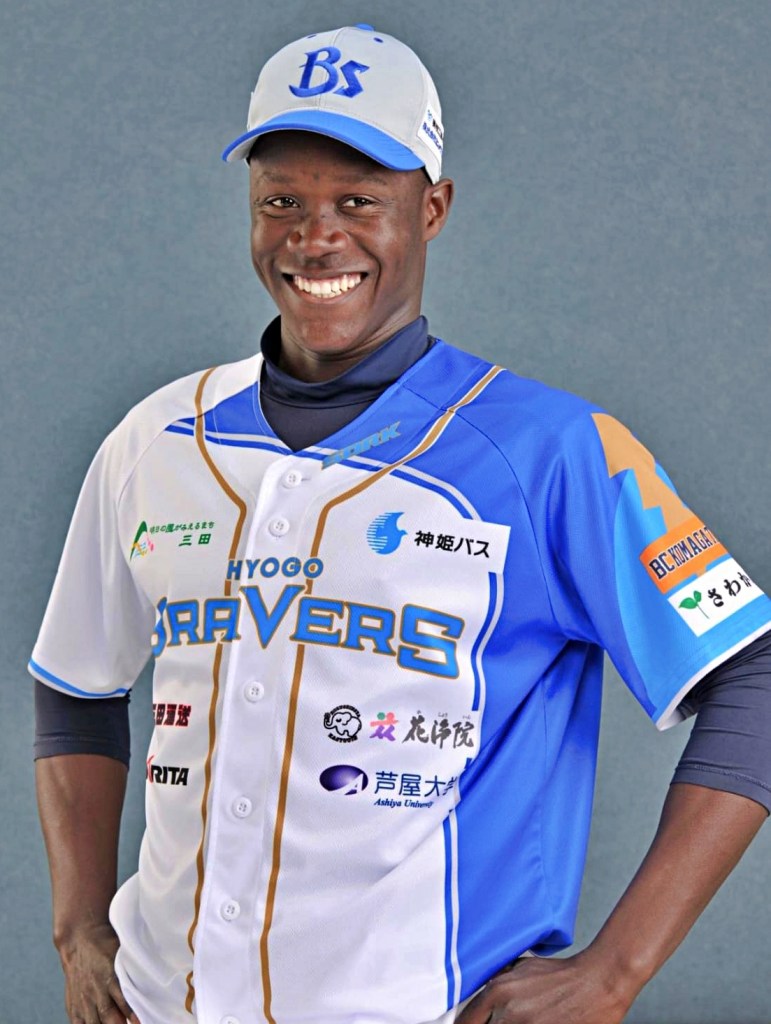
Edrine came from that community. “Baseball is still a minor sport in Uganda,” he said, “but I first encountered it when I was six years old through Tanaka, who came from Japan. I started attending an academy when I was 12.”
“Tanaka is trying to make players better and get them to Japan to play,” said Andy Berglund, who serves as an international scout for MLB’s Milwaukee Brewers, has coached for the South Africa national team, and worked as lead consultant for the former MLB European and African Academy. “He’s one of the most respected guys. He’s put years into it. Tanaka is huge for these guys – he’s in Japan and has spent a good amount of time in Uganda, so he can combine both worlds.”
Tanaka also started a baseball academy in 2025 near Uganda’s capital city of Kampala.
“The idea behind establishing the academy was to get more support and visibility for people interested in baseball and, thereby, create more opportunities,” he added. “There is definitely interest in the game in Uganda, and those who participate work very, very hard. Now that a few Ugandans have signed with MLB and independent teams, more young players have the same dream.”
Tanaka has been bringing Ugandan prospects to the Japan independent leagues since 2012, the first being Paul Wafula, who played for Hyogo, then known as the Blue Sanders, in the Kansai Independent League. According to Tanaka, Wafula is coaching at the academy in Gayaza.
Bernard Okello is another who has been around baseball in Uganda for quite a while and has both observed and been part of the growth. He started coaching in 2009 when he was just 14, played a season in the Japanese independent leagues in 2014, and then returned to Uganda to continue fostering the game’s growth.
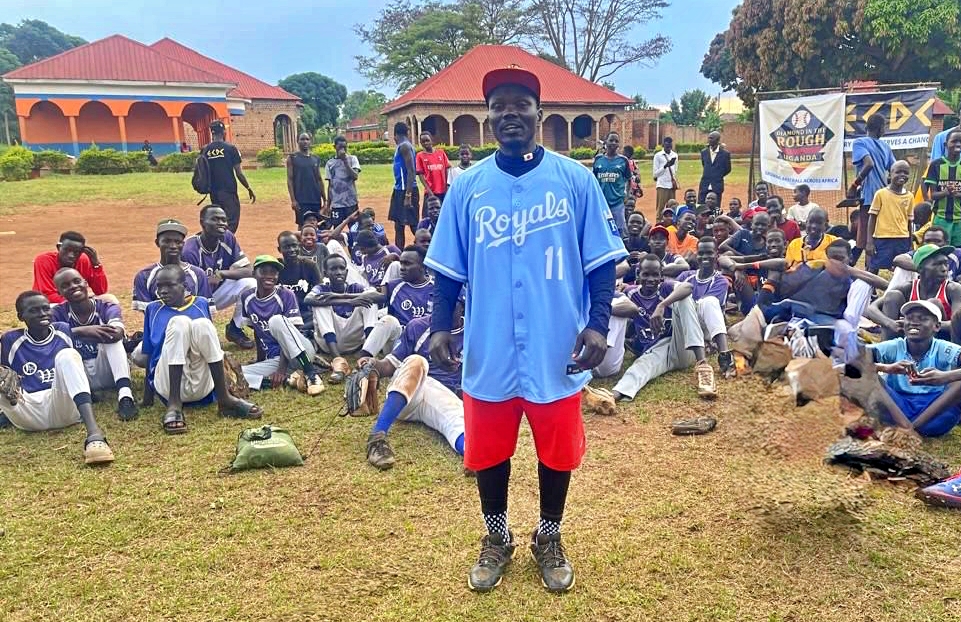
“Tanaka came over as a volunteer and saw that there was potential,” Okello said, “but we lacked opportunity and coaches then. There was no one to guide the kids and push them ahead.
“I started working to get players over to Japan in 2022,” he continued. “Although the Dodgers have their academy, not everyone can get in, and the Dodgers say that if a kid isn’t ready by the time he’s 18 or 19, he won’t have a chance to get signed by an MLB club. So getting some of these kids to Japan – some that don’t necessarily get seen by MLB scouts – can help provide opportunities.
“Most of the players now in Japan were in the district in which I coached, and I also coached a team in school. I’ve known some of these players since they were as young as seven years old.”
The path to Japan is especially important because it is difficult these days for citizens of many countries to get visas to come to the U.S. – whether to play collegiately or professionally. Also, there has not been an MLB academy in Africa since 2016.
“When the MLB academy was in South Africa, players knew that was a chance to get some visibility, but they had nowhere to go after that was shut down,” Okello said. “Now, though, we have the pipeline to Japan.”
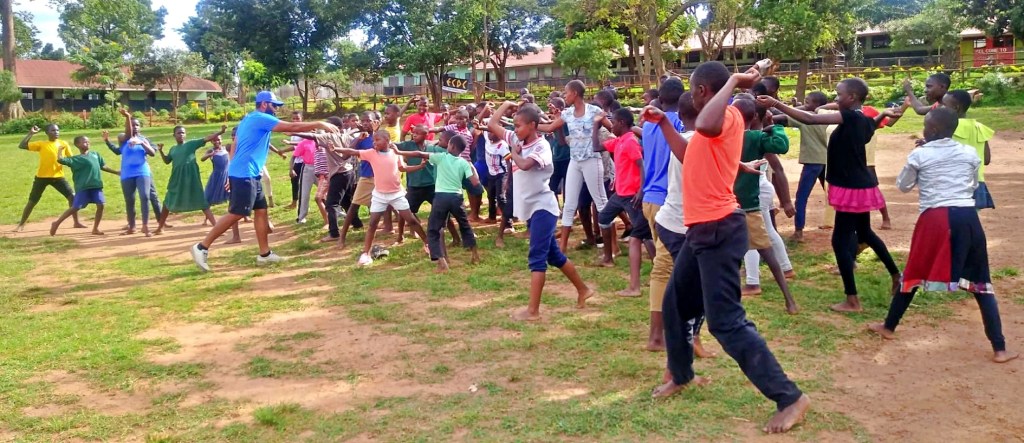
Jaz Shergill is a Canadian who has pitched in Australia, Canada, Europe, South Africa, and the U.S. independent leagues. While in South Africa, he began teaching baseball to youngsters through a non-profit group. After he returned to Canada, he got involved with a baseball organization in Uganda, which inspired him to found Every Child Deserves a Chance (ECDC) in 2018. The organization has since worked to support the growth of baseball in Uganda, and Okello is ECDC’s head of development.
“I think Japan is starting to realize there’s a deep pool of high-level talent in Uganda capable of competing at those levels,” Shergill said. “Because of that, there have been more recruiting trips to Uganda over the past few years, with more players being identified and signed. Japan has actually been bringing Ugandan players over for a good while, but since ECDC’s inception in 2018, the number of players going to Japan has increased significantly.”
Okello and Shergill say that Geiven, Dau John Wol Deng, Edrine, and Kabenge were involved in ECDC, as were pitchers David Matoma and Joseph Deng, who are now in the Pittsburgh and Los Angeles Dodgers organizations, respectively.
Of the group now with the Be:Stars, Okello says Eluk, Ojara, and Geiven “are probably the three I look most at right now, but the others have ability.” Okello said Wol Deng is just 15 and has a fastball ranging into the mid- to high-80s (mph). Ogwal reportedly has a smooth, repeatable delivery; Geiven is said to be a talented defender; and Eluk has a good combination of power and speed. The signing of Kora, Okello said, shows that the Japan-Africa bridge is expanding beyond East Africa.
Berglund is familiar with Kasumba and Kabenge, who is David Matoma’s half-brother.
“I coached Kabenge 10 years ago when he was a teenager,” Berglund said. “I saw him at an MLB tryout camp. He was raw but had good talent. And I knew about Kasumba because of all the social media stuff he’s done. Then I saw them both when I helped coach in the Japan Winter League last year. Kabenge made some mechanical adjustments and was touching upper 80s with his fastball and could spin the ball pretty well.”
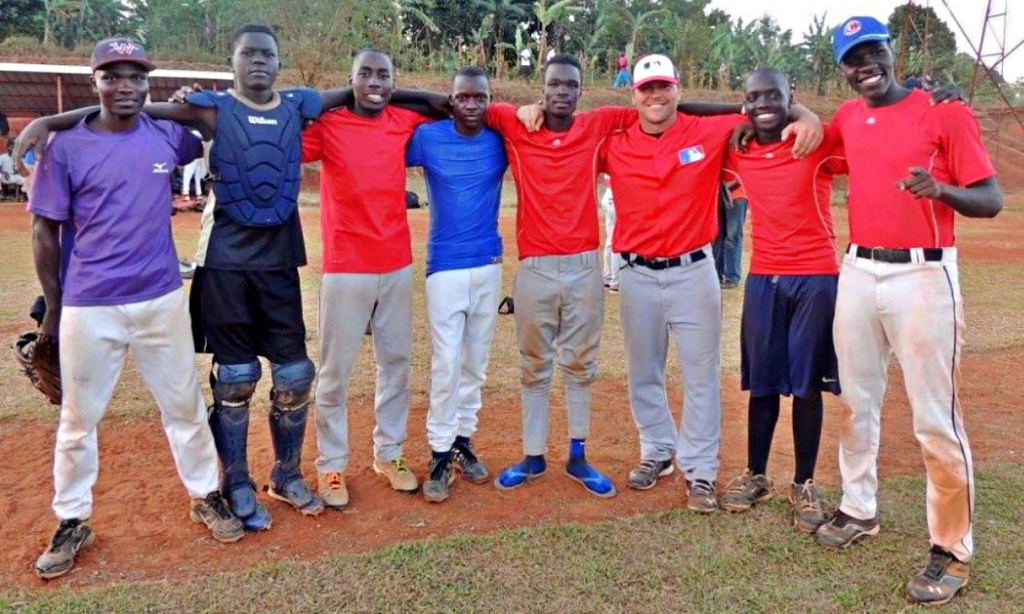
Kasumba, in his second season with the Be:Stars, gained recognition when the workout videos he posted on social media went viral. He comes from a very low-income family and has eight siblings. His father was killed in a civil war; his mother left when he was two months old; and he was raised by a grandmother. At 14, he went to work in a slaughterhouse.
“I quit baseball then because I had to work,” Kasumba said. “But my coach [Wafula, the first player Tanaka brought to Japan] said he’d help whenever I could come back. I started doing four practices a day and posting on Instagram and Twitter. I’m the only person who can help the family be better off. Baseball is a way I can be successful.”
Kasumba said he’s been limited thus far by an ankle injury. He played in the MLB Draft League in 2023 and 2024 and plans to play there again next year.
“I like blocking, and my framing is very good, but I need to up my skills,” he said. “My aim is to get into some showcases so I can be seen by scouts.”
Tanaka said, “I first knew Dennis in 2014 when he joined a team we started. He was 10 at the time. He didn’t have access to much equipment, but he was doing everything he could to train with different objects. He has a lot to learn, but he’s getting better. He works extremely hard.”
This is the fifth season in Japan for Edrine, whose first coach was Okello, and he believes he’s taken a step up by landing with Tokushima. Working in a relief role, he features a fastball, slider, and forkball. He says his fastball touched 148 kph (91.7 mph) a year ago, but is a tick lower now – “I need to get my velo back.”
“Considering the coaching know-how that has been built up here and the support system provided by the staff, this is a place where I can grow,” he said. “I want to develop my skills and someday play in a higher league or in the majors.
“Scouts are going to Uganda more now,” he added. “SoftBank [of the NPB] sends its scouts, for example. Also, the [Yomiuri] Giants. There weren’t as many scouts going there before I came, but it’s made a difference that I and a few others like Kasumba and Kabenge are playing here.”
Soren believes that “they’ll all get drastically better there – when they get away from the pressures of home. They’ll love the whole thing and will go 100 percent. I would not be surprised if some eventually get signed for NPB development teams.”
Everyone, though, understands that growing the game is a process. There are still issues with less equipment, qualified coaches, and standardized facilities than necessary.
Berglund said, “It’s too bad that the MLB academy no longer exists, but some of these guys back then got a taste of what training should be like, and now they’re paying it forward – training kids who are now 11, 12, 13. These guys are talented, but they’re playing on back fields and sometimes without shoes and much other equipment. The Dodgers have realized that there is much untapped potential there, but it will take more initiative [to get things going faster].”
Still, if more Africans can get to the independent leagues in Japan, it may lead to greater opportunities for them and others.
Soren believes that the Japanese independents are a viable option because “Japan is less business oriented [than MLB] in terms of players. There’s no money to be made from African baseball at the moment. That’s a generation away.”
Tanaka added that “Some of the NPB teams are scouting the independent leagues and are interested in keeping track of these guys. I’ve been involved with Ugandan baseball for more than 10 years, and it has grown in ways I never expected.”


Leave a comment