
by Bill Nowlin
Every Monday morning we will post an article from SABR’s award-winning books Nichibei Yakyu: Volumes I and II. Each will present a different chapter in the long history of US-Japan baseball relations. This week Bill Nowlin tells us about the 2008 Opening Series between the Red Sox and A’s.
The third in a series of five Major League Baseball visits to Japan opening the regular season featured the Boston Red Sox and Oakland Athletics in March 2008. Earlier series had been in 2000 with the New York Mets and Chicago Cubs playing each other and both teams facing off against the Seibu Lions and Yomiuri Giants, and in 2004 with the New York Yankees and Tampa Bay Devil Rays visiting Japan and playing the Hanshin Tigers and Yomiuri Giants. Both the later visits, in 2012 and 2019, featured the same visiting teams from the West Coast of the United States – the Oakland Athletics and the Seattle Mariners.
Preparing for the Opening Series
The 2008 visit was the first to Japan for both Oakland and Boston. The two scheduled games in Tokyo were deemed home games for Oakland. Oakland had finished the 2007 season with a record of 76-86, in third place in the American League West Division. The Red Sox had won the AL East, swept the Division Series, battled Cleveland to a seventh-game win in the ALCS, and then swept the Colorado Rockies in the World Series. Oakland owner Lew Wolff joked, “It’s very hard to get a ticket to the Boston games, so that’s one of the reasons we came out.”
The A’s had spring training in the Cactus League, and flew out of Phoenix, a 12-hour flight. A’s equipment manager Steve Vucinich said, “I heard they don’t have sunflower seeds there, so we’re bringing our own.” The Red Sox had a 19-hour flight from Florida via Chicago on a chartered Japan Air Lines 747.
In order not to disadvantage the visiting teams, as they prepared for the bulk of the championship season while wedging in the trans-Pacific visit, both teams scheduled three more spring-training games after the Japan Opening Series and before resuming the regular season.
The trip was nearly called off at the last minute. Not long before they were due to make the flight to Japan, Red Sox players raised an issue that had come to their attention. Represented by the Players Association in negotiations with Major League Baseball, the players had been promised a $40,000 per person incentive for the trip, but not all of the coaches had been. The Red Sox players voted to boycott the trip and not board the plane unless the coaches were paid the same. The Oakland players heard of this and held their own meetings, but their discussions never came to a vote because matters were worked out. MLB came up with $20,000 per coach, and Red Sox owners matched that for the Red Sox coaches. Other team personnel in the traveling party were promised additional pay as well.
For Red Sox shortstop Julio Lugo, it was his second trip to Japan. He had been with Tampa Bay on the 2004 tour, playing the Yankees. He said it was far more difficult to adjust after returning home than on arriving in Japan. “It took me a month and a half to get readjusted,” Lugo said. “I felt it when I was playing. I played good during that period of time, but I felt it a lot. I couldn’t fall asleep, and my appetite wasn’t good. You adjust for a week (in Japan), and then you’ve got to turn around.”
A’s second baseman Mark Ellis wasn’t sure which would be more difficult, but he wasn’t as worried as Lugo about feeling fatigue once back in the States. After arriving in Japan, he said, “I’ve heard both. I’ve heard it’s harder going (to Japan), and that it’s harder coming back. It’ll be fine. We have four or five days before we play Boston. We’ll be all right. I got less sleep than I thought I was going to, but I feel pretty good.”
As the Games Got Underway
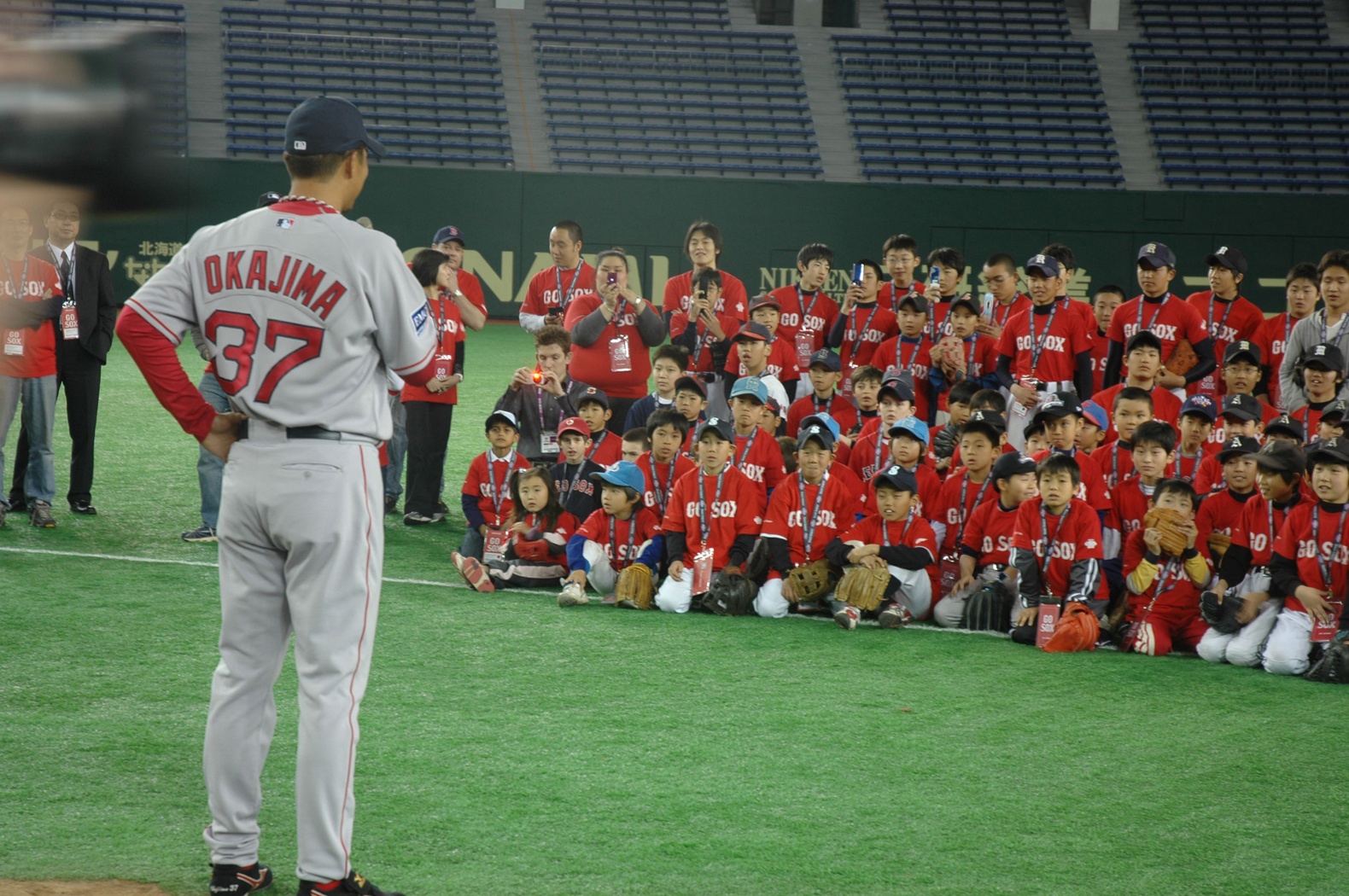
There was some extra excitement in Japan for the games, and not only because the Red Sox were the reigning World Series champions but also because two members of the team were returning to play in their native land – starting pitcher Daisuke Matsuzaka and reliever Hideki Okajima. Matsuzaka had starred in Japan since high-school days and had played eight seasons, through 2006, with the Seibu Lions. Okajima had played parts of 11 seasons for the Yomiuri Giants, from 1995 through 2005. He had joined the Red Sox and become the first Japanese-born pitcher to appear in a World Series game, throwing 2⅓ perfect innings in Game Two of the 2007 World Series against the Colorado Rockies. With a win in Game Three, Matsuzaka was the first Japanese native to win a World Series game.
The A’s received some attention with Kurt Suzuki, a Hawaiian native but with Japanese ancestry. His grandparents were from Nagoya, and he even spoke a little Japanese.
Prior to the Opening Series, both major-league clubs warmed up by playing a game each against the Yomiuri Giants and the Hanshin Tigers. The umpires for these exhibition games were two from MLB and two from NPB.
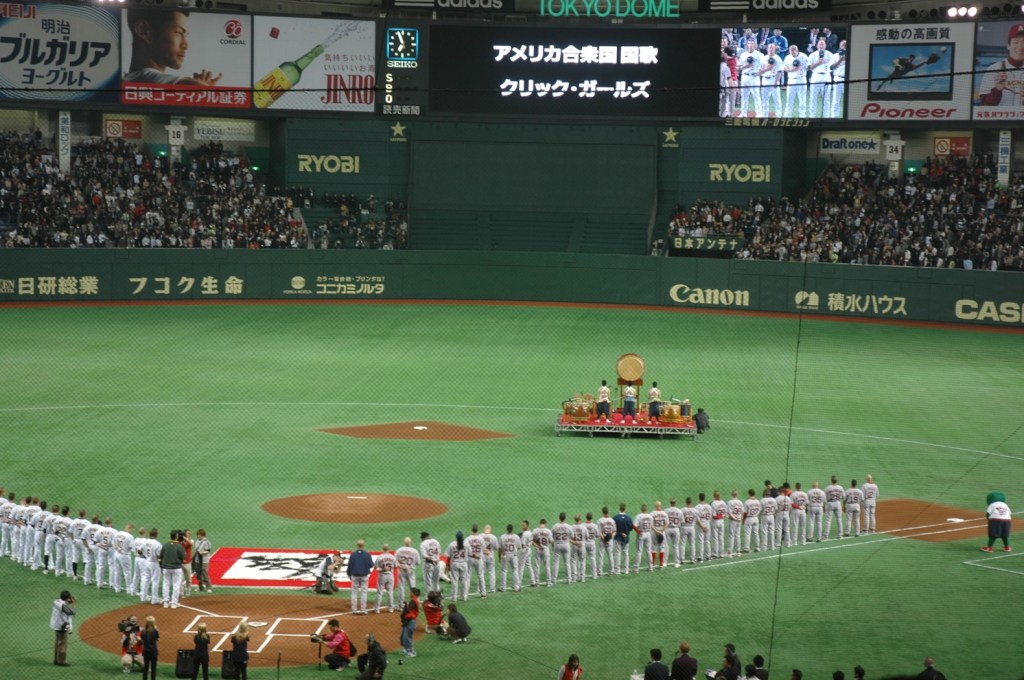
There were differences that visiting Americans noticed immediately, before the games at the Tokyo Dome, home ballpark for the Yomiuri Giants. When Japanese batters took batting practice, they did so from two adjacent cages, permitting them to get in twice as much practice in the same period of time, though those in the field had to keep a sharper eye.
Because slightly different baseballs were used by Nippon Professional Baseball and Major League Baseball, it was decided – so as not to disadvantage either team – that each team could use the baseball with which they were familiar when they were in the field. The Japanese baseball was slightly smaller, and its surface was a little “tackier” – the Japanese pitchers thus could get their accustomed grip on the ball, and the fielders would likewise find handling the ball familiar.
Announcements before and during the game were in both Japanese and English. Radar-gun readings were in kilometers per hour, not miles per hour. Red Sox reliever Jonathan Papelbon’s fastball hit 151.
And then there were the fans. Particularly for the four games involving the Japanese ballclubs, the ways fans showed their support for their team were very different. Team supporters sat in their own team’s “cheering section” where an organized band (with drums and trumpets) would perform while orchestrated by leaders (perhaps wearing white gloves and standing on a small platform) who would use whistles and hand motions to get fans to cheer and sing songs from distributed lyric sheets. Noisemakers and megaphones helped amplify the synchronized rooting.
Music between innings ranged from the Beach Boys to American country music to hip-hop to a Japanese version of “YMCA.”
The Games in Tokyo
The first two exhibition games were both one-run games. The next day, both American teams perhaps had settled in a bit better and won with ease, by very similar one-sided scores of 10-2 and 9-2.
Read the rest of this article on the SABR website


Leave a Reply