
by Tim Sokol
There has been an extensive amount of study on home field advantage in baseball and in sports in general. Home field advantage in baseball is known to exist, but the exact reasons for it remain elusive. Do teams perform better at home because of friendly fans? Because the players slept in their own beds the night before and didn’t have to travel? Because of familiarity with the batter’s eye and the physical field itself?
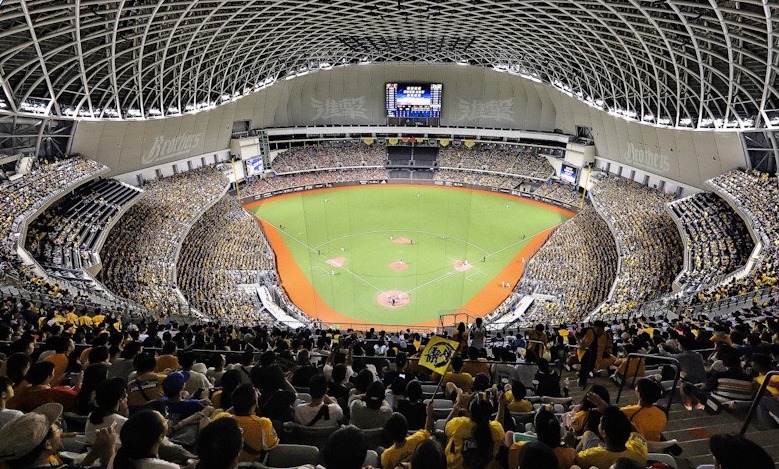
The CPBL offers an opportunity to attempt to isolate some of these possibilities. Since the opening of the Taipei Dome in late 2023, teams in Taiwan have been playing some of their “home” games at the dome. Over the course of 2024, 2025, and 2026, all six teams have played a decent number of games there. Teams also play a few “countryside” games per year, where they play outside of their normal home stadium. These two things combined give us a pretty large sample size of what I’ll call “phantom home games.” Large enough that I think we can begin to draw some conclusions about them and if/how they differ from a normal home game. The CPBL is not the only league with phantom home games; we see alternate home stadiums in other Asian leagues and in many baseball leagues around the world (and even in MLB from time to time), but it does have an unusually high percentage of them which gives us a good sample over the past three seasons.
So what I did was take each team from the previous three seasons and charted their Overall Home Record, True Home Record (their record at their normal home field), and Phantom Home Record (their record at alternate home fields). I excluded the 2025 Lions because their main stadium was damaged by a typhoon halfway through the year and they played an abnormal schedule with more than one “true” home. This left 17 different teams in the dataset. I also excluded ties for simplicity’s sake. The results are charted below:
| Wins | Losses | Win Percentage | |
| Overall Home | 525 | 488 | .519 |
| True Home | 411 | 383 | .518 |
| Phantom Home | 114 | 105 | .520 |
Looking at the totals, we see that the Overall Home Winning Percentage is .519 while the “True” Home Winning Percentage is .518 and the “Phantom” Home Winning Percentage is .520. This is a very small difference, well within the range where it is best to chalk up the gap between these rates to statistical noise. In other words, the data suggests that true home games and phantom home games are functionally the same thing as far as wins and losses are concerned.
This is an interesting finding. Phantom home games often do not provide many of the advantages typically associated with home field. In many Taipei Dome games, for example, the “home” team has a longer travel distance than the road team. It is also not unusual for the away team to have a majority of the crowd in certain circumstances. And in the case of the Taipei Dome, the “home” team doesn’t have any sort of extra familiarity with the park’s batter’s eye, wall dimensions, etc. because the entire league is more or less equally familiar with those things at this point.
So how can it be that with all of these advantages dulled, phantom home teams still win at almost exactly the same rate as true home teams? The obvious answer is that the real benefit of home field advantage lies in the power of batting last. Batting last is one of those things that we all intuitively know must confer some sort of advantage, but exactly how much advantage is basically impossible to quantify because batting last is normally always entangled with the other potential advantages mentioned above.
Based on the apparent lack of difference between your main home field and an alternate home field, the data suggests that almost all of the advantage of being home comes from batting last, and almost none of it comes from the other factors. But this is an unsatisfying answer. After all, home field advantage exists in every other sport, too. There is no “batting last” in basketball, yet home court advantage is absolutely a real thing, and there is statistical proof of its existence. Same for soccer, and ice hockey, and American football, and every other team sport that I’m aware of. So on the other hand, this suggests that some combination of travel/friendly crowd/familiarity with the venue/influence over refs does have an effect on athletes. Does that just not hold true for baseball? These factors affect every other athlete in the world besides baseball players? It does not seem to add up.
There is a dangerous path that some statistical analysis follows where everything that cannot be quantified is written off as either not real or just random luck. This at various times has included things like chemistry, morale, the impact of managers, clutchness (or lack thereof), and more. The absence of statistical evidence is not necessarily evidence of absence. I do not think it is wise to definitively say that these various factors of home field advantage do not exist, particularly because they are shown to exist in other team sports. But if those factors do exist, they aren’t showing up in the CPBL data.
There is some other evidence that these environmental factors are overstated. We learned from the 2020 season that fans do not seem to have much impact on results, as home field advantage maintained a normal rate in both MLB and the CPBL. MLB home teams won at a .557 rate that year, while CPBL teams had a .525 rate, both actually a little bit higher than average.
One other part of the data sticks out to me. As noted in the table above, the overall CPBL home winning percentage over these three years is .519. The MLB rolling average for home winning percentage is a bit higher, hovering around .540. So home field advantage appears to be larger in MLB than in the CPBL, and of course, this tracks with our intuitions because MLB has much greater travel distances and much more unique ballparks. Perhaps it is batting last that makes up the initial 52-48 split, and the other factors that push things further to 54-46 in MLB. But those factors are largely minimized in the CPBL, so they don’t really factor into home field advantage in Taiwan. This is only speculation of course, but it provides a plausible explanation for the gap between the two leagues.
Would this same behavior with alternate stadiums continue in other leagues? I am inclined to say yes, though there are a few potential hiccups. Taiwan is a relatively small place, so any effects of travel that appear to be reduced in Taiwan may be more pronounced elsewhere. It’s also only a six team circuit, and players end up having high familiarity with every stadium in the league pretty quickly, which again is not always the case in other leagues. The stadiums are also all relatively uniform compared to the stadiums seen in the Americas. So there are some reasons to believe this trend would not be reproduced across all baseball leagues even if they played phantom home games at the same rate as the CPBL.
Ultimately, even with the increase in phantom home games over the past three years thanks to the opening of the Taipei Dome, we are still working with a relatively small sample size and I don’t think it’s safe to draw any definitive conclusions from this data. But I do think there is enough evidence to take it with a grain of salt the next time you hear a pundit talk about a hostile crowd or the other vague benefits of home field advantage. All we can say definitively is that being listed as the home team provides a real advantage, and that batting last is at least part of the reason why that is.


Leave a Reply