
by Thomas Love Seagull
A recent poll for a TV special saw more than 50,000 people in Japan vote for their favorite retired baseball players. 20 players emerged from a pool of 9,000. Yes, they could only vote for players who are no longer active, so you won’t see Shohei Ohtani or other current stars on this list. Which is probably smart because I’m sure Ohtani would win by default. There are, however, players who were beloved but not necessarily brilliant, and foreign stars who found success after coming to NPB. Unsurprisingly, the list leans heavily towards the past 30 years, with a few legends thrown in for good measure.
Over the next few weeks, I’ll be profiling each of these players. Some of these players I know only a little about, so this will be as much a journey for me as, hopefully, it will be for you. It’ll be a mix of history, stats, and whatever interesting stories I can dig up.
For now, have a look at the list below and see how the public ranked them. I’ve included the years they played in NPB in parentheses.
20. Alex Ramirez (2001-2013); 19. Yoshinobu Takahashi (1998-2015); 18. Warren Cromartie (1984-1990), 17. Takashi Toritani (2004-2021); 16. Suguru Egawa (1979-1987); 15. Katsuya Nomura (1954-1980); 14. Tatsunori Hara (1981-1995); 13. Kazuhiro Kiyohara (1985-2008); 12. Masayuki Kakefu (1974-1988); 11. Masumi Kuwata (1986-2006); 10. Atsuya Furuta (1990-2007); 9. Randy Bass (1983-1988); 8. Daisuke Matsuzaka (1999-2006, 2015-2016, 2018-2019, 2021); 7. Tsuyoshi Shinjo (1991-2000, 2004-2006); 6. Hiromitsu Ochiai (1979-1998); 5. Hideo Nomo (1990-1994); 4. Hideki Matsui (1993-2002); 3. Shigeo Nagashima (1958-1974); 2. Sadaharu Oh (1958-1980); 1. Ichiro Suzuki (1992-2000).
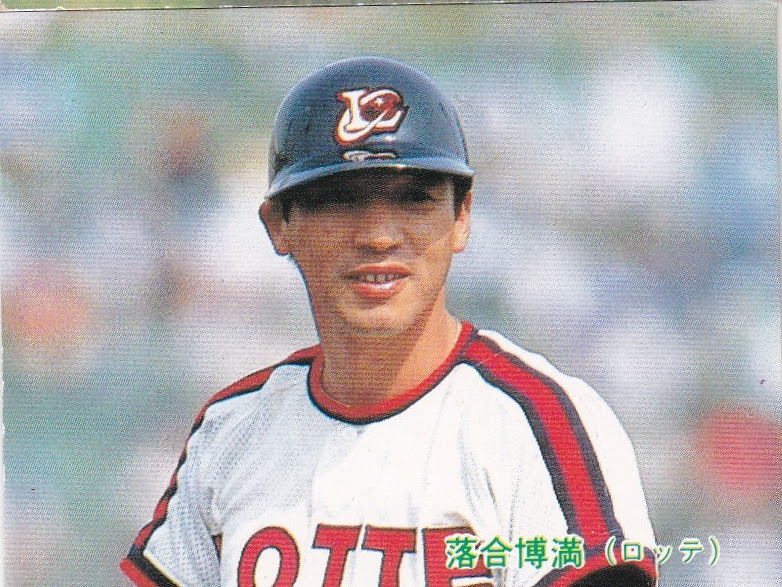
The three-time Triple Crown winner who did everything his own way
There is a word, oreryu, that you need to know before any of this makes sense. It means, roughly, “my way.” Not a better way. Not the accepted way. Just: my way. The word exists because one man lived it so completely, so defiantly, across so many years and so many people who told him he was doing it wrong, that the language simply had to make room for it.
His name was Hiromitsu Ochiai. He was the greatest right-handed hitter in the history of Nippon Professional Baseball. He was also, for much of his career, the most inconvenient man in the room.
He would have taken both as compliments.
Let’s start at the beginning, because the beginning is almost too good.
Ochiai was born in 1953 in a small town in Akita Prefecture, in northern Japan, the youngest of seven children in a family that ran a Japanese sweets shop. He played baseball as a kid, hitting crumpled up newspapers with a stick in the yard, and joining the local team in fourth grade because his older brother did, but he was never, precisely, a baseball obsessive. His childhood idol, like nearly every other boy from his generation, was Shigeo Nagashima, but what he really loved were movies. By high school, he was going to the cinema roughly a hundred times a year, sneaking into theaters in his school uniform while other kids were at practice. His attendance record was so poor he nearly failed to advance each of his three years.
Robert Whiting noted that as a boy he saw My Fair Lady seven times and could recite whole lines from it in English, which is pretty remarkable for a man who later admitted his English test papers in junior high were left completely blank, and who failed the English section of his high school entrance exam the same way. The movies were not about English. The movies were about being somewhere that wasn’t practice.
He was good enough at baseball that every top high school program in Akita wanted him, but he chose a technical school specifically because he’d heard they didn’t push their players around too much. When the upperclassmen still pushed him around, he simply stopped showing up. He quit and rejoined the team eight separate times during high school but was always called back before tournaments because he was, inconveniently, the best player they had.
Toyo University came next, on a recommendation after he hit a mammoth home run at a tryout. He quit after less than a year. The freshman players were traditionally required to wash the underwear of the upperclassmen, give them massages, and light their cigarettes. Ochiai found it to be ridiculous.
He went back to Akita, worked part-time at his brother’s bowling alley, became a serious competitive bowler, and might have turned professional except that he forgot to put his new driver’s license sticker on his brother’s car, got pulled over, paid a fine, and no longer had the entry fee for the qualifying exam. Baseball it was, then. He joined an industrial league team, working days assembling transistor radio circuit boards and playing in the evenings. He hit 70 home runs in five official seasons, and in 1978 was selected as Japan’s starting first baseman for the Amateur World Series. He hit .265/.413/.519 in the tournament, drew nine walks in ten games, and led the entire Japanese squad with 13 RBI. That autumn, the Lotte Orions drafted him in the third round. He was 25 years old. The scout’s only stated reason: he could handle breaking balls and he was the kind of hitter pitchers found annoying.
In the minors the following year, he set an Eastern League record by homering in five consecutive games. No one had any idea what was coming.
What was coming started almost immediately with a problem. Lotte’s manager was Kazuhiro Yamauchi*, and he took one look at Ochiai’s stance—bat aimed toward the first base dugout, stepping firmly away from the plate when he swung—and said flatly: “That guy will never make it as a pro.” The other coaches agreed. Ochiai remained in the minor league system, his talent visible to almost no one in a position to act on it.
*Yamauchi had been a star for the Orions in the 1950s and early 1960s. He was the first player in NPB to reach 300 career home runs.
Almost no one. A batting coach named Michihiro Takabatake had been watching Ochiai in the farm system and couldn’t understand why he wasn’t on the first team. One morning in 1980, he pulled aside a veteran who had just joined the Lotte organization and brought him down to Kawasaki Stadium to watch. The veteran was Isao Harimoto, one of the greatest hitters in the history of Japanese baseball, a man who had spent his career in title races against Sadaharu Oh and Shigeo Nagashima, who had hit .319 over 23 professional seasons and finished with 3,085 career hits. If Harimoto said a hitter was good, the hitter was good.
Harimoto watched Ochiai for a while. Then he went to find Yamauchi.
“Why aren’t you using him?” he asked.
But getting Ochiai onto the field was only the first problem. Ochiai was slow, and his defense was unremarkable, and when he struggled early in games, Yamauchi moved quickly to pull him. Every time Harimoto would get up from the bench, walk to where Yamauchi was moving toward the field to make a substitution, grab the manager’s belt, and say: “One more chance.” He did this two or three times. Each time, Yamauchi stopped.
Eventually Ochiai started hitting. Once he started, he didn’t stop. In 1981, his first full season, he hit .326/.423/.629 and won the batting title. He came to Harimoto’s locker afterward.
“I got it,” he said. “Thank you.”
In 1982, at 28, Ochiai won the Triple Crown, the fourth player in NPB history to do so, and at the time the youngest ever. In 1983, he won his third consecutive batting title, joining an exclusive list alongside Nagashima himself. He was not done.
In 1984, Boomer Wells was making a serious run at the Triple Crown. Ochiai, who had spent years fighting Japanese baseball’s rigid culture on his own terms, now revealed something else entirely: a fiercely Japanese competitive pride about who should win the game’s highest individual honor. He declared publicly that a foreigner should not win the Triple Crown. He chased Wells all season in the home run race. Wells even alleged his teammates grooved pitches to help Ochiai. It wasn’t enough. Wells hit 37. Ochiai hit 33. He fell four home runs short.
He noted the result and filed it away. And then came 1985.
Before the season, Ochiai made his intentions plain: he was going to win the Triple Crown, and he was really going to win all three parts of it. But this was not simply another prediction. When he had won his first Triple Crown in 1982 (.325, 32 home runs, 99 RBI) some critics had called the numbers unimpressive, unworthy of the title. Not a real Triple Crown, they implied. Ochiai had heard every word. Now, three years later, he wanted to win it in a way that made argument impossible. He wanted numbers that would sit boldly on the page and be beyond any criticism.
He also told his batting coaches he didn’t want to swing a bat during spring camp. Not during practice. Not during exhibition games. He wanted to run and do fielding drills only so he could preserve his swing, keep it fresh and uncontaminated. His manager Kazuhisa Inao simply said yes. His teammates watched, bewildered. Ochiai ran and fielded and waited.
He was otherworldly that year. In August, he hit .411 with 10 home runs and 24 RBI. In September, .409 with 10 more home runs and 27 RBI. The final four days of the season were his exclamation mark. On October 18, against the Nippon-Ham Fighters, he went 4-for-4 with four RBI, hitting two home runs in a game for the eleventh time that season. The next day, another home run, three more RBI. The day after that, a run-scoring hit in the first inning, a double in the fifth, a three-run home run in the ninth; five RBI in a single game. On October 21, in the season’s final game, two hits, two RBI, and his 52nd home run, tying Katsuya Nomura’s Pacific League record.
The final line: .367 batting average — beating second place by 24 points. 52 home runs — beating second place by 12. 146 RBI — beating second place by 24. He had won the Triple Crown before. This time he had won it so that no one would ever say the wrong thing about it again. With runners in scoring position, he hit .492 across 122 at-bats, with 16 home runs and 98 RBI in those situations alone. The 146 RBI is still the Pacific League record. The .487 on-base percentage from 1986 is still the NPB record. The .492 average with runners in scoring position is still the Japanese record.
In 1986 he did it again: .360, 50 home runs, 116 RBI. He played through severe back pain. He became the only player in the history of Japanese professional baseball to win three Triple Crowns. He had predicted all three.
Here is what people who faced Ochiai remember most: he was almost impossible to fool, and not in the way you expected.
Harimoto, whose eye for hitting mechanics was as sharp as anyone’s in the game, described Ochiai’s essential nature this way: he was fundamentally a gap hitter who had developed the technique to pull the ball into Kawasaki’s short right field porch when the situation called for it. When he saw a pitcher tiring or losing his stuff, Ochiai could shift his contact point forward and turn on the ball like a true pull hitter, completely transforming his approach within a single at-bat. Harimoto said he could think of almost no one else in the long history of the game who could do this.
Of his 510 career home runs, 176 went to right field. Sportswriters gushed about his ability to take outside pitches the other way. A Yomiuri Giants catcher once asked him directly: “Are you aiming for right field on those?” Ochiai’s answer stopped him cold: “Don’t be ridiculous. Those are late swings. My swing path is just better than yours, so they still go out.”
Pitchers didn’t like facing him for another reason: he was aggressively patient. He led the league in walks nine times, including eight consecutive seasons from 1984 to 1991. He led the league in on-base percentage seven times in his career. He set a record with 6 walks in one game in 1991. His career total of 1,475 walks is second only to Oh all-time, and first among all right-handed hitters in NPB history.
The great pitcher Hisashi Yamada of the Hankyu Braves, after a young Ochiai went 2-for-4 against him in 1980, pulled aside some younger pitchers afterward: “A great hitter just arrived. He might win a Triple Crown one day.” Then, two years later, Ochiai came to Yamada directly and asked him how to hit his signature sinker. Yamada told him: aim for center field. Ochiai thanked him. On April 29, 1982, the day Yamada was chasing his 200th career win, Ochiai hit three home runs off him. All three were sinkers. Yamada still won the game, though.
There’s also the story about a batting cage.
When Ochiai joined the Chunichi Dragons before the 1987 season, the club had hastily converted a gymnasium into an indoor batting center. The ceiling was covered with nets. Balls kept getting stuck up there. Players tried throwing bats to knock them down. Nothing worked.
Ochiai watched this for a moment, then said: “I’ll get them.” Did he grab a ladder? No, he stepped into the cage, queued up a pitching machine, and began hitting balls precisely into the ceiling netting, each one landing with just enough angle and force to dislodge the stuck balls and knock them down, one after another. The Central League’s chief umpire was watching and said afterward it was like watching magic or a circus act.
Whiting described Ochiai as someone who “hardly ever practiced, laughed at the term fighting spirit, and said he played baseball only for the money.” That is a fair description, and Ochiai would not have disputed a word of it.
During the season, while teammates went through long pregame workouts that left them soaked with sweat, Ochiai would lounge on the sidelines. “Ten swings is all I need,” he would say. “Then a good massage and I’m ready to play.” He refused voluntary training in January after his first Triple Crown. He skipped practices he found useless. He did not see the point of exhausting yourself before the game you were supposed to win.
This, of course, was at odds with the dominant philosophy of Japanese baseball and with its greatest exemplar. Sadaharu Oh was famous for the crippling hours he put in on the training ground, even in his final seasons. When the two appeared in a magazine interview together, Oh said he was afraid Ochiai’s example would mislead the youth of the nation. Ochiai responded, as Whiting recorded it, that he had practiced hard in his semipro days, had built his body and developed his technique but that was then, and this was now. Americans did things their own way. Why couldn’t he?
If Oh’s motto was doryoku (effort) Ochiai said his own would be: “Enjoy yourself and get rich.”
Leron Lee, who played alongside him at Lotte, put it plainly: “He had trouble with the media because he told people exactly what he thought, and Japanese aren’t supposed to do that.” His American teammate Alonzo Powell called him simply “an American in a Japanese body.”
Whiting noted that writers at the time called Ochiai “The Gaijin Who Spoke Japanese.”* In a country where stardom came with expectations of humility, collective sacrifice, and visible suffering, Ochiai was bewildering. He was immodest. He talked about money. He predicted his own Triple Crowns. He won them.
*Gaijin, shortened from gaikokujin, is the word for foreigners.
One relationship was different from all the others.
Kazuhisa Inao managed Lotte from 1984 to 1986, and Ochiai came to regard him as something close to a father figure in baseball. He would later say he was one of only two managers from whom he actually learned the game. The first night Inao took over, Ochiai followed the coaches out for drinks, sat down across from his new manager, and asked directly: “Are you going to run a controlled operation, or are you going to trust the players?” Inao answered simply: he had grown up in the old Nishitetsu Lions, where no one had ever been managed tightly, and he wasn’t going to start now. That was enough.
When Ochiai was hitting barely .200 in the first half of the season and coaches were urging Inao to drop him from the cleanup spot, Inao refused. Ochiai hit over .400 after the All-Star break. There was a night when Ochiai practiced so long in the indoor cage that his fingers went numb and locked around the bat handle. From the shadows, a figure appeared, gently pried the fingers loose, and slipped away. It was Inao. Ochiai said afterward that was the moment he understood what kind of man his manager was.
The day Ochiai won the Shoriki Award in November 2007 (for leading Chunichi to the Japan Series championship for the first time in 53 years as manager) was also the day of Inao’s death. At the press conference, Ochiai spoke about his old manager: that they had talked about baseball as equals, beyond the boundaries of their roles, and that what Inao had taught him about the pitcher’s mindset—what a pitcher fears, what a pitcher hides—had become one of his most treasured possessions.
After the 1986 season ended, Inao was let go. The new Lotte manager was a former Orions infielder with a very different philosophy, and everyone understood that Ochiai’s days in the organization were numbered. On November 4, at a fan appreciation event in Fukuoka, Inao himself lit the fuse, revealing publicly that the Giants had approached Lotte the previous year offering anyone on their roster except Tatsunori Hara in exchange for Ochiai, a deal Lotte had turned down. Ochiai, standing nearby, went further. He said that without Inao, he saw no reason to stay at Lotte. If any team wanted to hire him and Inao as a package, he would follow wherever that led.
The next day, before a Japan-America All-Star game at Heiwadai Stadium, he was even more blunt: he wanted to sign with whichever team valued him most highly.
The sports papers erupted. Lotte summoned Ochiai for a meeting. Afterward, the club’s representative held a press conference and read a prepared statement: Ochiai had reflected on his remarks, recognized they lacked consideration, and regretted them. The matter was closed.
Ochiai stood beside him throughout, wearing a thin smile. When the statement was finished, he said only: “Well, something like that.”
Then he went home and told reporters the memo had been written before the meeting even started.
The Giants assumed they would get him. They had been circling for a year, and they calculated that Ochiai would fall into their laps. After all, a player with a high salary, at odds with his own organization, with a new manager coming in who had no patience for him, was essentially already gone. They made offers and they waited.
Chunichi’s new manager Senichi Hoshino had decided he would rather bleed than watch Ochiai put on a Giants uniform. Chunichi offered a package that included their young closer Kazuhiko Ushijima, still only 25, along with several other players, a package that Lotte valued more than Yomiuri’s counteroffer. On December 21, the Giants’ owner finally said he was ready to move seriously. He was two days too late. On December 23, the trade was announced: Ochiai to Chunichi. The century’s great trade, the papers called it. And so Hoshino got his man, and the Giants got to spend the next several years wondering what might have been. Ochiai would finally join Yomiuri in 1994.
Can you imagine a player coming off two consecutive Triple Crowns being traded?
Now in the Central League for the first time, facing unfamiliar pitchers, playing through an injured wrist for much of the year, and hitting in a pitcher’s park for home games, Ochiai saw his power numbers drop to 28 home runs. He still hit .331/.435/.602. He still led the league in doubles, runs, and walks. And then, that winter, he did something that seemed to contradict everything anyone thought they knew about him.
He went to Chunichi’s fall camp in Hamamatsu. Out in a forest clearing, baseball’s leading nonconformist ran sprints and fielded grounders like a fresh rookie, in rigorous sessions that lasted until the beginning of winter.
“It’s the least I can do,” he said, “after the kind of season that I had.”
This was the man who said effort was a word he couldn’t stand.
Oreryu didn’t mean laziness. It meant that the work he chose to do was his to choose and that no one else would decide for him what mattered and what didn’t.
He played his last game on October 7, 1998. He was 44 years old. His manager offered him a starting spot that day; Ochiai declined, asking instead to pinch hit, the same role as his very first professional at-bat. He grounded out to first against the Lotte Orions, the team where it all began.
The career numbers: a .311/.422/.564 line. 510 home runs, sixth all-time in NPB history. 1,564 RBI. 1,475 walks, second all-time behind only Oh. Ten Best Nine selections across three different positions—twice at second base, four times each at first and third base. Fifteen All-Star appearances, with a career All-Star batting average of .365. His 1,000th hit, 1,500th hit, and his 2,000th hit? All of them home runs. His milestone at 1,000 career games? A home run. At 2,000 career games? A home run. He was the first Japanese player to earn 100 million yen in a season, then 200 million, then 300 million, then 400 million.
The three Triple Crowns remain his alone. No one else in NPB history has ever won three. He also took home MVP in two of those Triple Crown years.
And yet, in 2009 and again in 2010, Ochiai fell one vote short of the 75 percent threshold required for the Japanese Baseball Hall of Fame. One vote. Both years. The man who had done everything his own way, who had been an inconvenience and a provocation and an embarrassment to the baseball establishment for twenty years, needed one more voter to come around. In 2011, they finally did.
There is a question worth sitting with: what would have happened if his batting coach hadn’t spotted Ochiai in the Lotte farm system, or if Harimoto hadn’t been willing to go to bat for a player he had watched for one morning at Kawasaki Stadium? What if Harimoto hadn’t grabbed Yamauchi’s belt those two or three times when the manager was ready to pull Ochiai from games before he’d had a fair chance to prove himself?
And beyond that, what would have happened if Ochiai had simply listened?
If, in 1979, he had flattened out his swing on command, adopted the level stroke, made himself into something the Lotte coaches could recognize and approve of. If he had conformed to the seniority culture in high school and university and never developed that fierce, private certainty that he knew better than the people telling him he was wrong. If he had stopped trusting himself at any of the dozen moments when it would have been easier and more convenient to do so.
The answer, probably, is that we would never have heard of him.
Instead, somewhere in Akita, a young man kept hitting wooden utility poles with a bat until the electricity went out and the neighbors complained. He watched a hundred movies a year instead of going to school. He quit baseball programs and returned to them and eventually built a swing that no coach had ever designed or sanctioned, out of pieces of other people’s technique filtered entirely through his own judgment, until it was the most feared swing in Japanese baseball.
He said he played for money. He said spirit and effort were words he couldn’t stand. He said ten swings was all he needed.
Then he went out to the autumn forest and ran until winter came, because he felt he hadn’t earned his salary.
Oreryu. My way.
It was the only way he ever knew.
Thomas Love Seagull’s work can be found on his Substack Baseball in Japan
 SABR Asian Baseball Research Committee Blog
Leave a comment