
by Thomas Love Seagull
A recent poll for a TV special saw more than 50,000 people in Japan vote for their favorite retired baseball players. 20 players emerged from a pool of 9,000. Yes, they could only vote for players who are no longer active, so you won’t see Shohei Ohtani or other current stars on this list. Which is probably smart because I’m sure Ohtani would win by default. There are, however, players who were beloved but not necessarily brilliant, and foreign stars who found success after coming to NPB. Unsurprisingly, the list leans heavily towards the past 30 years, with a few legends thrown in for good measure.
Over the next few weeks, I’ll be profiling each of these players. Some of these players I know only a little about, so this will be as much a journey for me as, hopefully, it will be for you. It’ll be a mix of history, stats, and whatever interesting stories I can dig up.
For now, have a look at the list below and see how the public ranked them. I’ve included the years they played in NPB in parentheses.
20. Alex Ramirez (2001-2013); 19. Yoshinobu Takahashi (1998-2015); 18. Warren Cromartie (1984-1990), 17. Takashi Toritani (2004-2021); 16. Suguru Egawa (1979-1987); 15. Katsuya Nomura (1954-1980); 14. Tatsunori Hara (1981-1995); 13. Kazuhiro Kiyohara (1985-2008); 12. Masayuki Kakefu (1974-1988); 11. Masumi Kuwata (1986-2006); 10. Atsuya Furuta (1990-2007); 9. Randy Bass (1983-1988); 8. Daisuke Matsuzaka (1999-2006, 2015-2016, 2018-2019, 2021); 7. Tsuyoshi Shinjo (1991-2000, 2004-2006); 6. Hiromitsu Ochiai (1979-1998); 5. Hideo Nomo (1990-1994); 4. Hideki Matsui (1993-2002); 3. Shigeo Nagashima (1958-1974); 2. Sadaharu Oh (1958-1980); 1. Ichiro Suzuki (1992-2000).
The pitcher who refused to change, crossed an ocean, and altered baseball forever
On the night of September 17, 1996, Hideo Nomo did something that almost certainly will never be done again. He walked out to the mound at Coors Field in Denver—the most hitter-friendly ballpark in the history of of Major League Baseball, a place so absurdly hostile to pitchers that the team eventually had to store baseballs in a humidor just to keep fly balls from becoming souvenirs—and threw a no-hitter.
The Rockies that year were dangerous. They scored nearly 1000 runs. They hit 221 home runs. Three of their players hit 40 or more, including Ellis Burks, who led the league in runs scored and slugging percentage. They also led the league in attendance. The mile-high altitude thinned the air, making breaking balls misbehave and fastballs sail. Nomo himself had an 11.17 ERA in the park going into that game. He had never won there.
He threw nine innings. He walked four. He struck out eight. He won, 9-0.
No other pitcher has ever thrown a no-hitter at Coors Field. No one probably ever will. And that was just one night in the career of Hideo Nomo.
There is a version of Nomo’s story that starts with the statistics, and those statistics are genuinely remarkable: 201 wins across two leagues and nearly two decades, 3,122 strikeouts, two no-hitters, a Rookie of the Year award on each side of the Pacific. But the numbers don’t quite capture what Nomo was, or what he meant, or what it cost him to become what he became.
The better place to start is with a young man from Osaka who was told, at the age of 14, by the head coach of the top baseball high school in his city: “With that tornado windup, you’ll never make it.”
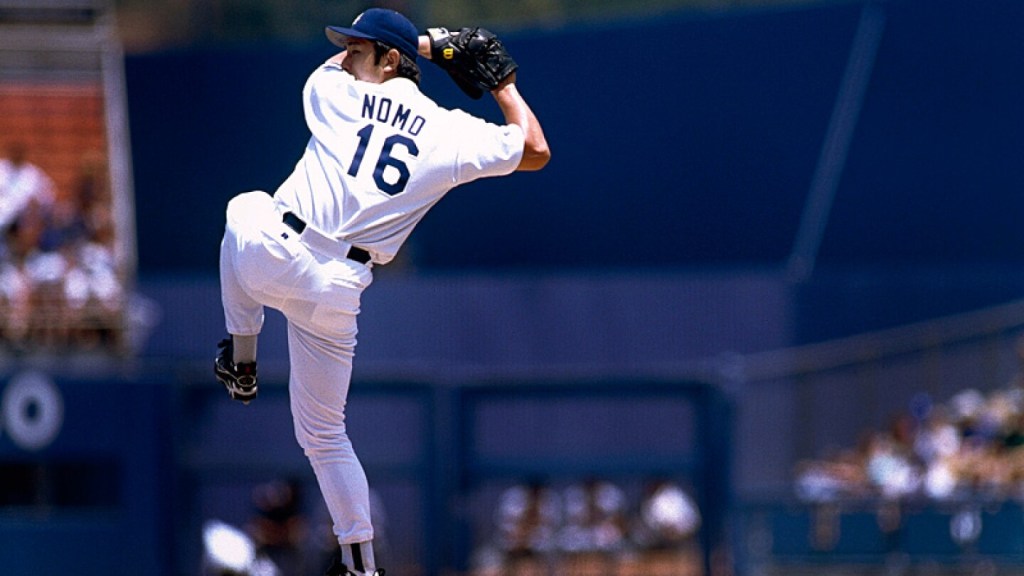
Nomo had invented the windup himself, as a kid trying to impress his father. He figured that twisting his body and coiling away from the batter until his back faced home plate, pausing there for a suspended, theatrical moment before releasing the ball allowed him to throw harder. He was correct. He was also never going to change it, no matter who told him to. When asked about the delivery later in his career, he would say that no one had taught it to him, though he did admit that one piece of it, the hip-first drive toward the plate, came from watching Masaji Hiramatsu* of the Taiyo Whales as a boy and wanting to move like him. Buried inside the most spectacular pitching motion in baseball was a child’s act of imitation. That stubbornness, that absolute certainty about who he was and how he pitched, is as important to understanding Nomo as anything that happened between the chalk lines.
*Hiramatsu won 201 games in his career, but his nickname was “The Glass Ace” because he missed so many games due to injuries and frequently catching colds.
He enrolled instead at a lesser-known high school, dominated the local competition, and pitched a perfect game. One year ahead of him in the Osaka baseball scene was Kazuhiro Kiyohara, already a legend at PL Gakuen High School, already being called the greatest hitter in the country. Kiyohara later said he had never even heard of Nomo. That is how anonymous Nomo was, invisible to the very generation he would come to dominate.
He joined a company team where he perfected his forkball with the kind of obsessive dedication that tends to separate the greats from mere mortals. The story goes that he taped a tennis ball between his index and middle fingers before bed each night, conditioning his grip while he slept.
In 1989, eight teams selected Nomo in the first round of the NPB draft. Eight. That had never happened before. The Kintetsu Buffaloes won the lottery and signed him, with one condition written into the contract at Nomo’s insistence: they would not try to change his pitching form.
The scouts and commentators who watched him in spring training of 1990 were not impressed. Even after the Tornado name was bestowed, the skeptics kept coming. Would he ever have real control? Could he hold up for a full season? Wouldn’t he break down eventually? In a rookie-year interview Nomo smiled faintly and said people had told him everything about his delivery was wrong. But, he added, once they actually watched him throw in a bullpen session, they tended to go quiet. After two early losses, he later recalled that stretch as the loneliest of his career; the dormitory felt like the only place he belonged. He said nothing publicly. He also changed nothing.
His first win came on April 29 against the Orix Braves, when he struck out 17 batters, tying the Japanese single-game record, while allowing only two runs in a complete game. Afterward, rather than celebrate, he deflected entirely: because his teammates had scored so many runs, it had given him a sort of rhythm. That was the version of Nomo the public would come to know, one who was private and guarded, but also generous toward others.
What followed was one of the greatest rookie seasons in Japanese baseball history. Nomo went 18-8 with a 2.91 ERA and 287 strikeouts, winning the Rookie of the Year, the MVP, and the Sawamura Award (the Japanese equivalent to the Cy Young) in the same breath. Oh, and he won the pitching Triple Crown. He was 21 years old. He led the Pacific League in wins and strikeouts for each of his first four seasons, a feat without precedent. The Tornado name was officially bestowed in late May, chosen by public contest from thousands of entries, arriving right in the middle of the season when he was still proving the critics wrong.
He also led the league in walks during his first four years, and in wild pitches two times. Tornado was an apt nickname in more ways than one.
The best part? He did nearly all of it with two pitches. A fastball and a forkball. That was essentially the entire arsenal. Shinichi Sato, who faced Nomo as a member of the Hawks, said there is simply no other starter who has ever gotten away with two pitches at that level.
What made the two pitches so devastating was the delivery that preceded them. Orestes Destrade, the Cuban-born slugger who played for the Seibu Lions, described the experience of standing in the batter’s box against Nomo this way: because Nomo turned his back to the plate and paused—that eerie, still moment where everything stopped, just like in the eye of a storm—timing him was nearly impossible. You couldn’t sync up with it. The ball came from nowhere and went somewhere unexpected. When reporters kept asking Nomo about strikeouts, he waved them off every time: “Strikeouts are just a result. What matters is the team winning.” It wasn’t false modesty. It was the same principle he had lived by since he was a boy twisting his body in a schoolyard. “If I change my own way,” he once said, “it’s over.”
His teammates from that era remember something else too: Nomo finished what he started. Eiji Kiyokawa, a reliever, said bluntly that Nomo was the kind of ace who pitched nine innings and left nothing for the bullpen. It wasn’t arrogance. It was a starter’s code, a sense of personal responsibility for the game he was given. He pitched 22 complete games in 1991—still the most by any pitcher in Japan since the end of the Showa era—and threw 3,996 pitches that season. Nearly four thousand pitches in a single year. Manager Akira Ohgi, an easygoing man who trusted his players and left them alone, simply kept handing Nomo the ball, start after start, around 145-150 pitches a time. Nomo, for his part, kept taking it. What else was an ace pitcher to do?
In 1991, Nomo set the all-time Japanese record by striking out ten or more batters in six consecutive starts. What makes the streak stranger, and more revealing, is his record during it: 2-4. He struck out at least ten batters in every one of those six games, threw complete games in five of them, and lost four times. He was unhittable and yet, the Buffaloes team kept losing anyway. That same year the All-Star Game offered a rare glimpse of a different Nomo entirely. In the second game, played in Hiroshima, the Pacific League ran out of position players in extra innings and had to send Nomo up as an emergency pinch-hitter. He borrowed an Orix helmet (remember, he played for Kintetsu*) put it on, and walked to the plate grinning. He never swung the bat. Three pitches later he took a called third strike and walked back to the dugout to a roaring ovation from the full stadium. It was the most cheerful strikeout anyone had ever seen. The crowd loved it. Nomo seemed to as well.
*Of course, Orix and Kintetsu would merge following the 2004 season to form the Orix Buffaloes. Foreshadowing, anyone?
He later said that his loyalty to Ohgi ran so deep precisely because Ohgi trusted him completely, never meddled, never second-guessed. Ohgi gave Nomo the ball and got out of the way. That relationship, more than anything else, is what made what came next so difficult. After two consecutive second place finishes, Ohgi resigned. His replacement was franchise legend and 300-game winner Keishi Suzuki. Suzuki’s management style was the complete opposite of Ohgi’s.
No game illustrated Nomo’s resilience more strangely than the one on July 1, 1994, against the Seibu Lions. Nomo walked 16 batters, a Japanese baseball record that stands to this day, with at least one walk in every single inning. The home plate umpire called a ball 105 times. Kazuhiro Kiyohara, who drew three of those walks, the same man who had never heard of Nomo growing up, shrugged afterward and said you couldn’t sit on any particular pitch when a pitcher was that wild; the wildness itself became a kind of weapon. The color commentator on the broadcast, former manager Senichi Hoshino, said simply that he was exhausted by the end of it. If he’d been managing, he would have pulled Nomo long ago. The patience on display, Hoshino noted with a laugh, belonged not to Nomo but to Suzuki. Nomo threw 191 pitches and finished with a complete-game win, allowing three runs. Afterward he was unapologetic but unsatisfied: “I wasn’t able to pitch my game at all.” That was Nomo. He stayed out there for 191 pitches in a game he considered a failure, and won.
Then the relationship with Suzuki soured entirely. The manager wanted Nomo to run more, throw more, and alter his mechanics. “Throw until you die” was, by one account, Suzuki’s actual philosophy of pitcher conditioning. He told a radio audience that Nomo’s form would never hold up. Meanwhile, the front office treated its franchise pitcher with a remarkable combination of condescension and indifference, offering no salary increase after four consecutive win and strikeout titles, trying to force him into voluntary retirement rather than grant him free agency, and telling him, flatly, that he was not considered the team’s ace.
Nomo would later say that he didn’t originally dream of playing in America. He just couldn’t play for Suzuki anymore. But the dream, it turned out, had been there all along. His locker at Fujiidera Stadium, the Buffaloes home, was covered wall to wall with baseball cards of Ken Griffey Jr., Roger Clemens, and other great American stars of the era. The training room down the hall looked the same. He had been staring at those faces for years, imagining what it would feel like to face them. When a reporter caught him in the summer of 1994, mid-rehabilitation, and Nomo told him quietly that he wanted to try the major leagues next year, he was smiling as he said it.
The loophole his agent Don Nomura found was elegant in its simplicity. The NPB’s voluntary retirement clause said nothing about foreign leagues. If Nomo retired from Japanese baseball, he could sign anywhere in the world. The clause had never been used this way before. It was a loophole that only existed because no one had ever thought to use it and because no Japanese star had ever wanted to leave badly enough, or been brave enough, to try.
The media was not kind about it. The conventional wisdom was that Nomo was running away, or chasing money, or both. He arrived in America with his reputation in Japan in tatters and his salary reduced from roughly $1.4 million to a minor-league contract worth $100,000. The Dodgers’ GM told him that a major league contract was not given but earned. Nomo nodded and said nothing. The strike was still ongoing when he arrived; if it dragged on, he faced the possibility of earning as little as $60,000 pitching in the minors. And this was for a man with a wife, children, and a salary back home that had been roughly 25 times that. He didn’t flinch. “It’ll start eventually,” he said. “Starting in the minors would be fine.”
Meanwhile, American baseball in the spring of 1995 was not in a great mood. The previous season had ended in a players’ strike that wiped out the World Series. Fans were furious. Attendance was cratering. The sport had spent years building goodwill and watched it drain away in a dispute that looked, to most observers, like very rich people arguing with slightly less rich people about money.
Into this particular moment stepped a 26-year-old pitcher from Osaka with a motion unlike anything American fans had ever seen, throwing a forkball that dropped off the table and a fastball that arrived from an angle that made no logical sense. He made his major league debut on May 2 at Candlestick Park in San Francisco, retiring Barry Bonds and Matt Williams along the way and pitching five shutout innings. Millions of people in Japan watched live on television, where the first pitch came at 5:33 in the morning. Only about 16,000 people were in the stadium.
By June, the stadiums were full. Nomo went 6-0 that month with a 0.89 ERA. He pitched at least eight innings in each of his six starts. He threw back-to-back complete-game shutouts with 13 strikeouts each, a feat no Dodger pitcher had ever accomplished. He was the starting pitcher for the National League in the All-Star Game, the first NL rookie to start since another Dodger sensation, Fernando Valenzuela, in 1981. His boyhood idol, Nolan Ryan, threw out the ceremonial first pitch. The term “Nomomania” entered the languages on both sides of the Pacific.
Before the season, someone had asked Nomo what he felt he owed to Japanese baseball. His answer was not what anyone expected. “I have to do this,” he said. “If I fail, it will brand all Japanese players who come after me as failures.” He was twenty-six years old, pitching on a continent where almost no one knew his name, and he had already accepted responsibility for an entire generation that hadn’t arrived yet.
Nomo finished the season 13-6 with a 2.54 ERA and a league-leading 236 strikeouts. He won the Rookie of the Year Award, edging out Chipper Jones. He finished 4th in Cy Young voting.
The years that followed were the full, complicated arc of a pitcher’s life, the brilliant stretches and the injured ones, the reinventions and the setbacks. He pitched an unfathomable game in Colorado. He had elbow surgery. He was traded. He was released. He became the first Japanese-born player to hit a home run in MLB*. He bounced from the Mets to the Brewers to the Tigers to the Red Sox, and then, in 2001, he did something that almost no pitcher in history has done: he threw a second no-hitter, this one in his Boston debut, against the Baltimore Orioles. Nomo became only the fourth pitcher ever to throw a no-hitter in both leagues. He was, briefly, a star again.
*The second was Dave Roberts. The third was Nomo’s former Kintetsu teammate Masato Yoshii, who was a big influence on his desire to join MLB. The two would be reunited on the Mets in 1998.
He returned to the Dodgers and had two more solid seasons before the body finally gave out. His tornado windup, that beautiful, impractical, singular motion he had invented as a child and refused to surrender his entire career, was diagnosed as the source of damage to his shoulder. Without it, he wasn’t Nomo anymore. He pitched a few more years, trying, and retired in 2008 at 39.
His place in history depends on where you’re standing. He received six votes for the Baseball Hall of Fame in his first year of eligibility. Six. He was inducted into the Japanese Baseball Hall of Fame the same year, in his first year of eligibility, becoming the youngest inductee in history.
Make of that what you will.
What Nomo really did, beyond the wins and the strikeouts and the two no-hitters, was open a door that had not existed before him. Since his arrival in 1995, more than 50 Japanese-born players have come to the major leagues. Ichiro. Matsui. Daisuke. Tanaka. Ohtani. None of it happens, or at least none of it happens when it did, without Nomo going first.
Ichiro recognized how important Nomo was. “Before Hideo came over here, everyone had an image of Major League Baseball and people looked at players over here as monsters because they were so big. We were able to watch more MLB games and were able to get an image of, ‘Maybe I can play in the big leagues.’”
Tommy Lasorda, who managed the Dodgers for two decades and knew a pioneer when he saw one, put it plainly: if Nomo had not succeeded, nowhere near as many Japanese players would be in the major leagues today. He had the talent for it, Lasorda said, and he had the character for it. Both were required.
When Ichiro announced in the fall of 2000 that he was coming to the major leagues, a reporter asked Nomo for his reaction. “Ichiro has to do this,” he said. The same words, the same logic, passed forward to the next man through the door that Nomo had opened.
He invented his delivery as a boy, was told it would ruin him, and refused to change it. He found a loophole in the rules, crossed an ocean under a cloud of criticism, and proceeded to help save baseball’s relationship with its own fans at one of the most fragile moments in the sport’s history. He threw a no-hitter at Coors Field. He is, by any honest accounting, one of the most important figures the game has produced in the last hundred years, and one of the most underappreciated.
During Ichiro’s Hall of Fame speech in Cooperstown, he thanked Nomo in Japanese, and pointed out his courage for challenging the majors.
But before all of that, before Dodger Stadium and the All-Star Game and Coors Field, there was a final night at Fujiidera Stadium. October 18, 1990. A meaningless late-season game, already out of the standings, and yet 16,000 fans showed up just to see him. Ohgi sent him out for one batter in the ninth, a one-run lead to protect. Nomo threw five pitches, all fastballs. The last one was clocked at 148 kilometers per hour (92 mph). Strike three. The crowd erupted: cheering, clapping, beating megaphones, confetti falling from the stands. Nomo wiped the sweat from his face, stepped off the mound, and turned to bow to the crowd. Then he walked back to the press room, answered questions in his characteristically flat, unhurried way, and as he was leaving, turned back one more time. “I hope for your continued support next year!” He smiled and added playfully, “Please keep things quiet during the off-season.”
The tornado touched down in 1990. The world of baseball was never the same.
Thomas Love Seagull’s work can be found on his Substack Baseball in Japan
 SABR Asian Baseball Research Committee Blog
Leave a comment