
by Trevor Raichura
Every Monday morning we will post an article from SABR’s award-winning books Nichibei Yakyu: Volumes I and II. Each will present a different chapter in the long history of US-Japan baseball relations. This week Trevor Raichura tells us MLB-Japan All-Star series.
It was the best of times, it was the worst of times. One of the longest droughts in baseball history came to an end in 2004 when the Boston Red Sox won their first World Series since 1918. With that victory, a new age was dawning. One in which even the Chicago Cubs could start hoping for a title of their own sooner rather than later. (And it came, in 2016.)
However, on the other side of the ocean, Nippon Professional Baseball experienced one of the most trying, core-changing seasons in its history. Two Pacific League teams, the Orix BlueWave and the Kintetsu Buffaloes, reached an agreement to merge at season’s end, leaving an imbalance (five teams) in league structure.
The players, voicing concern over the potential ramifications of this merger (one possibility floating around was a reduction from 12 to 8 teams in a single-league format), went on strike for two days. (This was the first and only strike in NPB history.) However, instead of downsizing, the league searched for a corporation to form an expansion team. The two main candidates were Livedoor, an internet company, and Rakuten, a commerce conglomerate owned by Hiroshi Mikitani, which won the right to join NPB, forming the Tohoku Rakuten Golden Eagles in 2005.
Amid the restructuring of the league came the announcement that interleague play would begin during the coming season, a draft scandal, and rumors of a second merger between two more flailing Pacific League franchises. On top of this, Japan was coming out of 2004 still feeling the sting of losing their semifinal match against unheralded Australia at the Summer Olympics in Athens. They would ultimately take the Bronze, but it was a disappointing finish for a nation expecting to contend for the Gold.
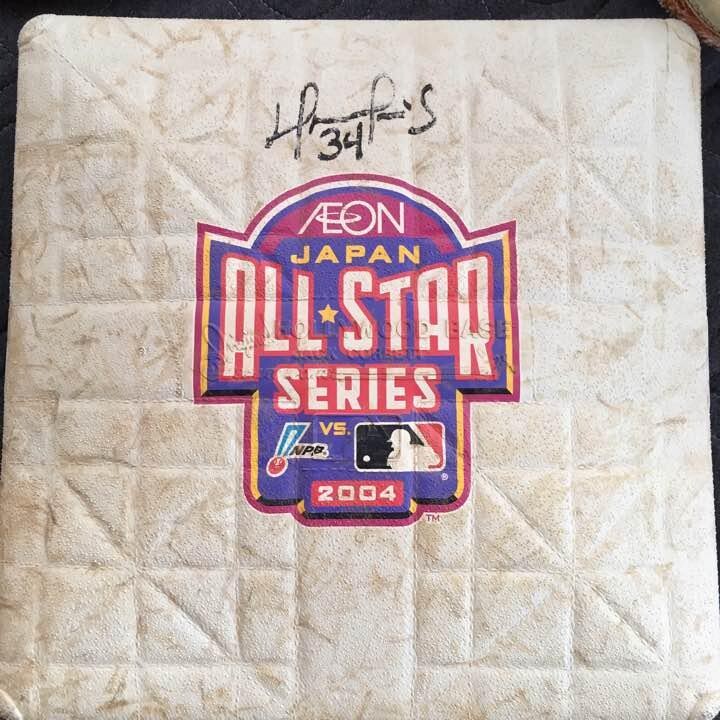
The 2004 Japan All-Star Series was more than just a feel-good series of friendly games between star players from two baseball organizations. Japan yearned to show it belonged in the conversation of baseball juggernauts. It needed to assure its fan base that the health of its de facto national sport was sound as well. And so, when the MLB representatives came to play eight games in 10 days at five domed stadiums across Japan, winning was actually important to one of the teams.
The 28 major leaguers comprised 19 Americans, 3 Venezuelans, 2 Dominicans, 2 Puerto Ricans, and 2 Japanese – Kazuhisa Ishii and Akinori Otsuka, who had played the previous season with the Los Angeles Dodgers and San Diego Padres respectively.
The All-MLB Roster
- Pitchers: Kiko Calero (St. Louis Cardinals), Roger Clemens (Houston Astros), Kazuhisa Ishii (Los Angeles Dodgers), Ray King (St. Louis Cardinals), Scott Linebrink (San Diego Padres), Kyle Lohse (Minnesota Twins), Jason Marquis (St. Louis Cardinals), Akinori Otsuka (San Diego Padres), Jake Peavy (San Diego Padres), Mark Redman (Oakland Athletics), Chris Reitsma (Atlanta Braves), Francisco Rodriguez (Anaheim Angels), Scot Shields (Anaheim Angels), Dontrelle Willis (Florida Marlins)
- Catchers: Johnny Estrada (Atlanta Braves), Victor Martinez (Cleveland Indians)
- Infielders: Hank Blalock (Texas Rangers), Alex Cora (Los Angeles Dodgers), Marcus Giles (Atlanta Braves), David Ortiz (Boston Red Sox), Jack Wilson (Pittsburgh Pirates), Michael Young (Texas Rangers)
- Outfielders: Moisés Alou (Chicago Cubs), Miguel Cabrera (Florida Marlins), Carl Crawford (Tampa Bay Devil Rays), Manny Ramirez (Boston Red Sox), Vernon Wells (Toronto Blue Jays), Brad Wilkerson (Montreal Expos)
- Coaching Staff: Bruce Bochy (San Diego Padres), Jim Colborn (Los Angeles Dodgers), Pat Corrales (Atlanta Braves), Bill Robinson (Florida Marlins)
Note: Albert Pujols (Cardinals), Alfonso Soriano (Rangers), Miguel Tejada (Orioles), and LaTroy Hawkins (Cubs) were selected but did not participate due to injury.
The All-NPB Roster
- Pitchers: Nagisa Arakaki (Fukuoka Daiei Hawks), Ryota Igarashi (Tokyo Yakult Swallows), Kei Igawa (Hanshin Tigers), Hirotoshi Ishii (Tokyo Yakult Swallows), Takeharu Kato (Yokohama Bay Stars), Hiroyuki Kobayashi (Chiba Lotte Marines), Hisashi Iwakuma (Kintetsu Buffaloes), Daisuke Matsuzaka (Seibu Lions), Koji Mise (Fukuoka Daiei Hawks), Koji Uehara (Yomiuri Giants), Shunsuke Watanabe (Chiba Lotte Marines), Kazuo Yamaguchi (Orix BlueWave), Yukiya Yokoyama (Hokkaido Nippon-Ham Fighters)
- Catchers: Shinnosuke Abe (Yomiuri Giants), Atsuya Furuta (Tokyo Yakult Swallows), Kenji Johjima (Fukuoka Daiei Hawks)
- Infielders: Kazuya Fukuura (Chiba Lotte Marines), Hirokazu Ibata (Chunichi Dragons), Makoto Imaoka (Hanshin Tigers), Akinori Iwamura (Tokyo Yakult Swallows), Hiroyuki Nakajima (Seibu Lions), Toshihisa Nishi (Yomiuri Giants), Michihiro Ogasawara (Hokkaido Nippon-Ham Fighters)
- Outfielders: Norihiro Akahoshi (Hanshin Tigers), Takahiro Saeki (Yokohama Bay Stars), Shigenobu Shima (Hiroshima Toyo Carp), Hitoshi Tamura (Yokohama Bay Stars), Kazuhiro Wada (Seibu Lions)
- Coaching Staff: Sadaharu Oh (Fukuoka Daiei Hawks), Takao Obana (Fukuoka Daiei Hawks), Hiromasa Arai (Fukuoka Daiei Hawks)
Note: Fan selections Kosuke Fukudome (Chunichi Dragons), Yoshinobu Takahashi (Yomiuri Giants), Tsuyoshi Shinjo (Hokkaido Nippon-Ham Fighters), Nobuhiko Matsunaka (Fukuoka Daiei Hawks), Tomohiro Nioka (Yomiuri Giants), Hiroki Kokubo (Yomiuri Giants), plus manager selection Tadahito Iguchi (Fukuoka Daiei Hawks) did not participate due to sickness and/or injury.
Starting on November 5, 2004, the two teams played three games in three days at Tokyo Dome. They took a day off to travel to Fukuoka, located in southwestern Japan. After a single game there, they migrated east to Osaka for a game the next day. The very next day they flew up to the northernmost island of Hokkaido to play a game in Sapporo. Then it was down to Nagoya in central Japan, followed by a day of rest. The series wrapped up where it started, in Tokyo, on November 14.
Game 1: November 5, Tokyo Dome
Among those in attendance were Japanese-born major-league players Kazuo Matsui (New York Mets), Tomo Ohka (Montreal Expos), and Shingo Takatsu (Chicago White Sox). Also celebrating the opening of the tournament was the US ambassador to Japan, Howard H. Baker Jr., who said the tour was beginning to take on an atmosphere similar to the World Series in recent years.
Much of the focus in this game was on MLB starter Roger Clemens, who at age 42 had already won six Cy Young Awards in his illustrious career. It took the NPB All-Stars until the bottom of the fifth inning to open the scoring with two runs (one earned) off Clemens. Japanese shortstop Hirokazu Ibata said after the game that Clemens felt a lot closer to home plate than regular pitchers do because of his intimidating size. Kenji Johjima said Clemens was beyond the realm of good pitchers: His fastball was fast, his forkball was amazing, and he was grateful to just make contact with his pitches. Clemens left the game before finishing the fifth inning, much to his dismay. He said it was hard for him to figure out the hitters, with this being his first time ever facing them, but that, all things considered, he felt he had done well.
The major leaguers, who had been stymied by starter Koji Uehara up to this point, put up three runs in the top of the sixth. David Ortiz singled home Carl Crawford and Hank Blalock, and the pinch-runner for Ortiz, Brad Wilkerson, scored on Vernon Wells’s sacrifice fly. Ortiz said he had noticed that Uehara’s forkball was coming in low on other batters, but the one he got hold of stayed up in the zone. That said, he felt that if Uehara were able to adjust to the major league strike zone and get ahead in counts, he would have no problems succeeding in America.
The MLB All-Stars put up four more runs in the top of the seventh on five singles and a walk, all coming against Kazuo Yamaguchi, to win 7-2. Kiko Calero earned the win by completing the fifth inning for Clemens.
After the game, Clemens said, “I really enjoyed it but I was surprised that the crowd was more quiet compared to last time I visited here (1992).” Manager Bruce Bochy said Ortiz was the spark plug that helped his team overcome a two-run deficit, and that they would need to keep playing this way in order to win more games in this series. Japanese manager Sadaharu Oh said he had hoped his team would win while the major leaguers were still adjusting to Japan, but that they would need to hit better. He also had high praise for the MLB hitters’ bat speed.
This game was of added interest because Uehara grew up idolizing Clemens and even attended Game Three of the 2004 National League Championship Series in Houston, for which Clemens was the Astros’ starter. “There was a lot I could learn by watching the game live. But I would not have gone all that way if I wasn’t also interested in pitching there someday,” Uehara said. The two were able to sit down and talk to each other on November 3 when the MLB team arrived in Japan, and Clemens signed a jersey and gave it to Uehara. “I have never before and will probably never again pay that much attention to how another pitcher goes about his business on the mound during the game,” an awestruck Uehara said after the game. “I have tried to model my own form after his. The signed uniform will get framed and hung in my house.”
Game 2: November 6, Tokyo Dome
The first-ever Japanese major-league player, left-handed pitcher Masanori Murakami, threw out the ceremonial first pitch while wearing a San Francisco Giants uniform. The 60-year-old commented that he was looking forward to seeing a lot of good games in the series.
The scoring in this seesaw battle began in the bottom of the first with Carl Crawford’s leadoff home run off starter Shunsuke Watanabe. The NPB All-Stars responded with Norihiro Akahoshi’s two-run triple in the top of the second.
The MLB team tied the game in the bottom of the frame, as Brad Wilkerson doubled Vernon Wells home. David Ortiz then hit the most talked-about home run of the entire tour in the bottom of the fourth, taking Watanabe deep to right. The estimated distance of his home run was 160 meters (525 feet). “I knew when I hit it that I got all of it,” Ortiz said. “I thought for a second that it might land in the Dominican (Republic). It was a 3-and-0 count, maybe he didn’t think I would swing. He’s not exactly like (MLB reliever) Takatsu, but pitchers like him who have an unorthodox delivery are hard to hit. But I saw the ball well, and he threw it right down the middle, so [hitting a home run] is to be expected.” Watanabe took the blow in stride, commenting, “It felt like he hit that ball almost twice the length of the stadium. You can’t make any mistakes against these guys.” He was even a little self-deprecatory, joking, “It actually felt good to be part of one of the best home runs ever hit.”
The talk about Ortiz’s home run did not end there. Carl Crawford said, “If that building had not been a dome, there is no telling how far it would have traveled.” Daisuke Matsuzaka speculated that if they had used NPB regulation balls, which were livelier than MLB balls, the home run could have traveled more than 180 meters (590 feet). Bruce Bochy said it was the longest home run he had ever seen. Furthermore, Hirotoshi Ishii, who later in the game struck Ortiz out, said, “He looked mad at the end when I did not challenge him with my fastball. But I took the matchup seriously and after seeing what he did to the last fastball he faced, I could not dare to throw him another one.”
With the Japanese down a run in the top of the fifth, Akahoshi scored on Akinori Iwamura’s single to tie the game, 3-3. After the game, Bochy had high praise for Akahoshi: “He’s an exciting player. Just like Crawford, he is able to make a difference with his speed and his bat. Very impressive.”
The game was decided in the bottom of the eighth, as Victor Martinez and Wilkerson hit back-to-back RBI singles to help their team win 5-3. Said Ortiz: “We came here to win. We’re still a little tired, but we’re going to keep on playing hard.”
Kyle Lohse started for the MLB team, surrendering three runs in 4⅔ innings. “We’re playing in (Hideki) Matsui’s home country. We have to be careful and throw well,” he commented postgame.
The win went to Chris Reitsma, who pitched a clean eighth inning. Sadaharu Oh said that despite his team having a chance to win, the MLB squad was playing hard, too. He was glad that it was not a one-sided affair and hoped his team would do better the next day. As for Ortiz’s home run, he said with a smile, “It was perfect. His batting is all about power.”
Read the full version of this article on the SABR website
 SABR Asian Baseball Research Committee Blog
Leave a comment